- Market Value (2025): USD 4.5 Bn
- Estimated Value (2026): USD 4.8 Bn
- Forecast Value (2036): USD 9.7 Bn
- CAGR (2026-2036): 7.3%
What is the Medical and Pharmaceutical Static Sealing Solutions Market forecast to be worth by 2036?
USD 4.8 Billion in 2026 and USD 9.7 Billion by 2036 at a 7.3% CAGR.
- The Medical and Pharmaceutical Static Sealing Solutions Market reached USD 4.5 billion in 2025.
- Demand is projected to increase from USD 4.8 billion in 2026 to USD 9.7 billion by 2036.
- The Medical and Pharmaceutical Static Sealing Solutions Market is valued at USD 4.8 Billion in 2026 as equipment builders and device manufacturers qualify seals for regulated fluid paths and product-contact interfaces.
- Revenue is projected to reach USD 9.7 Billion by 2036 as installed equipment, device platforms, and bioprocess systems create repeat demand for replacement and newly validated sealing components.
- The market is forecast to expand at 7.3% CAGR from 2026 to 2036 because sealing choices affect contamination control, equipment uptime, dose delivery, and validation risk.
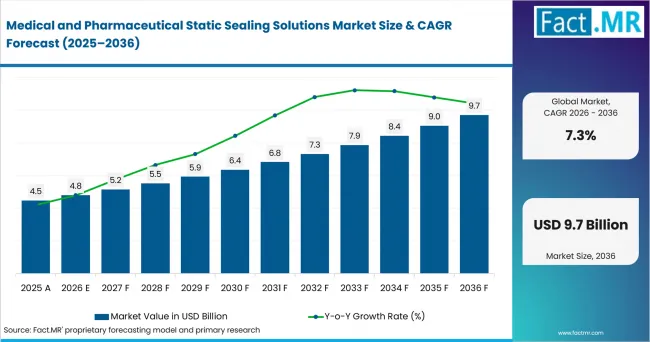
Medical And Pharmaceutical Static Sealing Solutions Market Value Analysis | Source: Fact.MR
Why do O-Rings lead Product Type?
USD 4.9 billion absolute opportunity by 2036. O-Rings lead Product Type with 38% share in 2026. Silicone leads Material at 37%, Pharmaceutical Processing Equipment leads Application at 36%, Medical Device Manufacturers lead End User at 41%, and Direct Sales leads Distribution Channel at 49%. South Korea records the highest listed country CAGR at 8.07%
- Demand Drivers in the Market
- Product-contact integrity is turning seal selection into a quality-system decision because a gasket or O-ring failure can introduce particles, permit fluid leakage, create cleaning shadows, or force batch investigation.
- Repeated clean-in-place, sterilization-in-place, autoclave, chemical cleaning, and disinfection cycles are increasing demand for compounds that retain compression and geometry after thermal and chemical exposure.
- Medical devices and diagnostic platforms are concentrating more fluid functions into smaller assemblies, which raises the value of precise molding, low-flash geometry, controlled friction, and component traceability.
- Biopharmaceutical manufacturers are adopting modular skids and single-use assemblies that reduce fixed piping but create more qualified connection points, closures, diaphragms, and gasket interfaces.
- Key Segments Analyzed
- By Product Type: O-Rings are expected to hold 38% share in 2026 because their standardized geometry supports broad use across equipment ports, valves, filters, device housings, and diagnostic fluid paths.
- By Material: Silicone is projected to account for 37% share in 2026 owing to molding flexibility, medical-grade availability, sterilization compatibility, and use across both equipment and device components.
- By Application: Pharmaceutical Processing Equipment is anticipated to represent 36% share in 2026 as bioreactors, filling systems, vessels, and process connections require documented static sealing performance.
- By End User: Medical Device Manufacturers are forecast to capture 41% share in 2026 because seals are qualified inside finished-device designs and must remain controlled through the product lifecycle.
- By Distribution Channel: Direct Sales are estimated to account for 49% share in 2026 as OEM supply agreements and long-term contracts support engineering review, validation documentation, and controlled material changes.
- Analyst Opinion at Fact.MR
- Shambhu Nath Jha, Principal Consultant at Fact.MR, states: "Static sealing is moving from a component purchase to a documented system decision. OEMs and pharmaceutical manufacturers will favor suppliers that prove material consistency, sterilization compatibility, traceability, and change-control discipline before production release. O-rings remain the volume base, but value capture will increasingly depend on custom geometry, cleanroom manufacturing, and application validation. Fact.MR opines that suppliers will be assessed on material compatibility, sterilization resilience, and controlled manufacturing."
- Strategic Implications
- Seal manufacturers should organize portfolios around validated material families so buyers can transfer from a standard O-ring to a custom geometry without reopening every material question.
- Medical device OEMs should include sealing suppliers early in design reviews because groove geometry, assembly force, sterilization method, and fluid exposure determine failure risk before tooling is released.
- Pharmaceutical equipment builders should compare intrusion, compression set, cleanability, and replacement intervals under actual CIP and SIP conditions rather than relying only on nominal material compatibility charts.
- Distributors should separate general industrial inventory from controlled medical and pharmaceutical stock so certificates, shelf-life controls, lot identity, and storage conditions remain attached to each shipment.
- Suppliers entering South Korea and the USA should prioritize local quality documentation and engineering response, while Canada, the UK, Australia, Germany, and Japan require country-specific validation and inspection readiness.
How does the Medical and Pharmaceutical Static Sealing Solutions Market break down by segment?
O-Rings lead Product Type at 38%, Silicone leads Material at 37%, Pharmaceutical Processing Equipment leads Application at 36%, Medical Device Manufacturers lead End User at 41%, and Direct Sales lead Distribution Channel at 49% in 2026.
Why does Silicone lead Material?
O-Rings are projected to hold 38% share in 2026.
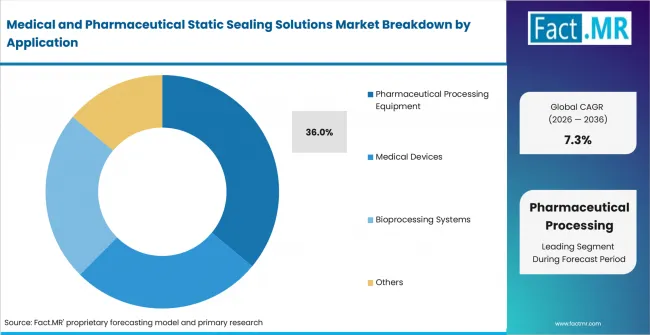
Medical And Pharmaceutical Static Sealing Solutions Market Analysis By Application | Source: Fact.MR
O-rings lead because one compact geometry can seal ports, manifolds, valves, housings, filters, sensors, pumps, connectors, and drug-delivery subassemblies. Standard sizes lower design and procurement friction, while custom compounds let engineers preserve the same groove concept across different fluids and sterilization routes. Silicone O-rings support medical devices and low-pressure static joints where flexibility and clean molding matter. EPDM O-rings remain important in pharmaceutical water, steam, and cleaning environments where resistance to repeated hot-water or steam exposure influences service life.
Trelleborg identifies O-rings as versatile static and slow-dynamic components for life-science applications, while James Walker positions high-purity O-rings for bioreactors, filtration systems, process connections, and other bioprocessing equipment. Gaskets serve larger flange and clamp interfaces, and diaphragms isolate actuating mechanisms from process fluids. Custom molded seals and gasket kits gain value when standard cross-sections cannot control dead space, assembly force, or leak paths.
Why does Pharmaceutical Processing Equipment lead Application?
Silicone is expected to account for 37% share in 2026.
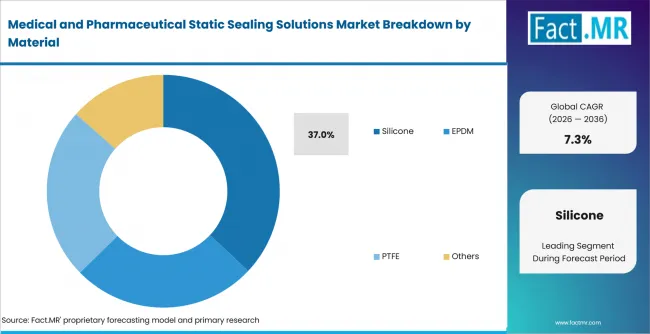
Medical And Pharmaceutical Static Sealing Solutions Market Analysis By Material | Source: Fact.MR
Silicone leads because medical-grade and liquid silicone rubber grades can be molded into small, precise, and complex components while retaining flexibility across a wide temperature range. Device manufacturers use silicone in diagnostic equipment, infusion systems, enclosures, valves, and custom molded components where low-flash production and repeatable assembly are critical.
Pharmaceutical buyers also use silicone gaskets and O-rings when steam exposure, cleanability, and transparent material documentation support qualification. EPDM remains a strong alternative for process-water, steam, and cleaning duties, particularly where compression set after repeated thermal cycling determines preventive-maintenance intervals. PTFE is selected for aggressive chemistries, low adhesion, and dimensional control in hygienic gaskets, although its sealing behavior requires careful flange design and load management. FKM, PEEK, and thermoplastic elastomers address narrower combinations of chemical resistance, stiffness, mechanical strength, or manufacturability. Material selection therefore follows the complete exposure map, not a single compliance certificate.
Why do Medical Device Manufacturers lead End User?
Pharmaceutical Processing Equipment is anticipated to represent 36% share in 2026.
Medical And Pharmaceutical Static Sealing Solutions Market Analysis By Application | Source: Fact.MR
Pharmaceutical processing equipment leads because static seals sit directly at the interfaces that contain product, cleaning media, steam, buffer, water, gas, and utility flows. Bioreactors use O-rings, flange seals, diaphragms, and hygienic gaskets across ports, probes, agitator housings, filters, and transfer connections. Filling and packaging systems require repeatable sealing around nozzles, manifolds, containers, dosing circuits, and inspection equipment where leakage or particle generation can interrupt a validated run. United States drug CGMP requirements state that product-contact equipment surfaces must not be reactive, additive, or absorptive in ways that alter a drug.
European Union GMP Annex 1 places contamination-control expectations around sterile manufacturing, while Annex 15 links qualification and validation to equipment and process changes. These expectations make seal material, surface finish, intrusion, cleaning access, and replacement procedure part of the equipment qualification package. Medical devices and bioprocessing systems follow closely, but their sealing architectures are more platform-specific.
Why do Direct Sales lead Distribution Channel?
Medical Device Manufacturers are forecast to capture 41% share in 2026.
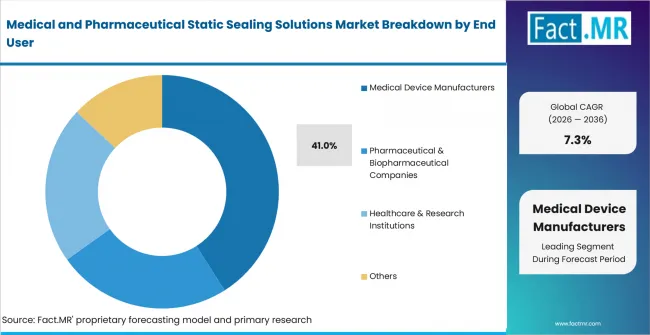
Medical And Pharmaceutical Static Sealing Solutions Market Analysis By End User | Source: Fact.MR
Medical device manufacturers lead because the seal becomes part of a finished product design rather than a maintenance consumable selected after installation. Diagnostic instruments, infusion systems, respiratory equipment, wearable drug-delivery devices, and other fluid-handling platforms depend on seals for dose consistency, leakage control, friction management, pressure retention, and environmental protection. The United States Quality Management System Regulation became effective on February 2, 2026 and incorporates ISO 13485:2016 into the device CGMP framework. This reinforces lifecycle controls around design, purchasing, risk management, production, and change handling. A supplier substitution can therefore trigger engineering review, verification, documentation updates, and regulatory assessment.
OEMs prefer partners that can provide prototype support, material declarations, controlled tooling, cleanroom production, inspection records, and long-term availability. Pharmaceutical and biopharmaceutical companies remain major buyers for processing equipment, while hospitals and laboratories purchase smaller volumes through equipment service channels and distributors.
Why does Direct Sales lead Distribution Channel?
Direct Sales are estimated to account for 49% share in 2026.
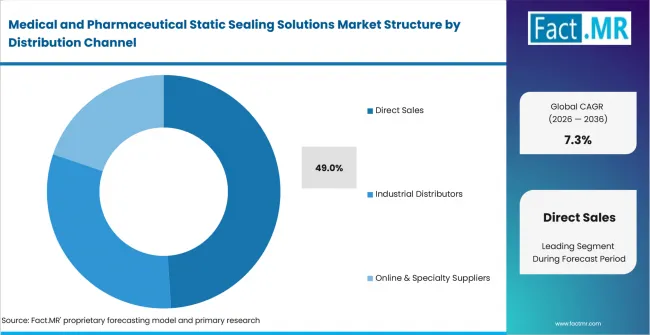
Medical And Pharmaceutical Static Sealing Solutions Market Analysis By Distribution Channel | Source: Fact.MR
Direct sales lead because high-value sealing programs require more than part availability. OEM supply agreements give manufacturers a defined route for drawing review, material selection, sample builds, tooling approval, validation support, lot traceability, forecast planning, and change notification. Long-term contracts also protect continuity for components embedded in medical devices or qualified pharmaceutical equipment. The commercial relationship often begins before serial production, when engineers compare groove design, molding tolerance, compression, surface finish, sterilization exposure, and assembly method. Authorized industrial distributors remain important for standard O-rings, sanitary gaskets, maintenance kits, and local stock, but they must preserve controlled documentation and source identity.
Online and specialty suppliers serve laboratory users, development teams, and low-volume replacements where quick access matters. Direct channels retain the largest share because the cost of an unapproved substitution is much higher than the purchase price of the seal.
What is accelerating Medical and Pharmaceutical Static Sealing Solutions Market adoption, and what is holding it back?
Contamination control, sterilization durability, device fluid-path complexity, and modular bioprocessing support adoption. Long qualification cycles, material degradation, cleanroom tooling economics, and fragmented documentation requirements restrain faster supplier switching.
Drivers Impact Analysis
| DRIVER | QUALITATIVE RELEVANCE | GEOGRAPHIC RELEVANCE | IMPACT TIMELINE |
|---|---|---|---|
| Product-contact contamination control and leak prevention | High | Global, with strongest effect in regulated pharmaceutical and device hubs | Current and medium term |
| CIP, SIP, autoclave, and sterilization cycle durability | High | North America, Europe, Japan, South Korea, and Australia | Current and medium term |
| Medical device miniaturization and fluid-path complexity | Medium-High | USA, Germany, Japan, South Korea, and the UK | Medium term |
| Single-use and modular bioprocess systems | Medium-High | North America, Europe, and East Asia | Medium to long term |
Source: Fact.MR analysis. Updated Aug 5, 2026
- Product-contact contamination control: A static seal defines the boundary between the process and the surrounding environment. Buyers therefore review surface continuity, intrusion, particle risk, extractables, installation damage, and leak behavior together. When a seal fails, the consequence can include product loss, line stoppage, investigation, re-cleaning, and repeat qualification. This makes proven sealing performance commercially valuable even when the component cost is small relative to the equipment or batch.
- Sterilization cycle durability: Pharmaceutical plants and reusable medical devices expose seals to steam, hot water, chemicals, gamma radiation, ethylene oxide, or other sterilization routes. Repeated exposure can harden, swell, soften, crack, or permanently deform a compound. Buyers increasingly ask for application-specific cycle evidence because compatibility at room temperature does not prove retained sealing force after repeated cleaning and sterilization.
- Device miniaturization: Compact diagnostic and drug-delivery systems place several functions inside tight housings. Seal dimensions, flash, friction, surface finish, and assembly damage become harder to control as components shrink. Suppliers that combine micro-molding, custom compounds, tool design, and inspection can reduce the number of interfaces and support more reliable device operation.
- Modular bioprocessing: Single-use assemblies and modular skids reduce fixed stainless-steel infrastructure, but each connection still needs a secure closure or sealing interface. Demand shifts toward preassembled, traceable, and application-matched components that can be installed quickly without creating a new contamination point. Overmolded joints and integrated closures gain attention where they remove manual clamps or separate gasket handling.
Opportunity Impact Analysis
| OPPORTUNITY | QUALITATIVE RELEVANCE | GEOGRAPHIC RELEVANCE | IMPACT TIMELINE |
|---|---|---|---|
| Validated high-purity silicone, EPDM, and PTFE material platforms | High | Global regulated markets | Short to medium term |
| Custom molded seals and overmolded leak-reduction assemblies | High | USA, Germany, Japan, South Korea, and the UK | Medium term |
| Direct OEM qualification and digital lot traceability | Medium-High | North America, Europe, and East Asia | Short to medium term |
| Regional cleanroom production and qualified inventory | Medium | Canada, Australia, South Korea, Japan, and regional export hubs | Medium to long term |
Source: Fact.MR analysis. Updated Aug 5, 2026
- Validated material platforms: Suppliers can increase design wins by building complete dossiers around high-purity silicone, EPDM, and PTFE families. Buyers need consistent formulation, biological or chemical characterization where applicable, sterilization compatibility, extractables information, shelf-life control, and change-notification rules. A platform approach reduces repeated qualification work when the geometry changes but the material system remains controlled.
- Custom and overmolded assemblies: A molded frame seal, diaphragm, sanitary end, or overmolded connection can replace several separate parts and manual interfaces. Saint-Gobain positions overmolded biopharma assemblies around leak reduction and fewer contamination points, while Freudenberg Medical offers pharmaceutical-grade silicone gaskets and molded sanitary ends. The commercial opening is strongest where integration reduces assembly steps and improves repeatability without making the system difficult to inspect or replace.
- Digital traceability: Direct-sales programs can connect drawings, material lots, certificates, inspection records, sterilization evidence, shelf life, and change history to a controlled part number. Medical device OEMs and pharmaceutical manufacturers gain faster deviation review when suppliers can retrieve complete batch records. Distributors also benefit when barcoding and controlled inventory prevent general industrial stock from entering regulated orders.
- Regional supply and cleanroom capacity: Long qualification cycles make supply interruption especially costly because a replacement source cannot be approved instantly. Regional molding, cleanroom packaging, and qualified safety stock reduce transit risk and shorten engineering response. This creates room for suppliers that combine global material control with local applications support rather than relying only on centralized production.
Restraints Impact Analysis
| RESTRAINT | QUALITATIVE RELEVANCE | GEOGRAPHIC RELEVANCE | IMPACT TIMELINE |
|---|---|---|---|
| Long qualification, revalidation, and change-control cycles | High | Global regulated markets | Current and long term |
| Compression set and degradation under combined exposure | High | Pharmaceutical processing and reusable device applications | Current and medium term |
| Cleanroom tooling and low-volume production economics | Medium-High | Specialty medical device and laboratory applications | Medium term |
| Fragmented specifications and documentation expectations | Medium | Cross-border programs and multi-site manufacturers | Current and medium term |
Source: Fact.MR analysis. Updated Aug 5, 2026
- Qualification and change control: A new seal supplier must prove geometry, material equivalence, manufacturing control, cleanliness, packaging, and performance under the buyer’s actual conditions. The process can involve sample approval, installation trials, sterilization studies, extractables work, device verification, and regulatory assessment. This protects incumbents but slows adoption of technically better alternatives when the business case does not offset validation effort.
- Combined exposure failure: A material that resists one chemical may still lose sealing force after repeated steam, pressure, cleaning, and storage cycles. Compression set, swelling, embrittlement, intrusion, adhesion, and particulate generation can emerge only after extended use. Buyers must test the complete exposure sequence, which increases development time and narrows the number of acceptable compounds.
- Tooling and volume economics: Custom medical seals often require dedicated tooling, validated molding parameters, controlled deflashing, inspection, cleanroom handling, and specialized packaging. These controls add cost before production volume is established. Small device programs and laboratory systems may struggle to justify dedicated capacity, pushing them toward standard parts even when a custom design would improve performance.
- Specification fragmentation: Pharmaceutical equipment, medical devices, diagnostics, injectable delivery, and laboratory systems do not use one universal qualification route. Requirements differ by product contact, implantation status, sterilization method, country, customer quality system, and application risk. Suppliers must maintain multiple documentation packages and avoid presenting a general compliance claim as proof for every use condition.
Which countries are scaling Medical and Pharmaceutical Static Sealing Solutions Market fastest?
- South Korea records 8.07% CAGR through 2036.
- The USA follows at 7.74% CAGR as QMSR implementation and pharmaceutical CGMP expectations keep supplier control and product-contact material decisions visible.
- Canada advances at 7.37% CAGR through GMP, equipment qualification, and cleaning-validation requirements across pharmaceutical and biological manufacturing.
- The UK posts 7.14% CAGR as risk-based GMP inspection and aseptic manufacturing oversight support documented sealing and maintenance programs.
- Australia records 7.09% CAGR as PIC/S PE009-17 applies to medicine manufacturing and reinforces sterile-process and equipment-control expectations.
- Germany expands at 6.93% CAGR through pharmaceutical equipment engineering, EU GMP Annex 1 implementation, and strong demand for hygienic process connections.
- Japan grows at 6.58% CAGR as PMDA GMP and QMS inspections support conservative qualification, detailed records, and reliable local technical service.
The listed country rates span different commercial conditions. Fast growth does not remove the need for validation. Suppliers must match regulatory documentation, local engineering support, material availability, and distributor controls to each market.
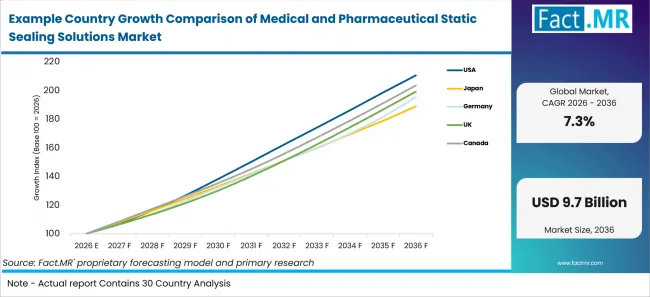
Example Country Growth Comparison Of Medical And Pharmaceutical Static Sealing Solutions Market | Source: Fact.MR
| Country | CAGR (2026-2036) |
|---|---|
| South Korea | 8.07% |
| USA | 7.74% |
| Canada | 7.37% |
| UK | 7.14% |
| Australia | 7.09% |
| Germany | 6.93% |
| Japan | 6.58% |
Source: Fact.MR analysis. Updated Aug 5, 2026
What is driving South Korea’s 8.07% CAGR through 2036?
8.07% CAGR through 2036.
South Korea’s market is shaped by medical device, in vitro diagnostic, biopharmaceutical, and digital-health manufacturing programs that need controlled components for domestic and export registrations. The Ministry of Food and Drug Safety published an English compilation of Medical Device Good Manufacturing Practice Regulations on February 11, 2026, covering quality-management rules for medical devices, in vitro diagnostics, and digital medical devices. Static sealing suppliers benefit when local OEMs need material records, supplier controls, clean manufacturing, and traceability that can travel with export dossiers. The country’s 8.07% CAGR also reflects the commercial value of local applications engineering: device teams can resolve groove, assembly, sterilization, and leakage issues faster when suppliers can provide prototypes and controlled production nearby. Standard O-rings support broad demand, while custom silicone parts, diagnostic fluid-path seals, and bioprocess gaskets create higher-value projects.
How does the USA support a 7.74% CAGR?
7.74% CAGR through 2036.
The USA combines a large medical device OEM base with pharmaceutical, biotechnology, diagnostic, and contract manufacturing demand. The FDA’s Quality Management System Regulation became effective on February 2, 2026 and incorporates ISO 13485:2016 into the device CGMP framework. For drug manufacturing, 21 CFR 211.65 requires product-contact equipment surfaces to avoid reactive, additive, or absorptive effects that alter drug safety, identity, strength, quality, or purity. These requirements keep seal materials and supplier controls inside quality and engineering review. Direct sales are especially important because OEMs need drawing control, risk documentation, lot records, and planned change notification. The 7.74% CAGR reflects recurring design-in activity across infusion, diagnostic, drug-delivery, and processing equipment, plus replacement demand from installed pharmaceutical lines. Suppliers that can support both standard inventory and custom cleanroom-molded parts have the clearest route to account expansion.
What supports Canada’s 7.37% CAGR?
7.37% CAGR through 2036.
Canada’s opportunity is concentrated in regulated pharmaceutical, biological, medical device, and research clusters where equipment must remain cleanable and fit for intended use. Health Canada’s Good Manufacturing Practices Guide for Drug Products explains that equipment should permit effective cleaning, prevent contamination, and function as intended. Its Cleaning Validation Guide, published on June 29, 2021, requires documented evidence that approved cleaning processes reproducibly reduce residues and contamination risk.
Static seals affect each of these outcomes because intrusion, dead space, swelling, or loss of compression can undermine cleaning and containment. The 7.37% CAGR favors suppliers that provide chemical and steam compatibility evidence, controlled lots, replacement guidance, and local distributor stock. Canadian buyers also value continuity because requalifying an imported seal after a supply interruption can delay maintenance or process transfer.
Why is the UK projected to record 7.14% CAGR?
7.14% CAGR through 2036.
The UK market is driven by pharmaceutical manufacturing, biotechnology development, diagnostic equipment, and medical device engineering. The Medicines and Healthcare products Regulatory Agency inspects manufacturers when they apply for a licence and then periodically according to risk. Inspection teams review manufacturing areas, quality systems, documents, equipment, storage, and corrective actions. This gives buyers a clear incentive to maintain qualified seal materials, documented maintenance intervals, approved suppliers, and traceable replacement parts. Aseptic operations place additional attention on contamination-control weaknesses around process connections and equipment interventions. The 7.14% CAGR therefore supports direct technical selling into OEM and regulated manufacturing accounts, while specialty distributors serve maintenance and laboratory users. Suppliers that can provide UK stock, fast deviation support, and consistent documentation are better positioned than vendors competing only on unit price.
What shapes Australia’s 7.09% CAGR?
7.09% CAGR through 2036.
Australia’s market reflects a smaller but highly regulated base of medicine manufacturers, biotechnology companies, medical device firms, hospitals, and research institutions. The Therapeutic Goods Administration states that the current manufacturing principles give the PIC/S Guide to GMP legal force in Australia. Version PE009-17 applies from September 1, 2025, with changes focused on Annex 1 for sterile medicines. This reinforces attention to contamination control, equipment condition, cleaning, qualification, and documented change. Static seal demand is therefore linked to planned maintenance, facility upgrades, imported equipment, and local device production. The 7.09% CAGR creates an opening for distributors and manufacturers that hold qualified inventory within the region, because long international lead times can conflict with shutdown schedules. Buyers also need evidence that replacement seals match the original material, geometry, and certification package.
How is Germany expected to achieve 6.93% CAGR?
6.93% CAGR through 2036.
Germany combines pharmaceutical and biopharmaceutical production with a strong base of process-equipment, automation, diagnostic, and medical technology manufacturers. EU GMP Annex 1 for sterile medicinal products has been fully applicable since August 25, 2024, while Annex 15 governs qualification and validation. These frameworks influence how German plants and equipment suppliers assess hygienic geometry, cleanability, seal intrusion, steam exposure, and change control. The 6.93% CAGR is supported by recurring demand from bioreactors, filling systems, filtration skids, process connections, and device platforms. German buyers tend to involve engineering and quality teams early, which benefits suppliers able to provide dimensional analysis, material evidence, installation guidance, and long-term availability. PTFE sanitary gaskets and high-purity EPDM or silicone seals compete according to chemical exposure, steam cycles, flange design, and cleanability rather than one material dominating every interface.
Why does Japan record 6.58% CAGR through 2036?
6.58% CAGR through 2036.
Japan’s market is shaped by conservative qualification practices across pharmaceutical, biological, medical device, in vitro diagnostic, and precision-equipment manufacturers. The Pharmaceuticals and Medical Devices Agency conducts on-site and document-based GMP inspections for high-risk products such as new drugs and biological products. It also conducts QMS inspections of medical device and in vitro diagnostic manufacturing sites in Japan and overseas. Seal suppliers must therefore support detailed material identity, process control, inspection, and change records. The 6.58% CAGR is measured rather than weak because established programs are slow to switch after validation, but approved suppliers can retain business across long product lifecycles. Local language documentation, stable delivery, careful packaging, and rapid engineering support influence purchasing. O-rings and custom molded silicone parts serve device and diagnostic uses, while hygienic gaskets and diaphragms support pharmaceutical and bioprocess equipment.
Who leads the Medical and Pharmaceutical Static Sealing Solutions Market?
Trelleborg AB is an active provider. The broader company set competes through different combinations of O-ring breadth, high-purity materials, custom molding, sanitary gaskets, medical device engineering, injectable drug-delivery components, and distribution reach.
Trelleborg AB holds the competitive position and brings a broad sealing portfolio that spans elastomer O-rings, static seals, PTFE-based geometries, and custom engineered molded components. Its medical-grade O-ring and life-science capabilities support device, drug-delivery, respiratory, diagnostic, and pharmaceutical equipment programs. The commercial advantage comes from linking material science, standard product availability, engineering tools, and application support across a global manufacturing network. Freudenberg Sealing Technologies contributes pharmaceutical-grade silicone gaskets, stoppers, molded sanitary ends, tubing-related components, and cleanroom manufacturing through its medical business.
Datwyler Holding Inc. adds precision elastomer components and collaboration for injectable drug-delivery and container-closure systems, giving the provider set exposure to pharmaceutical packaging interfaces and biologics requirements.
Saint-Gobain S.A. competes through bioprocess fluid-management products, closure systems, and overmolded assemblies that reduce separate connection points. Parker Hannifin Corporation offers O-rings, custom molded seals, stoppers, and high-performance compounds for drug-delivery, infusion, diagnostic, and broader life-science applications. Bal Seal Engineering, Inc. focuses on custom spring-energized and polymer sealing concepts for medical devices where low friction, compact geometry, and controlled contact force matter. Garlock Sealing Technologies is positioned in hygienic PTFE gaskets for pharmaceutical process connections, including products designed for CIP and SIP conditions. These suppliers win different applications rather than forming one uniform product group.
Precision Associates, Inc. supports custom rubber seals, O-rings, medical-grade compounds, and Class 7 cleanroom manufacturing. James Walker Group Ltd. provides high-purity EPDM and silicone O-rings and hygienic clamp gaskets for biopharmaceutical process connections, bioreactors, filtration, and single-use systems.
ERIKS N.V. combines seal and polymer component knowledge with distribution, inventory, and engineering support across industrial and life-science accounts. Competition through 2036 is expected to center on qualification speed, material consistency, cleanroom capability, documentation quality, regional supply resilience, and the ability to manage changes without forcing customers into unnecessary revalidation.
Which companies are the key providers?
Trelleborg AB is the active provider. Freudenberg Sealing Technologies, Datwyler Holding Inc., Saint-Gobain S.A., Parker Hannifin Corporation, Bal Seal Engineering, Inc., Garlock Sealing Technologies, Precision Associates, Inc., James Walker Group Ltd., and ERIKS N.V. complete the profiled provider set.
- Trelleborg AB
- Freudenberg Sealing Technologies
- Datwyler Holding Inc.
- Saint-Gobain S.A.
- Parker Hannifin Corporation
- Bal Seal Engineering, Inc.
- Garlock Sealing Technologies
- Precision Associates, Inc.
- James Walker Group Ltd.
- ERIKS N.V.
- Others
Bibliography
- Electronic Code of Federal Regulations. (2026). 21 CFR 211.65: Equipment construction.
- European Commission. (2015, March 31). EudraLex Volume 4, Annex 15: Qualification and Validation.
- European Commission. (2022, August 25). EudraLex Volume 4, Annex 1: Manufacture of Sterile Medicinal Products.
- Health Canada. (2020, July). Good manufacturing practices guide for drug products (GUI-0001).
- Health Canada. (2021, June 29). Cleaning validation guide (GUI-0028).
- Medicines and Healthcare products Regulatory Agency. (2024, May 13). Medicines: good manufacturing practice and good distribution practice.
- Ministry of Food and Drug Safety. (2026, February 11). Medical Device Good Manufacturing Practice Regulations.
- Pharmaceuticals and Medical Devices Agency. (n.d.). GMP / QMS / GCTP Inspections.
- Therapeutic Goods Administration. (2025, September 1). Complying with the PIC/S Guide to Good Manufacturing Practice for medicinal products.
- U.S. Food and Drug Administration. (2026, February 2). Quality Management System Regulation (QMSR).
- United States Pharmacopeia. (2026, May 1). General Chapter <665>: Plastic Components and Systems Used to Manufacture Pharmaceutical Drug Products and Biopharmaceutical Drug Substances and Products.
- Bal Seal Engineering, Inc. (n.d.). Sealing, connecting, conducting, and EMI/RFI shielding solutions for medical devices.
- Datwyler Healthcare. (n.d.). Precision components and trusted expertise for injectable drug delivery.
- Freudenberg Medical. (n.d.). Fluid management solutions for pharmaceutical and bioprocess applications.
- Garlock Sealing Technologies. (2016, April 26). Garlock introduces GYLON BIO-PRO PLUS sanitary gasket.
- James Walker Group Ltd. (n.d.). USP Class VI compliant sealing products for biopharmaceutical applications.
- Parker Hannifin Corporation. (n.d.). Healthcare and life sciences sealing solutions.
- Parker Hannifin Corporation. (n.d.). Enhancing wearable drug delivery device performance with internally lubricated sealing solutions.
- Precision Associates, Inc. (2026, February 20). Medical rubber seals and cleanroom manufacturing.
- Saint-Gobain Life Sciences. (n.d.). Overmolded biopharmaceutical assemblies and closure systems.
- Trelleborg Sealing Solutions. (n.d.). Products and solutions for static seals, O-rings, and engineered molded components.
- Trelleborg Sealing Solutions. (n.d.). Medical grade O-rings for life-science applications.
- ERIKS N.V. (n.d.). Sealing and polymer component solutions.
This Report Answers
- The report provides strategic intelligence on Product Type and Material choices that shape static sealing design, qualification, and replacement programs.
- Segment analysis covers O-Rings, Silicone, Pharmaceutical Processing Equipment, Medical Device Manufacturers, and Direct Sales as the 2026 share leaders.
- Country outlook evaluates South Korea and the USA alongside Canada, the UK, Australia, Germany, and Japan through the country growth comparison.
- Competitive analysis profiles Trelleborg AB as the active provider and explains the different market roles of the remaining profiled providers without creating unsupported rankings.
- Commercial assessment covers OEM qualification, material documentation, cleanroom production, sterilization exposure, distributor controls, and supply continuity across regulated applications.
What does the Medical and Pharmaceutical Static Sealing Solutions Market cover?
The market covers revenue from static sealing components and engineered sealing solutions used at interfaces where mating surfaces do not move relative to one another during normal operation.
Included products are O-rings, flat and sanitary gaskets, static seals, diaphragm seals, flange seals, custom molded seals, and gasket kits supplied for pharmaceutical processing equipment, medical devices, bioprocessing systems, laboratory equipment, and sterilization systems. The market includes silicone, EPDM, PTFE, FKM, PEEK, and thermoplastic elastomer solutions when sold within the defined material and application framework. Revenue is captured through direct OEM supply, industrial distribution, and online or specialty channels.
The commercial boundary is defined by the sealing function and the regulated application. A component is included when its principal role is to contain product, process fluid, gas, cleaning media, or the device environment across a non-moving interface. The market includes engineered elastomer components used in drug-delivery and diagnostic assemblies when they perform this static sealing role. It does not include the full value of the surrounding device, processing skid, primary package, or service contract.
What is included in the scope?
Standard and custom static seals are included when they are sold for the defined medical, pharmaceutical, bioprocess, laboratory, or sterilization applications.
The scope includes standard O-rings and gaskets, custom molded elastomer parts, sanitary connection seals, static diaphragms, flange seals, and application-specific kits. It includes components supplied to OEMs, contract manufacturers, drug manufacturers, biologics producers, hospitals, research laboratories, CDMOs, and diagnostic equipment manufacturers. Material documentation, cleanroom molding, inspection, packaging, and supplier support are included to the extent they are embedded in the selling price of the sealing solution.
What is excluded from the scope?
Dynamic sealing products and the value of complete equipment, devices, packaging systems, and services are excluded.
The scope excludes rotary shaft seals, reciprocating seals, hydraulic and pneumatic sealing systems whose primary function is dynamic motion control, and mechanical face seals. It excludes general industrial seals not specified for medical or pharmaceutical use, tubing sold without an integrated sealing function, complete valves, pumps, vessels, bioreactors, filling lines, diagnostic instruments, and infusion devices. It also excludes the full value of vials, syringes, cartridges, and other primary packages, along with installation labor, maintenance contracts, validation consulting, and downstream service revenue billed separately from the seal.
How Was the Analysis Built?
The analysis combines structured primary research, authoritative regulatory and technical sources, country-level operating conditions, company portfolio review, and bottom-up revenue modeling.
- Primary Research: Primary research includes discussions with sealing manufacturers, medical device engineers, pharmaceutical equipment builders, material specialists, distributors, quality teams, procurement professionals, and end users. These discussions examine qualification timelines, design criteria, sterilization exposure, replacement practice, pricing structure, supplier switching, and documentation requirements.
- Desk Research: Desk research covers government regulations, GMP and QMS guidance, official standards information, company technical portfolios, product literature, public filings, application notes, cleanroom capabilities, and authoritative technical sources. Source selection prioritizes direct authority, technical relevance, and traceable publication.
- Market Sizing and Forecasting: Market estimates combine the 2026 and 2036 values with static-seal attachment across equipment and device applications, material and product mix, replacement cycles, OEM design-in activity, distribution structure, and country-level growth conditions. Segment shares, country CAGRs, and company data are reconciled across the market model without substituting one indicator for another.
- Data Validation and Update Cycle: The analysis combines primary interviews with structured review of public company disclosures, official statistics, regulatory material, and sector publications. Forecast interpretation considers market conditions, adoption requirements, competitive positioning, and regional operating context.
Segmentation
What is the report’s scope and coverage?
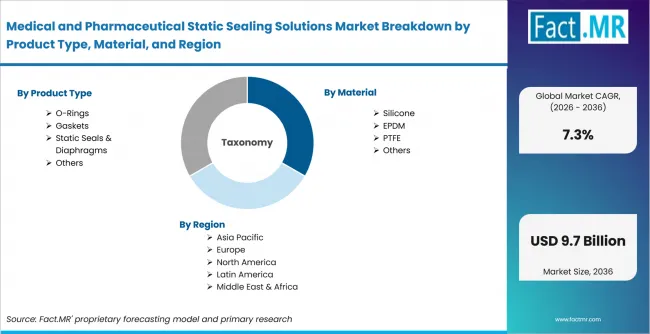
Medical And Pharmaceutical Static Sealing Solutions Market Breakdown By Product Type, Material, And Region | Source: Fact.MR
| Attribute | Details |
|---|---|
| Quantitative Units | USD Billion |
| Market Definition | Revenue from static elastomeric, polymer, and engineered sealing solutions installed at non-moving interfaces in medical devices, pharmaceutical processing equipment, bioprocess systems, and related regulated applications. |
| Product Type | O-Rings; Gaskets; Static Seals & Diaphragms; Others |
| Material | Silicone; EPDM; PTFE; Others |
| Application | Pharmaceutical Processing Equipment; Medical Devices; Bioprocessing Systems; Others |
| End User | Medical Device Manufacturers; Pharmaceutical & Biopharmaceutical Companies; Healthcare & Research Institutions; Others |
| Distribution Channel | Direct Sales; Industrial Distributors; Online & Specialty Suppliers |
| Regions Covered | North America; Europe; East Asia; South Asia and Pacific; Latin America; Middle East and Africa |
| Countries Covered | USA; Japan; Germany; UK; Canada; Australia; South Korea |
| Key Companies Profiled | Trelleborg AB; Freudenberg Sealing Technologies; Datwyler Holding Inc.; Saint-Gobain S.A.; Parker Hannifin Corporation; Bal Seal Engineering, Inc.; Garlock Sealing Technologies; Precision Associates, Inc.; James Walker Group Ltd.; ERIKS N.V.; Others |
| Forecast Period | 2026 to 2036 |
| Approach | Hybrid top-down and bottom-up approach using regulated equipment and device demand, static-seal attachment, material mix, replacement cycles, OEM qualification, distributor activity, country-level regulatory conditions, and company portfolio review. |
Source: Fact.MR analysis. Updated Aug 5, 2026
How is the market segmented?
-
By Product Type:
- O-Rings
- Silicone O-Rings
- EPDM O-Rings
- Gaskets
- Flat Gaskets
- Sanitary Gaskets
- Static Seals & Diaphragms
- Diaphragm Seals
- Flange Seals
- Others
- Custom Molded Seals
- Gasket Kits
- O-Rings
-
By Material:
- Silicone
- Medical Grade Silicone
- Liquid Silicone Rubber
- EPDM
- FDA-Compliant EPDM
- High-Purity EPDM
- PTFE
- Virgin PTFE
- Modified PTFE
- Others
- FKM
- PEEK
- Thermoplastic Elastomers
- Silicone
-
By Application:
- Pharmaceutical Processing Equipment
- Bioreactors
- Filling & Packaging Systems
- Medical Devices
- Diagnostic Equipment
- Infusion Systems
- Bioprocessing Systems
- Single-Use Assemblies
- Filtration Systems
- Others
- Laboratory Equipment
- Sterilization Systems
- Pharmaceutical Processing Equipment
-
By End User:
- Medical Device Manufacturers
- OEMs
- Contract Manufacturers
- Pharmaceutical & Biopharmaceutical Companies
- Drug Manufacturers
- Biologics Producers
- Healthcare & Research Institutions
- Hospitals
- Research Laboratories
- Others
- CDMOs
- Diagnostic Equipment Manufacturers
- Medical Device Manufacturers
-
By Distribution Channel:
- Direct Sales
- OEM Supply Agreements
- Long-Term Contracts
- Industrial Distributors
- Authorized Distributors
- Medical Component Suppliers
- Online & Specialty Suppliers
- E-Commerce Platforms
- Specialty Seal Distributors
- Direct Sales
-
By Region:
- North America
- USA
- Canada
- Europe
- Germany
- UK
- East Asia
- Japan
- South Korea
- South Asia and Pacific
- Australia
- Latin America
- Middle East and Africa
- North America
Frequently Asked Questions
The Medical and Pharmaceutical Static Sealing Solutions Market is valued at USD 4.8 Billion in 2026.
What is the market forecast for 2036?
Which Product Type leads the market?
Which Material leads the market?
Which Application leads the market?
Which End User leads the market?
Which Distribution Channel leads the market?
Which country records the highest listed CAGR?
Which companies are active in the market?
What is the primary driver in this market?
What is the main restraint?
Why are direct OEM agreements important?
Who worked on this report


Preview the report firsthand - request a free sample
Free SampleGet the brochure for pricing and purchase details
Download PDF