- Market Value (2025): USD 1.2 Bn
- Estimated Value (2026): USD 1.4 Bn
- Forecast Value (2036): USD 3.3 Bn
- CAGR (2026-2036): 9.4%
What is the Fast-Start Liquid Thrusters Market forecast to be worth by 2036?
USD 1.4 billion in 2026 to USD 3.3 billion by 2036 at a 9.4% CAGR.
- The Fast-Start Liquid Thrusters Market was valued at USD 1.2 billion in 2025.
- Demand is projected to increase from USD 1.4 billion in 2026 to USD 3.3 billion by 2036.
- The market is forecast to record 9.4% CAGR from 2026 to 2036 as satellite integrators and defence mission teams qualify propulsion modules for faster orbital response.
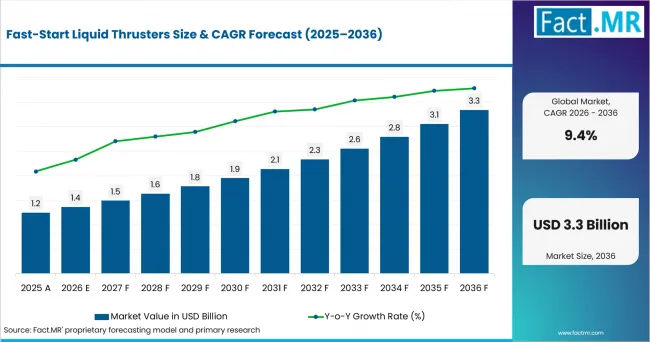
Fast Start Liquid Thrusters Value Analysis | Source: Fact.MR
What are the defining numbers behind Fast-Start Liquid Thrusters Market growth?
An absolute opportunity of USD 2.0 billion is expected between 2026 and 2036.
- Demand Drivers in the Market
- Satellite operators need pulse-ready attitude control as low-Earth orbit becomes crowded and conjunction reviews require timely manoeuvre options.
- Defence agencies need storable propulsion that supports responsive manoeuvre profiles while keeping ground handling manageable for each mission.
- Lunar and deep-space developers need restartable liquid engines that support orbit insertion, descent control and late mission correction burns.
- Small-satellite integrators need compact feed systems that combine valves, tanks and controllers while preserving spacecraft volume for payloads.
- Key Segments Analyzed
- By Propellant: Hydrazine / derivatives are expected to hold 32.0% share in 2026 due to long flight heritage and established handling procedures.
- By Thrust: 1-10 N is projected to account for 29.0% share in 2026 as small spacecraft need precise impulse control for attitude correction.
- By Start Response: 50-100 ms is anticipated to capture 31.0% share in 2026 because missions balance fast valve response with qualification confidence.
- By Application: Attitude control is estimated to represent 31.0% share in 2026 owing to recurring station-keeping and pointing requirements.
- Analyst Opinion at Fact.MR
- Shambhu Nath Jha, Principal Consultant at Fact.MR, states, “The commercial test goes beyond thrust. Mission teams ask whether a thruster starts predictably after storage, vibration and long idle periods. Demand is expected to shift toward suppliers that prove pulse life and propellant compatibility on flight-like hardware. Winning portfolios should combine heritage liquids, low-toxicity options and compact feed-system integration.”
- Strategic Implications
- Propulsion OEMs should document ignition delay, minimum impulse bit and restart history across mission-relevant temperature bands.
- Satellite bus integrators should compare thruster response against guidance-control timing so manoeuvre authority is designed into the platform early.
- Defence program offices should qualify dual-use propulsion architectures before urgent mission timelines compress test and approval windows.
- Green propellant suppliers should prove storage stability and materials compatibility before asking operators to replace hydrazine-based systems.
Norway is forecast to record 10.1% CAGR through 2036, supported by Arctic launch access and satellite-service investment. The USA is projected to post 9.6% CAGR due to commercial launch cadence and national-security space manoeuvre requirements. Germany is anticipated to advance at 9.1% CAGR as defence space investment and European mission infrastructure expand. France is estimated to hold 8.7% CAGR through launcher autonomy and CNES-backed propulsion programs. Japan is forecast to reach 8.3% CAGR owing to QZSS expansion and domestic spacecraft capability programs.
How does the Fast-Start Liquid Thrusters Market break down by segment?
Hydrazine / derivatives lead Propellant at 32.0% share in 2026; Attitude control leads Application at 31.0% share.
Which Propellant dominates?
Hydrazine / derivatives are expected to hold 32.0% share in 2026.
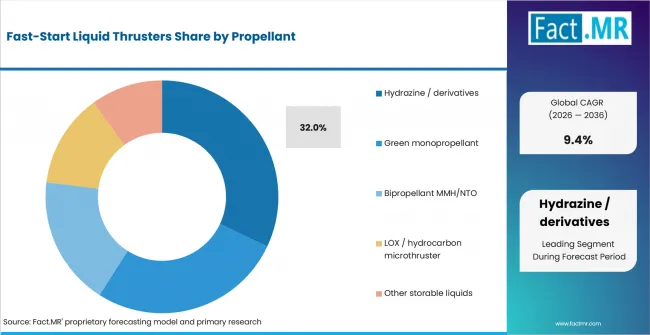
Fast Start Liquid Thrusters Analysis By Propellant | Source: Fact.MR
Hydrazine / derivatives remain widely specified where qualification risk is low and thruster families already match flight-proven feed systems. Handling controls and toxicity rules add cost, yet spacecraft programs value predictable storage, catalytic decomposition and restart behavior when mission assurance outweighs changeover pressure.
ISRO inaugurated a Monopropellant Thruster Test Facility in September 2025 for qualification, acceptance and performance evaluation of monopropellant hydrazine thrusters used in attitude control and orbit maintenance. That evidence shows why legacy propellants still anchor certified spacecraft programs.
What leads the Thrust segment?
1-10 N is projected to account for 17.0% share in 2026.
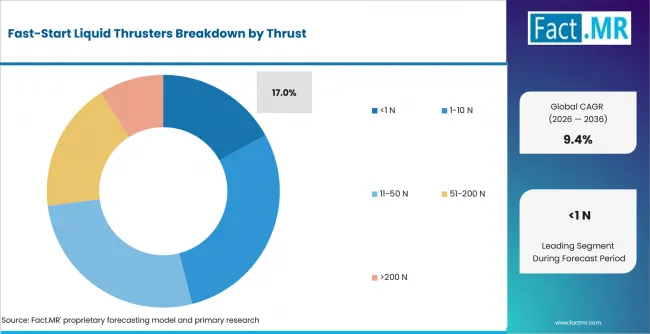
Fast Start Liquid Thrusters Analysis By Thrust | Source: Fact.MR
The 1-10 N range fits small and medium satellites that need repeated correction burns through smaller propulsion packages. It supports attitude trimming, reaction-wheel unloading and compact orbit-control tasks where short pulses carry more commercial value than high total thrust.
Low-newton liquid thrusters are expected to remain central to small spacecraft manoeuvre packages because the range supports fine attitude correction with limited propellant mass. Compact feed assemblies reduce spacecraft integration work where bus volume is tightly allocated.
How does Start Response shape demand?
50-100 ms is anticipated to capture 21.0% share in 2026.
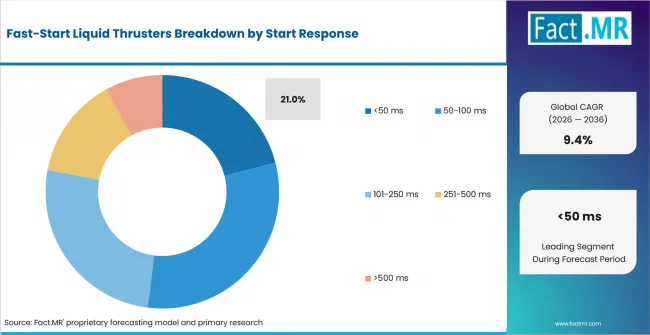
Fast Start Liquid Thrusters Analysis By Start Response | Source: Fact.MR
A 50-100 ms response band gives flight software enough timing precision for collision avoidance and fine attitude control while keeping actuator design practical. Spacecraft operators prize repeatable opening behavior because small delay shifts can accumulate during pulse trains.
ESA reported in its 2025 Space Environment Report that heavily populated orbital regions are becoming increasingly congested and that the growing debris population raises collision risk. Fast and repeatable thruster response can therefore support spacecraft manoeuvrability where avoidance action is required.
What supports Application demand?
Attitude control is estimated to represent 31.0% share in 2026.
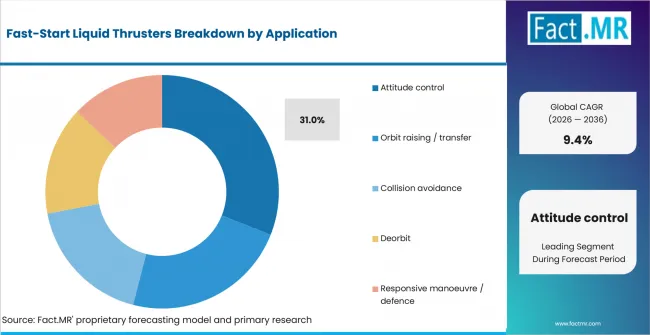
Fast Start Liquid Thrusters Analysis By Application | Source: Fact.MR
Attitude control leads because every active satellite needs pointing stability for communication, imaging or navigation payloads. Liquid thrusters serve this role when missions require higher impulse, longer storage life or more forceful control than reaction wheels alone can provide.
The Prime Minister’s Office of Japan stated in May 2025 that Japan aims to increase launch capacity from five to approximately 30 launches per year. The same policy direction includes expansion of the Quasi-Zenith Satellite System, highlighting continued development of domestic launch and satellite infrastructure.
What is accelerating Fast-Start Liquid Thrusters Market adoption, and what is holding it back?
Demand is expected to rise through satellite density, responsive defence missions and lunar mobility. Adoption is constrained by toxic handling, qualification cost and propellant integration risk.
Drivers Impact Analysis
| DRIVER | (~) % IMPACT ON CAGR | GEOGRAPHIC RELEVANCE | IMPACT TIMELINE |
|---|---|---|---|
| Crowded low-Earth orbit and collision avoidance needs | +1.4% | Global | Short term (<= 2 years) |
| Responsive manoeuvre demand in national-security satellites | +1.2% | USA, Europe, Japan | Medium term (2-4 years) |
| Small-satellite bus integration and compact liquid modules | +0.9% | North America, Europe, East Asia | Medium term (2-4 years) |
| Lunar and deep-space mission restart requirements | +0.6% | USA, Japan, Europe | Long term (>= 4 years) |
Source: Fact.MR analysis. Updated Sep 16, 2026
Opportunity Impact Analysis
| OPPORTUNITY | (~) % IMPACT ON CAGR | GEOGRAPHIC RELEVANCE | IMPACT TIMELINE |
|---|---|---|---|
| Green monopropellant systems for compact satellites | +1.0% | Global | Medium term (2-4 years) |
| Multimode chemical-electric propulsion packages | +0.8% | USA, Europe | Long term (>= 4 years) |
| Reusable and responsive spacecraft manoeuvre programs | +0.7% | USA, France, Germany | Long term (>= 4 years) |
Source: Fact.MR analysis. Updated Sep 16, 2026
Restraints Impact Analysis
| RESTRAINT | (~) % IMPACT ON CAGR | GEOGRAPHIC RELEVANCE | IMPACT TIMELINE |
|---|---|---|---|
| Hydrazine handling and safety controls | -0.6% | Global | Short term (<= 2 years) |
| Qualification cost for new propellants and valves | -0.5% | North America, Europe, Japan | Medium term (2-4 years) |
| Integration risk across compact spacecraft buses | -0.3% | Global | Medium term (2-4 years) |
Source: Fact.MR analysis. Updated Sep 16, 2026
Which countries are scaling the Fast-Start Liquid Thrusters Market through 2036?
- The country comparison spans 1.8 percentage points and forms three practical growth bands across the forecast period.
- Norway remains above the displayed range through Arctic launch access and Andoya Spaceport development.
- The USA follows through commercial space operations and national-security manoeuvre requirements.
- Germany stays ahead of France as its space-security strategy adds funding depth to European mission infrastructure.
- France remains tied to launcher autonomy, CNES propulsion work and Guiana Space Centre multi-launcher capacity.
- Japan closes the range through QZSS expansion and domestic spacecraft capability programs.
Comparable CAGRs create different entry conditions because launch access, export controls, propellant handling rules and space-agency programs vary by country. Full report coverage includes North America, Latin America, Western Europe, Eastern Europe, East Asia, South Asia & Pacific, Middle East & Africa.
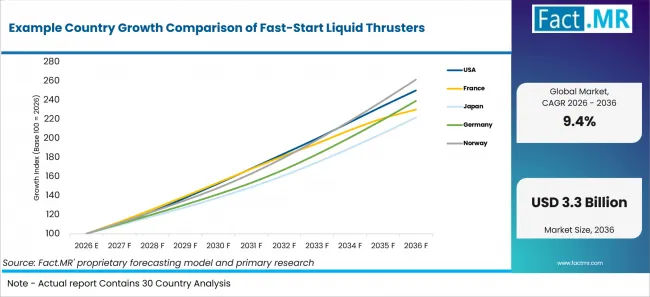
Example Country Growth Comparison Of Fast Start Liquid Thrusters | Source: Fact.MR
| Country | CAGR (2026-2036) |
|---|---|
| Norway | 10.1% |
| United States | 9.6% |
| Germany | 9.1% |
| France | 8.7% |
| Japan | 8.3% |
Source: Fact.MR analysis. Updated Sep 16, 2026
What supports Norway adoption?
10.1% CAGR, supported by Arctic launch access and satellite-service demand.
Norway is expected to benefit from a clearer Arctic launch route at Andoya Spaceport. The Norwegian Government said in January 2025 that a Technology Safeguards Agreement with the USA enables U.S. launchers and satellites to use the site. That agreement is expected to widen the mission base for spacecraft that need qualified orbit-control and attitude-correction hardware.
What supports USA adoption?
9.6% CAGR, supported by commercial launch cadence and defence-space manoeuvre requirements.
The USA is expected to retain deep demand for fast-start liquid thrusters as commercial and defence missions move through active launch pipelines. The FAA marked its 1,000th licensed or permitted commercial space operation in August 2025, after the second 500 operations arrived in four years. More active spacecraft raise the need for dependable manoeuvre hardware across attitude control and avoidance planning.
What supports Germany’s adoption?
9.1% CAGR, supported by space-security funding and European mission infrastructure.
Germany is expected to build demand through defence-space programs and European launch participation. The Federal Foreign Office said in November 2025 that the Defence Ministry planned around 35 billion euro in space-sector investment over the coming years. That funding path supports satellite networks and mission infrastructure where qualified liquid propulsion remains part of spacecraft readiness.
What supports France growth?
8.7% CAGR, supported by launcher autonomy and CNES-backed propulsion programs.
France is expected to support adoption through launch autonomy and CNES-backed facilities at the Guiana Space Centre. CNES said in September 2025 that shared ELM-Diamant facilities are funded at 50 million euros under France 2030 and can host up to five private operators. Wider launch access supports spacecraft programs that need qualified manoeuvre systems after deployment.
How does Japan perform?
8.3% CAGR, supported by QZSS expansion and domestic spacecraft capability programs.
Japan is expected to link demand to navigation, defence and Earth-observation programs that require high-assurance spacecraft control. IHI announced in September 2025 that it had agreed with SSTL to collaborate on the development of an Earth-observation constellation to strengthen Japan’s ISR capability. In the same announcement, IHI stated that it was already working with ICEYE to build a constellation of up to 24 SAR satellites. IHI also states that IHI Aerospace provides spacecraft propulsion systems and devices, including thrusters, tanks and integrated propulsion systems with extensive Japanese spaceflight heritage.
Who leads the Fast-Start Liquid Thrusters Market?
ArianeGroup, Moog and Aerojet Rocketdyne under L3Harris are active suppliers with extensive liquid spacecraft-propulsion heritage, flight-proven systems and ongoing development activity. Nammo, and IHI Aerospace add depth through apogee engines, SmallSat propulsion systems, fluid-control hardware and integrated spacecraft-propulsion capabilities.
ArianeGroup has direct relevance through its 400 N bipropellant apogee motor for geostationary satellite orbit injection and through broader chemical spacecraft-propulsion systems. The company is also advancing liquid oxygen/methane propulsion technologies through Prometheus and the ASTRE engine program, although these activities primarily address launcher propulsion. Moog contributes spacecraft propulsion integration and fluid-control capability across chemical, electric and cold-gas systems, with heritage in mono- and bipropellant apogee applications. L3Harris maintains Aerojet Rocketdyne's extensive in-space propulsion portfolio, including storable bipropellant engines and propulsion technologies supporting dynamic spacecraft manoeuvring.
Which companies are the key providers?
ArianeGroup, Moog, Aerojet Rocketdyne / L3Harris, Nammo, and IHI Aerospace.
- ArianeGroup
- Moog
- Aerojet Rocketdyne / L3Harris
- Nammo
- IHI Aerospace
Bibliography
- ArianeGroup. (2025, June 17). ArianeGroup selected by the French Space Agency, CNES, to prepare technologies for next-generation high performance engines.
- Centre national d’études spatiales. (2025, September 18). ELM-Diamant launch complex: Space history in the making.
- European Space Agency. (2025, April 1). ESA Space Environment Report 2025.
- Federal Aviation Administration. (2025, August 14). 1,000 commercial space operations.
- Federal Foreign Office. (2025, November 19). Outer space is vital to our security – the Federal Government presents the first Space Safety and Security Strategy.
- IHI Corporation. (2025, September 8). IHI collaborates with SSTL to develop Earth observation satellite constellation: Partnership with the UK’s leading small satellite manufacturer will contribute to Japan’s national security.
- L3Harris Technologies. (2025, April 8). Mission flexibility enabled with new L3Harris family of in-space engines.
- Moog Inc. (2025, May 28). Air Force Research Laboratory awards Moog contract to develop new multimode propulsion system to enhance dynamic space operations.
- Ministry of Industry, Commerce and Fisheries, Ministry of Defence, & Ministry of Foreign Affairs. (2025, January 16). Norway signs space agreement with the US. Government.no.
- Press Information Bureau, Government of India. (2025, December 17). Department of Space - Year End Review 2025.
- Prime Minister’s Office of Japan. (2025, May 30). Strategic Headquarters for Space Development.
- RBC Bearings Incorporated. (2025, July 21). RBC Bearings Incorporated completes acquisition of VACCO Industries.
This Report Answers
- The report explains where fast-start liquid thrusters are used across propellant, thrust range, start response and application.
- Segment analysis identifies the leading subsegments and the mission reasons spacecraft programs prioritize those options.
- Country analysis reviews the listed markets and the launch, defence and satellite-program mechanisms supporting adoption.
- Competitive analysis reviews current providers across storable liquids, green monopropellant modules and compact feed-system hardware.
- Application analysis assesses how ignition delay, pulse repeatability and propellant handling influence supplier selection.
What does the Fast-Start Liquid Thrusters Market cover?
The Fast-Start Liquid Thrusters Market covers spacecraft liquid propulsion hardware designed to ignite quickly and deliver repeatable pulses for mission control. It includes monopropellant and bipropellant thrusters, microthrusters, compatible valves, feed assemblies and integrated liquid propulsion modules used for on-orbit manoeuvres.
The assessment covers satellite attitude control, orbit raising, transfer manoeuvres, collision avoidance, deorbiting and responsive defence manoeuvres.
What is included in the scope?
The scope includes thrusters and propulsion modules used after launch for spacecraft pointing, station-keeping, transfer burns, deorbit and short-notice manoeuvres. It includes systems sold to spacecraft primes, satellite bus manufacturers, defence agencies, space agencies and mission integrators.
Payload demand is also linked to satellite communication systems that require stable on-orbit positioning. Broad mission connectivity is reflected in coverage of satellite internet services. Defence mission logic is aligned with analysis of software-defined defence satellites.
What is excluded from the scope?
The scope excludes launch-vehicle main engines, solid rocket motors, aircraft propulsion, missile-only propulsion and electric thrusters sold separately from a liquid chemical function. It also excludes raw propellant sales outside a thruster or integrated propulsion module.
General spacecraft bus electronics are excluded unless they are bundled with the propulsion controller inside a liquid thruster package. Ground support equipment is also excluded when it is sold separately from the flight propulsion system.
How Was the Analysis Built?
The analysis draws on 120+ sources, 35+ company portfolios, 25+ countries, and more than 20 industry interviews.
- Primary Research: Primary research includes discussions with manufacturers, propulsion engineers, mission integrators, satellite operators and subject-matter experts. These conversations examine qualification priorities, product adoption, operational challenges, safety requirements and factors that shape wider market acceptance.
- Desk Research: Desk research covers government statistics, regulatory publications, company releases, technical studies, space-agency programs, industry associations, standards, public policy and other authoritative sources. Every source used in the analysis is documented in the bibliography.
- Market Sizing and Forecasting: Market estimates combine historical performance, launch activity, spacecraft mission mix, propulsion architecture, segment shares, company participation, country-level growth, investment activity and barriers to market expansion.
- Data Validation and Update Cycle: Findings are validated by comparing interviews with public data, company activity, regulatory changes, technology qualification and mission developments. Regular updates review product launches, partnerships, capacity changes and shifts in commercial adoption.
Segmentation
What is the report’s scope and coverage?
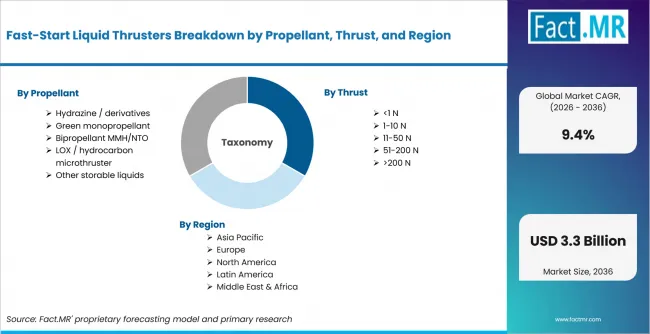
Fast Start Liquid Thrusters Breakdown By Propellant, Thrust, And Region | Source: Fact.MR
| Attribute | Details |
|---|---|
| Quantitative Units | USD billion |
| Market Definition | Liquid chemical thrusters designed for short ignition delay, repeatable pulse response and rapid manoeuvre readiness in spacecraft applications. |
| Propellant | Hydrazine / derivatives; Green monopropellant; Bipropellant MMH/NTO; LOX / hydrocarbon microthruster; Other storable liquids |
| Thrust | <1 N; 1-10 N; 11-50 N; 51-200 N; >200 N |
| Start Response | <50 ms; 50-100 ms; 101-250 ms; 251-500 ms; >500 ms |
| Application | Attitude control; Orbit raising / transfer; Collision avoidance; Deorbit; Responsive manoeuvre / defence |
| Regions Covered | North America; Latin America; Western Europe; Eastern Europe; East Asia; South Asia & Pacific; Middle East & Africa |
| Countries Covered | United States; France; Japan; Germany; Norway |
| Key Companies Profiled | ArianeGroup; Moog; Aerojet Rocketdyne / L3Harris; Nammo; IHI Aerospace |
| Forecast Period | 2026 to 2036 |
| Approach | Hybrid top-down and bottom-up approach using spacecraft mission demand, launch cadence, propulsion architecture, country programs and provider portfolio review. |
Source: Fact.MR analysis. Updated Sep 16, 2026
How is the market segmented?
-
By Propellant
- Hydrazine / derivatives
- Green monopropellant
- Bipropellant MMH/NTO
- LOX / hydrocarbon microthruster
- Other storable liquids
-
By Thrust
- <1 N
- 1-10 N
- 11-50 N
- 51-200 N
- >200 N
-
By Start Response
- <50 ms
- 50-100 ms
- 101-250 ms
- 251-500 ms
- >500 ms
-
By Application
- Attitude control
- Orbit raising / transfer
- Collision avoidance
- Deorbit
- Responsive manoeuvre / defence
-
By Region
- North America
- Latin America
- Western Europe
- Eastern Europe
- East Asia
- South Asia & Pacific
- Middle East & Africa
Frequently Asked Questions
How big is the fast-start liquid thrusters market in 2026?
What is the CAGR of the fast-start liquid thrusters market from 2026 to 2036?
Which propellant leads the fast-start liquid thrusters market?
Which application leads the fast-start liquid thrusters market?
Who are the leading companies in the fast-start liquid thrusters market?
Who worked on this report


Preview the report firsthand - request a free sample
Free SampleGet the brochure for pricing and purchase details
Download PDF