- Base Value(2025): 17.2 Bn
- Estimated Value(2026): 18.1 Bn
- Forecast Value (2036): 30.9 Bn
- CAGR (2026 - 2036): 5.5%
Organic Substrate Packaging Material Market Forecast and Outlook By Fact.MR
- In 2025, the organic substrate packaging material market was valued at USD 17.2 billion.
- Based on Fact.MR analysis, demand for organic substrate packaging materials is estimated to grow to USD 18.1 billion in 2026 and USD 30.9 billion by 2036.
- FACT.MR projects a CAGR of 5.5% during the forecast period.
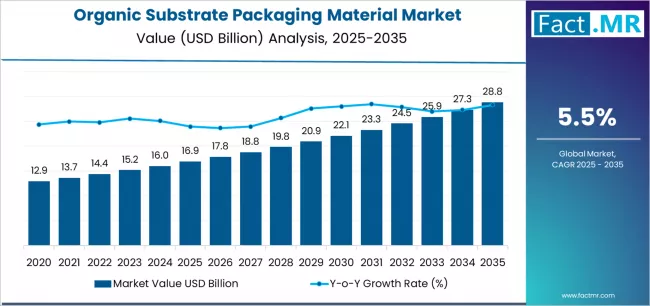
Organic Substrate Packaging Material Market Market Value Analysis | Source: Fact.MR
| Metric | Value |
|---|---|
| Estimated Value in 2026 | USD 18.1 billion |
| Forecast Value in 2036 | USD 30.9 billion |
| Forecast CAGR (2026 to 2036) | 5.5% |
Source: Fact.MR analysis. Updated May 16, 2026
Summary of Organic Substrate Packaging Material Market
- Market Definition
- The market covers organic laminate-based substrate materials used in SO, flip-chip, and advanced semiconductor packages procured by OSATs, IDMs, and automotive electronics suppliers globally.
- Demand Drivers
- Automotive semiconductor content growth, with ADAS and EV power management ICs requiring IATF 16949-qualified organic substrates, is driving high-reliability substrate demand from tier-one automotive electronics suppliers in Japan, Germany, and South Korea.
- U.S. CHIPS Act Advanced Packaging R&D Programme is funding domestic advanced substrate capacity at Amkor Technology and ASE Technology facilities, increasing demand for flip-chip and high-density organic substrate materials in North America.
- AI accelerator chip proliferation is driving demand for high layer-count, low-loss organic substrates in data centre and HPC semiconductor packaging, with Ibiden and Unimicron expanding capacity in Taiwan and Japan through 2025.
- Key Segments Analyzed
- By Technology: Small Outline (SO) packages hold approximately 41% share in 2026, reflecting their dominance across high-volume consumer electronics and standard semiconductor packaging applications globally.
- By Application: Consumer electronics leads with approximately 45% share in 2026 due to the largest semiconductor packaging volume base; automotive electronics is the fastest-growing application driven by electrification.
- By Material Use: Semiconductor packaging substrates represent core demand at approximately 70% share in 2026, anchoring organic substrate procurement across all end-use electronics sectors.
- Analyst Opinion at FACT.MR
- Shambhu Nath Jha, Principal Consultant at Fact.MR, opines, CXOs will find that substrate technology tier and automotive qualification depth are becoming the decisive competitive differentiators through 2036. These factors are shaping supplier selection in high-value packaging programs.
- Strategic Implications
- Invest in flip-chip and advanced high-density substrate capacity to capture AI chip and automotive electronics packaging demand from OSAT and IDM procurement programmes.
- Pursue IATF 16949 certification and dual-source qualification with automotive tier-one electronics suppliers to secure long-term substrate supply agreements.
- Establish substrate material production or supply partnerships in Taiwan and South Korea to align with leading OSAT procurement hubs and reduce geographic supply concentration risk.
- Methodology
- Market sizing based on substrate material revenues and semiconductor packaging volumes by application, validated with 2024-2025 OSAT procurement data and capacity expansion disclosures.
- Uses CHIPS Act disbursement records, IATF 16949 certification data, Ibiden and Unimicron capacity announcements, and company filings from Amkor, ASE, Kyocera, and Shinko Electric.
- Forecasts incorporate automotive semiconductor content growth rates, AI chip packaging demand trends, substrate material price indices, and expert inputs from semiconductor packaging supply chain specialists.
The market is set to generate an absolute opportunity of USD 12.8 billion between 2026 and 2036. Growth is steady and structurally distributed across semiconductor end-markets. Demand is supported by expanding automotive semiconductor content, AI chip packaging requirements, and consumer electronics upgrade cycles. Growth is partially constrained by substrate material cost inflation, capacity bottlenecks at advanced substrate fabs, and cyclical demand volatility in consumer electronics procurement.
Procurement behavior in organic substrate packaging is increasingly contract-driven. Semiconductor manufacturers and OSATs are locking in multi-year substrate supply agreements with qualified organic material providers to ensure production continuity. Automotive tier-one suppliers in Japan and Germany are requiring IATF 16949-qualified substrate procurement.
China leads among tracked markets with a projected CAGR of 7.4%, driven by domestic semiconductor assembly scale and expanding IC substrate capacity investments. Taiwan follows at 7.1%, anchored by leading OSAT and substrate manufacturer concentration. The United States registers 6.9%, supported by on shoring of advanced semiconductor packaging under CHIPS Act programmes. South Korea records 6.6%, driven by memory and foundry substrate demand. Germany grows at 5.5%, reflecting steady automotive electronics substrate procurement. Japan registers 5.1%, representing mature, replacement-oriented substrate demand from established electronics manufacturers facing pricing pressure.
Segmental Analysis
Organic Substrate Packaging Material Market Analysis by Technology
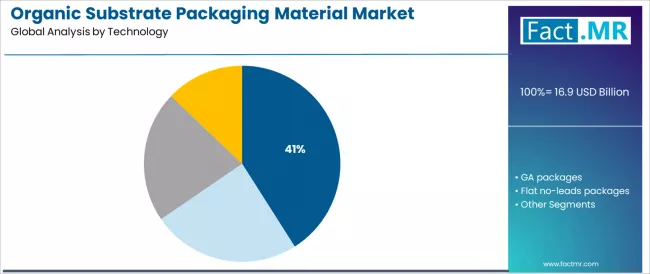
Organic Substrate Packaging Material Market Analysis By Technology | Source: Fact.MR
Based on FACT.MR's report, Small Outline (SO) packages are estimated to hold 41% share in 2026. This format dominates due to high-volume deployment across consumer electronics semiconductor packages. SO substrates offer cost efficiency and established supply chains.
- Amkor Technology Investment: Amkor Technology announced USD 2.0 billion investment in its advanced packaging facility in Peoria, Arizona in Q3 2024, increasing organic flip-chip substrate procurement capacity targeting AI and automotive semiconductor packaging for U.S. and global customers. [1]
- Kyocera Substrate Development: Kyocera Corporation launched a new low-loss organic substrate laminate product line in Q2 2025 at its Kagoshima facility, targeting mmWave 5G and automotive radar semiconductor packaging applications requiring low dielectric constant organic substrate materials. [4]
- Flip-chip Adoption Trend: SEMI reported a 28% increase in flip-chip substrate demand from AI accelerator chip packaging in 2024, with Ibiden and Unimicron capturing the majority of new capacity procurement from hyperscale data centre semiconductor customers. [3]
Organic Substrate Packaging Material Market Analysis by Application
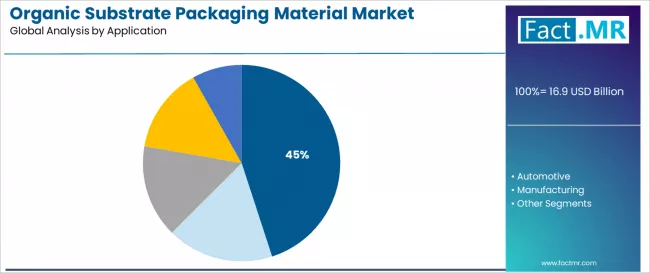
Organic Substrate Packaging Material Market Analysis By Application | Source: Fact.MR
Based on FACT.MR's report, consumer electronics is estimated to hold approximately 45% share in 2026. This segment leads due to the largest installed semiconductor packaging volume base. Automotive electronics is the fastest-growing application, driven by ADAS, EV power management, and V2X communication semiconductor content expansion requiring high-reliability organic substrates.
- ASE Technology Automotive Expansion: ASE Technology Holding expanded its IATF 16949-certified automotive packaging operations in Kaohsiung, Taiwan in Q1 2025, increasing organic substrate procurement for power semiconductor and ADAS chip packaging targeting European and Japanese automotive OEMs. [5]
- Shinko Electric Development: Shinko Electric Industries launched a new automotive-grade high-density organic substrate series in Q4 2024 at its Nagano facility, targeting EV inverter and battery management semiconductor packaging with AEC-Q100 qualification for Toyota and Denso supply chains. [6]
- Automotive Semiconductor Trend: Semiconductor content per vehicle reached USD 600 in premium EVs in 2024, per SEMI industry data, with organic substrate material consumption per vehicle increasing 18% year-on-year as power module and ADAS chip complexity expands. [2]
Organic Substrate Packaging Material Market Analysis by Material Use
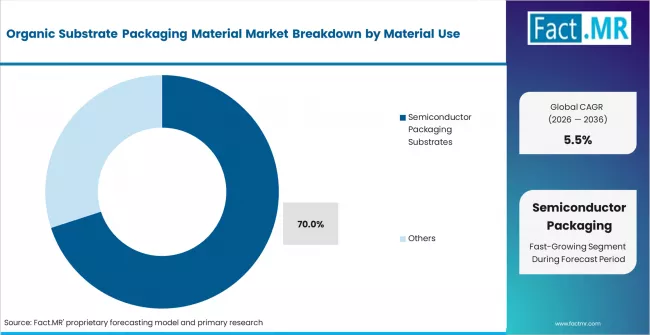
Organic Substrate Packaging Material Market Analysis By Material Use | Source: Fact.MR
Based on FACT.MR's report, semiconductor packaging substrates represent core demand at approximately 70% share in 2026. These substrates are the essential organic laminate layer in every advanced chip package. Demand is driven by overall semiconductor production volumes and is expanding fastest in AI accelerator and automotive power semiconductor packaging segments requiring advanced multi-layer organic substrate formats.
- Ibiden Capacity Investment: Ibiden Co., Ltd. announced a JPY 100 billion capex programme in FY2024 for ABF substrate capacity expansion at its Ogaki and Gifu facilities, targeting AI GPU and CPU chip packaging substrate demand from U.S. hyperscale data centre customers through 2027. [3]
- Unimicron Technology Development: Unimicron Technology Corporation introduced ultra-low-loss organic substrate laminates for sub-3nm chip packaging in Q3 2024, targeting TSMC and Intel Foundry Services advanced packaging substrate procurement for AI and HPC semiconductor customers. [7]
- ABF Substrate Demand Trend: Ajinomoto Build-up Film (ABF) substrate orders for AI chip packaging increased 35% in 2024 according to Ajinomoto Fine-Techno annual business report, driven by hyperscale data centre GPU and NPU chip volume growth from NVIDIA, Broadcom, and AMD. [8]
Drivers, Restraints, and Opportunities
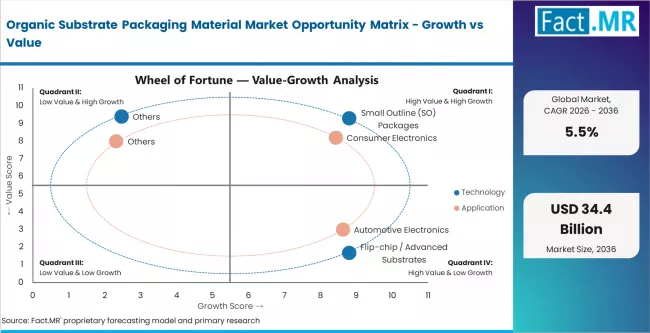
Organic Substrate Packaging Material Market Opportunity Matrix Growth Vs Value | Source: Fact.MR
FACT.MR analysts observe that the organic substrate packaging material market has expanded steadily alongside global semiconductor volume growth. The market exists at its current scale because every advanced semiconductor package requires an organic laminate substrate as the primary electrical interconnect layer.
The market is undergoing a technology-driven transition. Standard SO substrate volumes are plateauing in consumer electronics as smartphone refresh cycles slow. Advanced flip-chip and high-density interconnect substrates are capturing growing share, driven by AI and automotive semiconductor demand.
- CHIPS Act Advanced Packaging: The U.S. CHIPS and Science Act allocated USD 2.5 billion specifically for advanced packaging R&D and domestic substrate capacity in 2024. Amkor Technology received investment support for its Arizona OSAT facility, increasing local organic substrate procurement demand. [1]
- Automotive IATF Qualification Pressure: IATF 16949:2016 quality management requirements for automotive electronics are becoming mandatory for substrate suppliers at Toyota, Bosch, and Continental in 2024-2025 procurement qualification cycles. [2]
- Taiwan Advanced Substrate Expansion: Unimicron Technology and Ibiden Co., Ltd. announced combined capex of over USD 1.2 billion for advanced organic substrate capacity expansion in Taiwan and Japan in 2024, targeting AI accelerator and high-performance computing chip packaging demand from NVIDIA, AMD, and Intel. [3]
Regional Analysis
The organic substrate packaging material market is assessed across Asia Pacific, North America, Europe, Latin America, and Middle East and Africa, covering 40+ countries with distinct demand profiles shaped by semiconductor manufacturing concentration, OSAT and IDM procurement volumes, automotive electronics supply chains, and government semiconductor investment programmes. The full report offers market attractiveness analysis by region and country.
Organic Substrate Packaging Material Market Country Value Analysis | Source: Fact.MR
| Country | CAGR (2026 to 2036) |
|---|---|
| China | 7.4% |
| Taiwana | 7.1% |
| United States | 6.9% |
| South Korea | 6.6% |
| Germany | 5.5% |
| Japan | 5.1% |
Source: Fact.MR analysis. Updated May 16, 2026
Source: Fact.MR (FACT.MR) analysis, based on proprietary forecasting model and primary research
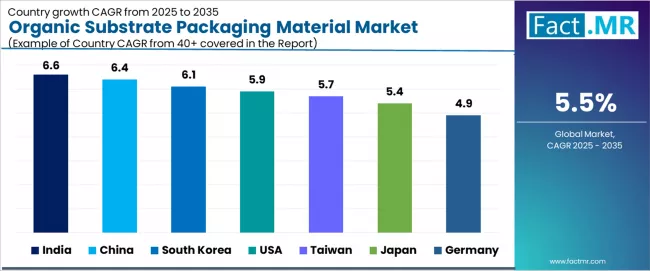
Organic Substrate Packaging Material Market Cagr Analysis By Country | Source: Fact.MR
Asia Pacific Organic Substrate Packaging Material Market Analysis
Asia Pacific is the global production epicenter for organic substrate packaging materials, accounting for the vast majority of OSAT and IDM substrate procurement volumes.
- China: China is projected to rise at 7.4% CAGR through 2036. Expansion is supported by massive IC assembly scale and aggressive localisation policies. The National IC Fund Phase III injected CNY 344 billion in 2024 to strengthen domestic supply chains. Semiconductor Manufacturing International Corporation and Hua Hong Semiconductor shifted procurement toward local substrate vendors. Shennan Circuits scaled multilayer substrate output in Shenzhen. Regional subsidies in Guangdong and Jiangsu are lowering production costs and reducing reliance on Taiwanese imports.
- Taiwan: Market expansion at 7.1% CAGR through 2036 is supported by unmatched OSAT density and advanced substrate leadership. Taiwan remains the backbone of global high-end packaging supply. Unimicron Technology Corporation committed TWD 12 billion for capacity expansion in 2024. This investment targets AI chip packaging linked to Taiwan Semiconductor Manufacturing Company advanced platforms. ASE Technology Holding Co., Ltd. increased sourcing from domestic suppliers. Government designation of substrates as strategic materials ensures infrastructure support and accelerates new facility development.
- South Korea: Organic substrate packaging materials in South Korea is projected to rise at 6.6% CAGR through 2036. Demand momentum is anchored in memory and advanced logic packaging. Samsung Electronics is expanding flip-chip substrate production at Busan. SK Hynix is increasing substrate intake for HBM3E packaging tied to AI workloads. The K-Semiconductor strategy is allocating KRW 550 trillion through 2030. Government-backed investment is supporting substrate material capacity expansion and strengthening domestic supply chains.
FACT.MR's analysis of organic substrate packaging material market in Asia Pacific covers China, Taiwan, South Korea, Japan, ASEAN, and Australia and New Zealand. Readers can find semiconductor investment programme impacts, OSAT procurement benchmarks, advanced substrate capacity expansion timelines, and domestic content policy effects.
North America Organic Substrate Packaging Material Market Analysis
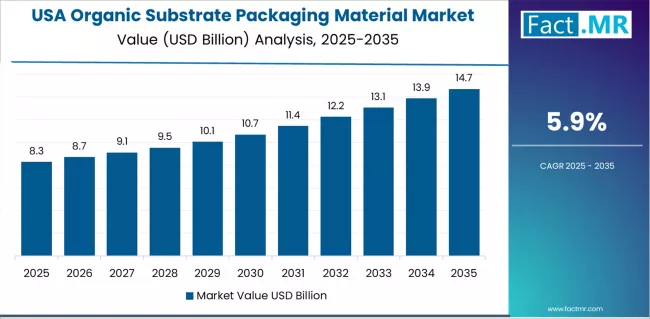
Organic Substrate Packaging Material Market Country Value Analysis | Source: Fact.MR
North America is an advanced packaging investment market defined by CHIPS Act-funded domestic OSAT expansion and growing AI semiconductor packaging substrate demand. Amkor Technology and ASE Technology's U.S. operations lead institutional substrate procurement. Government onshoring incentives are reshaping domestic organic substrate material sourcing dynamics away from Asian import dependency.
- United States: Demand for organic substrate packaging materials in the United States is projected to rise at 6.9% CAGR through 2036. Expansion is driven by AI chip packaging and domestic capacity build-out. The CHIPS and Science Act allocated USD 1.6 billion for advanced packaging in 2024. Amkor Technology received USD 400 million for its Arizona facility. Intel Corporation expanded domestic supplier qualification in 2025. SEMI reported a 22% rise in flip-chip substrate procurement inquiries. Demand is being driven by hyperscale data centre deployments.
FACT.MR's analysis of organic substrate packaging material market in North America covers the United States, Canada, and Mexico. Readers can find CHIPS Act investment impact data, advanced packaging procurement benchmarks, AI chip substrate demand trends, and domestic supplier qualification timelines.
Europe Organic Substrate Packaging Material Market Analysis
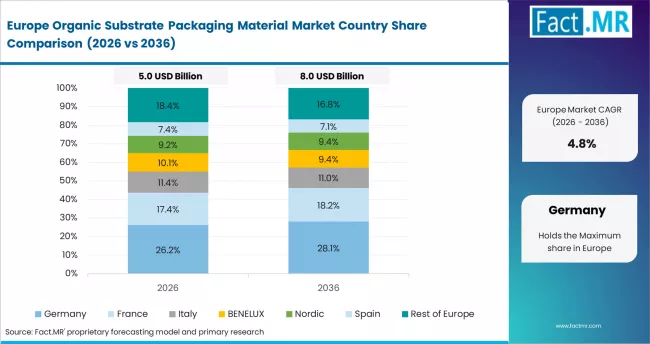
Organic Substrate Packaging Material Market Europe Country Market Share Analysis, 2026 & 2036 | Source: Fact.MR
Europe is a quality-intensive, automotive-anchored organic substrate market defined by IATF 16949 procurement standards and strong demand from German and French automotive electronics supply chains. Demand is concentrated in power semiconductor and ADAS chip packaging substrates. Kyocera and Shinko Electric maintain supply through IATF-certified facilities serving European automotive OEM procurement.
- Germany: Growth is estimated at 5.5% CAGR through 2036. Automotive semiconductor demand is the primary driver. Infineon Technologies increased substrate procurement for SiC modules in 2025. Bosch Mobility tightened supplier requirements under IATF standards in 2024. Dual sourcing and traceability are now mandatory. Government support under the European Chips Act reached EUR 220 million. This is strengthening domestic substrate qualification.
- Japan: A CAGR of 5.1% is expected through 2036. The market reflects mature demand with a shift toward high-value applications. Shinko Electric Industries upgraded high-density substrate offerings in 2024. Ibiden Co., Ltd. reported double-digit revenue growth from AI packaging demand. Consumer electronics volumes remain stable. Government funding of JPY 2 trillion is supporting supply chain competitiveness and cost efficiency.
FACT.MR's analysis of organic substrate packaging material market in Europe covers Germany, France, the United Kingdom, Italy, Spain, and Rest of Europe. Readers can find European Chips Act investment data, IATF 16949 automotive qualification trends, power semiconductor substrate procurement benchmarks, and EV electronics supply chain dynamics.
Competitive Aligners for Market Players
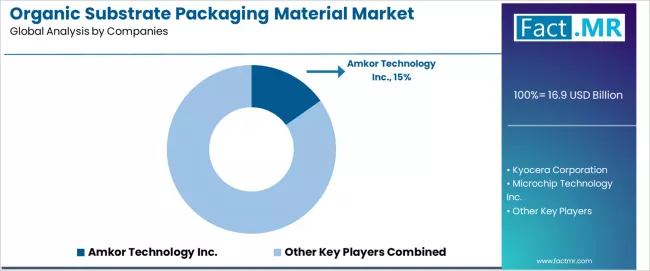
Organic Substrate Packaging Material Market Analysis By Company | Source: Fact.MR
Competition in the organic substrate packaging material market is shifting toward technology depth and qualification capability. Suppliers must move beyond volume-driven legacy packaging and align with advanced substrate demand.
Advanced substrate capability is the primary differentiator. High-density interconnect and flip-chip substrates are essential for AI and automotive applications. Companies like Ibiden Co., Ltd. and Unimicron Technology Corporation are investing in ABF substrate capacity to support high-performance chips. Vendors without these capabilities risk exclusion from premium contracts.
Automotive qualification is a key competitive barrier. IATF 16949 compliance and AEC standards are mandatory for EV and ADAS applications. Suppliers must demonstrate traceability, reliability, and dual-source capability. This increases entry barriers and favours established players.
OEM and OSAT integration is critical. Close collaboration with foundries and packaging players such as Taiwan Semiconductor Manufacturing Company and ASE Technology Holding Co., Ltd. ensures early design wins and long-term supply agreements. Embedded positioning improves revenue visibility. Regional supply chain strategy is evolving. Governments in the U.S., Europe, and China are incentivizing local production. Suppliers must balance global scale with localised manufacturing to secure contracts. Capacity expansion and yield improvement are also important. Advanced substrates require precision manufacturing and high capital investment. Companies that scale efficiently gain cost and margin advantages.
Key Players
- Amkor Technology
- Kyocera Corporation
- ASE Technology Holding
- Ibiden Co., Ltd.
- Unimicron Technology Corporation
- Shinko Electric Industries
- Samsung Electro-Mechanics
- Shennan Circuits Co., Ltd.
- Nan Ya PCB Corporation
- Kinsus Interconnect Technology
Bibliography
- [1] U.S. Department of Commerce, CHIPS Program Office. (November 2024). CHIPS Act Direct Funding Award: Amkor Technology Arizona Advanced Packaging Facility USD 400 Million Award for Flip-chip Organic Substrate Packaging Operations. commerce.gov/chips
- [2] SEMI. (2024). Automotive Semiconductor Content and Organic Substrate Demand Report: USD 600 Average Semiconductor Content Per EV and 18% Year-on-Year Substrate Consumption Growth in Automotive Power and ADAS Applications. semi.org/reports
- [3] Ibiden Co., Ltd. (FY2024). Annual Report and Investor Disclosure: JPY 100 Billion ABF Substrate Capacity Expansion Programme at Ogaki and Gifu Facilities for AI Accelerator and HPC Chip Packaging Substrate Supply. ibiden.com/investors
- [4] Kyocera Corporation. (Q2 2025). Press Release: Launch of Low Dielectric Loss Organic Substrate Laminate Product Line at Kagoshima Facility for 5G mmWave and Automotive Radar Semiconductor Packaging Applications. kyocera.com/news
- [5] ASE Technology Holding. (Q1 2025). Investor Disclosure: IATF 16949-Certified Automotive Packaging Operations Expansion in Kaohsiung for Power Semiconductor and ADAS Chip Organic Substrate Packaging Targeting European and Japanese Automotive OEMs. aseglobal.com/investors
- [6] Shinko Electric Industries. (Q4 2024). Product Launch Announcement: Automotive-Grade High-Density Organic Substrate Series with AEC-Q100 Qualification at Nagano Facility for EV Inverter and Battery Management Semiconductor Packaging for Toyota and Denso Supply Chains. shinko-elec.co.jp
- [7] Unimicron Technology Corporation. (Q3 2024). Investor Disclosure: Ultra-Low-Loss Organic Substrate Laminate Introduction for Sub-3nm Advanced Chip Packaging Targeting TSMC and Intel Foundry Services AI and HPC Semiconductor Customers. unimicron.com/investors
- [8] Ajinomoto Fine-Techno Co., Inc. (2024). Annual Business Report: ABF Substrate Order Growth 35% in 2024 Driven by AI GPU and NPU Chip Packaging Volume Increase from Hyperscale Data Centre Customers Including NVIDIA, Broadcom, and AMD. ajinomoto-finetech.co.jp
This Report Addresses
- Strategic intelligence on organic substrate packaging material demand across SO, flip-chip, and advanced substrate technologies for consumer electronics, automotive, and AI semiconductor packaging globally.
- Market forecast from USD 18.1 billion in 2026 to USD 30.9 billion by 2036 at a CAGR of 5.5%.
- Growth opportunity mapping across China domestic substrate capacity expansion, Taiwan OSAT advanced substrate procurement, U.S. CHIPS Act packaging investment, and Germany automotive IATF 16949-qualified substrate demand.
- Segment analysis by technology (SO, flip-chip/advanced, others), application (consumer electronics, automotive, others), and material use (semiconductor packaging substrates) across global and regional markets.
- Regional outlook covering Asia Pacific OSAT production concentration, North America CHIPS Act-driven onshoring, and Europe automotive electronics IATF-qualified substrate procurement cycles.
- Competitive analysis of Amkor, Kyocera, ASE Technology, Ibiden, Unimicron, and Shinko Electric covering substrate technology tier, advanced packaging qualification depth, and OSAT supply relationship positioning.
- Regulatory impact analysis covering U.S. CHIPS Act advanced packaging investments, China IC Fund Phase III semiconductor supply chain programmes, IATF 16949 automotive substrate qualification requirements, and European Chips Act material production grants.
- Report delivered in PDF, Excel datasets, and presentation formats, supported by primary interviews, OSAT procurement records, CHIPS Act disbursement filings, and semiconductor packaging capacity expansion disclosures.
Organic Substrate Packaging Material Market Definition
The organic substrate packaging material market covers laminate-based organic materials used as the primary interconnect substrate in semiconductor chip packages. These materials provide electrical routing, mechanical support, and thermal management between integrated circuits and printed circuit boards.
Organic Substrate Packaging Material Market Inclusions
Covers global and regional forecasts from 2026 to 2036 by technology, application, and material use. Includes SO package substrates, flip-chip substrates, and advanced high-density interconnect materials. Applications span consumer electronics and automotive electronics. Covers OSAT and IDM procurement across semiconductor packaging supply chains.
Organic Substrate Packaging Material Market Exclusions
Excludes ceramic and metal-based semiconductor packaging substrates not classified as organic laminates. Omits bare PCB materials used outside semiconductor packaging applications. Excludes finished semiconductor packages and assembled modules, focusing strictly on organic substrate materials and their immediate packaging intermediates.
Organic Substrate Packaging Material Market Research Methodology
- Primary Research:Interviews with OSAT procurement managers, substrate material engineers, semiconductor packaging directors, and automotive electronics supply chain specialists across Taiwan, Japan, South Korea, China, the United States, and Germany.
- Desk Research:Analysis of regulatory filings and investor disclosures from Amkor Technology, Ibiden, Unimicron, Shinko Electric, and ASE Technology, alongside CHIPS Act programme disbursement data and IATF 16949 certification records (2024-2025).
- Market-Sizing and Forecasting:Hybrid model combining top-down substrate material revenue estimates from leading suppliers with bottom-up volume estimates by application and package technology type, cross-referenced with average selling prices per substrate layer and technology tier.
- Data Validation and Update Cycle:Validated using OSAT procurement benchmarks, substrate capacity expansion announcements, semiconductor packaging trade flow data, and expert interviews with IC packaging supply chain specialists. Updated annually.
Segmentation
Scope of the Report
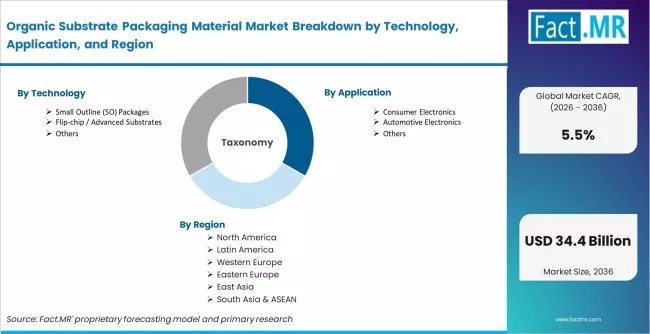
Organic Substrate Packaging Material Market Breakdown By Technology, Application, And Region | Source: Fact.MR
| Attribute | Details |
|---|---|
| Quantitative Units | USD 18.1 billion (2026) to USD 30.9 billion (2036), at a CAGR of 5.5% |
| Market Definition | Organic laminate-based substrate materials used in SO, flip-chip, and advanced semiconductor packages procured by OSATs, IDMs, and automotive electronics suppliers globally. |
| Technology Segmentation | Small Outline (SO) Packages, Flip-chip / Advanced Substrates, Others |
| Application Segmentation | Consumer Electronics, Automotive Electronics, Others |
| Material Use Segmentation | Semiconductor Packaging Substrates, Others |
| Application Coverage | Consumer electronics IC packaging, automotive ADAS and EV power semiconductor substrates, AI accelerator and HPC chip advanced substrate packaging, and 5G semiconductor module substrate procurement. |
| Regions Covered | North America, Europe, Asia Pacific, Latin America, Middle East and Africa |
| Countries Covered | USA, Canada, Mexico, Germany, UK, France, Italy, Spain, Nordic, BENELUX, China, Taiwan, Japan, South Korea, India, ASEAN, Australia and New Zealand, Brazil, Argentina, Chile, Saudi Arabia, UAE, Turkey, South Africa, Rest of MEA |
| Key Companies Profiled | Amkor Technology, Kyocera Corporation, ASE Technology Holding, Ibiden Co. Ltd., Unimicron Technology Corporation, Shinko Electric Industries, Samsung Electro-Mechanics, Shennan Circuits, Nan Ya PCB Corporation, Kinsus Interconnect Technology |
| Forecast Period | 2026 to 2036 |
| Approach | Hybrid top-down and bottom-up model using substrate material revenues, semiconductor packaging volumes by technology and application, average selling prices by substrate tier, OSAT procurement benchmarks, and primary interviews with IC packaging supply chain specialists. |
Source: Fact.MR analysis. Updated May 16, 2026
Organic Substrate Packaging Material Market by Segments
-
By Technology:
- Small Outline (SO) Packages
- Flip-chip / Advanced Substrates
- Others
-
By Application:
- Consumer Electronics
- Automotive Electronics
- Others
-
By Material Use:
- Semiconductor Packaging Substrates
- Others
-
By Region:
- North America
- United States
- Canada
- Mexico
- Latin America
- Brazil
- Argentina
- Chile
- Rest of Latin America
- Western Europe
- Germany
- United Kingdom
- France
- Italy
- Spain
- Nordic Countries
- BENELUX
- Rest of Western Europe
- Eastern Europe
- Russia
- Poland
- Hungary
- Balkan and Baltic
- Rest of Eastern Europe
- East Asia
- China
- Japan
- South Korea
- Taiwan
- South Asia and Pacific
- India
- ASEAN
- Australia and New Zealand
- Rest of South Asia and Pacific
- Middle East and Africa
- Saudi Arabia
- UAE
- Turkey
- South Africa
- Rest of Middle East and Africa
- North America
Frequently Asked Questions
How large is the global organic substrate packaging material market in 2025?
What will the market size be in 2026?
What is the projected market size by 2036?
What is the expected CAGR from 2026 to 2036?
Which technology segment is poised to lead the market?
Which application segment shows the fastest growth?
Which application segment holds the largest share?
Which country shows the fastest growth?
Who are the key players in the market?
Who worked on this report


Preview the report firsthand - request a free sample
Free SampleGet the brochure for pricing and purchase details
Download PDF