Felt Gasket Market (2026 - 2036)
Felt Gasket Market Size and Share Forecast Outlook 2026 to 2036
Core Findings
Felt Gasket Market Forecast Outlook 2026 to 2036
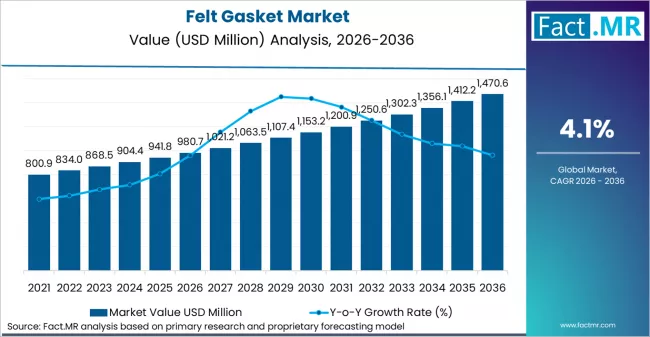
The felt gasket market is projected to reach USD 980.7 million in 2026, growing to USD 1,470.6 million by 2036, with a CAGR of 4.1%.
Key Takeaways from Felt Gasket Market
- Felt Gasket Market Value (2026): USD 980.7 million
- Felt Gasket Market Forecast Value (2036): USD 1,470.6 million
- Felt Gasket Market Forecast CAGR 2026 to 2036: 4.1%
- Leading Segment in Felt Gasket Market: 3-6 mm Thickness (53%)
- Key Growth Region in Felt Gasket Market: Asia Pacific
- Key Players in Felt Gasket Market: Freudenberg Sealing Technologies, Saint-Gobain S.A., Trelleborg AB, Rogers Corporation, W. L. Gore & Associates, Inc. (Gore), 3M Company, Parker Chomerics, Lydall, Inc., FilzFelt, Texon International Ltd.
While the market shows promising growth potential, execution risk remains a key concern for both manufacturers and buyers. The challenge lies in consistently meeting quality standards while managing production costs, especially in a market where material specifications are critical.
Adoption friction could emerge in industries reluctant to transition to newer gasket technologies or those focused on cost-cutting rather than long-term durability. Economic sensitivity also presents risks, as fluctuations in industrial production and raw material prices may lead to uneven demand patterns. These factors create a need for careful risk management, balancing the drive for innovation with the reality of market constraints. Companies will need to adapt to these dynamics to maintain stability, while managing both supply chain dependencies and shifting buyer priorities.
Felt Gasket Market
| Metric | Value |
|---|---|
| Estimated Value in (2026E) | USD 980.7 million |
| Forecast Value in (2036F) | USD 1,470.6 million |
| Forecast CAGR 2026 to 2036 | 4.1% |
Category
| Category | Segments |
|---|---|
| Material | Wool Felt; Synthetic Felt; Blended Felt |
| Application | Sealing; Vibration Damping; Thermal/Acoustic Insulation; Furniture/Other |
| End Use | Industrial Machinery; Automotive; Electronics; Other |
| Thickness | <3 mm; 3-6 mm; >6 mm |
| Region | North America; Europe; Asia Pacific; Latin America; Middle East & Africa |
Segmental Analysis
What Is the Impact of Material on the Felt Gasket Market?
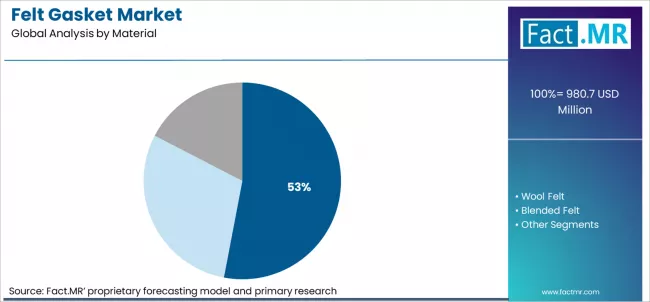
In the felt gasket market, material selection is key to determining the performance and suitability of gaskets for different applications. Synthetic felt leads the market with a 53% share, as it offers superior durability, resistance to chemicals, and consistent performance in sealing applications. Synthetic felt is particularly favored for its ability to withstand harsh environments and provide long-lasting sealing capabilities. While wool felt and blended felt are also used in specific applications where natural materials or a combination of properties are required, synthetic felt remains the dominant material due to its versatility and cost-effectiveness.
What Is the Impact of Application on the Felt Gasket Market?
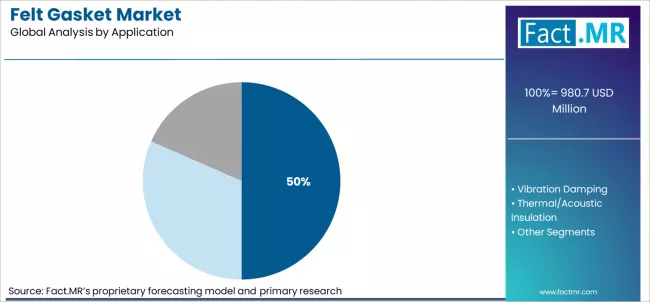
Application plays a significant role in driving demand for felt gaskets, with sealing accounting for 50% of the market share. Felt gaskets are commonly used in sealing applications to prevent the leakage of gases or liquids in various industries, including automotive, industrial equipment, and construction. The soft yet resilient nature of felt makes it an ideal material for creating reliable seals in machinery and piping systems. Other applications, such as vibration damping and thermal/acoustic insulation, also contribute to market growth, especially in industries that prioritize noise reduction and energy efficiency. As the demand for reliable sealing solutions grows across industries, the need for high-performance felt gaskets will continue to drive market expansion.
What are the Drivers, Restraints, and Key Trends in the Felt Gasket Market?
- Drivers: Demand for felt gaskets is shaped by requirements to provide sealing, cushioning, vibration damping, and noise control in automotive, industrial machinery, HVAC, and appliance assemblies. Engineers specify felt gaskets for irregular surfaces and interfaces where compressibility and resilience improve joint integrity and operational stability. Procurement teams prioritize materials with consistent thickness, density, and resistance to oils or environmental exposure to meet defined performance criteria. Growth in equipment manufacturing and maintenance services influences sourcing and inventory planning for felt gasket solutions.
- Restraints: Cost of higher performance felt materials constrains adoption in cost sensitive segments where basic sealing requirements may be met with alternative gasket types. Some operations face challenges ensuring dimensional consistency and long term compression set performance under variable loads, which can increase replacement frequency and quality validation efforts.
- Trend 1: Development of engineered fiber blends that improve abrasion resistance and durability.
- Trend 2: Expansion of pre cut and customizable gasket formats that reduce fabrication time and waste.
Analysis of the Felt Gasket Market by Key Country
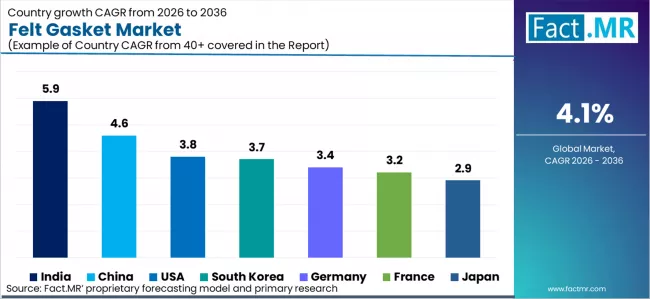
| Country | CAGR 2026 to 2036 |
|---|---|
| USA | 3.8% |
| China | 4.6% |
| India | 5.9% |
| Germany | 3.4% |
| Japan | 2.9% |
| South Korea | 3.7% |
| France | 3.2% |
The report covers an in-depth analysis of 40+ countries; top-performing countries are highlighted below.
What is the Outlook on the Felt Gasket Market in the USA?
USA market in felt gaskets is projected to grow at a CAGR of 3.8% from 2026 to 2036. The demand for felt gaskets is rising due to their widespread application in industries such as automotive, manufacturing, and construction, where they are used for sealing and cushioning applications. Felt gaskets are favored for their durability, resilience, and cost-effectiveness. With the USA's growing industrial base and increasing demand for sealing solutions that meet stringent quality standards, the market for felt gaskets is expected to experience steady growth.
What is the Demand for Felt Gaskets in China?
China sales of felt gaskets are expected to grow at a CAGR of 4.6% from 2026 to 2036. As China continues to be a manufacturing leader globally, the demand for felt gaskets in automotive, construction, and industrial applications is increasing. Felt gaskets provide essential sealing properties in equipment and machinery, ensuring efficiency and preventing leaks. With China’s continued expansion in manufacturing and industrial activities, the market for felt gaskets is projected to grow steadily, supported by domestic demand and global export requirements.
What is the Sales Outlook on Felt Gaskets in India?
India demand for felt gaskets is projected to grow at a CAGR of 5.9% from 2026 to 2036. As India’s automotive, manufacturing, and construction sectors continue to expand, the need for high-quality sealing solutions like felt gaskets is increasing. These gaskets are essential for ensuring leak-proof and effective sealing in various applications, including engines, pumps, and machinery. With India’s industrial growth and improving infrastructure, the market for felt gaskets is expected to experience strong growth, driven by both domestic demand and export opportunities.
What is the Demand for Felt Gaskets in Germany?
Germany market in felt gaskets is forecast to grow at a CAGR of 3.4% from 2026 to 2036. Germany’s advanced manufacturing and automotive industries are key drivers of the demand for felt gaskets, as these gaskets play a crucial role in sealing and insulation applications. Felt gaskets are used in machinery, vehicles, and industrial systems where high durability and efficiency are required. With Germany’s commitment to innovation and quality control in industrial manufacturing, the market for felt gaskets is expected to grow steadily.
What is the Sales Outlook on Felt Gaskets in Japan?
Japan demand for felt gaskets is set to grow at a CAGR of 2.9% from 2026 to 2036. Japan’s automotive and industrial sectors, where sealing solutions are critical, are driving the demand for felt gaskets. These gaskets are used in various applications to ensure airtight and leak-proof seals, particularly in automotive engines and industrial equipment. While the market in Japan is more mature, the steady demand for high-performance sealing materials and ongoing industrial advancements will continue to support moderate growth in the market.
What is the Market Expansion Outlook for Felt Gaskets in South Korea?
South Korea demand for felt gaskets is projected to grow at a CAGR of 3.7% from 2026 to 2036. South Korea’s automotive and manufacturing industries are increasingly adopting high-quality sealing solutions like felt gaskets. These gaskets are used in machinery, automotive components, and various other industrial applications to ensure reliable performance. With the country's strong focus on technology and product innovation, the market for felt gaskets is expected to grow steadily, driven by both domestic demand and global trade.
What is the Market Expansion Outlook for Felt Gaskets in France?
France sales of felt gaskets are expected to grow at a CAGR of 3.2% from 2026 to 2036. France’s automotive, aerospace, and manufacturing sectors rely on felt gaskets for high-performance sealing solutions. These gaskets are used in diverse applications where durability, flexibility, and resilience are essential. As France continues to strengthen its manufacturing base and adhere to stringent quality standards, the market for felt gaskets is expected to grow steadily, driven by both local demand and international market needs.
How Are Key Players Competing in the Felt Gasket Market?
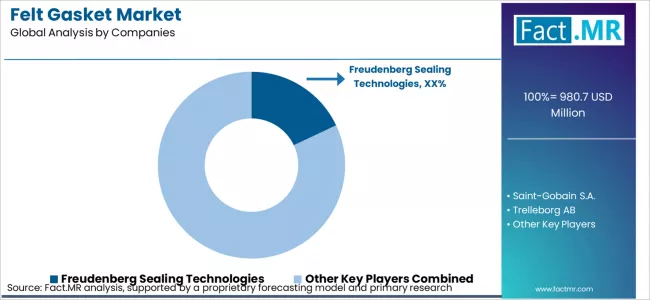
Competition in the felt gasket market is shaped by material quality, sealing performance, and compatibility with diverse operating environments. Freudenberg Sealing Technologies and Saint Gobain S.A. supply felt gaskets engineered for consistent thickness and compression recovery, supporting reliable sealing under vibration and thermal variation. Trelleborg AB and Rogers Corporation focus on tailored felt compositions that balance resilience with fluid resistance for industrial applications. W. L. Gore & Associates, Inc. (Gore) and 3M Company offer solutions emphasising engineered fiber structures that support precise tolerances and long service life. Parker Chomerics and Lydall, Inc. provide felt gaskets optimized for acoustic insulation and mechanical sealing. FilzFelt and Texon International Ltd. deliver specialized materials with performance attributes aligned to design requirements in automotive, aerospace, and equipment assembly contexts. Competitive positioning is defined by felt density control, resistance to compression set, and alignment with application specific sealing standards.
Key Players of the Felt Gasket Market
- Freudenberg Sealing Technologies
- Saint-Gobain S.A.
- Trelleborg AB
- Rogers Corporation
- W. L. Gore & Associates, Inc. (Gore)
- 3M Company
- Parker Chomerics
- Lydall, Inc.
- FilzFelt
- Texon International Ltd.
Scope of the Report
| Items | Values |
|---|---|
| Quantitative Units (2026) | USD Million |
| Material | Wool Felt, Synthetic Felt, Blended Felt |
| Application | Sealing, Vibration Damping, Thermal/Acoustic Insulation |
| End Use | Industrial Machinery, Automotive, Electronics, Furniture/Other |
| Thickness | <3 mm, 3-6 mm, >6 mm |
| Regions Covered | North America, Europe, Asia Pacific, Latin America, Middle East & Africa |
| Countries Covered | United States, Canada, Mexico, Germany, United Kingdom, France, Japan, South Korea, China, India, Brazil, and other countries |
| Key Companies Profiled | Freudenberg Sealing Technologies, Saint-Gobain S.A., Trelleborg AB, Rogers Corporation, W. L. Gore & Associates, Inc. (Gore), 3M Company, Parker Chomerics, Lydall, Inc., FilzFelt, Texon International Ltd. |
| Additional Attributes | Dollar revenue by material, application, end use, thickness, and region; regional demand trends, competitive landscape, technological advancements in felt gasket production, operational performance optimization initiatives, and product development strategies |
Felt Gasket Market Key Segments
-
Material :
- Wool Felt
- Synthetic Felt
- Blended Felt
-
Application :
- Sealing
- Vibration Damping
- Thermal/Acoustic Insulation
- Other
-
End Use :
- Industrial Machinery
- Automotive
- Electronics
- Furniture/Other
-
Thickness :
- <3 mm
- 3-6 mm
- 6 mm
-
Region :
- North America
- USA
- Canada
- Mexico
- Europe
- Germany
- UK
- France
- Italy
- Spain
- Rest of Europe
- Asia Pacific
- China
- Japan
- South Korea
- India
- Australia
- Rest of Asia Pacific
- Latin America
- Brazil
- Argentina
- Rest of Latin America
- Middle East and Africa
- Kingdom of Saudi Arabia
- United Arab Emirates
- South Africa
- Rest of Middle East and Africa
- Other Regions
- Oceania
- Central Asia
- Other Markets
- North America
Bibliographies
- International Organization for Standardization. (2024). ISO 1817: Rubber, vulcanized or thermoplastic - Determination of the effect of liquids. ISO.
- ASTM International. (2023). ASTM D1056-21(2023): Standard specification for flexible cellular materials-Sponge or expanded rubber. ASTM International.
- European Committee for Standardization. (2024). EN 682: Elastomeric seals - Materials requirements for pipe joints and fittings. CEN.
- U.S. Environmental Protection Agency. (2023). Technical guidance on vibration control and sealing materials in industrial equipment. EPA.
- International Electrotechnical Commission. (2023). IEC 60601-1: Medical electrical equipment - General requirements for basic safety and essential performance. IEC.
Table of Content
- Executive Summary
- Global Market Outlook
- Demand to side Trends
- Supply to side Trends
- Technology Roadmap Analysis
- Analysis and Recommendations
- Market Overview
- Market Coverage / Taxonomy
- Market Definition / Scope / Limitations
- Research Methodology
- Chapter Orientation
- Analytical Lens and Working Hypotheses
- Market Structure, Signals, and Trend Drivers
- Benchmarking and Cross-market Comparability
- Market Sizing, Forecasting, and Opportunity Mapping
- Research Design and Evidence Framework
- Desk Research Programme (Secondary Evidence)
- Company Annual and Sustainability Reports
- Peer-reviewed Journals and Academic Literature
- Corporate Websites, Product Literature, and Technical Notes
- Earnings Decks and Investor Briefings
- Statutory Filings and Regulatory Disclosures
- Technical White Papers and Standards Notes
- Trade Journals, Industry Magazines, and Analyst Briefs
- Conference Proceedings, Webinars, and Seminar Materials
- Government Statistics Portals and Public Data Releases
- Press Releases and Reputable Media Coverage
- Specialist Newsletters and Curated Briefings
- Sector Databases and Reference Repositories
- FMR Internal Proprietary Databases and Historical Market Datasets
- Subscription Datasets and Paid Sources
- Social Channels, Communities, and Digital Listening Inputs
- Additional Desk Sources
- Expert Input and Fieldwork (Primary Evidence)
- Primary Modes
- Qualitative Interviews and Expert Elicitation
- Quantitative Surveys and Structured Data Capture
- Blended A9oach
- Why Primary Evidence is Used
- Field Techniques
- Interviews
- Surveys
- C-suite Leaders
- Board Members
- Presidents and Vice Presidents
- R&D and Innovation Heads
- Technical Specialists
- Domain Subject-matter Experts
- Scientists
- Physicians and Other Healthcare Professionals
- Governance, Ethics, and Data Stewardship
- Research Ethics
- Data Integrity and Handling
- Primary Modes
- Tooling, Models, and Reference Databases
- Desk Research Programme (Secondary Evidence)
- Data Engineering and Model Build
- Data Acquisition and Ingestion
- Cleaning, Normalisation, and Verification
- Synthesis, Triangulation, and Analysis
- Quality Assurance and Audit Trail
- Market Background
- Market Dynamics
- Drivers
- Restraints
- Opportunity
- Trends
- Scenario Forecast
- Demand in Optimistic Scenario
- Demand in Likely Scenario
- Demand in Conservative Scenario
- Opportunity Map Analysis
- Product Life Cycle Analysis
- Supply Chain Analysis
- Investment Feasibility Matrix
- Value Chain Analysis
- PESTLE and Porter’s Analysis
- Regulatory Landscape
- Regional Parent Market Outlook
- Production and Consumption Statistics
- Import and Export Statistics
- Market Dynamics
- Global Market Analysis 2021 to 2025 and Forecast, 2026 to 2036
- Historical Market Size Value (USD Million) Analysis, 2021 to 2025
- Current and Future Market Size Value (USD Million) Projections, 2026 to 2036
- Y to o to Y Growth Trend Analysis
- Absolute $ Opportunity Analysis
- Global Market Pricing Analysis 2021 to 2025 and Forecast 2026 to 2036
- Global Market Analysis 2021 to 2025 and Forecast 2026 to 2036, By Material
- Introduction / Key Findings
- Historical Market Size Value (USD Million) Analysis By Material, 2021 to 2025
- Current and Future Market Size Value (USD Million) Analysis and Forecast By Material, 2026 to 2036
- Synthetic Felt
- Wool Felt
- Blended Felt
- Synthetic Felt
- Y to o to Y Growth Trend Analysis By Material, 2021 to 2025
- Absolute $ Opportunity Analysis By Material, 2026 to 2036
- Global Market Analysis 2021 to 2025 and Forecast 2026 to 2036, By Application
- Introduction / Key Findings
- Historical Market Size Value (USD Million) Analysis By Application, 2021 to 2025
- Current and Future Market Size Value (USD Million) Analysis and Forecast By Application, 2026 to 2036
- Sealing
- Vibration Damping
- Thermal/Acoustic Insulation
- Sealing
- Y to o to Y Growth Trend Analysis By Application, 2021 to 2025
- Absolute $ Opportunity Analysis By Application, 2026 to 2036
- Global Market Analysis 2021 to 2025 and Forecast 2026 to 2036, By End Use
- Introduction / Key Findings
- Historical Market Size Value (USD Million) Analysis By End Use, 2021 to 2025
- Current and Future Market Size Value (USD Million) Analysis and Forecast By End Use, 2026 to 2036
- Industrial Machinery
- Automotive
- Electronics
- Furniture/Other
- Industrial Machinery
- Y to o to Y Growth Trend Analysis By End Use, 2021 to 2025
- Absolute $ Opportunity Analysis By End Use, 2026 to 2036
- Global Market Analysis 2021 to 2025 and Forecast 2026 to 2036, By Thickness
- Introduction / Key Findings
- Historical Market Size Value (USD Million) Analysis By Thickness, 2021 to 2025
- Current and Future Market Size Value (USD Million) Analysis and Forecast By Thickness, 2026 to 2036
- 3-6 mm
- <3 mm
- >6 mm
- 3-6 mm
- Y to o to Y Growth Trend Analysis By Thickness, 2021 to 2025
- Absolute $ Opportunity Analysis By Thickness, 2026 to 2036
- Global Market Analysis 2021 to 2025 and Forecast 2026 to 2036, By Region
- Introduction
- Historical Market Size Value (USD Million) Analysis By Region, 2021 to 2025
- Current Market Size Value (USD Million) Analysis and Forecast By Region, 2026 to 2036
- North America
- Latin America
- Western Europe
- Eastern Europe
- East Asia
- South Asia and Pacific
- Middle East & Africa
- Market Attractiveness Analysis By Region
- North America Market Analysis 2021 to 2025 and Forecast 2026 to 2036, By Country
- Historical Market Size Value (USD Million) Trend Analysis By Market Taxonomy, 2021 to 2025
- Market Size Value (USD Million) Forecast By Market Taxonomy, 2026 to 2036
- By Country
- USA
- Canada
- Mexico
- By Material
- By Application
- By End Use
- By Thickness
- By Country
- Market Attractiveness Analysis
- By Country
- By Material
- By Application
- By End Use
- By Thickness
- Key Takeaways
- Latin America Market Analysis 2021 to 2025 and Forecast 2026 to 2036, By Country
- Historical Market Size Value (USD Million) Trend Analysis By Market Taxonomy, 2021 to 2025
- Market Size Value (USD Million) Forecast By Market Taxonomy, 2026 to 2036
- By Country
- Brazil
- Chile
- Rest of Latin America
- By Material
- By Application
- By End Use
- By Thickness
- By Country
- Market Attractiveness Analysis
- By Country
- By Material
- By Application
- By End Use
- By Thickness
- Key Takeaways
- Western Europe Market Analysis 2021 to 2025 and Forecast 2026 to 2036, By Country
- Historical Market Size Value (USD Million) Trend Analysis By Market Taxonomy, 2021 to 2025
- Market Size Value (USD Million) Forecast By Market Taxonomy, 2026 to 2036
- By Country
- Germany
- UK
- Italy
- Spain
- France
- Nordic
- BENELUX
- Rest of Western Europe
- By Material
- By Application
- By End Use
- By Thickness
- By Country
- Market Attractiveness Analysis
- By Country
- By Material
- By Application
- By End Use
- By Thickness
- Key Takeaways
- Eastern Europe Market Analysis 2021 to 2025 and Forecast 2026 to 2036, By Country
- Historical Market Size Value (USD Million) Trend Analysis By Market Taxonomy, 2021 to 2025
- Market Size Value (USD Million) Forecast By Market Taxonomy, 2026 to 2036
- By Country
- Russia
- Poland
- Hungary
- Balkan & Baltic
- Rest of Eastern Europe
- By Material
- By Application
- By End Use
- By Thickness
- By Country
- Market Attractiveness Analysis
- By Country
- By Material
- By Application
- By End Use
- By Thickness
- Key Takeaways
- East Asia Market Analysis 2021 to 2025 and Forecast 2026 to 2036, By Country
- Historical Market Size Value (USD Million) Trend Analysis By Market Taxonomy, 2021 to 2025
- Market Size Value (USD Million) Forecast By Market Taxonomy, 2026 to 2036
- By Country
- China
- Japan
- South Korea
- By Material
- By Application
- By End Use
- By Thickness
- By Country
- Market Attractiveness Analysis
- By Country
- By Material
- By Application
- By End Use
- By Thickness
- Key Takeaways
- South Asia and Pacific Market Analysis 2021 to 2025 and Forecast 2026 to 2036, By Country
- Historical Market Size Value (USD Million) Trend Analysis By Market Taxonomy, 2021 to 2025
- Market Size Value (USD Million) Forecast By Market Taxonomy, 2026 to 2036
- By Country
- India
- ASEAN
- Australia & New Zealand
- Rest of South Asia and Pacific
- By Material
- By Application
- By End Use
- By Thickness
- By Country
- Market Attractiveness Analysis
- By Country
- By Material
- By Application
- By End Use
- By Thickness
- Key Takeaways
- Middle East & Africa Market Analysis 2021 to 2025 and Forecast 2026 to 2036, By Country
- Historical Market Size Value (USD Million) Trend Analysis By Market Taxonomy, 2021 to 2025
- Market Size Value (USD Million) Forecast By Market Taxonomy, 2026 to 2036
- By Country
- Kingdom of Saudi Arabia
- Other GCC Countries
- Turkiye
- South Africa
- Other African Union
- Rest of Middle East & Africa
- By Material
- By Application
- By End Use
- By Thickness
- By Country
- Market Attractiveness Analysis
- By Country
- By Material
- By Application
- By End Use
- By Thickness
- Key Takeaways
- Key Countries Market Analysis
- USA
- Pricing Analysis
- Market Share Analysis, 2025
- By Material
- By Application
- By End Use
- By Thickness
- Canada
- Pricing Analysis
- Market Share Analysis, 2025
- By Material
- By Application
- By End Use
- By Thickness
- Mexico
- Pricing Analysis
- Market Share Analysis, 2025
- By Material
- By Application
- By End Use
- By Thickness
- Brazil
- Pricing Analysis
- Market Share Analysis, 2025
- By Material
- By Application
- By End Use
- By Thickness
- Chile
- Pricing Analysis
- Market Share Analysis, 2025
- By Material
- By Application
- By End Use
- By Thickness
- Germany
- Pricing Analysis
- Market Share Analysis, 2025
- By Material
- By Application
- By End Use
- By Thickness
- UK
- Pricing Analysis
- Market Share Analysis, 2025
- By Material
- By Application
- By End Use
- By Thickness
- Italy
- Pricing Analysis
- Market Share Analysis, 2025
- By Material
- By Application
- By End Use
- By Thickness
- Spain
- Pricing Analysis
- Market Share Analysis, 2025
- By Material
- By Application
- By End Use
- By Thickness
- France
- Pricing Analysis
- Market Share Analysis, 2025
- By Material
- By Application
- By End Use
- By Thickness
- India
- Pricing Analysis
- Market Share Analysis, 2025
- By Material
- By Application
- By End Use
- By Thickness
- ASEAN
- Pricing Analysis
- Market Share Analysis, 2025
- By Material
- By Application
- By End Use
- By Thickness
- Australia & New Zealand
- Pricing Analysis
- Market Share Analysis, 2025
- By Material
- By Application
- By End Use
- By Thickness
- China
- Pricing Analysis
- Market Share Analysis, 2025
- By Material
- By Application
- By End Use
- By Thickness
- Japan
- Pricing Analysis
- Market Share Analysis, 2025
- By Material
- By Application
- By End Use
- By Thickness
- South Korea
- Pricing Analysis
- Market Share Analysis, 2025
- By Material
- By Application
- By End Use
- By Thickness
- Russia
- Pricing Analysis
- Market Share Analysis, 2025
- By Material
- By Application
- By End Use
- By Thickness
- Poland
- Pricing Analysis
- Market Share Analysis, 2025
- By Material
- By Application
- By End Use
- By Thickness
- Hungary
- Pricing Analysis
- Market Share Analysis, 2025
- By Material
- By Application
- By End Use
- By Thickness
- Kingdom of Saudi Arabia
- Pricing Analysis
- Market Share Analysis, 2025
- By Material
- By Application
- By End Use
- By Thickness
- Turkiye
- Pricing Analysis
- Market Share Analysis, 2025
- By Material
- By Application
- By End Use
- By Thickness
- South Africa
- Pricing Analysis
- Market Share Analysis, 2025
- By Material
- By Application
- By End Use
- By Thickness
- USA
- Market Structure Analysis
- Competition Dashboard
- Competition Benchmarking
- Market Share Analysis of Top Players
- By Regional
- By Material
- By Application
- By End Use
- By Thickness
- Competition Analysis
- Competition Deep Dive
- Freudenberg Sealing Technologies
- Overview
- Product Portfolio
- Profitability by Market Segments (Product/Age /Sales Channel/Region)
- Sales Footprint
- Strategy Overview
- Marketing Strategy
- Product Strategy
- Channel Strategy
- Saint-Gobain S.A.
- Trelleborg AB
- Rogers Corporation
- W. L. Gore & Associates, Inc. (Gore)
- 3M Company
- Parker Chomerics
- Lydall, Inc.
- FilzFelt
- Texon International Ltd.
- Freudenberg Sealing Technologies
- Competition Deep Dive
- Assumptions & Acronyms Used
List Of Table
- Table 1: Global Market Value (USD Million) Forecast by Region, 2021 to 2036
- Table 2: Global Market Value (USD Million) Forecast by Material, 2021 to 2036
- Table 3: Global Market Value (USD Million) Forecast by Application, 2021 to 2036
- Table 4: Global Market Value (USD Million) Forecast by End Use, 2021 to 2036
- Table 5: Global Market Value (USD Million) Forecast by Thickness, 2021 to 2036
- Table 6: North America Market Value (USD Million) Forecast by Country, 2021 to 2036
- Table 7: North America Market Value (USD Million) Forecast by Material, 2021 to 2036
- Table 8: North America Market Value (USD Million) Forecast by Application, 2021 to 2036
- Table 9: North America Market Value (USD Million) Forecast by End Use, 2021 to 2036
- Table 10: North America Market Value (USD Million) Forecast by Thickness, 2021 to 2036
- Table 11: Latin America Market Value (USD Million) Forecast by Country, 2021 to 2036
- Table 12: Latin America Market Value (USD Million) Forecast by Material, 2021 to 2036
- Table 13: Latin America Market Value (USD Million) Forecast by Application, 2021 to 2036
- Table 14: Latin America Market Value (USD Million) Forecast by End Use, 2021 to 2036
- Table 15: Latin America Market Value (USD Million) Forecast by Thickness, 2021 to 2036
- Table 16: Western Europe Market Value (USD Million) Forecast by Country, 2021 to 2036
- Table 17: Western Europe Market Value (USD Million) Forecast by Material, 2021 to 2036
- Table 18: Western Europe Market Value (USD Million) Forecast by Application, 2021 to 2036
- Table 19: Western Europe Market Value (USD Million) Forecast by End Use, 2021 to 2036
- Table 20: Western Europe Market Value (USD Million) Forecast by Thickness, 2021 to 2036
- Table 21: Eastern Europe Market Value (USD Million) Forecast by Country, 2021 to 2036
- Table 22: Eastern Europe Market Value (USD Million) Forecast by Material, 2021 to 2036
- Table 23: Eastern Europe Market Value (USD Million) Forecast by Application, 2021 to 2036
- Table 24: Eastern Europe Market Value (USD Million) Forecast by End Use, 2021 to 2036
- Table 25: Eastern Europe Market Value (USD Million) Forecast by Thickness, 2021 to 2036
- Table 26: East Asia Market Value (USD Million) Forecast by Country, 2021 to 2036
- Table 27: East Asia Market Value (USD Million) Forecast by Material, 2021 to 2036
- Table 28: East Asia Market Value (USD Million) Forecast by Application, 2021 to 2036
- Table 29: East Asia Market Value (USD Million) Forecast by End Use, 2021 to 2036
- Table 30: East Asia Market Value (USD Million) Forecast by Thickness, 2021 to 2036
- Table 31: South Asia and Pacific Market Value (USD Million) Forecast by Country, 2021 to 2036
- Table 32: South Asia and Pacific Market Value (USD Million) Forecast by Material, 2021 to 2036
- Table 33: South Asia and Pacific Market Value (USD Million) Forecast by Application, 2021 to 2036
- Table 34: South Asia and Pacific Market Value (USD Million) Forecast by End Use, 2021 to 2036
- Table 35: South Asia and Pacific Market Value (USD Million) Forecast by Thickness, 2021 to 2036
- Table 36: Middle East & Africa Market Value (USD Million) Forecast by Country, 2021 to 2036
- Table 37: Middle East & Africa Market Value (USD Million) Forecast by Material, 2021 to 2036
- Table 38: Middle East & Africa Market Value (USD Million) Forecast by Application, 2021 to 2036
- Table 39: Middle East & Africa Market Value (USD Million) Forecast by End Use, 2021 to 2036
- Table 40: Middle East & Africa Market Value (USD Million) Forecast by Thickness, 2021 to 2036
List Of Figures
- Figure 1: Global Market Pricing Analysis
- Figure 2: Global Market Value (USD Million) Forecast 2021 to 2036
- Figure 3: Global Market Value Share and BPS Analysis by Material, 2026 and 2036
- Figure 4: Global Market Y to o to Y Growth Comparison by Material, 2026 to 2036
- Figure 5: Global Market Attractiveness Analysis by Material
- Figure 6: Global Market Value Share and BPS Analysis by Application, 2026 and 2036
- Figure 7: Global Market Y to o to Y Growth Comparison by Application, 2026 to 2036
- Figure 8: Global Market Attractiveness Analysis by Application
- Figure 9: Global Market Value Share and BPS Analysis by End Use, 2026 and 2036
- Figure 10: Global Market Y to o to Y Growth Comparison by End Use, 2026 to 2036
- Figure 11: Global Market Attractiveness Analysis by End Use
- Figure 12: Global Market Value Share and BPS Analysis by Thickness, 2026 and 2036
- Figure 13: Global Market Y to o to Y Growth Comparison by Thickness, 2026 to 2036
- Figure 14: Global Market Attractiveness Analysis by Thickness
- Figure 15: Global Market Value (USD Million) Share and BPS Analysis by Region, 2026 and 2036
- Figure 16: Global Market Y to o to Y Growth Comparison by Region, 2026 to 2036
- Figure 17: Global Market Attractiveness Analysis by Region
- Figure 18: North America Market Incremental Dollar Opportunity, 2026 to 2036
- Figure 19: Latin America Market Incremental Dollar Opportunity, 2026 to 2036
- Figure 20: Western Europe Market Incremental Dollar Opportunity, 2026 to 2036
- Figure 21: Eastern Europe Market Incremental Dollar Opportunity, 2026 to 2036
- Figure 22: East Asia Market Incremental Dollar Opportunity, 2026 to 2036
- Figure 23: South Asia and Pacific Market Incremental Dollar Opportunity, 2026 to 2036
- Figure 24: Middle East & Africa Market Incremental Dollar Opportunity, 2026 to 2036
- Figure 25: North America Market Value Share and BPS Analysis by Country, 2026 and 2036
- Figure 26: North America Market Value Share and BPS Analysis by Material, 2026 and 2036
- Figure 27: North America Market Y to o to Y Growth Comparison by Material, 2026 to 2036
- Figure 28: North America Market Attractiveness Analysis by Material
- Figure 29: North America Market Value Share and BPS Analysis by Application, 2026 and 2036
- Figure 30: North America Market Y to o to Y Growth Comparison by Application, 2026 to 2036
- Figure 31: North America Market Attractiveness Analysis by Application
- Figure 32: North America Market Value Share and BPS Analysis by End Use, 2026 and 2036
- Figure 33: North America Market Y to o to Y Growth Comparison by End Use, 2026 to 2036
- Figure 34: North America Market Attractiveness Analysis by End Use
- Figure 35: North America Market Value Share and BPS Analysis by Thickness, 2026 and 2036
- Figure 36: North America Market Y to o to Y Growth Comparison by Thickness, 2026 to 2036
- Figure 37: North America Market Attractiveness Analysis by Thickness
- Figure 38: Latin America Market Value Share and BPS Analysis by Country, 2026 and 2036
- Figure 39: Latin America Market Value Share and BPS Analysis by Material, 2026 and 2036
- Figure 40: Latin America Market Y to o to Y Growth Comparison by Material, 2026 to 2036
- Figure 41: Latin America Market Attractiveness Analysis by Material
- Figure 42: Latin America Market Value Share and BPS Analysis by Application, 2026 and 2036
- Figure 43: Latin America Market Y to o to Y Growth Comparison by Application, 2026 to 2036
- Figure 44: Latin America Market Attractiveness Analysis by Application
- Figure 45: Latin America Market Value Share and BPS Analysis by End Use, 2026 and 2036
- Figure 46: Latin America Market Y to o to Y Growth Comparison by End Use, 2026 to 2036
- Figure 47: Latin America Market Attractiveness Analysis by End Use
- Figure 48: Latin America Market Value Share and BPS Analysis by Thickness, 2026 and 2036
- Figure 49: Latin America Market Y to o to Y Growth Comparison by Thickness, 2026 to 2036
- Figure 50: Latin America Market Attractiveness Analysis by Thickness
- Figure 51: Western Europe Market Value Share and BPS Analysis by Country, 2026 and 2036
- Figure 52: Western Europe Market Value Share and BPS Analysis by Material, 2026 and 2036
- Figure 53: Western Europe Market Y to o to Y Growth Comparison by Material, 2026 to 2036
- Figure 54: Western Europe Market Attractiveness Analysis by Material
- Figure 55: Western Europe Market Value Share and BPS Analysis by Application, 2026 and 2036
- Figure 56: Western Europe Market Y to o to Y Growth Comparison by Application, 2026 to 2036
- Figure 57: Western Europe Market Attractiveness Analysis by Application
- Figure 58: Western Europe Market Value Share and BPS Analysis by End Use, 2026 and 2036
- Figure 59: Western Europe Market Y to o to Y Growth Comparison by End Use, 2026 to 2036
- Figure 60: Western Europe Market Attractiveness Analysis by End Use
- Figure 61: Western Europe Market Value Share and BPS Analysis by Thickness, 2026 and 2036
- Figure 62: Western Europe Market Y to o to Y Growth Comparison by Thickness, 2026 to 2036
- Figure 63: Western Europe Market Attractiveness Analysis by Thickness
- Figure 64: Eastern Europe Market Value Share and BPS Analysis by Country, 2026 and 2036
- Figure 65: Eastern Europe Market Value Share and BPS Analysis by Material, 2026 and 2036
- Figure 66: Eastern Europe Market Y to o to Y Growth Comparison by Material, 2026 to 2036
- Figure 67: Eastern Europe Market Attractiveness Analysis by Material
- Figure 68: Eastern Europe Market Value Share and BPS Analysis by Application, 2026 and 2036
- Figure 69: Eastern Europe Market Y to o to Y Growth Comparison by Application, 2026 to 2036
- Figure 70: Eastern Europe Market Attractiveness Analysis by Application
- Figure 71: Eastern Europe Market Value Share and BPS Analysis by End Use, 2026 and 2036
- Figure 72: Eastern Europe Market Y to o to Y Growth Comparison by End Use, 2026 to 2036
- Figure 73: Eastern Europe Market Attractiveness Analysis by End Use
- Figure 74: Eastern Europe Market Value Share and BPS Analysis by Thickness, 2026 and 2036
- Figure 75: Eastern Europe Market Y to o to Y Growth Comparison by Thickness, 2026 to 2036
- Figure 76: Eastern Europe Market Attractiveness Analysis by Thickness
- Figure 77: East Asia Market Value Share and BPS Analysis by Country, 2026 and 2036
- Figure 78: East Asia Market Value Share and BPS Analysis by Material, 2026 and 2036
- Figure 79: East Asia Market Y to o to Y Growth Comparison by Material, 2026 to 2036
- Figure 80: East Asia Market Attractiveness Analysis by Material
- Figure 81: East Asia Market Value Share and BPS Analysis by Application, 2026 and 2036
- Figure 82: East Asia Market Y to o to Y Growth Comparison by Application, 2026 to 2036
- Figure 83: East Asia Market Attractiveness Analysis by Application
- Figure 84: East Asia Market Value Share and BPS Analysis by End Use, 2026 and 2036
- Figure 85: East Asia Market Y to o to Y Growth Comparison by End Use, 2026 to 2036
- Figure 86: East Asia Market Attractiveness Analysis by End Use
- Figure 87: East Asia Market Value Share and BPS Analysis by Thickness, 2026 and 2036
- Figure 88: East Asia Market Y to o to Y Growth Comparison by Thickness, 2026 to 2036
- Figure 89: East Asia Market Attractiveness Analysis by Thickness
- Figure 90: South Asia and Pacific Market Value Share and BPS Analysis by Country, 2026 and 2036
- Figure 91: South Asia and Pacific Market Value Share and BPS Analysis by Material, 2026 and 2036
- Figure 92: South Asia and Pacific Market Y to o to Y Growth Comparison by Material, 2026 to 2036
- Figure 93: South Asia and Pacific Market Attractiveness Analysis by Material
- Figure 94: South Asia and Pacific Market Value Share and BPS Analysis by Application, 2026 and 2036
- Figure 95: South Asia and Pacific Market Y to o to Y Growth Comparison by Application, 2026 to 2036
- Figure 96: South Asia and Pacific Market Attractiveness Analysis by Application
- Figure 97: South Asia and Pacific Market Value Share and BPS Analysis by End Use, 2026 and 2036
- Figure 98: South Asia and Pacific Market Y to o to Y Growth Comparison by End Use, 2026 to 2036
- Figure 99: South Asia and Pacific Market Attractiveness Analysis by End Use
- Figure 100: South Asia and Pacific Market Value Share and BPS Analysis by Thickness, 2026 and 2036
- Figure 101: South Asia and Pacific Market Y to o to Y Growth Comparison by Thickness, 2026 to 2036
- Figure 102: South Asia and Pacific Market Attractiveness Analysis by Thickness
- Figure 103: Middle East & Africa Market Value Share and BPS Analysis by Country, 2026 and 2036
- Figure 104: Middle East & Africa Market Value Share and BPS Analysis by Material, 2026 and 2036
- Figure 105: Middle East & Africa Market Y to o to Y Growth Comparison by Material, 2026 to 2036
- Figure 106: Middle East & Africa Market Attractiveness Analysis by Material
- Figure 107: Middle East & Africa Market Value Share and BPS Analysis by Application, 2026 and 2036
- Figure 108: Middle East & Africa Market Y to o to Y Growth Comparison by Application, 2026 to 2036
- Figure 109: Middle East & Africa Market Attractiveness Analysis by Application
- Figure 110: Middle East & Africa Market Value Share and BPS Analysis by End Use, 2026 and 2036
- Figure 111: Middle East & Africa Market Y to o to Y Growth Comparison by End Use, 2026 to 2036
- Figure 112: Middle East & Africa Market Attractiveness Analysis by End Use
- Figure 113: Middle East & Africa Market Value Share and BPS Analysis by Thickness, 2026 and 2036
- Figure 114: Middle East & Africa Market Y to o to Y Growth Comparison by Thickness, 2026 to 2036
- Figure 115: Middle East & Africa Market Attractiveness Analysis by Thickness
- Figure 116: Global Market - Tier Structure Analysis
- Figure 117: Global Market - Company Share Analysis
- FAQs -
How big is the felt gasket market in 2026?
The global felt gasket market is estimated to be valued at USD 980.7 million in 2026.
What will be the size of felt gasket market in 2036?
The market size for the felt gasket market is projected to reach USD 1,470.6 million by 2036.
How much will be the felt gasket market growth between 2026 and 2036?
The felt gasket market is expected to grow at a 4.1% CAGR between 2026 and 2036.
What are the key product types in the felt gasket market?
The key product types in felt gasket market are synthetic felt, wool felt and blended felt.
Which application segment to contribute significant share in the felt gasket market in 2026?
In terms of application, sealing segment to command 50.0% share in the felt gasket market in 2026.