- Base Value(2025): 21.6 Bn
- Estimated Value(2026): 23.8 Bn
- Forecast Value (2036): 55.4 Bn
- CAGR (2026 - 2036): 8.8%
Female Athlete Sports Nutrition Market Forecast and Outlook By Fact.MR
In 2025, the female athlete sports nutrition market was valued at USD 21.6 billion. Based on Fact MR analysis, demand for female athlete sports nutrition products is estimated to grow to USD 23.8 billion in 2026 and USD 55.4 billion by 2036. FMR projects a CAGR of 8.8% during the forecast period.
A CAGR of 8.8% indicates moderate to transformational expansion, reflecting faster growth relative to general sports nutrition categories due to increased segmentation by physiological needs and performance optimization requirements. Growth remains supported by product differentiation addressing energy metabolism, recovery support, and micronutrient balance, while moderated by formulation cost pressures, regulatory scrutiny on functional claims, and substitution overlap with gender-neutral performance nutrition products.
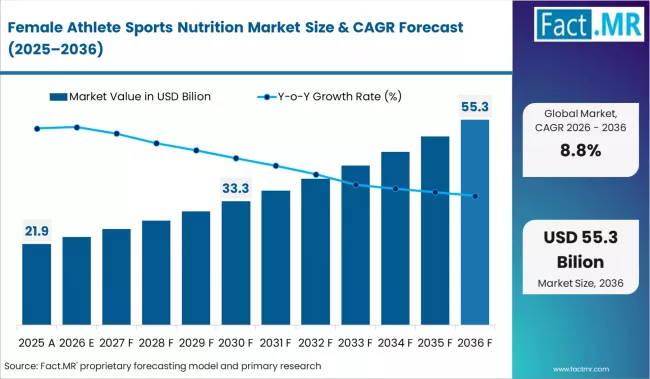
Female Athlete Sports Nutrition Market Market Value Analysis | Source: Fact.MR
Summary of the Female Athlete Sports Nutrition Market
- Market Definition
- The market includes nutrition products formulated to support endurance, strength, hydration, recovery, and micronutrient balance requirements among women participating in professional, amateur, and recreational sports activities. These products include protein powders, functional beverages, amino acid supplements, nutrition bars, collagen formulations, and performance snacks designed to address physiological factors such as energy metabolism, muscle repair, bone health, and electrolyte balance across athletic training environments.
- Demand Drivers
- Increasing participation of women in endurance sports, strength training programs, and competitive athletics
- Rising demand for targeted micronutrient formulations addressing iron balance, bone density, and hormonal considerations
- Expansion of digital retail channels supporting access to specialized sports nutrition products formulated for female physiology
- Growing availability of plant-based protein blends and functional ingredients aligned with performance nutrition requirements
- Key Segments Analyzed
- Form: Powder formulations account for approximately 38% share supported by dosage flexibility and formulation adaptability
- Distribution Channel: Online retail represents nearly 39% share supported by direct-to-consumer brand positioning and product portfolio accessibility
- Product Type: Protein supplements and functional sports beverages demonstrate consistent adoption across endurance and recovery nutrition applications
- Geography: Europe demonstrates steady demand supported by structured sports participation and targeted nutrition product availability
- Analyst Opinion at Fact MR
- Shambhu Nath Jha, Principal Consultant, Fact MR, opines, "In this updated edition of the Female Athlete Sports Nutrition Market report, industry participants will observe sustained expansion driven by targeted formulation strategies addressing performance nutrition requirements specific to female physiology. Manufacturers continue to refine ingredient composition to support endurance, muscle recovery, and micronutrient balance. Companies that invest in formulation transparency, ingredient validation, and distribution efficiency are expected to maintain competitive positioning through 2036."
- Strategic Implications Executive Takeaways
- Develop specialized formulations addressing iron intake, bone health nutrients, and amino acid balance aligned with female athlete nutrition requirements
- Expand digital retail distribution strategies enabling direct engagement with targeted consumer segments across performance nutrition categories
- Strengthen product portfolio diversification across protein powders, functional beverages, and recovery supplements supporting endurance and strength training needs
- Monitor regulatory guidelines influencing nutrition labeling and functional ingredient claims across sports supplement categories
- Methodology
- Primary interviews conducted with sports nutrition manufacturers, dietitians, fitness professionals, and retail distributors
- Desk research based on sports nutrition publications, regulatory documentation, product formulation studies, and athletic participation datasets
- Market sizing developed using hybrid top-down assessment of sports nutrition demand combined with bottom-up analysis of female-specific product adoption trends
- Data validation performed through cross comparison of product launch activity, distribution channel performance, and expert review aligned with Fact MR analytical standards
Female Athlete Sports Nutrition Market
| Metric | Details |
|---|---|
| Industry Size (2026E) | USD 23.8 billion |
| Industry Value (2036F) | USD 55.4 billion |
| CAGR (2026 to 2036) | 8.8% |
Source: Fact.MR analysis. Updated Mar 31, 2026
The United Kingdom leads with a projected CAGR of 9.6%, supported by expanding participation of women in endurance sports and increasing demand for gender-specific nutrition formulations. Germany follows with a CAGR of 9.1%, driven by rising adoption of performance nutrition products addressing micronutrient balance and recovery requirements. The United States records a CAGR of 8.7%, reflecting steady demand for protein supplements and functional beverages targeting female fitness segments. France shows a CAGR of 8.4%, supported by gradual expansion of specialized sports nutrition product portfolios across organized retail channels. Japan records the slowest growth at 7.9%, reflecting a mature market where demand is largely tied to replacement consumption cycles within established performance nutrition categories. Mature markets generate a significant share of replacement demand as product differentiation remains focused on formulation adjustments addressing endurance performance, recovery optimization, and micronutrient intake across female athlete nutrition applications.
Segmental Analysis
Female Athlete Sports Nutrition Market Analysis by Distribution Channel
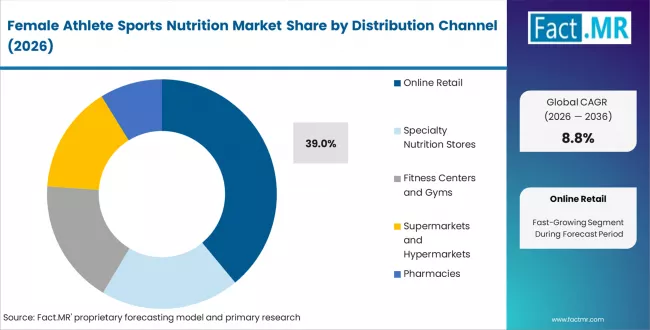
Female Athlete Sports Nutrition Market Analysis By Distribution Channel | Source: Fact.MR
- Market Overview: Based on Fact MR assessment, online retail is projected to account for 39% share of the female athlete sports nutrition market in 2026. Digital commerce platforms are utilized for distribution of protein supplements, hydration formulations, micronutrient blends, and recovery nutrition products formulated to address physiological requirements associated with female athletic performance. Online platforms support direct brand communication of formulation attributes related to iron balance, electrolyte replenishment, amino acid intake, and energy metabolism support. Product assortment expansion across condition-specific nutrition categories is supported by digital shelf architecture enabling targeted product discovery across endurance, strength training, and recovery nutrition segments.
- Demand Drivers:
- Product Discovery Accessibility: Online retail environments support comparison of ingredient composition, dosage formats, and nutrition claims aligned with performance nutrition requirements.
- Direct to Consumer Distribution Structure: Manufacturers utilize digital sales channels to communicate formulation characteristics associated with hydration balance, muscle recovery, and endurance nutrition intake.
- Portfolio Expansion Visibility: Online platforms enable display of specialized sports nutrition variants formulated to address physiological nutrient intake requirements across female athletic population segments.
Female Athlete Sports Nutrition Market Analysis by Form
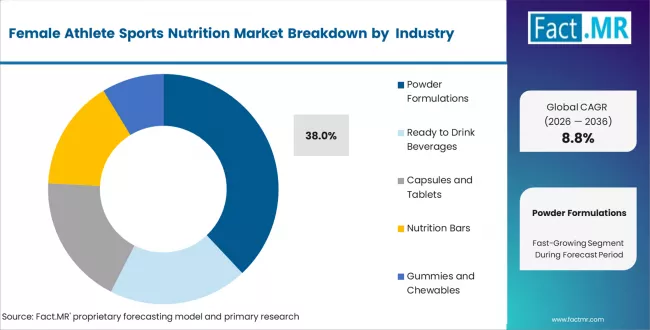
Female Athlete Sports Nutrition Market Analysis By Form | Source: Fact.MR
- Market Overview: Powder formulations are estimated to hold 38% share of the female athlete sports nutrition market in 2026, supported by compatibility with protein blending, electrolyte fortification, and micronutrient integration across performance nutrition products. Powder dosage formats enable controlled measurement of protein intake, branched chain amino acid concentration, and mineral composition aligned with athletic training nutrition planning. Solubility characteristics support rapid dispersion across hydration beverages and recovery shakes formulated to support muscle repair and metabolic energy balance requirements associated with athletic activity.
- Demand Drivers:
- Dosage Control Requirements: Powder formulations support precise measurement of macronutrient intake aligned with individualized nutrition protocols used across athletic training programs.
- Formulation Flexibility: Powder blends enable incorporation of protein isolates, vitamin complexes, and electrolyte minerals across performance nutrition product development pipelines.
- Storage Stability Characteristics: Low moisture content supports extended shelf stability across packaged sports nutrition products distributed through multi-region supply networks.
Key Dynamics
Female Athlete Sports Nutrition Market Drivers, Restraints, and Opportunities
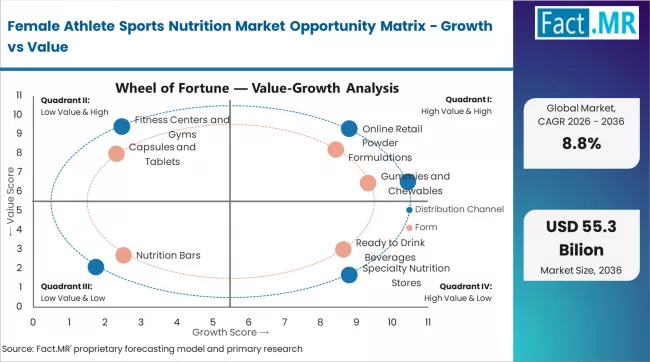
Female Athlete Sports Nutrition Market Opportunity Matrix Growth Vs Value | Source: Fact.MR
FMR analysts observe that the female athlete sports nutrition market developed as sports nutrition products historically formulated for general athletic populations began to incorporate gender-specific physiological considerations. Early sports nutrition products focused on protein supplementation and energy support without differentiation for hormonal variation or micronutrient requirements specific to female athletes. The current market valuation reflects increased formulation of products addressing iron balance, bone health, hydration needs, and recovery support associated with female physiology. Demand persists because female athletes require nutritional products aligned with endurance performance, muscle recovery, and metabolic support requirements.
A structural shift is occurring as conventional unisex sports nutrition products face competition from specialized formulations designed for female athletic performance and recovery. Traditional protein powders and performance supplements remain widely used across general fitness populations where broad nutritional formulations remain sufficient. Female-specific sports nutrition products incorporate micronutrient blends, plant-based protein options, and targeted functional ingredients designed to address physiological variability and training intensity patterns. These formulations involve higher research, formulation, and ingredient sourcing costs relative to standard sports supplements. Even with moderate market penetration, higher pricing associated with targeted sports nutrition supports gradual market value expansion.
- Targeted Nutrient Formulation: Manufacturers develop sports nutrition products incorporating iron, calcium, vitamin D, and protein blends designed for female athletic performance and recovery requirements.
- Nutrition Label Regulation: Standards such as U.S. Food and Drug Administration dietary supplement labeling regulations and European Food Safety Authority nutrition claim guidelines influence ingredient disclosure and health-related claims.
- North America Fitness Market: The United States maintains strong demand for specialized sports nutrition products supported by organized fitness industry infrastructure and sports participation rates.
Regional Analysis
The Female Athlete Sports Nutrition Market is assessed across North America, Europe, Asia Pacific, Latin America, and Middle East & Africa, segmented by country-level demand for performance nutrition, gender-specific formulations, and active lifestyle dietary products. Regional demand reflects sports participation rates, targeted supplementation trends, and specialized product innovation. The full report offers market attractiveness analysis.
.webp "Top Country Growth Comparison Female Athlete Sports Nutrition Market Cagr (2026 2036)")
Top Country Growth Comparison Female Athlete Sports Nutrition Market Cagr (2026 2036) | Source: Fact.MR
| Country | CAGR (2026-2036) |
|---|---|
| United Kingdom | 9.6% |
| Germany | 9.1% |
| United States | 8.7% |
| France | 8.4% |
| Japan | 7.9% |
Source: Fact.MR analysis. Updated Mar 31, 2026
Source: Fact MR analysis, based on proprietary forecasting model and primary research
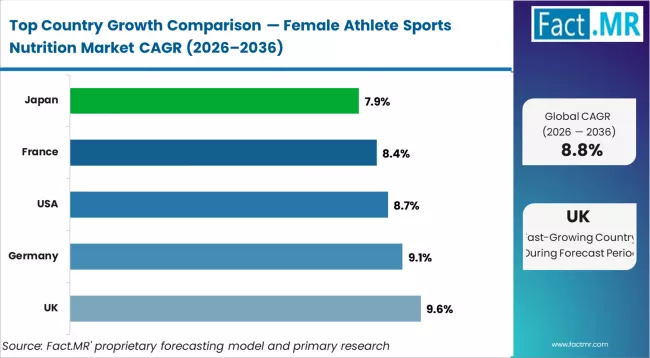
Female Athlete Sports Nutrition Market Cagr Analysis By Country | Source: Fact.MR
Europe
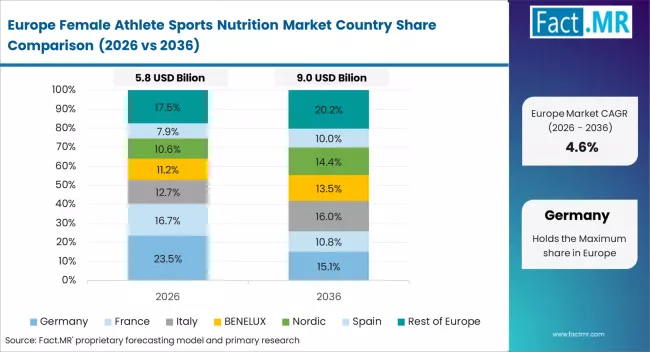
Female Athlete Sports Nutrition Market Europe Country Market Share Analysis, 2026 & 2036 | Source: Fact.MR
Europe functions as the performance nutrition formulation and gender-specific product innovation laboratory, supported by structured sports science research and specialized dietary product development. Glanbia plc strengthens performance nutrition ingredient supply. Nestlé Health Science expands sports nutrition product portfolio. Myprotein (The Hut Group) supports gender-targeted supplement product lines.
- United Kingdom: Demand for female athlete sports nutrition in United Kingdom is projected to rise at 9.6% CAGR through 2036. The UK Sport Active Lives Survey update (Sport England, 2022) supports increased female sports participation. Myprotein (The Hut Group) expanded women-focused nutrition product offerings (March 2023), supporting market growth.
- Germany: Demand for female athlete sports nutrition in Germany is projected to rise at 9.1% CAGR through 2036. The German National Action Plan for Physical Activity update (Federal Ministry of Health, 2021) supports sports participation initiatives. Glanbia plc expanded specialized sports nutrition ingredient distribution (February 2023), supporting adoption.
- France: Demand for female athlete sports nutrition in France is projected to rise at 8.4% CAGR through 2036. The National Sport Strategy update (Ministry of Sports, 2022) supports increased female athletic participation. Nestlé Health Science expanded performance nutrition product lines (January 2023), supporting demand.
North America
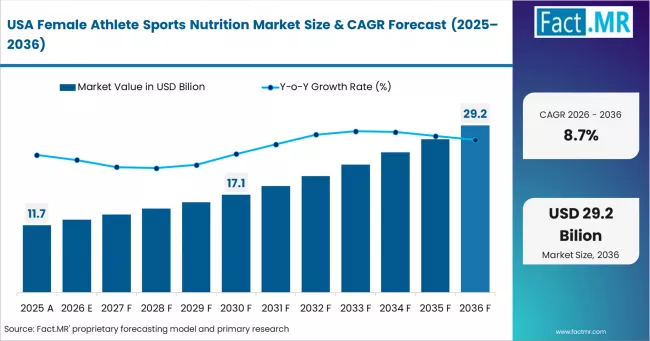
Female Athlete Sports Nutrition Market Country Value Analysis | Source: Fact.MR
North America functions as the high-performance sports nutrition and targeted supplement innovation hub, supported by strong fitness industry growth and gender-specific product positioning. Herbalife Nutrition Ltd. strengthens sports performance supplement offerings. Abbott Laboratories supports specialized performance nutrition solutions. PepsiCo, Inc. expands functional sports nutrition product lines.
- United States: Demand for female athlete sports nutrition in United States is projected to rise at 8.7% CAGR through 2036. The Physical Activity Guidelines for Americans update (U.S. Department of Health and Human Services, 2018 revision in use) supports sports participation awareness. Abbott Laboratories expanded performance nutrition product offerings (April 2023), supporting market expansion.
Asia Pacific
Asia Pacific serves as the emerging female sports participation and performance nutrition adoption market, supported by expanding fitness awareness and product availability. Yakult Honsha Co., Ltd. supports functional beverage development. Ajinomoto Co., Inc. expands amino acid-based sports nutrition solutions. Otsuka Holdings Co., Ltd. strengthens electrolyte and recovery nutrition product offerings.
- Japan: Demand for female athlete sports nutrition in Japan is projected to rise at 7.9% CAGR through 2036. The Sport Basic Plan update (Japan Sports Agency, 2022) supports increased female athletic participation. Ajinomoto Co., Inc. expanded amino acid-based sports nutrition products (May 2023), supporting market development.
Fact MR's analysis of female athlete sports nutrition market in global regions consists of country-wise assessment that includes United Kingdom, Germany, United States, France, and Japan. Readers can find sports nutrition trends, gender-specific formulation developments, participation growth patterns, and competitive positioning across key markets.
Competitive Landscape
Competitive Structure and Buyer Dynamics in the Female Athlete Sports Nutrition Market
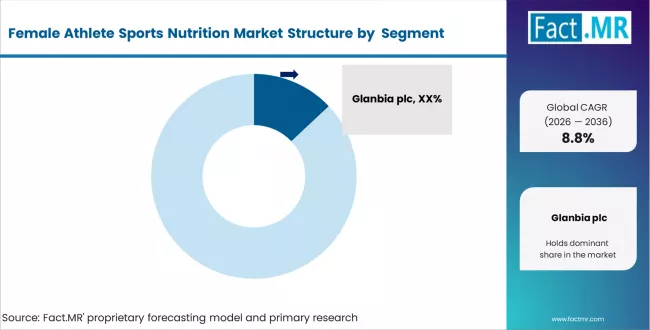
Female Athlete Sports Nutrition Market Analysis By Company | Source: Fact.MR
The competitive structure of the Female Athlete Sports Nutrition Market is moderately fragmented, with global nutrition companies and performance supplement brands competing across protein, hydration, and functional nutrition categories. Companies such as Glanbia plc, Abbott Laboratories, Nestle Health Science, Danone SA, and PepsiCo Inc. maintain strong positions through established sports nutrition portfolios and broad retail distribution networks. These firms offer protein powders, ready to drink beverages, and micronutrient fortified products designed to support endurance, recovery, and muscle maintenance. Additional participants including Herbalife Ltd, The Hut Group, NOW Health Group Inc, Transparent Labs, and Nutrabolt LLC contribute through specialized formulations targeting performance nutrition requirements. Competition is primarily influenced by ingredient efficacy, formulation transparency, brand credibility, and product positioning aligned with fitness and athletic performance needs.
Several companies maintain structural advantages through integrated ingredient sourcing and established brand recognition in sports nutrition categories. Firms such as Glanbia plc and Abbott Laboratories benefit from extensive research capabilities and global supply infrastructure supporting consistent product availability. Nestle Health Science and Danone SA maintain advantages through clinical nutrition expertise and established consumer trust. Companies such as The Hut Group leverage direct to consumer distribution platforms that support global market reach. Retailers and online channels typically offer multiple sports nutrition brands to reduce dependence on a single supplier and respond to evolving consumer preferences. Procurement decisions evaluate suppliers based on formulation quality, product consistency, and brand demand patterns. This purchasing behavior moderates supplier pricing leverage, while brands with strong recognition and validated formulations retain moderate negotiating influence.
Key Players of the Female Athlete Sports Nutrition Market
- Glanbia plc
- Abbott Laboratories
- Nestle Health Science
- Danone SA
- Herbalife Ltd
- PepsiCo Inc
- The Hut Group (Myprotein)
- NOW Health Group Inc
- Transparent Labs
- Nutrabolt LLC
Bibliographies
- [1] CONVERT Collaborators. (2018). Nutrition for the female athlete. Journal of the International Society of Sports Nutrition, 15(1), 13.
- [2] Burke, L. M., Close, G. L., Lundy, B., et al. (2023). International Olympic Committee consensus statement on sports nutrition 2023: Female athlete considerations. British Journal of Sports Medicine, 57(10), 621–633.
- [3] Mountjoy, M., Sundgot-Borgen, J., Burke, L., et al. (2014). The International Olympic Committee consensus statement on relative energy deficiency in sport (RED-S). British Journal of Sports Medicine, 48(7), 491–501.
- [4] American College of Sports Medicine, American Dietetic Association, Dietitians of Canada. (2016). ACSM/ACSM-ADA/DC joint position statement: Nutrition and athletic performance. Medicine and Science in Sports and Exercise, 48(3), 543–568.
- [5] Sport England. (2022). Active Lives: Adult survey – 2022 publication (including gender participation data). Sport England.
This Report Addresses
- Market size estimation and revenue forecasts for the Female Athlete Sports Nutrition Market from 2026 to 2036, supported by sports participation trends and demand benchmarks across performance nutrition categories targeting female physiology.
- Growth opportunity mapping across protein supplements, functional sports beverages, energy bars and performance snacks, amino acids and BCAAs, pre-workout formulations, and collagen and recovery supplements aligned with endurance, recovery, and strength training nutrition requirements.
- Segment and regional revenue forecasts covering product forms, distribution channels, and major demand markets including United Kingdom, Germany, United States, France, and Japan.
- Competition strategy assessment of major companies such as Glanbia plc, Abbott Laboratories, Nestlé Health Science, Danone SA, and PepsiCo Inc, including formulation capability benchmarking and distribution network positioning analysis across performance nutrition categories.
- Regulatory impact analysis covering U.S. Food and Drug Administration dietary supplement labeling standards, European Food Safety Authority nutrition claim frameworks, and sports nutrition compliance guidelines influencing formulation and marketing practices.
- Market report delivery in PDF, Excel, PPT, and interactive dashboard formats designed for sports nutrition portfolio evaluation, formulation strategy development, and retail channel benchmarking.
- Supply chain vulnerability assessments examining ingredient sourcing variability, protein isolate cost fluctuations, micronutrient stability requirements, regulatory claim verification complexity, and substitution overlap with general sports supplements influencing market expansion trajectory.
Female Athlete Sports Nutrition Market Definition
Female Athlete Sports Nutrition Market Definition Paragraph
The Female Athlete Sports Nutrition Market includes nutritional products formulated to support energy, endurance, muscle recovery, hydration, and micronutrient balance for women engaged in professional, amateur, and recreational sports activities, including powders, bars, drinks, supplements, and functional foods tailored to female physiology.
Female Athlete Sports Nutrition Market Inclusions
The report includes global and regional market size estimates, forecast analysis, and segmentation by product type, ingredient profile, sport category, distribution channel, end user group, pricing structure, and consumption patterns.
Female Athlete Sports Nutrition Market Exclusions
The scope excludes general dietary supplements not positioned for athletic performance, medical nutrition products, weight management products without sports application, and conventional packaged foods lacking sports nutrition formulation.
Female Athlete Sports Nutrition Market Research Methodology
- Primary Research
- Interviews were conducted with sports nutrition manufacturers, athletes, fitness trainers, dietitians, sports associations, and retail distributors.
- Desk Research
- Public sources included sports nutrition publications, company product documentation, regulatory guidelines, and industry reports on athlete dietary requirements.
- Market-Sizing and Forecasting
- A hybrid model combining top-down sports nutrition industry assessment and bottom-up analysis of female specific product adoption was applied.
- Data Validation and Update Cycle
- Outputs were validated through expert review, cross source comparison, and periodic tracking of product launches and participation trends in women sports.
Segmentation
Report Scope
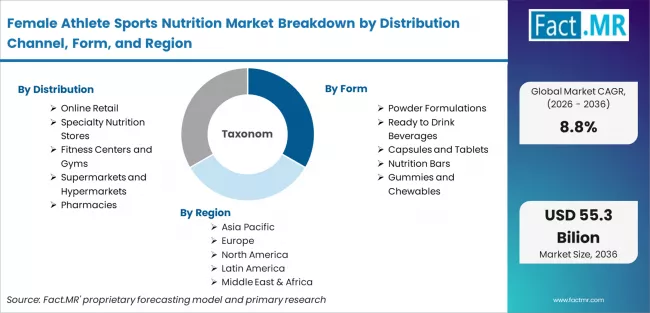
Female Athlete Sports Nutrition Market Breakdown By Distribution Channel, Form, And Region | Source: Fact.MR
| Metric | Value |
|---|---|
| Quantitative Units | USD 23.8 billion (2026) to USD 55.4 billion (2036), at a CAGR of 8.8% |
| Market Definition | The female athlete sports nutrition market includes dietary supplements and functional nutrition products formulated to support performance, endurance, recovery, hormonal balance, and muscle maintenance requirements specific to female physiology across professional and recreational fitness activities. |
| Product Type Segmentation | Protein supplements, Functional sports beverages, Energy bars and performance snacks, Amino acids and BCAAs, Pre-workout formulations, Collagen and recovery supplements |
| Form Segmentation | Powder formulations, Ready to drink beverages, Capsules and tablets, Nutrition bars, Gummies and chewables |
| Distribution Channel Segmentation | Online retail, Specialty nutrition stores, Fitness centers and gyms, Supermarkets and hypermarkets, Pharmacies |
| Regions Covered | North America, Latin America, Europe, East Asia, South Asia, Oceania, Middle East and Africa |
| Countries Covered | United States, Canada, Mexico, Brazil, Argentina, Germany, France, United Kingdom, Italy, Spain, China, India, Japan, South Korea, Australia, New Zealand, United Arab Emirates, South Africa, and 40+ countries |
| Key Companies Profiled | Glanbia plc, Abbott Laboratories, Nestle Health Science, Danone SA, Herbalife Ltd, PepsiCo Inc, The Hut Group (Myprotein), NOW Health Group Inc, Transparent Labs, Nutrabolt LLC |
| Forecast Period | 2026 to 2036 |
| Approach | Hybrid top-down and bottom-up market estimation based on sports participation trends among female consumers, supplement consumption benchmarking, product formulation innovation tracking, retail sales channel analysis, and validation through primary interviews with sports nutrition manufacturers, fitness professionals, and ingredient suppliers. |
Source: Fact.MR analysis. Updated Mar 31, 2026
Female Athlete Sports Nutrition Market Key Segments
-
Product Type :
- Protein Supplements
- Functional Sports Beverages
- Energy Bars and Performance Snacks
- Amino Acids and BCAAs
- Pre Workout Formulations
- Collagen and Recovery Supplements
-
Form :
- Powder Formulations
- Ready to Drink Beverages
- Capsules and Tablets
- Nutrition Bars
- Gummies and Chewables
-
Distribution Channel :
- Online Retail
- Specialty Nutrition Stores
- Fitness Centers and Gyms
- Supermarkets and Hypermarkets
- Pharmacies
-
Region :
- North America
- USA
- Canada
- Mexico
- Europe
- Germany
- UK
- France
- Italy
- Spain
- Nordic Countries
- BENELUX
- Rest of Europe
- Asia Pacific
- China
- Japan
- South Korea
- India
- Australia
- Rest of Asia Pacific
- Latin America
- Brazil
- Argentina
- Rest of Latin America
- Middle East and Africa
- Kingdom of Saudi Arabia
- United Arab Emirates
- South Africa
- Rest of Middle East and Africa
- Other Regions
- Oceania
- Central Asia
- Other Markets
- North America
Frequently Asked Questions
How large is the demand for Female Athlete Sports Nutrition in the global market in 2026?
What will be the market size of the Female Athlete Sports Nutrition market by 2036?
What is the expected demand growth for the Female Athlete Sports Nutrition market between 2026 and 2036?
Which company is identified as a leading participant in the Female Athlete Sports Nutrition market?
Which distribution channel is projected to dominate Female Athlete Sports Nutrition sales by 2026?
Why is online retail an important distribution channel for female athlete sports nutrition products?
What is driving demand for Female Athlete Sports Nutrition products in the United Kingdom?
What is the growth outlook for the Female Athlete Sports Nutrition market in the United Kingdom?
Why is Germany an important market for female athlete sports nutrition products?
What is the growth outlook for the Female Athlete Sports Nutrition market in Germany?
How is demand for Female Athlete Sports Nutrition evolving in the United States?
What is the growth outlook for the Female Athlete Sports Nutrition market in the United States?
What is the growth outlook for the Female Athlete Sports Nutrition market in France?
How is Japan positioned in the Female Athlete Sports Nutrition market?
What is the growth outlook for the Female Athlete Sports Nutrition market in Japan?
What is female athlete sports nutrition and what is it mainly used for?
What does the Female Athlete Sports Nutrition market include in this report?
What applications are included in the scope of the Female Athlete Sports Nutrition market?
What is excluded from the scope of the Female Athlete Sports Nutrition market report?
What does market forecast mean in the Female Athlete Sports Nutrition market report?
How is the Female Athlete Sports Nutrition market forecast developed in this report?
What does primary validation indicate in the Female Athlete Sports Nutrition market analysis?
Who worked on this report


Preview the report firsthand - request a free sample
Free SampleGet the brochure for pricing and purchase details
Download PDF