- Market Value (2025): USD 347.1 Mn
- Estimated Value (2026): USD 420.0 Mn
- Forecast Value (2036): USD 2826.0 Mn
- CAGR (2026-2036): 21.0%
What is the Fermented Yeast Proteins Market forecast to be worth by 2036?
USD 420.0 million in 2026 to USD 2,826.0 million by 2036 at a 21.0% CAGR.
- The fermented yeast proteins market reached USD 347.1 million in 2025.
- Demand is projected to increase from USD 420.0 million in 2026 to USD 2,826.0 million by 2036.
- The market is forecast to record 21.0% CAGR from 2026 to 2036 as bakery manufacturers, meat alternative brands and nutrition formulators qualify yeast-derived proteins.
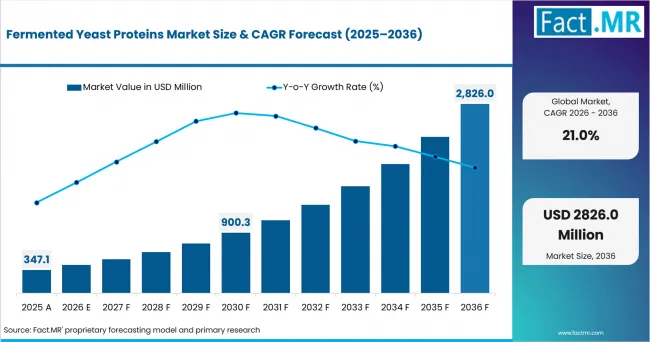
Fermented Yeast Proteins Market Value Analysis | Source: Fact.MR
What are the defining numbers behind Fermented Yeast Proteins Market growth?
USD 2,406.0 million absolute opportunity by 2036, led by Isolates, Powder and meat alternative applications.
- Demand Drivers in the Market
- Bakery manufacturers need protein enrichment that protects dough handling. Lesaffre reported in November 2025 that yeast-based proteins were evaluated at 8%, 10% and 12% in white bread formulations.
- Food safety teams need clear approval routes for fermented protein. FDA closed GRN 1248 on September 23, 2025 with a ‘no questions’ letter for yeast biomass produced by Kluyveromyces marxianus CCTCC M 20211265, intended as an ingredient and source of protein in specified food categories at category-specific maximum use levels of up to 20%.
- Nutrition brands need repeatable amino acid and digestibility profiles so powder blends can carry protein claims across snacks, drinks and meal replacements.
- Alternative-protein formulators need savory protein inputs that work with plant matrices and reduce the taste burden linked to pulse concentrates.
- Key Segments Analyzed
- By Ingredient Type: Isolates are expected to hold 44.0% share in 2026 because purified fractions raise protein loading with less flavor drift.
- By Production Route: Precision fermentation is projected to account for 38.0% share in 2026 owing to controlled strain performance and consistent protein quality.
- By Function: Nutrition is anticipated to capture 34.0% share in 2026 since protein fortification gives brands a clear benefit to communicate.
- By Application: Meat alternatives are estimated to represent 38.0% share in 2026 due to the need for savory protein systems that complement plant bases.
- By Form: Powder is forecast to hold 53.0% share in 2026 while dry handling supports storage, blending and shipment efficiency.
- Analyst Opinion at Fact.MR
- Shambhu Nath Jha, Principal Consultant at Fact.MR, states, “Fermented yeast proteins are drawing attention because they separate protein nutrition from the flavor limits of several plant inputs. The market is expected to gain from bakery fortification, meat alternative reformulation and precision fermentation capacity. Suppliers should combine strain knowledge, food safety dossiers and customer recipe support.”
- Strategic Implications
- Ingredient suppliers should publish protein content, amino acid profile and sensory data for each grade before approaching food brands.
- Regulatory teams should map strain identity, process control and HACCP expectations early. The UK Food Standards Agency published precision fermentation safety guidance in February 2026 for products made with microbes such as yeast.
- Alternative-protein brands should test yeast proteins in blended systems where dosage, flavor masking and texture goals differ by recipe.
- Bakery manufacturers should validate loaf volume, crumb softness and label claims together so formulation trials move through approval faster.
Japan is projected to post 24.1% CAGR through 2036 because export-focused food innovation supports differentiated protein inputs. Germany is estimated to advance at 18.6% CAGR due to large processed-food output and ingredient qualification depth. The USA is forecast to record 18.3% CAGR owing to broad food spending and GRAS review activity. The UK is anticipated to reach 16.2% CAGR with precision fermentation guidance and food manufacturing demand. South Korea is expected to hold 14.8% CAGR as K-food exports support reformulation activity.
How does the Fermented Yeast Proteins Market break down by segment?
Isolates lead Ingredient Type at 44.0%; Powder leads Form at 53.0%.
Which Ingredient Type dominates?
Isolates are expected to hold 44.0% share in 2026.
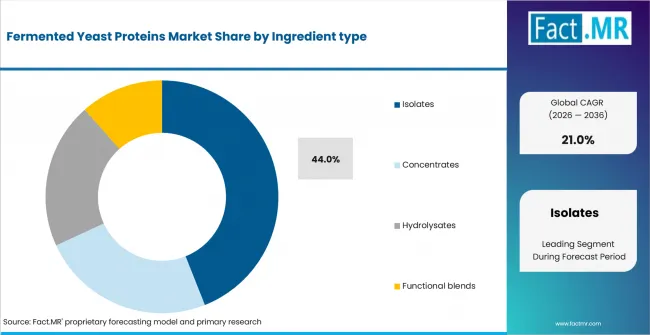
Fermented Yeast Proteins Market Analysis By Ingredient Type | Source: Fact.MR
Isolates lead because they give formulators a cleaner route to protein density. A purified ingredient can be blended into meat alternatives, protein bakery and beverage powders with lower color and bitterness exposure. These grades are easier to qualify when labels need a visible protein claim.
What leads the Production Route segment?
Precision fermentation is projected to account for 38.0% share in 2026.
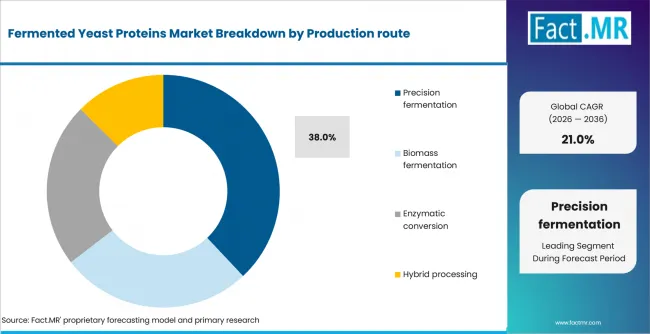
Fermented Yeast Proteins Market Analysis By Production Route | Source: Fact.MR
Precision fermentation leads where strain control and batch consistency are central to customer approval. Food developers can ask for tighter specifications on protein fraction, taste and nutrition before scaling a product line. Formal safety planning remains central where fermentation-derived proteins enter multiple food formats.
How does Function shape demand?
Nutrition is anticipated to capture 34.0% share in 2026.
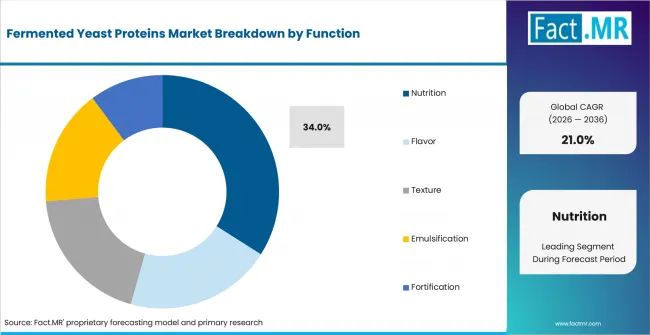
Fermented Yeast Proteins Market Analysis By Function | Source: Fact.MR
Nutrition leads because protein claims are easiest to communicate in retail and foodservice channels. Yeast proteins support fortification in formats where dairy or soy creates label complexity for food brands. The function also works across powders, bakery and prepared foods.
What supports meat alternatives within Application?
Meat alternatives are estimated to represent 38.0% share in 2026.
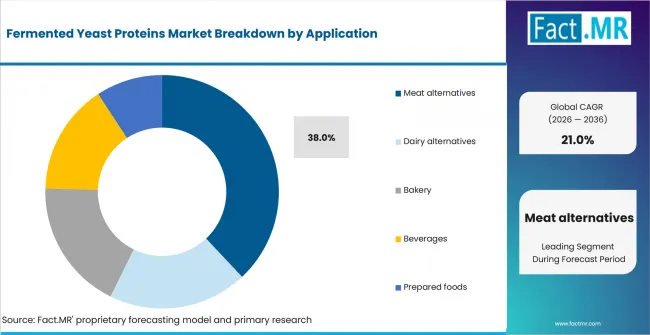
Fermented Yeast Proteins Market Analysis By Application | Source: Fact.MR
Meat alternatives use yeast proteins where product developers need protein density and savory balance in the same recipe. Yeast inputs can complement textured plant proteins by adding nutrition and mild umami support. This route helps brands improve protein content while keeping the base formulation familiar.
Which Form leads commercial use?
Powder is forecast to hold 53.0% share in 2026.
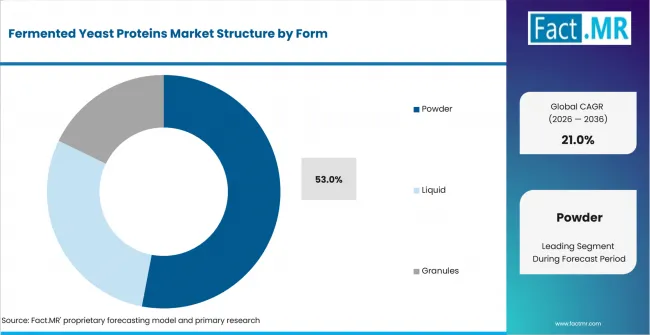
Fermented Yeast Proteins Market Analysis By Form | Source: Fact.MR
Powder leads because dry ingredient handling fits existing blending, storage and shipping systems. Lower water activity also helps contract manufacturers manage shelf life and batch control. Ohly opened a new spray drying tower in Hamburg in January 2026, reinforcing the role of dry yeast specialties in supplier portfolios.
What is accelerating Fermented Yeast Proteins Market adoption, and what is holding it back?
Demand is expected to rise through protein fortification, precision fermentation and meat alternative reformulation. Growth is constrained by regulatory dossiers, taste control and price competition.
Drivers Impact Analysis
| DRIVER | (~) % IMPACT ON CAGR | GEOGRAPHIC RELEVANCE | IMPACT TIMELINE |
|---|---|---|---|
| Protein-density needs in alternative foods | +2.4% | Global | Short term (<= 2 years) |
| Precision-fermentation capacity and safety review | +1.8% | USA, UK, East Asia | Medium term (2-4 years) |
| Bakery and fortification reformulation | +1.2% | North America, Europe | Medium term (2-4 years) |
| Shelf-stable powder handling | +0.8% | Global | Long term (>= 4 years) |
- Protein-density needs in alternative foods: Product developers are looking for concentrated inputs that can raise protein levels without adding strong pulse flavors.
- Precision-fermentation capacity and safety review: Fermentation suppliers can scale protein production when dossiers and strain documentation align with food safety expectations.
- Bakery and fortification reformulation: Yeast proteins fit bakery trials where brands want higher protein content with familiar process equipment.
Opportunity Impact Analysis
| OPPORTUNITY | (~) % IMPACT ON CAGR | GEOGRAPHIC RELEVANCE | IMPACT TIMELINE |
|---|---|---|---|
| Yeast isolate blends for meat and dairy alternatives | +1.5% | USA, UK, Germany | Medium term (2-4 years) |
| Powdered nutrition formats for sports and everyday foods | +1.1% | USA, Japan, South Korea | Medium term (2-4 years) |
| Co-development with bakery manufacturers | +0.9% | Europe, North America | Short term (<= 2 years) |
- Yeast isolate blends for meat and dairy alternatives: Ingredient suppliers can pair neutral protein fractions with flavor and texture systems for faster customer trials.
- Powdered nutrition formats: Powder grades support drink mixes, bars and fortified foods where low moisture and consistent dosing simplify manufacturing.
- Co-development with bakery manufacturers: Joint trials can shorten approval time by testing protein content, loaf quality and label claims in one cycle.
Restraints Impact Analysis
| RESTRAINT | (~) % IMPACT ON CAGR | GEOGRAPHIC RELEVANCE | IMPACT TIMELINE |
|---|---|---|---|
| Novel food and GRAS documentation burden | -0.7% | USA, UK, Europe | Short term (<= 2 years) |
| Taste and color management in high-dosage recipes | -0.5% | Global | Medium term (2-4 years) |
| Price competition from pea, soy and whey proteins | -0.4% | Global | Long term (>= 4 years) |
- Novel food and GRAS documentation burden: Fermented proteins require strain, process and exposure data before many customers approve wide food use.
- Taste and color management in high-dosage recipes: Yeast-derived notes can limit dosage when recipes need a neutral sensory profile.
- Price competition from pea, soy and whey proteins: Established proteins are often cheaper so yeast proteins need a clear performance or label advantage.
Which countries are scaling the Fermented Yeast Proteins Market through 2036?
- The country comparison spans 9.3 percentage points between Japan and South Korea across the forecast period.
- Japan remains 5.5 percentage points above Germany as export-facing food manufacturers test higher-value protein formats.
- Germany remains 0.3 percentage point above the USA through a large processed-food base and documented ingredient evaluation.
- The USA remains 2.1 percentage points above the UK as food spending and GRAS review pathways support earlier commercial trials.
- The UK remains 1.4 percentage points above South Korea through precision fermentation guidance and public innovation funding.
- South Korea closes the displayed range through K-food exports and local food production scale.
Comparable CAGRs create different entry conditions because food safety review, sensory needs and manufacturing access vary by country. Full report coverage includes North America, Latin America, Western Europe, Eastern Europe, East Asia, South Asia & Pacific, Middle East & Africa.
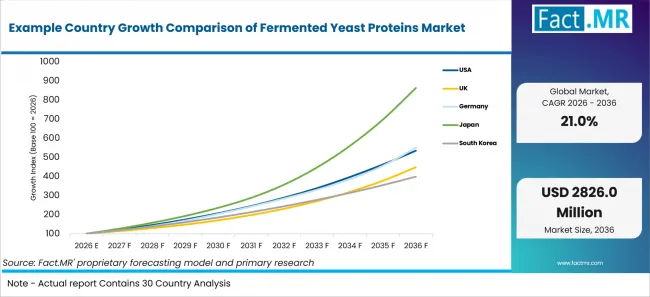
Example Country Growth Comparison Of Fermented Yeast Proteins Market | Source: Fact.MR
| Country | CAGR (2026-2036) |
|---|---|
| Japan | 24.1% |
| Germany | 18.6% |
| USA | 18.3% |
| UK | 16.2% |
| South Korea | 14.8% |
What supports Japan adoption?
24.1% CAGR, supported by export-oriented food innovation and premium nutrition reformulation.
Japanese food exporters evaluate protein ingredients through quality, label fit and export readiness before approving new recipes. In February 2026, MAFF reported 2025 agricultural, forestry, fishery and food exports of JPY 1.7005 trillion, up 12.8% from the prior year. Fermented yeast proteins fit premium bakery and beverage formats where protein enrichment needs a cleaner taste profile than several plant inputs.
What supports Germany adoption?
18.6% CAGR, backed by food-processing scale and specialty ingredient qualification.
Germany offers a deep customer base for fermented yeast proteins because its food-processing sector uses specialty ingredients across bakery, prepared foods and meat alternative recipes. A March 2026 USDA FAS report placed Germany’s 2024 processed food and beverage output at USD 270.1 billion. That manufacturing base gives yeast protein suppliers a route into disciplined procurement systems where application data and traceability guide supplier selection.
How is the USA scaling demand?
18.3% CAGR, driven by food spending and GRAS-backed ingredient review.
U.S. brands have a large commercial route for yeast protein because food, beverage and nutrition categories support frequent formulation trials. USDA ERS reported in June 2026 that U.S. food spending reached USD 2.51 trillion in 2025. FDA activity around yeast biomass protein also gives ingredient teams a clearer safety-review reference for baked goods, beverages, snacks and plant protein products.
What supports the UK’s growth?
16.2% CAGR, supported by precision fermentation guidance and food-manufacturing demand.
The UK combines a meaningful food manufacturing base with clearer regulatory guidance for fermentation-derived ingredients. ONS reported in July 2026 that food manufacturing represented 22.9% of total UK manufacturers’ product sales in 2025. That demand base supports yeast protein trials in bakery, meat alternatives and fortified foods where applicants prepare safety and composition data early.
How is South Korea developing demand?
14.8% CAGR, led by K-food exports and domestic reformulation activity.
South Korea’s export-facing food brands create a route for yeast protein where nutrition, shelf stability and label clarity help packaged foods travel well. MAFRA reported in January 2026 that K-Food Plus exports reached USD 13.6 billion in 2025, up 5.1% year over year. Local formulators are expected to prefer powders because dry blending fits snacks, bakery mixes and nutrition products.
Who leads the Fermented Yeast Proteins Market?
Lesaffre leads with a wide yeast and fermentation portfolio, including Biospringer yeast-derived protein work and bakery application testing. Angel Yeast Co., Ltd. is active through AngeoPro yeast protein and commercial yeast protein capacity. Lallemand Inc. participates through yeast-based ingredients for fortified foods, including Engevita HiPRO Beyond for high-protein formulations.
Ohly supports the market through yeast-based ingredients, bionutrients and dry specialty production. Leiber GmbH broadens the field through dried yeast, yeast extract and yeast-cell-wall food ingredients. Competition is expected to center on sensory performance, food safety documentation and proof that yeast proteins work at commercial dosage levels.
Which companies are profiled in the competitive landscape?
Key companies include Lesaffre, Angel Yeast Co., Ltd., Lallemand Inc., Ohly, Leiber GmbH.
- Lesaffre
- Angel Yeast Co., Ltd.
- Lallemand Inc.
- Ohly
- Leiber GmbH
Bibliography
- U.S. Food and Drug Administration. (2025, September 23). GRN No. 1248: Yeast biomass produced by Kluyveromyces marxianus CCTCC M 20211265.
- Food Standards Agency. (2026, February 18). UK safety guidance on precision fermentation products. GOV.UK.
- Lesaffre. (2025, November 7). Yeast-based proteins: A promising ingredient for the next generation of protein-rich breads.
- Ministry of Agriculture, Food and Rural Affairs. (2026, January 20). Exports of K-Food Plus reached USD 13.6 billion in 2025, up 5.1% year-over-year.
- Office for National Statistics. (2026, July 24). UK manufacturers' sales by product: 2025.
- Ohly. (2026, January 15). Ohly opens new spray drying tower in Hamburg.
- U.S. Department of Agriculture, Foreign Agricultural Service. (2026, March 30). Food processing ingredients annual: Germany. Asahi Group Holdings, Ltd. (2025, March 10). Asahi Group Foods acquires shares in German beer yeast products company.
This Report Answers
- The report explains where fermented yeast proteins are used across ingredient type, production route, function, application and form.
- Segment analysis identifies the leading subsegments and the formulation reasons food brands prioritize them.
- Country analysis examines the listed markets and the policy, price and manufacturing factors shaping adoption.
- Competitive analysis reviews current providers across yeast protein, yeast derivatives and fermentation-enabled food ingredients.
- Application analysis assesses how protein density, sensory control and food safety documentation influence purchase decisions.
What does the Fermented Yeast Proteins Market cover?
The market covers food-grade yeast proteins used for nutrition, flavor support and functional formulation. Coverage includes yeast ingredients, yeast extracts and high nucleotide yeast extract where protein functionality overlaps with food formulation.
The assessment focuses on yeast as the protein origin. It is adjacent to single-cell protein and single cell protein extracts where microbial biomass supplies commercial protein ingredients.
What is included in the scope?
The scope includes yeast protein isolates, concentrates, hydrolysates and functional blends used in meat alternatives, dairy alternatives, bakery and beverages. It connects with nutritional yeast and brewer’s yeast only when the ingredient is positioned for protein delivery.
Commercial use is assessed across powder, liquid and granule formats. Powder applications overlap with powder dietary supplements where protein-rich dry blends depend on clean handling and stable dosing.
What is excluded from the scope?
The scope excludes animal feed yeast proteins, culture media nutrients and fermentation aids used only during processing. Consumer foods in meat substitutes and plant-based meat are included only when yeast protein is sold as an ingredient input.
Plant proteins that use microbial fermentation only as a process step are kept outside core sizing. The boundary remains focused on yeast-derived protein sold to food, beverage and nutrition manufacturers.
How Was the Analysis Built?
The analysis draws on 120+ sources, 35+ company portfolios, 25+ countries and more than 20 industry interviews.
- Primary Research: Primary research includes discussions with ingredient manufacturers, fermentation technology developers, food brands, distributors, procurement teams and formulation specialists. These conversations examine purchasing priorities, approval requirements, application performance and the factors that influence wider market acceptance.
- Desk Research: Desk research covers government statistics, regulatory publications, company filings, technical studies, official policy pages, public food price data and company announcements. Every reference used in the analysis is documented in the bibliography.
- Market Sizing and Forecasting: Market estimates combine historical performance, food manufacturing indicators, application demand, segment shares, provider participation, country-level growth, adoption patterns and barriers to market expansion.
- Data Validation and Update Cycle: Findings are validated by comparing primary interviews with public data, company activity, regulatory changes, pricing pressure and ingredient portfolio developments. Regular updates review launches, capacity changes, partnerships, approval trends and shifts in commercial adoption.
What is the report’s scope and coverage?
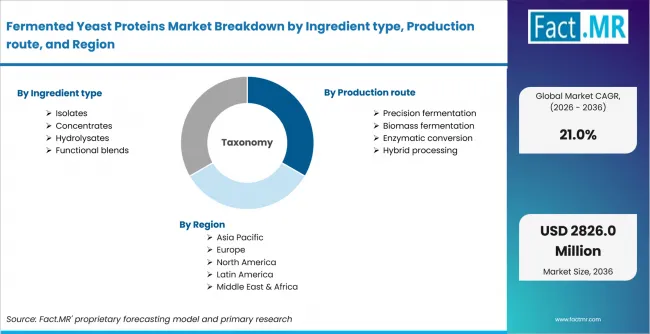
Fermented Yeast Proteins Market Breakdown By Ingredient Type, Production Route, And Region | Source: Fact.MR
| Attribute | Details |
|---|---|
| Quantitative Units | USD million |
| Market Definition | Protein ingredients derived from yeast through fermentation, isolation, concentration, hydrolysis or blending for food, beverage and nutrition applications. |
| Ingredient Type | Isolates; Concentrates; Hydrolysates; Functional Blends |
| Production Route | Precision fermentation; Biomass fermentation; Enzymatic conversion; Hybrid processing |
| Function | Nutrition; Flavor; Texture; Emulsification |
| Application | Meat alternatives; Dairy alternatives; Bakery; Beverages; Fortification; Prepared foods |
| Form | Powder; Liquid; Granules |
| Regions Covered | North America; Latin America; Western Europe; Eastern Europe; East Asia; South Asia & Pacific; Middle East & Africa |
| Countries Covered | USA; UK; Germany; Japan; South Korea |
| Key Companies Profiled | Lesaffre; Angel Yeast Co., Ltd.; Lallemand Inc.; Ohly; Leiber GmbH |
| Forecast Period | 2026 to 2036 |
| Approach | Hybrid top-down and bottom-up approach using food ingredient demand, fermentation capacity, application mix, country adoption and provider portfolio review. |
How is the market segmented?
-
By Ingredient Type
- Isolates
- Concentrates
- Hydrolysates
- Functional Blends
-
By Production Route
- Precision fermentation
- Biomass fermentation
- Enzymatic conversion
- Hybrid processing
-
By Function
- Nutrition
- Flavor
- Texture
- Emulsification
- By Application
- Meat alternatives
- Dairy alternatives
- Bakery
- Beverages
- Fortification
- Prepared foods
-
By Form
- Powder
- Liquid
- Granules
-
By Region
- North America
- Latin America
- Western Europe
- Eastern Europe
- East Asia
- South Asia & Pacific
- Middle East & Africa