Fiber-Integrated Fat Mimetics for Dairy Alternatives Market
The Fiber-Integrated Fat Mimetics for Dairy Alternatives Market is analyzed across its key product, application and end-use segments, with regional trends and demand outlook, forecast 2026 to 2036.
By Fact.MR Food & Beverage DeskLead analyst:
S.N. JhaPublished :
Updated :
13 min read
Fact-checked under the Fact.MR editorial process
Fiber-Integrated Fat Mimetics for Dairy Alternatives Market Forecast and Outlook 2026 to 2036
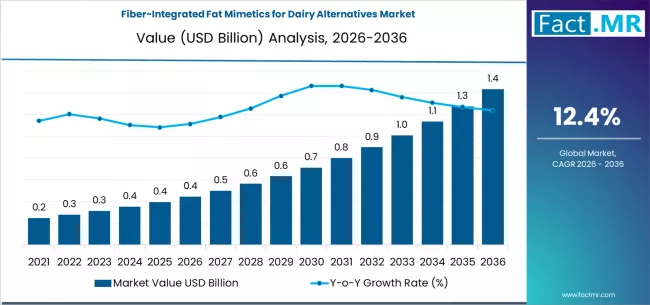
The global market for fiber-integrated fat mimetics in dairy alternatives is positioned at the epicenter of a profound transformation in food technology and consumer preference, projected to surge from USD 0.45 billion in 2026 to USD 1.43 billion by 2036, advancing at a compelling 12.4% CAGR. This robust growth trajectory is not merely a function of the expanding plant-based dairy sector but signifies a critical maturation in its development priorities. The initial wave of alternative dairy products focused on achieving basic functionality and flavor neutrality.
Fiber Integrated Fat Mimetics For Dairy Alternatives Market Market Value Analysis | Source: Fact.MR
Summary of Fiber-Integrated FatMimeticsfor Dairy Alternatives Market
Market Snapshot
Globalfiber-integrated fatmimeticsfor dairy alternatives market revenue stood at USD 0.45 billion in 2026 and is forecast to reach USD 1.43 billion by 2036.
At a 12.4%CAGRfrom 2026 to 2036, this market is at theepicenterof a profound transformation in food technology and consumer preference for plant-based dairy.
Growth is driven by relentless consumer demand for plant-based dairy products that deliver sensory parity with conventional dairy, particularly creamymouthfeeland indulgent texture.
The market is progressing beyond basic stabilization to active sensory design, withfiber-basedmimeticsengineered to replicate fat-like lubricity and viscosity through water-binding and gelation.
Demand and Growth Drivers
Relentless consumer demand for plant-based dairy products delivering sensory parity with conventional dairy, where textureremainsthe largest barrier to repeat purchase.
Dual nutritional narrative combining reduced saturated fat intake with increased dietaryfiberconsumption creates powerful front-of-pack marketing claims for these ingredients.
Regulatory support in various regions for sustainable food systems indirectly promotes investment in plant-based ingredient technologies.
Development of multifunctionalfiberblends combining differentfibertypes to target specific rheological properties such asthixotropyfor yogurt or elastic modulus for cheese.
Strong movement toward upcycled fruit and vegetablefibersources aligning with circular economy principles while meeting clean-label and label-friendly demands.
Product and Segment View
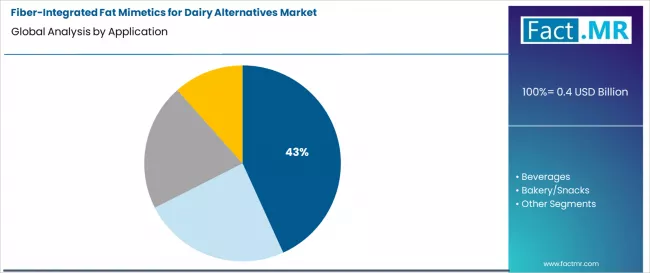
Dairy/Alt-Dairy leads the Application segment with a 43.2% market share in 2026, serving as the primary proving ground formimeticsenabling melt/stretch in cheese and gel structure in yogurt.
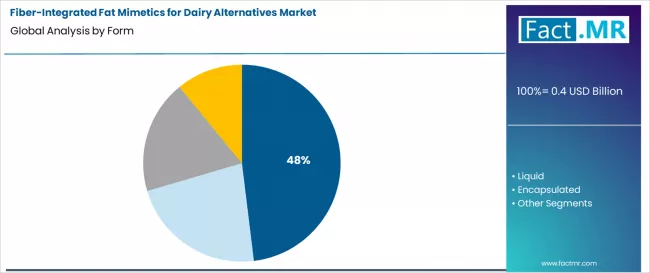
Powder form leads with a 48.1% share in 2026,favoredfor superior stability, precise dosing, ease of blending into dry mixes, superior shelf life, and reduced logistical cost.
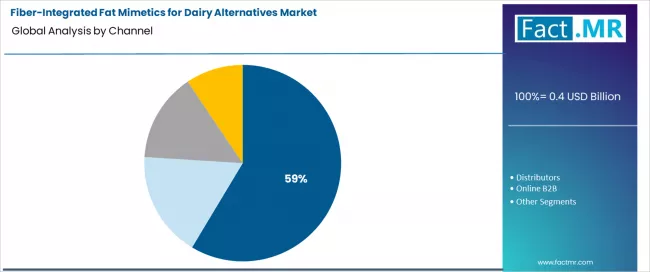
Direct-to-B2B leads the Channel segment with a 59% share in 2026, underpinning the deep technical collaboration required between ingredient suppliers and alternative dairy R&D teams.
Additional segments include Beverages, Bakery/Snacks, Meat/Alt-Meat applications; Liquid, Encapsulated, Paste forms; and Distributors, Online B2B, Contract Manufacturing channels.
Geography and Competitive Outlook
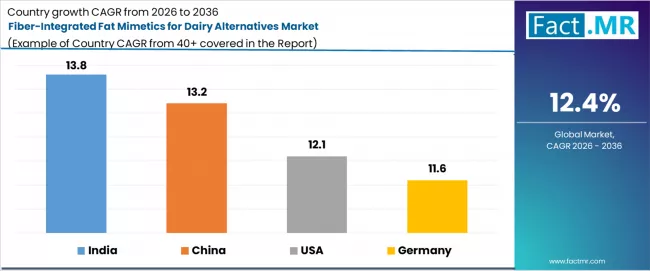
India (13.8%CAGR), China (13.2%), USA (12.1%), and Germany (11.6%) are the key growth countries across this market.
South Asia & Pacific, East Asia, North America, and Western Europe are primary regional markets, driven by lactose intolerance prevalence,premiumization, and plant-based food innovation.
Market expansion is closely tied to the maturation of the alternative dairy sector, consumer education on texture ingredients, and sourcing of consistent high-purityfiberfrom agricultural streams.
Key companies active in this market include Ingredion Inc., Tate & Lyle, Cargill, Kerry Group plc., DSM-Firmenich, and International Flavors & Fragrances (IFF).
Fiber-Integrated FatMimeticsfor Dairy Alternatives — At a Glance
Attribute
Details
Market Value 2026
USD 0.45 Billion
Market Value 2036
USD 1.43 Billion
Absolute Dollar Opportunity 2026–2036
USD 0.98 Billion
Total Growth 2026–2036
221%
CAGR2026–2036
12.4%
Growth Multiple
3.2x
Key Demand Theme
Fiber-based fat mimetic systems engineered to deliver creamy mouthfeel, melt, and texture parity in plant-based dairy alternatives through water-binding and gelation mechanisms
Leading Segment by Application (2026)
Dairy/Alt-Dairy
Application Segment Share (2026)
43.2%
Leading Segment by Form (2026)
Powder
Form Segment Share (2026)
48.1%
Leading Segment by Channel (2026)
Direct-to-B2B
Channel Segment Share (2026)
59%
Key Growth Regions
South Asia & Pacific, East Asia, North America, Western Europe
CountryCAGRs
India 13.8%, China 13.2%, USA 12.1%, Germany 11.6%
Top Companies
Ingredion Inc., Tate & Lyle, Cargill, Kerry Group plc., DSM-Firmenich,IFF
North America, Latin America, Western Europe, Eastern Europe, East Asia, South Asia & Pacific, MEA
Source: Fact.MR analysis. Updated Apr 15, 2026
The current and future phase is decisively oriented toward replicating and enhancing the sophisticated multisensory experience of traditional dairy, particularly the creamy mouthfeel, indulgent texture, and flavor release profile intrinsically linked to dairy fats. Fiber-integrated fat mimetics represent the technological key to this evolution, moving beyond simple stabilization to active sensory design. This market expansion is fundamentally driven by the convergence of heightened consumer sensory expectations and the imperative for cleaner labels. Consumers of plant-based dairy are increasingly discerning, rejecting products with chalky, thin, or waxy textures. Simultaneously, demand is growing for labels free from chemically modified starches and synthetic additives. Fiber-integrated solutions, often derived from recognizable sources like citrus fiber, oat fiber, pea fiber, or soluble roots like inulin, directly address this dual demand. They function as holistic system builders, providing fat-like lubricity and viscosity through water-binding and gelation, while also contributing dietary fiber content-a positive nutritional marketing claim. The progression of this market is centered on precision engineering; the next generation of mimetics is being designed to melt at specific temperatures, stabilize protein networks more effectively, and carry flavor compounds in a manner identical to milk fat globules, thereby unlocking unprecedented authenticity in plant-based cheese, ice cream, yogurt, and creamers.
North America, Latin America, Western Europe, Eastern Europe, East Asia, South Asia & Pacific, MEA
Source: Fact.MR analysis. Updated Apr 15, 2026
Segmental Analysis
By Application, Which Segment Demonstrates the Broadest Adoption?
Fiber Integrated Fat Mimetics For Dairy Alternatives Market Analysis By Application | Source: Fact.MR
The dairy and alternative-dairy segment holds a dominant 43% market share, serving as the primary proving ground and adoption driver for fiber-integrated fat mimetics. Within this segment, the technical challenges are most acute: replicating the melt and stretch of cheese, the spoonable thickness and gel structure of yogurt, and the creamy dispersion and foam stability in barista-style milk alternatives.
Fiber-based mimetics are uniquely suited to address these challenges across a wide pH and processing temperature range. Their adoption is critical for brands aiming to move from being mere alternatives to becoming preferred choices, competing directly with dairy on sensory pleasure rather than just on ethical or environmental claims.
By Form, Which Type Offers the Greatest Processing and Handling Advantage?
Fiber Integrated Fat Mimetics For Dairy Alternatives Market Analysis By Form | Source: Fact.MR
Powder-form fat mimetics lead the market with a 48% share, favored for their superior stability, ease of transportation, and flexibility in formulation. Powdered fibers, often through specialized drying processes like spray-drying, offer consistent particle size and high solubility or dispersibility. This allows food manufacturers to integrate them seamlessly into existing dry blending operations with minimal changes to production lines.
Their long shelf life and reduced logistical cost compared to liquid forms make them a pragmatic and efficient choice for global supply chains, especially for large-scale manufacturers producing multiple alternative dairy product lines.
By Channel, How are Products Primarily Reaching End-Users?
Fiber Integrated Fat Mimetics For Dairy Alternatives Market Analysis By Channel | Source: Fact.MR
Direct-to-B2B sales constitute the leading channel, accounting for 59% of the market. This dominance underscores the highly technical and collaborative development cycle required for successful alternative dairy products. Formulating with fiber-integrated fat mimetics is not a simple one-to-one substitution; it requires deep understanding of interaction with proteins, other hydrocolloids, and processing parameters like shear and heat.
Ingredient suppliers work directly with R&D teams at alternative dairy companies, providing application-specific expertise, prototyping, and troubleshooting support. These direct partnerships are essential for achieving the precise texture and mouthfeel targets that define a successful product launch in this competitive space.
What are the Drivers, Restraints, and Key Trends of the Fiber-Integrated Fat Mimetics for Dairy Alternatives Market?
The primary market driver is the relentless consumer demand for plant-based dairy products that deliver sensory parity with conventional dairy. Texture remains the largest barrier to repeat purchase, placing immense pressure on brands to solve mouthfeel challenges.
Emphasis on reducing saturated fat intake and increasing dietary fiber consumption creates a powerful nutritional narrative for these ingredients, allowing for front-of-pack claims related to fiber content and reduced fat. Regulatory support in various regions for sustainable food systems also indirectly promotes investment in plant-based ingredient technologies.
A significant market restraint is the technical complexity and cost-in-use of high-performance fiber systems. Sourcing consistent, high-purity fiber from agricultural streams can be volatile, impacting price and supply.
Each plant-based protein source interacts differently with fiber mimetics, often necessitating custom blends and extensive, costly application testing. There is also a lingering consumer education gap regarding the functional role of fibers as texture creators, sometimes misinterpreted on labels merely as added filler or fiber supplement rather than a critical sensory component.
Key trends include the development of multifunctional fiber blends that combine different fiber types to target specific rheological properties, such as thixotropy for yogurt or elastic modulus for cheese. There is a strong movement toward source-specific and label-friendly fibers, such as upcycled fruit and vegetable fibers, aligning with circular economy principles.
Precision processing techniques like enzymatic modification or high-pressure homogenization are being employed to tailor the molecular structure of fibers for enhanced fat-mimicking performance. Finally, the integration of these mimetics with flavor modulation technologies is becoming standard, ensuring that texture enhancement does not come at the cost of flavor masking or undesirable aftertastes.
Analysis of the Fiber-Integrated Fat Mimetics for Dairy Alternatives Market by Key Countries
Fiber Integrated Fat Mimetics For Dairy Alternatives Market Cagr Analysis By Country | Source: Fact.MR
Country
CAGR (2026-2036)
India
13.8%
China
13.2%
USA
12.1%
Germany
11.6%
Source: Fact.MR analysis. Updated Apr 15, 2026
How is India's Dairy Culture and Lactose Intolerance Profile Shaping a Unique Market?
India's leading CAGR of 13.8% is fueled by a complex interplay of factors: a deep-rooted dairy tradition, a high prevalence of lactose intolerance, and a growing urban, health-conscious middle class. The market is not simply importing Western plant-based models but evolving its own segment centered on traditional products like plant-based shrikhand, paneer alternatives, and lassi.
The demand for fat mimetics here is specific, requiring functionality in high-acid, fermented systems and the ability to withstand cooking and frying for alt-paneer applications. Local innovation is focusing on leveraging indigenous fiber sources from millets, legumes, and fruits to create cost-effective and culturally tailored texture solutions.
What is Driving Rapid Adoption in China's Dynamic Alternative Protein Scene?
China's 13.2% CAGR reflects its rapid embrace of food technology and a growing dietary shift driven by health and wellness trends, particularly among younger consumers. The government's push for food security and sustainable protein sources provides a supportive backdrop. The Chinese market exhibits a high willingness to try novel food technologies, accelerating the adoption of advanced ingredient systems.
Fiber-integrated mimetics are critical for improving the often-grainy or chalky texture of existing plant-based milk and yogurt products, a key deterrent for broader acceptance. Development is focused on creating neutral-tasting, highly soluble fibers that work in the delicate, lightly sweetened dairy alternatives preferred in the region.
Why does the USA Remain a Core Market for Innovation and Premiumization?
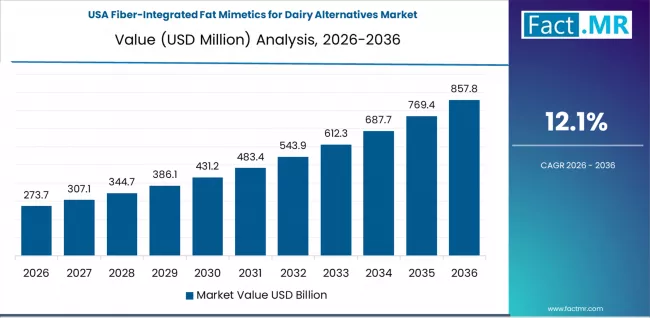
Fiber Integrated Fat Mimetics For Dairy Alternatives Market Country Value Analysis | Source: Fact.MR
The USA's 12.1% growth is sustained by its mature and highly segmented plant-based dairy market, where competition has moved decisively to the premium sensory tier. American consumers expect plant-based ice cream to be as rich and creamy, and plant-based cheese to melt and brown authentically. This drives continuous R&D for next-generation mimetics.
The market is characterized by demand for clean-label, non-GMO, and organic-certified fiber ingredients that can deliver these high-performance outcomes. Furthermore, the trend toward hybrid products-blends of dairy and plant-based ingredients-creates additional complexity, requiring mimetics that function seamlessly in both milieus.
How is Germany's Technical Rigor and Sustainability Focus Influencing Development?
Germany's 11.6% CAGR is indicative of its role as a European hub for food science and sustainable sourcing. German consumers and manufacturers alike prioritize naturalness, organic certification, and transparent supply chains. This environment favors fiber mimetics derived from well-understood, locally-sourced raw materials like oat bran or apple fiber.
The technical approach is meticulous, with a strong emphasis on clinical and rheological data to prove functionality. German ingredient companies and alternative dairy brands are often pioneers in developing integrated systems that combine fiber mimetics with plant-based proteins and flavors to create optimized, holistic ingredient solutions that meet both technical and ethical standards.
Competitive Landscape of the Fiber-Integrated Fat Mimetics for Dairy Alternatives Market
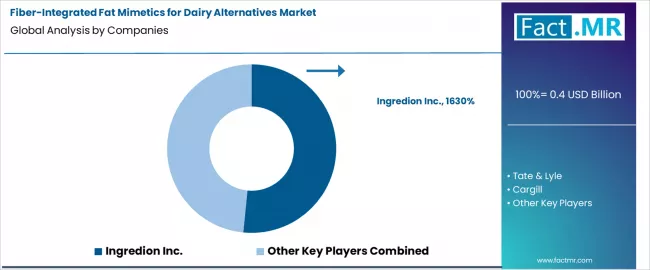
Fiber Integrated Fat Mimetics For Dairy Alternatives Market Analysis By Company | Source: Fact.MR
The competitive landscape is defined by established global ingredient conglomerates with deep expertise in carbohydrate and texturant science, competing directly with diversified flavor and nutrition companies expanding their texture portfolios.
Competition revolves around proprietary fiber processing technologies, the breadth and functionality of fiber blends, and unparalleled application support. Success is increasingly dependent on a deep, scientifically-grounded understanding of colloidal and polymer chemistry as it applies to complex plant protein matrices.
Companies are competing not just on product specifications, but on their ability to provide complete, validated solutions for specific product categories, such as a turnkey texture system for plant-based mozzarella or whipped cream. Strategic partnerships with leading alternative dairy brands for co-development and exclusivity agreements are a common tactic to secure market leadership and drive innovation pipelines.
Key Players in the Fiber-Integrated Fat Mimetics for Dairy Alternatives Market
Ingredion Inc.
Tate & Lyle
Cargill
Kerry Group plc.
DSM-Firmenich
International Flavors & Fragrances (IFF)
References
Arancibia, C., Navarro-Lisboa, R., & Matiacevich, S. (2023). Application of dietary fibers as fat replacers: A review of their microstructural and rheological effects. Food Hydrocolloids, 135, 108183.
Day, L., & Sworn, G. (2024). Hydrocolloids and fibers in plant-based dairy: Building texture from the ground up. Annual Review of Food Science and Technology, 15, 301-322.
Gartaula, G., & Adhikari, B. (2022). Sensory perception and consumer acceptance of plant-based dairy analogs: The central role of texture. Journal of Sensory Studies, 37(3), e12747.
McClements, D. J., & Grossmann, L. (2024). The science of plant-based foods: Constructing next-generation meat and dairy analogs. Food & Function, 15(5), 2309-2326.
Mokoonlall, A., & Hinrichs, J. (2023). Post-processing of plant-based dairy alternatives: Approaches to improve texture and sensory properties. International Dairy Journal, 137, 105532.
Norton, J. E., & Fryer, P. J. (2022). Designing food structure for controlled fat digestion and satiety. Food Structure, 33, 100289.
Patel, A. R., & Dewettinck, K. (2023). Current update on the influence of dietary fibers on lipid digestion and bioaccessibility. Food Research International, 163(Part 2), 112292.
Singh, J. P., Kaur, A., & Shevkani, K. (2024). Legume and cereal fibers as functional ingredients for fat mimetics in vegan foods. Legume Science, 6(1), e185.
Stribiţcaia, E., & Sarkar, A. (2023). Tribology and rheology of fiber-enriched plant-based beverages: Correlating instrumental measurements with sensory perception. Journal of Food Engineering, 347, 111440.
Xie, Y., & Li, D. (2024). Development and characterization of novel fat mimetics from upcycled fruit pomace for application in plant-based yogurt. LWT - Food Science and Technology, 191, 115641.
Ingredion Inc., Tate & Lyle, Cargill, Kerry Group plc., DSM-Firmenich, International Flavors & Fragrances (IFF)
Additional Analysis
Rheological profiling of fiber-protein interactions; impact of mimetics on nutrient bioavailability and gut health; lifecycle assessment of fiber sourcing and production; analysis of cost-structure and scalability of novel fiber sources; regulatory pathways for novel fiber approvals in key regions; comparative analysis of functionality across different plant-based protein substrates (oat, pea, soy, almond).
Source: Fact.MR analysis. Updated Apr 15, 2026
Market by Segments
Application :
Dairy/Alt-Dairy
Beverages
Bakery/Snacks
Meat/Alt-Meat
Form :
Powder
Liquid
Encapsulated
Paste
Channel :
Direct-to-B2B
Distributors
Online B2B
Contract Manufacturing
Region :
North America
USA
Canada
Latin America
Brazil
Mexico
Argentina
Rest of Latin America
Western Europe
Germany
UK
France
Spain
Italy
BENELUX
Rest of Western Europe
Eastern Europe
Russia
Poland
Czech Republic
Rest of Eastern Europe
East Asia
China
Japan
South Korea
Rest of East Asia
South Asia & Pacific
India
ASEAN
Australia
Rest of South Asia & Pacific
MEA
Saudi Arabia
UAE
Turkiye
Rest of MEA
Questions Answered
Frequently Asked Questions
How big is the fiber-integrated fat mimetics for dairy alternatives market in 2026?
The global fiber-integrated fat mimetics for dairy alternatives market is estimated to be valued at USD 0.4 billion in 2026.
What will be the size of fiber-integrated fat mimetics for dairy alternatives market in 2036?
The market size for the fiber-integrated fat mimetics for dairy alternatives market is projected to reach USD 1.4 billion by 2036.
How much will be the fiber-integrated fat mimetics for dairy alternatives market growth between 2026 and 2036?
The fiber-integrated fat mimetics for dairy alternatives market is expected to grow at a 12.4% CAGR between 2026 and 2036.
What are the key product types in the fiber-integrated fat mimetics for dairy alternatives market?
The key product types in fiber-integrated fat mimetics for dairy alternatives market are dairy/alt-dairy, beverages, bakery/snacks and meat/alt-meat.
Which form segment to contribute significant share in the fiber-integrated fat mimetics for dairy alternatives market in 2026?
In terms of form, powder segment to command 48.1% share in the fiber-integrated fat mimetics for dairy alternatives market in 2026.