Fiber- Protein Blends Market (2026 - 2036)

Fiber–Protein Blends Market is segmented by Product Type (Plant-Based Protein–Fiber Blends, Animal-Based Protein–Fiber Blends, Whey Protein–Fiber Blends, Collagen Protein–Fiber Blends, Vegan Protein–Fiber Blends, Prebiotic-Fortified Protein–Fiber Blends, Customized / Multi-Source Blends), By Formulation & Ingredients (Soluble Fiber-Based Blends, Insoluble Fiber-Based Blends, High-Protein Concentration Blends, Balanced Protein–Fiber Ratio Blends, Organic & Clean-Label Blends, Non-GMO & Allergen-Free Blends), By Application (Sports & Performance Nutrition, Weight Management Products, Functional Foods & Beverages, Meal Replacement Products, Dietary Supplements, Bakery & Snack Products, Clinical & Medical Nutrition), By End-User (Individual Consumers, Food & Beverage Manufacturers, Nutraceutical Companies, Healthcare & Clinical Institutions, Fitness Centers & Sports Facilities), By Distribution Channel (Online Retail, Supermarkets & Hypermarkets, Specialty Health Stores, Pharmacies & Drug Stores, Direct-to-Consumer, Institutional Sales) and Region. Forecast for 2025 to 2036.

Core Findings

    Fiber- Protein Blends Market Forecast 2026 to 2036

    In 2025, the Fiber-Protein Blends market was valued at USD 1,518 million. Based on Fact.MR's analysis, demand for fiber-protein blends is estimated to grow to USD 1,657 million in 2026 and USD 4,220 million by 2036. FACT.MR projects a CAGR of 9.8% during the forecast period.

    This represents an absolute dollar growth of USD 2,702 million between 2025 and 2036. In practical terms, this expansion reflects steady structural adoption rather than a speculative surge. Growth remains supported by sustained reformulation cycles in functional foods and sports nutrition, though moderated by raw material price volatility in plant proteins and dairy inputs, as well as margin pressures from private-label competition and retailer consolidation.

    Country-wise, India leads with an 11.5% CAGR, driven by expanding urban nutrition awareness and plant-protein investments. China follows at 10.2%, supported by functional food penetration and domestic processing expansion. The U.K. (9.6%) and Canada (9.5%) benefit from active reformulation and clean-label demand. Japan registers 9.3% growth, supported by aging demographics and clinical nutrition adoption. The U.S. grows at 9.0%, reflecting premium sports nutrition demand but increasing pricing competition. France (8.8%) and Germany (8.2%) represent mature European markets where growth is largely replacement-driven, constrained by retailer bargaining power and slower new product velocity.
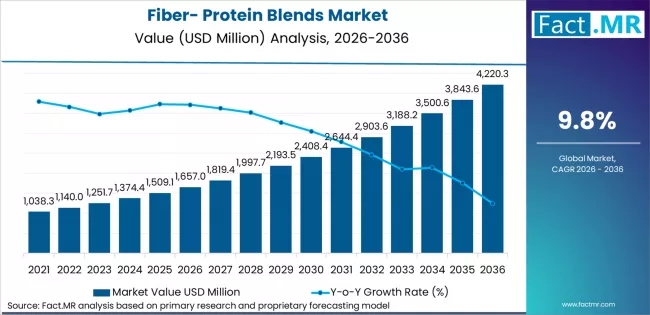
    Fiber Protein Blends Market Market Value Analysis

    Fiber- Protein Blends Market Definition

    The Fiber-Protein Blends Market refers to the commercial trade of integrated nutritional ingredient systems that combine dietary fiber and protein into a single formulation. These blends are manufactured as powders or functional ingredient bases and are supplied to food, beverage, and nutraceutical companies. Their primary industrial function is to enhance the nutritional density of products by delivering both muscle-supporting protein and digestion-supporting fiber in one solution. They are widely used in sports nutrition powders, meal replacements, fortified snacks, ready-to-drink beverages, and dietary supplements. Buyers typically include packaged food manufacturers and supplement brands seeking balanced macronutrient profiles and clean-label claims.

    Market Inclusions

    This report covers global and regional market size estimates, historical data, and forecasts through the assessment period. It includes segmentation by product type, application, and end user, along with regional and country-level analysis. The study evaluates pricing trends, supply chain structure, competitive landscape, and trade flow patterns. Additional analytical dimensions include raw material sourcing dynamics, formulation trends, regulatory impact assessment, and value chain analysis across major producing and consuming regions.

    Market Exclusions

    The scope excludes standalone protein isolates, concentrates, and pure dietary fiber ingredients unless sold as integrated blend systems. It does not cover finished consumer goods such as branded protein bars, beverages, or capsules, focusing strictly on ingredient-level blends supplied to manufacturers. The report also omits animal feed-grade protein-fiber mixtures and pharmaceutical-grade medical nutrition formulations unless they are commercially positioned within the food and nutraceutical ingredient supply chain.

    Research Methodology

    • Primary Research: Insights were gathered through interviews with ingredient manufacturers, formulation specialists, distributors, and procurement managers across food and nutraceutical companies.
    • Desk Research: Public company filings, annual reports, regulatory publications, trade statistics, and industry association data were analyzed to support market estimates.
    • Market‑Sizing and Forecasting: A hybrid approach combining bottom-up revenue aggregation from key players and top-down validation against industry-level consumption data was applied.
    • Data Validation and Update Cycle; Findings were cross-verified through triangulation across supply-side and demand-side inputs, with periodic updates aligned to financial disclosures and regulatory developments.

    Fiber- Protein Blends Market Summary

    • Market Definition:
      • The Fiber-Protein Blends Market comprises integrated nutritional ingredient systems combining dietary fiber and protein to deliver multifunctional health benefits across food, beverage, and nutraceutical formulations.
    • Demand Drivers:
      • Rising participation in sports and active lifestyles is increasing demand for high-protein, fiber-enriched powders and ready-to-drink beverages that support muscle recovery and digestive balance.
      • Food manufacturers are reformulating products to comply with sugar-reduction and front-of-pack labeling regulations, driving inclusion of fiber-protein systems to improve nutrient profiles.
      • Growth in plant-based and flexitarian diets is accelerating adoption of allergen-free, dairy-free protein-fiber blends in meal replacements and functional snacks.
    • Key Segments Analyzed:
      • By Product Type: Plant-Based Protein-Fiber Blends lead with approximately one-third share in 2025, supported by sustainability and clean-label positioning.
      • By Application: Sports & Performance Nutrition remains the dominant application, accounting for nearly 30% of demand due to premium product innovation cycles.
      • By Geography: North America leads the global market, driven by strong sports nutrition penetration and advanced ingredient commercialization infrastructure.
    • Analyst Opinion at FACT.MR
      • ‘Senior Consultant at Fact.MR, opines, ‘Senior executives will find that margin resilience in this market depends less on commodity protein volumes and more on differentiated, application-driven blend innovation.’’
    • Strategic Implications / Executive Takeaways:
      • Invest in application-specific R&D to enhance solubility, taste masking, and gut-health functionality within integrated blends.
      • Diversify protein sourcing geographically to mitigate raw material volatility and supply-chain disruption risks.
      • Strengthen partnerships with CPG brands to co-develop proprietary formulations that support premium pricing.
    • Methodology:
      • Market sizing validated through triangulation of company annual reports, ingredient shipment data, and trade statistics.
      • Demand-side inputs collected via structured interviews with manufacturers, distributors, and formulation experts.
      • Regulatory and policy impacts assessed through review of official government publications and compliance guidelines.

    Segmental Analysis

    Fiber-Protein Blends Market Analysis by Product Type

    Based on FACT.MR's Fiber-Protein Blends market report, consumption of Plant-Based Protein-Fiber Blends is estimated to hold 34% share in 2025. This sub-segment dominates due to strong alignment with plant-forward dietary shifts, allergen-free positioning, and sustainability preferences. It offers structural advantages including broader consumer acceptance across vegan, flexitarian, and lactose-intolerant populations, while enabling clean-label and environmental marketing claims.

    • Capacity Expansion: Roquette expanded its pea protein production capacity at its Manitoba facility in 2023 to strengthen North American supply for plant-based formulations [1]. This investment supports scalable raw material integration into blended protein-fiber systems.
    • Product Innovation: Ingredion launched VITESSENCE® Pea 100 HD in July 2024 to improve texture and protein density in high-protein bars and beverages [2]. Such advancements enhance compatibility of plant proteins with soluble fibers in blended systems.
    • Supply Diversification: ADM expanded alternative protein production capabilities in Asia in November 2023 to meet rising demand for plant-based functional ingredients [3]. This reflects a broader logistics trend of regionalizing plant-protein supply chains to stabilize pricing.

    Fiber-Protein Blends Market Analysis by Application

    Based on FACT.MR's Fiber-Protein Blends market report, consumption of Sports & Performance Nutrition is estimated to hold 29% share in 2025. This application leads due to high consumer demand for muscle recovery, satiety, and digestive support within single formulations. The segment benefits from premium pricing, strong brand loyalty, and continuous product innovation cycles.

    • Strategic Acquisition: Glanbia plc acquired Flavor Producers in November 2023 to enhance functional ingredient capabilities supporting sports nutrition portfolios [4]. This strengthens blend formulation and application development capacity.
    • Technology Launch: Kerry Group introduced advanced plant-based protein combinations under its ProDiem™ portfolio in July 2024 to improve taste and texture in high-performance beverages [5]. These technologies facilitate protein-fiber integration without compromising sensory attributes.
    • Retail Expansion: E-commerce growth across North America and Asia-Pacific has accelerated direct-to-consumer sports nutrition sales since 2023, increasing demand for shelf-stable, fortified powders and ready-to-drink blends [6]. Logistics optimization supports broader distribution.

    Fiber- Protein Blends Market Drivers, Restraints, and Opportunities

    Fact.MR analysis indicates that the Fiber-Protein Blends Market is in a structured growth phase, transitioning from niche functional fortification to mainstream formulation integration. Historically, protein and fiber were incorporated separately into food and supplement products, limiting formulation efficiency and consumer messaging coherence. The market exists at its current size due to the convergence of preventive healthcare awareness, sports nutrition expansion, and regulatory emphasis on improved macronutrient labeling standards. Structural forces such as sugar-reduction mandates, clean-label demand, and dietary fiber recognition by regulatory bodies have encouraged manufacturers to adopt combined protein-fiber systems rather than single-ingredient fortification. As a result, valuation growth is increasingly linked to reformulation cycles within large packaged food portfolios.

    The current market tension lies between commodity protein or fiber ingredients and higher-value integrated blends. Standard bulk proteins and standalone fibers are experiencing pricing pressure due to oversupply and private-label competition, particularly in North America and parts of Europe. In contrast, customized plant-based and prebiotic-fortified blends are gaining traction despite higher per-unit costs. Although volumes for premium blends are comparatively lower, their higher margins and functional positioning offset volume constraints. This shift results in moderate aggregate volume growth but stronger value expansion, as manufacturers prioritize differentiated, health-oriented SKUs over commoditized nutrition claims.

    • Preventive Nutrition Shift: Rising consumer focus on gut health, satiety, and metabolic wellness is structurally driving demand for multifunctional ingredients. Fiber-protein blends align with lifestyle disease management trends, particularly in urbanized markets with aging populations.
    • Regulatory Reformulation Push: Policies such as the UK’s HFSS (High Fat, Sugar, and Salt) Regulations and evolving FDA dietary fiber labeling guidance are incentivizing reformulation toward higher fiber and balanced macronutrient profiles, directly supporting blend adoption.
    • Asia-Pacific Expansion: Rapid urbanization and middle-class growth in China and India are expanding demand for fortified foods and meal replacements. This geographic dynamic is accelerating localized production investments and increasing competitive intensity across plant-based protein supply chains.

    Regional Analysis

    The market analysis covers key global regions, including South Asia and Pacific, Middle East & Africa, North America, Latin America, Western Europe, and Eastern Europe. It is segmented geographically, with specific market dynamics for each region. The full report provides a detailed market attractiveness analysis.
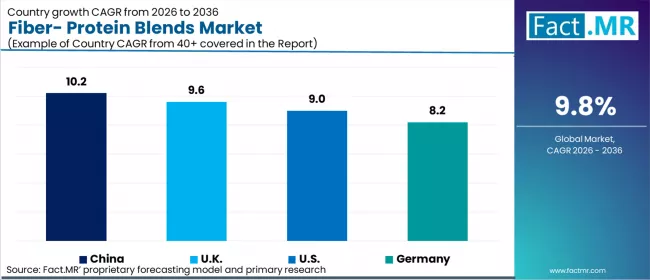
    Fiber Protein Blends Market Cagr Analysis By Country

    Country CAGR (%)
    U.S. 9.0%
    China 10.2%
    Germany 8.2%
    U.K. 9.6%
    France 8.8%
    Japan 9.3%
    India 11.5%
    Canada 9.5%

    Source: Fact MR (FMR) analysis, based on proprietary forecasting model and primary research.

    North America

    The Commercialization Powerhouse

    North America serves as the commercialization powerhouse of the Fiber-Protein Blends Market, driven by mature sports nutrition, functional food innovation, and strong retail penetration. The region hosts global leaders such as Cargill, Archer Daniels Midland Company, and Ingredion Incorporated, all of which maintain integrated supply chains and advanced application laboratories. These players compete on formulation performance, clean-label positioning, and scale efficiencies, supplying both multinational food brands and emerging nutraceutical companies across diverse high-protein and gut-health categories.

    • United States: Demand for Fiber-Protein Blends in the United States is projected to rise at 9.0% CAGR through 2034. Growth is supported by regulatory clarity and active corporate investment. The U.S. Food and Drug Administration (FDA) updated its guidance on dietary fiber definition compliance in June 2023, reinforcing labeling standards that support functional fiber inclusion in fortified foods. In April 2024, Ingredion Incorporated announced expanded production capacity for specialty proteins and fibers in North America to meet rising demand for clean-label and high-protein formulations. Additionally, the U.S. Department of Agriculture (USDA) continues to support high-protein food innovation through public research grants under its National Institute of Food and Agriculture programs (2023 funding cycle). However, pricing sensitivity among large CPG buyers and raw material volatility, particularly in pea and dairy protein inputs, may moderate margin expansion. Strong e-commerce penetration and sports nutrition consumption trends continue to underpin sustained demand growth.
    • Canada: Demand for Fiber-Protein Blends in Canada is projected to rise at 9.5% CAGR through 2034. Growth is influenced by regulatory modernization and domestic plant-protein investment. Health Canada’s front-of-pack nutrition labeling regulations, finalized in July 2022 and implemented progressively through 2026, are encouraging reformulation toward higher fiber and protein density products. In May 2023, Roquette Frères advanced operations at its pea protein facility in Manitoba, strengthening North American supply capacity for plant-based protein blends. Furthermore, Protein Industries Canada, under federal innovation funding programs (2023 investment round), continues to support collaborative projects aimed at expanding domestic plant-protein processing. While the market remains smaller than the U.S., strong plant-protein infrastructure and government-backed agri-food innovation provide structural growth advantages. Retail consolidation, however, increases buyer bargaining leverage, limiting excessive price escalation.

    East Asia

    The Functional Nutrition Growth Engine

    East Asia functions as the functional nutrition growth engine of the Fiber-Protein Blends Market, characterized by rapid health awareness expansion and strong regulatory oversight. Key regional participants include domestic subsidiaries of ADM and Cargill, alongside multinational players such as Kerry Group plc and IFF, which maintain innovation centers across China and Japan. Competitive positioning centers on localized formulation, compliance with stringent food standards, and partnerships with beverage and dairy manufacturers.

    • China: Demand for Fiber-Protein Blends in China is projected to rise at 10.2% CAGR through 2034. The National Health Commission (NHC) updated guidelines for functional food registration and filing in February 2023, reinforcing compliance standards for nutrient-fortified products. In November 2023, Archer Daniels Midland Company expanded its nutrition production capacity in China to serve growing demand for alternative proteins and specialty ingredients. Additionally, China’s “Healthy China 2030” initiative continues to promote balanced diets and protein intake improvements, indirectly stimulating fortified food demand. Domestic competition and price pressure from local protein processors may constrain premium margins, yet rising middle-class consumption and expanding sports nutrition channels sustain strong volume growth.
    • Japan: Demand for Fiber-Protein Blends in Japan is projected to rise at 9.3% CAGR through 2034. Regulatory support for functional labeling under the Consumer Affairs Agency’s Foods with Function Claims (FFC) system, updated guidance in March 2023, enables companies to market digestive and protein-related benefits more transparently. In June 2024, Kerry Group plc expanded its application capabilities in Japan to strengthen plant-based and fortified product development. Aging demographics and high health consciousness favor fiber-protein integration in meal replacements and clinical nutrition. However, stringent quality standards and conservative consumer adoption patterns moderate rapid product turnover.

    Western Europe

    The Regulatory Benchmark Market

    Western Europe operates as the regulatory benchmark market for Fiber-Protein Blends, emphasizing sustainability, labeling transparency, and premium functional positioning. Leading regional players include Roquette Frères, BENEO GmbH, and FrieslandCampina Ingredients, all of which maintain strong R&D pipelines and vertically integrated supply chains. Competition centers on high-purity plant proteins, specialty fibers, and compliance with European Food Safety Authority standards.

    • Germany: Demand for Fiber-Protein Blends in Germany is projected to rise at 8.2% CAGR through 2034. The Federal Ministry of Food and Agriculture (BMEL) updated its national nutrition strategy framework in January 2024, encouraging reduced sugar and improved macronutrient balance in packaged foods. In September 2023, BENEO GmbH expanded its pulse-processing capacity in Europe to strengthen plant-based ingredient supply. Germany’s strong private-label retail presence encourages reformulation with protein and fiber fortification, although cost pressures and energy pricing volatility remain constraints.
    • United Kingdom: Demand for Fiber-Protein Blends in the United Kingdom is projected to rise at 9.6% CAGR through 2034. The UK Department of Health and Social Care advanced HFSS (High Fat, Sugar, and Salt) regulation implementation phases in October 2023, incentivizing reformulation toward higher fiber and protein content. In March 2024, Tate & Lyle PLC announced continued investment in specialty ingredient solutions aligned with healthier product development. Strong sports nutrition retail channels and active product innovation support growth, though post-Brexit trade adjustments continue to influence ingredient sourcing costs.

    FACT.MR Report Callout: FACT.MR’s analysis of the Fiber-Protein Blends Market in North America, East Asia, and Western Europe consists of country-wise assessment that includes the United States, Canada, China, Japan, Germany, and the United Kingdom. Readers can find detailed CAGR projections, regulatory impact analysis, competitive positioning insights, and supply-chain developments shaping regional growth trajectories.

    How Competitive Is the Fiber–Protein Blends Market and Where Does Pricing Power Reside?

    The Fiber-Protein Blends Market exhibits a moderately concentrated competitive structure at the global level, with the top multinational ingredient suppliers accounting for a significant share of total revenues, while numerous regional and specialty formulators serve niche segments. Large diversified players such as Cargill, ADM, Ingredion, Kerry, and Tate & Lyle collectively command a substantial portion of the organized B2B ingredient market, particularly in North America and Europe. However, the broader ecosystem remains fragmented due to private-label manufacturers, specialty plant-protein processors, and regional fiber producers. The primary competitive variable is formulation performance encompassing solubility, texture, nutritional claims, and clean-label positioning followed closely by price stability and supply reliability.

    Structural advantages are concentrated among vertically integrated agribusinesses and dairy-based ingredient specialists. Companies such as Cargill and ADM benefit from upstream access to agricultural feedstocks, global processing infrastructure, and diversified ingredient portfolios, which provide cost efficiency and cross-selling opportunities. Roquette and BENEO leverage deep expertise in plant proteins and specialty fibers, while Arla Foods Ingredients and FrieslandCampina Ingredients benefit from captive dairy streams and strong R&D capabilities. Kerry and IFF hold formulation and application-development advantages, enabling them to offer customized solutions rather than commodity ingredients.

    Buyer behavior is increasingly strategic and risk-mitigating. Large food and nutraceutical manufacturers typically dual-source key protein and fiber inputs to avoid supply disruption and strengthen negotiation leverage. Long-term contracts, formulation trials across multiple suppliers, and regional supplier diversification are common practices. As a result, pricing power is balanced: while leading ingredient companies can command premiums for specialized, high-performance blends, bulk formulations remain price-sensitive. Overall, innovation-driven differentiation not scale alone determines sustainable margin leadership in this market.

    Recent Industry Developments

    • Ingredion Incorporated - Launch of FIBERTEX® CF Citrus Fiber (July 2024): Ingredion launched FIBERTEX® CF 500 and FIBERTEX® CF 100 clean-label citrus fibers to enhance texture, water-binding, and fiber enrichment in food and beverage applications.
    • Ingredion Incorporated - Launch of VITESSENCE® Pea 100 HD (July 2024): Ingredion introduced VITESSENCE® Pea 100 HD pea protein to improve texture and softness in high-protein bars and functional products, supporting plant-based protein innovation.
    • Kerry Group - Expansion of Sustainable Nutrition Solutions (September 2023): Kerry Group expanded its sustainable nutrition portfolio with enhanced plant-protein and functional ingredient solutions to meet rising demand for clean-label and fortified food products.

    Key Players of the Fiber- Protein Blends Market

    • Cargill Incorporated
    • Archer Daniels Midland Company
    • Ingredion Incorporated
    • Tate & Lyle PLC
    • Roquette Frères
    • BENEO GmbH
    • International Flavors & Fragrances Inc.
    • Kerry Group plc
    • Glanbia Nutritionals
    • Arla Foods Ingredients
    • Prinova Group LLC
    • Cosucra Groupe Warcoing SA

    Report Scope

    Metric Value
    Quantitative Units USD 1,657 million (2026) to USD 4,220 million (2036), at a CAGR of 9.8%
    Market Definition The Fiber-Protein Blends Market comprises integrated ingredient systems combining dietary fiber and protein to enhance nutritional value, supporting muscle health, digestive wellness, satiety, and functional performance across food, beverage, and nutraceutical applications.
    By Product Type Plant-Based Protein-Fiber Blends, Animal-Based Protein-Fiber Blends, Whey Protein-Fiber Blends, Collagen Protein-Fiber Blends, Vegan Protein-Fiber Blends, Prebiotic-Fortified Protein-Fiber Blends, Customized / Multi-Source Blends
    By Formulation & Ingredients Soluble Fiber-Based Blends, Insoluble Fiber-Based Blends, High-Protein Concentration Blends, Balanced Protein-Fiber Ratio Blends, Organic & Clean-Label Blends, Non-GMO & Allergen-Free Blends
    By Application Sports & Performance Nutrition, Weight Management Products, Functional Foods & Beverages, Meal Replacement Products, Dietary Supplements, Bakery & Snack Products, Clinical & Medical Nutrition
    By End-User Individual Consumers, Food & Beverage Manufacturers, Nutraceutical Companies, Healthcare & Clinical Institutions, Fitness Centers & Sports Facilities
    By Distribution Channel Online Retail, Supermarkets & Hypermarkets, Specialty Health Stores, Pharmacies & Drug Stores, Direct-to-Consumer, Institutional Sales
    Regions Covered North America, Latin America, Europe, East Asia, South Asia, Oceania, Middle East and Africa
    Countries Covered United States, Canada, Mexico, Brazil, Argentina, Germany, France, United Kingdom, Italy, Spain, China, India, Japan, South Korea, Indonesia, Australia, and 40+ countries
    Key Companies Profiled Cargill Incorporated, Archer Daniels Midland Company, Ingredion Incorporated, Tate & Lyle PLC, Roquette Frères, BENEO GmbH, International Flavors & Fragrances Inc., Kerry Group plc, Glanbia Nutritionals
    Forecast Period 2026 to 2036
    Approach Hybrid top-down and bottom-up market modeling validated through primary interviews with manufacturers and supported by trade data benchmarking and market research.

    Fiber- Protein Blends Market Key Segments

    • By Product Type

      • Plant-Based Protein-Fiber Blends
      • Animal-Based Protein-Fiber Blends
      • Whey Protein-Fiber Blends
      • Collagen Protein-Fiber Blends
      • Vegan Protein-Fiber Blends
      • Prebiotic-Fortified Protein-Fiber Blends
      • Customized / Multi-Source Blends
    • By Formulation & Ingredients

      • Soluble Fiber-Based Blends
      • Insoluble Fiber-Based Blends
      • High-Protein Concentration Blends
      • Balanced Protein-Fiber Ratio Blends
      • Organic & Clean-Label Blends
      • Non-GMO & Allergen-Free Blends
    • By Application

      • Sports & Performance Nutrition
      • Weight Management Products
      • Functional Foods & Beverages
      • Meal Replacement Products
      • Dietary Supplements
      • Bakery & Snack Products
      • Clinical & Medical Nutrition
    • By End-User

      • Individual Consumers
      • Food & Beverage Manufacturers
      • Nutraceutical Companies
      • Healthcare & Clinical Institutions
      • Fitness Centers & Sports Facilities
    • By Distribution Channel

      • Online Retail
      • Supermarkets & Hypermarkets
      • Specialty Health Stores
      • Pharmacies & Drug Stores
      • Direct-to-Consumer
      • Institutional Sales
    • Region

      • North America
        • USA
        • Canada
        • Mexico
      • Europe
        • Germany
        • UK
        • France
        • Italy
        • Spain
        • Nordic Countries
        • BENELUX
        • Rest of Europe
      • Asia Pacific
        • China
        • Japan
        • South Korea
        • India
        • Australia
        • Rest of Asia Pacific
      • Latin America
        • Brazil
        • Argentina
        • Rest of Latin America
      • Middle East and Africa
        • Kingdom of Saudi Arabia
        • United Arab Emirates
        • South Africa
        • Rest of Middle East and Africa
      • Other Regions
        • Oceania
        • Central Asia
        • Other Markets

    Bibliographies

    • [1] Roquette Roquette officially opens the world’s largest pea protein plant in Manitoba September 2023
    • [2] Ingredion Incorporated Ingredion launches VITESSENCE® Pea 100 HD to maintain softness throughout shelf life July 2024
    • [3] Archer Daniels Midland Company (ADM) ADM expands alternative protein production to support growing global demand November 2023
    • [4] Glanbia plc Glanbia completes acquisition of Flavor Producers November 2023
    • [5] Kerry Group Kerry launches ProDiem™ advanced plant protein solutions July 2024
    • [6] U.S. Department of Commerce - International Trade Administration E-commerce continues to drive growth in global consumer goods marketsOctober 2023
    • [7] Ingredion Incorporated Ingredion introduces multi-benefit, naturally sourced clean-label citrus fiber July 2024
    • [8] Ingredion Incorporated Ingredion launches VITESSENCE® Pea 100 HD July 2024
    • [9] Nutraceuticals World Kerry to Premier Advanced Plant-Based Protein July 2024

    Table of Content

    1. Executive Summary
      • Global Market Outlook
      • Demand-side Trends
      • Supply-side Trends
      • Technology Roadmap Analysis
      • Analysis and Recommendations
    2. Market Overview
      • Market Coverage / Taxonomy
      • Market Definition / Scope / Limitations
    3. Market Background
      • Market Dynamics
        • Drivers
        • Restraints
        • Opportunity
        • Trends
      • Scenario Forecast
        • Demand in Optimistic Scenario
        • Demand in Likely Scenario
        • Demand in Conservative Scenario
      • Opportunity Map Analysis
      • Product Life Cycle Analysis
      • Supply Chain Analysis
      • Investment Feasibility Matrix
      • Value Chain Analysis
      • PESTLE and Porter’s Analysis
      • Regulatory Landscape
      • Regional Parent Market Outlook
      • Production and Consumption Statistics
      • Import and Export Statistics
    4. Global Fiber- Protein Blends Market Analysis 2020-2024 and Forecast, 2025-2035
      • Historical Market Size Value (USD Mn) & MT Analysis, 2020-2024
      • Current and Future Market Size Value (USD Mn) & MT Projections, 2025-2035
        • Y-o-Y Growth Trend Analysis
        • Absolute $ Opportunity Analysis
    5. Global Fiber- Protein Blends Market Pricing Analysis 2020-2024 and Forecast 2025-2035
    6. Global Fiber- Protein Blends Market Analysis 2020-2024 and Forecast 2025-2035, By Product Type
      • Introduction / Key Findings
      • Historical Market Size Value (USD Mn) & MT Analysis By Product Type, 2020-2024
      • Current and Future Market Size Value (USD Mn) & MT Analysis and Forecast By Product Type, 2025-2035
        • Plant-Based Protein-Fiber Blends
        • Animal-Based Protein-Fiber Blends
        • Whey Protein-Fiber Blends
        • Collagen Protein-Fiber Blends
        • Vegan Protein-Fiber Blends
        • Prebiotic-Fortified Protein-Fiber Blends
        • Customized / Multi-Source Blends
      • Y-o-Y Growth Trend Analysis By Product Type, 2020-2024
      • Absolute $ Opportunity Analysis By Product Type, 2025-2035
    7. Global Fiber- Protein Blends Market Analysis 2020-2024 and Forecast 2025-2035, By Formulation & Ingredients
      • Introduction / Key Findings
      • Historical Market Size Value (USD Mn) & MT Analysis By Formulation & Ingredients, 2020-2024
      • Current and Future Market Size Value (USD Mn) & MT Analysis and Forecast By Formulation & Ingredients, 2025-2035
        • Soluble Fiber-Based Blends
        • Insoluble Fiber-Based Blends
        • High-Protein Concentration Blends
        • Balanced Protein-Fiber Ratio Blends
        • Organic & Clean-Label Blends
        • Non-GMO & Allergen-Free Blends
      • Y-o-Y Growth Trend Analysis By Formulation & Ingredients, 2020-2024
      • Absolute $ Opportunity Analysis By Formulation & Ingredients, 2025-2035
    8. Global Fiber- Protein Blends Market Analysis 2020-2024 and Forecast 2025-2035, By Application
      • Introduction / Key Findings
      • Historical Market Size Value (USD Mn) & MT Analysis By Application, 2020-2024
      • Current and Future Market Size Value (USD Mn) & MT Analysis and Forecast By Application, 2025-2035
        • Sports & Performance Nutrition
        • Weight Management Products
        • Functional Foods & Beverages
        • Meal Replacement Products
        • Dietary Supplements
        • Bakery & Snack Products
        • Clinical & Medical Nutrition
      • Y-o-Y Growth Trend Analysis By Application, 2020-2024
      • Absolute $ Opportunity Analysis By Application, 2025-2035
    9. Global Fiber- Protein Blends Market Analysis 2020-2024 and Forecast 2025-2035, By End-User
      • Introduction / Key Findings
      • Historical Market Size Value (USD Mn) & MT Analysis By End-User, 2020-2024
      • Current and Future Market Size Value (USD Mn) & MT Analysis and Forecast By End-User, 2025-2035
        • Individual Consumers
        • Food & Beverage Manufacturers
        • Nutraceutical Companies
        • Healthcare & Clinical Institutions
        • Fitness Centers & Sports Facilities
      • Y-o-Y Growth Trend Analysis By End-User, 2020-2024
      • Absolute $ Opportunity Analysis By End-User, 2025-2035
    10. Global Fiber- Protein Blends Market Analysis 2020-2024 and Forecast 2025-2035, By Distribution Channel
      • Introduction / Key Findings
      • Historical Market Size Value (USD Mn) & MT Analysis By Distribution Channel, 2020-2024
      • Current and Future Market Size Value (USD Mn) & MT Analysis and Forecast By Distribution Channel, 2025-2035
        • Online Retail
        • Supermarkets & Hypermarkets
        • Specialty Health Stores
        • Pharmacies & Drug Stores
        • Direct-to-Consumer
        • Institutional Sales
      • Y-o-Y Growth Trend Analysis By Distribution Channel, 2020-2024
      • Absolute $ Opportunity Analysis By Distribution Channel, 2025-2035
    11. Global Fiber- Protein Blends Market Analysis 2020-2024 and Forecast 2025-2035, By Region
      • Introduction
      • Historical Market Size Value (USD Mn) & MT Analysis By Region, 2020-2024
      • Current Market Size Value (USD Mn) & MT Analysis and Forecast By Region, 2025-2035
        • North America
        • Latin America
        • Western Europe
        • Eastern Europe
        • East Asia
        • South Asia and Pacific
        • Middle East & Africa
      • Market Attractiveness Analysis By Region
    12. North America Fiber- Protein Blends Market Analysis 2020-2024 and Forecast 2025-2035, By Country
      • Historical Market Size Value (USD Mn) & MT Trend Analysis By Market Taxonomy, 2020-2024
      • Market Size Value (USD Mn) & MT Forecast By Market Taxonomy, 2025-2035
        • By Country
          • U.S.
          • Canada
          • Mexico
        • By Product Type
        • By Formulation & Ingredients
        • By Application
        • By End-User
        • By Distribution Channel
      • Market Attractiveness Analysis
        • By Country
        • By Product Type
        • By Formulation & Ingredients
        • By Application
        • By End-User
        • By Distribution Channel
      • Key Takeaways
    13. Latin America Fiber- Protein Blends Market Analysis 2020-2024 and Forecast 2025-2035, By Country
      • Historical Market Size Value (USD Mn) & MT Trend Analysis By Market Taxonomy, 2020-2024
      • Market Size Value (USD Mn) & MT Forecast By Market Taxonomy, 2025-2035
        • By Country
          • Brazil
          • Chile
          • Rest of Latin America
        • By Product Type
        • By Formulation & Ingredients
        • By Application
        • By End-User
        • By Distribution Channel
      • Market Attractiveness Analysis
        • By Country
        • By Product Type
        • By Formulation & Ingredients
        • By Application
        • By End-User
        • By Distribution Channel
      • Key Takeaways
    14. Western Europe Fiber- Protein Blends Market Analysis 2020-2024 and Forecast 2025-2035, By Country
      • Historical Market Size Value (USD Mn) & MT Trend Analysis By Market Taxonomy, 2020-2024
      • Market Size Value (USD Mn) & MT Forecast By Market Taxonomy, 2025-2035
        • By Country
          • Germany
          • U.K.
          • Italy
          • Spain
          • France
          • Nordic
          • BENELUX
          • Rest of Western Europe
        • By Product Type
        • By Formulation & Ingredients
        • By Application
        • By End-User
        • By Distribution Channel
      • Market Attractiveness Analysis
        • By Country
        • By Product Type
        • By Formulation & Ingredients
        • By Application
        • By End-User
        • By Distribution Channel
      • Key Takeaways
    15. Eastern Europe Fiber- Protein Blends Market Analysis 2020-2024 and Forecast 2025-2035, By Country
      • Historical Market Size Value (USD Mn) & MT Trend Analysis By Market Taxonomy, 2020-2024
      • Market Size Value (USD Mn) & MT Forecast By Market Taxonomy, 2025-2035
        • By Country
          • Russia
          • Poland
          • Hungary
          • Balkan & Baltic
          • Rest of Eastern Europe
        • By Product Type
        • By Formulation & Ingredients
        • By Application
        • By End-User
        • By Distribution Channel
      • Market Attractiveness Analysis
        • By Country
        • By Product Type
        • By Formulation & Ingredients
        • By Application
        • By End-User
        • By Distribution Channel
      • Key Takeaways
    16. East Asia Fiber- Protein Blends Market Analysis 2020-2024 and Forecast 2025-2035, By Country
      • Historical Market Size Value (USD Mn) & MT Trend Analysis By Market Taxonomy, 2020-2024
      • Market Size Value (USD Mn) & MT Forecast By Market Taxonomy, 2025-2035
        • By Country
          • China
          • Japan
          • South Korea
        • By Product Type
        • By Formulation & Ingredients
        • By Application
        • By End-User
        • By Distribution Channel
      • Market Attractiveness Analysis
        • By Country
        • By Product Type
        • By Formulation & Ingredients
        • By Application
        • By End-User
        • By Distribution Channel
      • Key Takeaways
    17. South Asia and Pacific Fiber- Protein Blends Market Analysis 2020-2024 and Forecast 2025-2035, By Country
      • Historical Market Size Value (USD Mn) & MT Trend Analysis By Market Taxonomy, 2020-2024
      • Market Size Value (USD Mn) & MT Forecast By Market Taxonomy, 2025-2035
        • By Country
          • India
          • ASEAN
          • Australia & New Zealand
          • Rest of South Asia and Pacific
        • By Product Type
        • By Formulation & Ingredients
        • By Application
        • By End-User
        • By Distribution Channel
      • Market Attractiveness Analysis
        • By Country
        • By Product Type
        • By Formulation & Ingredients
        • By Application
        • By End-User
        • By Distribution Channel
      • Key Takeaways
    18. Middle East & Africa Fiber- Protein Blends Market Analysis 2020-2024 and Forecast 2025-2035, By Country
      • Historical Market Size Value (USD Mn) & MT Trend Analysis By Market Taxonomy, 2020-2024
      • Market Size Value (USD Mn) & MT Forecast By Market Taxonomy, 2025-2035
        • By Country
          • Kingdom of Saudi Arabia
          • Other GCC Countries
          • Turkiye
          • South Africa
          • Other African Union
          • Rest of Middle East & Africa
        • By Product Type
        • By Formulation & Ingredients
        • By Application
        • By End-User
        • By Distribution Channel
      • Market Attractiveness Analysis
        • By Country
        • By Product Type
        • By Formulation & Ingredients
        • By Application
        • By End-User
        • By Distribution Channel
      • Key Takeaways
    19. Key Countries Fiber- Protein Blends Market Analysis
      • U.S.
        • Pricing Analysis
        • Market Share Analysis, 2024
          • By Product Type
          • By Formulation & Ingredients
          • By Application
          • By End-User
          • By Distribution Channel
      • Canada
        • Pricing Analysis
        • Market Share Analysis, 2024
          • By Product Type
          • By Formulation & Ingredients
          • By Application
          • By End-User
          • By Distribution Channel
      • Mexico
        • Pricing Analysis
        • Market Share Analysis, 2024
          • By Product Type
          • By Formulation & Ingredients
          • By Application
          • By End-User
          • By Distribution Channel
      • Brazil
        • Pricing Analysis
        • Market Share Analysis, 2024
          • By Product Type
          • By Formulation & Ingredients
          • By Application
          • By End-User
          • By Distribution Channel
      • Chile
        • Pricing Analysis
        • Market Share Analysis, 2024
          • By Product Type
          • By Formulation & Ingredients
          • By Application
          • By End-User
          • By Distribution Channel
      • Germany
        • Pricing Analysis
        • Market Share Analysis, 2024
          • By Product Type
          • By Formulation & Ingredients
          • By Application
          • By End-User
          • By Distribution Channel
      • U.K.
        • Pricing Analysis
        • Market Share Analysis, 2024
          • By Product Type
          • By Formulation & Ingredients
          • By Application
          • By End-User
          • By Distribution Channel
      • Italy
        • Pricing Analysis
        • Market Share Analysis, 2024
          • By Product Type
          • By Formulation & Ingredients
          • By Application
          • By End-User
          • By Distribution Channel
      • Spain
        • Pricing Analysis
        • Market Share Analysis, 2024
          • By Product Type
          • By Formulation & Ingredients
          • By Application
          • By End-User
          • By Distribution Channel
      • France
        • Pricing Analysis
        • Market Share Analysis, 2024
          • By Product Type
          • By Formulation & Ingredients
          • By Application
          • By End-User
          • By Distribution Channel
      • India
        • Pricing Analysis
        • Market Share Analysis, 2024
          • By Product Type
          • By Formulation & Ingredients
          • By Application
          • By End-User
          • By Distribution Channel
      • ASEAN
        • Pricing Analysis
        • Market Share Analysis, 2024
          • By Product Type
          • By Formulation & Ingredients
          • By Application
          • By End-User
          • By Distribution Channel
      • Australia & New Zealand
        • Pricing Analysis
        • Market Share Analysis, 2024
          • By Product Type
          • By Formulation & Ingredients
          • By Application
          • By End-User
          • By Distribution Channel
      • China
        • Pricing Analysis
        • Market Share Analysis, 2024
          • By Product Type
          • By Formulation & Ingredients
          • By Application
          • By End-User
          • By Distribution Channel
      • Japan
        • Pricing Analysis
        • Market Share Analysis, 2024
          • By Product Type
          • By Formulation & Ingredients
          • By Application
          • By End-User
          • By Distribution Channel
      • South Korea
        • Pricing Analysis
        • Market Share Analysis, 2024
          • By Product Type
          • By Formulation & Ingredients
          • By Application
          • By End-User
          • By Distribution Channel
      • Russia
        • Pricing Analysis
        • Market Share Analysis, 2024
          • By Product Type
          • By Formulation & Ingredients
          • By Application
          • By End-User
          • By Distribution Channel
      • Poland
        • Pricing Analysis
        • Market Share Analysis, 2024
          • By Product Type
          • By Formulation & Ingredients
          • By Application
          • By End-User
          • By Distribution Channel
      • Hungary
        • Pricing Analysis
        • Market Share Analysis, 2024
          • By Product Type
          • By Formulation & Ingredients
          • By Application
          • By End-User
          • By Distribution Channel
      • Kingdom of Saudi Arabia
        • Pricing Analysis
        • Market Share Analysis, 2024
          • By Product Type
          • By Formulation & Ingredients
          • By Application
          • By End-User
          • By Distribution Channel
      • Turkiye
        • Pricing Analysis
        • Market Share Analysis, 2024
          • By Product Type
          • By Formulation & Ingredients
          • By Application
          • By End-User
          • By Distribution Channel
      • South Africa
        • Pricing Analysis
        • Market Share Analysis, 2024
          • By Product Type
          • By Formulation & Ingredients
          • By Application
          • By End-User
          • By Distribution Channel
    20. Market Structure Analysis
      • Competition Dashboard
      • Competition Benchmarking
      • Market Share Analysis of Top Players
        • By Regional
        • By Product Type
        • By Formulation & Ingredients
        • By Application
        • By End-User
        • By Distribution Channel
    21. Competition Analysis
      • Competition Deep Dive
        • Cargill Incorporated
          • Overview
          • Product Portfolio
          • Profitability by Market Segments (Product/Age /Sales Channel/Region)
          • Sales Footprint
          • Strategy Overview
          • Archer Daniels Midland Company
          • Ingredion Incorporated
          • Tate & Lyle PLC
          • Roquette Frères
          • BENEO GmbH
          • International Flavors & Fragrances Inc.
          • Kerry Group plc
          • Glanbia Nutritionals
          • Arla Foods Ingredients
          • Prinova Group LLC
          • Cosucra Groupe Warcoing SA
          • FrieslandCampina Ingredients
          • CP Kelco
          • Axiom Foods, Inc.
      • Assumptions & Acronyms Used
      • Research Methodology

    List Of Table

    • Table 1: Global Fiber- Protein Blends Market Value (USD Mn) Forecast by Region, 2020-2035
    • Table 2: Global Fiber- Protein Blends Market MT Forecast by Region, 2020-2035
    • Table 3: Global Fiber- Protein Blends Market Value (USD Mn) Forecast by Product Type, 2020-2035
    • Table 4: Global Fiber- Protein Blends Market MT Forecast by Product Type, 2020-2035
    • Table 5: Global Fiber- Protein Blends Market Value (USD Mn) Forecast by Formulation & Ingredients, 2020-2035
    • Table 6: Global Fiber- Protein Blends Market MT Forecast by Formulation & Ingredients, 2020-2035
    • Table 7: Global Fiber- Protein Blends Market Value (USD Mn) Forecast by Application, 2020-2035
    • Table 8: Global Fiber- Protein Blends Market MT Forecast by Application, 2020-2035
    • Table 9: Global Fiber- Protein Blends Market Value (USD Mn) Forecast by End-User, 2020-2035
    • Table 10: Global Fiber- Protein Blends Market MT Forecast by End-User, 2020-2035
    • Table 11: Global Fiber- Protein Blends Market Value (USD Mn) Forecast by Distribution Channel, 2020-2035
    • Table 12: Global Fiber- Protein Blends Market MT Forecast by Distribution Channel, 2020-2035
    • Table 13: North America Fiber- Protein Blends Market Value (USD Mn) Forecast by Country, 2020-2035
    • Table 14: North America Fiber- Protein Blends Market MT Forecast by Country, 2020-2035
    • Table 15: North America Fiber- Protein Blends Market Value (USD Mn) Forecast by Product Type, 2020-2035
    • Table 16: North America Fiber- Protein Blends Market MT Forecast by Product Type, 2020-2035
    • Table 17: North America Fiber- Protein Blends Market Value (USD Mn) Forecast by Formulation & Ingredients, 2020-2035
    • Table 18: North America Fiber- Protein Blends Market MT Forecast by Formulation & Ingredients, 2020-2035
    • Table 19: North America Fiber- Protein Blends Market Value (USD Mn) Forecast by Application, 2020-2035
    • Table 20: North America Fiber- Protein Blends Market MT Forecast by Application, 2020-2035
    • Table 21: North America Fiber- Protein Blends Market Value (USD Mn) Forecast by End-User, 2020-2035
    • Table 22: North America Fiber- Protein Blends Market MT Forecast by End-User, 2020-2035
    • Table 23: North America Fiber- Protein Blends Market Value (USD Mn) Forecast by Distribution Channel, 2020-2035
    • Table 24: North America Fiber- Protein Blends Market MT Forecast by Distribution Channel, 2020-2035
    • Table 25: Latin America Fiber- Protein Blends Market Value (USD Mn) Forecast by Country, 2020-2035
    • Table 26: Latin America Fiber- Protein Blends Market MT Forecast by Country, 2020-2035
    • Table 27: Latin America Fiber- Protein Blends Market Value (USD Mn) Forecast by Product Type, 2020-2035
    • Table 28: Latin America Fiber- Protein Blends Market MT Forecast by Product Type, 2020-2035
    • Table 29: Latin America Fiber- Protein Blends Market Value (USD Mn) Forecast by Formulation & Ingredients, 2020-2035
    • Table 30: Latin America Fiber- Protein Blends Market MT Forecast by Formulation & Ingredients, 2020-2035
    • Table 31: Latin America Fiber- Protein Blends Market Value (USD Mn) Forecast by Application, 2020-2035
    • Table 32: Latin America Fiber- Protein Blends Market MT Forecast by Application, 2020-2035
    • Table 33: Latin America Fiber- Protein Blends Market Value (USD Mn) Forecast by End-User, 2020-2035
    • Table 34: Latin America Fiber- Protein Blends Market MT Forecast by End-User, 2020-2035
    • Table 35: Latin America Fiber- Protein Blends Market Value (USD Mn) Forecast by Distribution Channel, 2020-2035
    • Table 36: Latin America Fiber- Protein Blends Market MT Forecast by Distribution Channel, 2020-2035
    • Table 37: Western Europe Fiber- Protein Blends Market Value (USD Mn) Forecast by Country, 2020-2035
    • Table 38: Western Europe Fiber- Protein Blends Market MT Forecast by Country, 2020-2035
    • Table 39: Western Europe Fiber- Protein Blends Market Value (USD Mn) Forecast by Product Type, 2020-2035
    • Table 40: Western Europe Fiber- Protein Blends Market MT Forecast by Product Type, 2020-2035
    • Table 41: Western Europe Fiber- Protein Blends Market Value (USD Mn) Forecast by Formulation & Ingredients, 2020-2035
    • Table 42: Western Europe Fiber- Protein Blends Market MT Forecast by Formulation & Ingredients, 2020-2035
    • Table 43: Western Europe Fiber- Protein Blends Market Value (USD Mn) Forecast by Application, 2020-2035
    • Table 44: Western Europe Fiber- Protein Blends Market MT Forecast by Application, 2020-2035
    • Table 45: Western Europe Fiber- Protein Blends Market Value (USD Mn) Forecast by End-User, 2020-2035
    • Table 46: Western Europe Fiber- Protein Blends Market MT Forecast by End-User, 2020-2035
    • Table 47: Western Europe Fiber- Protein Blends Market Value (USD Mn) Forecast by Distribution Channel, 2020-2035
    • Table 48: Western Europe Fiber- Protein Blends Market MT Forecast by Distribution Channel, 2020-2035
    • Table 49: Eastern Europe Fiber- Protein Blends Market Value (USD Mn) Forecast by Country, 2020-2035
    • Table 50: Eastern Europe Fiber- Protein Blends Market MT Forecast by Country, 2020-2035
    • Table 51: Eastern Europe Fiber- Protein Blends Market Value (USD Mn) Forecast by Product Type, 2020-2035
    • Table 52: Eastern Europe Fiber- Protein Blends Market MT Forecast by Product Type, 2020-2035
    • Table 53: Eastern Europe Fiber- Protein Blends Market Value (USD Mn) Forecast by Formulation & Ingredients, 2020-2035
    • Table 54: Eastern Europe Fiber- Protein Blends Market MT Forecast by Formulation & Ingredients, 2020-2035
    • Table 55: Eastern Europe Fiber- Protein Blends Market Value (USD Mn) Forecast by Application, 2020-2035
    • Table 56: Eastern Europe Fiber- Protein Blends Market MT Forecast by Application, 2020-2035
    • Table 57: Eastern Europe Fiber- Protein Blends Market Value (USD Mn) Forecast by End-User, 2020-2035
    • Table 58: Eastern Europe Fiber- Protein Blends Market MT Forecast by End-User, 2020-2035
    • Table 59: Eastern Europe Fiber- Protein Blends Market Value (USD Mn) Forecast by Distribution Channel, 2020-2035
    • Table 60: Eastern Europe Fiber- Protein Blends Market MT Forecast by Distribution Channel, 2020-2035
    • Table 61: East Asia Fiber- Protein Blends Market Value (USD Mn) Forecast by Country, 2020-2035
    • Table 62: East Asia Fiber- Protein Blends Market MT Forecast by Country, 2020-2035
    • Table 63: East Asia Fiber- Protein Blends Market Value (USD Mn) Forecast by Product Type, 2020-2035
    • Table 64: East Asia Fiber- Protein Blends Market MT Forecast by Product Type, 2020-2035
    • Table 65: East Asia Fiber- Protein Blends Market Value (USD Mn) Forecast by Formulation & Ingredients, 2020-2035
    • Table 66: East Asia Fiber- Protein Blends Market MT Forecast by Formulation & Ingredients, 2020-2035
    • Table 67: East Asia Fiber- Protein Blends Market Value (USD Mn) Forecast by Application, 2020-2035
    • Table 68: East Asia Fiber- Protein Blends Market MT Forecast by Application, 2020-2035
    • Table 69: East Asia Fiber- Protein Blends Market Value (USD Mn) Forecast by End-User, 2020-2035
    • Table 70: East Asia Fiber- Protein Blends Market MT Forecast by End-User, 2020-2035
    • Table 71: East Asia Fiber- Protein Blends Market Value (USD Mn) Forecast by Distribution Channel, 2020-2035
    • Table 72: East Asia Fiber- Protein Blends Market MT Forecast by Distribution Channel, 2020-2035
    • Table 73: South Asia and Pacific Fiber- Protein Blends Market Value (USD Mn) Forecast by Country, 2020-2035
    • Table 74: South Asia and Pacific Fiber- Protein Blends Market MT Forecast by Country, 2020-2035
    • Table 75: South Asia and Pacific Fiber- Protein Blends Market Value (USD Mn) Forecast by Product Type, 2020-2035
    • Table 76: South Asia and Pacific Fiber- Protein Blends Market MT Forecast by Product Type, 2020-2035
    • Table 77: South Asia and Pacific Fiber- Protein Blends Market Value (USD Mn) Forecast by Formulation & Ingredients, 2020-2035
    • Table 78: South Asia and Pacific Fiber- Protein Blends Market MT Forecast by Formulation & Ingredients, 2020-2035
    • Table 79: South Asia and Pacific Fiber- Protein Blends Market Value (USD Mn) Forecast by Application, 2020-2035
    • Table 80: South Asia and Pacific Fiber- Protein Blends Market MT Forecast by Application, 2020-2035
    • Table 81: South Asia and Pacific Fiber- Protein Blends Market Value (USD Mn) Forecast by End-User, 2020-2035
    • Table 82: South Asia and Pacific Fiber- Protein Blends Market MT Forecast by End-User, 2020-2035
    • Table 83: South Asia and Pacific Fiber- Protein Blends Market Value (USD Mn) Forecast by Distribution Channel, 2020-2035
    • Table 84: South Asia and Pacific Fiber- Protein Blends Market MT Forecast by Distribution Channel, 2020-2035
    • Table 85: Middle East & Africa Fiber- Protein Blends Market Value (USD Mn) Forecast by Country, 2020-2035
    • Table 86: Middle East & Africa Fiber- Protein Blends Market MT Forecast by Country, 2020-2035
    • Table 87: Middle East & Africa Fiber- Protein Blends Market Value (USD Mn) Forecast by Product Type, 2020-2035
    • Table 88: Middle East & Africa Fiber- Protein Blends Market MT Forecast by Product Type, 2020-2035
    • Table 89: Middle East & Africa Fiber- Protein Blends Market Value (USD Mn) Forecast by Formulation & Ingredients, 2020-2035
    • Table 90: Middle East & Africa Fiber- Protein Blends Market MT Forecast by Formulation & Ingredients, 2020-2035
    • Table 91: Middle East & Africa Fiber- Protein Blends Market Value (USD Mn) Forecast by Application, 2020-2035
    • Table 92: Middle East & Africa Fiber- Protein Blends Market MT Forecast by Application, 2020-2035
    • Table 93: Middle East & Africa Fiber- Protein Blends Market Value (USD Mn) Forecast by End-User, 2020-2035
    • Table 94: Middle East & Africa Fiber- Protein Blends Market MT Forecast by End-User, 2020-2035
    • Table 95: Middle East & Africa Fiber- Protein Blends Market Value (USD Mn) Forecast by Distribution Channel, 2020-2035
    • Table 96: Middle East & Africa Fiber- Protein Blends Market MT Forecast by Distribution Channel, 2020-2035

    List Of Figures

    • Figure 1: Global Fiber- Protein Blends Market MT Forecast 2020-2035
    • Figure 2: Global Fiber- Protein Blends Market Pricing Analysis
    • Figure 3: Global Fiber- Protein Blends Market Value (USD Mn) Forecast 2020-2035
    • Figure 4: Global Fiber- Protein Blends Market Value Share and BPS Analysis by Product Type, 2025 and 2035
    • Figure 5: Global Fiber- Protein Blends Market Y-o-Y Growth Comparison by Product Type, 2025 to 2035
    • Figure 6: Global Fiber- Protein Blends Market Attractiveness Analysis by Product Type
    • Figure 7: Global Fiber- Protein Blends Market Value Share and BPS Analysis by Formulation & Ingredients, 2025 and 2035
    • Figure 8: Global Fiber- Protein Blends Market Y-o-Y Growth Comparison by Formulation & Ingredients, 2025 to 2035
    • Figure 9: Global Fiber- Protein Blends Market Attractiveness Analysis by Formulation & Ingredients
    • Figure 10: Global Fiber- Protein Blends Market Value Share and BPS Analysis by Application, 2025 and 2035
    • Figure 11: Global Fiber- Protein Blends Market Y-o-Y Growth Comparison by Application, 2025 to 2035
    • Figure 12: Global Fiber- Protein Blends Market Attractiveness Analysis by Application
    • Figure 13: Global Fiber- Protein Blends Market Value Share and BPS Analysis by End-User, 2025 and 2035
    • Figure 14: Global Fiber- Protein Blends Market Y-o-Y Growth Comparison by End-User, 2025 to 2035
    • Figure 15: Global Fiber- Protein Blends Market Attractiveness Analysis by End-User
    • Figure 16: Global Fiber- Protein Blends Market Value Share and BPS Analysis by Distribution Channel, 2025 and 2035
    • Figure 17: Global Fiber- Protein Blends Market Y-o-Y Growth Comparison by Distribution Channel, 2025 to 2035
    • Figure 18: Global Fiber- Protein Blends Market Attractiveness Analysis by Distribution Channel
    • Figure 19: Global Fiber- Protein Blends Market Value (USD Mn) Share and BPS Analysis by Region, 2025 and 2035
    • Figure 20: Global Fiber- Protein Blends Market Y-o-Y Growth Comparison by Region, 2025 to 2035
    • Figure 21: Global Fiber- Protein Blends Market Attractiveness Analysis by Region
    • Figure 22: North America Fiber- Protein Blends Market Incremental $ Opportunity, 2025 to 2035
    • Figure 23: Latin America Fiber- Protein Blends Market Incremental $ Opportunity, 2025 to 2035
    • Figure 24: Western Europe Fiber- Protein Blends Market Incremental $ Opportunity, 2025 to 2035
    • Figure 25: Eastern Europe Fiber- Protein Blends Market Incremental $ Opportunity, 2025 to 2035
    • Figure 26: East Asia Fiber- Protein Blends Market Incremental $ Opportunity, 2025 to 2035
    • Figure 27: South Asia and Pacific Fiber- Protein Blends Market Incremental $ Opportunity, 2025 to 2035
    • Figure 28: Middle East & Africa Fiber- Protein Blends Market Incremental $ Opportunity, 2025 to 2035
    • Figure 29: North America Fiber- Protein Blends Market Value Share and BPS Analysis by Country, 2025 and 2035
    • Figure 30: North America Fiber- Protein Blends Market Value Share and BPS Analysis by Product Type, 2025 and 2035
    • Figure 31: North America Fiber- Protein Blends Market Y-o-Y Growth Comparison by Product Type, 2025 to 2035
    • Figure 32: North America Fiber- Protein Blends Market Attractiveness Analysis by Product Type
    • Figure 33: North America Fiber- Protein Blends Market Value Share and BPS Analysis by Formulation & Ingredients, 2025 and 2035
    • Figure 34: North America Fiber- Protein Blends Market Y-o-Y Growth Comparison by Formulation & Ingredients, 2025 to 2035
    • Figure 35: North America Fiber- Protein Blends Market Attractiveness Analysis by Formulation & Ingredients
    • Figure 36: North America Fiber- Protein Blends Market Value Share and BPS Analysis by Application, 2025 and 2035
    • Figure 37: North America Fiber- Protein Blends Market Y-o-Y Growth Comparison by Application, 2025 to 2035
    • Figure 38: North America Fiber- Protein Blends Market Attractiveness Analysis by Application
    • Figure 39: North America Fiber- Protein Blends Market Value Share and BPS Analysis by End-User, 2025 and 2035
    • Figure 40: North America Fiber- Protein Blends Market Y-o-Y Growth Comparison by End-User, 2025 to 2035
    • Figure 41: North America Fiber- Protein Blends Market Attractiveness Analysis by End-User
    • Figure 42: North America Fiber- Protein Blends Market Value Share and BPS Analysis by Distribution Channel, 2025 and 2035
    • Figure 43: North America Fiber- Protein Blends Market Y-o-Y Growth Comparison by Distribution Channel, 2025 to 2035
    • Figure 44: North America Fiber- Protein Blends Market Attractiveness Analysis by Distribution Channel
    • Figure 45: Latin America Fiber- Protein Blends Market Value Share and BPS Analysis by Country, 2025 and 2035
    • Figure 46: Latin America Fiber- Protein Blends Market Value Share and BPS Analysis by Product Type, 2025 and 2035
    • Figure 47: Latin America Fiber- Protein Blends Market Y-o-Y Growth Comparison by Product Type, 2025 to 2035
    • Figure 48: Latin America Fiber- Protein Blends Market Attractiveness Analysis by Product Type
    • Figure 49: Latin America Fiber- Protein Blends Market Value Share and BPS Analysis by Formulation & Ingredients, 2025 and 2035
    • Figure 50: Latin America Fiber- Protein Blends Market Y-o-Y Growth Comparison by Formulation & Ingredients, 2025 to 2035
    • Figure 51: Latin America Fiber- Protein Blends Market Attractiveness Analysis by Formulation & Ingredients
    • Figure 52: Latin America Fiber- Protein Blends Market Value Share and BPS Analysis by Application, 2025 and 2035
    • Figure 53: Latin America Fiber- Protein Blends Market Y-o-Y Growth Comparison by Application, 2025 to 2035
    • Figure 54: Latin America Fiber- Protein Blends Market Attractiveness Analysis by Application
    • Figure 55: Latin America Fiber- Protein Blends Market Value Share and BPS Analysis by End-User, 2025 and 2035
    • Figure 56: Latin America Fiber- Protein Blends Market Y-o-Y Growth Comparison by End-User, 2025 to 2035
    • Figure 57: Latin America Fiber- Protein Blends Market Attractiveness Analysis by End-User
    • Figure 58: Latin America Fiber- Protein Blends Market Value Share and BPS Analysis by Distribution Channel, 2025 and 2035
    • Figure 59: Latin America Fiber- Protein Blends Market Y-o-Y Growth Comparison by Distribution Channel, 2025 to 2035
    • Figure 60: Latin America Fiber- Protein Blends Market Attractiveness Analysis by Distribution Channel
    • Figure 61: Western Europe Fiber- Protein Blends Market Value Share and BPS Analysis by Country, 2025 and 2035
    • Figure 62: Western Europe Fiber- Protein Blends Market Value Share and BPS Analysis by Product Type, 2025 and 2035
    • Figure 63: Western Europe Fiber- Protein Blends Market Y-o-Y Growth Comparison by Product Type, 2025 to 2035
    • Figure 64: Western Europe Fiber- Protein Blends Market Attractiveness Analysis by Product Type
    • Figure 65: Western Europe Fiber- Protein Blends Market Value Share and BPS Analysis by Formulation & Ingredients, 2025 and 2035
    • Figure 66: Western Europe Fiber- Protein Blends Market Y-o-Y Growth Comparison by Formulation & Ingredients, 2025 to 2035
    • Figure 67: Western Europe Fiber- Protein Blends Market Attractiveness Analysis by Formulation & Ingredients
    • Figure 68: Western Europe Fiber- Protein Blends Market Value Share and BPS Analysis by Application, 2025 and 2035
    • Figure 69: Western Europe Fiber- Protein Blends Market Y-o-Y Growth Comparison by Application, 2025 to 2035
    • Figure 70: Western Europe Fiber- Protein Blends Market Attractiveness Analysis by Application
    • Figure 71: Western Europe Fiber- Protein Blends Market Value Share and BPS Analysis by End-User, 2025 and 2035
    • Figure 72: Western Europe Fiber- Protein Blends Market Y-o-Y Growth Comparison by End-User, 2025 to 2035
    • Figure 73: Western Europe Fiber- Protein Blends Market Attractiveness Analysis by End-User
    • Figure 74: Western Europe Fiber- Protein Blends Market Value Share and BPS Analysis by Distribution Channel, 2025 and 2035
    • Figure 75: Western Europe Fiber- Protein Blends Market Y-o-Y Growth Comparison by Distribution Channel, 2025 to 2035
    • Figure 76: Western Europe Fiber- Protein Blends Market Attractiveness Analysis by Distribution Channel
    • Figure 77: Eastern Europe Fiber- Protein Blends Market Value Share and BPS Analysis by Country, 2025 and 2035
    • Figure 78: Eastern Europe Fiber- Protein Blends Market Value Share and BPS Analysis by Product Type, 2025 and 2035
    • Figure 79: Eastern Europe Fiber- Protein Blends Market Y-o-Y Growth Comparison by Product Type, 2025 to 2035
    • Figure 80: Eastern Europe Fiber- Protein Blends Market Attractiveness Analysis by Product Type
    • Figure 81: Eastern Europe Fiber- Protein Blends Market Value Share and BPS Analysis by Formulation & Ingredients, 2025 and 2035
    • Figure 82: Eastern Europe Fiber- Protein Blends Market Y-o-Y Growth Comparison by Formulation & Ingredients, 2025 to 2035
    • Figure 83: Eastern Europe Fiber- Protein Blends Market Attractiveness Analysis by Formulation & Ingredients
    • Figure 84: Eastern Europe Fiber- Protein Blends Market Value Share and BPS Analysis by Application, 2025 and 2035
    • Figure 85: Eastern Europe Fiber- Protein Blends Market Y-o-Y Growth Comparison by Application, 2025 to 2035
    • Figure 86: Eastern Europe Fiber- Protein Blends Market Attractiveness Analysis by Application
    • Figure 87: Eastern Europe Fiber- Protein Blends Market Value Share and BPS Analysis by End-User, 2025 and 2035
    • Figure 88: Eastern Europe Fiber- Protein Blends Market Y-o-Y Growth Comparison by End-User, 2025 to 2035
    • Figure 89: Eastern Europe Fiber- Protein Blends Market Attractiveness Analysis by End-User
    • Figure 90: Eastern Europe Fiber- Protein Blends Market Value Share and BPS Analysis by Distribution Channel, 2025 and 2035
    • Figure 91: Eastern Europe Fiber- Protein Blends Market Y-o-Y Growth Comparison by Distribution Channel, 2025 to 2035
    • Figure 92: Eastern Europe Fiber- Protein Blends Market Attractiveness Analysis by Distribution Channel
    • Figure 93: East Asia Fiber- Protein Blends Market Value Share and BPS Analysis by Country, 2025 and 2035
    • Figure 94: East Asia Fiber- Protein Blends Market Value Share and BPS Analysis by Product Type, 2025 and 2035
    • Figure 95: East Asia Fiber- Protein Blends Market Y-o-Y Growth Comparison by Product Type, 2025 to 2035
    • Figure 96: East Asia Fiber- Protein Blends Market Attractiveness Analysis by Product Type
    • Figure 97: East Asia Fiber- Protein Blends Market Value Share and BPS Analysis by Formulation & Ingredients, 2025 and 2035
    • Figure 98: East Asia Fiber- Protein Blends Market Y-o-Y Growth Comparison by Formulation & Ingredients, 2025 to 2035
    • Figure 99: East Asia Fiber- Protein Blends Market Attractiveness Analysis by Formulation & Ingredients
    • Figure 100: East Asia Fiber- Protein Blends Market Value Share and BPS Analysis by Application, 2025 and 2035
    • Figure 101: East Asia Fiber- Protein Blends Market Y-o-Y Growth Comparison by Application, 2025 to 2035
    • Figure 102: East Asia Fiber- Protein Blends Market Attractiveness Analysis by Application
    • Figure 103: East Asia Fiber- Protein Blends Market Value Share and BPS Analysis by End-User, 2025 and 2035
    • Figure 104: East Asia Fiber- Protein Blends Market Y-o-Y Growth Comparison by End-User, 2025 to 2035
    • Figure 105: East Asia Fiber- Protein Blends Market Attractiveness Analysis by End-User
    • Figure 106: East Asia Fiber- Protein Blends Market Value Share and BPS Analysis by Distribution Channel, 2025 and 2035
    • Figure 107: East Asia Fiber- Protein Blends Market Y-o-Y Growth Comparison by Distribution Channel, 2025 to 2035
    • Figure 108: East Asia Fiber- Protein Blends Market Attractiveness Analysis by Distribution Channel
    • Figure 109: South Asia and Pacific Fiber- Protein Blends Market Value Share and BPS Analysis by Country, 2025 and 2035
    • Figure 110: South Asia and Pacific Fiber- Protein Blends Market Value Share and BPS Analysis by Product Type, 2025 and 2035
    • Figure 111: South Asia and Pacific Fiber- Protein Blends Market Y-o-Y Growth Comparison by Product Type, 2025 to 2035
    • Figure 112: South Asia and Pacific Fiber- Protein Blends Market Attractiveness Analysis by Product Type
    • Figure 113: South Asia and Pacific Fiber- Protein Blends Market Value Share and BPS Analysis by Formulation & Ingredients, 2025 and 2035
    • Figure 114: South Asia and Pacific Fiber- Protein Blends Market Y-o-Y Growth Comparison by Formulation & Ingredients, 2025 to 2035
    • Figure 115: South Asia and Pacific Fiber- Protein Blends Market Attractiveness Analysis by Formulation & Ingredients
    • Figure 116: South Asia and Pacific Fiber- Protein Blends Market Value Share and BPS Analysis by Application, 2025 and 2035
    • Figure 117: South Asia and Pacific Fiber- Protein Blends Market Y-o-Y Growth Comparison by Application, 2025 to 2035
    • Figure 118: South Asia and Pacific Fiber- Protein Blends Market Attractiveness Analysis by Application
    • Figure 119: South Asia and Pacific Fiber- Protein Blends Market Value Share and BPS Analysis by End-User, 2025 and 2035
    • Figure 120: South Asia and Pacific Fiber- Protein Blends Market Y-o-Y Growth Comparison by End-User, 2025 to 2035
    • Figure 121: South Asia and Pacific Fiber- Protein Blends Market Attractiveness Analysis by End-User
    • Figure 122: South Asia and Pacific Fiber- Protein Blends Market Value Share and BPS Analysis by Distribution Channel, 2025 and 2035
    • Figure 123: South Asia and Pacific Fiber- Protein Blends Market Y-o-Y Growth Comparison by Distribution Channel, 2025 to 2035
    • Figure 124: South Asia and Pacific Fiber- Protein Blends Market Attractiveness Analysis by Distribution Channel
    • Figure 125: Middle East & Africa Fiber- Protein Blends Market Value Share and BPS Analysis by Country, 2025 and 2035
    • Figure 126: Middle East & Africa Fiber- Protein Blends Market Value Share and BPS Analysis by Product Type, 2025 and 2035
    • Figure 127: Middle East & Africa Fiber- Protein Blends Market Y-o-Y Growth Comparison by Product Type, 2025 to 2035
    • Figure 128: Middle East & Africa Fiber- Protein Blends Market Attractiveness Analysis by Product Type
    • Figure 129: Middle East & Africa Fiber- Protein Blends Market Value Share and BPS Analysis by Formulation & Ingredients, 2025 and 2035
    • Figure 130: Middle East & Africa Fiber- Protein Blends Market Y-o-Y Growth Comparison by Formulation & Ingredients, 2025 to 2035
    • Figure 131: Middle East & Africa Fiber- Protein Blends Market Attractiveness Analysis by Formulation & Ingredients
    • Figure 132: Middle East & Africa Fiber- Protein Blends Market Value Share and BPS Analysis by Application, 2025 and 2035
    • Figure 133: Middle East & Africa Fiber- Protein Blends Market Y-o-Y Growth Comparison by Application, 2025 to 2035
    • Figure 134: Middle East & Africa Fiber- Protein Blends Market Attractiveness Analysis by Application
    • Figure 135: Middle East & Africa Fiber- Protein Blends Market Value Share and BPS Analysis by End-User, 2025 and 2035
    • Figure 136: Middle East & Africa Fiber- Protein Blends Market Y-o-Y Growth Comparison by End-User, 2025 to 2035
    • Figure 137: Middle East & Africa Fiber- Protein Blends Market Attractiveness Analysis by End-User
    • Figure 138: Middle East & Africa Fiber- Protein Blends Market Value Share and BPS Analysis by Distribution Channel, 2025 and 2035
    • Figure 139: Middle East & Africa Fiber- Protein Blends Market Y-o-Y Growth Comparison by Distribution Channel, 2025 to 2035
    • Figure 140: Middle East & Africa Fiber- Protein Blends Market Attractiveness Analysis by Distribution Channel
    • Figure 141: Global Fiber- Protein Blends Market - Tier Structure Analysis
    • Figure 142: Global Fiber- Protein Blends Market - Company Share Analysis

    - FAQs -

    How large is the demand for Fiber-Protein Blends in the global market in 2026?

    Demand for Fiber-Protein Blends in the global market is estimated to be valued at USD 1,657 million in 2026.

    What will be the market size of Fiber-Protein Blends in the global market by 2036?

    The market size for Fiber-Protein Blends is projected to reach USD 4,220 million by 2036.

    What is the expected demand growth for Fiber-Protein Blends in the global market between 2026 and 2036?

    Demand for Fiber-Protein Blends in the global market is expected to grow at a CAGR of 9.8% - between 2026 and 2036.

    Which product type is expected to dominate the market?

    Plant-Based Protein–Fiber Blends are expected to dominate the market, accounting for 22% of the market share in 2026, driven by rising demand for functional, clean-label, and plant-derived nutrition solutions.

    Which region is expected to show the highest growth rate for Fiber-Protein Blends?

    China is projected to show the highest regional CAGR at 10.2% during the forecast period, supported by increasing health awareness and expansion of fortified food products.

    How significant is the growth outlook for the United Kingdom in this market?

    The United Kingdom is expected to grow at a CAGR of 9.6%, reflecting strong consumer demand for plant-based and high-fiber functional foods.

    What is the growth outlook for the United States in this report?

    The United States is anticipated to grow at a CAGR of 9.0% from 2026 to 2036, supported by rising consumption of protein-enriched snacks, beverages, and meal replacements.

    What is the growth forecast for France in the Fiber-Protein Blends market?

    France is expected to grow at a CAGR of 8.8%, driven by growing demand for digestive health and sports nutrition products.

    Which European market is highlighted in this analysis?

    Germany is a key European market, projected to grow at a CAGR of 8.2%, influenced by strong functional food and dietary supplement demand.

    Which company is identified as a leading player in the Fiber-Protein Blends market?

    Cargill Incorporated is recognized as a leading player in this market, offering a diversified portfolio of plant-based proteins and functional fiber solutions for food and beverage applications.

    What are Fiber-Protein Blends used for?

    Fiber-Protein Blends are used in functional foods, dietary supplements, bakery products, beverages, and sports nutrition to enhance protein content, improve digestive health, and support clean-label formulations.

    What does the Fiber-Protein Blends market include in this report?

    The market scope includes blended formulations combining dietary fibers and protein sources particularly plant-based variants used across food, beverage, and nutritional applications.

    How is the market forecast developed in this report?

    The forecast is developed using historical consumption trends, regulatory developments, technological advancements in plant proteins and fibers, and competitive landscape assessment.

    What is meant by the Fiber-Protein Blends market in this report?

    The market refers to the global production, commercialization, and consumption of combined fiber and protein ingredient blends formulated to enhance nutritional value and functional performance in food products.

    Fiber- Protein Blends Market