- Market Value (2025): USD 197.9 Mn
- Estimated Value (2026): USD 204.0 Mn
- Forecast Value (2036): USD 276.5 Mn
- CAGR (2026-2036): 3.1%
What is the Galantamine Hydrobromide Market forecast to be worth by 2036?
USD 204.0 million in 2026 to USD 276.5 million by 2036, at a 3.1% CAGR.
- The galantamine hydribromide market reached USD 197.9 million in 2025.
- Market value is projected to increase from USD 204.0 million in 2026 to USD 276.5 million by 2036.
- Revenue is forecast to increase at a 3.1% CAGR from 2026 to 2036, reflecting ongoing symptomatic treatment in Alzheimer’s care.
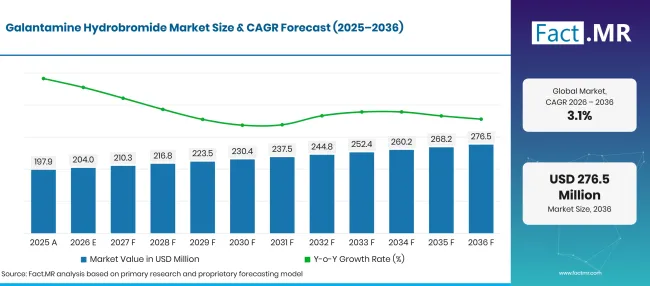
Galantamine Hydrobromide Market Forecast Global | Source: Fact.MR
| Year | Basis | Market Value (USD million) |
|---|---|---|
| 2025 | Actual | 197.9 |
| 2026 | Estimate | 204.0 |
| 2036 | Forecast | 276.5 |
| CAGR 2026 to 2036 | Forecast period | 3.1% |
Source: Fact.MR analysis. Updated Nov 5, 2026
What are the main figures behind Galantamine Hydrobromide Market growth?
The projected increase is USD 72.5 million by 2036. Tablets account for the largest product share, while prescriptions for Alzheimer's dementia and distribution through hospital pharmacies shape the largest market segments.
- Demand Drivers in the Market
- A formal dementia diagnosis gives clinicians a basis for considering appropriate symptomatic treatments. England recorded approximately 483,000 people aged 65 or older with a formal diagnosis of dementia by December 2024, according to an official statistical commentary released in March 2025 [2].
- Pharmacies must keep a reliable supply of each prescribed strength. Interruptions in therapy can require a fresh low-dose start and gradual dose increases, making medicine continuity particularly relevant for older patients and their carers [4].
- Follow-up care matters because galantamine is prescribed to manage symptoms rather than cure Alzheimer's disease. Clinicians review tolerability, adverse effects and the patient's response with caregivers when deciding whether treatment should continue.
- Key Segments Analyzed
- By Product Type: Tablets represent 62.3% of market value in 2026. Oral dosing familiarity and established generic tablet listings help explain their role in routine prescribing.
- By Application: Alzheimer’s Disease accounts for 62.4% of 2026 revenue. Formal symptomatic treatment of Alzheimer’s dementia forms the core clinical use of galantamine.
- By Distribution Channel: Hospital Pharmacies lead with 48.3% of 2026 value. Hospital-linked prescriptions and specialist treatment initiation support this channel.
- Analyst Opinion at Fact.MR
- Shambhu Nath Jha, Principal Consultant at Fact.MR, states, “A proposed buyer-research study would examine the continuity of prescribed galantamine therapy. It would ask neurologists and pharmacists to compare the value of reliable refills with support for gradual dose adjustment.”
- Strategic Implications
- Generic manufacturers should maintain consistency across tablet strengths and publish current regulatory product information so pharmacists can identify the exact preparation prescribed.
- Hospital and community pharmacies both need to identify the precise galantamine formulation and strength ordered by the clinician. A change between immediate-release and extended-release products can affect the administration schedule, so dependable stock records and clear instructions are important during transitions in care.
- Community pharmacists should check treatment continuity and explain the administration schedule to carers without changing the prescriber’s dose instructions.
- Distribution partners should manage stock at the formulation level, since a tablet shortage is not necessarily resolved by availability of a modified-release capsule.
The United Kingdom is forecast to expand at 3.9% CAGR; the USA follows at 3.5%. Brazil is projected at 3.2%, Japan at 2.8%, and Germany at 2.5%. The variation reflects differing diagnosis pathways, established treatment choices and medicine distribution arrangements; individual forecasts concern galantamine hydrobromide rather than the total dementia-treatment category
How does the Galantamine Hydrobromide Market break down by segment?
Tablets account for 62.3%; Alzheimer’s Disease accounts for 62.4%; Hospital Pharmacies account for 48.3% in 2026.
Which Product Type dominates?
Tablets account for 62.3% of market value in 2026.
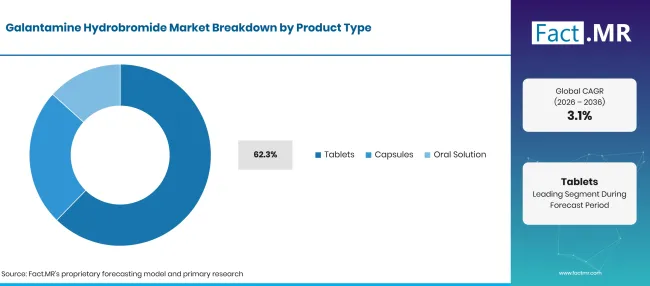
Galantamine Hydrobromide Market Breakdown Product Type | Source: Fact.MR
| Product Type | Share (2026) |
|---|---|
| Tablets (Leading segment) | 62.3% |
| Other segments combined | 37.7% |
| Total | 100.0% |
Source: Fact.MR analysis. Updated Nov 5, 2026
Immediate-release tablets offer prescribers a familiar oral format. Galantamine also comes in extended-release capsules and an oral solution, so these options serve different administration needs rather than separate disease populations. U.S. drug information describes twice-daily tablet dosing and once-daily extended-release capsules [3]. Treatment usually begins at a low dose and rises gradually under medical supervision.
How does Application shape demand?
Alzheimer’s Disease holds a 62.4% share in 2026.
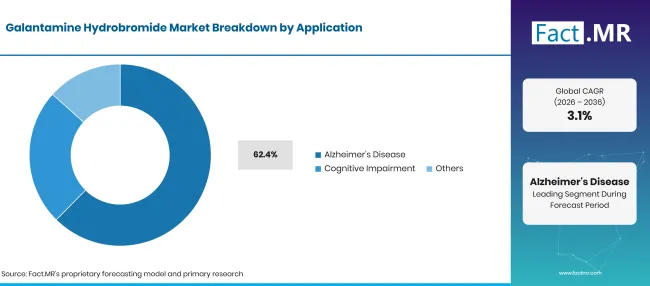
Galantamine Hydrobromide Market Breakdown Application | Source: Fact.MR
| Application | Share (2026) |
|---|---|
| Alzheimer’s Disease (Leading segment) | 62.4% |
| Other applications combined | 37.6% |
| Total | 100.0% |
Source: Fact.MR analysis. Updated Nov 5, 2026
Galantamine hydrobromide is indicated for mild to moderate dementia of the Alzheimer’s type in U.S. prescribing information [5]. Treating those categories as interchangeable would overstate the addressable patient population and weaken the connection between prescription volume and diagnosed disease.
Which Distribution Channel contributes the greatest share?
Hospital Pharmacies lead with 48.3% share in 2026.
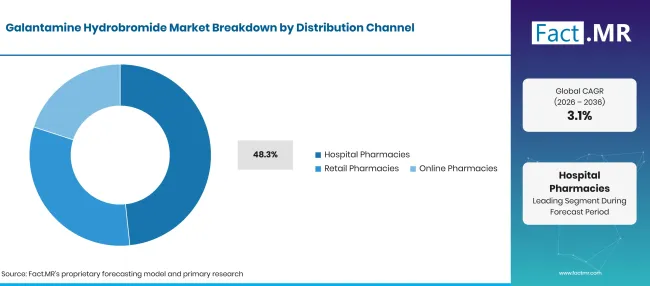
Galantamine Hydrobromide Market Breakdown Distribution Channel | Source: Fact.MR
| Distribution Channel | Share (2026) |
|---|---|
| Hospital Pharmacies (Leading segment) | 48.3% |
| Other channels combined | 51.7% |
| Total | 100.0% |
Source: Fact.MR analysis. Updated Nov 5, 2026
Hospital pharmacies handle prescriptions that arise from specialist assessment and treatment initiation. Their role includes matching the preparation to the physician’s order and explaining dosage changes during care transitions. Retail pharmacies serve repeat dispensing after the treatment plan is established. Online pharmacies form another route where local regulations permit lawful dispensing of prescription medicines.
What is accelerating Galantamine Hydrobromide Market adoption, and what is holding it back?
Assessment for Alzheimer's dementia and continuity of prescribed treatment shape galantamine demand. Clinical suitability, gradual dose adjustment and the availability of alternative medicines also influence prescribing decisions.
Drivers Impact Analysis
| Driver | (~) % IMPACT ON CAGR | Geographic Relevance | Impact Timeline |
|---|---|---|---|
| Ageing patient populations | +0.8% | Global | Long term (4+ years) |
| Specialist diagnosis and initiation | +0.6% | Europe, North America | Medium term (2–4 years) |
| Availability of generic formulations | +0.5% | Global | Short term (under 2 years) |
| Reliable pharmacy refills | +0.4% | Global | Short term (under 2 years) |
| Caregiver-supported adherence | +0.3% | Global | Medium term (2–4 years) |
Source: Fact.MR analysis. Updated Nov 5, 2026
Opportunity Impact Analysis
| Opportunity | (~) % IMPACT ON CAGR | Geographic Relevance | Impact Timeline |
|---|---|---|---|
| Formulation-specific stock management | +0.5% | Global | Short term (under 2 years) |
| Coordination between specialist and community care | +0.4% | Europe, North America | Medium term (2–4 years) |
| Patient and caregiver guidance | +0.3% | Global | Medium term (2–4 years) |
Source: Fact.MR analysis. Updated Nov 5, 2026
Restraints Impact Analysis
| Restraint | (~) % IMPACT ON CAGR | Geographic Relevance | Impact Timeline |
|---|---|---|---|
| Adverse reactions and titration requirements | -0.6% | Global | Short term (under 2 years) |
| Limits of approved use | -0.5% | Global | Long term (4+ years) |
| Alternative symptomatic treatments | -0.4% | Global | Medium term (2–4 years) |
Source: Fact.MR analysis. Updated Nov 5, 2026
Which countries are scaling the Galantamine Hydrobromide Market through 2036?
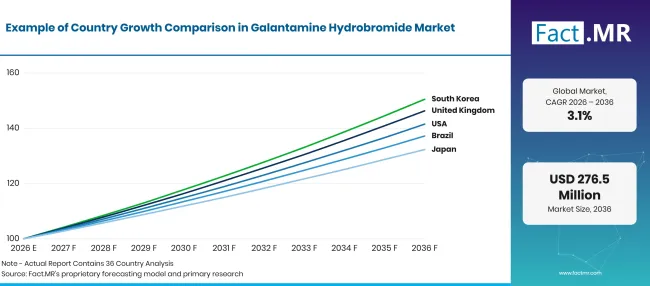
Galantamine Hydrobromide Market Growth Index | Source: Fact.MR
| Country | CAGR (2026 to 2036) |
|---|---|
| United Kingdom | 3.9% |
| USA | 3.5% |
| Brazil | 3.2% |
| Japan | 2.8% |
| Germany | 2.5% |
Source: Fact.MR analysis. Updated Nov 5, 2026
How is the United Kingdom developing galantamine use?
3.9% CAGR, influenced by specialist assessment and prescription follow-up.
UK treatment patterns follow specialist assessment before patients receive galantamine through routine pharmacy services. NHS England's January 2026 publication recorded dementia diagnoses across primary care for December 2025 [7]. The NHS treatment pathway includes galantamine alongside other acetylcholinesterase inhibitors.
What supports the United States market?
3.5% CAGR, linked to diagnosed Alzheimer’s disease and established generics.
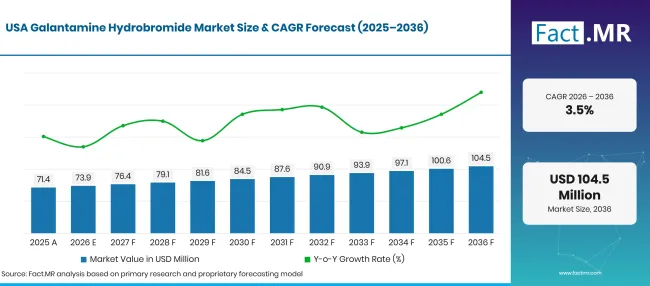
Galantamine Hydrobromide Market Forecast Usa | Source: Fact.MR
The United States combines an extensive Alzheimer’s treatment population with established generic dispensing. The Alzheimer’s Association estimated in April 2026 that 7.4 million Americans aged 65 and older were living with Alzheimer’s dementia [8].
How does Brazil shape galantamine demand?
3.2% CAGR, reflecting ageing and regulated pharmaceutical distribution.
Brazilian demand depends on diagnosis through clinical care and access to authorized oral medicines. Brazil's Ministry of Social Security for 2025 show 8,644,776 residents aged 65 to 69 [9]. Anvisa's medicine reference lists also make presentation-level status important for pharmacies and manufacturers [10].
How is Japan shaping treatment requirements?
2.8% CAGR, amid a large older population and clinical prescribing controls.
Japan's older population places dementia assessment within a large and established healthcare system. The Statistics Bureau estimated approximately 36.24 million people aged 65 or older in its September 2026 release [6]. Treatment choices depend on local authorization and assessment of the particular dementia condition, so demographic totals are better understood as a care-planning indicator.
What shapes Germany’s galantamine market?
2.5% CAGR, linked to ageing and continuity across care settings.
In Germany, continued treatment depends on specialist assessment and practical support from community pharmacies. Destatis reported 19.3 million residents aged 65 or above in its August 2026 statistical release [1]. Population ageing is relevant to dementia service planning, while the prescribed medicine is determined by diagnosis and clinical assessment.
Who leads the Galantamine Hydrobromide Market?
The competitive picture depends on the individual registered preparation.
Sun Pharmaceutical Industries is named on U.S. galantamine hydrobromide extended-release capsule listings, while Aurobindo Pharma appears on U.S. immediate-release tablet and extended-release capsule listings. These product records establish direct participation without assigning company revenue shares. Prescribers and pharmacy buyers evaluate approved strengths, supply continuity and product information as well as price.
Which companies are the key providers?
Key companies include Sun Pharmaceutical Industries Ltd.; Viatris Inc. / Mylan; Zydus Lifesciences Ltd.; Apotex Inc.; Aurobindo Pharma Limited.
- Sun Pharmaceutical Industries Ltd.
- Viatris Inc. / Mylan
- Zydus Lifesciences Ltd.
- Apotex Inc.
- Aurobindo Pharma Limited
How is the market segmented?
-
By Product Type
- Tablets
- Capsules
- Oral Solution
-
By Application
- Alzheimer’s Disease
- Cognitive Impairment
- Others
-
By Distribution Channel
- Hospital Pharmacies
- Retail Pharmacies
- Online Pharmacies
-
By Region
- North America
- Latin America
- Western Europe
- Eastern Europe
- East Asia
- South Asia & Pacific
- Middle East & Africa
Bibliography
- [1]Statistisches Bundesamt (Destatis). (2026, August 18). Ältere Menschen: Bevölkerung ab 65 Jahren.
- [2] Office for Health Improvement and Disparities. (2025, March 4). Dementia profile: Prevalence and supporting well topics statistical commentary, March 2025. GOV.UK.
- [3] National Library of Medicine. (2026, August 15). Galantamine: MedlinePlus drug information.
- [4] NHS Scotland. (2026). Treatment initiation and follow-up of cholinesterase inhibitors in patients newly diagnosed with dementia.
- [5] National Library of Medicine. (2026). DailyMed: Galantamine search results.
- [6] Statistics Bureau of Japan. (2026, September 20). Statistical Topics No. 149: Older persons in Japan.
- [7] NHS England. (2026, January 22). Primary Care Dementia Data, December 2025.
- [8] National Institute on Aging. (2026). 2026 NIH Alzheimer’s Disease and Related Dementias Research Progress Report: Advances and achievements.
- [9] Ministério da Previdência Social. (2026, October 26). População residente por situação do domicílio e sexo, segundo os grupos de idade: 2023/2025.
- [10] Agência Nacional de Vigilância Sanitária. (2025, February 5). Lista A de medicamentos de referência excluídos.
This Report Answers
- The report examines how immediate-release tablets, extended-release capsules and oral solution fit distinct administration requirements.
- Application analysis distinguishes the approved Alzheimer’s dementia indication from wider cognitive-impairment classifications.
- Distribution analysis considers hospital-led initiation, ongoing retail dispensing and lawful online prescription supply.
- Country coverage compares the United Kingdom, USA, Brazil, Japan and Germany using their individual forecast rates.
- Competitive analysis focuses on formulation-specific listings and product availability rather than unsupported company-share estimates.
What does the Galantamine Hydrobromide Market cover?
The market covers prescription presentations containing galantamine hydrobromide. It considers oral tablets, capsules and liquid preparations used within a clinician’s treatment plan for Alzheimer’s dementia. Commercial demand is measured across relevant pharmaceutical channels.
What is included in the scope?
Sales of relevant galantamine hydrobromide preparations through hospital pharmacies, retail pharmacies and lawful online pharmacy channels are included.
The analysis follows approved dosage presentations and the treatment setting in which they reach patients.
What is excluded from the scope?
Other active ingredients used in dementia care are excluded from market revenue. Diagnostic tests, caregiver services and medicines intended for unrelated disorders are outside the boundary.
General cognitive concerns without an approved galantamine indication are not treated as established prescriptions.
How Was the Analysis Built?
The analysis draws on 120+ sources, 35+ company portfolios, 25+ countries, and more than 20 industry interviews.
- Primary Research: Primary research includes discussions with manufacturers, service providers, technology developers, distributors, end users, and subject-matter experts. These conversations examine purchasing priorities, product adoption, operational challenges, approval requirements, competitive positioning, and the factors that influence wider market acceptance.
- Desk Research: Desk research covers government statistics, regulatory publications, company filings, trade data, technical studies, industry associations, standards, public policy, and other authoritative sources. Every source used in the analysis is documented in the bibliography.
- Market Sizing and Forecasting: Market estimates combine historical performance, demand indicators, pricing and volume trends, segment shares, company participation, country-level growth, adoption patterns, investment activity, and barriers to market expansion.
- Data Validation and Update Cycle: Findings are validated by comparing primary interviews with public data, company activity, regulatory changes, trade patterns, and industry developments. Regular updates review new product launches, capacity changes, partnerships, approvals, and shifts in commercial adoption.
Segmentation
What is the report’s scope and coverage?
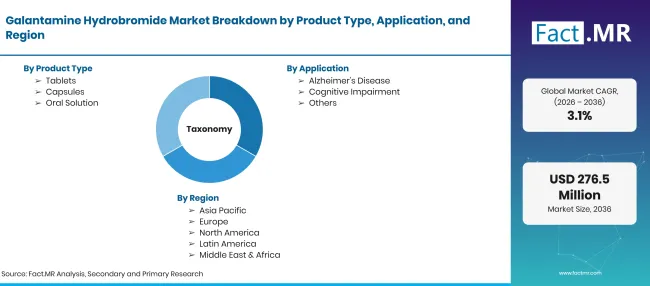
Galantamine Hydrobromide Market Taxonomy | Source: Fact.MR
| Attribute | Details |
|---|---|
| Quantitative Units | USD million |
| Market Definition | Prescription medicines containing galantamine hydrobromide for symptomatic Alzheimer’s dementia care. |
| Product Type | Tablets; Capsules; Oral Solution |
| Application | Alzheimer’s Disease; Cognitive Impairment; Others (market classifications subject to approved indications) |
| Distribution Channel | Hospital Pharmacies; Retail Pharmacies; Online Pharmacies |
| Regions Covered | North America; Latin America; Western Europe; Eastern Europe; East Asia; South Asia & Pacific; Middle East & Africa |
| Countries Covered | United Kingdom; USA; Brazil; Japan; Germany |
| Companies Profiled | Sun Pharmaceutical Industries Ltd.; Viatris Inc. / Mylan; Zydus Lifesciences Ltd.; Apotex Inc.; Aurobindo Pharma Limited. |
| Forecast Period | 2026 to 2036 |
| Approach | Clinical indication review, product-formulation checks, public demographic evidence and country-level forecast analysis |
Source: Fact.MR analysis. Updated Nov 5, 2026
Frequently Asked Questions
How big is the galantamine hydrobromide market in 2026?
What is the market CAGR from 2026 to 2036?
Which product type holds the main share?
Which application holds the main share?
Which companies are discussed?
Who worked on this report


Preview the report firsthand - request a free sample
Free SampleGet the brochure for pricing and purchase details
Download PDF