- Base Value(2025): 3.5 Bn
- Estimated Value(2026): 3.8 Bn
- Forecast Value (2036): 8.2 Bn
- CAGR (2026 - 2036): 7.9%
Halogen-Free Flame Retardant Polymers Market Forecast and Outlook 2026 to 2036
In 2025, the halogen-free flame retardant polymers market was valued at USD 3.5 billion. Based on Fact.MR analysis, demand for halogen-free flame retardant polymers is estimated to grow to USD 3.8 billion in 2026 and USD 8.2 billion by 2036. FACT.MR projects a CAGR of 7.9% during the forecast period.
The absolute dollar growth from 2026 to 2036 represents an incremental gain of USD 4.4 billion, a transformation driven less by volume displacement than by regulatory value migration, as electronics and automotive OEMs systematically re-specify legacy halogenated flame retardants with halogen-free alternatives costing 25-60% premium per kilogram but delivering compliance certainty under EU RoHS Directive, California Proposition 65, and emerging Chinese GB standards.
Angela Cackovich, Business President Adsorbents & Additives at Clariant states that, "This joint venture marks an important step in our commitment to developing flame retardants that solve both performance needs and regulatory concerns. We're combining expertise to create solutions that will help our customers stay ahead of regulatory changes while maintaining the highest performance standards."
China leads with a 12.5% CAGR, supported by GB/T 4943.1 halogen-free standards and its massive electronics and EV manufacturing base. The United States follows at 11.8%, driven by California Proposition 65 restrictions and wider adoption of phosphorus-based systems meeting UL V-0 standards. Germany grows at 10.5% as automotive OEMs specify lightweight, halogen-free polyamide parts and EU RoHS enforcement remains strict. Japan records 9.8% CAGR, with steady demand but limited new substitution due to already mature adoption.
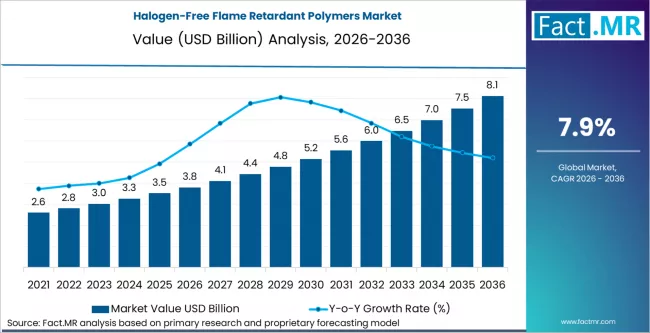
Halogen Free Flame Retardant Polymers Market Market Value Analysis | Source: Fact.MR
Market Definition
Halogen-free flame retardant polymers are plastic compounds that use phosphorus, nitrogen, or mineral-based additives instead of bromine or chlorine to reduce fire risk. They are widely used in electronics housings, automotive components, wires, and construction materials where fire safety ratings must be met without releasing toxic halogens.
Market Inclusions
The report covers global and regional market size from 2026 to 2036, segmented by material type, application, end-use industry, and geography. It analyzes pricing trends, compatibility with different polymer bases, and compliance with UL and IEC fire standards.
Market Exclusions
Halogenated flame retardants, surface-treated textiles, coatings, and finished consumer products are excluded. The focus is on compounded polymer resins supplied to processors.
Research Methodology
- Primary Research: Primary research involved structured interviews with polymer compounding chemists at Clariant, BASF, and ICL; procurement managers at electronics contract manufacturers including Foxconn and Flex; and automotive materials engineers at BMW, Volkswagen, and General Motors purchasing flame retardant polyamide and polypropylene compounds.
- Desk Research: Desk research synthesized data from UL Prospector flame retardant polymer database, European Chemicals Agency REACH registration dossiers for phosphorus flame retardants, and disclosed segment revenues from publicly listed specialty chemical producers including Lanxess and Albemarle.
- Market-Sizing and Forecasting: Market sizing employed a bottom-up approach, building from electronics and automotive production volumes by region, average polymer content per unit, flame retardant loading rates by polymer matrix (10-25% by weight), and compound selling prices validated against compounder list pricing and large-account contract disclosures.
- Data Validation and Update Cycle: Outputs were cross-validated against quarterly earnings disclosures from Lanxess High Performance Materials and Clariant Care Chemicals divisions, and reconciled semi-annually with UL Yellow Card updated listings for newly recognized halogen-free flame retardant formulations and polymer matrix combinations achieving V-0 ratings.
Summary
-
Market Definition
- Halogen-free flame retardant polymers are thermoplastic and thermoset compounds sold to electronics, automotive, and construction manufacturers incorporating phosphorus, nitrogen, or mineral-based additives achieving UL 94 fire safety ratings without brominated or chlorinated flame retardants restricted under RoHS, REACH, and regional environmental regulations.
-
Demand Drivers
- EU Green Deal and Circular Economy Action Plan targets are accelerating the shift toward safer material chemistry in electronics and construction, encouraging OEMs to eliminate brominated and chlorinated flame retardants from new product designs across consumer electronics, appliances, and building materials.
- Global EV production growth is increasing demand for halogen-free flame retardant polymers in battery modules, high-voltage connectors, and charging infrastructure, where thermal stability, low smoke emission, and compliance with international fire safety standards are critical.
- Stricter building fire codes across North America and Asia Pacific are driving adoption of halogen-free compounds in wire and cable insulation, particularly in commercial and high-rise construction where low-smoke, low-toxicity performance is mandated for occupant safety.
-
Key Segments Analyzed
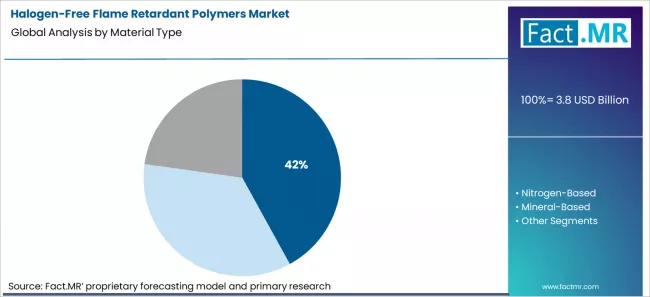
- By Material Type, Phosphorus-Based flame retardants command 42% share, reflecting their efficacy in engineering thermoplastics including polyamide, polycarbonate, and polyester at 10-18% loading achieving UL 94 V-0 ratings while maintaining mechanical properties superior to mineral-filled alternatives requiring 40-60% loading that degrades impact strength.
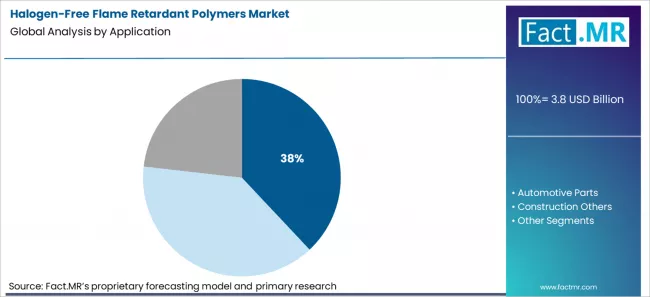
- By Application, E&E Components hold 38% share as consumer electronics housings, connectors, and PCB substrates represent the highest regulatory enforcement intensity under RoHS and the most stringent flammability requirements where 0.4-0.8mm wall thickness housings must achieve UL 94 V-0 or 5VA ratings.
- By End-Use Industry, Electronics leads with 35% share driven by smartphone, laptop, tablet, and charger production volumes exceeding 2.5 billion units annually requiring halogen-free flame retardant polymers under buyer specifications from Apple, Samsung, Dell, and HP mandating RoHS compliance throughout supply chains.
-
Analyst Opinion at FACT.MR
- Shambhu Nath Jha, Principal Consultant at Fact.MR, opines, 'CXOs will find this report valuable for understanding how regulatory pathway divergence between brominated flame retardant phase-outs and halogen-free system approvals creates asymmetric market access where first-mover compounders achieving UL recognition for novel phosphorus-nitrogen packages capture specification lock-in lasting 3-5 product generation cycles before competitors qualify equivalent alternatives.'
-
Strategic Implications / Executive Takeaways
- Polymer compounders should prioritize UL 94 testing and secure Yellow Card listings across key resin families such as PA, PC, PBT, and PP. OEM buyers value proven compliance and recall risk reduction more than small material cost savings.
- Electronics manufacturers should qualify at least two halogen-free suppliers for high-volume parts. A balanced sourcing strategy protects supply continuity while maintaining pricing leverage.
- Automotive Tier 1 suppliers should move early toward phosphorus-based systems in structural polyamides. Proactive transition avoids costly requalification cycles and strengthens ESG positioning.
-
Methodology
- Market estimates were built using electronics and vehicle production data combined with typical flame retardant loading rates and validated compound pricing benchmarks.
- Compliance cost modeling factored in UL testing fees, REACH registration expenses, and RoHS documentation requirements to assess total cost of ownership.
- Adoption trends were tracked using UL certification records, patent filings, and publicly disclosed R&D investments from leading specialty chemical companies.
Segmental Analysis
Halogen-Free Flame Retardant Polymers Market Analysis by Material Type
Halogen Free Flame Retardant Polymers Market Analysis By Material Type | Source: Fact.MR
Based on FACT.MR’s analysis, phosphorus-based flame retardants hold a 42% share in 2025. They lead because they can achieve UL 94 V-0 ratings at relatively low loadings of 10-18% in engineering plastics such as polyamide, polycarbonate, and PBT, while largely preserving strength and impact properties. Compared to mineral-filled systems that require very high loading and weaken the base resin, phosphorus systems offer a better balance between fire safety and mechanical performance.
- Clariant’s Exolit OP capacity expansion in 2024 supports rising EV and automotive demand [4].
- ICL’s microencapsulated red phosphorus technology improves color stability and shelf life, opening applications in visible consumer electronics parts [5].
- Research on phosphorus-nitrogen synergy further shows improved flame performance at lower loadings [6].
Halogen-Free Flame Retardant Polymers Market Analysis by Application
Halogen Free Flame Retardant Polymers Market Analysis By Application | Source: Fact.MR
Based on FACT.MR’s analysis, E&E components account for 38% share in 2025. Electronics dominate demand because this sector faces the toughest regulatory scrutiny under EU RoHS, China RoHS, and California Proposition 65, while also requiring high fire safety performance such as UL 94 V-0 or 5VA at thin wall thicknesses. Power supply housings, connectors, adapters, and circuit board parts must meet strict flammability and electrical safety standards, making halogen-free phosphorus-based systems the preferred solution.
- Apple Halogen-Free Product Line: Apple’s 2024 Environmental Progress Report confirms that recent iPhone, MacBook, and iPad models use halogen-free flame retardant polymers across internal plastic components, achieving UL 94 V-0 with phosphorus-based materials [7].
- USB-C Connector Fire Safety Requirements: Updated USB-C specifications require V-0 compliance for high-power cables above 100W, accelerating the shift toward halogen-free reinforced polyamide compounds in billions of connectors annually [8].
- IEC 62368-1 Regulatory Transition: The global shift to IEC 62368-1 safety standards forced manufacturers to requalify materials, driving significant migration from HB-rated systems to premium halogen-free V-0 formulations between 2020 and 2023 [9].
Drivers, Restraints, and Opportunities
Fact.MR analysis shows the halogen-free flame retardant polymers market is shaped by a clear regulatory versus performance challenge. Environmental rules such as RoHS and REACH restrict brominated and chlorinated flame retardants, while fire safety standards like UL 94 and IEC still demand the same high flammability ratings. Manufacturers must therefore meet V-0 performance using additives that are less efficient per unit weight than legacy brominated systems.
Halogen-free solutions were limited to thick-wall parts because mineral fillers required very high loading, weakening mechanical strength. Advances in phosphorus-nitrogen synergist systems changed this dynamic. These technologies now achieve V-0 ratings in thin-wall electronics and automotive components at lower loadings, preserving strength and impact resistance.
- Regulatory actions such as the EU RoHS DecaBDE restriction [1], China’s EV battery safety standard GB 38031-2020 [2], and the UL 94 certification process [3] continue to drive structured material replacement.
- By material type, phosphorus-based flame retardants hold 42% share in 2025 due to their balance of performance and mechanical retention.
- By application, electronics and electrical components account for 38% share, supported by global OEM halogen-free specifications and evolving IEC safety standards [9].
Regional Analysis
The halogen-free flame retardant polymers market is analyzed across North America, Europe, Asia-Pacific, Latin America, and Middle East. Regional adoption intensity is shaped by RoHS enforcement rigor, automotive light weighting program maturity, electronics manufacturing concentration, and fire safety code stringency. The report offers detailed market attractiveness analysis comparing regulatory compliance costs, UL recognition prevalence, and compounder competitive landscapes across regions.
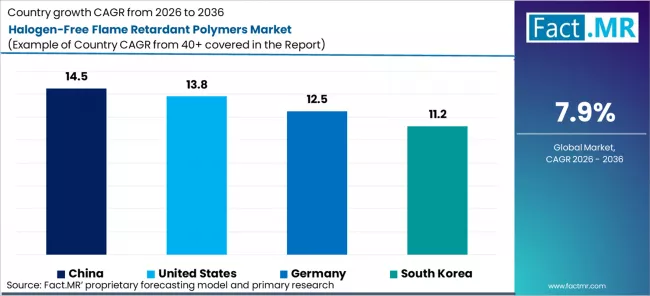
Halogen Free Flame Retardant Polymers Market Cagr Analysis By Country | Source: Fact.MR
| Country | CAGR% |
|---|---|
| China | 14.5% |
| United States | 13.8% |
| Germany | 12.5% |
| South Korea | 11.2% |
Source: Fact.MR analysis. Updated Feb 21, 2026
Source: Fact.MR (FACT.MR) analysis, based on proprietary forecasting model and primary research
Europe Halogen-Free Flame Retardant Polymers Market
Europe remains the global policy leader for halogen-free flame retardants, driven by RoHS and REACH enforcement. Regional producers such as Clariant, Lanxess, and BASF benefit from integrated chemical operations and close ties to German automotive OEM engineering hubs. EU export exposure further amplifies regulatory influence beyond Europe.
- Germany: Demand in Germany is projected to grow at 10.5% CAGR through 2036. Updated Chemicals Prohibition Ordinance rules now extend halogen restrictions to building electrical materials, expanding adoption into renovation and new housing projects. Automotive electrification is another major driver. Volkswagen’s updated material standards for its EV platforms require very low total halogen content, forcing suppliers to shift from brominated to phosphorus-based systems.
FACT.MR’s Europe analysis covers Germany, France, the United Kingdom, Italy, Spain, the Netherlands, Poland, the Czech Republic, and Sweden, highlighting OEM timelines and compounder expansion plans.
North America Halogen-Free Flame Retardant Polymers Market
North America is a performance-driven market where UL 94 Yellow Card recognition defines commercial acceptance. U.S. certification processes heavily influence global material specifications. Clariant and BASF supply automotive OEMs from domestic facilities, while California regulations often set the compliance tone nationally.
- United States: Demand is projected to rise at 11.8% CAGR through 2036. California Proposition 65 restrictions on brominated flame retardants have encouraged electronics brands to eliminate halogenated systems nationwide. The EPA’s evolving TSCA reviews are also pushing reformulation toward newer phosphorus-nitrogen chemistries. Automotive electrification adds momentum. General Motors has committed funding to transition suppliers toward halogen-free materials for EV battery and connector systems.
FACT.MR’s North America coverage includes the United States, Canada, and Mexico, with detailed insights into UL certification trends and automotive adoption roadmaps.
Asia-Pacific Halogen-Free Flame Retardant Polymers Market
Asia-Pacific combines the world’s largest electronics base with rapid EV expansion and evolving national standards. Domestic compounders compete alongside multinational suppliers, while contract manufacturers drive specification upgrades across supply chains.
- China: Demand is projected to grow at 12.5% CAGR through 2036. Mandatory IT equipment safety standards now require halogen-free materials in power supplies and adapters, affecting large-scale electronics production. Government green manufacturing policies further support adoption in public procurement. EV growth also plays a major role, with domestic automakers integrating glass-fiber reinforced halogen-free polyamide in battery and structural applications. Local production capacity expansion has shortened lead times and improved cost competitiveness.
- Japan: Demand is projected to grow at 9.8% CAGR through 2036. Updated safety laws aligned with IEC standards require thin-wall V-0 performance in electronics, accelerating adoption of phosphorus-based systems. Leading brands such as Sony and Panasonic are increasing halogen-free content across electronics and EV components. Japanese material suppliers are also developing bio-based halogen-free polymers to align with sustainability targets.
FACT.MR’s Asia-Pacific assessment covers China, Japan, South Korea, India, Taiwan, Thailand, Vietnam, Indonesia, and Malaysia, focusing on national standards, domestic compound competition, and electronics supply chain adoption rates.
Competitive Aligners for Market Players
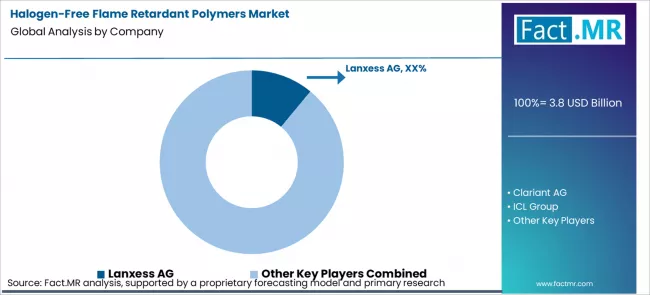
Halogen Free Flame Retardant Polymers Market Analysis By Company | Source: Fact.MR
The halogen-free flame retardant polymers market is moderately concentrated at the additive level. Leading suppliers including Clariant, BASF, Lanxess, ICL, and Albemarle corporation contribute maximum share of the phosphorus- and nitrogen-based flame retardant segment by value. However, the finished compound market remains fragmented, with more than 300 regional compounders blending additives into polyamide, polycarbonate, and polypropylene grades. Competitive strength is largely defined by the breadth of UL 94 Yellow Card certifications across multiple polymer types, wall thicknesses, and colors. OEM buyers in electronics and automotive often prioritize certification depth and compliance certainty over small price differences. Mineral-based systems such as aluminum trihydroxide follow more commodity-style pricing dynamics.
Structural advantages favor vertically integrated producers. Companies such as Clariant and ICL benefit from proprietary phosphorus chemistry and upstream feedstock control, improving cost efficiency in high-volume automotive and EV applications. BASF and Lanxess leverage their polyamide resin platforms to offer integrated resin-plus-flame-retardant solutions, reducing supply chain complexity for OEMs.
Buyer behavior differs by segment. Major electronics and automotive OEMs run multi-year qualification programs and select a limited number of approved suppliers under long-term contracts. Meanwhile, construction and appliance manufacturers focus more on price competitiveness and maintain multi-source procurement strategies.
Recent Development
- In 2025, Huber Advanced Materials renewed its distribution partnership with Nordmann, expanding commercial availability of halogen-free flame-retardant additives like aluminum hydroxides and magnesium hydroxides across elastomer, rubber, and polymer applications.
- In 2025, Envalior launched a new halogen-free flame-retardant PBT compound called Pocan® BFN4232ZHR S1 at K 2025, designed for high-voltage connectors, AI data center power systems, and electric vehicle components with UL 94 V-0 performance and strong mechanical properties.
Bibliography
- People's Republic of China State Administration for Market Regulation, GB 38031-2020 Electric Vehicle Battery Safety Standard.
- UL Solutions. (2024). UL 94 Standard for Tests for Flammability of Plastic Materials for Parts in Devices and Appliances.
- Clariant AG. (2024, March). Exolit OP Capacity Expansion Announcement Knapsack Facility Investment.
- ICL Group Ltd. (2024, June). 2024 Investor Day Presentation Advanced Phosphorus Flame Retardant Pipeline.
- Zhang, Y., et al. (2023, September). Synergistic Effects of Phosphorus-Nitrogen Flame Retardants in Polyamide 6. Polymer Degradation and Stability, 215, 110455.
- Apple Inc. (2024, April). 2024 Environmental Progress Report Product Material Specifications.
- USB Implementers Forum. (2022, August). USB Type-C Cable and Connector Specification Revision 2.1 Safety Requirements.
- International Electro Technical Commission. (2020, December). IEC 62368-1 Audio/Video, IT and Communication Equipment Safety Standard.
This Report Addresses
- Market intelligence for strategic planning: comprehensive analysis of halogen-free flame retardant technology evolution, RoHS and REACH regulatory compliance pathways, UL 94 recognition strategies, and phosphorus-nitrogen synergist chemistry development trajectories shaping material specification decisions across electronics, automotive, and construction end-uses.
- Market size and forecast: global halogen-free flame retardant polymers market valued at USD 3.8 billion in 2025, projected to reach USD 8.2 billion by 2036 at 7.9% CAGR, with segment-level sizing by material type, application, end-use industry, polymer matrix, and regional market.
- Growth opportunity mapping: identification of high-value subsegments including phosphorus-based systems for thin-wall electronics (0.4-1.0mm), EV battery enclosures requiring V-0 at elevated temperatures, and bio-based halogen-free polymers meeting OEM sustainability targets where premium pricing and regulatory mandates sustain above-market growth rates.
- Segment and regional forecasts: country-level CAGR analysis for China (12.5%), United States (11.8%), Germany (10.5%), Japan (9.8%), and 10+ additional markets, with material type and application breakdowns revealing regulatory compliance driver geographic dispersion and electronics-versus-automotive demand balance.
- Competition strategy assessment: competitive positioning of Clariant, BASF, Lanxess, ICL, Albemarle, and regional challengers, including UL 94 Yellow Card portfolio breadth, phosphorus feedstock vertical integration, automotive OEM specification lock-in advantages, and China domestic compounder cost competitiveness analysis.
- Product and compliance tracking: regulatory impact analysis of EU RoHS DecaBDE restriction timeline, China GB 4943.1 halogen-free mandates, California Proposition 65 enforcement precedents, and IEC 62368-1 flammability test method updates reshaping polymer formulation and supplier qualification requirements.
- Total cost of ownership modeling: comparative analysis incorporating raw material costs, UL 94 testing fees (USD 8,000-12,000 per formulation), REACH registration expenses (EUR 80,000-150,000), processing modifications, and mechanical property trade-offs to quantify halogen-free premium versus brominated systems at part-level economics.
- Report delivery formats: Excel data tables with segment-level volume and value forecasts and compound pricing trajectories by polymer matrix, PowerPoint executive summary with regulatory timeline Gantt charts and UL recognition competitive landscapes, and PDF comprehensive report with verifiable chemical society journal and regulatory agency source citations.
Segmentation
Key Players
- Lanxess AG
- Clariant AG
- ICL Group
- Albemarle Corporation
- BASF SE
Scope of Report
| Items | Values |
|---|---|
| Quantitative Units | USD 3.8 billion (2026) to USD 8.2billion (2036), at a CAGR of 7.9% |
| Market Definition | Halogen-free flame retardant polymers are plastic compounds that use phosphorus, nitrogen, or mineral-based additives instead of bromine or chlorine to reduce fire risk. |
| By Material Type | Phosphorus-Based, Nitrogen-Based, Mineral-Based |
| By Application | E&E Components, Automotive Parts, Construction Others |
| By End-Use Industry | Electronics, Automotive, Construction |
| Regions Covered | Asia Pacific, Europe, North America, Latin America, Middle East & Africa |
| Countries Covered | China, Japan, South Korea, Australia & New Zealand, India, ASEAN, Rest of Asia Pacific, Norway, Germany, United Kingdom, France, Spain, Netherlands, Nordics, Rest of Europe, United States, Canada, Mexico, Brazil, Chile, Ecuador, Rest of Latin America, Kingdom of Saudi Arabia, United Arab Emirates, South Africa, Turkey, Rest of Middle East & Africa |
| Key Companies Profiled | Lanxess AG, Clariant AG, ICL Group Ltd., Albemarle Corporation, and BASF SE. |
| Forecast Period | 2026 to 2036 |
| Approach | Top-down and bottom-up market modeling validated through primary interviews with polymer compounders, flame retardant additive manufacturers, automotive and electronics OEM material engineers, and UL compliance specialists. Estimates were cross-verified using UL Yellow Card listings, RoHS and REACH regulatory disclosures. |
Source: Fact.MR analysis. Updated Feb 21, 2026
Halogen-Free Flame Retardant Polymers Market Key Segments
-
By Material Type :
- Phosphorus-Based
- Nitrogen-Based
- Mineral-Based
-
By Application :
- E&E Components
- Automotive Parts
- Construction Others
-
By End-Use Industry :
- Electronics
- Automotive
- Construction
-
Region :
- Asia Pacific
- China
- Japan
- South Korea
- Australia & New Zealand
- India
- ASEAN
- Rest of Asia Pacific
- Europe
- Norway
- Germany
- United Kingdom
- France
- Spain
- Netherlands
- Nordics
- Rest of Europe
- North America
- United States
- Canada
- Mexico
- Latin America
- Brazil
- Chile
- Ecuador
- Rest of Latin America
- Middle East & Africa
- Kingdom of Saudi Arabia
- United Arab Emirates
- South Africa
- Turkey
- Rest of Middle East & Africa
- Asia Pacific
Frequently Asked Questions
How large is the halogen-free flame retardant polymers market in 2025?
What will the market size be in 2026?
What is the projected market size by 2036?
What is the expected CAGR for the forecast period 2026 to 2036?
Which Material Type segment holds the largest market share?
Which Application segment leads the market?
Which End-Use Industry dominates?
What is the absolute dollar growth from 2026 to 2036?
Which country shows the fastest growth rate?
How do Mineral-Based flame retardants perform?
How significant is Germany's market?
What is Japan's growth trajectory?
How do Nitrogen-Based systems compare?
Who worked on this report


Preview the report firsthand - request a free sample
Free SampleGet the brochure for pricing and purchase details
Download PDF