Floor Degreasers Market (2026 - 2036)
Floor Degreasers Market Size and Share Forecast Outlook 2026 to 2036
Core Findings
Floor Degreasers Market Forecast and Outlook 2026 to 2036
The floor degreasers market is expected to reach USD 2,677.5 million in 2026 and expand to USD 4,279.0 million by 2036, registering a CAGR of 4.8%. Growth is increasingly driven by a shift away from high-odor, caustic formulations toward substrate-specific, low-foam chemistries designed for modern facilities. Procurement priorities now emphasize compatibility with autonomous scrubbers, protection of epoxy and resin floors, and measurable improvements in indoor air quality across food processing, retail, and light industrial environments.
Floor Degreasers Market Key Takeaways
- Market Value in 2026: USD 2,677.5 million
- Market Forecast Value in 2036: USD 4,279.0 million
- Market Forecast CAGR (2026-2036): 4.8%
- Dominant Chemistry: Alkaline Degreasers with 44.0% market share
- Leading Application Area: Foodservice Kitchens with 34.0% market share
- Key Market Players: Ecolab, Diversey, SC Johnson Professional, 3M, Zep, Betco, Spartan Chemical, CloroxPro, P&G Professional, Unilever Professional
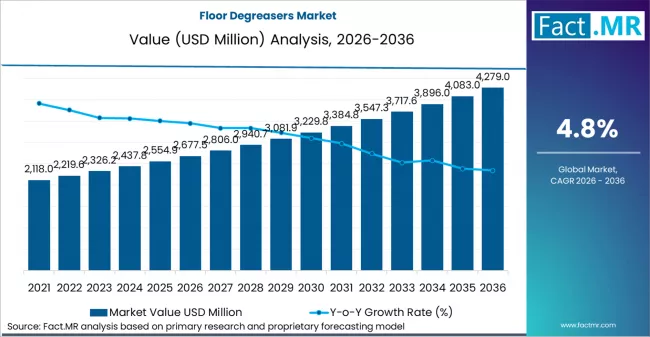
Industry leaders are redefining value through formulation precision and delivery format innovation. Ecolab’s rollout of the ReadyDose™ Cleaning Program reflects a move toward solid-state dosing systems that eliminate overuse, reduce logistics emissions, and ensure consistent cleaning outcomes across multi-site operations. Zep’s expansion of industrial-grade mist degreasers into mass retail channels signals rising demand from small businesses and facility managers seeking fast grease removal without solvent fumes. In parallel, Solenis, following its integration of Diversey, is positioning degreasers within a broader “chemistry-as-a-service” model that links cleaning performance directly to water, energy, and labor efficiency.
Floor Degreasers Market
| Metric | Value |
|---|---|
| Estimated Value in (2026E) | USD 2,677.5 million |
| Forecast Value in (2036F) | USD 4,279.0 million |
| Forecast CAGR (2026 to 2036) | 4.8% |
Category
| Category | Segments |
|---|---|
| Chemistry | Alkaline Degreasers; Solvent-Assisted Degreasers; Enzymatic / Bio-Based Degreasers; Other Chemistries |
| Application Area | Foodservice Kitchens; Industrial Floors & Shops; Retail / Commercial Back-of-House; Other Areas |
| Form | Concentrates; RTU Sprays; Foaming Products; Other Forms |
| End-Use Sector | Hospitality & Foodservice; Industrial & Manufacturing; Commercial Buildings; Other Sectors |
| Region | North America; Europe; Asia Pacific; Latin America; Middle East & Africa |
Segmental Analysis
What Is the Impact of Chemistry on the Floor Degreasers Market?
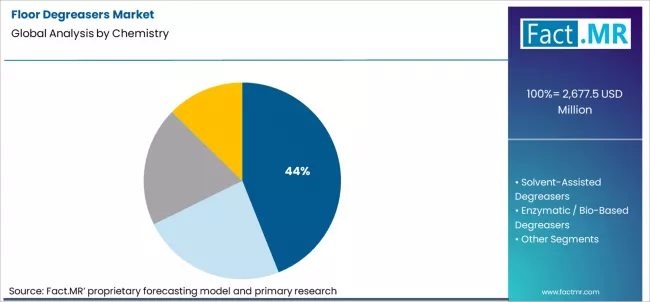
In the floor degreasers market, chemistry choice is driven by grease loading intensity, cleaning frequency, and surface compatibility in professional environments. Alkaline degreasers hold a 44.0% share because they effectively saponify animal fats, cooking oils, and petroleum residues commonly found on commercial and industrial floors. These formulations perform reliably on concrete, quarry tile, and epoxy-coated surfaces without requiring extended dwell times. Their dominance is reinforced by widespread approval for use with automatic scrubbers and manual mop systems in regulated cleaning protocols where predictable grease removal and rinse efficiency are operational priorities.
How Does Application Area Influence Demand in the Floor Degreasers Market?
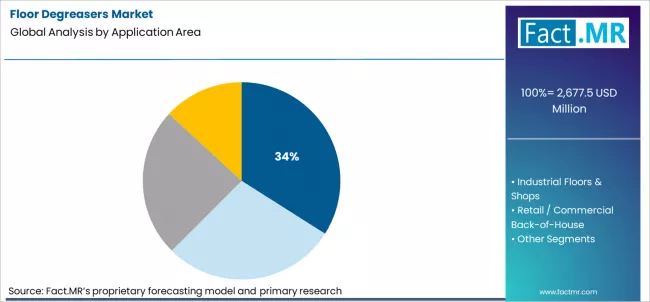
Application area strongly shapes purchasing volume and formulation preference due to safety compliance and sanitation intensity. Foodservice kitchens account for a 34.0% share as floors in commercial kitchens accumulate grease overspray, protein residues, and slip hazards on a daily basis. Degreasing is performed multiple times per shift to meet hygiene audits and workplace safety standards. Demand is concentrated in quick service restaurants, central kitchens, and institutional food preparation facilities where failure to control floor grease directly increases accident risk, inspection failures, and operational downtime.
What are the Drivers, Restraints, and Key Trends in the Floor Degreasers Market?
| Country | Driver | Restraint | Trend |
|---|---|---|---|
| USA | Strong demand from commercial and industrial cleaning services for heavy-duty degreasing solutions. | Higher cost of specialized degreasers compared with general cleaners. | Growth in eco-friendly, low-VOC, and biodegradable floor degreaser products. |
| UK | Strict hygiene and safety standards in public and institutional facilities. | Budget constraints in small businesses limiting premium product adoption. | Increased use of ready-to-use and concentrated floor degreaser formulations. |
| Germany | Well-established industrial base with high sanitation standards. | Complex chemical compliance and environmental restrictions. | Adoption of automated dosing systems and enzyme-enhanced degreasers. |
| China | Rapid expansion of commercial spaces and industrial facilities boosting cleaning chemical demand. | Price sensitivity and competition from lower-cost local products. | Growth in locally formulated, performance-driven floor degreasers. |
| India | Rising awareness of cleanliness across retail, hospitality, and public sectors. | Limited awareness of specialized degreasing chemistries in smaller markets. | Increasing preference for packaged degreasing systems with support services. |
Analysis of the Floor Degreasers Market by Key Country
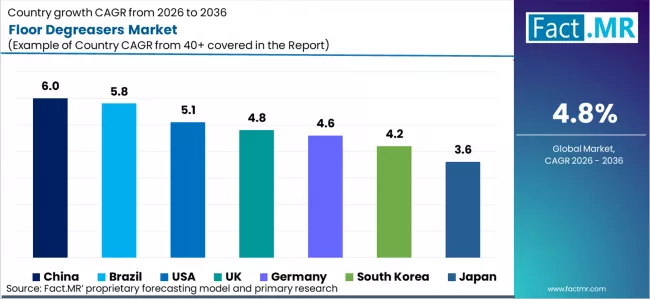
| Country | CAGR (%) |
|---|---|
| China | 6.0% |
| Brazil | 5.8% |
| USA | 5.1% |
| UK | 4.8% |
| Germany | 4.6% |
| South Korea | 4.2% |
| Japan | 3.6% |
The report covers an in-depth analysis of 40+ countries; top-performing countries are highlighted below.
How is the USA market evolving in the Floor Degreasers sector?
The USA market is forecast to grow at 5.1%, sustained by demand from commercial, industrial, and institutional segments where stringent hygiene and maintenance standards increasingly prioritize effective degreasing performance. Floor degreasers are essential in manufacturing facilities, food processing plants, and automotive service centers because they remove oil, grease, and particulate residues that compromise surface safety and operational efficiency. According to the American Cleaning Institute, facility managers are specifying high-performance degreasers that balance strong cleaning power with improved worker safety and reduced environmental impact.
“Advanced enzymatic and surfactant-enhanced degreasers are helping U.S. facilities maintain clean, slip-resistant floors while aligning with VOC and safety guidelines,” says Jessica Carter, Director of Industrial Cleaning Products at a U.S. chemicals distributor.
Growth also reflects broader adoption of concentrated and low-odor formulations that simplify training and minimize worker exposure risk.
What drives growth in China for floor degreasers?
China is projected to grow at 6.0% CAGR, the fastest among major markets, propelled by expanding industrial infrastructure, urban commercial development, and strengthened sanitation regulations in public and private facilities. Floor degreasers are increasingly integrated into routine maintenance protocols in manufacturing plants, hotels, transport hubs, and large retail complexes to improve safety and cleanliness standards. Domestic manufacturers are reformulating products to meet both GB/T environmental requirements and the performance expectations of corporate hygiene programs.
“In China’s rapidly urbanizing environment, facilities are prioritizing floor cleaning chemistries that deliver strong grease removal with minimal handling risks,” explains Li Wei, Product Specialist at a Chinese cleaning chemicals producer.
Why is the UK market important for floor degreasers?
The UK market is expanding at 4.8%, supported by stringent public health guidance and industry standards that emphasize effective removal of grease and soil to maintain safe, clean floors in commercial kitchens, healthcare facilities, and industrial sites. Floor degreasers specified in the UK often combine strong surfactant systems with improved safety profiles to comply with COSHH (Control of Substances Hazardous to Health) regulations and to minimize surface damage.
“In regulated environments, performance consistency and safety data drive purchasing decisions for floor degreasers,” says Dr. Amelia Clarke, Head of Hygiene at a UK facilities management firm.
Procurement favored products that reduce slip hazards and improve sanitation compliance, reinforcing steady market uptake.
What fuels the rapid rise in Brazil?
Brazil’s floor degreasers market is expected to grow at 5.8% CAGR, anchored by strong industrial, commercial, and food service sectors where grease and soil buildup is pervasive. Operators in urban centers such as São Paulo and Rio de Janeiro prioritize degreasers that deliver consistent performance under varied surface and contamination conditions, including heavy oils common in automotive and food processing facilities. Brazilian cleaning service firms increasingly adopt concentrated and ergonomic formulations to reduce water use and worker exposure.
“In Brazil’s diverse operational environments, cleaning products that balance degreasing strength with ease of use are critical to daily operations,” notes Carlos Santos, Operations Manager at a Brazilian industrial cleaning services provider.
What is driving expansion in Germany?
Germany is projected to grow at 4.6% CAGR, supported by disciplined facility management practices and rigorous safety expectations within industrial and commercial environments. Floor degreasers are integral to preventive maintenance strategies that preserve surface integrity and improve occupational safety by minimizing slip risks caused by oil and grease. German operators emphasize products with well-documented performance and environmental compliance aligned with EU VOC and biodegradability criteria.
“Effective degreasing contributes to operational safety and aligns with corporate environmental goals,” says Dr. Petra Müller, Industrial Cleaning Specialist at a German maintenance consultancy.
Consistent uptake in automotive, manufacturing, and commercial facilities underpins incremental category growth.
How is South Korea shaping demand for floor degreasers?
South Korea’s market is growing at 4.2% CAGR, driven by robust industrial production, advanced facility standards, and high expectations for cleanliness in educational and healthcare environments. Floor degreasers with strong surfactant systems and improved safety profiles are specified to improve removal of oils, lubricants, and general soil across manufacturing floors and service facilities. South Korean formulators emphasize ease of use, rapid soil penetration, and minimized worker risk to meet stringent internal process requirements.
“In South Korea’s high-performance facilities, degreasers contribute directly to workplace safety and process cleanliness,” explains Min-Jae Kim, Technical Director at a South Korean cleaning products firm.
Export-oriented industrial activity reinforces local product development aligned with global performance expectations.
What fuels the gradual rise in Japan?
Japan’s floor degreasers market is forecast to grow at 3.6% CAGR, reflecting measured but steady adoption where precision cleaning and surface safety are priorities. Japanese facilities emphasize degreasers that deliver consistent soil and grease removal without compromising surface finishes or worker safety, aligning with national industrial hygiene and environmental guidelines. The Japan Sanitary Chemicals Association highlights incremental shifts toward concentrated and low-odor products that support both performance and operational safety.
“In Japan’s highly regulated environments, cleaning chemistries must deliver dependable performance with minimal adverse impacts,” says Hiroshi Tanaka, Senior Materials Analyst at a Japanese facility services association.
Strategic Moves Are Defining Competitive Landscape?
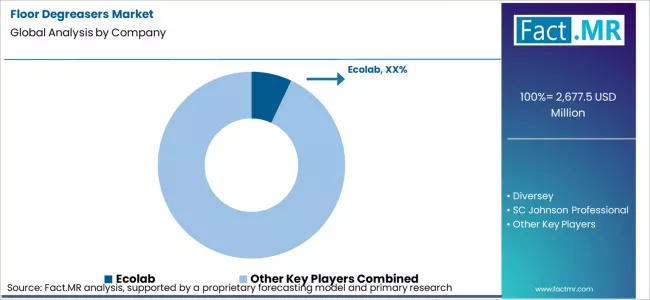
The floor degreasers market is undergoing a structural pivot from "brute-force chemistry" toward a model of precision surface orchestration. Between 2020 and 2024, the industry focused on the rapid adoption of water-based and low-VOC (Volatile Organic Compound) formulations to meet tightening environmental mandates. This initial phase established the benchmark for worker safety and indoor air quality, but often left heavy-duty industrial users such as those in automotive and food processing struggling with the slower dwell times of "green" degreasers compared to traditional solvent-based alternatives.
Entering 2026 and beyond, the competitive landscape is defined by the race for robotic compatibility and total water circularity. Fact.MR analysis indicates that strategic investment is now intensifying around "system-integrated" chemistries designed to protect the sensors and mechanical integrity of autonomous floor scrubbers. Christophe Beck, Chairman and CEO of Ecolab, emphasizes that the next frontier of growth lies in the convergence of physical hygiene and digital intelligence.
Companies like Ecolab and Diversey are leveraging their early lead in IoT-enabled dosing systems to set the standard for "Smart Hygiene," where chemical consumption is optimized in real-time based on floor traffic data. The consumer-facing giants like P&G Professional and Unilever Professional are scaling their "Concentrate-First" models to eliminate plastic waste and reduce the carbon footprint of chemical logistics.
Key Players in the Floor Degreasers Market
- Ecolab
- Diversey
- SC Johnson Professional
- 3M
- Zep
- Betco
- Spartan Chemical
- CloroxPro
- P&G Professional
- Unilever Professional
Scope of the Report
| Items | Values |
|---|---|
| Quantitative Units | USD million |
| Chemistry | Alkaline Degreasers; Solvent-Assisted Degreasers; Enzymatic / Bio-Based Degreasers; Other Chemistries |
| Application Area | Foodservice Kitchens; Industrial Floors & Shops; Retail / Commercial Back-of-House; Other Areas |
| Form | Concentrates; RTU Sprays; Foaming Products; Other Forms |
| End-Use Sector | Hospitality & Foodservice; Industrial & Manufacturing; Commercial Buildings; Other Sectors |
| Regions Covered | Asia Pacific, Europe, North America, Latin America, Middle East & Africa |
| Countries Covered | China, Brazil, USA, UK, Germany, South Korea, Japan, and 40+ countries |
| Key Companies Profiled | Ecolab; Diversey; SC Johnson Professional; 3M; Zep; Betco; Spartan Chemical; CloroxPro; P&G Professional; Unilever Professional |
| Additional Attributes | Dollar sales by chemistry, application area, form factor, and end-use sector; rising preference for alkaline and solvent-assisted degreasers in high-load foodservice and industrial environments; increasing adoption of enzymatic and bio-based formulations aligned with sustainability and worker-safety programs; foaming and RTU formats gaining traction for back-of-house and retail cleaning efficiency; procurement decisions influenced by grease removal efficacy, dwell time, surface compatibility, and regulatory compliance; distributor-led Jan-San programs and direct facility contracts shaping purchasing behavior across hospitality and commercial building operators. |
Floor Degreasers Market Key Segment
-
Chemistry :
- Alkaline Degreasers
- Solvent-Assisted Degreasers
- Enzymatic / Bio-Based Degreasers
- Other Chemistries
-
Application Area :
- Foodservice Kitchens
- Industrial Floors & Shops
- Retail / Commercial Back-of-House
- Other Areas
-
Form :
- Concentrates
- RTU Sprays
- Foaming Products
- Other Forms
-
End-Use Sector :
- Hospitality & Foodservice
- Industrial & Manufacturing
- Commercial Buildings
- Other Sectors
-
Region :
- North America
- USA
- Canada
- Mexico
- Europe
- Germany
- UK
- France
- Italy
- Spain
- Nordic Countries
- BENELUX
- Rest of Europe
- Asia Pacific
- China
- Japan
- South Korea
- India
- Australia
- Rest of Asia Pacific
- Latin America
- Brazil
- Argentina
- Rest of Latin America
- Middle East and Africa
- Kingdom of Saudi Arabia
- United Arab Emirates
- South Africa
- Rest of Middle East and Africa
- Other Regions
- Oceania
- Central Asia
- Other Markets
- North America
Bibliographies
- American Cleaning Institute. (2023). Cleaning product ingredients, performance, and safety in professional floor care. ACI.
- U.S. Environmental Protection Agency. (2024). Safer Choice standard for institutional and industrial cleaning products. EPA.
- European Chemicals Agency. (2023). Detergents and surfactants: Regulatory requirements and environmental considerations. ECHA.
- Food and Agriculture Organization of the United Nations. (2023). Good hygiene practices in commercial food preparation environments. FAO.
- International Organization for Standardization. (2023). ISO 21469: Safety of machinery-Lubricants with incidental product contact (cleaning relevance update). ISO.
- Ecolab. (2024). Solid and concentrated degreasing systems for commercial kitchens and industrial floors. Ecolab Technical Documentation.
Table of Content
- Executive Summary
- Global Market Outlook
- Demand to side Trends
- Supply to side Trends
- Technology Roadmap Analysis
- Analysis and Recommendations
- Market Overview
- Market Coverage / Taxonomy
- Market Definition / Scope / Limitations
- Research Methodology
- Chapter Orientation
- Analytical Lens and Working Hypotheses
- Market Structure, Signals, and Trend Drivers
- Benchmarking and Cross-market Comparability
- Market Sizing, Forecasting, and Opportunity Mapping
- Research Design and Evidence Framework
- Desk Research Programme (Secondary Evidence)
- Company Annual and Sustainability Reports
- Peer-reviewed Journals and Academic Literature
- Corporate Websites, Product Literature, and Technical Notes
- Earnings Decks and Investor Briefings
- Statutory Filings and Regulatory Disclosures
- Technical White Papers and Standards Notes
- Trade Journals, Industry Magazines, and Analyst Briefs
- Conference Proceedings, Webinars, and Seminar Materials
- Government Statistics Portals and Public Data Releases
- Press Releases and Reputable Media Coverage
- Specialist Newsletters and Curated Briefings
- Sector Databases and Reference Repositories
- FMR Internal Proprietary Databases and Historical Market Datasets
- Subscription Datasets and Paid Sources
- Social Channels, Communities, and Digital Listening Inputs
- Additional Desk Sources
- Expert Input and Fieldwork (Primary Evidence)
- Primary Modes
- Qualitative Interviews and Expert Elicitation
- Quantitative Surveys and Structured Data Capture
- Blended Approach
- Why Primary Evidence is Used
- Field Techniques
- Interviews
- Surveys
- Focus Groups
- Observational and In-context Research
- Social and Community Interactions
- Stakeholder Universe Engaged
- C-suite Leaders
- Board Members
- Presidents and Vice Presidents
- R&D and Innovation Heads
- Technical Specialists
- Domain Subject-matter Experts
- Scientists
- Physicians and Other Healthcare Professionals
- Governance, Ethics, and Data Stewardship
- Research Ethics
- Data Integrity and Handling
- Primary Modes
- Tooling, Models, and Reference Databases
- Desk Research Programme (Secondary Evidence)
- Data Engineering and Model Build
- Data Acquisition and Ingestion
- Cleaning, Normalisation, and Verification
- Synthesis, Triangulation, and Analysis
- Quality Assurance and Audit Trail
- Market Background
- Market Dynamics
- Drivers
- Restraints
- Opportunity
- Trends
- Scenario Forecast
- Demand in Optimistic Scenario
- Demand in Likely Scenario
- Demand in Conservative Scenario
- Opportunity Map Analysis
- Product Life Cycle Analysis
- Supply Chain Analysis
- Investment Feasibility Matrix
- Value Chain Analysis
- PESTLE and Porter’s Analysis
- Regulatory Landscape
- Regional Parent Market Outlook
- Production and Consumption Statistics
- Import and Export Statistics
- Market Dynamics
- Global Market Analysis 2021 to 2025 and Forecast, 2026 to 2036
- Historical Market Size Value (USD Million) Analysis, 2021 to 2025
- Current and Future Market Size Value (USD Million) Projections, 2026 to 2036
- Y to o to Y Growth Trend Analysis
- Absolute $ Opportunity Analysis
- Global Market Pricing Analysis 2021 to 2025 and Forecast 2026 to 2036
- Global Market Analysis 2021 to 2025 and Forecast 2026 to 2036, By Chemistry
- Introduction / Key Findings
- Historical Market Size Value (USD Million) Analysis By Chemistry, 2021 to 2025
- Current and Future Market Size Value (USD Million) Analysis and Forecast By Chemistry, 2026 to 2036
- Alkaline Degreasers
- Solvent-Assisted Degreasers
- Enzymatic / Bio-Based Degreasers
- Other Chemistries
- Alkaline Degreasers
- Y to o to Y Growth Trend Analysis By Chemistry, 2021 to 2025
- Absolute $ Opportunity Analysis By Chemistry, 2026 to 2036
- Global Market Analysis 2021 to 2025 and Forecast 2026 to 2036, By Application Area
- Introduction / Key Findings
- Historical Market Size Value (USD Million) Analysis By Application Area, 2021 to 2025
- Current and Future Market Size Value (USD Million) Analysis and Forecast By Application Area, 2026 to 2036
- Foodservice Kitchens
- Industrial Floors & Shops
- Retail / Commercial Back-of-House
- Other Areas
- Foodservice Kitchens
- Y to o to Y Growth Trend Analysis By Application Area, 2021 to 2025
- Absolute $ Opportunity Analysis By Application Area, 2026 to 2036
- Global Market Analysis 2021 to 2025 and Forecast 2026 to 2036, By Form
- Introduction / Key Findings
- Historical Market Size Value (USD Million) Analysis By Form, 2021 to 2025
- Current and Future Market Size Value (USD Million) Analysis and Forecast By Form, 2026 to 2036
- Concentrates
- RTU Sprays
- Foaming Products
- Other Forms
- Concentrates
- Y to o to Y Growth Trend Analysis By Form, 2021 to 2025
- Absolute $ Opportunity Analysis By Form, 2026 to 2036
- Global Market Analysis 2021 to 2025 and Forecast 2026 to 2036, By End-Use Sector
- Introduction / Key Findings
- Historical Market Size Value (USD Million) Analysis By End-Use Sector, 2021 to 2025
- Current and Future Market Size Value (USD Million) Analysis and Forecast By End-Use Sector, 2026 to 2036
- Hospitality & Foodservice
- Industrial & Manufacturing
- Commercial Buildings
- Other Sectors
- Hospitality & Foodservice
- Y to o to Y Growth Trend Analysis By End-Use Sector, 2021 to 2025
- Absolute $ Opportunity Analysis By End-Use Sector, 2026 to 2036
- Global Market Analysis 2021 to 2025 and Forecast 2026 to 2036, By Region
- Introduction
- Historical Market Size Value (USD Million) Analysis By Region, 2021 to 2025
- Current Market Size Value (USD Million) Analysis and Forecast By Region, 2026 to 2036
- North America
- Latin America
- Western Europe
- Eastern Europe
- East Asia
- South Asia and Pacific
- Middle East & Africa
- Market Attractiveness Analysis By Region
- North America Market Analysis 2021 to 2025 and Forecast 2026 to 2036, By Country
- Historical Market Size Value (USD Million) Trend Analysis By Market Taxonomy, 2021 to 2025
- Market Size Value (USD Million) Forecast By Market Taxonomy, 2026 to 2036
- By Country
- USA
- Canada
- Mexico
- By Chemistry
- By Application Area
- By Form
- By End-Use Sector
- By Country
- Market Attractiveness Analysis
- By Country
- By Chemistry
- By Application Area
- By Form
- By End-Use Sector
- Key Takeaways
- Latin America Market Analysis 2021 to 2025 and Forecast 2026 to 2036, By Country
- Historical Market Size Value (USD Million) Trend Analysis By Market Taxonomy, 2021 to 2025
- Market Size Value (USD Million) Forecast By Market Taxonomy, 2026 to 2036
- By Country
- Brazil
- Chile
- Rest of Latin America
- By Chemistry
- By Application Area
- By Form
- By End-Use Sector
- By Country
- Market Attractiveness Analysis
- By Country
- By Chemistry
- By Application Area
- By Form
- By End-Use Sector
- Key Takeaways
- Western Europe Market Analysis 2021 to 2025 and Forecast 2026 to 2036, By Country
- Historical Market Size Value (USD Million) Trend Analysis By Market Taxonomy, 2021 to 2025
- Market Size Value (USD Million) Forecast By Market Taxonomy, 2026 to 2036
- By Country
- Germany
- UK
- Italy
- Spain
- France
- Nordic
- BENELUX
- Rest of Western Europe
- By Chemistry
- By Application Area
- By Form
- By End-Use Sector
- By Country
- Market Attractiveness Analysis
- By Country
- By Chemistry
- By Application Area
- By Form
- By End-Use Sector
- Key Takeaways
- Eastern Europe Market Analysis 2021 to 2025 and Forecast 2026 to 2036, By Country
- Historical Market Size Value (USD Million) Trend Analysis By Market Taxonomy, 2021 to 2025
- Market Size Value (USD Million) Forecast By Market Taxonomy, 2026 to 2036
- By Country
- Russia
- Poland
- Hungary
- Balkan & Baltic
- Rest of Eastern Europe
- By Chemistry
- By Application Area
- By Form
- By End-Use Sector
- By Country
- Market Attractiveness Analysis
- By Country
- By Chemistry
- By Application Area
- By Form
- By End-Use Sector
- Key Takeaways
- East Asia Market Analysis 2021 to 2025 and Forecast 2026 to 2036, By Country
- Historical Market Size Value (USD Million) Trend Analysis By Market Taxonomy, 2021 to 2025
- Market Size Value (USD Million) Forecast By Market Taxonomy, 2026 to 2036
- By Country
- China
- Japan
- South Korea
- By Chemistry
- By Application Area
- By Form
- By End-Use Sector
- By Country
- Market Attractiveness Analysis
- By Country
- By Chemistry
- By Application Area
- By Form
- By End-Use Sector
- Key Takeaways
- South Asia and Pacific Market Analysis 2021 to 2025 and Forecast 2026 to 2036, By Country
- Historical Market Size Value (USD Million) Trend Analysis By Market Taxonomy, 2021 to 2025
- Market Size Value (USD Million) Forecast By Market Taxonomy, 2026 to 2036
- By Country
- India
- ASEAN
- Australia & New Zealand
- Rest of South Asia and Pacific
- By Chemistry
- By Application Area
- By Form
- By End-Use Sector
- By Country
- Market Attractiveness Analysis
- By Country
- By Chemistry
- By Application Area
- By Form
- By End-Use Sector
- Key Takeaways
- Middle East & Africa Market Analysis 2021 to 2025 and Forecast 2026 to 2036, By Country
- Historical Market Size Value (USD Million) Trend Analysis By Market Taxonomy, 2021 to 2025
- Market Size Value (USD Million) Forecast By Market Taxonomy, 2026 to 2036
- By Country
- Kingdom of Saudi Arabia
- Other GCC Countries
- Turkiye
- South Africa
- Other African Union
- Rest of Middle East & Africa
- By Chemistry
- By Application Area
- By Form
- By End-Use Sector
- By Country
- Market Attractiveness Analysis
- By Country
- By Chemistry
- By Application Area
- By Form
- By End-Use Sector
- Key Takeaways
- Key Countries Market Analysis
- USA
- Pricing Analysis
- Market Share Analysis, 2025
- By Chemistry
- By Application Area
- By Form
- By End-Use Sector
- Canada
- Pricing Analysis
- Market Share Analysis, 2025
- By Chemistry
- By Application Area
- By Form
- By End-Use Sector
- Mexico
- Pricing Analysis
- Market Share Analysis, 2025
- By Chemistry
- By Application Area
- By Form
- By End-Use Sector
- Brazil
- Pricing Analysis
- Market Share Analysis, 2025
- By Chemistry
- By Application Area
- By Form
- By End-Use Sector
- Chile
- Pricing Analysis
- Market Share Analysis, 2025
- By Chemistry
- By Application Area
- By Form
- By End-Use Sector
- Germany
- Pricing Analysis
- Market Share Analysis, 2025
- By Chemistry
- By Application Area
- By Form
- By End-Use Sector
- UK
- Pricing Analysis
- Market Share Analysis, 2025
- By Chemistry
- By Application Area
- By Form
- By End-Use Sector
- Italy
- Pricing Analysis
- Market Share Analysis, 2025
- By Chemistry
- By Application Area
- By Form
- By End-Use Sector
- Spain
- Pricing Analysis
- Market Share Analysis, 2025
- By Chemistry
- By Application Area
- By Form
- By End-Use Sector
- France
- Pricing Analysis
- Market Share Analysis, 2025
- By Chemistry
- By Application Area
- By Form
- By End-Use Sector
- India
- Pricing Analysis
- Market Share Analysis, 2025
- By Chemistry
- By Application Area
- By Form
- By End-Use Sector
- ASEAN
- Pricing Analysis
- Market Share Analysis, 2025
- By Chemistry
- By Application Area
- By Form
- By End-Use Sector
- Australia & New Zealand
- Pricing Analysis
- Market Share Analysis, 2025
- By Chemistry
- By Application Area
- By Form
- By End-Use Sector
- China
- Pricing Analysis
- Market Share Analysis, 2025
- By Chemistry
- By Application Area
- By Form
- By End-Use Sector
- Japan
- Pricing Analysis
- Market Share Analysis, 2025
- By Chemistry
- By Application Area
- By Form
- By End-Use Sector
- South Korea
- Pricing Analysis
- Market Share Analysis, 2025
- By Chemistry
- By Application Area
- By Form
- By End-Use Sector
- Russia
- Pricing Analysis
- Market Share Analysis, 2025
- By Chemistry
- By Application Area
- By Form
- By End-Use Sector
- Poland
- Pricing Analysis
- Market Share Analysis, 2025
- By Chemistry
- By Application Area
- By Form
- By End-Use Sector
- Hungary
- Pricing Analysis
- Market Share Analysis, 2025
- By Chemistry
- By Application Area
- By Form
- By End-Use Sector
- Kingdom of Saudi Arabia
- Pricing Analysis
- Market Share Analysis, 2025
- By Chemistry
- By Application Area
- By Form
- By End-Use Sector
- Turkiye
- Pricing Analysis
- Market Share Analysis, 2025
- By Chemistry
- By Application Area
- By Form
- By End-Use Sector
- South Africa
- Pricing Analysis
- Market Share Analysis, 2025
- By Chemistry
- By Application Area
- By Form
- By End-Use Sector
- USA
- Market Structure Analysis
- Competition Dashboard
- Competition Benchmarking
- Market Share Analysis of Top Players
- By Regional
- By Chemistry
- By Application Area
- By Form
- By End-Use Sector
- Competition Analysis
- Competition Deep Dive
- Ecolab
- Overview
- Product Portfolio
- Profitability by Market Segments (Product/Age /Sales Channel/Region)
- Sales Footprint
- Strategy Overview
- Marketing Strategy
- Product Strategy
- Channel Strategy
- Diversey
- SC Johnson Professional
- 3M
- Zep
- Betco
- Spartan Chemical
- CloroxPro
- P&G Professional
- Unilever Professional
- Ecolab
- Competition Deep Dive
- Assumptions & Acronyms Used
List Of Table
- Table 1: Global Market Value (USD Million) Forecast by Region, 2021 to 2036
- Table 2: Global Market Value (USD Million) Forecast by Chemistry, 2021 to 2036
- Table 3: Global Market Value (USD Million) Forecast by Application Area, 2021 to 2036
- Table 4: Global Market Value (USD Million) Forecast by Form, 2021 to 2036
- Table 5: Global Market Value (USD Million) Forecast by End-Use Sector, 2021 to 2036
- Table 6: North America Market Value (USD Million) Forecast by Country, 2021 to 2036
- Table 7: North America Market Value (USD Million) Forecast by Chemistry, 2021 to 2036
- Table 8: North America Market Value (USD Million) Forecast by Application Area, 2021 to 2036
- Table 9: North America Market Value (USD Million) Forecast by Form, 2021 to 2036
- Table 10: North America Market Value (USD Million) Forecast by End-Use Sector, 2021 to 2036
- Table 11: Latin America Market Value (USD Million) Forecast by Country, 2021 to 2036
- Table 12: Latin America Market Value (USD Million) Forecast by Chemistry, 2021 to 2036
- Table 13: Latin America Market Value (USD Million) Forecast by Application Area, 2021 to 2036
- Table 14: Latin America Market Value (USD Million) Forecast by Form, 2021 to 2036
- Table 15: Latin America Market Value (USD Million) Forecast by End-Use Sector, 2021 to 2036
- Table 16: Western Europe Market Value (USD Million) Forecast by Country, 2021 to 2036
- Table 17: Western Europe Market Value (USD Million) Forecast by Chemistry, 2021 to 2036
- Table 18: Western Europe Market Value (USD Million) Forecast by Application Area, 2021 to 2036
- Table 19: Western Europe Market Value (USD Million) Forecast by Form, 2021 to 2036
- Table 20: Western Europe Market Value (USD Million) Forecast by End-Use Sector, 2021 to 2036
- Table 21: Eastern Europe Market Value (USD Million) Forecast by Country, 2021 to 2036
- Table 22: Eastern Europe Market Value (USD Million) Forecast by Chemistry, 2021 to 2036
- Table 23: Eastern Europe Market Value (USD Million) Forecast by Application Area, 2021 to 2036
- Table 24: Eastern Europe Market Value (USD Million) Forecast by Form, 2021 to 2036
- Table 25: Eastern Europe Market Value (USD Million) Forecast by End-Use Sector, 2021 to 2036
- Table 26: East Asia Market Value (USD Million) Forecast by Country, 2021 to 2036
- Table 27: East Asia Market Value (USD Million) Forecast by Chemistry, 2021 to 2036
- Table 28: East Asia Market Value (USD Million) Forecast by Application Area, 2021 to 2036
- Table 29: East Asia Market Value (USD Million) Forecast by Form, 2021 to 2036
- Table 30: East Asia Market Value (USD Million) Forecast by End-Use Sector, 2021 to 2036
- Table 31: South Asia and Pacific Market Value (USD Million) Forecast by Country, 2021 to 2036
- Table 32: South Asia and Pacific Market Value (USD Million) Forecast by Chemistry, 2021 to 2036
- Table 33: South Asia and Pacific Market Value (USD Million) Forecast by Application Area, 2021 to 2036
- Table 34: South Asia and Pacific Market Value (USD Million) Forecast by Form, 2021 to 2036
- Table 35: South Asia and Pacific Market Value (USD Million) Forecast by End-Use Sector, 2021 to 2036
- Table 36: Middle East & Africa Market Value (USD Million) Forecast by Country, 2021 to 2036
- Table 37: Middle East & Africa Market Value (USD Million) Forecast by Chemistry, 2021 to 2036
- Table 38: Middle East & Africa Market Value (USD Million) Forecast by Application Area, 2021 to 2036
- Table 39: Middle East & Africa Market Value (USD Million) Forecast by Form, 2021 to 2036
- Table 40: Middle East & Africa Market Value (USD Million) Forecast by End-Use Sector, 2021 to 2036
List Of Figures
- Figure 1: Global Market Pricing Analysis
- Figure 2: Global Market Value (USD Million) Forecast 2021 to 2036
- Figure 3: Global Market Value Share and BPS Analysis by Chemistry, 2026 and 2036
- Figure 4: Global Market Y to o to Y Growth Comparison by Chemistry, 2026 to 2036
- Figure 5: Global Market Attractiveness Analysis by Chemistry
- Figure 6: Global Market Value Share and BPS Analysis by Application Area, 2026 and 2036
- Figure 7: Global Market Y to o to Y Growth Comparison by Application Area, 2026 to 2036
- Figure 8: Global Market Attractiveness Analysis by Application Area
- Figure 9: Global Market Value Share and BPS Analysis by Form, 2026 and 2036
- Figure 10: Global Market Y to o to Y Growth Comparison by Form, 2026 to 2036
- Figure 11: Global Market Attractiveness Analysis by Form
- Figure 12: Global Market Value Share and BPS Analysis by End-Use Sector, 2026 and 2036
- Figure 13: Global Market Y to o to Y Growth Comparison by End-Use Sector, 2026 to 2036
- Figure 14: Global Market Attractiveness Analysis by End-Use Sector
- Figure 15: Global Market Value (USD Million) Share and BPS Analysis by Region, 2026 and 2036
- Figure 16: Global Market Y to o to Y Growth Comparison by Region, 2026 to 2036
- Figure 17: Global Market Attractiveness Analysis by Region
- Figure 18: North America Market Incremental Dollar Opportunity, 2026 to 2036
- Figure 19: Latin America Market Incremental Dollar Opportunity, 2026 to 2036
- Figure 20: Western Europe Market Incremental Dollar Opportunity, 2026 to 2036
- Figure 21: Eastern Europe Market Incremental Dollar Opportunity, 2026 to 2036
- Figure 22: East Asia Market Incremental Dollar Opportunity, 2026 to 2036
- Figure 23: South Asia and Pacific Market Incremental Dollar Opportunity, 2026 to 2036
- Figure 24: Middle East & Africa Market Incremental Dollar Opportunity, 2026 to 2036
- Figure 25: North America Market Value Share and BPS Analysis by Country, 2026 and 2036
- Figure 26: North America Market Value Share and BPS Analysis by Chemistry, 2026 and 2036
- Figure 27: North America Market Y to o to Y Growth Comparison by Chemistry, 2026 to 2036
- Figure 28: North America Market Attractiveness Analysis by Chemistry
- Figure 29: North America Market Value Share and BPS Analysis by Application Area, 2026 and 2036
- Figure 30: North America Market Y to o to Y Growth Comparison by Application Area, 2026 to 2036
- Figure 31: North America Market Attractiveness Analysis by Application Area
- Figure 32: North America Market Value Share and BPS Analysis by Form, 2026 and 2036
- Figure 33: North America Market Y to o to Y Growth Comparison by Form, 2026 to 2036
- Figure 34: North America Market Attractiveness Analysis by Form
- Figure 35: North America Market Value Share and BPS Analysis by End-Use Sector, 2026 and 2036
- Figure 36: North America Market Y to o to Y Growth Comparison by End-Use Sector, 2026 to 2036
- Figure 37: North America Market Attractiveness Analysis by End-Use Sector
- Figure 38: Latin America Market Value Share and BPS Analysis by Country, 2026 and 2036
- Figure 39: Latin America Market Value Share and BPS Analysis by Chemistry, 2026 and 2036
- Figure 40: Latin America Market Y to o to Y Growth Comparison by Chemistry, 2026 to 2036
- Figure 41: Latin America Market Attractiveness Analysis by Chemistry
- Figure 42: Latin America Market Value Share and BPS Analysis by Application Area, 2026 and 2036
- Figure 43: Latin America Market Y to o to Y Growth Comparison by Application Area, 2026 to 2036
- Figure 44: Latin America Market Attractiveness Analysis by Application Area
- Figure 45: Latin America Market Value Share and BPS Analysis by Form, 2026 and 2036
- Figure 46: Latin America Market Y to o to Y Growth Comparison by Form, 2026 to 2036
- Figure 47: Latin America Market Attractiveness Analysis by Form
- Figure 48: Latin America Market Value Share and BPS Analysis by End-Use Sector, 2026 and 2036
- Figure 49: Latin America Market Y to o to Y Growth Comparison by End-Use Sector, 2026 to 2036
- Figure 50: Latin America Market Attractiveness Analysis by End-Use Sector
- Figure 51: Western Europe Market Value Share and BPS Analysis by Country, 2026 and 2036
- Figure 52: Western Europe Market Value Share and BPS Analysis by Chemistry, 2026 and 2036
- Figure 53: Western Europe Market Y to o to Y Growth Comparison by Chemistry, 2026 to 2036
- Figure 54: Western Europe Market Attractiveness Analysis by Chemistry
- Figure 55: Western Europe Market Value Share and BPS Analysis by Application Area, 2026 and 2036
- Figure 56: Western Europe Market Y to o to Y Growth Comparison by Application Area, 2026 to 2036
- Figure 57: Western Europe Market Attractiveness Analysis by Application Area
- Figure 58: Western Europe Market Value Share and BPS Analysis by Form, 2026 and 2036
- Figure 59: Western Europe Market Y to o to Y Growth Comparison by Form, 2026 to 2036
- Figure 60: Western Europe Market Attractiveness Analysis by Form
- Figure 61: Western Europe Market Value Share and BPS Analysis by End-Use Sector, 2026 and 2036
- Figure 62: Western Europe Market Y to o to Y Growth Comparison by End-Use Sector, 2026 to 2036
- Figure 63: Western Europe Market Attractiveness Analysis by End-Use Sector
- Figure 64: Eastern Europe Market Value Share and BPS Analysis by Country, 2026 and 2036
- Figure 65: Eastern Europe Market Value Share and BPS Analysis by Chemistry, 2026 and 2036
- Figure 66: Eastern Europe Market Y to o to Y Growth Comparison by Chemistry, 2026 to 2036
- Figure 67: Eastern Europe Market Attractiveness Analysis by Chemistry
- Figure 68: Eastern Europe Market Value Share and BPS Analysis by Application Area, 2026 and 2036
- Figure 69: Eastern Europe Market Y to o to Y Growth Comparison by Application Area, 2026 to 2036
- Figure 70: Eastern Europe Market Attractiveness Analysis by Application Area
- Figure 71: Eastern Europe Market Value Share and BPS Analysis by Form, 2026 and 2036
- Figure 72: Eastern Europe Market Y to o to Y Growth Comparison by Form, 2026 to 2036
- Figure 73: Eastern Europe Market Attractiveness Analysis by Form
- Figure 74: Eastern Europe Market Value Share and BPS Analysis by End-Use Sector, 2026 and 2036
- Figure 75: Eastern Europe Market Y to o to Y Growth Comparison by End-Use Sector, 2026 to 2036
- Figure 76: Eastern Europe Market Attractiveness Analysis by End-Use Sector
- Figure 77: East Asia Market Value Share and BPS Analysis by Country, 2026 and 2036
- Figure 78: East Asia Market Value Share and BPS Analysis by Chemistry, 2026 and 2036
- Figure 79: East Asia Market Y to o to Y Growth Comparison by Chemistry, 2026 to 2036
- Figure 80: East Asia Market Attractiveness Analysis by Chemistry
- Figure 81: East Asia Market Value Share and BPS Analysis by Application Area, 2026 and 2036
- Figure 82: East Asia Market Y to o to Y Growth Comparison by Application Area, 2026 to 2036
- Figure 83: East Asia Market Attractiveness Analysis by Application Area
- Figure 84: East Asia Market Value Share and BPS Analysis by Form, 2026 and 2036
- Figure 85: East Asia Market Y to o to Y Growth Comparison by Form, 2026 to 2036
- Figure 86: East Asia Market Attractiveness Analysis by Form
- Figure 87: East Asia Market Value Share and BPS Analysis by End-Use Sector, 2026 and 2036
- Figure 88: East Asia Market Y to o to Y Growth Comparison by End-Use Sector, 2026 to 2036
- Figure 89: East Asia Market Attractiveness Analysis by End-Use Sector
- Figure 90: South Asia and Pacific Market Value Share and BPS Analysis by Country, 2026 and 2036
- Figure 91: South Asia and Pacific Market Value Share and BPS Analysis by Chemistry, 2026 and 2036
- Figure 92: South Asia and Pacific Market Y to o to Y Growth Comparison by Chemistry, 2026 to 2036
- Figure 93: South Asia and Pacific Market Attractiveness Analysis by Chemistry
- Figure 94: South Asia and Pacific Market Value Share and BPS Analysis by Application Area, 2026 and 2036
- Figure 95: South Asia and Pacific Market Y to o to Y Growth Comparison by Application Area, 2026 to 2036
- Figure 96: South Asia and Pacific Market Attractiveness Analysis by Application Area
- Figure 97: South Asia and Pacific Market Value Share and BPS Analysis by Form, 2026 and 2036
- Figure 98: South Asia and Pacific Market Y to o to Y Growth Comparison by Form, 2026 to 2036
- Figure 99: South Asia and Pacific Market Attractiveness Analysis by Form
- Figure 100: South Asia and Pacific Market Value Share and BPS Analysis by End-Use Sector, 2026 and 2036
- Figure 101: South Asia and Pacific Market Y to o to Y Growth Comparison by End-Use Sector, 2026 to 2036
- Figure 102: South Asia and Pacific Market Attractiveness Analysis by End-Use Sector
- Figure 103: Middle East & Africa Market Value Share and BPS Analysis by Country, 2026 and 2036
- Figure 104: Middle East & Africa Market Value Share and BPS Analysis by Chemistry, 2026 and 2036
- Figure 105: Middle East & Africa Market Y to o to Y Growth Comparison by Chemistry, 2026 to 2036
- Figure 106: Middle East & Africa Market Attractiveness Analysis by Chemistry
- Figure 107: Middle East & Africa Market Value Share and BPS Analysis by Application Area, 2026 and 2036
- Figure 108: Middle East & Africa Market Y to o to Y Growth Comparison by Application Area, 2026 to 2036
- Figure 109: Middle East & Africa Market Attractiveness Analysis by Application Area
- Figure 110: Middle East & Africa Market Value Share and BPS Analysis by Form, 2026 and 2036
- Figure 111: Middle East & Africa Market Y to o to Y Growth Comparison by Form, 2026 to 2036
- Figure 112: Middle East & Africa Market Attractiveness Analysis by Form
- Figure 113: Middle East & Africa Market Value Share and BPS Analysis by End-Use Sector, 2026 and 2036
- Figure 114: Middle East & Africa Market Y to o to Y Growth Comparison by End-Use Sector, 2026 to 2036
- Figure 115: Middle East & Africa Market Attractiveness Analysis by End-Use Sector
- Figure 116: Global Market - Tier Structure Analysis
- Figure 117: Global Market - Company Share Analysis
- FAQs -
How big is the floor degreasers market in 2026?
The global floor degreasers market is estimated to be valued at USD 2,677.5 million in 2026.
What will be the size of floor degreasers market in 2036?
The market size for the floor degreasers market is projected to reach USD 4,279.0 million by 2036.
How much will be the floor degreasers market growth between 2026 and 2036?
The floor degreasers market is expected to grow at a 4.8?GR between 2026 and 2036.
What are the key product types in the floor degreasers market?
The key product types in floor degreasers market are alkaline degreasers, solvent-assisted degreasers, enzymatic / bio-based degreasers and other chemistries.
Which application area segment to contribute significant share in the floor degreasers market in 2026?
In terms of application area, foodservice kitchens segment to command 34.0% share in the floor degreasers market in 2026.