Soil Washing Chemicals for Contaminated Sites Market
Soil Washing Chemicals for Contaminated Sites Market Size and Share Forecast Outlook 2026 to 2036
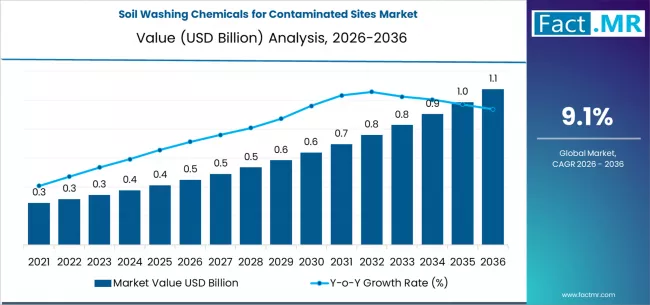
Soil washing chemicals for contaminated sites market is projected to grow from USD 0.5 billion in 2026 to USD 1.1 billion by 2036, at a CAGR of 9.1%. Surfactant-Based Washing Agents will dominate with a 32.0% market share, while heavy metals (pb, cr, as, hg, cd) will lead the contaminant type segment with a 38.0% share.
Soil Washing Chemicals for Contaminated Sites Market Forecast and Outlook 2026 to 2036
The global market for soil washing chemicals used in the remediation of contaminated sites is projected to reach USD 1.08 billion by 2036. The market is valued at USD 0.45 billion in 2026 and is set to rise at a CAGR of 9.1% during the assessment period.
Key Takeaways from the Soil Washing Chemicals for Contaminated Sites Market
- Market Value for 2026: USD 0.45 Billion
- Market Value for 2036: USD 1.08 Billion
- Forecast CAGR (2026-2036): 9.1%
- Leading Chemical Type Share (2026): Surfactant-Based Washing Agents (32%)
- Leading Contaminant Type Share (2026): Heavy Metals (Pb, Cr, As, Hg, Cd) (38%)
- Leading End-Use Sector Share (2026): Environmental Remediation Firms (34%)
- Key Players in the Market: Clean Earth, Veolia Environmental Services, Remondis Group, EOS Remediation, Regenesis, Republic Services Inc.
By chemical type, surfactant-based washing agents hold a leading 32% share. Heavy metal contamination represents the dominant contaminant type addressed, accounting for a 38% share. Environmental remediation firms constitute the primary end-use sector, with a 34% share.
Growth is propelled by the increasing global imperative to rehabilitate brownfield sites, legacy industrial land, and areas impacted by mining and chemical spills. As land becomes a scarcer resource and regulatory pressure to clean up historical pollution intensifies, ex-situ soil washing has emerged as a vital, rapid treatment technology.
Soil washing chemicals are critical for separating hazardous contaminants from soil matrices, enhancing the efficiency of physical separation processes. These specialized formulations enable the recovery of land for safe reuse, support urban redevelopment, and mitigate long-term environmental and public health liabilities.
Soil Washing Chemicals for Contaminated Sites Market
| Metric | Value |
|---|---|
| Market Value (2026) | USD 0.45 Billion |
| Market Forecast Value (2036) | USD 1.08 Billion |
| Forecast CAGR (2026-2036) | 9.1% |
Category
| Category | Segments |
|---|---|
| Chemical Type | Surfactant-Based Washing Agents, Chelating Agents (EDTA, DTPA, etc.), pH Adjusters & Acid/Alkaline Extractants, Bio-Based & Enzymatic Soil Washing Chemicals, Other Specialty Soil Washing Chemicals |
| Contaminant Type | Heavy Metals (Pb, Cr, As, Hg, Cd), Hydrocarbons & Petroleum, Pesticides & Agrochemicals, Industrial Organics & Solvents (PCBs, PAHs), Mixed Contaminants |
| End-Use Sector | Environmental Remediation Firms, Industrial & Manufacturing Sites, Mining & Metallurgical Sites, Oil & Gas Contaminated Land, Government & Municipal Remediation Projects |
| Region | North America, Latin America, Western Europe, Eastern Europe, East Asia, South Asia & Pacific, MEA |
Segmental Analysis
By Chemical Type, Which Formulation is Most Versatile for Diverse Contaminants?
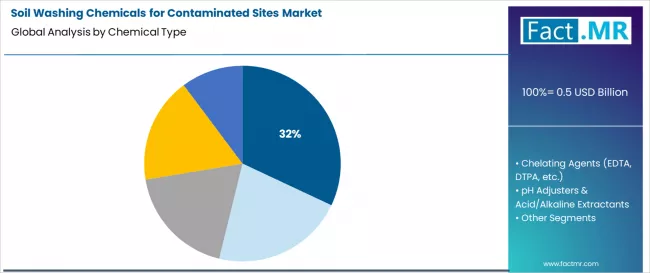
Surfactant-based washing agents lead the segment with a 32% share. Their dominance stems from their dual ability to treat both organic and inorganic contamination. Surfactants enhance the solubility and mobilization of hydrophobic organic compounds like oils and PAHs while also helping to separate fine, contaminated particles from cleaner soil grains. This versatility makes them a foundational chemical choice in many soil washing recipes, especially for sites with mixed or poorly characterized contamination profiles.
By Contaminant Type, Which Legacy Pollution Issue Drives the Most Remediation Activity?
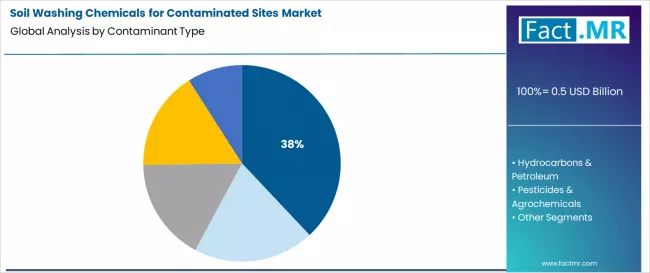
Heavy metal contamination represents the largest contaminant segment with a 38% share. This is due to the pervasive legacy of mining, smelting, industrial manufacturing, and the historical use of lead-based paints and arsenic-treated wood.
Heavy metals are persistent, toxic, and often tightly bound to soil particles, making chemical extraction with chelants or acid wash a necessary step in many remediation strategies. The scale and severity of heavy metal pollution worldwide ensure it remains the primary driver for chemical-enhanced soil washing.
By End-Use Sector, Who are the Primary Implementers of Soil Washing Technology?
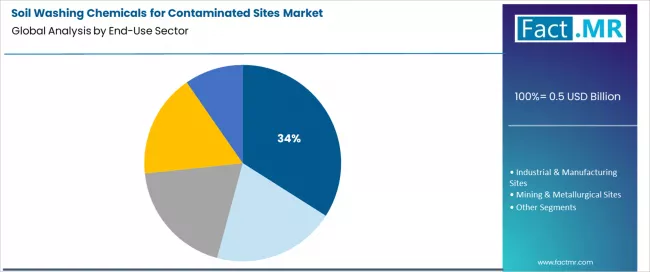
Environmental remediation firms constitute the leading end-use sector with a 34% share. These specialized contractors possess the technical expertise, mobile processing equipment, and regulatory knowledge to deploy soil washing solutions on a project basis.
They serve a diverse clientele, including industrial companies liable for cleanup, developers remediating brownfields, and government agencies. Their role as the hands-on implementers creates the most direct and substantial demand for soil washing chemical formulations.
What are the Drivers, Restraints, and Key Trends of the Soil Washing Chemicals for Contaminated Sites Market?
The primary market driver is the strong global push for urban redevelopment and the productive reuse of brownfield land. Converting contaminated sites into residential, commercial, or recreational spaces is often more sustainable than greenfield development, creating economic incentive for cleanup. Stricter enforcement of polluters pay principles and liability laws compels industries to address historical contamination, often requiring aggressive technologies like soil washing.
A significant restraint is the complexity and potential cost of managing the resulting wastewater and concentrated residual streams generated by the washing process. This can include contaminated process water and extracted sludges, which themselves require treatment or stabilization, adding layers of cost and regulatory complexity. The effectiveness of chemical washing can also be highly dependent on site-specific soil characteristics like clay content and organic matter, limiting its universal applicability.
Key trends include the development of more selective and biodegradable chelating agents to reduce secondary environmental impacts. There is growing innovation in combined chemical and physical treatment trains that optimize contaminant removal while minimizing chemical use. The market is moving toward on-site, mobile treatment units that reduce transportation costs and liabilities. Enhanced bioremediation following chemical washing is gaining traction as a polishing step to degrade any residual organics and close the remediation loop.
Analysis of the Soil Washing Chemicals for Contaminated Sites Market by Key Countries
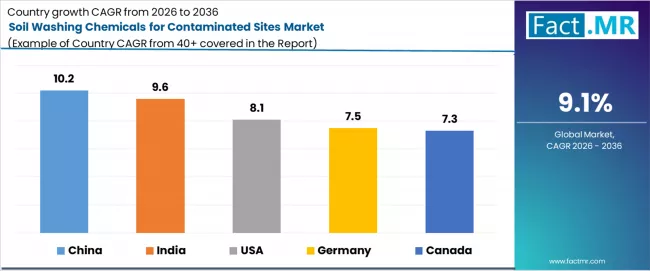
| Country | CAGR (2026-2036) |
|---|---|
| China | 10.20% |
| India | 9.60% |
| USA | 8.10% |
| Germany | 7.50% |
| Canada | 7.30% |
How are China's Brownfield Redevelopment and "Beautiful China" Initiatives Driving Growth?
China's leading CAGR of 10.20% is fueled by its massive urban renewal projects and the national Beautiful China ecological policy. As industries relocate and cities expand, vast tracts of historically contaminated land are being identified for cleanup and redevelopment. State-led investment in environmental remediation and strict new soil pollution laws are creating a large, policy-driven market for advanced remediation technologies and the chemicals that enable them.
What is the Impact of India's Industrial Growth and Emerging Environmental Enforcement?
India's 9.60% growth is underpinned by rapid industrial expansion and the subsequent identification of legacy contaminated sites, alongside stronger enforcement of environmental laws. The need to remediate land for new infrastructure, industrial clusters, and urban expansion is becoming a priority. This emerging recognition of land contamination as a liability is driving initial investments in remediation technologies, including soil washing.
How do US Superfund and Liability Frameworks Sustain a Mature Market?
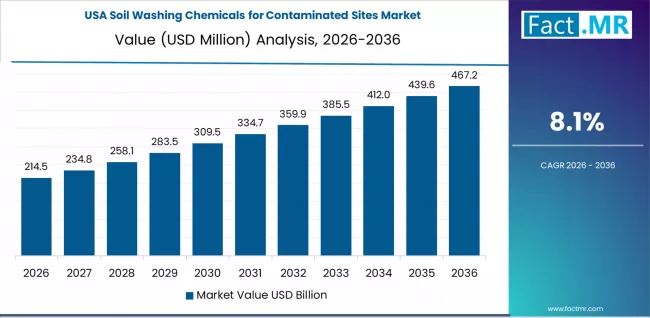
The USA's 8.10% growth is supported by its long-established regulatory framework, including the Superfund program and state-level cleanup laws. The strong legal liability for contamination ensures ongoing demand for effective, time-efficient remediation solutions like soil washing. Sophisticated contracting, performance-based remediation, and demand for innovative chemistries that can treat complex contaminant mixtures characterize the market.
Why is Germany a Key Market for Precision Engineering in Remediation?
Germany's 7.50% CAGR reflects its stringent regulations governing soil protection and its extensive history of industrial activity. German remediation projects often involve complex contamination in densely populated areas, requiring highly engineered, precise solutions. This drives demand for advanced, often customized, chemical formulations and integrated treatment systems that minimize secondary waste and ensure thorough cleanup.
What Role does Canada's Mining Legacy and Resource Sector Play?
Canada's 7.30% growth is anchored in its vast mining and resource extraction history, which has left a legacy of metal-contaminated sites. Federal and provincial programs aimed at rehabilitating these lands, coupled with the need to remediate former industrial and fuel depot sites, create sustained demand for chemical extraction technologies capable of operating in diverse, often remote, environments.
Competitive Landscape of the Soil Washing Chemicals for Contaminated Sites Market
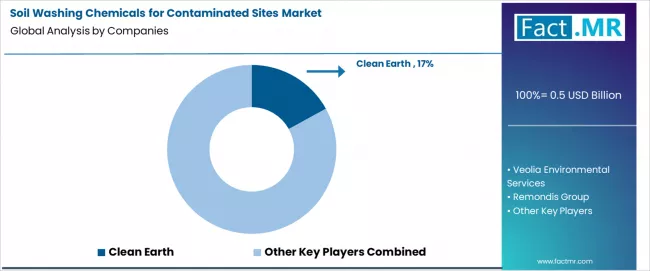
The competitive landscape involves a mix of specialized environmental service companies, waste management giants, and niche technology providers. Large players like Veolia and Republic Services leverage their extensive waste processing infrastructure and service networks to offer integrated soil treatment solutions. Specialists like Clean Earth and EOS Remediation compete through proprietary chemical formulations and focused expertise.
Competition centers on providing proven effectiveness for specific contaminant challenges, demonstrating cost-effectiveness against alternative methods like excavation-and-disposal, and managing the full lifecycle of the process, including waste stream treatment.
Key Players in the Soil Washing Chemicals for Contaminated Sites Market
- Clean Earth
- Veolia Environmental Services
- Remondis Group
- EOS Remediation
- Regenesis
- Republic Services Inc.
Scope of Report
| Items | Values |
|---|---|
| Quantitative Units | USD Billion |
| Chemical Type | Surfactants, Chelating Agents, pH Adjusters, Bio-Based/Enzymatic, Other |
| Contaminant Type | Heavy Metals, Hydrocarbons, Pesticides, Industrial Organics, Mixed |
| End-Use Sector | Environmental Remediation Firms, Industrial Sites, Mining, Oil & Gas, Government |
| Key Countries | China, India, USA, Germany, Canada |
| Key Companies | Clean Earth, Veolia, Remondis, EOS Remediation, Regenesis, Republic Services |
| Additional Analysis | Analysis of soil washing process chemistry and kinetics; treatment and disposal of spent wash water; regulatory frameworks for treated soil reuse; performance benchmarking against stabilization/solidification; life cycle cost analysis of ex-situ washing versus in-situ remediation. |
Market by Segments
-
Chemical Type :
- Surfactant-Based Washing Agents
- Chelating Agents (EDTA, DTPA, etc.)
- pH Adjusters & Acid/Alkaline Extractants
- Bio-Based & Enzymatic Soil Washing Chemicals
- Other Specialty Soil Washing Chemicals
-
Contaminant Type :
- Heavy Metals (Pb, Cr, As, Hg, Cd)
- Hydrocarbons & Petroleum
- Pesticides & Agrochemicals
- Industrial Organics & Solvents (PCBs, PAHs)
- Mixed Contaminants
-
End-Use Sector :
- Environmental Remediation Firms
- Industrial & Manufacturing Sites
- Mining & Metallurgical Sites
- Oil & Gas Contaminated Land
- Government & Municipal Remediation Projects
-
Region :
-
North America
- USA
- Canada
-
Latin America
- Brazil
- Mexico
- Argentina
- Rest of Latin America
-
Western Europe
- Germany
- UK
- France
- Spain
- Italy
- BENELUX
- Rest of Western Europe
-
Eastern Europe
- Russia
- Poland
- Czech Republic
- Rest of Eastern Europe
-
East Asia
- China
- Japan
- South Korea
- Rest of East Asia
-
South Asia & Pacific
- India
- ASEAN
- Australia
- Rest of South Asia & Pacific
-
MEA
- Saudi Arabia
- UAE
- Turkiye
- Rest of MEA
-
Table of Content
- Executive Summary
- Global Market Outlook
- Demand to side Trends
- Supply to side Trends
- Technology Roadmap Analysis
- Analysis and Recommendations
- Market Overview
- Market Coverage / Taxonomy
- Market Definition / Scope / Limitations
- Market Background
- Market Dynamics
- Drivers
- Restraints
- Opportunity
- Trends
- Scenario Forecast
- Demand in Optimistic Scenario
- Demand in Likely Scenario
- Demand in Conservative Scenario
- Opportunity Map Analysis
- Product Life Cycle Analysis
- Supply Chain Analysis
- Investment Feasibility Matrix
- Value Chain Analysis
- PESTLE and Porter’s Analysis
- Regulatory Landscape
- Regional Parent Market Outlook
- Production and Consumption Statistics
- Import and Export Statistics
- Market Dynamics
- Global Market Analysis 2021 to 2025 and Forecast, 2026 to 2036
- Historical Market Size Value (USD Million) Analysis, 2021 to 2025
- Current and Future Market Size Value (USD Million) Projections, 2026 to 2036
- Y to o to Y Growth Trend Analysis
- Absolute $ Opportunity Analysis
- Global Market Pricing Analysis 2021 to 2025 and Forecast 2026 to 2036
- Global Market Analysis 2021 to 2025 and Forecast 2026 to 2036, By Chemical Type
- Introduction / Key Findings
- Historical Market Size Value (USD Million) Analysis By Chemical Type, 2021 to 2025
- Current and Future Market Size Value (USD Million) Analysis and Forecast By Chemical Type, 2026 to 2036
- Surfactant-Based Washing Agents
- Chelating Agents (EDTA, DTPA, etc.)
- pH Adjusters & Acid/Alkaline Extractants
- Bio-Based & Enzymatic Soil Washing Chemicals
- Other Specialty Soil Washing Chemicals
- Surfactant-Based Washing Agents
- Y to o to Y Growth Trend Analysis By Chemical Type, 2021 to 2025
- Absolute $ Opportunity Analysis By Chemical Type, 2026 to 2036
- Global Market Analysis 2021 to 2025 and Forecast 2026 to 2036, By Contaminant Type
- Introduction / Key Findings
- Historical Market Size Value (USD Million) Analysis By Contaminant Type, 2021 to 2025
- Current and Future Market Size Value (USD Million) Analysis and Forecast By Contaminant Type, 2026 to 2036
- Heavy Metals (Pb, Cr, As, Hg, Cd)
- Hydrocarbons & Petroleum
- Pesticides & Agrochemicals
- Industrial Organics & Solvents (PCBs, PAHs)
- Mixed Contaminants
- Heavy Metals (Pb, Cr, As, Hg, Cd)
- Y to o to Y Growth Trend Analysis By Contaminant Type, 2021 to 2025
- Absolute $ Opportunity Analysis By Contaminant Type, 2026 to 2036
- Global Market Analysis 2021 to 2025 and Forecast 2026 to 2036, By End-Use Sector
- Introduction / Key Findings
- Historical Market Size Value (USD Million) Analysis By End-Use Sector, 2021 to 2025
- Current and Future Market Size Value (USD Million) Analysis and Forecast By End-Use Sector, 2026 to 2036
- Environmental Remediation Firms
- Industrial & Manufacturing Sites
- Mining & Metallurgical Sites
- Oil & Gas Contaminated Land
- Government & Municipal Remediation Projects
- Environmental Remediation Firms
- Y to o to Y Growth Trend Analysis By End-Use Sector, 2021 to 2025
- Absolute $ Opportunity Analysis By End-Use Sector, 2026 to 2036
- Global Market Analysis 2021 to 2025 and Forecast 2026 to 2036, By Region
- Introduction
- Historical Market Size Value (USD Million) Analysis By Region, 2021 to 2025
- Current Market Size Value (USD Million) Analysis and Forecast By Region, 2026 to 2036
- North America
- Latin America
- Western Europe
- Eastern Europe
- East Asia
- South Asia and Pacific
- Middle East & Africa
- Market Attractiveness Analysis By Region
- North America Market Analysis 2021 to 2025 and Forecast 2026 to 2036, By Country
- Historical Market Size Value (USD Million) Trend Analysis By Market Taxonomy, 2021 to 2025
- Market Size Value (USD Million) Forecast By Market Taxonomy, 2026 to 2036
- By Country
- USA
- Canada
- Mexico
- By Chemical Type
- By Contaminant Type
- By End-Use Sector
- By Country
- Market Attractiveness Analysis
- By Country
- By Chemical Type
- By Contaminant Type
- By End-Use Sector
- Key Takeaways
- Latin America Market Analysis 2021 to 2025 and Forecast 2026 to 2036, By Country
- Historical Market Size Value (USD Million) Trend Analysis By Market Taxonomy, 2021 to 2025
- Market Size Value (USD Million) Forecast By Market Taxonomy, 2026 to 2036
- By Country
- Brazil
- Chile
- Rest of Latin America
- By Chemical Type
- By Contaminant Type
- By End-Use Sector
- By Country
- Market Attractiveness Analysis
- By Country
- By Chemical Type
- By Contaminant Type
- By End-Use Sector
- Key Takeaways
- Western Europe Market Analysis 2021 to 2025 and Forecast 2026 to 2036, By Country
- Historical Market Size Value (USD Million) Trend Analysis By Market Taxonomy, 2021 to 2025
- Market Size Value (USD Million) Forecast By Market Taxonomy, 2026 to 2036
- By Country
- Germany
- UK
- Italy
- Spain
- France
- Nordic
- BENELUX
- Rest of Western Europe
- By Chemical Type
- By Contaminant Type
- By End-Use Sector
- By Country
- Market Attractiveness Analysis
- By Country
- By Chemical Type
- By Contaminant Type
- By End-Use Sector
- Key Takeaways
- Eastern Europe Market Analysis 2021 to 2025 and Forecast 2026 to 2036, By Country
- Historical Market Size Value (USD Million) Trend Analysis By Market Taxonomy, 2021 to 2025
- Market Size Value (USD Million) Forecast By Market Taxonomy, 2026 to 2036
- By Country
- Russia
- Poland
- Hungary
- Balkan & Baltic
- Rest of Eastern Europe
- By Chemical Type
- By Contaminant Type
- By End-Use Sector
- By Country
- Market Attractiveness Analysis
- By Country
- By Chemical Type
- By Contaminant Type
- By End-Use Sector
- Key Takeaways
- East Asia Market Analysis 2021 to 2025 and Forecast 2026 to 2036, By Country
- Historical Market Size Value (USD Million) Trend Analysis By Market Taxonomy, 2021 to 2025
- Market Size Value (USD Million) Forecast By Market Taxonomy, 2026 to 2036
- By Country
- China
- Japan
- South Korea
- By Chemical Type
- By Contaminant Type
- By End-Use Sector
- By Country
- Market Attractiveness Analysis
- By Country
- By Chemical Type
- By Contaminant Type
- By End-Use Sector
- Key Takeaways
- South Asia and Pacific Market Analysis 2021 to 2025 and Forecast 2026 to 2036, By Country
- Historical Market Size Value (USD Million) Trend Analysis By Market Taxonomy, 2021 to 2025
- Market Size Value (USD Million) Forecast By Market Taxonomy, 2026 to 2036
- By Country
- India
- ASEAN
- Australia & New Zealand
- Rest of South Asia and Pacific
- By Chemical Type
- By Contaminant Type
- By End-Use Sector
- By Country
- Market Attractiveness Analysis
- By Country
- By Chemical Type
- By Contaminant Type
- By End-Use Sector
- Key Takeaways
- Middle East & Africa Market Analysis 2021 to 2025 and Forecast 2026 to 2036, By Country
- Historical Market Size Value (USD Million) Trend Analysis By Market Taxonomy, 2021 to 2025
- Market Size Value (USD Million) Forecast By Market Taxonomy, 2026 to 2036
- By Country
- Kingdom of Saudi Arabia
- Other GCC Countries
- Turkiye
- South Africa
- Other African Union
- Rest of Middle East & Africa
- By Chemical Type
- By Contaminant Type
- By End-Use Sector
- By Country
- Market Attractiveness Analysis
- By Country
- By Chemical Type
- By Contaminant Type
- By End-Use Sector
- Key Takeaways
- Key Countries Market Analysis
- USA
- Pricing Analysis
- Market Share Analysis, 2025
- By Chemical Type
- By Contaminant Type
- By End-Use Sector
- Canada
- Pricing Analysis
- Market Share Analysis, 2025
- By Chemical Type
- By Contaminant Type
- By End-Use Sector
- Mexico
- Pricing Analysis
- Market Share Analysis, 2025
- By Chemical Type
- By Contaminant Type
- By End-Use Sector
- Brazil
- Pricing Analysis
- Market Share Analysis, 2025
- By Chemical Type
- By Contaminant Type
- By End-Use Sector
- Chile
- Pricing Analysis
- Market Share Analysis, 2025
- By Chemical Type
- By Contaminant Type
- By End-Use Sector
- Germany
- Pricing Analysis
- Market Share Analysis, 2025
- By Chemical Type
- By Contaminant Type
- By End-Use Sector
- UK
- Pricing Analysis
- Market Share Analysis, 2025
- By Chemical Type
- By Contaminant Type
- By End-Use Sector
- Italy
- Pricing Analysis
- Market Share Analysis, 2025
- By Chemical Type
- By Contaminant Type
- By End-Use Sector
- Spain
- Pricing Analysis
- Market Share Analysis, 2025
- By Chemical Type
- By Contaminant Type
- By End-Use Sector
- France
- Pricing Analysis
- Market Share Analysis, 2025
- By Chemical Type
- By Contaminant Type
- By End-Use Sector
- India
- Pricing Analysis
- Market Share Analysis, 2025
- By Chemical Type
- By Contaminant Type
- By End-Use Sector
- ASEAN
- Pricing Analysis
- Market Share Analysis, 2025
- By Chemical Type
- By Contaminant Type
- By End-Use Sector
- Australia & New Zealand
- Pricing Analysis
- Market Share Analysis, 2025
- By Chemical Type
- By Contaminant Type
- By End-Use Sector
- China
- Pricing Analysis
- Market Share Analysis, 2025
- By Chemical Type
- By Contaminant Type
- By End-Use Sector
- Japan
- Pricing Analysis
- Market Share Analysis, 2025
- By Chemical Type
- By Contaminant Type
- By End-Use Sector
- South Korea
- Pricing Analysis
- Market Share Analysis, 2025
- By Chemical Type
- By Contaminant Type
- By End-Use Sector
- Russia
- Pricing Analysis
- Market Share Analysis, 2025
- By Chemical Type
- By Contaminant Type
- By End-Use Sector
- Poland
- Pricing Analysis
- Market Share Analysis, 2025
- By Chemical Type
- By Contaminant Type
- By End-Use Sector
- Hungary
- Pricing Analysis
- Market Share Analysis, 2025
- By Chemical Type
- By Contaminant Type
- By End-Use Sector
- Kingdom of Saudi Arabia
- Pricing Analysis
- Market Share Analysis, 2025
- By Chemical Type
- By Contaminant Type
- By End-Use Sector
- Turkiye
- Pricing Analysis
- Market Share Analysis, 2025
- By Chemical Type
- By Contaminant Type
- By End-Use Sector
- South Africa
- Pricing Analysis
- Market Share Analysis, 2025
- By Chemical Type
- By Contaminant Type
- By End-Use Sector
- USA
- Market Structure Analysis
- Competition Dashboard
- Competition Benchmarking
- Market Share Analysis of Top Players
- By Regional
- By Chemical Type
- By Contaminant Type
- By End-Use Sector
- Competition Analysis
- Competition Deep Dive
- Clean Earth
- Overview
- Product Portfolio
- Profitability by Market Segments (Product/Age /Sales Channel/Region)
- Sales Footprint
- Strategy Overview
- Marketing Strategy
- Product Strategy
- Channel Strategy
- Veolia Environmental Services
- Remondis Group
- EOS Remediation
- Regenesis
- Republic Services Inc.
- Clean Earth
- Competition Deep Dive
- Assumptions & Acronyms Used
- Research Methodology
List Of Table
- Table 1: Global Market Value (USD Million) Forecast by Region, 2021 to 2036
- Table 2: Global Market Value (USD Million) Forecast by Chemical Type, 2021 to 2036
- Table 3: Global Market Value (USD Million) Forecast by Contaminant Type, 2021 to 2036
- Table 4: Global Market Value (USD Million) Forecast by End-Use Sector, 2021 to 2036
- Table 5: North America Market Value (USD Million) Forecast by Country, 2021 to 2036
- Table 6: North America Market Value (USD Million) Forecast by Chemical Type, 2021 to 2036
- Table 7: North America Market Value (USD Million) Forecast by Contaminant Type, 2021 to 2036
- Table 8: North America Market Value (USD Million) Forecast by End-Use Sector, 2021 to 2036
- Table 9: Latin America Market Value (USD Million) Forecast by Country, 2021 to 2036
- Table 10: Latin America Market Value (USD Million) Forecast by Chemical Type, 2021 to 2036
- Table 11: Latin America Market Value (USD Million) Forecast by Contaminant Type, 2021 to 2036
- Table 12: Latin America Market Value (USD Million) Forecast by End-Use Sector, 2021 to 2036
- Table 13: Western Europe Market Value (USD Million) Forecast by Country, 2021 to 2036
- Table 14: Western Europe Market Value (USD Million) Forecast by Chemical Type, 2021 to 2036
- Table 15: Western Europe Market Value (USD Million) Forecast by Contaminant Type, 2021 to 2036
- Table 16: Western Europe Market Value (USD Million) Forecast by End-Use Sector, 2021 to 2036
- Table 17: Eastern Europe Market Value (USD Million) Forecast by Country, 2021 to 2036
- Table 18: Eastern Europe Market Value (USD Million) Forecast by Chemical Type, 2021 to 2036
- Table 19: Eastern Europe Market Value (USD Million) Forecast by Contaminant Type, 2021 to 2036
- Table 20: Eastern Europe Market Value (USD Million) Forecast by End-Use Sector, 2021 to 2036
- Table 21: East Asia Market Value (USD Million) Forecast by Country, 2021 to 2036
- Table 22: East Asia Market Value (USD Million) Forecast by Chemical Type, 2021 to 2036
- Table 23: East Asia Market Value (USD Million) Forecast by Contaminant Type, 2021 to 2036
- Table 24: East Asia Market Value (USD Million) Forecast by End-Use Sector, 2021 to 2036
- Table 25: South Asia and Pacific Market Value (USD Million) Forecast by Country, 2021 to 2036
- Table 26: South Asia and Pacific Market Value (USD Million) Forecast by Chemical Type, 2021 to 2036
- Table 27: South Asia and Pacific Market Value (USD Million) Forecast by Contaminant Type, 2021 to 2036
- Table 28: South Asia and Pacific Market Value (USD Million) Forecast by End-Use Sector, 2021 to 2036
- Table 29: Middle East & Africa Market Value (USD Million) Forecast by Country, 2021 to 2036
- Table 30: Middle East & Africa Market Value (USD Million) Forecast by Chemical Type, 2021 to 2036
- Table 31: Middle East & Africa Market Value (USD Million) Forecast by Contaminant Type, 2021 to 2036
- Table 32: Middle East & Africa Market Value (USD Million) Forecast by End-Use Sector, 2021 to 2036
List Of Figures
- Figure 1: Global Market Pricing Analysis
- Figure 2: Global Market Value (USD Million) Forecast 2021 to 2036
- Figure 3: Global Market Value Share and BPS Analysis by Chemical Type, 2026 and 2036
- Figure 4: Global Market Y to o to Y Growth Comparison by Chemical Type, 2026 to 2036
- Figure 5: Global Market Attractiveness Analysis by Chemical Type
- Figure 6: Global Market Value Share and BPS Analysis by Contaminant Type, 2026 and 2036
- Figure 7: Global Market Y to o to Y Growth Comparison by Contaminant Type, 2026 to 2036
- Figure 8: Global Market Attractiveness Analysis by Contaminant Type
- Figure 9: Global Market Value Share and BPS Analysis by End-Use Sector, 2026 and 2036
- Figure 10: Global Market Y to o to Y Growth Comparison by End-Use Sector, 2026 to 2036
- Figure 11: Global Market Attractiveness Analysis by End-Use Sector
- Figure 12: Global Market Value (USD Million) Share and BPS Analysis by Region, 2026 and 2036
- Figure 13: Global Market Y to o to Y Growth Comparison by Region, 2026 to 2036
- Figure 14: Global Market Attractiveness Analysis by Region
- Figure 15: North America Market Incremental Dollar Opportunity, 2026 to 2036
- Figure 16: Latin America Market Incremental Dollar Opportunity, 2026 to 2036
- Figure 17: Western Europe Market Incremental Dollar Opportunity, 2026 to 2036
- Figure 18: Eastern Europe Market Incremental Dollar Opportunity, 2026 to 2036
- Figure 19: East Asia Market Incremental Dollar Opportunity, 2026 to 2036
- Figure 20: South Asia and Pacific Market Incremental Dollar Opportunity, 2026 to 2036
- Figure 21: Middle East & Africa Market Incremental Dollar Opportunity, 2026 to 2036
- Figure 22: North America Market Value Share and BPS Analysis by Country, 2026 and 2036
- Figure 23: North America Market Value Share and BPS Analysis by Chemical Type, 2026 and 2036
- Figure 24: North America Market Y to o to Y Growth Comparison by Chemical Type, 2026 to 2036
- Figure 25: North America Market Attractiveness Analysis by Chemical Type
- Figure 26: North America Market Value Share and BPS Analysis by Contaminant Type, 2026 and 2036
- Figure 27: North America Market Y to o to Y Growth Comparison by Contaminant Type, 2026 to 2036
- Figure 28: North America Market Attractiveness Analysis by Contaminant Type
- Figure 29: North America Market Value Share and BPS Analysis by End-Use Sector, 2026 and 2036
- Figure 30: North America Market Y to o to Y Growth Comparison by End-Use Sector, 2026 to 2036
- Figure 31: North America Market Attractiveness Analysis by End-Use Sector
- Figure 32: Latin America Market Value Share and BPS Analysis by Country, 2026 and 2036
- Figure 33: Latin America Market Value Share and BPS Analysis by Chemical Type, 2026 and 2036
- Figure 34: Latin America Market Y to o to Y Growth Comparison by Chemical Type, 2026 to 2036
- Figure 35: Latin America Market Attractiveness Analysis by Chemical Type
- Figure 36: Latin America Market Value Share and BPS Analysis by Contaminant Type, 2026 and 2036
- Figure 37: Latin America Market Y to o to Y Growth Comparison by Contaminant Type, 2026 to 2036
- Figure 38: Latin America Market Attractiveness Analysis by Contaminant Type
- Figure 39: Latin America Market Value Share and BPS Analysis by End-Use Sector, 2026 and 2036
- Figure 40: Latin America Market Y to o to Y Growth Comparison by End-Use Sector, 2026 to 2036
- Figure 41: Latin America Market Attractiveness Analysis by End-Use Sector
- Figure 42: Western Europe Market Value Share and BPS Analysis by Country, 2026 and 2036
- Figure 43: Western Europe Market Value Share and BPS Analysis by Chemical Type, 2026 and 2036
- Figure 44: Western Europe Market Y to o to Y Growth Comparison by Chemical Type, 2026 to 2036
- Figure 45: Western Europe Market Attractiveness Analysis by Chemical Type
- Figure 46: Western Europe Market Value Share and BPS Analysis by Contaminant Type, 2026 and 2036
- Figure 47: Western Europe Market Y to o to Y Growth Comparison by Contaminant Type, 2026 to 2036
- Figure 48: Western Europe Market Attractiveness Analysis by Contaminant Type
- Figure 49: Western Europe Market Value Share and BPS Analysis by End-Use Sector, 2026 and 2036
- Figure 50: Western Europe Market Y to o to Y Growth Comparison by End-Use Sector, 2026 to 2036
- Figure 51: Western Europe Market Attractiveness Analysis by End-Use Sector
- Figure 52: Eastern Europe Market Value Share and BPS Analysis by Country, 2026 and 2036
- Figure 53: Eastern Europe Market Value Share and BPS Analysis by Chemical Type, 2026 and 2036
- Figure 54: Eastern Europe Market Y to o to Y Growth Comparison by Chemical Type, 2026 to 2036
- Figure 55: Eastern Europe Market Attractiveness Analysis by Chemical Type
- Figure 56: Eastern Europe Market Value Share and BPS Analysis by Contaminant Type, 2026 and 2036
- Figure 57: Eastern Europe Market Y to o to Y Growth Comparison by Contaminant Type, 2026 to 2036
- Figure 58: Eastern Europe Market Attractiveness Analysis by Contaminant Type
- Figure 59: Eastern Europe Market Value Share and BPS Analysis by End-Use Sector, 2026 and 2036
- Figure 60: Eastern Europe Market Y to o to Y Growth Comparison by End-Use Sector, 2026 to 2036
- Figure 61: Eastern Europe Market Attractiveness Analysis by End-Use Sector
- Figure 62: East Asia Market Value Share and BPS Analysis by Country, 2026 and 2036
- Figure 63: East Asia Market Value Share and BPS Analysis by Chemical Type, 2026 and 2036
- Figure 64: East Asia Market Y to o to Y Growth Comparison by Chemical Type, 2026 to 2036
- Figure 65: East Asia Market Attractiveness Analysis by Chemical Type
- Figure 66: East Asia Market Value Share and BPS Analysis by Contaminant Type, 2026 and 2036
- Figure 67: East Asia Market Y to o to Y Growth Comparison by Contaminant Type, 2026 to 2036
- Figure 68: East Asia Market Attractiveness Analysis by Contaminant Type
- Figure 69: East Asia Market Value Share and BPS Analysis by End-Use Sector, 2026 and 2036
- Figure 70: East Asia Market Y to o to Y Growth Comparison by End-Use Sector, 2026 to 2036
- Figure 71: East Asia Market Attractiveness Analysis by End-Use Sector
- Figure 72: South Asia and Pacific Market Value Share and BPS Analysis by Country, 2026 and 2036
- Figure 73: South Asia and Pacific Market Value Share and BPS Analysis by Chemical Type, 2026 and 2036
- Figure 74: South Asia and Pacific Market Y to o to Y Growth Comparison by Chemical Type, 2026 to 2036
- Figure 75: South Asia and Pacific Market Attractiveness Analysis by Chemical Type
- Figure 76: South Asia and Pacific Market Value Share and BPS Analysis by Contaminant Type, 2026 and 2036
- Figure 77: South Asia and Pacific Market Y to o to Y Growth Comparison by Contaminant Type, 2026 to 2036
- Figure 78: South Asia and Pacific Market Attractiveness Analysis by Contaminant Type
- Figure 79: South Asia and Pacific Market Value Share and BPS Analysis by End-Use Sector, 2026 and 2036
- Figure 80: South Asia and Pacific Market Y to o to Y Growth Comparison by End-Use Sector, 2026 to 2036
- Figure 81: South Asia and Pacific Market Attractiveness Analysis by End-Use Sector
- Figure 82: Middle East & Africa Market Value Share and BPS Analysis by Country, 2026 and 2036
- Figure 83: Middle East & Africa Market Value Share and BPS Analysis by Chemical Type, 2026 and 2036
- Figure 84: Middle East & Africa Market Y to o to Y Growth Comparison by Chemical Type, 2026 to 2036
- Figure 85: Middle East & Africa Market Attractiveness Analysis by Chemical Type
- Figure 86: Middle East & Africa Market Value Share and BPS Analysis by Contaminant Type, 2026 and 2036
- Figure 87: Middle East & Africa Market Y to o to Y Growth Comparison by Contaminant Type, 2026 to 2036
- Figure 88: Middle East & Africa Market Attractiveness Analysis by Contaminant Type
- Figure 89: Middle East & Africa Market Value Share and BPS Analysis by End-Use Sector, 2026 and 2036
- Figure 90: Middle East & Africa Market Y to o to Y Growth Comparison by End-Use Sector, 2026 to 2036
- Figure 91: Middle East & Africa Market Attractiveness Analysis by End-Use Sector
- Figure 92: Global Market - Tier Structure Analysis
- Figure 93: Global Market - Company Share Analysis
- FAQs -
How big is the soil washing chemicals for contaminated sites market in 2026?
The global soil washing chemicals for contaminated sites market is estimated to be valued at USD 0.5 billion in 2026.
What will be the size of soil washing chemicals for contaminated sites market in 2036?
The market size for the soil washing chemicals for contaminated sites market is projected to reach USD 1.1 billion by 2036.
How much will be the soil washing chemicals for contaminated sites market growth between 2026 and 2036?
The soil washing chemicals for contaminated sites market is expected to grow at a 9.1% CAGR between 2026 and 2036.
What are the key product types in the soil washing chemicals for contaminated sites market?
The key product types in soil washing chemicals for contaminated sites market are surfactant-based washing agents, chelating agents (edta, dtpa, etc.), ph adjusters & acid/alkaline extractants, bio-based & enzymatic soil washing chemicals and other specialty soil washing chemicals.
Which contaminant type segment to contribute significant share in the soil washing chemicals for contaminated sites market in 2026?
In terms of contaminant type, heavy metals (pb, cr, as, hg, cd) segment to command 38.0% share in the soil washing chemicals for contaminated sites market in 2026.