- Base Value(2026): 0.39 Bn
- Estimated Value(2026): 0.4 Bn
- Forecast Value (2036): 1.4 Bn
- CAGR (2026 - 2036): 13.7%
Cold-Soil Emergence Enhancer Seed Coating Market Forecast and Outlook 2026 to 2036
The global cold-soil emergence enhancer seed coating market is projected to reach USD 1.42 billion by 2036. The market is valued at USD 0.39 billion in 2026 and is set to rise at a CAGR of 13.7% during the assessment period. By coating technology type, polymer-based thermal insulating coatings hold a leading 36% share. The cereals & grains crop type segment represents a dominant 46% share, while the functional benefit of faster & uniform emergence accounts for 42% market share.
Key Takeaways from the Cold-Soil Emergence Enhancer Seed Coating Market
- Market Value for 2026: USD 0.39 Billion
- Market Value for 2036: USD 1.42 Billion
- Forecast CAGR (2026-2036): 13.7%
- Leading Coating Technology Type Share (2026): Polymer-Based Thermal Insulating Coatings (36%)
- Leading Crop Type Share (2026): Cereals & Grains (46%)
- Leading Functional Benefit Share (2026): Faster & Uniform Emergence (42%)
- Key Players in the Market: BASF SE, Bayer CropScience, Corteva Agriscience, Syngenta Group, Croda International
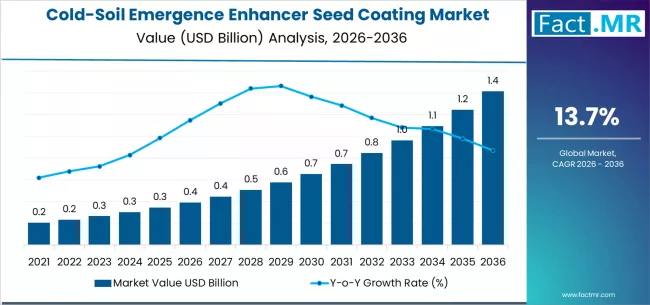
Cold Soil Emergence Enhancer Seed Coating Market Market Value Analysis | Source: Fact.MR
A pivotal trend is the development of multifunctional coatings that combine physical insulation with biological or nutritional components. These hybrid systems aim to protect the seed from thermal shock while simultaneously stimulating root growth to capitalize on shorter growing seasons. Integration with precision planting data is also advancing, allowing for the tailoring of coating formulations based on predicted soil temperature maps and field-specific sowing dates.
Regulatory drivers are less prohibitive and more supportive, focusing on climate adaptation and yield stability. Agricultural policies in key regions that incentivize practices mitigating climate risk indirectly promote adoption. Seed treatment regulations that facilitate the use of biostimulant and nutrient-based coating components further enable product innovation and market entry for these specialized enhancement technologies.
Cold-Soil Emergence Enhancer Seed Coating Market
| Metric | Value |
|---|---|
| Market Value (2026) | USD 0.39 Billion |
| Market Forecast Value (2036) | USD 1.42 Billion |
| Forecast CAGR (2026-2036) | 13.7% |
Source: Fact.MR analysis. Updated Dec 22, 2025
Category
| Category | Segments |
|---|---|
| Coating Technology Type | Polymer-Based Thermal Insulating Coatings, Bio-Stimulant Embedded Coatings, Nutrient-Infused Cold-Activation Coatings, Microbial-Assisted Emergence Coatings, Others |
| Crop Type | Cereals & Grains, Oilseeds & Pulses, Vegetables, Forage & Specialty Crops, Others |
| Functional Benefit | Faster & Uniform Emergence, Improved Early-Stage Root Development, Cold Stress Protection, Yield Stability in Early Sowing, Others |
| Region | North America, Latin America, Western Europe, Eastern Europe, East Asia, South Asia & Pacific, MEA |
Source: Fact.MR analysis. Updated Dec 22, 2025
Segmental Analysis
By Coating Technology, Which Approach Provides a Direct Physical Barrier?
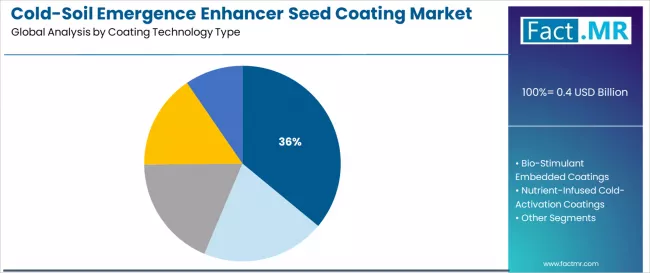
Cold Soil Emergence Enhancer Seed Coating Market Analysis By Coating Technology Type | Source: Fact.MR
Polymer-based thermal insulating coatings lead the segment with a 36% share. This dominance stems from their ability to create a protective microenvironment around the seed, buffering it against rapid temperature fluctuations in the seedbed. These coatings delay moisture uptake in cold conditions, preventing imbibitional chilling injury, and are valued for their reliable, predictable performance in large-scale cereal and oilseed planting.
By Crop Type, Which Sector Prioritizes Early Sowing for Agronomic Advantage?
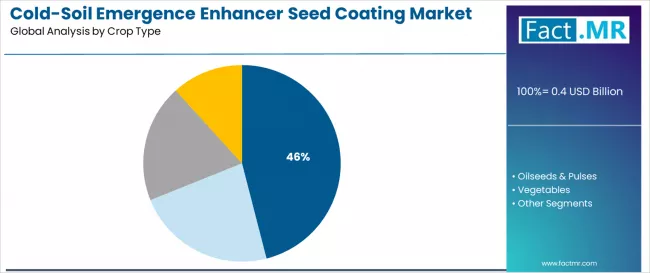
Cold Soil Emergence Enhancer Seed Coating Market Analysis By Crop Type | Source: Fact.MR
Cereals and grains command a 46% share. Farmers consistently seek to sow crops like corn, wheat, and barley earlier to extend the growing season and maximize yield potential. This practice carries significant cold-soil risk, creating a substantial and recurring demand for seed coatings that safeguard germination and ensure uniform stand establishment, protecting the foundational investment in each seed.
By Functional Benefit, What is the Ultimate Measure of Coating Success?
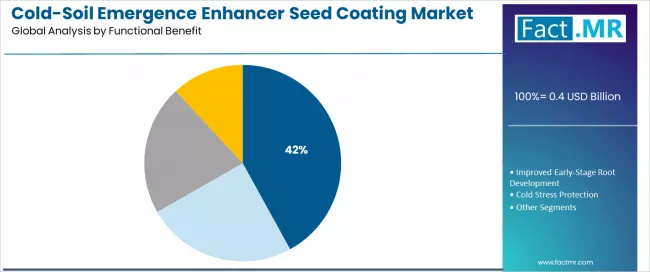
Cold Soil Emergence Enhancer Seed Coating Market Analysis By Functional Benefit | Source: Fact.MR
Faster and uniform emergence is the leading functional benefit at 42%. This metric directly translates to agronomic and economic value for the farmer. A uniform stand avoids yield loss from gaps, outcompetes weeds more effectively, and simplifies crop management. Coatings that demonstrably deliver this benefit under marginal soil conditions provide a clear return on investment, driving repeat purchases.
What are the Drivers, Restraints, and Key Trends of the Cold-Soil Emergence Enhancer Seed Coating Market?
Market growth is driven by the agricultural imperative to extend planting windows and mitigate climate variability. Earlier sowing is a key strategy for avoiding summer heat stress and drought. The increasing value of individual seeds, especially hybrids and traits, justifies investments in coatings that protect that value. Advancements in polymer and biostimulant science are enabling more effective coating formulations.
A primary restraint is the variable and often unpredictable nature of spring soil conditions, which can make the tangible benefits of the coating less visible in some seasons. The added cost per seed unit can deter adoption in commodity crop markets with tight margins. Demonstrating consistent yield ROI across diverse geographies and soil types remains a challenge for widespread validation.
Key trends include the combination of insulation with early-rooting biostimulants for a dual-mode action. The use of plant-derived materials for insulation aligns with sustainability goals. Data-driven approaches are emerging, linking soil sensor information to specific coating recommendations for different zones within a field.
Analysis of the Cold-Soil Emergence Enhancer Seed Coating Market by Key Countries
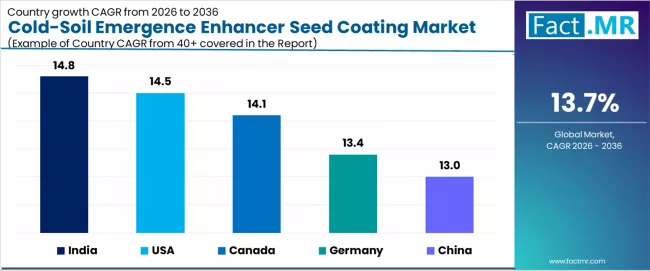
Cold Soil Emergence Enhancer Seed Coating Market Cagr Analysis By Country | Source: Fact.MR
| Country | CAGR (2026-2036) |
|---|---|
| USA | 14.50% |
| India | 14.80% |
| Canada | 14.10% |
| Germany | 13.40% |
| China | 13.00% |
Source: Fact.MR analysis. Updated Dec 22, 2025
How does the USA's Push for Earlier Planting Drive Market Demand?
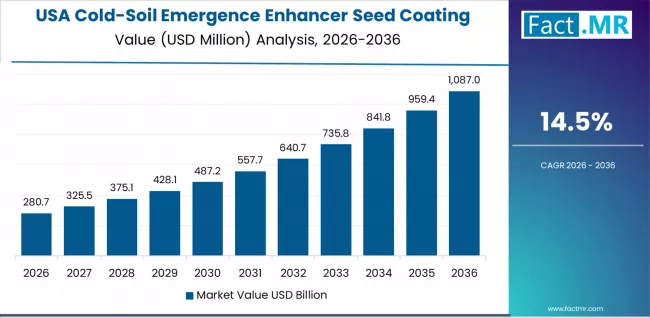
Cold Soil Emergence Enhancer Seed Coating Market Country Value Analysis | Source: Fact.MR
The USA exhibits a 14.50% CAGR, fueled by the widespread practice of planting corn and soybean into cool soils to maximize growing degree days. This strategy is standard across the Midwest and Northern Plains. The high financial stakes of these crops make farmers risk-averse to replanting, creating strong demand for insurance-like seed coatings that improve emergence odds and stand uniformity, protecting their upfront seed investment.
Why Does India's Diverse Climate and Cropping Intensity Fuel Growth?
India leads with a 14.80% CAGR, driven by the need for climate resilience across multiple cropping seasons. The rabi winter crop season, which includes wheat and pulses, often faces cold stress at sowing. Additionally, the push for earlier planting of spring crops to escape terminal heat relies on cold-tolerant establishment. The smallholder need for yield stability makes these coatings increasingly attractive.
What Role Does Canada's Shorter Growing Season Play in Adoption?
Canada's 14.10% growth is fundamentally linked to its short, intense growing season. Every day lost to slow emergence reduces the yield potential of crops like canola and spring wheat. Canadian farmers are early adopters of technologies that permit seeding into colder soils, safely advancing the calendar. Coatings that ensure rapid, uniform starts are viewed as essential yield-protection tools.
How Does Germany's Precision Agriculture Ethos Support Niche Adoption?
Germany's 13.40% CAGR reflects a precision-focused approach where optimizing every input is paramount. German farmers, particularly those growing high-value winter cereals and sugar beets, utilize these coatings as a component of risk-managed early sowing. The willingness to invest in premium seed treatments for marginal gains supports the adoption of advanced coating technologies that offer physiological benefits beyond simple protection.
What Factors Underpin Steady Demand in China's Intensive Production Systems?
China's 13.00% growth is supported by the intensive multi-cropping systems, especially in northern regions where early spring planting of corn and vegetables is critical for annual productivity. The drive to increase yield per unit area encourages investments in technologies that reduce seedling mortality and variability. Large-scale farming operations are particularly receptive to coatings that deliver measurable improvements in stand establishment.
Competitive Landscape of the Cold-Soil Emergence Enhancer Seed Coating Market
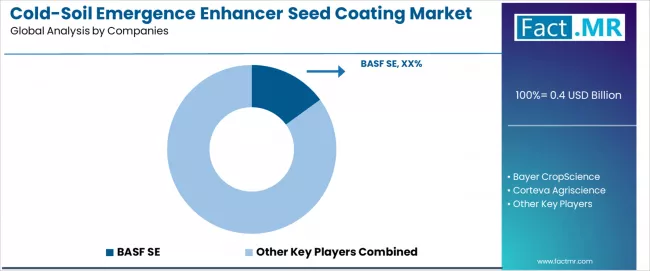
Cold Soil Emergence Enhancer Seed Coating Market Analysis By Company | Source: Fact.MR
The market features competition between integrated seed and crop protection companies and specialized coating technology firms. Major players like BASF SE, Bayer CropScience, Corteva Agriscience, and Syngenta Group leverage their seed treatment platforms and direct access to seed companies to develop and commercialize proprietary cold-emergence coating formulations, often integrating them with their seed-applied insecticide and fungicide offerings.
Specialty ingredient companies like Croda International compete through advanced material science, developing novel polymer and adjuvant systems that enhance coating performance. Competition centers on demonstrable agronomic data from field trials in key geographies, technical differentiation in mode of action, and the ability to formulate stable coatings compatible with complex seed treatment recipes. Partnerships for co-development with regional seed companies are a common route to market.
Key Players in the Cold-Soil Emergence Enhancer Seed Coating Market
- BASF SE
- Bayer CropScience
- Corteva Agriscience
- Syngenta Group
- Croda International
Segmentation
Scope of Report
| Items | Values |
|---|---|
| Quantitative Units | USD Billion |
| Coating Technology Type | Polymer-Based Thermal Insulating Coatings, Bio-Stimulant Embedded Coatings, Nutrient-Infused Cold-Activation Coatings, Microbial-Assisted Emergence Coatings, Others |
| Crop Type | Cereals & Grains, Oilseeds & Pulses, Vegetables, Forage & Specialty Crops, Others |
| Functional Benefit | Faster & Uniform Emergence, Improved Early-Stage Root Development, Cold Stress Protection, Yield Stability in Early Sowing, Others |
| Key Countries | USA, India, Canada, Germany, China |
| Key Companies | BASF SE, Bayer CropScience, Corteva Agriscience, Syngenta Group, Croda International |
| Additional Analysis | Analysis of soil temperature modeling and planting date correlations, coating interaction with seed-applied chemicals, field trial design for emergence quantification, and economic modeling of yield benefit versus coating cost. |
Source: Fact.MR analysis. Updated Dec 22, 2025
Cold-Soil Emergence Enhancer Seed Coating Market by Segments
-
Coating Technology Type :
- Polymer-Based Thermal Insulating Coatings
- Bio-Stimulant Embedded Coatings
- Nutrient-Infused Cold-Activation Coatings
- Microbial-Assisted Emergence Coatings
- Others
-
Crop Type :
- Cereals & Grains
- Oilseeds & Pulses
- Vegetables
- Forage & Specialty Crops
- Others
-
Functional Benefit :
- Faster & Uniform Emergence
- Improved Early-Stage Root Development
- Cold Stress Protection
- Yield Stability in Early Sowing
- Others
-
Region :
-
North America
- USA
- Canada
-
Latin America
- Brazil
- Mexico
- Argentina
- Rest of Latin America
-
Western Europe
- Germany
- UK
- France
- Spain
- Italy
- BENELUX
- Rest of Western Europe
-
Eastern Europe
- Czech Republic
- Poland
- Russia
- Rest of Eastern Europe
-
East Asia
- China
- Japan
- South Korea
- Rest of East Asia
-
South Asia & Pacific
- India
- Indonesia
- Australia
- Rest of South Asia & Pacific
-
MEA
- GCC Countries
- Turkiye
- Saudi Arabia
- Rest of MEA
-
Frequently Asked Questions
How big is the cold-soil emergence enhancer seed coating market in 2026?
What will be the size of cold-soil emergence enhancer seed coating market in 2036?
How much will be the cold-soil emergence enhancer seed coating market growth between 2026 and 2036?
What are the key product types in the cold-soil emergence enhancer seed coating market?
Which crop type segment to contribute significant share in the cold-soil emergence enhancer seed coating market in 2026?
Who worked on this report


Preview the report firsthand - request a free sample
Free SampleGet the brochure for pricing and purchase details
Download PDF