- Base Value(2025): 1.7 Bn
- Estimated Value(2026): 1.8 Bn
- Forecast Value (2036): 2.7 Bn
- CAGR (2026 - 2036): 4.2%
Foldable and Collapsible Container Market Analysis and Forecast by Fact.MR
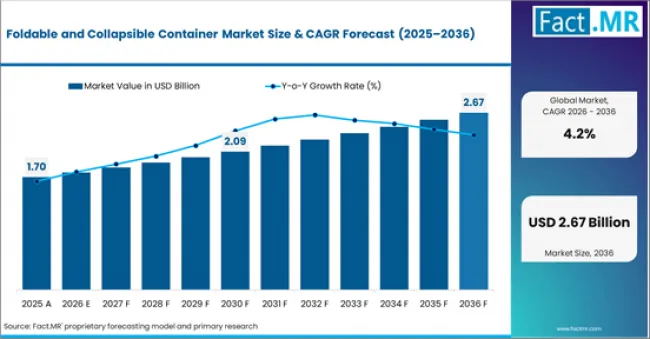
- The global foldable and collapsible container market is estimated at USD 1.77 billion in 2026 and is forecast to expand at a CAGR of 4.2% to reach USD 2.67 billion by 2036.
- Foldable and collapsible containers are reusable packaging solutions engineered to reduce volume by 50 to 75% when empty through folding, collapsing, or nesting mechanisms, delivering significant savings in return transport costs and warehouse storage.
- The market is driven by logistics cost optimization in automotive and food supply chains, e-commerce reverse logistics growth, sustainability-driven transition from single-use packaging, and increasing specification of modular, space-saving container systems that improve fleet utilization across multi-tier distribution networks.
Foldable And Collapsible Container Market Value Analysis | Source: Fact.MR
Summary of Foldable and Collapsible Container Market
- Market Snapshot
- In 2025, the global Foldable and Collapsible Container Market was valued at approximately USD 1.7 billion.
- The market is estimated to reach USD 1.77 billion in 2026 and is projected to attain USD 2.67 billion by 2036.
- The foldable and collapsible container market is likely to expand at a CAGR of 4.2% during the forecast period.
- The market is anticipated to create an absolute dollar opportunity of USD 0.90 billion between 2026 and 2036.
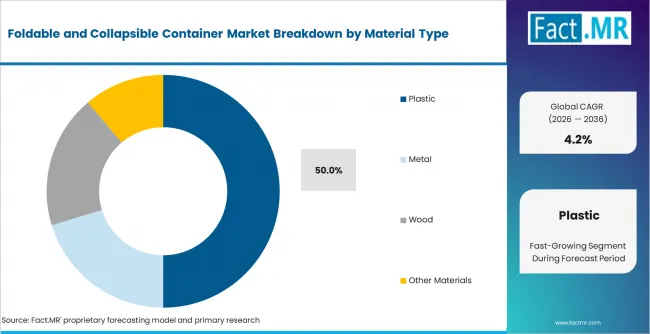
- Plastic accounts for 50% of material type share in 2026.
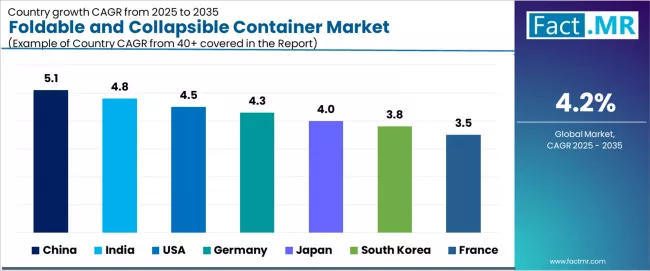
- China (5.1%) and India (4.8%) are the key growth markets during the forecast period.
- Demand and Growth Drivers
- Logistics cost optimization through 50 to 75% volume reduction during empty return transport is the primary driver, as companies seek to reduce freight costs and improve fleet utilization across supply chain networks.
- Automotive supply chain requirements for standardized, space-efficient containers that protect components during transit and minimize storage footprint at assembly plants sustain steady demand.
- E-commerce reverse logistics growth is creating demand for foldable delivery containers that reduce return transport costs and support circular packaging models.
- Sustainability mandates and corporate packaging waste reduction targets are accelerating transition from single-use corrugated and disposable containers to reusable foldable alternatives.
- Fresh food distribution requirements for ventilated, stackable, and easily cleaned foldable crates are driving adoption across produce, dairy, and meat supply chains.
- Product and Segment View
- Foldable containers account for 55% of the product type segment in 2026, driven by demand for attached-lid containers, ventilated crates, and wire mesh containers across logistics, automotive, and food applications.
- Plastic accounts for 50% of the material type segment, reflecting the dominance of polypropylene and HDPE in lightweight, durable, washable container construction.
- Medium duty (500 to 1500 kg) holds 45% of the load capacity segment, serving the broadest range of automotive parts, food distribution, and industrial logistics applications.
- Key segmentation includes:
- Product Type: Foldable containers (plastic, metal), Collapsible containers (plastic, pallet boxes)
- Material Type: Plastic (PP, HDPE), Metal (steel, aluminum), Wood, Other materials
- Load Capacity: Light duty, Medium duty, Heavy duty
- Application: Logistics and transportation, Automotive, Food and beverage, Retail and e-commerce, Industrial
- End Use Industry: Automotive, Food and beverage, Retail, Industrial, Healthcare
- Design Type: Rigid foldable, Collapsible, Modular design
- These systems enable:
- 50 to 75% volume reduction when empty, minimizing return transport costs and warehouse storage requirements
- Standardized, stackable construction supporting efficient handling, automated sorting, and space-optimized warehousing
- Reusable, washable design that reduces single-use packaging waste and supports circular supply chain models
- Geography and Competitive Outlook
- Europe leads by market maturity through established automotive and food distribution pooling networks, supported by PPWR reuse targets and advanced reverse logistics infrastructure.
- Asia Pacific is the fastest-growing region through China and India, driven by automotive manufacturing expansion, food distribution modernization, and e-commerce logistics growth.
- North America sustains demand through the USA, supported by automotive supply chain requirements, food distribution standards, and growing e-commerce packaging optimization.
- China (5.1%) and India (4.8%) lead growth, while the USA (4.5%), Germany (4.3%), Japan (4.0%), South Korea (3.8%), and France (3.5%) sustain demand.
- Major players include Schoeller Allibert Group, CHEP (Brambles), WestRock Company, and Corplex Group.
- Analyst Opinion
- Shambhu Nath Jha, Principal Consultant at Fact.MR, says 'The foldable and collapsible container market is entering a phase of sustained but measured growth as logistics cost optimization and sustainability mandates converge to accelerate the transition from single-use to reusable packaging. The 50 to 75% volume reduction during empty return transport creates a clear financial case that procurement teams can quantify, while PPWR reuse targets in Europe add regulatory urgency. Companies offering integrated solutions that combine foldable container hardware with tracking technology, cleaning services, and fleet management analytics are commanding premium pricing, while commodity container manufacturers face margin compression from Asian import competition.'
Key Growth Drivers, Constraints, and Opportunities
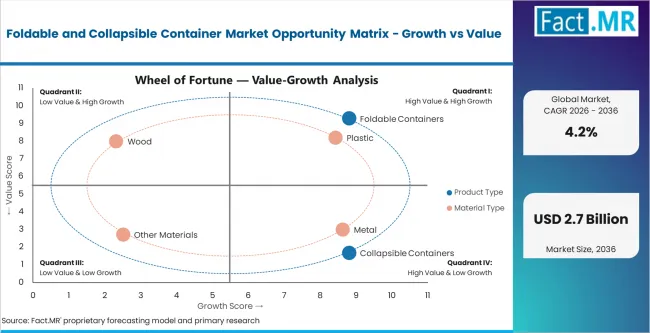
Foldable And Collapsible Container Market Opportunity Matrix Growth Vs Value | Source: Fact.MR
Key Factors Driving Growth
- Empty return transport cost reduction of 50 to 75% through volume minimization creates a quantifiable financial case that drives procurement conversion from rigid to foldable containers.
- EU PPWR reuse targets and equivalent sustainability regulations are creating compliance-driven demand for reusable container systems in food, retail, and industrial supply chains.
- E-commerce reverse logistics growth is creating new demand for foldable delivery containers that optimize return transport economics in multi-cycle fulfillment operations.
Key Market Constraints
- Higher unit acquisition cost compared to single-use corrugated packaging creates procurement resistance in price-sensitive supply chains with short product lifecycles.
- Container loss rates in open-loop and multi-party supply chains erode return on investment, particularly where tracking and pooling infrastructure is insufficient.
- Limited compatibility between different manufacturers' foldable container systems creates interoperability challenges in supply chains involving multiple partners and pooling networks.
Key Opportunity Areas
- RFID and IoT tracking integration into foldable containers is enabling asset-as-a-service models that reduce upfront capital requirements and improve fleet utilization rates.
- Growing specification of foldable containers in pharmaceutical and healthcare cold chain logistics creates premium-priced application segments.
- Emerging market adoption in India, China, and Southeast Asia presents volume growth as automotive and food supply chains formalize and regulatory frameworks develop.
Segment-wise Analysis of the Foldable and Collapsible Container Market
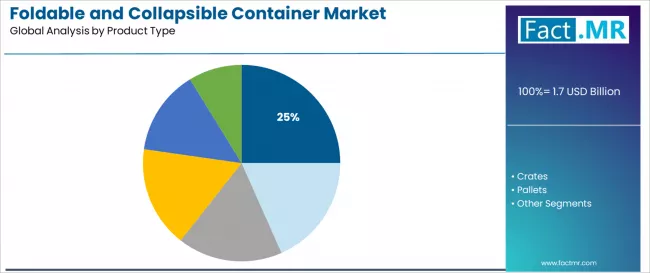
- Foldable containers hold 55% of the product type segment in 2026, driven by attached-lid containers and ventilated crates serving automotive, food, and retail logistics.
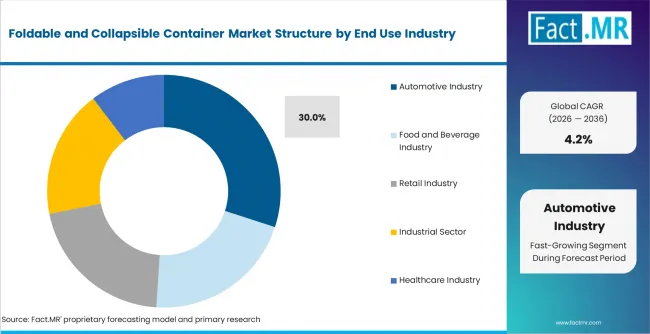
- Automotive accounts for 30% of the end use industry segment, reflecting the deep adoption of foldable containers for component handling across multi-tier supplier networks.
- Rigid foldable design accounts for 40% of the design type segment, driven by attached-lid and vented configurations that combine folding capability with secure closure.
The market is segmented by product type, material type, load capacity, application, end use industry, design type, and region. Foldable containers lead by product type. Plastic dominates by material. Medium duty leads by load capacity, and logistics and transportation leads by application.
Which Product Type Segment Dominates the Foldable and Collapsible Container Market?
Foldable And Collapsible Container Market Analysis By Product Type | Source: Fact.MR
Foldable containers account for 55% of the product type segment in 2026. Plastic foldable containers, including attached-lid containers and ventilated crates, serve the broadest range of applications across automotive component handling, food distribution, and retail logistics. Metal foldable containers, including wire mesh and steel foldable bins, serve heavier-duty automotive and industrial applications.
Collapsible containers, including collapsible plastic bins and pallet boxes, serve applications requiring larger capacity and heavier load ratings. Collapsible pallet boxes are gaining specification in industrial and bulk handling applications where the combination of high load capacity with space-efficient empty storage is a priority.
Which Application Segment Dominates the Foldable and Collapsible Container Market?
Foldable And Collapsible Container Market Analysis By End Use Industry | Source: Fact.MR
Logistics and transportation accounts for 30% of the application segment in 2026. Supply chain movement, warehousing, distribution center operations, and reverse logistics represent the core demand base for foldable containers. The financial case for foldable systems is strongest in logistics applications where containers make frequent round trips and empty return volumes directly impact freight costs.
Automotive is the second-largest application, with foldable containers serving component handling, assembly line supply, and in-plant logistics. Food and beverage applications are growing through ventilated foldable crates for fresh produce and dairy distribution. Retail and e-commerce represent the fastest-growing segment as fulfillment centers and last-mile delivery operations adopt foldable systems.
Which Material Type Segment Dominates the Foldable and Collapsible Container Market?
Foldable And Collapsible Container Market Analysis By Material Type | Source: Fact.MR
Plastic accounts for 50% of the material type segment in 2026. Polypropylene and HDPE remain the dominant materials for foldable containers due to their combination of lightweight construction, mechanical durability, chemical resistance, and compatibility with automated washing and sanitization processes. Plastic foldable containers typically achieve service lives of 5 to 10 years across hundreds of use cycles.
Metal containers serve heavier-duty applications where load capacity and impact resistance requirements exceed plastic performance limits. Wood and composite materials serve specialized applications in specific industries and regions.
Which Product Trend is Shaping the Next Phase of Growth in the Foldable and Collapsible Container Market?
Smart foldable containers with embedded RFID tracking and IoT sensors are the defining product trend. The integration of tracking technology into container walls or lids enables real-time fleet visibility, automated inventory management, and predictive maintenance scheduling that improves asset utilization and reduces loss rates. This technology layer transforms foldable containers from passive packaging into connected logistics assets that generate operational data.
The industry consolidation trend, exemplified by the IPL-Schoeller Allibert merger valued at USD 1.4 billion and Schoeller Allibert's May 2025 partnership with Transoplast Group, reflects the strategic importance of combining manufacturing scale with digital service capabilities. Companies that can offer foldable container hardware integrated with tracking technology, cleaning services, and fleet analytics are building switching costs that commodity container manufacturers cannot match.
Regional Outlook Across Key Markets
.webp "Top Country Growth Comparison Foldable And Collapsible Container Market Cagr (2026 2036)")
Top Country Growth Comparison Foldable And Collapsible Container Market Cagr (2026 2036) | Source: Fact.MR
- China leads growth at 5.1%, driven by automotive manufacturing expansion, food cold chain development, e-commerce logistics, and domestic container manufacturing capability.
- India follows at 4.8%, supported by automotive supply chain growth, food distribution modernization, and growing awareness of reusable packaging economics.
- The USA grows at 4.5%, driven by automotive supply chain requirements, e-commerce reverse logistics, and sustainability-driven packaging transitions.
- Europe sustains demand through Germany (4.3%) and France (3.5%), supported by PPWR reuse mandates, mature pooling networks, and established automotive supply chains.
| Country | CAGR (%) |
|---|---|
| China | 5.1% |
| India | 4.8% |
| USA | 4.5% |
| Germany | 4.3% |
| Japan | 4.0% |
| South Korea | 3.8% |
| France | 3.5% |
Source: Fact.MR analysis. Updated May 25, 2026
Source: Fact MR (FMR) analysis, based on proprietary forecasting model and primary research.
Foldable And Collapsible Container Market Cagr Analysis By Country | Source: Fact.MR
Market Outlook for Foldable and Collapsible Containers in China
The China market is projected to grow at a CAGR of 5.1% through 2036. Demand is driven by automotive manufacturing, food cold chain development, e-commerce logistics expansion, and strong domestic manufacturing capability.
- Automotive manufacturing drives component handling container demand.
- Food cold chain development supports ventilated foldable crate adoption.
- Domestic manufacturing supports cost-competitive container supply.
Foldable and Collapsible Container Demand Trends in India
The India market is projected to grow at a CAGR of 4.8% through 2036. Growth is supported by automotive supply chain formalization, food distribution modernization, and growing awareness of reusable packaging economics.
- Automotive supply chain drives adoption of standardized foldable containers.
- Food distribution modernization creates demand for reusable crate systems.
- Growing awareness of lifecycle cost advantages accelerates adoption.
United States Foldable and Collapsible Container Market Growth Assessment
Foldable And Collapsible Container Market Country Value Analysis | Source: Fact.MR
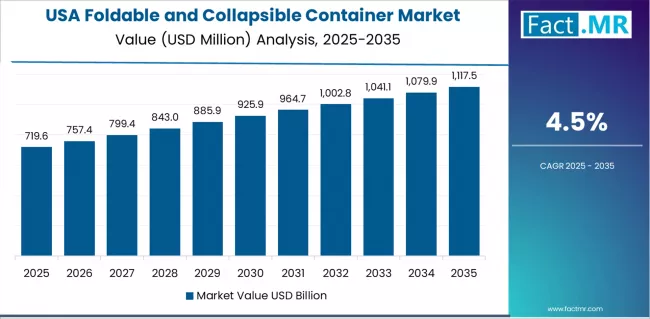
The U.S. market is projected to grow at a CAGR of 4.5% through 2036. Demand is shaped by automotive supply chain standards, e-commerce reverse logistics optimization, and corporate sustainability commitments.
- Automotive supply chains sustain demand for standardized foldable containers.
- E-commerce reverse logistics drives foldable delivery container adoption.
- Corporate sustainability commitments accelerate transition from single-use packaging.
Germany Foldable and Collapsible Container Market Demand Analysis
The Germany market is projected to grow at a CAGR of 4.3% through 2036. Demand is shaped by PPWR reuse mandates, mature automotive supply chains, food distribution standards, and advanced pooling infrastructure.
- PPWR reuse targets create compliance-driven container demand.
- Automotive supply chains sustain high-specification foldable container use.
- Mature pooling infrastructure supports efficient asset management.
Japan Foldable and Collapsible Container Market Opportunity Outlook
Foldable And Collapsible Container Market Japan Market Share Analysis By Product Type | Source: Fact.MR
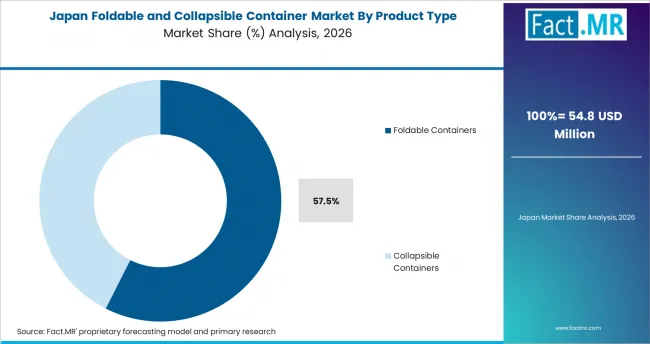
The Japan market is projected to grow at a CAGR of 4.0% through 2036. Demand is supported by automotive manufacturing precision requirements, food distribution efficiency standards, and emphasis on space optimization in logistics.
- Automotive precision drives high-quality foldable container specification.
- Food distribution efficiency supports ventilated foldable crate demand.
- Space optimization emphasis favors volume-reducing container designs.
Competitive Benchmarking and Company Positioning
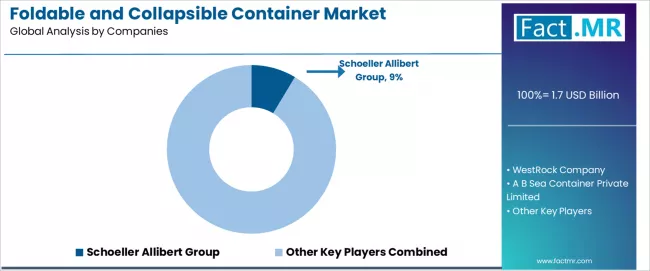
Foldable And Collapsible Container Market Analysis By Company | Source: Fact.MR
Foldable and Collapsible Container Market Analysis By Company
- Schoeller Allibert Group and CHEP (Brambles) dominate through broad product portfolios, global pooling network scale, and integrated service capabilities.
- WestRock Company, Corplex Group, and RPP Containers compete through product specialization, regional strength, and focused end-use industry expertise.
- Product design innovation, pooling infrastructure, tracking technology integration, and cleaning service capability are primary differentiators.
The competitive landscape is moderately concentrated. Schoeller Allibert holds approximately 9% market share through its broad range of foldable and collapsible containers, global manufacturing presence, and established automotive and food distribution customer relationships. The IPL-Schoeller Allibert merger strengthens the combined entity's manufacturing and distribution scale.
CHEP (Brambles) competes through its global pooling network that integrates foldable containers with tracking, cleaning, and fleet management services. WestRock Company brings packaging expertise across multiple formats, while Corplex Group and RPP Containers serve specific regional and application segments.
Asian manufacturers including A B Sea Container, Vinsum Axpress, and Shandong Liansheng serve growing domestic markets with competitive pricing and expanding product ranges. Flex Container and Logimarkt compete through specialized design and application-focused solutions.
Strategic priorities include integrating RFID tracking, expanding food-grade foldable container ranges, building cleaning and sanitization infrastructure, and strengthening e-commerce fulfillment container capabilities.
Key Companies in the Foldable and Collapsible Container Market
Schoeller Allibert Group and CHEP (Brambles) are leading players supported by broad portfolios, pooling infrastructure, and integrated services.
WestRock Company, Corplex Group, and RPP Containers hold established positions through product specialization and regional strength.
A B Sea Container, Vinsum Axpress, Spectainer, Sahay Racks, Flex Container, Logimarkt, and Shandong Liansheng compete through regional manufacturing and price-competitive offerings.
Recent Industry Developments
- IPL and Schoeller Allibert - Strategic Merger / Global Foldable Container Platform (Q3 2025)
- The IPL-Schoeller Allibert merger, valued at approximately USD 1.4 billion, creates a combined entity with enhanced manufacturing scale for foldable and returnable packaging across North America and Europe, strengthening capabilities in automotive, food, and industrial container segments.
- Schoeller Allibert - Product Innovation / Recycled Beverage Carton Container (April 2025)
- Schoeller Allibert and Tetra Pak developed a transport crate manufactured from recycled beverage carton materials (polyAl), rolled out at the Plastics Recycling Show in Amsterdam, demonstrating circular economy material innovation in foldable container manufacturing.
- Schoeller Allibert - Distribution Partnership / Transoplast Group Alliance (May 2025)
- Schoeller Allibert partnered with Transoplast Group to enhance distribution, customization, and inventory management of reusable foldable crates, pallets, and containers, strengthening its circular economy packaging service across European markets.
Leading Companies Shaping the Foldable and Collapsible Container Market
- Schoeller Allibert Group
- WestRock Company
- A B Sea Container Private Limited
- Vinsum Axpress
- Spectainer
- Sahay Racks
- Flexible Packaging Solutions
- Logimarkt
- CHEP (a Brambles Limited company)
- Flex Container
- RPP Containers
- Corplex (Corplex Group)
- Shandong Liansheng Prefabricated Construction Co., Ltd.
Sources and Research References
- Schoeller Allibert. IPL merger documentation and Tetra Pak recycled material container innovation.
- CHEP (Brambles). Pooling platform and foldable container fleet management documentation.
- EU PPWR reuse target documentation and packaging waste regulation timelines.
- Automotive production databases, food distribution logistics data, and e-commerce packaging trend analysis.
- Primary interviews with container manufacturers, pooling operators, logistics providers, and end users.
This bibliography is provided for reader reference and is not exhaustive. The full report contains the complete reference list and detailed citations.
Key Questions This Report Addresses
- What is the current and future size of the Foldable and Collapsible Container market?
- How fast is the market expected to grow between 2026 and 2036?
- Which product type leads in 2026?
- Which application holds highest share?
- What drives demand?
- How is e-commerce influencing the market?
- Why is China the fastest-growing market?
- How are PPWR regulations shaping demand?
- Which countries show fastest growth?
- Who are the key companies?
- How does Fact.MR validate the forecast?
Foldable and Collapsible Container Market Definition
The foldable and collapsible container market covers reusable containers engineered with folding, collapsing, or nesting mechanisms that reduce empty volume for return transport and storage, manufactured from plastic, metal, wood, and composite materials for logistics, automotive, food, retail, and industrial applications.
Foldable and Collapsible Container Market Inclusions
- The scope covers global and regional market size and forecasts for 2026 to 2036 across product type, material type, load capacity, application, end use industry, design type, and region.
- It includes analysis of logistics cost structures, return transport economics, packaging waste regulations, and pooling model adoption rates.
- The report covers pricing and cost analysis including container acquisition costs, volume reduction savings, cleaning costs, and lifecycle economics.
- It covers technology trends, market drivers, and competitive landscape including product portfolios and service integration of leading manufacturers.
Foldable and Collapsible Container Market Exclusions
- The scope excludes non-foldable returnable containers, standard pallets, and rigid bulk bins without folding or collapsing capability.
- It excludes single-use corrugated and disposable containers not designed for reuse.
- The report excludes container cleaning equipment, tracking hardware, and logistics software sold independently.
- It also excludes inflatable dunnage and void-fill packaging without structural container function.
Foldable and Collapsible Container Market Research Methodology
- The methodology combines secondary research, primary interviews, and forecast modelling.
- It draws on 50+ secondary sources and benchmarks 25+ manufacturer product portfolios.
- Market sizing covers 20+ countries through a demand-side model, supported by top-down validation.
- Key inputs include automotive production volumes, food distribution logistics spending, e-commerce packaging trends, and packaging waste regulation timelines.
- The model cross-checks demand with manufacturing capacity, material pricing, and fleet deployment data.
- Primary validation includes 15+ interviews across container manufacturers, pooling operators, logistics providers, and end users.
- Final estimates go through fleet-utilization checks, logistics-cost analysis, and sensitivity testing.
Segmentation
Scope of Analysis
| Parameter | Details |
|---|---|
| Quantitative Units | USD 1.77 billion to USD 2.67 billion, at a CAGR of 4.2% |
| Market Definition | The market covers reusable containers with folding, collapsing, or nesting mechanisms for volume reduction during empty return transport across logistics, automotive, food, retail, and industrial applications. |
| Regions Covered | North America, Latin America, Europe, East Asia, South Asia and Pacific, Middle East and Africa |
| Countries Covered | China, India, USA, Germany, Japan, South Korea, France, 20 plus countries |
| Key Companies | Schoeller Allibert, WestRock, A B Sea Container, Vinsum Axpress, Spectainer, CHEP, Flex Container, RPP Containers, Corplex, Shandong Liansheng |
| Forecast Period | 2026 to 2036 |
| Approach | Hybrid demand-side and top-down methodology built on automotive production, food distribution logistics, e-commerce packaging trends, and primary interviews across manufacturers, pooling operators, and end users |
Source: Fact.MR analysis. Updated May 25, 2026
Foldable and Collapsible Container Market Segmentation
-
Foldable and Collapsible Container Market Segmented by Product Type:
- Foldable Containers
- Plastic Foldable Containers
- Attached Lid Containers
- Ventilated Crates
- Metal Foldable Containers
- Wire Mesh Containers
- Steel Foldable Bins
- Plastic Foldable Containers
- Collapsible Containers
- Collapsible Plastic Containers
- Bulk Bins
- Folding Crates
- Collapsible Pallet Boxes
- Heavy-duty Pallet Boxes
- Stackable Containers
- Collapsible Plastic Containers
- Foldable Containers
-
Foldable and Collapsible Container Market Segmented by Material Type:
- Plastic
- Polypropylene (PP)
- Lightweight Containers
- Reusable Crates
- High-density Polyethylene (HDPE)
- Chemical Resistant
- Heavy-duty Use
- Polypropylene (PP)
- Metal
- Steel
- High Strength
- Industrial Applications
- Aluminum
- Lightweight
- Corrosion Resistant
- Steel
- Wood
- Softwood
- Cost-effective
- General Storage
- Engineered Wood
- Plywood Containers
- Enhanced Strength
- Softwood
- Other Materials
- Corrugated Plastic
- Lightweight Panels
- Reusable Packaging
- Composite Materials
- Hybrid Structures
- Durability
- Corrugated Plastic
- Plastic
-
Foldable and Collapsible Container Market Segmented by Load Capacity:
- Medium Duty
- 500–1000 kg
- Industrial Use
- Bulk Handling
- 1000–1500 kg
- Automotive Parts
- Manufacturing
- 500–1000 kg
- Light Duty
- Below 100 kg
- Retail Storage
- Small Goods
- 100–500 kg
- Warehouse Handling
- Food Distribution
- Below 100 kg
- Heavy Duty
- Above 1500 kg
- Bulk Materials
- Heavy Equipment
- Ultra-heavy Duty
- Industrial Applications
- High Load Handling
- Above 1500 kg
- Medium Duty
-
Foldable and Collapsible Container Market Segmented by Application:
- Logistics and Transportation
- Supply Chain Movement
- Warehousing
- Distribution Centers
- Returnable Packaging
- Reverse Logistics
- Reusable Systems
- Supply Chain Movement
- Automotive
- Component Handling
- Engine Parts
- Body Components
- Assembly Line Use
- In-plant Logistics
- Material Flow
- Component Handling
- Food and Beverage
- Fresh Produce
- Fruits and Vegetables
- Dairy Products
- Processed Food
- Packaged Food
- Beverage Crates
- Fresh Produce
- Retail and E-commerce
- Inventory Storage
- Sorting Systems
- Warehouse Management
- Last-mile Delivery
- Order Fulfillment
- Returns Handling
- Inventory Storage
- Industrial and Manufacturing
- Material Handling
- Bulk Goods
- Intermediate Products
- Storage Solutions
- Production Lines
- Factory Use
- Material Handling
- Logistics and Transportation
-
Foldable and Collapsible Container Market Segmented by End Use Industry:
- Automotive Industry
- OEM Manufacturers
- Assembly Plants
- Component Transport
- Aftermarket
- Spare Parts
- Service Logistics
- OEM Manufacturers
- Food and Beverage Industry
- Producers
- Dairy
- Beverage Companies
- Distributors
- Cold Chain
- Retail Supply
- Producers
- Retail Industry
- E-commerce Platforms
- Order Fulfillment
- Warehouse Operations
- Supermarkets
- Inventory Management
- Distribution
- E-commerce Platforms
- Industrial Sector
- Manufacturing Units
- Material Handling
- Production Support
- Logistics Providers
- Warehousing
- Transportation
- Manufacturing Units
- Healthcare Industry
- Pharmaceutical Companies
- Drug Transport
- Cold Chain Logistics
- Hospitals
- Medical Supplies
- Sterile Packaging
- Pharmaceutical Companies
- Automotive Industry
-
Foldable and Collapsible Container Market Segmented by Design Type:
- Rigid Foldable Design
- Attached Lid Design
- Secure Closure
- Stackability
- Vented Design
- Air Circulation
- Perishable Goods
- Attached Lid Design
- Collapsible Design
- Folding Wall Containers
- Space Saving
- Easy Storage
- Collapsible Pallet Boxes
- Heavy-duty Use
- Bulk Handling
- Folding Wall Containers
- Modular Design
- Stackable Systems
- Efficient Storage
- Warehouse Use
- Custom Modular Units
- Industry-specific
- Configurable Systems
- Stackable Systems
- Rigid Foldable Design
-
Foldable and Collapsible Container Market by Region:
- North America
- USA
- Canada
- Mexico
- Latin America
- Brazil
- Chile
- Rest of Latin America
- Western Europe
- Germany
- UK
- Italy
- Spain
- France
- Nordic
- BENELUX
- Rest of Western Europe
- Eastern Europe
- Russia
- Poland
- Hungary
- Balkan & Baltic
- Rest of Eastern Europe
- East Asia
- China
- Japan
- South Korea
- South Asia and Pacific
- India
- ASEAN
- Australia & New Zealand
- Rest of South Asia and Pacific
- Middle East & Africa
- Kingdom of Saudi Arabia
- Other GCC Countries
- Turkiye
- South Africa
- Other African Union
- Rest of Middle East & Africa
- North America
Frequently Asked Questions
How big is the foldable and collapsible container market in 2025?
What will be the size of the HVDC Converter Station Market in 2036?
How much will the HVDC Converter Station Market grow between 2026 and 2036?
What are the key technology types in the HVDC Converter Station Market?
Which application holds the highest share in the HVDC Converter Station Market in 2026?
Which are the fastest-growing countries in the HVDC Converter Station Market?
Who worked on this report


Preview the report firsthand - request a free sample
Free SampleGet the brochure for pricing and purchase details
Download PDF