Foldable Drone Market Size, Share, Growth and Forecast (2026 - 2036)
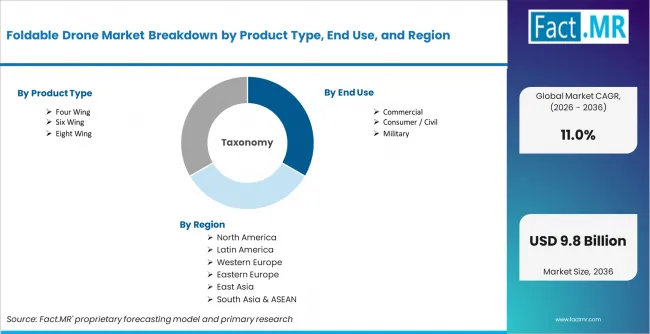
The Foldable Drone Market is segmented by Product Type (Four Wing, Six Wing, and Eight Wing), End Use (Commercial, Consumer/Civil, and Military), Use Case/Application (Filming & Photography, Inspection & Maintenance, Mapping & Surveying, Precision Agriculture, and Surveillance & Monitoring), Buyer Type (Media & Entertainment, Agriculture & Forestry, Delivery & Logistics, Construction & Mining, Oil & Gas, Security & Law Enforcement, and Recreational Activity), Connectivity Technology (GPS Enabled Drones, Wi-Fi Controlled Drones, AI-Assisted Autonomous Drones, and Hybrid Connectivity Drones) and Region. Forecast for 2026 to 2036.
Fact.MR opinions that the foldable drone market is approaching a portability-versus-performance tipping point. Lightweight foldable airframes are increasingly replacing fixed-frame platforms across inspection and surveillance applications. AI-assisted autonomous navigation is narrowing the operational gap between compact foldable drones and larger industrial systems.
Foldable Drone Market Forecast and Outlook By FACT MR
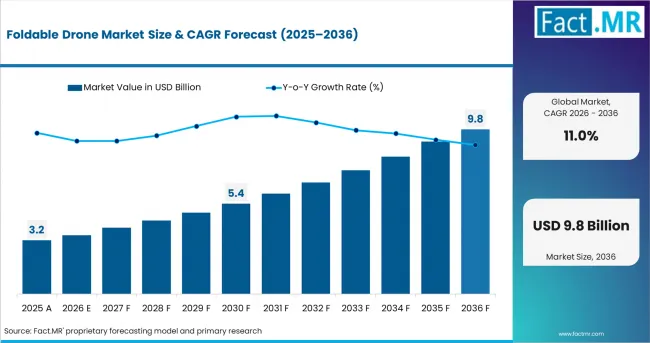
- In 2025, the foldable drone market crossed a valuation of USD 3.2 billion. Based on Fact.MR analysis, demand for foldable drones is estimated to grow to USD 3.5 billion in 2026 and USD 9.8 billion by 2036. Fact.MR projects a CAGR of 11.0% during the forecast period.
- The foldable drone market is projected to add strong absolute dollar opportunity through 2036 as commercial deployment expands across inspection and agriculture.
- Falling sensor costs and AI-assisted flight capability support adoption across industrial operations.
- Battery weight limitations and airframe rigidity constraints restricting payload performance for heavy industrial applications.
Summary of Foldable Drone Market
- Demand Drivers
- Commercial operators in construction and oil and gas are shifting to foldable platforms for rapid deployment on dispersed field sites. Infrastructure inspection providers add another adoption base. Fixed-frame aircraft require added handling equipment in these locations.
- Agricultural service providers in India and China are scaling foldable drone deployments for crop spraying and mapping applications, driven by government subsidy programs that reduce upfront capital costs for farming cooperatives.
- Media production companies and public safety agencies are increasing adoption of foldable platforms as AI-assisted stabilization and GPS-guided autonomous flight reduce skilled pilot dependency across aerial filming and surveillance missions.
- Key Segments Analyzed
- By Product Type: Four Wing foldable drones account for 45.2% share in 2026. The segment benefits from strong portability and stable flight performance.
- By End Use: Commercial applications contribute 55.0% share in 2026. Inspection, agriculture, and surveillance deployment driving demand.
- By Use Case/Application: Filming and photography generate 30.0% share in 2026. Content creators prefer foldable drones for flexible outdoor shooting.
- By Buyer Type: Media and entertainment represents 25.0% share in 2026. Film and broadcasting operators are increasing aerial drone usage.
- By Connectivity Technology: GPS-enabled drones account for 48.0% share in 2026. Positioning accuracy remains critical across industrial operations.
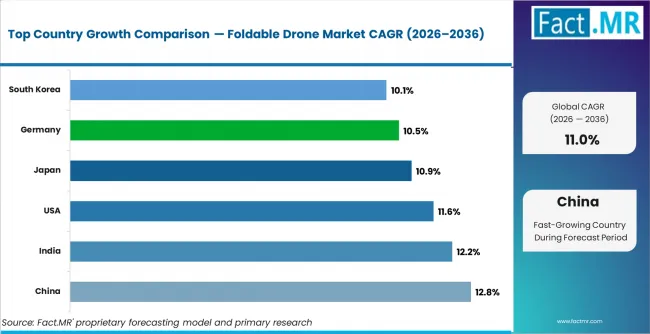
- By Geography: China leads at 12.8% CAGR through 2036. Domestic manufacturing and agriculture programs supporting deployment.
- Analyst Opinion at FACT.MR
- Shambhu Nath Jha, Principal Consultant at Fact.MR, opines, ‘CXOs will find that the shift from consumer-grade foldable drones toward professional commercial platforms is accelerating rapidly. AI-assisted navigation and compact sensor integration are reducing the performance gap with larger industrial drones.'
- Strategic Implications
- Foldable drone manufacturers should pursue certification across FAA Part 107 commercial operations and EASA Open Category A2 regulations to access high-frequency commercial inspection deployments across North America and European industrial corridors simultaneously.
- Agricultural drone service companies expanding into India and China through partnerships with local OEMs gain access to government subsidy programs that subsidize platform costs and reduce commercial adoption friction across farming cooperatives.
- Investing in modular payload design enabling rapid sensor swap between RGB cameras, multispectral units, and LiDAR improves fleet utilization across multiple application verticals without requiring additional aircraft units per deployment team.
| Metric | Value |
|---|---|
| Estimated Value in 2026 | USD 3.5 billion |
| Forecast Value in 2036 | USD 9.8 billion |
| Forecast CAGR (2026 to 2036) | 11.0% |
China is projected to expand at 12.8% CAGR through 2036 as domestic manufacturers strengthen AI-enabled foldable drone deployment across precision agriculture and commercial inspection operations. India is forecast to grow at 12.2% CAGR driven by drone manufacturing incentives and expanding agri-drone deployment programs across rural farming regions. The United States is projected to rise at 11.6% CAGR through 2036 as commercial drone approvals support foldable drone deployment across infrastructure inspection and construction monitoring operations. Japan is forecast to grow at 10.9% CAGR due to increasing rural delivery trials and autonomous drone deployment across remote regions with limited road access. Germany is projected to expand at 10.5% CAGR through 2036 as structured drone regulations support industrial inspection deployment across manufacturing-intensive regions. South Korea is forecast to grow at 10.1% CAGR driven by national airspace modernization programs supporting commercial drone delivery and inspection services.
Segmental Analysis
Foldable Drone Market Analysis by Product Type
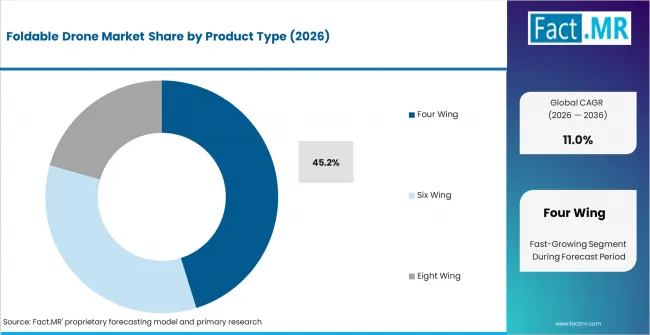
Based on Fact.MR's foldable drone market report, Four Wing foldable drones are estimated to account for 45.2% share in 2026 because the configuration provides strong portability and stable flight performance across commercial applications.
- Compact Platform Preference: Commercial operators are prioritizing lightweight foldable drones for easier transport and rapid deployment.
- Six Wing Adoption Growth: Six Wing configurations are gaining traction for higher payload and improved flight redundancy.
- DJI launched the Mavic 3: DJI launched the Mavic 3 Enterprise series in 2024 with integrated AI obstacle sensing and automated mission planning, reducing the autonomous flight cost barrier for commercial inspection operators deploying foldable platforms across utility and infrastructure inspection contracts. [2]
Foldable Drone Market Analysis by End Use
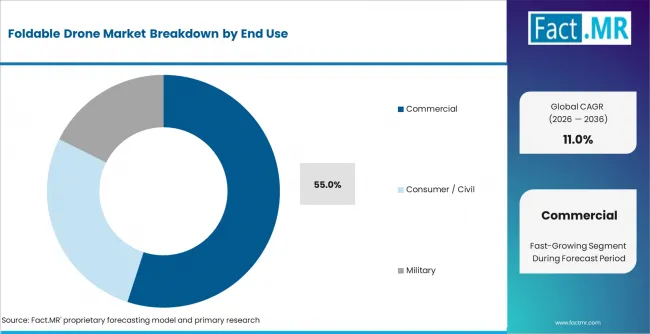
Based on Fact. MR’s foldable drone market report, commercial applications are estimated to account for 55% share in 2026. Inspection and agriculture deployments driving commercial foldable drone demand.
- Inspection Fleet Scaling: Industrial operators are expanding foldable drone fleets across infrastructure and utility inspection operations.
- Consumer Market Expansion: Recreational drone adoption remains strong across photography and outdoor entertainment applications.
Foldable Drone Market Analysis by Use Case/Application
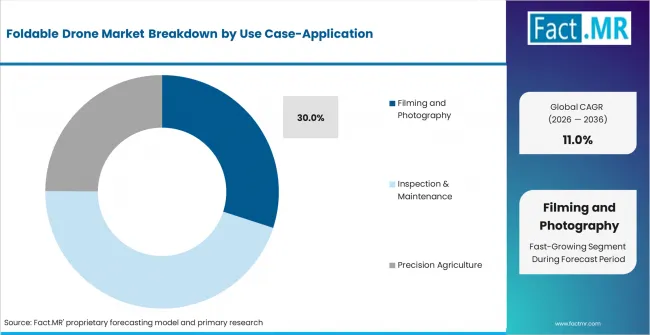
Based on Fact. MR’s foldable drone market report, filming and photography are estimated to account for 30.0% share in 2026. Content creators and media production operators prefer foldable drones for portability and rapid aerial setup capability.
- Media Production Adoption: Broadcasting and event coverage companies are increasing foldable drone deployment for aerial filming operations.
- Inspection Application Growth: Foldable drones are expanding across pipeline, offshore, and industrial inspection activity.
- Skydio Unveils R10 and F10 Drones at Ascend 2025: Skydio introduced the R10 indoor drone and F10 long-range fixed-wing drone during its Ascend 2025 event. The R10 targets indoor public safety and inspection missions while the F10 is designed for high-speed long-endurance operations including infrastructure inspection and emergency response. [3]
Foldable Drone Market Analysis by Buyer Type
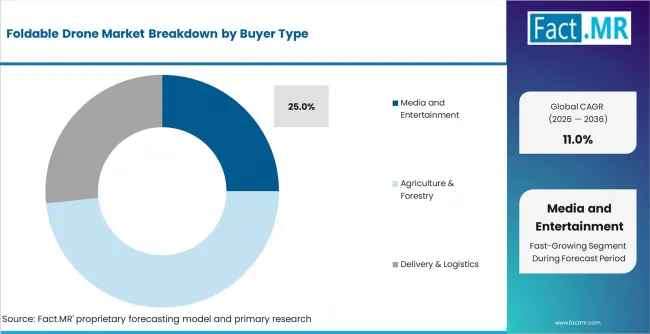
Based on Fact. MR’s foldable drone market report, media and entertainment buyers are estimated to account for 25% share in 2026. Compact transport and flexible deployment supporting adoption across film and broadcasting operations.
- Media Fleet Expansion: Production companies are increasing aerial drone usage for sports and outdoor event coverage.
- Agriculture Buyer Growth: Farming operators are strengthening foldable drone adoption across crop management applications.
- Construction and Logistics Deployment: Industrial operators are increasing drone deployment for route monitoring and site inspection activity.
Foldable Drone Market Analysis by Connectivity Technology
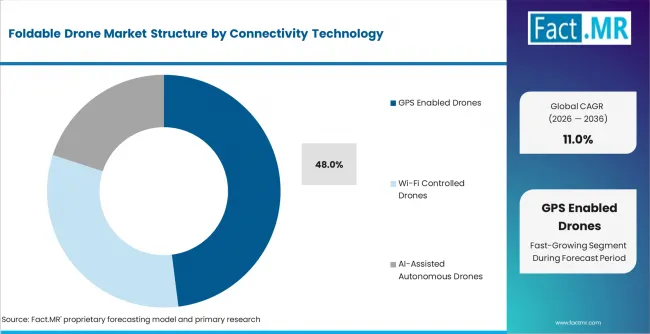
Based on Fact.MR's foldable drone market report, GPS-enabled drones are estimated to account for 48.0% share in 2026. Positioning accuracy is essential across inspection and agricultural monitoring operations.
- GPS Platform Dominance: GPS-based navigation supporting automated route planning and mapping operations.
- Hybrid Connectivity Adoption: Hybrid connectivity systems are gaining traction across long-range commercial inspection routes.
- Media Production Adoption: Parrot announced partnerships with European broadcasting networks in 2024 to supply ANAFI series foldable drones for live event aerial coverage, targeting productions requiring rapid setup within crowded venue environments where fixed-frame aircraft are impractical. [4]
Drivers, Restraints, and Opportunities
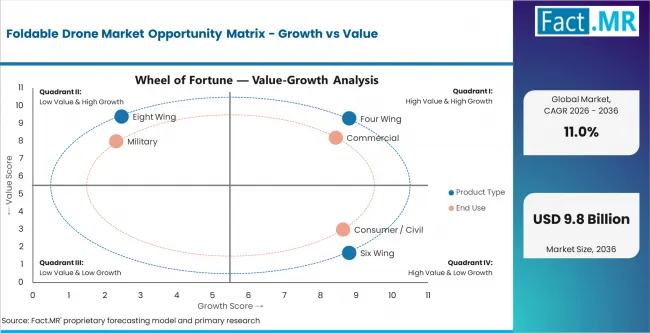
Fact.MR analysts observe the foldable drone market as an early-commercial sector transitioning from consumer photography toward structured deployment across inspection and agriculture operations. Commercial growth is supported by regulatory approvals, AI-assisted navigation, and sensor miniaturization trends.
- Commercial Inspection Expansion: Infrastructure and utility operators are increasing foldable drone deployment for faster site inspection and monitoring operations.
- Agricultural Technology Adoption: Foldable drones are gaining popularity across precision agriculture due to compact transport and field deployment flexibility.
- Autel Robotics Launches EVO Lite Enterprise Foldable Drone Series: Autel Robotics launched the EVO Lite Enterprise foldable drone series in 2025 for commercial inspection, mapping, and surveillance operations. The platform includes AI-assisted navigation, thermal imaging support, and compact foldable architecture for rapid field deployment across industrial applications. [1]
Regional Analysis
.webp)
The foldable drone market is assessed across North America, Europe, Asia Pacific, Latin America, and Middle East and Africa covering 40+ countries segmented by regulatory framework maturity, commercial application adoption pace, agricultural deployment scale, and connectivity technology infrastructure. The full report offers market attractiveness analysis by region and country.
| Country | CAGR (2026 to 2036) |
|---|---|
| China | 12.8% |
| India | 12.2% |
| United States | 11.6% |
| Japan | 10.9% |
| Germany | 10.5% |
| South Korea | 10.1% |
Source: Fact.MR analysis, based on proprietary forecasting model and primary research
Asia Pacific Foldable Drone Market Analysis
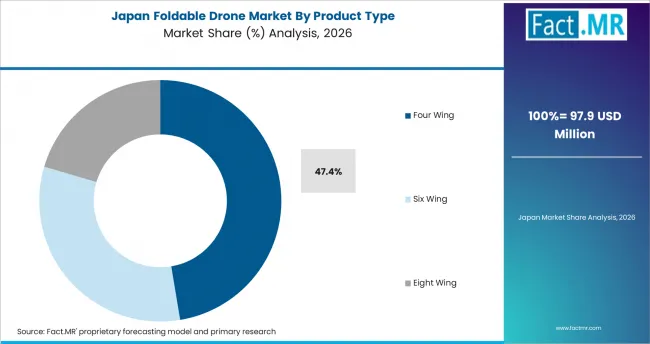
Asia Pacific shows high regional growth for foldable drones due to government-backed agricultural drone programs and strong domestic manufacturing capacity. Precision farming initiatives and commercial inspection demand support large-scale deployment across the region.
- China: Demand for foldable drones in China is projected to rise at 12.8% CAGR by 2036 driven by precision agriculture programs and expanding commercial inspection activity. Domestic manufacturers are strengthening AI-enabled foldable drone production for crop monitoring and industrial inspection applications. Large-scale farming regions and infrastructure modernization projects supporting commercial deployment growth.
- India: Foldable drone demand in India is forecast to expand at 12.2% CAGR from 2026 to 2036 as structured drone regulations support wider deployment across agriculture and infrastructure inspection applications. Government-backed agri-drone initiatives and domestic manufacturing incentives are increasing adoption across farming cooperatives and industrial operators. Compact foldable systems are also improving deployment efficiency across remote agricultural regions. IdeaForge received DGCA type certification in India in 2025 for its Switch foldable drone platform, enabling the first domestically certified foldable multi-rotor aircraft for commercial inspection and agricultural operations under India's Drone Rules 2021 framework. [5]
- Japan: The foldable drone market in Japan is projected to grow at 10.9% CAGR by 2036 across mountainous regions with limited transport access. Foldable drones are becoming important for infrastructure monitoring and autonomous delivery operations. Compact transport and rapid deployment are critical in these routes.
Fact.MR's Asia Pacific analysis covers China, India, Japan, ASEAN, South Korea, and Australia and New Zealand. The study includes drone regulation frameworks and commercial fleet deployment trends by country.
North America Foldable Drone Market Analysis
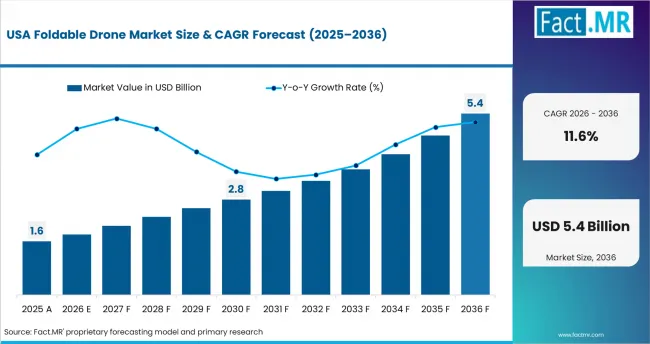
North America has an advanced commercial certification environment for foldable drone deployment because structured approval systems and BVLOS infrastructure support operations. Construction inspection and media production operators form major commercial user groups across the region. AI assisted autonomous navigation and high resolution imaging capability support deployment across industrial applications.
- United States: Demand for foldable drones in the United States is projected to rise at 11.6% CAGR from 2026 to 2036 as expanding commercial drone approvals support deployment across inspection and precision agriculture operations. Commercial operators are increasing foldable drone usage across infrastructure monitoring and aerial imaging activity. Compact foldable systems are reducing transport time and improving operational efficiency across multi-site deployment routes.
Fact.MR's North America analysis covers the United States, Canada, and Mexico. The study includes regulatory impact analysis, commercial inspection investment trends, and media production deployment benchmarks.
Europe Foldable Drone Market Analysis
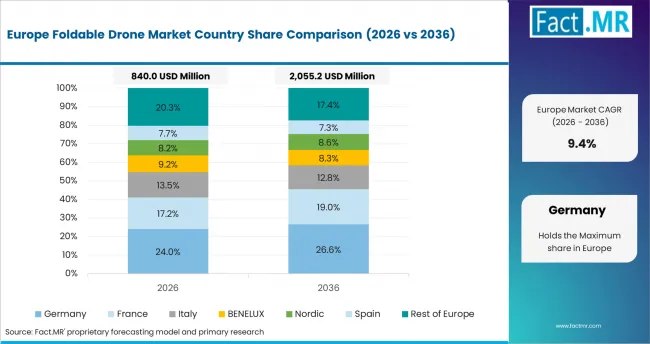
Europe is a regulation-harmonized foldable drone market shaped by structured airspace frameworks and emission reduction priorities. Industrial inspection and logistics operators are increasing foldable drone deployment across commercial operations. Compact drone platforms are also gaining traction across infrastructure monitoring and environmental inspection activity.
- Germany: Foldable drone demand in Germany is projected to expand at 10.5% CAGR by 2036 as structured drone regulations support deployment across industrial inspection routes in manufacturing and energy facilities. Compact foldable platforms are gaining preference for confined structure inspection activity and urban industrial monitoring operations. Commercial operators are increasing investment in AI-assisted foldable drone fleets for automated inspection workflows.
Fact.MR's Europe analysis covers Germany, the United Kingdom, France, Italy, Spain, Nordic Countries, BENELUX, and Rest of Western Europe. The study includes airspace regulation analysis and commercial inspection deployment trends by country.
Competitive Aligners for Market Players
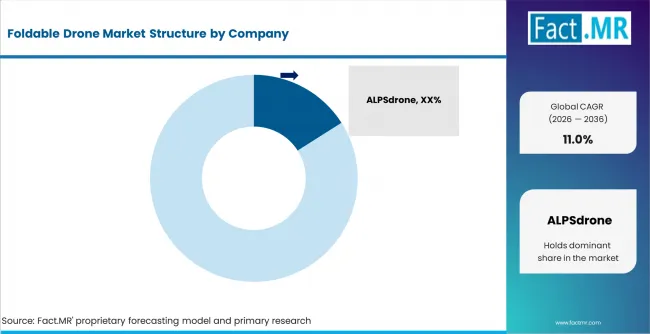
Competition in the foldable drone market is increasingly centered on operational efficiency and autonomous capability rather than basic portability alone. Commercial operators are selecting platforms that combine compact transport with stable flight performance across inspection, agriculture, and surveillance tasks. Manufacturers capable of delivering lightweight systems without sacrificing imaging quality or flight endurance are gaining stronger commercial traction.
AI-enabled navigation is becoming a major differentiating factor across industrial deployment contracts. Automated route planning, obstacle avoidance, and precision mapping functions are reducing dependence on highly trained drone pilots. This shift is widening the addressable customer base across infrastructure monitoring and agricultural operations. Battery optimization and modular payload integration remain important areas of product development. Commercial users prefer foldable drones that support thermal cameras, LiDAR systems, and multispectral imaging without increasing transport complexity. Durability across outdoor operating conditions is also influencing purchasing decisions among industrial operators.
Agriculture and infrastructure inspection generating the strongest commercial demand because foldable drones reduce deployment time across dispersed operating sites. Media production companies are also increasing adoption due to easier transport and faster setup during outdoor filming assignments.
China maintains a strong manufacturing advantage through domestic OEM scale and lower component costs. North America leads regulatory commercialization while Europe continues expanding industrial drone deployment under structured airspace management frameworks.
Key Players
- ALPSdrone
- Diodon
- DJI
- EMBENTION
- Heliceo
- Intellisystem Technologies
- ONYXSTAR
- Parrot
- RIEGL LMS
- Yuneec
- Other Market Players
Bibliography
- [1] Autel Robotics. (2024). New drones: EVO Lite 6K Enterprise & 640T Enterprise. Autel Pilot.
- [2] DJI. (2026). DJI launches AI challenge for drone developers. DroneDJ.
- [3] Skydio. (2025). Skydio unveils R10 and F10 drones at Ascend 2025. Commercial UAV News.
- [4] Parrot. (2025). Parrot expands its global distribution network with five new partners across Europe and Asia.
- [5] ideaForge. (2025). ideaForge SWITCH UAS receives DGCA type certification bringing military-grade capabilities to civil, paramilitary, and enterprise applications. Mobility India.
This Report Addresses
- Strategic intelligence on foldable drone demand across product type, end use, use case, buyer type, and connectivity technology segments covering commercial inspection, agricultural deployment, and surveillance applications globally.
- Market forecast from USD 3.5 billion in 2026 to USD 9.8 billion by 2036 at a CAGR of 11.0% with absolute dollar opportunity assessment across commercial, consumer, and military deployment categories.
- Growth opportunity mapping across China precision agriculture program contracts, US FAA Part 107 commercial waiver expansion routes, India DGCA type-certified foldable platform permits, Germany EASA U-Space corridor licenses, and Japan MLIT rural delivery subsidy programs.
- Segment analysis by product type, end use, use case, buyer type, and connectivity technology with global and regional CAGR forecasts and leading sub-segment share benchmarks for 2026.
- Regional outlook covering Asia Pacific government-led agricultural drone program growth, North America FAA certification-driven commercial inspection scaling, Europe EASA U-Space harmonized deployment, and emerging market infrastructure inspection adoption.
- Competitive analysis of DJI, Parrot, Yuneec, IdeaForge, and ONYXSTAR covering platform certification status, payload-to-range performance, commercial fleet deployment partnerships, and regulatory compliance positioning.
- Regulatory impact analysis covering FAA Part 107 commercial waivMarket Definitionpace access rules, India Drone Rules 2021 BVLOS approvals, and China CAAC commercial drone operation permit frameworks.
- Report delivered in PDF, Excel, and presentation formats supported by drone fleet deployment data, aviation regulatory filing benchmarks, and primary interviews with commercial drone operations directors and agricultural technology program managers.
Foldable Drone Market Definition
The foldable drone market covers unmanned aerial vehicles with collapsible arm or frame designs that reduce the aircraft footprint for transport and storage without affecting flight performance. These platforms are deployed across commercial filming, inspection, agricultural mapping, and surveillance operations.
Foldable Drone Market Inclusions
The study covers global and regional forecasts from 2026 to 2036 across product type, end use, application, buyer type, and connectivity technology. It includes multirotor foldable drone platforms deployed across commercial, consumer, and military applications including filming, agricultural spraying, infrastructure inspection, and autonomous surveillance operations.
Foldable Drone Market Exclusions
The study excludes fixed-frame drones not designed with collapsible arm systems. It omits ground control software platforms and drone fleet management applications unless bundled with aircraft contracts. Consumer toy-grade foldable drones below 250g with no commercial-grade sensors or payload capacity fall outside study scope.
Foldable Drone Market Research Methodology
- Primary Research
- Primary research includes interviews with commercial drone fleet operators, agricultural drone service providers, and civil aviation authority officials. Drone OEM product managers at companies operating foldable platforms across Asia Pacific and North America are also covered.
- Desk Research
- Desk research uses public disclosures from DJI, Parrot, and Yuneec. It includes DGCA drone regulation updates, FAA UAS commercial waiver data, and EASA U-Space category filings covering 2024 and 2025.
- Market-Sizing and Forecasting
- Market sizing applies a hybrid top-down and bottom-up model. Commercial drone shipment data and application-specific deployment contract values form the base inputs. Segment forecasts are built separately for commercial, consumer, and military applications across connectivity and use case categories.
- Data Validation and Update Cycle
- Data validation uses foldable drone OEM revenue disclosures and commercial fleet investment benchmarks validated against 2024 and 2025 company filings. Findings are cross-checked through interviews with drone certification specialists and agricultural technology program directors.
Scope of the Report

| Attribute | Details |
|---|---|
| Quantitative Units | USD 3.5 billion (2026) to USD 9.8 billion (2036), at a CAGR of 11.0% |
| Market Definition | Unmanned aerial vehicles with collapsible airframe designs deployed across commercial filming, precision agriculture, infrastructure inspection, autonomous surveillance, and recreational operations globally. |
| Product Type Segmentation | Four Wing, Six Wing, Eight Wing |
| End Use Segmentation | Commercial, Consumer/Civil, Military |
| Use Case/Application Segmentation | Filming & Photography, Inspection & Maintenance, Mapping & Surveying, Precision Agriculture, Surveillance & Monitoring |
| Buyer Type Segmentation | Media & Entertainment, Agriculture & Forestry, Delivery & Logistics, Construction & Mining, Oil & Gas, Security & Law Enforcement, Recreational Activity |
| Connectivity Technology Segmentation | GPS Enabled Drones, Wi-Fi Controlled Drones, AI-Assisted Autonomous Drones, Hybrid Connectivity Drones |
| Regions Covered | North America, Europe, Asia Pacific, Latin America, Middle East and Africa |
| Countries Covered | USA, Canada, Mexico, Germany, UK, France, Italy, Spain, Nordic, BENELUX, China, Japan, South Korea, India, ASEAN, Australia and New Zealand, Brazil, Argentina, Colombia, Saudi Arabia, UAE, South Africa, Rest of MEA |
| Key Companies Profiled | ALPSdrone, Diodon, DJI, EMBENTION, Heliceo, Intellisystem Technologies, ONYXSTAR, Parrot, RIEGL LMS, Yuneec |
| Forecast Period | 2026 to 2036 |
| Approach | Hybrid top-down and bottom-up model using commercial drone shipment data, agricultural program deployment benchmarks, application-specific fleet contract analysis, and primary interviews with commercial drone operators and aviation regulatory officials. |
Foldable Drone Market by Segments
-
By Product Type
- Four Wing
- Six Wing
- Eight Wing
-
By End Use
- Commercial
- Consumer / Civil
- Military
-
By Use Case/Application
- Filming & Photography
- Inspection & Maintenance
- Mapping & Surveying
- Precision Agriculture
- Surveillance & Monitoring
-
By Buyer Type
- Media & Entertainment
- Agriculture & Forestry
- Delivery & Logistics
- Construction & Mining
- Oil & Gas
- Security & Law Enforcement
- Recreational Activity
-
By Connectivity Technology
- GPS Enabled Drones
- Wi-Fi Controlled Drones
- AI-Assisted Autonomous Drones
- Hybrid Connectivity Drones
-
By Region
- North America
- United States
- Canada
- Mexico
- Latin America
- Brazil
- Argentina
- Colombia
- Rest of Latin America
- Western Europe
- Germany
- United Kingdom
- France
- Italy
- Spain
- Nordic Countries
- BENELUX
- Rest of Western Europe
- Eastern Europe
- Russia
- Poland
- Hungary
- Balkan and Baltic
- Rest of Eastern Europe
- East Asia
- China
- Japan
- South Korea
- South Asia and Pacific
- India
- ASEAN
- Australia and New Zealand
- Rest of South Asia and Pacific
- Middle East and Africa
- Kingdom of Saudi Arabia
- UAE
- South Africa
- Rest of Middle East and Africa
- North America
- Frequently Asked Questions -
How large is the global foldable drone market in 2025?
The global foldable drone market was valued at USD 3.2 billion in 2025.
What will the foldable drone market size be in 2026?
Based on Fact.MR analysis, demand for foldable drones is estimated to grow to USD 3.5 billion in 2026.
What is the projected foldable drone market size by 2036?
The foldable drone market is projected to reach USD 9.8 billion by 2036, reflecting transformational commercial scale adoption as AI-assisted autonomous platforms replace manual inspection and agricultural operations across multiple verticals.
What is the expected CAGR for the foldable drone market from 2026 to 2036?
Fact.MR projects a CAGR of 11.0% for the global foldable drone market during the 2026 to 2036 forecast period.
Which product type segment is poised to lead the foldable drone market?
Four Wing foldable drones lead with 45.2% share in 2026 as this configuration delivers commercially viable flight stability and payload capacity at compact dimensions that meet professional inspection and agricultural operator deployment requirements.
Which end use holds the leading share in the foldable drone market?
Commercial end use accounts for 55% share in 2026 as professional inspection, agricultural mapping, and surveillance operators are deploying certified foldable platforms at a faster rate than consumer or military channels across the forecast period.
Which country shows the fastest growth in the foldable drone market?
China leads at 12.8% CAGR through 2036 driven by CAAC urban air mobility pilot city approvals and national precision agriculture subsidy programs accelerating large-scale foldable drone fleet deployment across commercial farming and inspection corridors.
Table of Content
- Executive Summary
- Global Market Outlook
- Demand to side Trends
- Supply to side Trends
- Technology Roadmap Analysis
- Analysis and Recommendations
- Market Overview
- Market Coverage / Taxonomy
- Market Definition / Scope / Limitations
- Research Methodology
- Chapter Orientation
- Analytical Lens and Working Hypotheses
- Market Structure, Signals, and Trend Drivers
- Benchmarking and Cross-market Comparability
- Market Sizing, Forecasting, and Opportunity Mapping
- Research Design and Evidence Framework
- Desk Research Programme (Secondary Evidence)
- Company Annual and Sustainability Reports
- Peer-reviewed Journals and Academic Literature
- Corporate Websites, Product Literature, and Technical Notes
- Earnings Decks and Investor Briefings
- Statutory Filings and Regulatory Disclosures
- Technical White Papers and Standards Notes
- Trade Journals, Industry Magazines, and Analyst Briefs
- Conference Proceedings, Webinars, and Seminar Materials
- Government Statistics Portals and Public Data Releases
- Press Releases and Reputable Media Coverage
- Specialist Newsletters and Curated Briefings
- Sector Databases and Reference Repositories
- Fact.MR Internal Proprietary Databases and Historical Market Datasets
- Subscription Datasets and Paid Sources
- Social Channels, Communities, and Digital Listening Inputs
- Additional Desk Sources
- Expert Input and Fieldwork (Primary Evidence)
- Primary Modes
- Qualitative Interviews and Expert Elicitation
- Quantitative Surveys and Structured Data Capture
- Blended Approach
- Why Primary Evidence is Used
- Field Techniques
- Interviews
- Surveys
- Focus Groups
- Observational and In-context Research
- Social and Community Interactions
- Stakeholder Universe Engaged
- C-suite Leaders
- Board Members
- Presidents and Vice Presidents
- R&D and Innovation Heads
- Technical Specialists
- Domain Subject-matter Experts
- Scientists
- Physicians and Other Healthcare Professionals
- Governance, Ethics, and Data Stewardship
- Research Ethics
- Data Integrity and Handling
- Primary Modes
- Tooling, Models, and Reference Databases
- Desk Research Programme (Secondary Evidence)
- Data Engineering and Model Build
- Data Acquisition and Ingestion
- Cleaning, Normalisation, and Verification
- Synthesis, Triangulation, and Analysis
- Quality Assurance and Audit Trail
- Market Background
- Market Dynamics
- Drivers
- Restraints
- Opportunity
- Trends
- Scenario Forecast
- Demand in Optimistic Scenario
- Demand in Likely Scenario
- Demand in Conservative Scenario
- Opportunity Map Analysis
- Product Life Cycle Analysis
- Supply Chain Analysis
- Investment Feasibility Matrix
- Value Chain Analysis
- PESTLE and Porter’s Analysis
- Regulatory Landscape
- Regional Parent Market Outlook
- Production and Consumption Statistics
- Import and Export Statistics
- Market Dynamics
- Global Market Analysis 2021 to 2025 and Forecast, 2026 to 2036
- Historical Market Size Value (USD Million) Analysis, 2021 to 2025
- Current and Future Market Size Value (USD Million) Projections, 2026 to 2036
- Y to o to Y Growth Trend Analysis
- Absolute $ Opportunity Analysis
- Global Market Pricing Analysis 2021 to 2025 and Forecast 2026 to 2036
- Global Market Analysis 2021 to 2025 and Forecast 2026 to 2036, By Product Type
- Introduction / Key Findings
- Historical Market Size Value (USD Million) Analysis By Product Type , 2021 to 2025
- Current and Future Market Size Value (USD Million) Analysis and Forecast By Product Type , 2026 to 2036
- Four Wing
- Six Wing
- Eight Wing
- Four Wing
- Y to o to Y Growth Trend Analysis By Product Type , 2021 to 2025
- Absolute $ Opportunity Analysis By Product Type , 2026 to 2036
- Global Market Analysis 2021 to 2025 and Forecast 2026 to 2036, By End Use
- Introduction / Key Findings
- Historical Market Size Value (USD Million) Analysis By End Use, 2021 to 2025
- Current and Future Market Size Value (USD Million) Analysis and Forecast By End Use, 2026 to 2036
- Commercial
- Consumer / Civil
- Military
- Commercial
- Y to o to Y Growth Trend Analysis By End Use, 2021 to 2025
- Absolute $ Opportunity Analysis By End Use, 2026 to 2036
- Global Market Analysis 2021 to 2025 and Forecast 2026 to 2036, By Use Case-Application
- Introduction / Key Findings
- Historical Market Size Value (USD Million) Analysis By Use Case-Application, 2021 to 2025
- Current and Future Market Size Value (USD Million) Analysis and Forecast By Use Case-Application, 2026 to 2036
- Filming and Photography
- Inspection & Maintenance
- Precision Agriculture
- Filming and Photography
- Y to o to Y Growth Trend Analysis By Use Case-Application, 2021 to 2025
- Absolute $ Opportunity Analysis By Use Case-Application, 2026 to 2036
- Global Market Analysis 2021 to 2025 and Forecast 2026 to 2036, By Buyer Type
- Introduction / Key Findings
- Historical Market Size Value (USD Million) Analysis By Buyer Type, 2021 to 2025
- Current and Future Market Size Value (USD Million) Analysis and Forecast By Buyer Type, 2026 to 2036
- Media and Entertainment
- Agriculture & Forestry
- Delivery & Logistics
- Media and Entertainment
- Y to o to Y Growth Trend Analysis By Buyer Type, 2021 to 2025
- Absolute $ Opportunity Analysis By Buyer Type, 2026 to 2036
- Global Market Analysis 2021 to 2025 and Forecast 2026 to 2036, By Connectivity Technology
- Introduction / Key Findings
- Historical Market Size Value (USD Million) Analysis By Connectivity Technology, 2021 to 2025
- Current and Future Market Size Value (USD Million) Analysis and Forecast By Connectivity Technology, 2026 to 2036
- GPS Enabled Drones
- Wi-Fi Controlled Drones
- AI-Assisted Autonomous Drones
- GPS Enabled Drones
- Y to o to Y Growth Trend Analysis By Connectivity Technology, 2021 to 2025
- Absolute $ Opportunity Analysis By Connectivity Technology, 2026 to 2036
- Global Market Analysis 2021 to 2025 and Forecast 2026 to 2036, By Region
- Introduction
- Historical Market Size Value (USD Million) Analysis By Region, 2021 to 2025
- Current Market Size Value (USD Million) Analysis and Forecast By Region, 2026 to 2036
- North America
- Latin America
- Western Europe
- Eastern Europe
- East Asia
- South Asia and Pacific
- Middle East & Africa
- Market Attractiveness Analysis By Region
- North America Market Analysis 2021 to 2025 and Forecast 2026 to 2036, By Country
- Historical Market Size Value (USD Million) Trend Analysis By Market Taxonomy, 2021 to 2025
- Market Size Value (USD Million) Forecast By Market Taxonomy, 2026 to 2036
- By Country
- USA
- Canada
- Mexico
- By Product Type
- By End Use
- By Use Case-Application
- By Buyer Type
- By Connectivity Technology
- By Country
- Market Attractiveness Analysis
- By Country
- By Product Type
- By End Use
- By Use Case-Application
- By Buyer Type
- By Connectivity Technology
- Key Takeaways
- Latin America Market Analysis 2021 to 2025 and Forecast 2026 to 2036, By Country
- Historical Market Size Value (USD Million) Trend Analysis By Market Taxonomy, 2021 to 2025
- Market Size Value (USD Million) Forecast By Market Taxonomy, 2026 to 2036
- By Country
- Brazil
- Chile
- Rest of Latin America
- By Product Type
- By End Use
- By Use Case-Application
- By Buyer Type
- By Connectivity Technology
- By Country
- Market Attractiveness Analysis
- By Country
- By Product Type
- By End Use
- By Use Case-Application
- By Buyer Type
- By Connectivity Technology
- Key Takeaways
- Western Europe Market Analysis 2021 to 2025 and Forecast 2026 to 2036, By Country
- Historical Market Size Value (USD Million) Trend Analysis By Market Taxonomy, 2021 to 2025
- Market Size Value (USD Million) Forecast By Market Taxonomy, 2026 to 2036
- By Country
- Germany
- UK
- Italy
- Spain
- France
- Nordic
- BENELUX
- Rest of Western Europe
- By Product Type
- By End Use
- By Use Case-Application
- By Buyer Type
- By Connectivity Technology
- By Country
- Market Attractiveness Analysis
- By Country
- By Product Type
- By End Use
- By Use Case-Application
- By Buyer Type
- By Connectivity Technology
- Key Takeaways
- Eastern Europe Market Analysis 2021 to 2025 and Forecast 2026 to 2036, By Country
- Historical Market Size Value (USD Million) Trend Analysis By Market Taxonomy, 2021 to 2025
- Market Size Value (USD Million) Forecast By Market Taxonomy, 2026 to 2036
- By Country
- Russia
- Poland
- Hungary
- Balkan & Baltic
- Rest of Eastern Europe
- By Product Type
- By End Use
- By Use Case-Application
- By Buyer Type
- By Connectivity Technology
- By Country
- Market Attractiveness Analysis
- By Country
- By Product Type
- By End Use
- By Use Case-Application
- By Buyer Type
- By Connectivity Technology
- Key Takeaways
- East Asia Market Analysis 2021 to 2025 and Forecast 2026 to 2036, By Country
- Historical Market Size Value (USD Million) Trend Analysis By Market Taxonomy, 2021 to 2025
- Market Size Value (USD Million) Forecast By Market Taxonomy, 2026 to 2036
- By Country
- China
- Japan
- South Korea
- By Product Type
- By End Use
- By Use Case-Application
- By Buyer Type
- By Connectivity Technology
- By Country
- Market Attractiveness Analysis
- By Country
- By Product Type
- By End Use
- By Use Case-Application
- By Buyer Type
- By Connectivity Technology
- Key Takeaways
- South Asia and Pacific Market Analysis 2021 to 2025 and Forecast 2026 to 2036, By Country
- Historical Market Size Value (USD Million) Trend Analysis By Market Taxonomy, 2021 to 2025
- Market Size Value (USD Million) Forecast By Market Taxonomy, 2026 to 2036
- By Country
- India
- ASEAN
- Australia & New Zealand
- Rest of South Asia and Pacific
- By Product Type
- By End Use
- By Use Case-Application
- By Buyer Type
- By Connectivity Technology
- By Country
- Market Attractiveness Analysis
- By Country
- By Product Type
- By End Use
- By Use Case-Application
- By Buyer Type
- By Connectivity Technology
- Key Takeaways
- Middle East & Africa Market Analysis 2021 to 2025 and Forecast 2026 to 2036, By Country
- Historical Market Size Value (USD Million) Trend Analysis By Market Taxonomy, 2021 to 2025
- Market Size Value (USD Million) Forecast By Market Taxonomy, 2026 to 2036
- By Country
- Kingdom of Saudi Arabia
- Other GCC Countries
- Turkiye
- South Africa
- Other African Union
- Rest of Middle East & Africa
- By Product Type
- By End Use
- By Use Case-Application
- By Buyer Type
- By Connectivity Technology
- By Country
- Market Attractiveness Analysis
- By Country
- By Product Type
- By End Use
- By Use Case-Application
- By Buyer Type
- By Connectivity Technology
- Key Takeaways
- Key Countries Market Analysis
- USA
- Pricing Analysis
- Market Share Analysis, 2025
- By Product Type
- By End Use
- By Use Case-Application
- By Buyer Type
- By Connectivity Technology
- Canada
- Pricing Analysis
- Market Share Analysis, 2025
- By Product Type
- By End Use
- By Use Case-Application
- By Buyer Type
- By Connectivity Technology
- Mexico
- Pricing Analysis
- Market Share Analysis, 2025
- By Product Type
- By End Use
- By Use Case-Application
- By Buyer Type
- By Connectivity Technology
- Brazil
- Pricing Analysis
- Market Share Analysis, 2025
- By Product Type
- By End Use
- By Use Case-Application
- By Buyer Type
- By Connectivity Technology
- Chile
- Pricing Analysis
- Market Share Analysis, 2025
- By Product Type
- By End Use
- By Use Case-Application
- By Buyer Type
- By Connectivity Technology
- Germany
- Pricing Analysis
- Market Share Analysis, 2025
- By Product Type
- By End Use
- By Use Case-Application
- By Buyer Type
- By Connectivity Technology
- UK
- Pricing Analysis
- Market Share Analysis, 2025
- By Product Type
- By End Use
- By Use Case-Application
- By Buyer Type
- By Connectivity Technology
- Italy
- Pricing Analysis
- Market Share Analysis, 2025
- By Product Type
- By End Use
- By Use Case-Application
- By Buyer Type
- By Connectivity Technology
- Spain
- Pricing Analysis
- Market Share Analysis, 2025
- By Product Type
- By End Use
- By Use Case-Application
- By Buyer Type
- By Connectivity Technology
- France
- Pricing Analysis
- Market Share Analysis, 2025
- By Product Type
- By End Use
- By Use Case-Application
- By Buyer Type
- By Connectivity Technology
- India
- Pricing Analysis
- Market Share Analysis, 2025
- By Product Type
- By End Use
- By Use Case-Application
- By Buyer Type
- By Connectivity Technology
- ASEAN
- Pricing Analysis
- Market Share Analysis, 2025
- By Product Type
- By End Use
- By Use Case-Application
- By Buyer Type
- By Connectivity Technology
- Australia & New Zealand
- Pricing Analysis
- Market Share Analysis, 2025
- By Product Type
- By End Use
- By Use Case-Application
- By Buyer Type
- By Connectivity Technology
- China
- Pricing Analysis
- Market Share Analysis, 2025
- By Product Type
- By End Use
- By Use Case-Application
- By Buyer Type
- By Connectivity Technology
- Japan
- Pricing Analysis
- Market Share Analysis, 2025
- By Product Type
- By End Use
- By Use Case-Application
- By Buyer Type
- By Connectivity Technology
- South Korea
- Pricing Analysis
- Market Share Analysis, 2025
- By Product Type
- By End Use
- By Use Case-Application
- By Buyer Type
- By Connectivity Technology
- Russia
- Pricing Analysis
- Market Share Analysis, 2025
- By Product Type
- By End Use
- By Use Case-Application
- By Buyer Type
- By Connectivity Technology
- Poland
- Pricing Analysis
- Market Share Analysis, 2025
- By Product Type
- By End Use
- By Use Case-Application
- By Buyer Type
- By Connectivity Technology
- Hungary
- Pricing Analysis
- Market Share Analysis, 2025
- By Product Type
- By End Use
- By Use Case-Application
- By Buyer Type
- By Connectivity Technology
- Kingdom of Saudi Arabia
- Pricing Analysis
- Market Share Analysis, 2025
- By Product Type
- By End Use
- By Use Case-Application
- By Buyer Type
- By Connectivity Technology
- Turkiye
- Pricing Analysis
- Market Share Analysis, 2025
- By Product Type
- By End Use
- By Use Case-Application
- By Buyer Type
- By Connectivity Technology
- South Africa
- Pricing Analysis
- Market Share Analysis, 2025
- By Product Type
- By End Use
- By Use Case-Application
- By Buyer Type
- By Connectivity Technology
- USA
- Market Structure Analysis
- Competition Dashboard
- Competition Benchmarking
- Market Share Analysis of Top Players
- By Regional
- By Product Type
- By End Use
- By Use Case-Application
- By Buyer Type
- By Connectivity Technology
- Competition Analysis
- Competition Deep Dive
- ALPSdrone
- Overview
- Product Portfolio
- Profitability by Market Segments (Product/Age /Sales Channel/Region)
- Sales Footprint
- Strategy Overview
- Marketing Strategy
- Product Strategy
- Channel Strategy
- Diodon
- DJI
- EMBENTION
- Heliceo
- Intellisystem Technologies
- ONYXSTAR
- ALPSdrone
- Competition Deep Dive
- Assumptions & Acronyms Used
List Of Table
- Table 1: Global Market Value (USD Million) Forecast by Region, 2021 to 2036
- Table 2: Global Market Value (USD Million) Forecast by Product Type , 2021 to 2036
- Table 3: Global Market Value (USD Million) Forecast by End Use, 2021 to 2036
- Table 4: Global Market Value (USD Million) Forecast by Use Case-Application, 2021 to 2036
- Table 5: Global Market Value (USD Million) Forecast by Buyer Type, 2021 to 2036
- Table 6: Global Market Value (USD Million) Forecast by Connectivity Technology, 2021 to 2036
- Table 7: North America Market Value (USD Million) Forecast by Country, 2021 to 2036
- Table 8: North America Market Value (USD Million) Forecast by Product Type , 2021 to 2036
- Table 9: North America Market Value (USD Million) Forecast by End Use, 2021 to 2036
- Table 10: North America Market Value (USD Million) Forecast by Use Case-Application, 2021 to 2036
- Table 11: North America Market Value (USD Million) Forecast by Buyer Type, 2021 to 2036
- Table 12: North America Market Value (USD Million) Forecast by Connectivity Technology, 2021 to 2036
- Table 13: Latin America Market Value (USD Million) Forecast by Country, 2021 to 2036
- Table 14: Latin America Market Value (USD Million) Forecast by Product Type , 2021 to 2036
- Table 15: Latin America Market Value (USD Million) Forecast by End Use, 2021 to 2036
- Table 16: Latin America Market Value (USD Million) Forecast by Use Case-Application, 2021 to 2036
- Table 17: Latin America Market Value (USD Million) Forecast by Buyer Type, 2021 to 2036
- Table 18: Latin America Market Value (USD Million) Forecast by Connectivity Technology, 2021 to 2036
- Table 19: Western Europe Market Value (USD Million) Forecast by Country, 2021 to 2036
- Table 20: Western Europe Market Value (USD Million) Forecast by Product Type , 2021 to 2036
- Table 21: Western Europe Market Value (USD Million) Forecast by End Use, 2021 to 2036
- Table 22: Western Europe Market Value (USD Million) Forecast by Use Case-Application, 2021 to 2036
- Table 23: Western Europe Market Value (USD Million) Forecast by Buyer Type, 2021 to 2036
- Table 24: Western Europe Market Value (USD Million) Forecast by Connectivity Technology, 2021 to 2036
- Table 25: Eastern Europe Market Value (USD Million) Forecast by Country, 2021 to 2036
- Table 26: Eastern Europe Market Value (USD Million) Forecast by Product Type , 2021 to 2036
- Table 27: Eastern Europe Market Value (USD Million) Forecast by End Use, 2021 to 2036
- Table 28: Eastern Europe Market Value (USD Million) Forecast by Use Case-Application, 2021 to 2036
- Table 29: Eastern Europe Market Value (USD Million) Forecast by Buyer Type, 2021 to 2036
- Table 30: Eastern Europe Market Value (USD Million) Forecast by Connectivity Technology, 2021 to 2036
- Table 31: East Asia Market Value (USD Million) Forecast by Country, 2021 to 2036
- Table 32: East Asia Market Value (USD Million) Forecast by Product Type , 2021 to 2036
- Table 33: East Asia Market Value (USD Million) Forecast by End Use, 2021 to 2036
- Table 34: East Asia Market Value (USD Million) Forecast by Use Case-Application, 2021 to 2036
- Table 35: East Asia Market Value (USD Million) Forecast by Buyer Type, 2021 to 2036
- Table 36: East Asia Market Value (USD Million) Forecast by Connectivity Technology, 2021 to 2036
- Table 37: South Asia and Pacific Market Value (USD Million) Forecast by Country, 2021 to 2036
- Table 38: South Asia and Pacific Market Value (USD Million) Forecast by Product Type , 2021 to 2036
- Table 39: South Asia and Pacific Market Value (USD Million) Forecast by End Use, 2021 to 2036
- Table 40: South Asia and Pacific Market Value (USD Million) Forecast by Use Case-Application, 2021 to 2036
- Table 41: South Asia and Pacific Market Value (USD Million) Forecast by Buyer Type, 2021 to 2036
- Table 42: South Asia and Pacific Market Value (USD Million) Forecast by Connectivity Technology, 2021 to 2036
- Table 43: Middle East & Africa Market Value (USD Million) Forecast by Country, 2021 to 2036
- Table 44: Middle East & Africa Market Value (USD Million) Forecast by Product Type , 2021 to 2036
- Table 45: Middle East & Africa Market Value (USD Million) Forecast by End Use, 2021 to 2036
- Table 46: Middle East & Africa Market Value (USD Million) Forecast by Use Case-Application, 2021 to 2036
- Table 47: Middle East & Africa Market Value (USD Million) Forecast by Buyer Type, 2021 to 2036
- Table 48: Middle East & Africa Market Value (USD Million) Forecast by Connectivity Technology, 2021 to 2036
List Of Figures
- Figure 1: Global Market Pricing Analysis
- Figure 2: Global Market Value (USD Million) Forecast 2021-2036
- Figure 3: Global Market Value Share and BPS Analysis by Product Type , 2026 and 2036
- Figure 4: Global Market Y-o-Y Growth Comparison by Product Type , 2026-2036
- Figure 5: Global Market Attractiveness Analysis by Product Type
- Figure 6: Global Market Value Share and BPS Analysis by End Use, 2026 and 2036
- Figure 7: Global Market Y-o-Y Growth Comparison by End Use, 2026-2036
- Figure 8: Global Market Attractiveness Analysis by End Use
- Figure 9: Global Market Value Share and BPS Analysis by Use Case-Application, 2026 and 2036
- Figure 10: Global Market Y-o-Y Growth Comparison by Use Case-Application, 2026-2036
- Figure 11: Global Market Attractiveness Analysis by Use Case-Application
- Figure 12: Global Market Value Share and BPS Analysis by Buyer Type, 2026 and 2036
- Figure 13: Global Market Y-o-Y Growth Comparison by Buyer Type, 2026-2036
- Figure 14: Global Market Attractiveness Analysis by Buyer Type
- Figure 15: Global Market Value Share and BPS Analysis by Connectivity Technology, 2026 and 2036
- Figure 16: Global Market Y-o-Y Growth Comparison by Connectivity Technology, 2026-2036
- Figure 17: Global Market Attractiveness Analysis by Connectivity Technology
- Figure 18: Global Market Value (USD Million) Share and BPS Analysis by Region, 2026 and 2036
- Figure 19: Global Market Y-o-Y Growth Comparison by Region, 2026-2036
- Figure 20: Global Market Attractiveness Analysis by Region
- Figure 21: North America Market Incremental Dollar Opportunity, 2026-2036
- Figure 22: Latin America Market Incremental Dollar Opportunity, 2026-2036
- Figure 23: Western Europe Market Incremental Dollar Opportunity, 2026-2036
- Figure 24: Eastern Europe Market Incremental Dollar Opportunity, 2026-2036
- Figure 25: East Asia Market Incremental Dollar Opportunity, 2026-2036
- Figure 26: South Asia and Pacific Market Incremental Dollar Opportunity, 2026-2036
- Figure 27: Middle East & Africa Market Incremental Dollar Opportunity, 2026-2036
- Figure 28: North America Market Value Share and BPS Analysis by Country, 2026 and 2036
- Figure 29: North America Market Value Share and BPS Analysis by Product Type , 2026 and 2036
- Figure 30: North America Market Y-o-Y Growth Comparison by Product Type , 2026-2036
- Figure 31: North America Market Attractiveness Analysis by Product Type
- Figure 32: North America Market Value Share and BPS Analysis by End Use, 2026 and 2036
- Figure 33: North America Market Y-o-Y Growth Comparison by End Use, 2026-2036
- Figure 34: North America Market Attractiveness Analysis by End Use
- Figure 35: North America Market Value Share and BPS Analysis by Use Case-Application, 2026 and 2036
- Figure 36: North America Market Y-o-Y Growth Comparison by Use Case-Application, 2026-2036
- Figure 37: North America Market Attractiveness Analysis by Use Case-Application
- Figure 38: North America Market Value Share and BPS Analysis by Buyer Type, 2026 and 2036
- Figure 39: North America Market Y-o-Y Growth Comparison by Buyer Type, 2026-2036
- Figure 40: North America Market Attractiveness Analysis by Buyer Type
- Figure 41: North America Market Value Share and BPS Analysis by Connectivity Technology, 2026 and 2036
- Figure 42: North America Market Y-o-Y Growth Comparison by Connectivity Technology, 2026-2036
- Figure 43: North America Market Attractiveness Analysis by Connectivity Technology
- Figure 44: Latin America Market Value Share and BPS Analysis by Country, 2026 and 2036
- Figure 45: Latin America Market Value Share and BPS Analysis by Product Type , 2026 and 2036
- Figure 46: Latin America Market Y-o-Y Growth Comparison by Product Type , 2026-2036
- Figure 47: Latin America Market Attractiveness Analysis by Product Type
- Figure 48: Latin America Market Value Share and BPS Analysis by End Use, 2026 and 2036
- Figure 49: Latin America Market Y-o-Y Growth Comparison by End Use, 2026-2036
- Figure 50: Latin America Market Attractiveness Analysis by End Use
- Figure 51: Latin America Market Value Share and BPS Analysis by Use Case-Application, 2026 and 2036
- Figure 52: Latin America Market Y-o-Y Growth Comparison by Use Case-Application, 2026-2036
- Figure 53: Latin America Market Attractiveness Analysis by Use Case-Application
- Figure 54: Latin America Market Value Share and BPS Analysis by Buyer Type, 2026 and 2036
- Figure 55: Latin America Market Y-o-Y Growth Comparison by Buyer Type, 2026-2036
- Figure 56: Latin America Market Attractiveness Analysis by Buyer Type
- Figure 57: Latin America Market Value Share and BPS Analysis by Connectivity Technology, 2026 and 2036
- Figure 58: Latin America Market Y-o-Y Growth Comparison by Connectivity Technology, 2026-2036
- Figure 59: Latin America Market Attractiveness Analysis by Connectivity Technology
- Figure 60: Western Europe Market Value Share and BPS Analysis by Country, 2026 and 2036
- Figure 61: Western Europe Market Value Share and BPS Analysis by Product Type , 2026 and 2036
- Figure 62: Western Europe Market Y-o-Y Growth Comparison by Product Type , 2026-2036
- Figure 63: Western Europe Market Attractiveness Analysis by Product Type
- Figure 64: Western Europe Market Value Share and BPS Analysis by End Use, 2026 and 2036
- Figure 65: Western Europe Market Y-o-Y Growth Comparison by End Use, 2026-2036
- Figure 66: Western Europe Market Attractiveness Analysis by End Use
- Figure 67: Western Europe Market Value Share and BPS Analysis by Use Case-Application, 2026 and 2036
- Figure 68: Western Europe Market Y-o-Y Growth Comparison by Use Case-Application, 2026-2036
- Figure 69: Western Europe Market Attractiveness Analysis by Use Case-Application
- Figure 70: Western Europe Market Value Share and BPS Analysis by Buyer Type, 2026 and 2036
- Figure 71: Western Europe Market Y-o-Y Growth Comparison by Buyer Type, 2026-2036
- Figure 72: Western Europe Market Attractiveness Analysis by Buyer Type
- Figure 73: Western Europe Market Value Share and BPS Analysis by Connectivity Technology, 2026 and 2036
- Figure 74: Western Europe Market Y-o-Y Growth Comparison by Connectivity Technology, 2026-2036
- Figure 75: Western Europe Market Attractiveness Analysis by Connectivity Technology
- Figure 76: Eastern Europe Market Value Share and BPS Analysis by Country, 2026 and 2036
- Figure 77: Eastern Europe Market Value Share and BPS Analysis by Product Type , 2026 and 2036
- Figure 78: Eastern Europe Market Y-o-Y Growth Comparison by Product Type , 2026-2036
- Figure 79: Eastern Europe Market Attractiveness Analysis by Product Type
- Figure 80: Eastern Europe Market Value Share and BPS Analysis by End Use, 2026 and 2036
- Figure 81: Eastern Europe Market Y-o-Y Growth Comparison by End Use, 2026-2036
- Figure 82: Eastern Europe Market Attractiveness Analysis by End Use
- Figure 83: Eastern Europe Market Value Share and BPS Analysis by Use Case-Application, 2026 and 2036
- Figure 84: Eastern Europe Market Y-o-Y Growth Comparison by Use Case-Application, 2026-2036
- Figure 85: Eastern Europe Market Attractiveness Analysis by Use Case-Application
- Figure 86: Eastern Europe Market Value Share and BPS Analysis by Buyer Type, 2026 and 2036
- Figure 87: Eastern Europe Market Y-o-Y Growth Comparison by Buyer Type, 2026-2036
- Figure 88: Eastern Europe Market Attractiveness Analysis by Buyer Type
- Figure 89: Eastern Europe Market Value Share and BPS Analysis by Connectivity Technology, 2026 and 2036
- Figure 90: Eastern Europe Market Y-o-Y Growth Comparison by Connectivity Technology, 2026-2036
- Figure 91: Eastern Europe Market Attractiveness Analysis by Connectivity Technology
- Figure 92: East Asia Market Value Share and BPS Analysis by Country, 2026 and 2036
- Figure 93: East Asia Market Value Share and BPS Analysis by Product Type , 2026 and 2036
- Figure 94: East Asia Market Y-o-Y Growth Comparison by Product Type , 2026-2036
- Figure 95: East Asia Market Attractiveness Analysis by Product Type
- Figure 96: East Asia Market Value Share and BPS Analysis by End Use, 2026 and 2036
- Figure 97: East Asia Market Y-o-Y Growth Comparison by End Use, 2026-2036
- Figure 98: East Asia Market Attractiveness Analysis by End Use
- Figure 99: East Asia Market Value Share and BPS Analysis by Use Case-Application, 2026 and 2036
- Figure 100: East Asia Market Y-o-Y Growth Comparison by Use Case-Application, 2026-2036
- Figure 101: East Asia Market Attractiveness Analysis by Use Case-Application
- Figure 102: East Asia Market Value Share and BPS Analysis by Buyer Type, 2026 and 2036
- Figure 103: East Asia Market Y-o-Y Growth Comparison by Buyer Type, 2026-2036
- Figure 104: East Asia Market Attractiveness Analysis by Buyer Type
- Figure 105: East Asia Market Value Share and BPS Analysis by Connectivity Technology, 2026 and 2036
- Figure 106: East Asia Market Y-o-Y Growth Comparison by Connectivity Technology, 2026-2036
- Figure 107: East Asia Market Attractiveness Analysis by Connectivity Technology
- Figure 108: South Asia and Pacific Market Value Share and BPS Analysis by Country, 2026 and 2036
- Figure 109: South Asia and Pacific Market Value Share and BPS Analysis by Product Type , 2026 and 2036
- Figure 110: South Asia and Pacific Market Y-o-Y Growth Comparison by Product Type , 2026-2036
- Figure 111: South Asia and Pacific Market Attractiveness Analysis by Product Type
- Figure 112: South Asia and Pacific Market Value Share and BPS Analysis by End Use, 2026 and 2036
- Figure 113: South Asia and Pacific Market Y-o-Y Growth Comparison by End Use, 2026-2036
- Figure 114: South Asia and Pacific Market Attractiveness Analysis by End Use
- Figure 115: South Asia and Pacific Market Value Share and BPS Analysis by Use Case-Application, 2026 and 2036
- Figure 116: South Asia and Pacific Market Y-o-Y Growth Comparison by Use Case-Application, 2026-2036
- Figure 117: South Asia and Pacific Market Attractiveness Analysis by Use Case-Application
- Figure 118: South Asia and Pacific Market Value Share and BPS Analysis by Buyer Type, 2026 and 2036
- Figure 119: South Asia and Pacific Market Y-o-Y Growth Comparison by Buyer Type, 2026-2036
- Figure 120: South Asia and Pacific Market Attractiveness Analysis by Buyer Type
- Figure 121: South Asia and Pacific Market Value Share and BPS Analysis by Connectivity Technology, 2026 and 2036
- Figure 122: South Asia and Pacific Market Y-o-Y Growth Comparison by Connectivity Technology, 2026-2036
- Figure 123: South Asia and Pacific Market Attractiveness Analysis by Connectivity Technology
- Figure 124: Middle East & Africa Market Value Share and BPS Analysis by Country, 2026 and 2036
- Figure 125: Middle East & Africa Market Value Share and BPS Analysis by Product Type , 2026 and 2036
- Figure 126: Middle East & Africa Market Y-o-Y Growth Comparison by Product Type , 2026-2036
- Figure 127: Middle East & Africa Market Attractiveness Analysis by Product Type
- Figure 128: Middle East & Africa Market Value Share and BPS Analysis by End Use, 2026 and 2036
- Figure 129: Middle East & Africa Market Y-o-Y Growth Comparison by End Use, 2026-2036
- Figure 130: Middle East & Africa Market Attractiveness Analysis by End Use
- Figure 131: Middle East & Africa Market Value Share and BPS Analysis by Use Case-Application, 2026 and 2036
- Figure 132: Middle East & Africa Market Y-o-Y Growth Comparison by Use Case-Application, 2026-2036
- Figure 133: Middle East & Africa Market Attractiveness Analysis by Use Case-Application
- Figure 134: Middle East & Africa Market Value Share and BPS Analysis by Buyer Type, 2026 and 2036
- Figure 135: Middle East & Africa Market Y-o-Y Growth Comparison by Buyer Type, 2026-2036
- Figure 136: Middle East & Africa Market Attractiveness Analysis by Buyer Type
- Figure 137: Middle East & Africa Market Value Share and BPS Analysis by Connectivity Technology, 2026 and 2036
- Figure 138: Middle East & Africa Market Y-o-Y Growth Comparison by Connectivity Technology, 2026-2036
- Figure 139: Middle East & Africa Market Attractiveness Analysis by Connectivity Technology
- Figure 140: Global Market - Tier Structure Analysis
- Figure 141: Global Market - Company Share Analysis