The Foldable OLED Next-Gen Smart Substrates Market is analyzed across its key product, application and end-use segments, with the study covering market dynamics, regional trends and demand outlook, forecast 2026 to 2036.
By Fact.MR Technology DeskLead analyst:
Ganesh PaiPublished :
Updated :
9 min read
Fact-checked under the Fact.MR editorial process
Foldable OLED Next-Gen Smart Substrates Market Forecast and Outlook 2026 to 2036
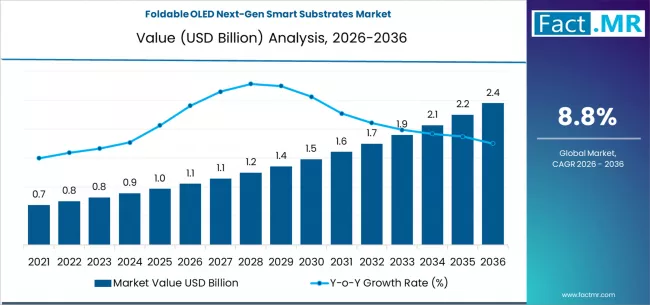
The global market for foldable OLED next-generation smart substrates is projected to total USD 1.06 billion in 2026, advancing to USD 2.45 billion by 2036. A CAGR of 8.8% is forecast for the period from 2026 to 2036. This growth is intrinsically linked to the evolution of flexible displays from a niche novelty to a mainstream form factor, which places unprecedented physical demands on the foundational layer of the screen.
Foldable Oled Next Gen Smart Substrates Market Market Value Analysis | Source: Fact.MR
Summary of Foldable OLED Next-Gen Smart Substrates Market
Market Snapshot
Global foldable OLED next-gen smart substrates market revenue stood atUSD 1.06 billion in 2026and is forecast to reachUSD 2.45 billion by 2036.
Ata8.8%CAGRfrom 2026 to 2036, this market is set to expand~2.3x in value, addingUSD 1.39 billion in absolute opportunity.
Growth is driven by the rapid transition offoldable and flexible OLED displays from niche innovation to mainstream consumer electronics formats.
Next-generation smart substrates are evolving intocritical enabling layers, balancing flexibility, durability, optical clarity, and barrier performancerequiredfor repeated folding cycles.
Demand and Growth Drivers
Increasing adoption offoldable smartphones, tablets, and emerging flexible device formatsis the primary growth driver.
Rising competition among OEMs todifferentiate premium devices through innovative form factorsis accelerating substrate demand.
Need for materials that combinemechanical flexibility with high optical and surface performanceis driving innovation in substrate technologies.
Increasing focus ondevice durability and fold-cycle reliabilityis reinforcing demand for advanced substrate materials.
Product and Segment View
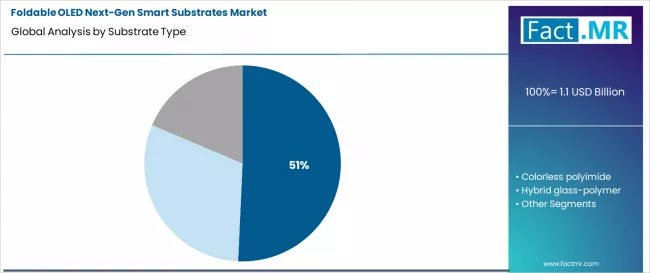
Ultra-thin glass holds ~51% of substrate type share in 2026,emergingas the leading segment due to superior optical clarity, stability, and barrier performance.
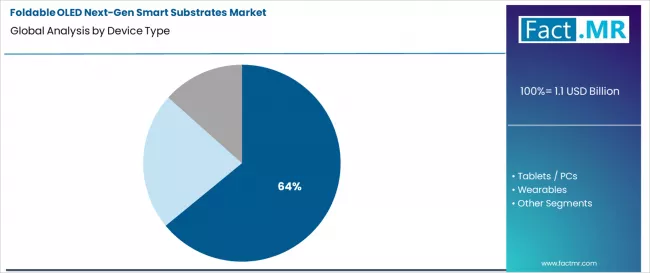
Smartphones account for ~64% of device type share in 2026, positioning them as the dominant segment driven by high-volume commercialization of foldable devices.
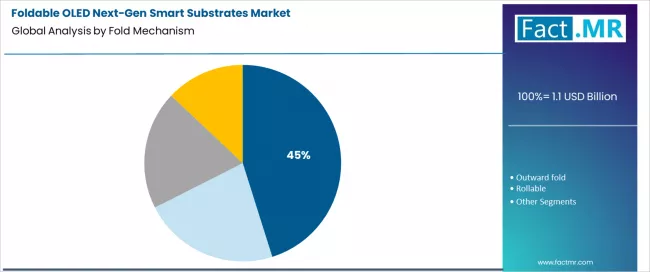
Inward fold mechanisms hold ~45% of segment share in 2026, reflecting their widespread adoption due to better screen protection and durability.
Key substrate technologies include:
Ultra-thin glass
Colorlesspolyimide
Hybrid glass-polymer composites
Geography and Competitive Outlook
Growth is concentrated inEast Asia, North America, and Europe, driven by strong display manufacturing ecosystems.
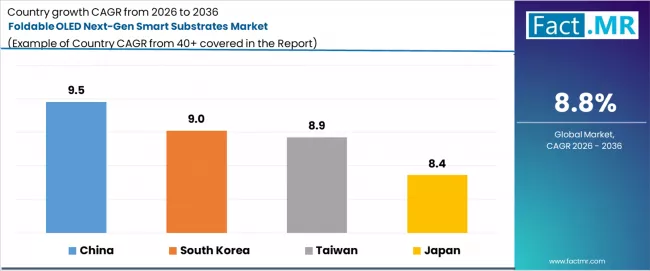
China (9.5%CAGR), South Korea (9.0%), Taiwan (8.9%), and Japan (8.4%)are key growth markets.
Market expansion is closely tied toOLED display manufacturing leadership, material innovation capabilities, and consumer electronics demand cycles.
Key companies active in this market includeSamsung Display,BOE Technology,LG Display,Tianma,Visionox, andAUO.
Foldable OLED Next-Gen Smart Substrates Market — At a Glance
North America, Latin America, Western Europe, Eastern Europe, East Asia, South Asia & Pacific, MEA
Source: Fact.MR analysis. Updated Apr 29, 2026
The core challenge lies in finding a material that can reconcile inherent contradictions: it must be as thin and flexible as plastic to withstand hundreds of thousands of folds, yet as smooth, stable, and impermeable as glass to support ultra-high-resolution OLED deposition and provide a pristine touch surface. Next-generation smart substrates are engineered to resolve this paradox, serving as the critical enabling platform upon which the entire foldable display stack is built. Their performance directly dictates the device's durability, optical clarity, and ultimately, consumer adoption. The expansion of this market is fueled by the competitive drive among OEMs to differentiate their flagship mobile products and explore new device categories. As foldable and rollable designs move toward greater reliability and lower cost, the innovation and scalability of the substrate itself become the primary battleground for technological leadership in the flexible display industry.
North America, Latin America, Western Europe, Eastern Europe, East Asia, South Asia & Pacific, MEA
Source: Fact.MR analysis. Updated Apr 29, 2026
Segmental Analysis
By Substrate Type, Which Material Balances Flexibility and Display Quality?
Foldable Oled Next Gen Smart Substrates Market Analysis By Substrate Type | Source: Fact.MR
Ultra-thin glass commands a dominant 51% share. This segment's leadership is attributed to its superior optical properties, dimensional stability, and excellent gas barrier performance, which are critical for high-end OLED displays.
Advances in thinning and strengthening technologies have enabled UTG to achieve the necessary flexibility for folding while maintaining a glass-like feel and surface hardness that plastic substrates cannot match, making it the premium choice for flagship foldable devices.
By Device Type, Which Product Category is the Primary Commercial Driver?
Foldable Oled Next Gen Smart Substrates Market Analysis By Device Type | Source: Fact.MR
Smartphones overwhelmingly lead the device type segment with a 64% share. As the highest-volume and most competitive segment in consumer electronics, smartphones are the primary vehicle for introducing and scaling foldable technology.
The substrate requirements here are the most stringent, demanding a balance of extreme thinness, durability for daily use, and compatibility with high-yield mass production, which concentrates advanced material development and investment in this application.
By Fold Mechanism, Which Design Dominates Current Product Strategy?
Foldable Oled Next Gen Smart Substrates Market Analysis By Fold Mechanism | Source: Fact.MR
The inward fold mechanism leads with a 45% share. This design, where the screen is protected on the inside of the fold, has been widely adopted as it minimizes the risk of damage to the most sensitive display surface from scratches or impacts.
It presents a significant substrate challenge, as the material must withstand compressive stress on the inner radius. Its current market prevalence drives substrate innovation focused on improving compressive fatigue resistance and minimizing the crease.
What are the Principal Drivers, Constraints, and Evolving Dynamics of this Market?
DROT Element
Analysis
Driver
Demand for immersive, large-screen portability in consumer electronics directly fuels the need for advanced substrates that enable reliable, crease-free foldable displays.
Restraint
High manufacturing costs and complexity from thinning glass or synthesizing advanced polymers limit yield, creating cost premiums that confine devices to premium market segments.
Opportunity
Developing substrates for new form factors like rollable, stretchable, or slidable displays opens untapped markets in wearables, automotive, and IoT, representing a major growth frontier.
Trend
The dominant trend is the innovation race toward hybrid polymer-glass substrates, aiming to composite flexibility with hardness into a single high-performance, cost-effective platform.
Source: Fact.MR analysis. Updated Apr 29, 2026
Analysis of the Foldable OLED Next-Gen Smart Substrates Market by Key Countries
Foldable Oled Next Gen Smart Substrates Market Cagr Analysis By Country | Source: Fact.MR
Country
CAGR 2026 to 2036
China
9.5%
South Korea
9.0%
Taiwan
8.9%
Japan
8.4%
Source: Fact.MR analysis. Updated Apr 29, 2026
How is China's Display Manufacturing Scale Shaping Substrate Supply?
Foldable Oled Next Gen Smart Substrates Market Country Value Analysis | Source: Fact.MR
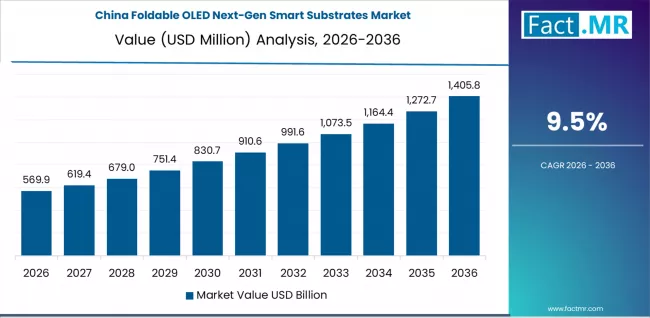
China's leading growth rate of 9.5% CAGR is propelled by its massive investments in next-generation display fabrication and a strategic push for supply chain independence. Domestic panel giants like BOE and Visionox are driving demand for substrates to supply both their own foldable modules and the global market.
This growth is characterized by rapid scaling of ultra-thin glass and CPI production capacities, aiming to reduce reliance on imported materials and capture more value within the domestic display ecosystem.
What is South Korea's Role as an Early Innovator and Integrator?
Its leadership in both foldable device commercialization and advanced display manufacturing anchors South Korea’s strong growth at 9.0% CAGR. The market is driven by deep vertical integration, where display makers work closely with substrate technology developers.
South Korean growth focuses on pioneering and refining high-performance UTG solutions, setting early quality benchmarks, and driving the technology roadmap for complex foldable and rollable prototypes.
How does Taiwan's Semiconductor Expertise Translate to Substrate Innovation?
Taiwan's significant growth at 8.9% CAGR leverages its world-leading semiconductor materials and precision chemical engineering expertise. Companies are applying know-how in thin-film deposition, etching, and composite materials to develop advanced hybrid glass-polymer substrates and precision coating solutions.
Taiwan's role is often as a critical enabler and supplier of specialized materials and process technologies to the major panel makers in China and South Korea, fueling innovation through the supply chain.
What is Japan's Contribution in Specialized Materials and Equipment?
Japan's growth, forecast at 8.4% CAGR, is defined by its strength in foundational materials science and precision manufacturing equipment. Japanese firms are key suppliers of high-performance polyimide resins, specialty glass compositions, and the laser cutting/grinding equipment essential for producing ultra-thin glass.
Rather than leading in panel assembly, Japan's market is driven by providing the high-value, specialized inputs and machinery that enable substrate production globally, focusing on quality and performance over volume.
Competitive Landscape of the Foldable OLED Next-Gen Smart Substrates Market
Foldable Oled Next Gen Smart Substrates Market Analysis By Company | Source: Fact.MR
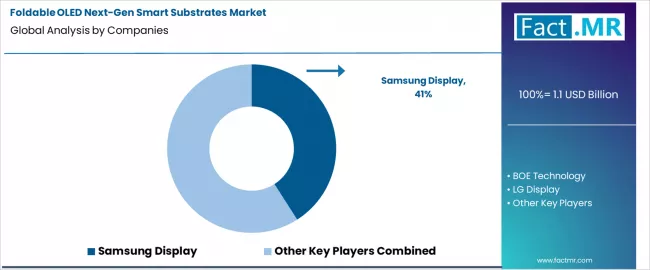
Integrated display giants who view substrate technology as a core strategic differentiator dominate the competitive landscape. Samsung Display and LG Display lead with vertically integrated UTG development. Chinese players like BOE and Visionox are aggressively scaling capacity and pursuing technological parity.
Competition revolves around material performance patents, production yield, and the ability to offer a complete, optimized substrate solution to device OEMs. The high capital and R&D barriers create a tiered market, with leaders setting specifications and a second tier of material suppliers competing on cost and niche innovations.
Key Players in the Foldable OLED Next-Gen Smart Substrates Market
Samsung Display
BOE Technology
LG Display
Tianma
Visionox
AUO
References
Cairns, D. R., & Crawford, G. P. (2024). Electromechanical properties of flexible electronic materials. Proceedings of the IEEE, 112(5), 651-678.
Khan, A., & Lee, S. (2025). Materials for flexible and stretchable electronics. Springer Series in Materials Science.
Society for Information Display. (2025). Foldable and flexible display technology roadmap. SID.
Tang, C. W., & VanSlyke, S. A. (2024). Organic electroluminescent diodes. Applied Physics Letters (Historical Perspective Reprint). AIP Publishing.
U.S. Department of Energy. (2025). Solid-state lighting R&D plan: Next-generation materials. DOE/EE-2500.
Samsung Display, BOE Technology, LG Display, Tianma, Visionox, AUO
Additional Analysis
Comparative analysis of fatigue failure cycles for different substrate materials; study of optical performance (haze, transmittance) post-folding; total cost breakdown of substrate in a foldable display module; impact of substrate properties on thin-film encapsulation yield; assessment of environmental and recycling challenges for composite substrates.
Source: Fact.MR analysis. Updated Apr 29, 2026
Market by Segments
Substrate Type :
Ultra-thin Glass
Colorless Polyimide
Hybrid Glass-Polymer
Device Type :
Smartphones
Tablets/PCs
Wearables
Fold Mechanism :
Inward Fold
Outward Fold
Rollable
Multi-fold
Region :
North America
USA
Canada
Latin America
Brazil
Mexico
Argentina
Rest of Latin America
Western Europe
Germany
France
Italy
Spain
UK
BENELUX
Rest of Western Europe
Eastern Europe
Russia
Poland
Czech Republic
Rest of Eastern Europe
East Asia
China
Japan
South Korea
Taiwan
Rest of East Asia
South Asia & Pacific
India
ASEAN
Australia
Rest of South Asia & Pacific
MEA
GCC Countries
South Africa
Turkiye
Rest of MEA
Questions Answered
Frequently Asked Questions
How big is the foldable oled next-gen smart substrates market in 2026?
The global foldable oled next-gen smart substrates market is estimated to be valued at USD 1.1 billion in 2026.
What will be the size of foldable oled next-gen smart substrates market in 2036?
The market size for the foldable oled next-gen smart substrates market is projected to reach USD 2.4 billion by 2036.
How much will be the foldable oled next-gen smart substrates market growth between 2026 and 2036?
The foldable oled next-gen smart substrates market is expected to grow at a 8.8% CAGR between 2026 and 2036.
What are the key product types in the foldable oled next-gen smart substrates market?
The key product types in foldable oled next-gen smart substrates market are ultra-thin glass, colorless polyimide and hybrid glass-polymer.
Which device type segment to contribute significant share in the foldable oled next-gen smart substrates market in 2026?
In terms of device type, smartphones segment to command 64.1% share in the foldable oled next-gen smart substrates market in 2026.