- Base Value(2025): 5.2 Bn
- Estimated Value(2026): 5.6 Bn
- Forecast Value (2036): 11.6 Bn
- CAGR (2026 - 2036): 7.6%
Foot and Ankle Devices Market Analysis and Forecast by Fact.MR
- The global foot and ankle devices market is estimated to be around US$ 5.60 billion in 2026 and has been forecast to expand at a CAGR of 7.6% to end up at US$ 11.6 billion by 2036.
- Internal Fixation Devices represent the primary product category, supported by trauma and fracture repair as the leading application area.
- The market reflects growing commercial adoption, technological improvements in product design, and expanding distribution infrastructure across established and developing regions.

Foot And Ankle Devices Market Market Value Analysis | Source: Fact.MR
Summary of Foot and Ankle Devices Market
- Market Snapshot
- In 2025, the global Foot and Ankle Devices Market was valued at approximately USD 5.20 billion.
- The market is estimated to reach USD 5.60 billion in 2026 and is projected to attain USD 11.6 billion by 2036.
- The foot and ankle devices market is likely to expand at a CAGR of 7.6% during the forecast period.
- The market is anticipated to create an absolute dollar opportunity of USD 6.04 billion between 2026 and 2036.
- Internal Fixation Devices account for 44% of product share in 2026.
- India (9%) and China (8.5%) are the key growth markets during the forecast period.
- Demand and Growth Drivers
- Expanding end-use applications across healthcare, industrial, and consumer segments are broadening the addressable market for specialized products.
- Growing regulatory emphasis on product quality and safety standards is supporting demand for higher-specification products with verified performance data.
- Increasing adoption across emerging markets is supported by improving distribution infrastructure and growing institutional procurement budgets.
- Procurement consolidation among large healthcare networks and industrial buyers is creating stable demand through multi-year supply contracts.
- Technology improvements in manufacturing processes are enabling better product performance at lower per-unit costs, supporting volume growth.
- Product and Segment View
- Internal Fixation Devices account for 44% of the product segment in 2026, supported by established demand across primary use cases and strong channel positioning.
- Trauma and Fracture Repair represents 48% of the application segment in 2026, reflecting concentrated demand from core end-user groups.
- Hospitals account for 57% of the end-use segment in 2026, driven by institutional procurement and established clinical or operational workflows.
- Key segmentation includes:
- Product: Internal Fixation Devices, External Fixation Devices, Joint Replacement Devices, Soft Tissue Repair Devices
- Application: Trauma and Fracture Repair, Foot Deformities, Sports Injuries, Degenerative Conditions
- End Use: Hospitals, Ambulatory Surgical Centers, Specialty Clinics, Rehabilitation Centers
- Technology: Internal Fixation Technology, Minimally Invasive Surgery, 3D Printing Technology, Biodegradable Implants
- Distribution Channel: Direct Sales, Distributors, Online Sales
- Packaging: Sterile Packaging, Procedure Kits, Protective Packaging
- These systems enable:
- Application-specific performance across defined end-use requirements.
- Standardized procurement through institutional and commercial channels.
- Quality and compliance alignment with applicable regulatory standards.
- Geography and Competitive Outlook
- North America remains the largest regional market, supported by established procurement infrastructure, regulatory frameworks, and high per-capita spending in the category.
- Europe shows steady demand supported by standardized regulatory environments, strong institutional purchasing, and growing adoption across both Western and Central European markets.
- Asia Pacific is emerging as a growth area, with expanding institutional budgets, improving distribution networks, and rising adoption across healthcare and industrial applications.
- India (9%) and China (8.5%) are the fastest-growing country markets, while USA and Brazil maintain steady growth trajectories.
- Key companies operating in this market include Stryker Corporation, DePuy Synthes, Zimmer Biomet, Smith & Nephew, Arthrex, and Wright Medical (Stryker), Integra LifeSciences, Acumed.
- Analyst Opinion
- Shambhu Nath Jha, Principal Consultant at Fact.MR, says 'The foot and ankle devices market is structurally evolving from a product-led market toward one where supply chain positioning, regulatory compliance, and distribution reach determine competitive outcomes. Buyers are consolidating procurement around suppliers that can guarantee consistent quality, meet certification requirements, and maintain supply continuity across multiple geographies. The margin structure favors manufacturers with vertically integrated operations and established relationships with institutional purchasers. Companies that rely solely on product differentiation without building distribution and compliance capabilities will find it increasingly difficult to maintain market position.'
Key Growth Drivers, Constraints, and Opportunities
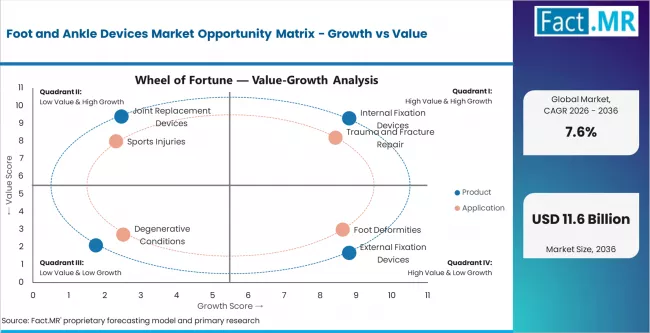
Foot And Ankle Devices Market Opportunity Matrix Growth Vs Value | Source: Fact.MR
Key Factors Driving Growth
- Expanding applications across healthcare, industrial, and consumer segments are broadening the treatable or addressable market and supporting volume growth.
- Regulatory emphasis on product quality and safety standards is supporting demand for higher-specification products with established compliance credentials.
- Institutional procurement consolidation is creating stable demand channels through multi-year contracts and supply agreements.
Key Market Constraints
- Pricing pressure from competitive entries and commodity product segments limits margin expansion for undifferentiated manufacturers.
- Regulatory fragmentation across geographies adds compliance complexity and increases time-to-market for new product introductions.
- Supply chain concentration creates vulnerability to raw material price fluctuations and logistics disruption.
Key Opportunity Areas
- Expanding adoption in emerging markets supported by improving distribution infrastructure and growing institutional budgets.
- Technology advancements enabling better product performance create opportunities for premium positioning and differentiated product lines.
- Growing preference for sustainable and compliant product solutions creates demand for manufacturers with established certification and quality credentials.
Segment-wise Analysis of the Foot and Ankle Devices Market
- Internal Fixation Devices is expected to lead the product segment with 44% share in 2026.
- Trauma and Fracture Repair is expected to lead the application segment with 48% share in 2026.
- Hospitals is expected to lead the end use segment with 57% share in 2026.
The foot and ankle devices market is segmented by product, application, end use, technology, distribution channel, packaging, and region. The segmentation structure reflects established demand patterns across product categories, application areas, and buyer types. Leading segments maintain dominance through institutional procurement relationships, clinical or operational evidence, and distribution scale.
Which Product Segment Dominates the Foot and Ankle Devices Market?
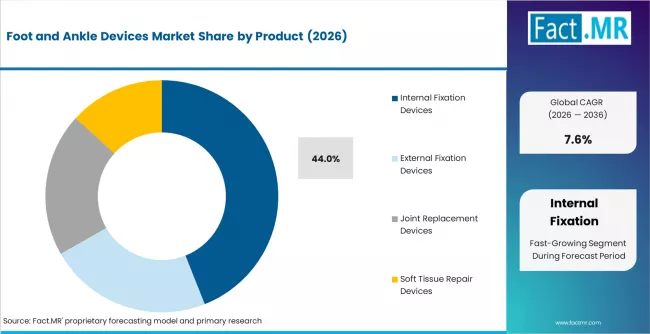
Foot And Ankle Devices Market Analysis By Product | Source: Fact.MR
Internal Fixation Devices is expected to lead the product segment with 44% share in 2026. Demand is supported by broad applicability, competitive pricing, and established distribution across institutional and commercial channels.
External Fixation Devices and Joint Replacement Devices serve complementary market positions within the product category. The segment structure reflects established demand patterns with the leading category maintaining dominance through scale, cost positioning, and distribution reach.
Which Application Segment Dominates the Foot and Ankle Devices Market?
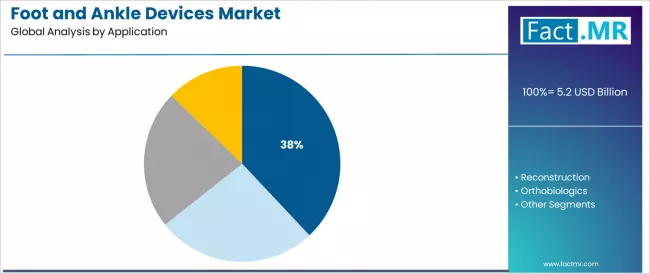
Foot And Ankle Devices Market Analysis By Application | Source: Fact.MR
Trauma and Fracture Repair is expected to lead the application segment with 48% share in 2026. Demand is supported by broad applicability, competitive pricing, and established distribution across institutional and commercial channels.
Foot Deformities and Sports Injuries serve complementary market positions within the application category. The segment structure reflects established demand patterns with the leading category maintaining dominance through scale, cost positioning, and distribution reach.
Which End Use Segment Dominates the Foot and Ankle Devices Market?
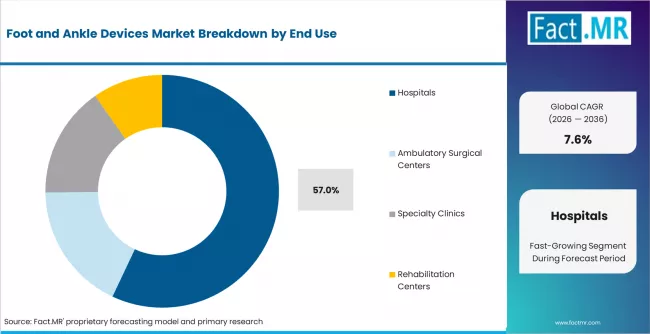
Foot And Ankle Devices Market Analysis By End Use | Source: Fact.MR
Hospitals is expected to lead the end use segment with 57% share in 2026. Demand is supported by broad applicability, competitive pricing, and established distribution across institutional and commercial channels.
Ambulatory Surgical Centers and Specialty Clinics serve complementary market positions within the end use category. The segment structure reflects established demand patterns with the leading category maintaining dominance through scale, cost positioning, and distribution reach.
Which Product Trend is Shaping the Next Phase of Growth in the Foot and Ankle Devices Market?
External Fixation Devices are not yet the largest product segment, but they represent an increasingly important growth area. Demand is supported by evolving end-user requirements, improving cost-performance ratios, and expanding applications that were not served by existing product categories.
The shift reflects changing buyer priorities. Procurement decisions are increasingly influenced by product performance data, compliance credentials, and total cost of ownership rather than upfront pricing alone. This creates space for categories that offer measurable advantages in durability, efficacy, or regulatory standing.
Regional Outlook Across Key Markets
.webp "Top Country Growth Comparison Foot And Ankle Devices Market Cagr (2026 2036)")
Top Country Growth Comparison Foot And Ankle Devices Market Cagr (2026 2036) | Source: Fact.MR
- North America leads in market value, supported by high per-capita spending, established institutional procurement networks, and strong regulatory infrastructure that supports product adoption.
- Europe shows stable demand driven by standardized regulatory frameworks, institutional purchasing consolidation, and growing cross-border distribution capabilities.
- Asia Pacific is emerging as the fastest-growing region, supported by expanding institutional budgets, improving distribution infrastructure, and rising end-use demand across healthcare and industrial applications.
CAGR Table
| Country | CAGR (%) |
|---|---|
| India | 9% |
| China | 8.5% |
| USA | 7% |
| Brazil | 6.8% |
| UK | 6.2% |
| Germany | 6% |
| Japan | 5.5% |
Source: Fact.MR analysis. Updated May 14, 2026
Source: Fact MR (FMR) analysis, based on proprietary forecasting model and primary research.

Foot And Ankle Devices Market Cagr Analysis By Country | Source: Fact.MR
Market Outlook for Foot and Ankle Devices Market in India
The India foot and ankle devices market is projected to grow at a CAGR of 9% through 2036. Demand is driven by expanding institutional healthcare infrastructure, rising adoption in both public and private sectors, and growing end-use requirements across clinical and industrial applications.
- Healthcare infrastructure expansion is creating new institutional demand.
- Public and private sector adoption is broadening the buyer base.
- Cost-competitive manufacturing supports both domestic and export demand.
Demand Trends for Foot and Ankle Devices Market in China
The China foot and ankle devices market is projected to grow at a CAGR of 8.5% through 2036. Growth is supported by expanding domestic consumption, institutional procurement growth, strong manufacturing capabilities, and widening adoption across healthcare and industrial applications.
- Domestic demand expansion is the primary growth driver.
- Manufacturing strength supports competitive pricing and scale.
- Institutional procurement growth is broadening the buyer base.
Growth Assessment for Foot and Ankle Devices Market in USA

Foot And Ankle Devices Market Country Value Analysis | Source: Fact.MR
The U.S. foot and ankle devices market is projected to grow at a CAGR of 7% through 2036. Demand is supported by strong institutional procurement, established regulatory frameworks, and high end-use spending across both public and private sectors.
- Institutional procurement networks sustain steady category demand.
- Established regulatory frameworks support product adoption and market access.
- High per-capita spending maintains premium product positioning.
Market Opportunity for Foot and Ankle Devices Market in Brazil
The Brazil foot and ankle devices market is projected to grow at a CAGR of 6.8% through 2036.
- Growing institutional demand supports market expansion.
- Improving distribution infrastructure broadens product access.
- Regulatory alignment with international standards supports adoption.
Demand Analysis for Foot and Ankle Devices Market in UK
The UK foot and ankle devices market is projected to grow at a CAGR of 6.2% through 2036. Demand is supported by institutional healthcare and research spending, regulatory alignment with international standards, and a mature distribution infrastructure.
- Institutional spending sustains demand across healthcare and research applications.
- Regulatory alignment supports product access and adoption cycles.
- Established distribution channels maintain market accessibility.
Competitive Benchmarking and Company Positioning

Foot And Ankle Devices Market Analysis By Company | Source: Fact.MR
Foot and Ankle Devices Market Analysis By Company
- Stryker Corporation, DePuy Synthes, Zimmer Biomet, Smith & Nephew hold established positions through broad product portfolios, institutional relationships, and geographic reach.
- Arthrex, Wright Medical (Stryker), Integra LifeSciences, Acumed maintain relevant positions across specific product categories, price tiers, and regional markets.
- Technology capability, regulatory compliance, and distribution infrastructure create the primary barriers to competitive positioning in this market.
Stryker Corporation, DePuy Synthes, Zimmer Biomet, Smith & Nephew hold established positions in the global foot and ankle devices market through broad product portfolios, geographic reach, and institutional relationships.
Arthrex, Wright Medical (Stryker), Integra LifeSciences, Acumed maintain positions across specific product categories and regional markets, competing on pricing, service capability, and distribution strength.
The competitive structure is moderately consolidated, with leading companies capturing significant institutional demand through procurement relationships and product coverage. Smaller manufacturers compete through price positioning and regional specialization.
Strategic priorities include expanding product portfolios, strengthening distribution reach, and building institutional relationships that support recurring procurement.
Key Companies in the Foot and Ankle Devices Market
- Stryker Corporation, DePuy Synthes, Zimmer Biomet, Smith & Nephew are among the leading companies in the foot and ankle devices market, supported by broad product coverage, institutional procurement relationships, and established distribution networks.
- Arthrex, Wright Medical (Stryker), Integra LifeSciences, Acumed hold established positions across specific market segments, supported by product specialization, regional distribution strength, and competitive pricing strategies.
- Orthofix, Paragon 28, Extremity Medical, Vilex, In2Bones, Nextremity Solutions, Medin compete through focused product offerings, price-point coverage, and niche strength in specific applications or geographic markets.
Recent Industry Developments
- Stryker Corporation , Product Portfolio Expansion (February 2026)
- Stryker Corporation expanded its product portfolio with the introduction of an updated product line targeting institutional buyers. The launch strengthens the company's position in the internal fixation devices segment and supports growing demand for higher-specification products across hospital and commercial channels.
- DePuy Synthes , Distribution Network Expansion (2025)
- DePuy Synthes expanded its distribution network across Asia Pacific markets, reinforcing the company's geographic reach and supporting growing institutional demand in the region. The expansion supports the company's strategy to capture share in faster-growing markets outside North America and Europe.
- Zimmer Biomet , Product Launch (2025)
- Zimmer Biomet announced the launch of an updated product platform designed for improved performance and operational efficiency. The launch supports the company's positioning in the premium product tier and addresses demand for differentiated solutions in institutional and commercial settings.
Leading Companies Shaping the Foot and Ankle Devices Market
- Stryker Corporation
- DePuy Synthes
- Zimmer Biomet
- Smith & Nephew
- Arthrex
- Wright Medical (Stryker)
- Integra LifeSciences
- Acumed
- Orthofix
- Paragon 28
- Extremity Medical
- Vilex
- In2Bones
- Nextremity Solutions
- Medin
Sources and Research References
- Stryker Corporation. Product portfolio and market activity updates.
- DePuy Synthes. Product launches and strategic developments.
- Zimmer Biomet. Product and technology updates.
- Industry association publications, regulatory agency databases, and trade data sources.
- Government statistics, import-export databases, and institutional procurement records.
- Primary interviews with manufacturers, distributors, institutional buyers, and end users.
This bibliography is provided for reader reference and is not exhaustive. The full report contains the complete reference list and detailed citations.
Key Questions This Report Addresses
- What is the current and projected size of the Foot and Ankle Devices Market?
- How fast is the Foot and Ankle Devices Market expected to grow between 2026 and 2036?
- Which product type is expected to lead the market by 2026?
- Which application segment accounts for the highest demand in 2026?
- What factors are shaping demand in the foot and ankle devices market?
- How are procurement patterns and distribution strategies evolving?
- Which country markets are projected to grow fastest through 2036?
- What is the competitive structure of the foot and ankle devices market?
- What role does regulatory compliance play in market positioning?
- Who are the key companies operating in the Foot and Ankle Devices Market?
- How does Fact.MR estimate and validate the market forecast?
Foot and Ankle Devices Market Definition
The foot and ankle devices market covers internal fixation devices and related product categories used across trauma and fracture repair and adjacent applications. The market scope includes products sold through direct sales channels across established and emerging geographies, covering both institutional and commercial end-user segments.
Foot and Ankle Devices Market Inclusions
- The scope covers global and regional market size and forecasts for 2026 to 2036 across product type, application, end use, technology, distribution channel, and region.
- It includes regional demand analysis based on factors such as end-use demand patterns, regulatory requirements, procurement structures, and distribution infrastructure.
- The report includes pricing and cost analysis across product tiers and distribution channels, covering manufacturing costs and commercial margins.
- It covers market drivers, constraints, competitive landscape, and strategic positioning of leading companies.
Foot and Ankle Devices Market Exclusions
- The scope excludes products outside the defined market category and its stated product segments.
- It excludes services, software, and platforms not sold as part of the defined product categories.
- The report excludes pre-commercial or experimental products without regulatory clearance or market availability.
- It also excludes informal or unbranded products with limited commercial distribution.
Foot and Ankle Devices Market Research Methodology
- The methodology combines secondary research, primary interviews, and forecast modelling.
- It draws on 120+ secondary sources and benchmarks 65+ company product portfolios.
- Market sizing covers 30+ countries through a demand-side model, supported by top-down validation.
- Key inputs include end-use demand indicators, regulatory frameworks, pricing trends, and distribution channel data.
- The model cross-checks demand estimates with shipment data, import-export flows, and company revenue benchmarks.
- Primary validation includes 25+ interviews across manufacturers, distributors, institutional buyers, and end users.
- Final estimates go through trade-flow checks, pricing analysis, and sensitivity testing.
Segmentation
Scope of Analysis
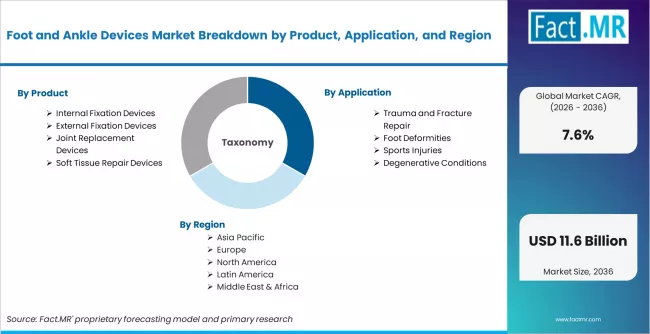
Foot And Ankle Devices Market Breakdown By Product, Application, And Region | Source: Fact.MR
| Parameter | Details |
|---|---|
| Quantitative Units | USD 5.60 billion to USD 11.6 billion, at a CAGR of 7.6% |
| Market Definition | The foot and ankle devices market covers internal fixation devices and related product categories used across trauma and fracture repair and adjacent applications. The market scope includes products sold through direct sales channels across established and emerging geographies, covering both institutional and commercial end-user segments. |
| Regions Covered | North America, Latin America, Europe, East Asia, South Asia and Pacific, Middle East and Africa |
| Countries Covered | India, China, USA, Brazil, UK, Germany, Japan, 30 plus countries |
| Key Companies | Stryker Corporation, DePuy Synthes, Zimmer Biomet, Smith & Nephew, Arthrex, Wright Medical (Stryker), Integra LifeSciences, Acumed, Orthofix, Paragon 28, Extremity Medical, Vilex, In2Bones, Nextremity Solutions, Medin |
| Forecast Period | 2026 to 2036 |
| Approach | Hybrid demand-side and top-down methodology built on country-level demand indicators, product benchmarking, pricing analysis, shipment validation, and primary interviews across manufacturers, distributors, and end users |
Source: Fact.MR analysis. Updated May 14, 2026
Foot and Ankle Devices Market Segmentation
-
Foot and Ankle Devices Market Segmented by Product:
- Internal Fixation Devices
- Plates and Screws Systems
- Locking Plates
- Compression Plates
- Intramedullary Devices
- Tibial Nails
- Fibular Fixation Nails
- Plates and Screws Systems
- External Fixation Devices
- Ring Fixators
- Ilizarov Systems
- Hybrid External Fixators
- Ring Fixators
- Joint Replacement Devices
- Ankle Replacement Systems
- Total Ankle Arthroplasty
- Partial Ankle Implants
- Ankle Replacement Systems
- Soft Tissue Repair Devices
- Ligament Repair Systems
- Tendon Anchors
- Suture Anchor Systems
- Ligament Repair Systems
- Internal Fixation Devices
-
Foot and Ankle Devices Market Segmented by Application:
- Trauma and Fracture Repair
- Ankle Fractures
- Malleolar Fractures
- Complex Fracture Fixation
- Ankle Fractures
- Foot Deformities
- Flatfoot Correction
- Clubfoot Treatment
- Hallux Valgus Correction
- Flatfoot Correction
- Sports Injuries
- Ligament Injuries
- Achilles Tendon Repair
- Sprains and Strains
- Ligament Injuries
- Degenerative Conditions
- Arthritis Management
- Osteoarthritis
- Rheumatoid Arthritis
- Arthritis Management
- Trauma and Fracture Repair
-
Foot and Ankle Devices Market Segmented by End Use:
- Hospitals
- Orthopedic Departments
- Trauma Units
- Surgical Wards
- Orthopedic Departments
- Ambulatory Surgical Centers
- Day Care Orthopedic Units
- Minimally Invasive Procedures
- Outpatient Surgeries
- Day Care Orthopedic Units
- Specialty Clinics
- Podiatry Clinics
- Foot and Ankle Centers
- Sports Medicine Clinics
- Podiatry Clinics
- Rehabilitation Centers
- Physiotherapy Centers
- Post Surgical Rehab
- Mobility Recovery Programs
- Physiotherapy Centers
- Hospitals
-
Foot and Ankle Devices Market Segmented by Technology:
- Internal Fixation Technology
- Locking Plate Systems
- Anatomical Plates
- Minimally Invasive Fixation
- Locking Plate Systems
- Minimally Invasive Surgery
- Arthroscopic Procedures
- Endoscopic Repair Systems
- Small Incision Techniques
- Arthroscopic Procedures
- 3D Printing Technology
- Patient Specific Implants
- Custom Orthopedic Devices
- Preoperative Planning Systems
- Patient Specific Implants
- Biodegradable Implants
- Absorbable Fixation Devices
- Bioabsorbable Screws
- Temporary Support Systems
- Absorbable Fixation Devices
- Internal Fixation Technology
-
Foot and Ankle Devices Market Segmented by Distribution Channel:
- Direct Sales
- Hospital Procurement
- Bulk Orthopedic Supply
- Institutional Contracts
- Hospital Procurement
- Distributors
- Medical Device Distributors
- Regional Orthopedic Suppliers
- Surgical Equipment Vendors
- Medical Device Distributors
- Online Sales
- E Commerce Platforms
- Direct Manufacturer Platforms
- Third Party Marketplaces
- E Commerce Platforms
- Direct Sales
-
Foot and Ankle Devices Market Segmented by Packaging:
- Sterile Packaging
- Individually Packed Implants
- Pre Sterilized Devices
- Single Use Kits
- Individually Packed Implants
- Procedure Kits
- Orthopedic Surgery Kits
- Complete Fixation Sets
- Instrument and Implant Sets
- Orthopedic Surgery Kits
- Protective Packaging
- Shock Resistant Cases
- Transport Safe Containers
- Storage Ready Packaging
- Shock Resistant Cases
- Sterile Packaging
-
Foot and Ankle Devices Market by Region:
- North America
- USA
- Canada
- Mexico
- Latin America
- Brazil
- Chile
- Rest of Latin America
- Western Europe
- Germany
- UK
- Italy
- Spain
- France
- Nordic
- BENELUX
- Rest of Western Europe
- Eastern Europe
- Russia
- Poland
- Hungary
- Balkan & Baltic
- Rest of Eastern Europe
- East Asia
- China
- Japan
- South Korea
- South Asia and Pacific
- India
- ASEAN
- Australia & New Zealand
- Rest of South Asia and Pacific
- Middle East & Africa
- Kingdom of Saudi Arabia
- Other GCC Countries
- Turkiye
- South Africa
- Other African Union
- Rest of Middle East & Africa
- North America
Frequently Asked Questions
How big is the foot and ankle devices market in 2025?
What will be the size of the foot and ankle devices market in 2036?
How much will the foot and ankle devices market grow between 2026 and 2036?
What are the key product types in the foot and ankle devices market?
Which application segment accounts for the highest share in 2026?
Which countries are projected to grow fastest?
Who are the leading companies in the foot and ankle devices market?
Who worked on this report


Preview the report firsthand - request a free sample
Free SampleGet the brochure for pricing and purchase details
Download PDF