Foot and Ankle Orthobiologics Market
Foot and Ankle Orthobiologics Market Size and Share Forecast Outlook 2026 to 2036
Foot and ankle orthobiologics market is projected to grow from USD 0.8 billion in 2026 to USD 1.7 billion by 2036, at a CAGR of 8.1%. Biologics will dominate with a 63.2% market share, while hospitals will lead the end use segment with a 63.4% share.
Foot and Ankle Orthobiologics Market Forecast and Outlook 2026 to 2036
The global foot and ankle orthobiologics market is set to grow from USD 0.8 billion in 2026 to USD 1.74 billion by 2036, advancing at a CAGR of 8.1%. Growth is driven by rising demand for regenerative orthopedic validation, expanding sports medicine infrastructure across developed markets, and accelerating minimally invasive surgery requirements among orthopedic and surgical organizations seeking biologics-based healing solutions.
Key Takeaways from the Foot and Ankle Orthobiologics Market
- Foot and Ankle Orthobiologics Market Value (2026): USD 0.8 billion
- Foot and Ankle Orthobiologics Market Forecast Value (2036): USD 1.74 billion
- Foot and Ankle Orthobiologics Market Forecast CAGR: 8.1%
- Leading Product in Foot and Ankle Orthobiologics Market: Biologics (63.2%)
- Key Growth Regions in Foot and Ankle Orthobiologics Market: Asia Pacific, North America, and Europe
- Top Players in Foot and Ankle Orthobiologics Market: Medtronic, Johnson & Johnson (DePuySynthes), Zimmer Biomet, Stryker Corporation, Orthofix Inc.
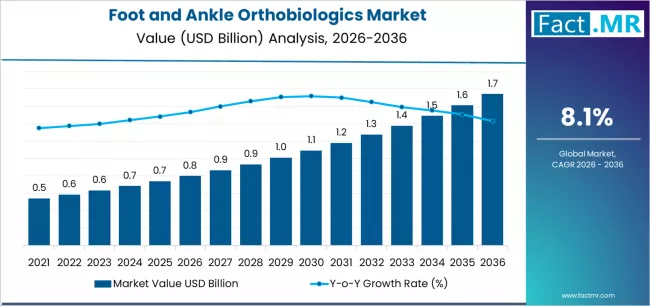
Foot and ankle orthobiologics technologies are increasingly recognized as essential products for orthopedic practitioners, offering precise bone regeneration capabilities, healing acceleration assurance, and comprehensive tissue repair characteristics compared to traditional autograft approaches. Biologics formulations dominate the market, favored in hospital and surgical environments for their established osteoinductive properties, providing bone healing mechanisms, fusion enhancement capabilities, and clinical acceptance across diverse orthopedic applications and patient demographics.
Hospital facilities remain fundamental in orthopedic protocols where complex reconstruction and trauma management match operational requirements and surgical confidence standards. Biologics users are advancing among product categories as specialized orthopedic facility networks expand and regenerative medicine infrastructure increases accessibility in surgery-convenient locations with comprehensive clinical structures.
Foot and Ankle Orthobiologics Market
| Metric | Value |
|---|---|
| Market Value (2026) | USD 0.8 billion |
| Market Forecast (2036) | USD 1.74 billion |
| Growth Rate | 8.1% CAGR |
Category
| Category | Segments |
|---|---|
| Product | Biologics (Demineralized Bone Matrix [DBM]; Allograft; Bone Morphogenetic Protein [BMP]; Stem Cell); Wedges (Viscosupplementation; Synthetic Bone Substitutes) |
| End Use | Hospitals; Outpatient Clinics |
| Region | North America; Europe; Asia Pacific; Latin America; MEA |
Segmental Analysis
What makes Biologics Command the Largest Share in the Foot and Ankle Orthobiologics Market?
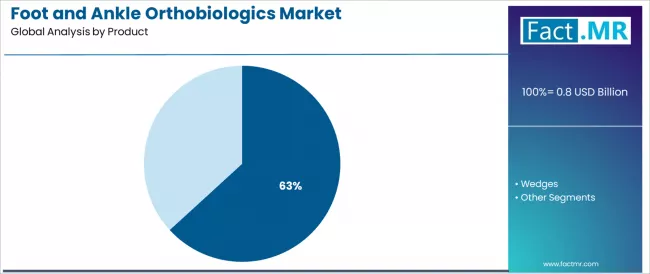
Biologics command the leading position in the foot and ankle orthobiologics market with a 63.2% market share through superior osteoinductive characteristics, including established bone healing presence, extensive clinical documentation, and proven fusion enhancement pathways that enable surgeons to achieve predictable surgical outcomes across varied procedure categories and diverse patient demographics.
The segment benefits from regenerative advantages through cellular activity stimulation optimization, autograft replacement without donor site morbidity, and established clinical validation documentation without requiring extensive outcome verification procedures.
Why are Hospitals the Dominant End Users of Foot and Ankle Orthobiologics?
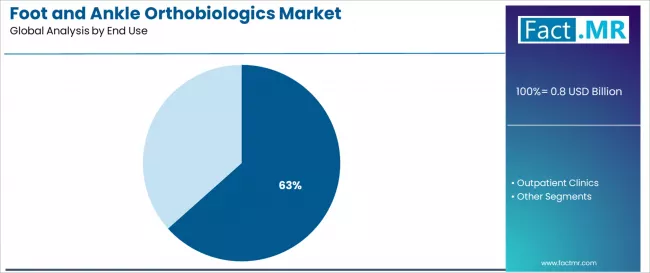
Hospitals demonstrate facility leadership in the foot and ankle orthobiologics market with 63.4% share due to widespread complex procedure requirements and established focus on trauma management, revision surgery, and multispecialty coordination that maximizes surgical capability while maintaining consistent clinical care characteristics.
Surgeons and healthcare administrators prioritize hospital settings for surgical complexity management, comprehensive care integration, and coordination with established operating room workflows that enables multidisciplinary treatment experiences across multiple procedure protocols.
What are the Drivers, Restraints, and Key Trends of the Foot and Ankle Orthobiologics Market?
The orthobiologics market for foot and ankle applications is driven by rising sports injuries and trauma linked to active lifestyles, which increase demand for solutions that accelerate healing and recovery. Growth in minimally invasive and arthroscopic procedures further supports adoption, as surgeons increasingly prefer injectable biologics compatible with less invasive techniques and faster rehabilitation timelines. An aging population and higher prevalence of degenerative foot conditions, including arthritis and diabetes-related complications, are also expanding the patient base beyond younger athletic demographics.
Market restraints include high product costs and reimbursement limitations, which constrain adoption in cost-sensitive healthcare systems and outpatient settings. Limited long-term clinical evidence and lack of standardized treatment protocols create uncertainty around efficacy, slowing uptake among conservative surgeons and evidence-driven institutions.
Key trends include growing integration of stem cell therapies and platelet-rich plasma (PRP), often used in combination with growth factors to enhance regenerative outcomes. Another important trend is the migration of procedures toward outpatient and ambulatory surgery centers, improving accessibility while emphasizing cost efficiency and patient convenience.
Analysis of the Foot and Ankle Orthobiologics Market by Key Countries
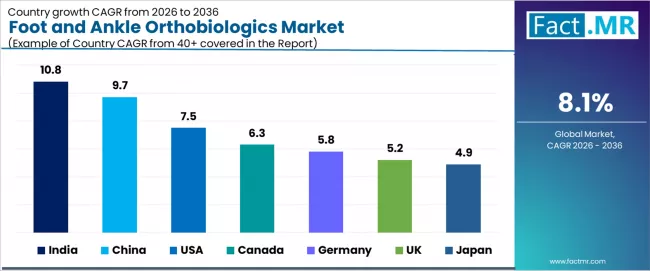
| Country | CAGR 2026-2036 |
|---|---|
| India | 10.8% |
| China | 9.7% |
| USA | 7.5% |
| Canada | 6.3% |
| Germany | 5.8% |
| UK | 5.2% |
| Japan | 4.9% |
Why is India Driving the Fastest Growth in Foot and Ankle Orthobiologics?
India records the fastest growth at a 10.8% CAGR, supported by expanding orthopedic infrastructure and rising surgical volumes. Demand is concentrated in major urban hubs such as Delhi, Mumbai, and Bangalore, where hospitals and specialty centers are scaling foot and ankle procedures. Increasing elective surgeries and sports medicine activity are encouraging wider adoption of regenerative biologics.
Surgeons are combining internationally validated products with cost-efficient surgical approaches, supported by growing use of minimally invasive techniques and structured outcome tracking. Expanding distributor networks, hospital procurement systems, and focused surgical training programs continue to strengthen market access and adoption consistency.
How Does China Lead Growth Through Private Orthopedic Hospital Expansion?
China grows at a 9.7% CAGR, driven by strong private healthcare investment and rising expectations for advanced orthopedic care. Private hospitals and specialty clinics in Beijing, Shanghai, and Guangzhou are increasingly adopting premium orthobiologics for trauma and elective foot and ankle reconstruction.
Surgeons favor products supported by international clinical evidence and quality standards, particularly in high-end facilities where patient outcomes and satisfaction are critical. Expansion of sports medicine centers and medical tourism-oriented hospitals continues to support broader adoption of regenerative orthopedic solutions.
Why does the USA Lead in Clinical Evidence-Based Adoption?
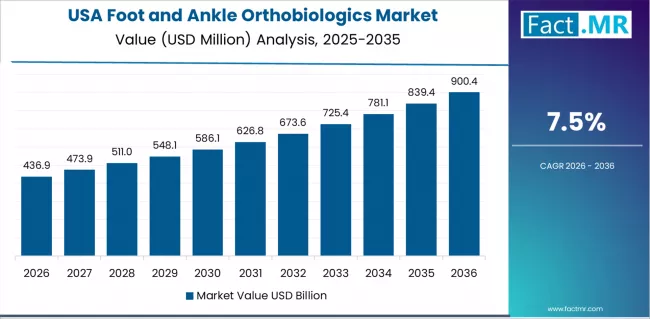
The USA maintains a 7.5% growth rate, anchored in robust orthopedic infrastructure and a mature FDA regulatory environment. Orthobiologics are widely integrated across hospitals, ambulatory surgery centers, and sports medicine facilities.
Surgeons rely on extensive clinical trial data, reimbursement coverage, and standardized evidence-based protocols to guide adoption. Growth is strongest in established orthopedic and sports medicine regions, where predictable outcomes and documented healing benefits support patient demand and continued investment in advanced biologics.
How Is Canada Expanding Adoption Through Outpatient Orthopedic Care?
Canada records a 6.3% CAGR, supported by expanding ambulatory surgery centers and efficiency-driven care models. Orthobiologics adoption is increasing across outpatient facilities in Ontario, Quebec, and British Columbia, where surgeons emphasize cost-effective treatment and outcome documentation.
Provincial reimbursement frameworks and healthcare efficiency initiatives encourage use of approved biologics compatible with day surgery pathways. Established outpatient infrastructure continues to support steady market expansion.
Why does Germany Demonstrate Hospital Integration Excellence?
Germany grows at a 5.8% CAGR, driven by strong clinical standards and structured orthopedic care delivery. Specialized orthopedic hospitals and university medical centers integrate orthobiologics within evidence-based surgical protocols. Surgeons prioritize CE-marked products supported by clinical studies, outcome benchmarking, and detailed technical documentation. Quality assurance maturity and strict regulatory oversight continue to support consistent adoption across high-volume orthopedic centers.
How does the UK Support Growth through Minimally Invasive Orthopedic Integration?
The UK market expands at a 5.2% CAGR, supported by minimally invasive surgery trends and integrated orthopedic networks. NHS centers and private hospitals increasingly use orthobiologics to support efficient recovery and optimized outcomes in foot and ankle procedures. Surgeons emphasize cost-effectiveness, procedural efficiency, and outcome evidence aligned with NICE evaluation requirements. Established day-case surgery practices and structured procurement frameworks continue to guide adoption.
Why Is Japan’s Market Shaped by Aging Population Needs?
Japan records a 4.9% growth rate, driven by aging demographics and demand for safe, reliable orthopedic interventions. Specialized hospitals and university centers adopt orthobiologics within tightly controlled surgical protocols focused on elderly patient outcomes. Surgeons prioritize safety validation, Japanese clinical data, and PMDA approval. Strong research culture and meticulous outcome monitoring continue to support selective, quality-focused adoption.
Competitive Landscape of the Foot and Ankle Orthobiologics Market
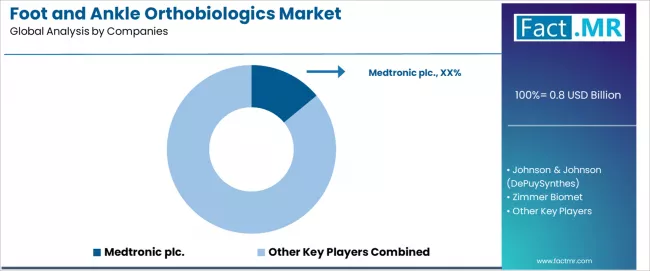
The foot and ankle orthobiologics market is moderately consolidated, with an estimated 30-60 active participants operating across global orthopedic device platforms and regional surgical portfolios. Competition reflects the maturation of regenerative orthopedic technologies, where clinical evidence strength, surgeon familiarity, and distribution reach are key determinants of market position.
Medtronic plc. holds a leading position, supported by a broad orthobiologics portfolio, strong clinical validation programs, and established relationships with orthopedic and foot and ankle surgeons. Other established players compete through global distribution networks, procedure-specific biologic offerings, and comprehensive training programs that support fusion outcomes and surgical consistency. Manufacturing scale, tissue processing quality, cold-chain management, and product reliability further differentiate larger suppliers from smaller competitors.
Emerging regenerative medicine companies and specialized graft manufacturers add competitive pressure through stem cell-based products, synthetic substitutes, and innovative delivery systems. Differentiation is increasingly visible in cellular therapies, BMP-enabled solutions, and procedure-optimized biologic combinations. Overall competitiveness favors companies combining robust clinical evidence, surgeon education, and integrated surgical solutions that extend beyond standalone graft products.
Key Players in the Foot and Ankle Orthobiologics Market
- Medtronic plc.
- Johnson & Johnson (DePuySynthes)
- Zimmer Biomet
- Stryker Corporation
- Orthofix, Inc.
- Arthrex, Inc.
- Smith & Nephew
- Integra LifeSciences
- Acumed
- Bioventus
Scope of the Report
| Items | Values |
|---|---|
| Quantitative Units (2026) | USD 0.8 billion |
| Product | Biologics (Demineralized Bone Matrix (DBM), Allograft, Bone Morphogenetic Protein (BMP), Stem Cell), Wedges (Viscosupplementation, Synthetic Bone Substitutes) |
| End Use | Hospitals, Outpatient Clinics |
| Regions Covered | North America, Europe, Asia Pacific, Latin America, MEA |
| Countries Covered | USA, China, India, Germany, UK, France, Canada, Japan, and 15+ additional countries |
| Key Companies Profiled | Medtronic, Johnson & Johnson (DePuySynthes), Zimmer Biomet, Stryker Corporation, Orthofix Inc., Arthrex Inc. |
| Additional Attributes | Dollar sales by product and end-use categories, regional adoption trends across Asia Pacific, North America, and Europe, competitive landscape with established orthopedic corporations and specialized biologics companies, surgeon preferences for Biologics and clinical evidence, integration with hospital surgical facilities and outpatient ASC organizations, innovations in stem cell technologies and synthetic substitute platforms, and development of sophisticated regenerative systems with enhanced osteoinductive profiles and comprehensive clinical outcome documentation frameworks. |
Foot and Ankle Orthobiologics Market by Segments
-
Product :
- Biologics
- Demineralized Bone Matrix (DBM)
- Allograft
- Bone Morphogenetic Protein (BMP)
- Stem Cell
- Wedges
- Viscosupplementation
- Synthetic Bone Substitutes
- Biologics
-
End Use :
- Hospitals
- Outpatient Clinics
-
Region :
- North America
- USA
- Canada
- Mexico
- Europe
- Germany
- France
- UK
- Italy
- Spain
- Rest of Europe
- Asia Pacific
- India
- China
- Japan
- South Korea
- ASEAN
- Australia & New Zealand
- Rest of Asia Pacific
- Latin America
- Brazil
- Rest of Latin America
- MEA
- GCC Countries
- South Africa
- Rest of MEA
- North America
Table of Content
- Executive Summary
- Global Market Outlook
- Demand to side Trends
- Supply to side Trends
- Technology Roadmap Analysis
- Analysis and Recommendations
- Market Overview
- Market Coverage / Taxonomy
- Market Definition / Scope / Limitations
- Market Background
- Market Dynamics
- Drivers
- Restraints
- Opportunity
- Trends
- Scenario Forecast
- Demand in Optimistic Scenario
- Demand in Likely Scenario
- Demand in Conservative Scenario
- Opportunity Map Analysis
- Product Life Cycle Analysis
- Supply Chain Analysis
- Investment Feasibility Matrix
- Value Chain Analysis
- PESTLE and Porter’s Analysis
- Regulatory Landscape
- Regional Parent Market Outlook
- Production and Consumption Statistics
- Import and Export Statistics
- Market Dynamics
- Global Market Analysis 2021 to 2025 and Forecast, 2026 to 2036
- Historical Market Size Value (USD Million) Analysis, 2021 to 2025
- Current and Future Market Size Value (USD Million) Projections, 2026 to 2036
- Y to o to Y Growth Trend Analysis
- Absolute $ Opportunity Analysis
- Global Market Pricing Analysis 2021 to 2025 and Forecast 2026 to 2036
- Global Market Analysis 2021 to 2025 and Forecast 2026 to 2036, By Product
- Introduction / Key Findings
- Historical Market Size Value (USD Million) Analysis By Product, 2021 to 2025
- Current and Future Market Size Value (USD Million) Analysis and Forecast By Product, 2026 to 2036
- Biologics
- Wedges
- Y to o to Y Growth Trend Analysis By Product, 2021 to 2025
- Absolute $ Opportunity Analysis By Product, 2026 to 2036
- Global Market Analysis 2021 to 2025 and Forecast 2026 to 2036, By End Use
- Introduction / Key Findings
- Historical Market Size Value (USD Million) Analysis By End Use, 2021 to 2025
- Current and Future Market Size Value (USD Million) Analysis and Forecast By End Use, 2026 to 2036
- Hospitals
- Outpatient Clinics
- Y to o to Y Growth Trend Analysis By End Use, 2021 to 2025
- Absolute $ Opportunity Analysis By End Use, 2026 to 2036
- Global Market Analysis 2021 to 2025 and Forecast 2026 to 2036, By Region
- Introduction
- Historical Market Size Value (USD Million) Analysis By Region, 2021 to 2025
- Current Market Size Value (USD Million) Analysis and Forecast By Region, 2026 to 2036
- North America
- Latin America
- Western Europe
- Eastern Europe
- East Asia
- South Asia and Pacific
- Middle East & Africa
- Market Attractiveness Analysis By Region
- North America Market Analysis 2021 to 2025 and Forecast 2026 to 2036, By Country
- Historical Market Size Value (USD Million) Trend Analysis By Market Taxonomy, 2021 to 2025
- Market Size Value (USD Million) Forecast By Market Taxonomy, 2026 to 2036
- By Country
- USA
- Canada
- Mexico
- By Product
- By End Use
- By Country
- Market Attractiveness Analysis
- By Country
- By Product
- By End Use
- Key Takeaways
- Latin America Market Analysis 2021 to 2025 and Forecast 2026 to 2036, By Country
- Historical Market Size Value (USD Million) Trend Analysis By Market Taxonomy, 2021 to 2025
- Market Size Value (USD Million) Forecast By Market Taxonomy, 2026 to 2036
- By Country
- Brazil
- Chile
- Rest of Latin America
- By Product
- By End Use
- By Country
- Market Attractiveness Analysis
- By Country
- By Product
- By End Use
- Key Takeaways
- Western Europe Market Analysis 2021 to 2025 and Forecast 2026 to 2036, By Country
- Historical Market Size Value (USD Million) Trend Analysis By Market Taxonomy, 2021 to 2025
- Market Size Value (USD Million) Forecast By Market Taxonomy, 2026 to 2036
- By Country
- Germany
- UK
- Italy
- Spain
- France
- Nordic
- BENELUX
- Rest of Western Europe
- By Product
- By End Use
- By Country
- Market Attractiveness Analysis
- By Country
- By Product
- By End Use
- Key Takeaways
- Eastern Europe Market Analysis 2021 to 2025 and Forecast 2026 to 2036, By Country
- Historical Market Size Value (USD Million) Trend Analysis By Market Taxonomy, 2021 to 2025
- Market Size Value (USD Million) Forecast By Market Taxonomy, 2026 to 2036
- By Country
- Russia
- Poland
- Hungary
- Balkan & Baltic
- Rest of Eastern Europe
- By Product
- By End Use
- By Country
- Market Attractiveness Analysis
- By Country
- By Product
- By End Use
- Key Takeaways
- East Asia Market Analysis 2021 to 2025 and Forecast 2026 to 2036, By Country
- Historical Market Size Value (USD Million) Trend Analysis By Market Taxonomy, 2021 to 2025
- Market Size Value (USD Million) Forecast By Market Taxonomy, 2026 to 2036
- By Country
- China
- Japan
- South Korea
- By Product
- By End Use
- By Country
- Market Attractiveness Analysis
- By Country
- By Product
- By End Use
- Key Takeaways
- South Asia and Pacific Market Analysis 2021 to 2025 and Forecast 2026 to 2036, By Country
- Historical Market Size Value (USD Million) Trend Analysis By Market Taxonomy, 2021 to 2025
- Market Size Value (USD Million) Forecast By Market Taxonomy, 2026 to 2036
- By Country
- India
- ASEAN
- Australia & New Zealand
- Rest of South Asia and Pacific
- By Product
- By End Use
- By Country
- Market Attractiveness Analysis
- By Country
- By Product
- By End Use
- Key Takeaways
- Middle East & Africa Market Analysis 2021 to 2025 and Forecast 2026 to 2036, By Country
- Historical Market Size Value (USD Million) Trend Analysis By Market Taxonomy, 2021 to 2025
- Market Size Value (USD Million) Forecast By Market Taxonomy, 2026 to 2036
- By Country
- Kingdom of Saudi Arabia
- Other GCC Countries
- Turkiye
- South Africa
- Other African Union
- Rest of Middle East & Africa
- By Product
- By End Use
- By Country
- Market Attractiveness Analysis
- By Country
- By Product
- By End Use
- Key Takeaways
- Key Countries Market Analysis
- USA
- Pricing Analysis
- Market Share Analysis, 2025
- By Product
- By End Use
- Canada
- Pricing Analysis
- Market Share Analysis, 2025
- By Product
- By End Use
- Mexico
- Pricing Analysis
- Market Share Analysis, 2025
- By Product
- By End Use
- Brazil
- Pricing Analysis
- Market Share Analysis, 2025
- By Product
- By End Use
- Chile
- Pricing Analysis
- Market Share Analysis, 2025
- By Product
- By End Use
- Germany
- Pricing Analysis
- Market Share Analysis, 2025
- By Product
- By End Use
- UK
- Pricing Analysis
- Market Share Analysis, 2025
- By Product
- By End Use
- Italy
- Pricing Analysis
- Market Share Analysis, 2025
- By Product
- By End Use
- Spain
- Pricing Analysis
- Market Share Analysis, 2025
- By Product
- By End Use
- France
- Pricing Analysis
- Market Share Analysis, 2025
- By Product
- By End Use
- India
- Pricing Analysis
- Market Share Analysis, 2025
- By Product
- By End Use
- ASEAN
- Pricing Analysis
- Market Share Analysis, 2025
- By Product
- By End Use
- Australia & New Zealand
- Pricing Analysis
- Market Share Analysis, 2025
- By Product
- By End Use
- China
- Pricing Analysis
- Market Share Analysis, 2025
- By Product
- By End Use
- Japan
- Pricing Analysis
- Market Share Analysis, 2025
- By Product
- By End Use
- South Korea
- Pricing Analysis
- Market Share Analysis, 2025
- By Product
- By End Use
- Russia
- Pricing Analysis
- Market Share Analysis, 2025
- By Product
- By End Use
- Poland
- Pricing Analysis
- Market Share Analysis, 2025
- By Product
- By End Use
- Hungary
- Pricing Analysis
- Market Share Analysis, 2025
- By Product
- By End Use
- Kingdom of Saudi Arabia
- Pricing Analysis
- Market Share Analysis, 2025
- By Product
- By End Use
- Turkiye
- Pricing Analysis
- Market Share Analysis, 2025
- By Product
- By End Use
- South Africa
- Pricing Analysis
- Market Share Analysis, 2025
- By Product
- By End Use
- USA
- Market Structure Analysis
- Competition Dashboard
- Competition Benchmarking
- Market Share Analysis of Top Players
- By Regional
- By Product
- By End Use
- Competition Analysis
- Competition Deep Dive
- Medtronic plc.
- Overview
- Product Portfolio
- Profitability by Market Segments (Product/Age /Sales Channel/Region)
- Sales Footprint
- Strategy Overview
- Marketing Strategy
- Product Strategy
- Channel Strategy
- Johnson & Johnson (DePuySynthes)
- Zimmer Biomet
- Stryker Corporation
- Orthofix, Inc.
- Arthrex, Inc.
- Smith & Nephew
- Integra LifeSciences
- Acumed
- Bioventus
- Medtronic plc.
- Competition Deep Dive
- Assumptions & Acronyms Used
- Research Methodology
List Of Table
- Table 1: Global Market Value (USD Million) Forecast by Region, 2021 to 2036
- Table 2: Global Market Value (USD Million) Forecast by Product, 2021 to 2036
- Table 3: Global Market Value (USD Million) Forecast by End Use, 2021 to 2036
- Table 4: North America Market Value (USD Million) Forecast by Country, 2021 to 2036
- Table 5: North America Market Value (USD Million) Forecast by Product, 2021 to 2036
- Table 6: North America Market Value (USD Million) Forecast by End Use, 2021 to 2036
- Table 7: Latin America Market Value (USD Million) Forecast by Country, 2021 to 2036
- Table 8: Latin America Market Value (USD Million) Forecast by Product, 2021 to 2036
- Table 9: Latin America Market Value (USD Million) Forecast by End Use, 2021 to 2036
- Table 10: Western Europe Market Value (USD Million) Forecast by Country, 2021 to 2036
- Table 11: Western Europe Market Value (USD Million) Forecast by Product, 2021 to 2036
- Table 12: Western Europe Market Value (USD Million) Forecast by End Use, 2021 to 2036
- Table 13: Eastern Europe Market Value (USD Million) Forecast by Country, 2021 to 2036
- Table 14: Eastern Europe Market Value (USD Million) Forecast by Product, 2021 to 2036
- Table 15: Eastern Europe Market Value (USD Million) Forecast by End Use, 2021 to 2036
- Table 16: East Asia Market Value (USD Million) Forecast by Country, 2021 to 2036
- Table 17: East Asia Market Value (USD Million) Forecast by Product, 2021 to 2036
- Table 18: East Asia Market Value (USD Million) Forecast by End Use, 2021 to 2036
- Table 19: South Asia and Pacific Market Value (USD Million) Forecast by Country, 2021 to 2036
- Table 20: South Asia and Pacific Market Value (USD Million) Forecast by Product, 2021 to 2036
- Table 21: South Asia and Pacific Market Value (USD Million) Forecast by End Use, 2021 to 2036
- Table 22: Middle East & Africa Market Value (USD Million) Forecast by Country, 2021 to 2036
- Table 23: Middle East & Africa Market Value (USD Million) Forecast by Product, 2021 to 2036
- Table 24: Middle East & Africa Market Value (USD Million) Forecast by End Use, 2021 to 2036
List Of Figures
- Figure 1: Global Market Pricing Analysis
- Figure 2: Global Market Value (USD Million) Forecast 2021 to 2036
- Figure 3: Global Market Value Share and BPS Analysis by Product, 2026 and 2036
- Figure 4: Global Market Y to o to Y Growth Comparison by Product, 2026 to 2036
- Figure 5: Global Market Attractiveness Analysis by Product
- Figure 6: Global Market Value Share and BPS Analysis by End Use, 2026 and 2036
- Figure 7: Global Market Y to o to Y Growth Comparison by End Use, 2026 to 2036
- Figure 8: Global Market Attractiveness Analysis by End Use
- Figure 9: Global Market Value (USD Million) Share and BPS Analysis by Region, 2026 and 2036
- Figure 10: Global Market Y to o to Y Growth Comparison by Region, 2026 to 2036
- Figure 11: Global Market Attractiveness Analysis by Region
- Figure 12: North America Market Incremental Dollar Opportunity, 2026 to 2036
- Figure 13: Latin America Market Incremental Dollar Opportunity, 2026 to 2036
- Figure 14: Western Europe Market Incremental Dollar Opportunity, 2026 to 2036
- Figure 15: Eastern Europe Market Incremental Dollar Opportunity, 2026 to 2036
- Figure 16: East Asia Market Incremental Dollar Opportunity, 2026 to 2036
- Figure 17: South Asia and Pacific Market Incremental Dollar Opportunity, 2026 to 2036
- Figure 18: Middle East & Africa Market Incremental Dollar Opportunity, 2026 to 2036
- Figure 19: North America Market Value Share and BPS Analysis by Country, 2026 and 2036
- Figure 20: North America Market Value Share and BPS Analysis by Product, 2026 and 2036
- Figure 21: North America Market Y to o to Y Growth Comparison by Product, 2026 to 2036
- Figure 22: North America Market Attractiveness Analysis by Product
- Figure 23: North America Market Value Share and BPS Analysis by End Use, 2026 and 2036
- Figure 24: North America Market Y to o to Y Growth Comparison by End Use, 2026 to 2036
- Figure 25: North America Market Attractiveness Analysis by End Use
- Figure 26: Latin America Market Value Share and BPS Analysis by Country, 2026 and 2036
- Figure 27: Latin America Market Value Share and BPS Analysis by Product, 2026 and 2036
- Figure 28: Latin America Market Y to o to Y Growth Comparison by Product, 2026 to 2036
- Figure 29: Latin America Market Attractiveness Analysis by Product
- Figure 30: Latin America Market Value Share and BPS Analysis by End Use, 2026 and 2036
- Figure 31: Latin America Market Y to o to Y Growth Comparison by End Use, 2026 to 2036
- Figure 32: Latin America Market Attractiveness Analysis by End Use
- Figure 33: Western Europe Market Value Share and BPS Analysis by Country, 2026 and 2036
- Figure 34: Western Europe Market Value Share and BPS Analysis by Product, 2026 and 2036
- Figure 35: Western Europe Market Y to o to Y Growth Comparison by Product, 2026 to 2036
- Figure 36: Western Europe Market Attractiveness Analysis by Product
- Figure 37: Western Europe Market Value Share and BPS Analysis by End Use, 2026 and 2036
- Figure 38: Western Europe Market Y to o to Y Growth Comparison by End Use, 2026 to 2036
- Figure 39: Western Europe Market Attractiveness Analysis by End Use
- Figure 40: Eastern Europe Market Value Share and BPS Analysis by Country, 2026 and 2036
- Figure 41: Eastern Europe Market Value Share and BPS Analysis by Product, 2026 and 2036
- Figure 42: Eastern Europe Market Y to o to Y Growth Comparison by Product, 2026 to 2036
- Figure 43: Eastern Europe Market Attractiveness Analysis by Product
- Figure 44: Eastern Europe Market Value Share and BPS Analysis by End Use, 2026 and 2036
- Figure 45: Eastern Europe Market Y to o to Y Growth Comparison by End Use, 2026 to 2036
- Figure 46: Eastern Europe Market Attractiveness Analysis by End Use
- Figure 47: East Asia Market Value Share and BPS Analysis by Country, 2026 and 2036
- Figure 48: East Asia Market Value Share and BPS Analysis by Product, 2026 and 2036
- Figure 49: East Asia Market Y to o to Y Growth Comparison by Product, 2026 to 2036
- Figure 50: East Asia Market Attractiveness Analysis by Product
- Figure 51: East Asia Market Value Share and BPS Analysis by End Use, 2026 and 2036
- Figure 52: East Asia Market Y to o to Y Growth Comparison by End Use, 2026 to 2036
- Figure 53: East Asia Market Attractiveness Analysis by End Use
- Figure 54: South Asia and Pacific Market Value Share and BPS Analysis by Country, 2026 and 2036
- Figure 55: South Asia and Pacific Market Value Share and BPS Analysis by Product, 2026 and 2036
- Figure 56: South Asia and Pacific Market Y to o to Y Growth Comparison by Product, 2026 to 2036
- Figure 57: South Asia and Pacific Market Attractiveness Analysis by Product
- Figure 58: South Asia and Pacific Market Value Share and BPS Analysis by End Use, 2026 and 2036
- Figure 59: South Asia and Pacific Market Y to o to Y Growth Comparison by End Use, 2026 to 2036
- Figure 60: South Asia and Pacific Market Attractiveness Analysis by End Use
- Figure 61: Middle East & Africa Market Value Share and BPS Analysis by Country, 2026 and 2036
- Figure 62: Middle East & Africa Market Value Share and BPS Analysis by Product, 2026 and 2036
- Figure 63: Middle East & Africa Market Y to o to Y Growth Comparison by Product, 2026 to 2036
- Figure 64: Middle East & Africa Market Attractiveness Analysis by Product
- Figure 65: Middle East & Africa Market Value Share and BPS Analysis by End Use, 2026 and 2036
- Figure 66: Middle East & Africa Market Y to o to Y Growth Comparison by End Use, 2026 to 2036
- Figure 67: Middle East & Africa Market Attractiveness Analysis by End Use
- Figure 68: Global Market - Tier Structure Analysis
- Figure 69: Global Market - Company Share Analysis
- FAQs -
How big is the foot and ankle orthobiologics market in 2026?
The global foot and ankle orthobiologics market is estimated to be valued at USD 0.8 billion in 2026.
What will be the size of foot and ankle orthobiologics market in 2036?
The market size for the foot and ankle orthobiologics market is projected to reach USD 1.7 billion by 2036.
How much will be the foot and ankle orthobiologics market growth between 2026 and 2036?
The foot and ankle orthobiologics market is expected to grow at a 8.1% CAGR between 2026 and 2036.
What are the key product types in the foot and ankle orthobiologics market?
The key product types in foot and ankle orthobiologics market are biologics and wedges.
Which end use segment to contribute significant share in the foot and ankle orthobiologics market in 2026?
In terms of end use, hospitals segment to command 63.4% share in the foot and ankle orthobiologics market in 2026.