- Base Value(2025): 520.0 Mn
- Estimated Value(2026): 539.2 Mn
- Forecast Value (2036): 775.5 Mn
- CAGR (2026 - 2036): 3.7%
Tiller Rental Market Analysis and Forecast by Fact.MR
- The global Tiller Rental Market is estimated at US$ 539.2 million in 2026 and has been forecast to expand at a CAGR of 3.7% to reach US$ 775.5 million by 2036.
- Tillers are powered soil cultivation machines used to break, turn, and prepare ground for planting in agricultural, landscaping, and garden applications.
- Product formats include front tine, rear tine, mid tine, and vertical tine configurations powered by gas, electric, and battery systems.
- Rental demand is shaped by seasonal field preparation cycles, the cost of equipment ownership for small and medium farm operators, and growing adoption of organized rental services in agricultural and landscaping markets.
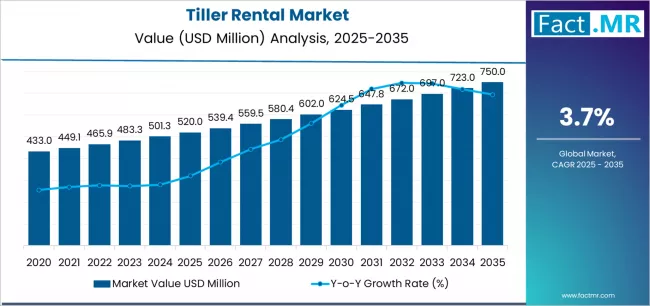
Tiller Rental Market Market Value Analysis | Source: Fact.MR
Summary of Tiller Rental Market
- Market Snapshot
- In 2025, the global Tiller Rental Market was valued at approximately USD 520.0 million.
- The market is estimated to reach USD 539.2 million in 2026 and is projected to attain USD 775.5 million by 2036.
- The tiller rental market is likely to expand at a CAGR of 3.7% during the forecast period.
- The market is anticipated to create an absolute dollar opportunity of USD 236.2 million between 2026 and 2036.
- Front Tine Tiller Rental accounts for 27.4% of product share in 2026.
- India (4.4%) and China (3.9%) are the key growth markets during the forecast period.
- Demand and Growth Drivers
- Seasonal agricultural field preparation cycles generate the primary rental demand for tillers across large and small scale farming operations in developed and emerging markets.
- Growing landscaping and garden services markets are supporting year round rental demand for front tine and mid tine tillers in residential and commercial property maintenance.
- Rising adoption of organized rental services among small and medium farm operators is reducing equipment ownership costs and supporting higher rental penetration in agricultural segments.
- Expansion of community garden programs and urban agriculture initiatives is adding incremental rental demand for compact and electric powered tillers in metropolitan areas.
- Growth in vineyard, orchard, and specialty crop cultivation is supporting demand for compact rear tine tillers suited to row crop and inter-row soil preparation applications.
- Product and Segment View
- Front Tine Tiller Rental accounts for 27.4% of the product segment in 2026.
- Business to Business represents 42.1% of the distribution channel segment in 2026.
- Agriculture Industry accounts for 38.6% of the application segment in 2026.
- Key segmentation includes:
- Product: Front Tine Tiller Rental, Rear Tine Tiller Rental, Mini Tiller Rental, Rotary Tiller Rental
- Application: Agriculture Industry, Landscaping Industry, Construction Industry, Residential Applications
- End Use: Agricultural Farms, Landscaping Companies, Construction Companies, Residential Users
- Technology: Engine Technology, Drive Technology, Tilling Technology, Equipment Monitoring Technology
- Distribution Channel: Business to Business, Business to Consumer
- These systems enable:
- Soil cultivation, ground breaking, and seedbed preparation across agricultural, landscaping, and garden applications
- Front tine, rear tine, mid tine, and vertical tine configurations for different soil types and cultivation depth requirements
- Gas, electric, and battery powered options supporting operation in open field, greenhouse, and emission restricted environments
- Geography and Competitive Outlook
- India leads growth at 4.4%, driven by agricultural mechanization programs, expanding organized rental networks, and small farm operator demand.
- North America shows stable demand, with the USA at 3.6% reflecting commercial landscaping, garden preparation, and established rental channels.
- European demand is steady, with Germany at 3.3% and the UK at 3.2% shaped by sustainable agriculture and emission standards.
- India (4.4%) and China (3.9%) are the key growth markets during the forecast period.
- Leading companies include Honda Motor Co., Ltd., Kubota Corporation, MTD Products Inc., John Deere (Deere & Company), Husqvarna AB.
- Analyst Opinion
- Shambhu Nath Jha, Principal Consultant at Fact.MR, says 'The tiller rental market is being supported by structural changes in both agricultural and landscaping end use segments. Small and medium farm operators in India, Brazil, and Southeast Asia are shifting from manual cultivation to powered tiller rental as organized rental networks expand into rural and semi-rural areas. In developed markets, commercial landscaping and property maintenance services provide year round rental demand that reduces the seasonal volatility traditionally associated with agricultural equipment. Electric and battery powered tillers are also creating new demand in emission restricted urban growing environments.'
Key Growth Drivers, Constraints, and Opportunities
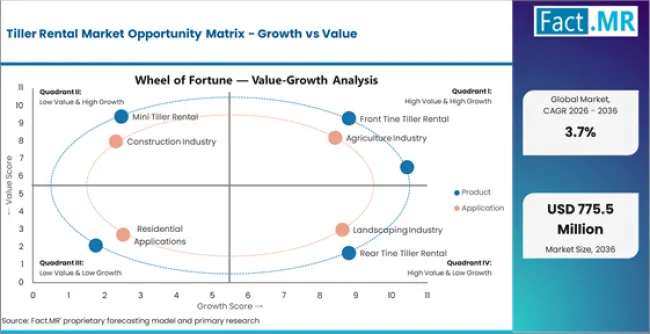
Tiller Rental Market Opportunity Matrix Growth Vs Value | Source: Fact.MR
Key Factors Driving Growth
- Seasonal field preparation cycles in agriculture generate the primary demand for tiller rental, with planting windows driving concentrated rental volumes across spring and autumn periods in temperate markets.
- Commercial landscaping and property maintenance services are supporting year round rental demand for compact tillers in turf renovation, garden bed preparation, and grounds management applications across residential and commercial properties.
- Expanding organized rental networks in India, Brazil, and parts of Southeast Asia are increasing access to powered tillers for small and medium farm operators, replacing manual cultivation and supporting higher agricultural productivity.
Key Market Constraints
- Strong seasonal demand concentration creates utilization peaks during planting windows and extended idle periods during off-seasons, complicating fleet economics and storage logistics for rental operators.
- Competition from informal rental arrangements and equipment sharing among neighboring farms limits the penetration of organized rental services in rural and semi-rural agricultural markets.
- Limited product differentiation across gas powered tiller models creates price-based competition among rental providers, compressing margins in mature markets with established rental infrastructure.
Key Opportunity Areas
- Agricultural mechanization programs in India, Brazil, and parts of Africa are creating large-scale rental demand pools for powered tillers among smallholder and medium scale farm operators transitioning from manual cultivation.
- Development of battery electric tillers with competitive runtime and torque is creating new demand in emission sensitive urban agriculture, community garden, and greenhouse cultivation environments.
- Growth in vineyard, orchard, and specialty crop cultivation in Southern Europe, California, and parts of South America is supporting demand for compact, precision tillers suited to row crop and inter-row soil management.
Segment-wise Analysis of the Tiller Rental Market
- Front Tine Tiller Rental holds 27.4% of the product segment in 2026.
- Agriculture Industry holds 38.6% of the application segment in 2026.
- Agricultural Farms holds 35.9% of the end use segment in 2026.
Which Product Segment Dominates the Tiller Rental Market?
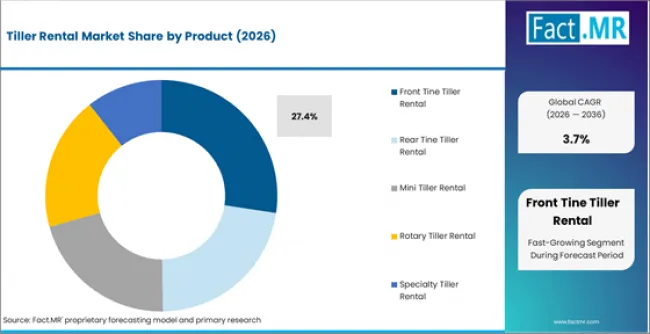
Tiller Rental Market Analysis By Product | Source: Fact.MR
Front Tine Tiller Rental accounts for 27.4% of the product segment in 2026. Leadership is supported by broad applicability, established fleet presence, and alignment with the most common specification requirements across primary end use applications. The installed base continues to expand as rental operators refresh fleets to meet evolving compliance and performance standards.
Sub-categories within this segment serve a range of applications from standard operations to specialized tasks. Lower total cost of ownership, reliable field performance, and compatibility with existing rental infrastructure support the sustained share position of front tine tiller rental in organized rental markets globally.
Which Distribution Channel Segment Dominates the Tiller Rental Market?
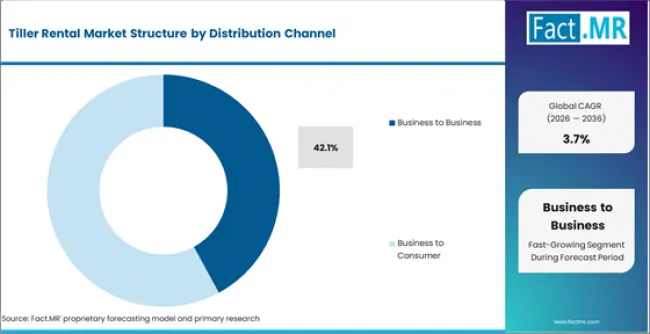
Tiller Rental Market Analysis By Distribution Channel | Source: Fact.MR
Business to Business accounts for 42.1% of the distribution channel segment in 2026. Demand is concentrated in core operational use cases that generate the highest volume of rental and procurement activity across established institutional and commercial channels.
The segment is expected to maintain its leading position through the forecast period as growth in secondary applications broadens the demand base without displacing core end use concentrations.
Which Product Trend is Shaping the Next Phase of Growth in the Tiller Rental Market?
Battery electric tillers are emerging as the fastest growing product subcategory within the rental market, driven by demand from urban agriculture programs, community garden operations, greenhouse cultivation, and emission restricted landscaping environments. Electric models offer lower noise levels, zero local emissions, and reduced maintenance requirements compared to gas powered alternatives, making them increasingly preferred for residential property maintenance, municipal greening projects, and indoor cultivation applications.
Rental operators that add electric tillers to their fleet alongside established gas powered models are broadening their addressable customer base. Property management companies, municipal parks departments, and urban farming cooperatives represent growing demand sources that are less sensitive to seasonal agricultural cycles. This diversification reduces utilization volatility and supports higher year round rental rates for providers that maintain mixed power source tiller inventories.
Regional Outlook Across Key Markets
- India leads growth at 4.4%, driven by agricultural mechanization programs, expanding organized rental networks, and small farm operator demand.
- North America shows stable demand, with the USA at 3.6% reflecting commercial landscaping, garden preparation, and established rental channels.
- European demand is steady, with Germany at 3.3% and the UK at 3.2% shaped by sustainable agriculture and emission standards.
.webp "Top Country Growth Comparison Tiller Rental Market Cagr (2026 2036)")
Top Country Growth Comparison Tiller Rental Market Cagr (2026 2036) | Source: Fact.MR
CAGR Table
| Country | CAGR (%) |
|---|---|
| India | 4.4% |
| China | 3.9% |
| USA | 3.6% |
| Germany | 3.3% |
| UK | 3.2% |
| South Korea | 3.1% |
| Japan | 2.9% |
Source: Fact.MR analysis. Updated Jun 3, 2026
Source: Fact MR (FMR) analysis, based on proprietary forecasting model and primary research.
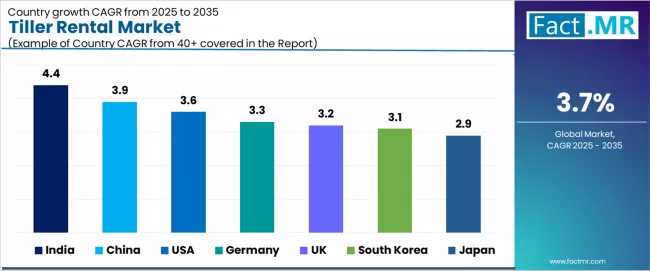
Tiller Rental Market Cagr Analysis By Country | Source: Fact.MR
India Tiller Rental Market Growth Assessment
The scale of smallholder agricultural activity and expanding organized rental networks position India as the fastest growing market at a CAGR of 4.4% through 2036. PLI schemes for agricultural equipment and government mechanization programs support transition from manual cultivation to powered tiller rental. Make in India incentives encourage domestic production of rental grade tillers.
- Government mechanization programs and PLI schemes support transition from manual to powered tiller rental.
- Expanding organized rental networks into tier-2 and tier-3 regions broaden access for smallholder farm operators.
Tiller Rental Demand Trends in China
Domestic manufacturer cost advantages and the scale of agricultural mechanization investment keep tiller rental fleet economics favorable in China, projected to grow at a CAGR of 3.9% through 2036. Rural modernization policies and expanding organized rental networks generate sustained demand for powered cultivation equipment.
- Domestic OEM cost advantages support favorable fleet economics for organized tiller rental providers.
- Rural modernization investment and agricultural mechanization programs generate sustained powered tiller demand.
Tiller Rental Demand Outlook in the United States
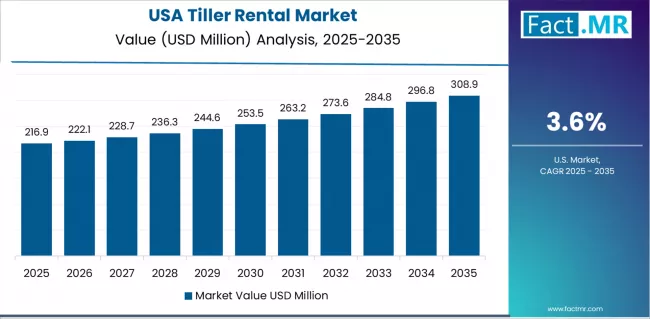
Tiller Rental Market Country Value Analysis | Source: Fact.MR
Commercial landscaping, residential property maintenance, and seasonal garden preparation generate broad rental demand in the U.S., projected to grow at a CAGR of 3.6% through 2036. Established national and regional rental networks provide high equipment availability. EPA emission standards gradually shape fleet composition toward electric tiller configurations.
- Commercial landscaping and garden preparation generate year round tiller rental demand.
- EPA emission standards support gradual fleet transition toward electric tiller models.
Germany Tiller Rental Market Demand Analysis
EU agricultural policy alignment and DIN/EU CE compliance standards shape tiller rental specifications in Germany, projected to grow at a CAGR of 3.3% through 2036. Lifecycle cost priorities and emission controls support adoption of electric and low emission powered tillers across commercial landscaping and agricultural applications.
- DIN/EU CE compliance and emission controls support procurement of certified low emission tiller rental equipment.
- Lifecycle cost focus and sustainable agriculture mandates drive preference for modern rental fleet models.
United Kingdom Tiller Rental Market Opportunity Outlook
Urban greening programs, community garden initiatives, and commercial grounds maintenance generate steady tiller rental demand in the UK, projected to grow at a CAGR of 3.2% through 2036. Updated grounds management regulations and energy performance targets support specification of low emission and electric cultivation equipment.
- Urban greening and community garden programs create institutional demand for compact tiller rental.
- Updated grounds management standards drive specification toward electric and battery powered models.
Competitive Benchmarking and Company Positioning
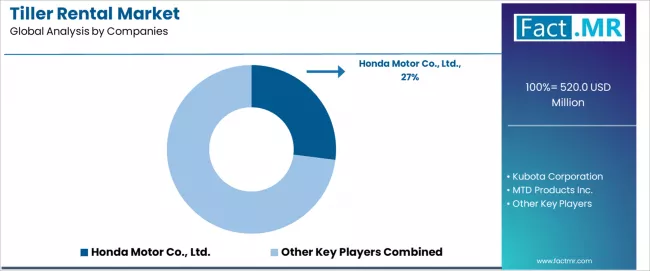
Tiller Rental Market Analysis By Company | Source: Fact.MR
Tiller Rental Market Analysis By Company
- Honda Motor Co., Ltd., Kubota Corporation, MTD Products Inc., John Deere (Deere & Company) hold established positions through product range depth, geographic coverage, and strong channel presence.
- Husqvarna AB, Stihl AG & Co. KG, Troy-Bilt (STIHL Inc.), Sunbelt Rentals, Inc. maintain competitive relevance across specific geographies and customer segments.
- Competition is shaped by fleet composition, pricing strategy, service capability, and the ability to serve evolving technology and compliance requirements.
The competitive landscape is moderately fragmented. Honda Motor Co., Ltd., Kubota Corporation, MTD Products Inc., John Deere (Deere & Company) compete through scale, product breadth, and multi-site service capability. Husqvarna AB, Stihl AG & Co. KG, Troy-Bilt (STIHL Inc.), Sunbelt Rentals, Inc. and other regional players maintain positions through pricing flexibility and localized service networks.
Strategic priorities include expanding product portfolios to address evolving compliance and technology requirements, building digital fleet management capability, improving geographic coverage, and developing recurring service revenue models.
Recent Industry Developments
- Kubota Corporation, Compact Equipment Portfolio Expansion at Bauma (2025)
- Kubota expanded its compact construction and agricultural equipment lineup with 22 new or updated machines at Bauma 2025. The expanded portfolio includes compact excavators, loaders, and agricultural equipment suited to rental fleet deployment across construction, landscaping, and farm applications.
- Bobcat Company, Technology Integration Across Compact Loader Platform (2025)
- Bobcat expanded deployment of its MaxControl remote operation system and integrated attachment recognition technology across the compact loader product range. The technology updates improve operational flexibility and reduce operator training requirements for rental fleet customers in landscaping and agricultural applications.
- Husqvarna AB, Battery Powered Equipment Range Expansion (2025 to 2026)
- Husqvarna continued expanding its battery powered professional equipment portfolio across gardening, landscaping, and grounds maintenance applications through 2025 and into 2026. The battery platform extension supports the company's transition toward emission-free equipment solutions for professional and rental fleet customers.
Leading Companies Shaping the Tiller Rental Market
- Honda Motor Co., Ltd.
- Kubota Corporation
- MTD Products Inc.
- John Deere (Deere & Company)
- Husqvarna AB
- Stihl AG & Co. KG
- Troy-Bilt (STIHL Inc.)
- Sunbelt Rentals, Inc.
- Boels Rental B.V.
- The Toro Company
Sources and Research References
- Honda Motor Co., Ltd.. Product portfolio and market positioning data.
- Kubota Corporation. Product portfolio and market positioning data.
- MTD Products Inc.. Product portfolio and market positioning data.
- Industry associations, regulatory publications, equipment rental trade bodies, and government infrastructure databases.
- Primary interviews with manufacturers, rental operators, distributors, contractors, and institutional users.
- This bibliography is provided for reader reference and is not exhaustive. The full report contains the complete reference list and detailed citations.
Key Questions This Report Addresses
- What is the current and future size of the Tiller Rental Market?
- How fast is the Tiller Rental Market expected to grow between 2026 and 2036?
- Which product type is likely to lead the market by 2026?
- Which distribution channel segment is expected to account for the highest demand by 2026?
- What factors are driving demand globally?
- How is the shift toward newer technology configurations influencing the market?
- Which countries are projected to show the fastest growth through 2036?
- What is driving market expansion in India and China?
- Who are the key companies active in the Tiller Rental Market?
- How does Fact.MR estimate and validate the market forecast?
Tiller Rental Market Definition
The Tiller Rental Market covers the rental and lease of powered soil cultivation equipment used in agricultural field preparation, landscaping, garden maintenance, and grounds management.
Tiller Rental Market Inclusions
- The scope covers global and regional market size and forecasts for 2026 to 2036 across product, application, end use, technology, distribution channel, and region.
- It includes regional demand analysis across major geographies, based on application demand drivers, regulatory conditions, and infrastructure investment levels.
- The report covers pricing and cost analysis across product categories, competitive landscape analysis including product portfolios, geographic reach, and distribution positioning of leading companies.
Tiller Rental Market Exclusions
- The scope excludes products and systems outside the defined market boundary, equipment sold exclusively through outright purchase without rental or lease component, and informal rental arrangements with low market visibility.
- It also excludes standalone services sold independently of equipment, ancillary software-only solutions, and custom-built systems without commercial procurement channels.
Tiller Rental Market Research Methodology
- The methodology combines secondary research, primary interviews, and forecast modelling.
- It draws on 120+ secondary sources and benchmarks 65+ company product portfolios.
- Market sizing covers 30+ countries through a demand-side model, supported by top-down validation.
- The model cross-checks demand with shipment data, pricing trends, and product launches.
- Primary validation includes 25+ interviews across manufacturers, distributors, rental operators, and end users.
- Final estimates go through trade-flow checks, sales-pattern review, and sensitivity testing.
Segmentation
Scope of Analysis
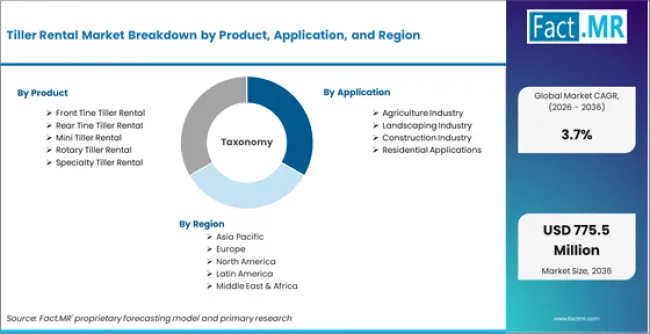
Tiller Rental Market Breakdown By Product, Application, And Region | Source: Fact.MR
| Metric | Value |
|---|---|
| Quantitative Units | USD 539.2 million to USD 775.5 million, at a CAGR of 3.7% |
| Market Definition | The Tiller Rental Market covers product, application, end use, technology, distribution channel across global and regional markets. |
| Regions Covered | North America, Latin America, Europe, East Asia, South Asia and Pacific, Middle East and Africa |
| Countries Covered | USA, Canada, UK, Germany, China, India, Brazil, South Korea, Japan, 30 plus countries |
| Key Companies | Honda Motor Co., Ltd., Kubota Corporation, MTD Products Inc., John Deere (Deere & Company), Husqvarna AB, Stihl AG & Co. KG, Troy-Bilt (STIHL Inc.), Sunbelt Rentals, Inc., Boels Rental B.V., The Toro Company |
| Forecast Period | 2026 to 2036 |
| Approach | Hybrid demand-side and top-down methodology built on country-level application demand, product benchmarking, pricing analysis, shipment validation, and primary interviews across manufacturers, distributors, rental operators, and end users |
Source: Fact.MR analysis. Updated Jun 3, 2026
Tiller Rental Market Segmentation
-
Tiller Rental Market Segmented by Product:
- Front Tine Tiller Rental
- Light Duty Front Tiller Rental
- Residential Garden Tiller Rental
- Compact Soil Preparation Tiller Rental
- Medium Duty Front Tiller Rental
- Landscape Tiller Rental
- Vegetable Farm Tiller Rental
- Light Duty Front Tiller Rental
- Rear Tine Tiller Rental
- Standard Rear Tiller Rental
- Counter Rotating Tiller Rental
- Forward Rotating Tiller Rental
- Heavy Duty Rear Tiller Rental
- Commercial Farming Tiller Rental
- Hard Soil Tiller Rental
- Standard Rear Tiller Rental
- Mini Tiller Rental
- Electric Mini Tiller Rental
- Corded Mini Tiller Rental
- Battery Powered Mini Tiller Rental
- Gas Powered Mini Tiller Rental
- Portable Garden Tiller Rental
- Compact Cultivator Rental
- Electric Mini Tiller Rental
- Rotary Tiller Rental
- Tractor Mounted Rotary Tiller Rental
- Agricultural Rotary Tiller Rental
- Field Preparation Rotary Tiller Rental
- Walk Behind Rotary Tiller Rental
- Commercial Landscape Rotary Tiller Rental
- Deep Soil Rotary Tiller Rental
- Tractor Mounted Rotary Tiller Rental
- Specialty Tiller Rental
- Organic Farming Tiller Rental
- Low Emission Tiller Rental
- Precision Soil Tiller Rental
- Multi Purpose Tiller Rental
- Cultivator Tiller Rental
- Seedbed Preparation Tiller Rental
- Organic Farming Tiller Rental
- Front Tine Tiller Rental
-
Tiller Rental Market Segmented by Application:
- Agriculture Industry
- Field Preparation Applications
- Primary Soil Preparation
- Secondary Soil Cultivation
- Crop Cultivation Applications
- Row Crop Cultivation
- Vegetable Farming Applications
- Field Preparation Applications
- Landscaping Industry
- Garden Landscaping Applications
- Residential Landscaping
- Commercial Landscaping
- Soil Maintenance Applications
- Ground Leveling Applications
- Weed Control Applications
- Garden Landscaping Applications
- Construction Industry
- Land Preparation Applications
- Site Soil Preparation
- Foundation Soil Loosening
- Ground Maintenance Applications
- Utility Trenching Preparation
- Temporary Access Soil Work
- Land Preparation Applications
- Residential Applications
- Home Gardening Applications
- Backyard Soil Cultivation
- Kitchen Garden Preparation
- Lawn Maintenance Applications
- Seasonal Soil Aeration
- Small Plot Tilling
- Home Gardening Applications
- Agriculture Industry
-
Tiller Rental Market Segmented by End Use:
- Agricultural Farms
- Large Scale Farms
- Commercial Crop Farms
- Contract Farming Operations
- Small and Medium Farms
- Family Owned Farms
- Seasonal Farming Businesses
- Large Scale Farms
- Landscaping Companies
- Commercial Landscaping Firms
- Urban Landscaping Contractors
- Ground Maintenance Companies
- Residential Landscaping Firms
- Garden Service Providers
- Lawn Care Companies
- Commercial Landscaping Firms
- Construction Companies
- Infrastructure Contractors
- Road Development Contractors
- Utility Installation Contractors
- Site Development Companies
- Land Clearing Contractors
- Foundation Preparation Firms
- Infrastructure Contractors
- Residential Users
- Homeowners
- Backyard Gardening Users
- Seasonal Equipment Renters
- Hobby Gardeners
- Kitchen Gardening Users
- Community Gardening Users
- Homeowners
- Agricultural Farms
-
Tiller Rental Market Segmented by Technology:
- Engine Technology
- Gas Powered Engine Systems
- Four Stroke Engine Systems
- Fuel Efficient Engine Systems
- Electric Powered Engine Systems
- Corded Electric Systems
- Battery Powered Systems
- Gas Powered Engine Systems
- Drive Technology
- Gear Driven Systems
- Heavy Duty Gear Systems
- Torque Control Systems
- Belt Driven Systems
- Flexible Drive Systems
- Low Maintenance Drive Systems
- Gear Driven Systems
- Tilling Technology
- Forward Rotating Tilling Systems
- Soft Soil Cultivation Systems
- Surface Soil Mixing Systems
- Counter Rotating Tilling Systems
- Hard Soil Penetration Systems
- Deep Tilling Systems
- Forward Rotating Tilling Systems
- Equipment Monitoring Technology
- GPS Tracking Systems
- Fleet Tracking Systems
- Usage Monitoring Systems
- Remote Diagnostics Systems
- Predictive Maintenance Systems
- Performance Monitoring Systems
- GPS Tracking Systems
- Engine Technology
-
Tiller Rental Market Segmented by Distribution Channel:
- Business to Business
- Equipment Rental Companies
- Agricultural Equipment Rental Providers
- Construction Equipment Rental Providers
- Dealer Rental Networks
- Authorized Equipment Dealers
- Multi Brand Rental Networks
- Equipment Rental Companies
- Business to Consumer
- Local Rental Stores
- Neighborhood Equipment Rentals
- Independent Rental Shops
- Online Rental Platforms
- Digital Equipment Booking Platforms
- Mobile Rental Applications
- Direct Rental Services
- Manufacturer Rental Programs
- Seasonal Rental Services
- Local Rental Stores
- Business to Business
-
Tiller Rental Market by Region:
- North America
- USA
- Canada
- Mexico
- Latin America
- Brazil
- Chile
- Rest of Latin America
- Western Europe
- Germany
- UK
- Italy
- Spain
- France
- Nordic
- BENELUX
- Rest of Western Europe
- Eastern Europe
- Russia
- Poland
- Hungary
- Balkan & Baltic
- Rest of Eastern Europe
- East Asia
- China
- Japan
- South Korea
- South Asia and Pacific
- India
- ASEAN
- Australia & New Zealand
- Rest of South Asia and Pacific
- Middle East & Africa
- Kingdom of Saudi Arabia
- Other GCC Countries
- Turkiye
- South Africa
- Other African Union
- Rest of Middle East & Africa
- North America
Frequently Asked Questions
How big is the tiller rental market in 2026?
What will be the size of tiller rental market in 2036?
How much will be the tiller rental market growth between 2026 and 2036?
What are the key product types in the tiller rental market?
Which application segment is expected to contribute significant share in the tiller rental market in 2026?
Who worked on this report


Preview the report firsthand - request a free sample
Free SampleGet the brochure for pricing and purchase details
Download PDF