Conveyor-Free Sortation Modules Market
Conveyor-Free Sortation Modules Market Size and Share Forecast Outlook 2026 to 2036
Conveyor-free sortation modules market is projected to grow from USD 0.5 billion in 2026 to USD 1.3 billion by 2036, at a CAGR of 10.5%. E-commerce & Distribution Centers will dominate with a 55.0% market share, while modular sortation pods will lead the system type segment with a 60.0% share.
Conveyor-Free Sortation Systems Market Forecast and Outlook 2026 to 2036
The global conveyor-free sortation systems market is valued at USD 0.46 billion in 2026 and is set to reach USD 1.25 billion by 2036, recording a compound annual growth rate (CAGR) of 10.5% between 2026 and 2036. In 2026, the e-commerce & distribution centers application segment is projected to hold a 55% share, while modular sortation pods account for 60% by system type.
Key Takeaways from the Conveyor-Free Sortation Systems Market Report
- Market Value of the Conveyor-Free Sortation Systems Market (2026): USD 0.46 Billion
- Market Forecast Value of the Conveyor-Free Sortation Systems Market (2036): USD 1.25 Billion
- Forecast CAGR of the Conveyor-Free Sortation Systems Market (2026-2036): 10.5%
- Leading Application Segment of the Conveyor-Free Sortation Systems Market: E-commerce & Distribution Centers (55%)
- Leading System Type of the Conveyor-Free Sortation Systems Market: Modular Sortation Pods (60%)
- Key Growth Regions of the Conveyor-Free Sortation Systems Market: North America, Europe, Asia Pacific, Latin America, MEA
- Key Players of the Conveyor-Free Sortation Systems Market: Swisslog Holding AG, Hikrobot, KNAPP, SSI Schaefer, Daifuku, GreyOrange
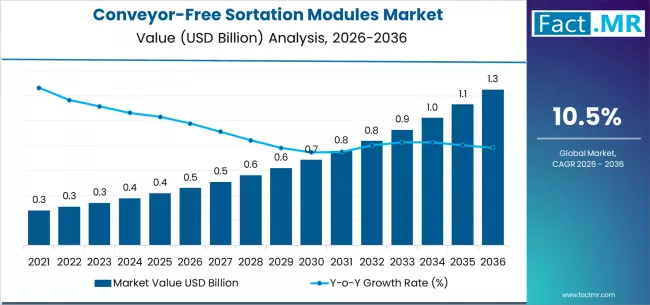
Market expansion is driven by the need for extreme flexibility and scalability in modern logistics. Traditional fixed conveyor systems struggle to adapt to fluctuating order volumes, variable item sizes, and the rapid reconfiguration needs of omnichannel fulfillment. Conveyor-free solutions, utilizing autonomous mobile robots (AMRs) and vision-guided systems, create dynamic sorting networks that can be easily scaled, relocated, or reprogrammed, future-proofing warehouse operations.
Growth over the forecast period will be shaped by advancements in artificial intelligence and swarm robotics. Improved computer vision allows for accurate sorting of non-uniform items without pre-labeling, while smarter fleet management software enables hundreds of autonomous shuttles to operate simultaneously with minimal collision or congestion. This evolution supports the transition towards lights-out, fully automated distribution centers where sortation modules self-organize to meet real-time demand, drastically reducing labor dependency and increasing throughput predictability.
Conveyor-Free Sortation Systems Market Key Takeaways
| Metric | Value |
|---|---|
| Estimated Value in (2026E) | USD 0.46 Billion |
| Forecast Value in (2036F) | USD 1.25 Billion |
| Forecast CAGR (2026 to 2036) | 10.5% |
Category
| Category | Segments |
|---|---|
| End-use/Application | E-commerce & Distribution Centers, Parcel & Postal Sortation, Automotive Component Sortation, Retail & Last-Mile Hubs, Regional Parcel Hubs, Others |
| System Type | Modular Sortation Pods, Mobile Sort Pods, High-Speed Sortation Modules, Small-Footprint Sorters, Others |
| Material | Aluminum & Composite Frames, Steel & Alloy Frames, High-Strength Steel, Localized Builds, Others |
| Technology | Autonomous Shuttles/Vision Sorting, AGV + Vision Systems, Vision-Guided Robotics, Semi-Autonomous Sorting Cells, Others |
| Region | North America, Europe, Asia Pacific, Latin America, MEA |
Segmental Analysis
Which Application Category is the Largest in the Conveyor-Free Sortation Modules Market?
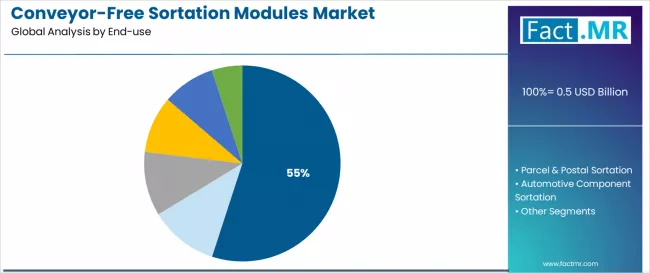
The e-commerce and distribution centers segment commands a 55% market share in 2026, reflecting its role as the primary catalyst for adopting flexible automation. The relentless growth of online retail, with its peak season surges and vast SKU variety, has rendered fixed conveyor sortation economically and operationally inflexible. Conveyor-free systems excel in this environment by enabling on-demand capacity scaling and seamless re-zoning of sortation layouts to handle everything from small parcels to oversized items.
This segment prioritizes systems that minimize downtime for reconfiguration and maximize utilization of cubic space. The ability to deploy and redeploy mobile sort pods allows operators to adapt daily workflows to changing order profiles, directly translating to faster order cycle times and higher facility throughput without physical expansion.
- The need for same-day and next-day delivery service-level agreements makes sortation speed and reliability a competitive differentiator, pushing major retailers and 3PLs towards agile systems.
- These systems reduce the long-term risk of warehouse obsolescence, as the sortation asset can be repurposed or reconfigured as business needs evolve.
Why do Modular Sortation Pods emerge as the Dominant Conveyor-Free Sortation Modules System Type?
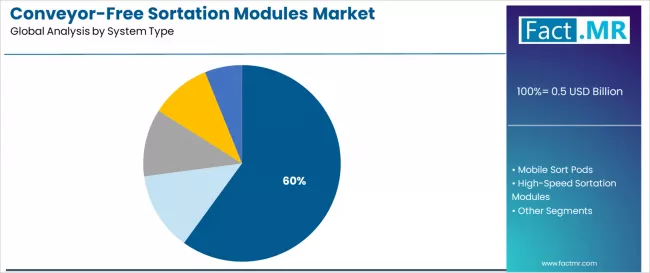
Modular sortation pods are projected to hold a 60% share by system type in 2026. Their dominance is based on the optimal balance of performance, scalability, and relatively lower implementation complexity compared to fully dispersed mobile robot swarms. Each pod functions as a self-contained, high-throughput sortation point, typically using cross-belt or tilt-tray mechanisms mounted on a rigid aluminum or composite frame.
This modularity allows facilities to start with a single pod to automate a specific process lane and add identical units as volume grows, creating a pay-as-you-grow investment model. The pod-based approach simplifies integration with existing warehouse management systems and maintains a higher degree of mechanical sortation reliability for high-speed induction, while still offering significant layout flexibility.
- The design is particularly effective for parcel sortation and batch-picked e-commerce orders, where items are inducted in waves and sorted to destination chutes or put walls.
- It offers a clear transitional path for facilities moving from traditional conveyor sorters to more flexible automation, managing risk through incremental deployment.
What are the Drivers, Restraints, and Trends in the Conveyor-Free Sortation Systems Market?
The market is driven by exploding e-commerce volumes, severe labor shortages in warehousing, and the need for warehouses to achieve multi-purpose flexibility. The high capital investment required and the complexity of integrating robotic systems with legacy software present significant restraints.
The market is trending towards hybrid systems that combine the high-speed induction of modular pods with the ultimate flexibility of AMRs for final disposition. Another key trend is the emergence of "sortation-as-a-service" models, where providers install and manage the system for a per-sort fee, lowering the barrier to entry for mid-sized operators.
Analysis of the Conveyor-Free Sortation Systems Market by Key Countries
| Country | CAGR (2026-2036) |
|---|---|
| India | 12.0% |
| China | 11.0% |
| USA | 8.8% |
| Brazil | 8.0% |
| Germany | 7.0% |
| Japan | 5.0% |
How is Logistics Infrastructure Expansion Fueling High Growth in India?
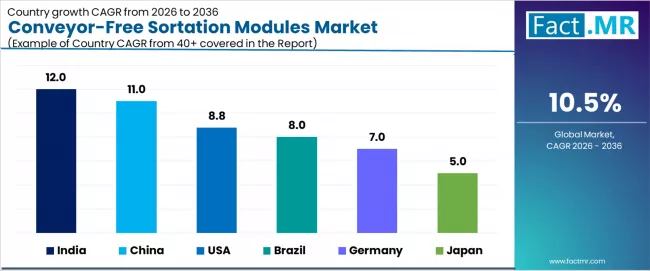
Deployment of conveyor-free sortation systems in India is projected to grow at a leading CAGR of 12.0% through 2036. This is propelled by the construction of massive new greenfield fulfillment centers to support domestic e-commerce growth and export-oriented manufacturing. These new facilities are bypassing fixed conveyor technology entirely, opting for modern, flexible systems from the start. High-speed sortation modules are in demand for large hub operations, while mobile and semi-autonomous cells gain traction in last-mile sorting stations.
- Government investments in logistics parks and the push for formalized supply chains create ideal conditions for adopting advanced automation.
- The need to achieve global-scale efficiency while managing a complex, multi-lingual operational environment makes adaptable automation highly attractive.
What Role does Automation Scale and Technical Innovation Play in China's Market?
The market in China is forecast to grow at a CAGR of 11.0%. Driven by the world's largest e-commerce market and a national strategy for manufacturing automation, China represents a massive testing and scaling ground. Domestic robotics firms like Hikrobot are driving innovation and cost reduction in AGV and vision systems. Deployment focuses on vast parcel sortation hubs and sortation within highly automated "dark warehouses" serving major metropolitan areas.
- The scale of operations justifies significant R&D investment, leading to rapid iterations in autonomous shuttle technology and fleet management AI.
- Integration with dominant domestic e-commerce platforms and super-app logistics is a key requirement for system providers.
How do Retrofit Needs and Labor Dynamics Shape the Market in USA?
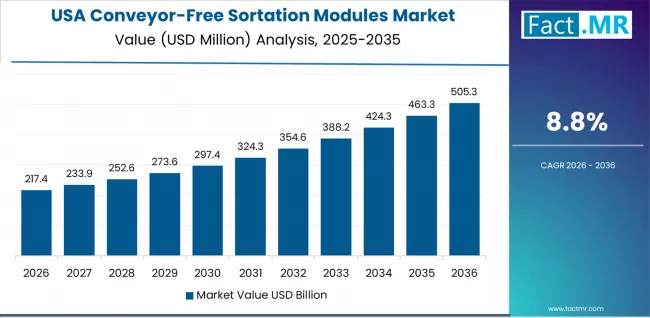
Demand for conveyor-free sortation systems in the USA is set to grow at a CAGR of 8.8%. The market is characterized by the need to retrofit and modernize the extensive network of existing distribution centers built for traditional retail. Conveyor-free modules are ideal for augmenting or replacing sections of fixed infrastructure without a complete rebuild. The acute labor shortage and high wages make the business case for automation exceptionally strong, with a focus on systems that deliver a rapid return on investment.
- Major retailers and parcel carriers are deploying modular pods and mobile sorters to add sortation capacity within constrained urban last-mile facilities.
- The mature market has a strong focus on system reliability, vendor support, and seamless integration with incumbent WMS and control platforms.
Why do Precision Engineering and High-Throughput Needs Define the German Market?
The market in Germany is expected to grow at a CAGR of 7.0%. German adoption is driven by precision engineering standards and the needs of the automotive, engineering, and high-end manufacturing sectors for accurate component sortation. Parcel and postal operators also invest in these systems to maintain efficiency and meet stringent service guarantees. The emphasis is on systems with exceptional reliability, precise sortation accuracy, and the ability to integrate with highly engineered material flow environments.
- Compliance with strict operational safety regulations for human-robot collaboration is a critical factor in system design and adoption.
- The market favors high-quality, engineered solutions from established European providers known for durability and precision.
How is E-commerce Growth and Urban Logistics Driving Brazilian Adoption?
Deployment in Brazil is projected to grow at a CAGR of 8.0%. Growth is fueled by the rapid expansion of e-commerce and the corresponding need for efficient urban last-mile hubs. Small-footprint sorters and semi-autonomous cells are favored for their ability to be installed in tight urban spaces, such as converted retail spaces or multi-story warehouses, where traditional conveyor layouts are impossible. This technology enables faster sortation closer to the end consumer.
- The focus is on cost-effective solutions that can handle the diverse packaging and labeling common in the region's logistics.
- As retail chains transform their supply chains for omnichannel, adaptable sortation systems are key to enabling store fulfillment and click-and-collect services.
What drives the Niche for High-Density Automation in Japan's Market?
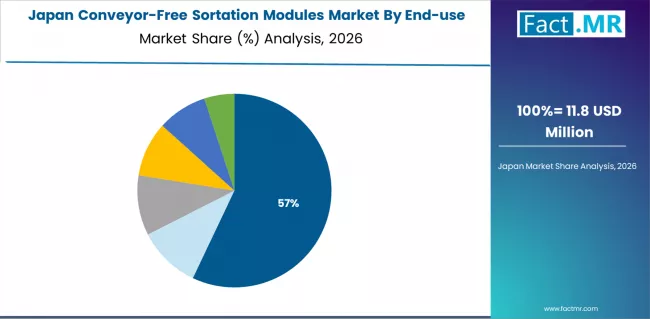
The market in Japan is projected to grow at a CAGR of 5.0%. Adoption is driven by extreme space constraints, high labor costs, and the need for flawless accuracy. Conveyor-free systems are deployed in high-value niches, such as regional parcel hubs serving dense urban corridors and sortation within highly automated pharmaceutical and electronics logistics centers. The focus is on ultra-reliable, high-density systems that maximize throughput per square meter.
- The technology supports Japan's focus on compact, highly efficient urban logistics solutions to cope with limited real estate.
- Integration focuses on flawless interoperability with other automated storage and retrieval systems (AS/RS) in fully automated facilities.
Competitive Landscape of the Conveyor-Free Sortation Systems Market
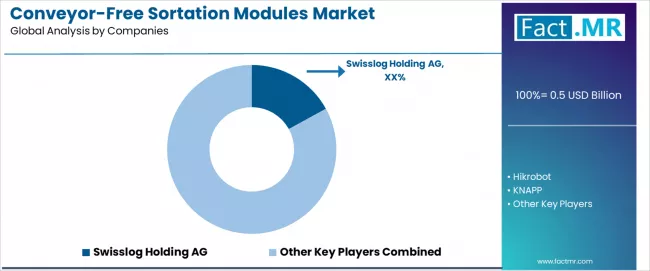
Established warehouse automation giants and agile robotics startups define the competitive landscape. Traditional players like Daifuku and Swisslog leverage their deep integration expertise and broad automation portfolios, while firms like GreyOrange and Hikrobot compete with innovative, software-centric robotic solutions. Competition centers on the intelligence of the fleet management software, total cost of ownership, and the ability to deliver reliable 24/7 performance.
Key players are racing to develop more sophisticated perception algorithms for handling unstructured items and to create hybrid systems that blend the strengths of various technologies. Success hinges on forming strategic partnerships with major logistics real estate developers and global 3PLs to design next-generation facilities around these flexible systems.
Key Players in the Conveyor-Free Sortation Systems Market
- Swisslog Holding AG (KUKA)
- Hikrobot
- KNAPP AG
- SSI Schaefer
- Daifuku Co., Ltd.
- GreyOrange
Scope of the Report
| Items | Values |
|---|---|
| Quantitative Units (2026) | USD 0.46 Billion |
| End-use/Application | E-commerce & Distribution Centers, Parcel & Postal Sortation, Automotive Component Sortation, Retail & Last-Mile Hubs, Regional Parcel Hubs, Others |
| System Type | Modular Sortation Pods, Mobile Sort Pods, High-Speed Sortation Modules, Small-Footprint Sorters, Others |
| Material | Aluminum & Composite Frames, Steel & Alloy Frames, High-Strength Steel, Localized Builds, Others |
| Technology | Autonomous Shuttles/Vision Sorting, AGV + Vision Systems, Vision-Guided Robotics, Semi-Autonomous Sorting Cells, Others |
| Regions Covered | North America, Europe, Asia Pacific, Latin America, MEA |
| Key Companies Profiled | Swisslog Holding AG, Hikrobot, KNAPP, SSI Schaefer, Daifuku, GreyOrange, and other leading players |
| Additional Attributes | Market share analysis, total cost of ownership (TCO) models, analysis of integration challenges with legacy WMS, insights into software platforms and AI-driven optimization. |
Conveyor-Free Sortation Systems Market by Segments
-
By End-use/Application :
- E-commerce & Distribution Centers
- Parcel & Postal Sortation
- Automotive Component Sortation
- Retail & Last-Mile Hubs
- Regional Parcel Hubs
- Others
-
By System Type :
- Modular Sortation Pods
- Mobile Sort Pods
- High-Speed Sortation Modules
- Small-Footprint Sorters
- Others
-
By Material :
- Aluminum & Composite Frames
- Steel & Alloy Frames
- High-Strength Steel
- Localized Builds
- Others
-
By Technology :
- Autonomous Shuttles/Vision Sorting
- AGV + Vision Systems
- Vision-Guided Robotics
- Semi-Autonomous Sorting Cells
- Others
-
By Region :
-
North America
- USA
- Canada
- Mexico
-
Europe
- Germany
- UK
- France
- Italy
- Spain
- Nordic Countries
- BENELUX
- Rest of Europe
-
Asia Pacific
- China
- India
- Japan
- South Korea
- Australia
- Rest of Asia Pacific
-
Latin America
- Brazil
- Argentina
- Rest of Latin America
-
MEA
- Saudi Arabia
- UAE
- South Africa
- Rest of MEA
-
Table of Content
- Executive Summary
- Global Market Outlook
- Demand to side Trends
- Supply to side Trends
- Technology Roadmap Analysis
- Analysis and Recommendations
- Market Overview
- Market Coverage / Taxonomy
- Market Definition / Scope / Limitations
- Market Background
- Market Dynamics
- Drivers
- Restraints
- Opportunity
- Trends
- Scenario Forecast
- Demand in Optimistic Scenario
- Demand in Likely Scenario
- Demand in Conservative Scenario
- Opportunity Map Analysis
- Product Life Cycle Analysis
- Supply Chain Analysis
- Investment Feasibility Matrix
- Value Chain Analysis
- PESTLE and Porter’s Analysis
- Regulatory Landscape
- Regional Parent Market Outlook
- Production and Consumption Statistics
- Import and Export Statistics
- Market Dynamics
- Global Market Analysis 2021 to 2025 and Forecast, 2026 to 2036
- Historical Market Size Value (USD Million) Analysis, 2021 to 2025
- Current and Future Market Size Value (USD Million) Projections, 2026 to 2036
- Y to o to Y Growth Trend Analysis
- Absolute $ Opportunity Analysis
- Global Market Pricing Analysis 2021 to 2025 and Forecast 2026 to 2036
- Global Market Analysis 2021 to 2025 and Forecast 2026 to 2036, By End-use/Application
- Introduction / Key Findings
- Historical Market Size Value (USD Million) Analysis By End-use/Application, 2021 to 2025
- Current and Future Market Size Value (USD Million) Analysis and Forecast By End-use/Application, 2026 to 2036
- E-commerce & Distribution Centers
- Parcel & Postal Sortation
- Automotive Component Sortation
- Retail & Last-Mile Hubs
- Regional Parcel Hubs
- Others
- Y to o to Y Growth Trend Analysis By End-use/Application, 2021 to 2025
- Absolute $ Opportunity Analysis By End-use/Application, 2026 to 2036
- Global Market Analysis 2021 to 2025 and Forecast 2026 to 2036, By System Type
- Introduction / Key Findings
- Historical Market Size Value (USD Million) Analysis By System Type, 2021 to 2025
- Current and Future Market Size Value (USD Million) Analysis and Forecast By System Type, 2026 to 2036
- Modular Sortation Pods
- Mobile Sort Pods
- High-Speed Sortation Modules
- Small-Footprint Sorters
- Others
- Y to o to Y Growth Trend Analysis By System Type, 2021 to 2025
- Absolute $ Opportunity Analysis By System Type, 2026 to 2036
- Global Market Analysis 2021 to 2025 and Forecast 2026 to 2036, By Material
- Introduction / Key Findings
- Historical Market Size Value (USD Million) Analysis By Material, 2021 to 2025
- Current and Future Market Size Value (USD Million) Analysis and Forecast By Material, 2026 to 2036
- Aluminum & Composite Frames
- Steel & Alloy Frames
- High-Strength Steel
- Localized Builds
- Others
- Y to o to Y Growth Trend Analysis By Material, 2021 to 2025
- Absolute $ Opportunity Analysis By Material, 2026 to 2036
- Global Market Analysis 2021 to 2025 and Forecast 2026 to 2036, By Technology
- Introduction / Key Findings
- Historical Market Size Value (USD Million) Analysis By Technology, 2021 to 2025
- Current and Future Market Size Value (USD Million) Analysis and Forecast By Technology, 2026 to 2036
- Autonomous Shuttles/Vision Sorting
- AGV + Vision Systems
- Vision-Guided Robotics
- Semi-Autonomous Sorting Cells
- Others
- Y to o to Y Growth Trend Analysis By Technology, 2021 to 2025
- Absolute $ Opportunity Analysis By Technology, 2026 to 2036
- Global Market Analysis 2021 to 2025 and Forecast 2026 to 2036, By Region
- Introduction
- Historical Market Size Value (USD Million) Analysis By Region, 2021 to 2025
- Current Market Size Value (USD Million) Analysis and Forecast By Region, 2026 to 2036
- North America
- Latin America
- Western Europe
- Eastern Europe
- East Asia
- South Asia and Pacific
- Middle East & Africa
- Market Attractiveness Analysis By Region
- North America Market Analysis 2021 to 2025 and Forecast 2026 to 2036, By Country
- Historical Market Size Value (USD Million) Trend Analysis By Market Taxonomy, 2021 to 2025
- Market Size Value (USD Million) Forecast By Market Taxonomy, 2026 to 2036
- By Country
- USA
- Canada
- Mexico
- By End-use/Application
- By System Type
- By Material
- By Technology
- By Country
- Market Attractiveness Analysis
- By Country
- By End-use/Application
- By System Type
- By Material
- By Technology
- Key Takeaways
- Latin America Market Analysis 2021 to 2025 and Forecast 2026 to 2036, By Country
- Historical Market Size Value (USD Million) Trend Analysis By Market Taxonomy, 2021 to 2025
- Market Size Value (USD Million) Forecast By Market Taxonomy, 2026 to 2036
- By Country
- Brazil
- Chile
- Rest of Latin America
- By End-use/Application
- By System Type
- By Material
- By Technology
- By Country
- Market Attractiveness Analysis
- By Country
- By End-use/Application
- By System Type
- By Material
- By Technology
- Key Takeaways
- Western Europe Market Analysis 2021 to 2025 and Forecast 2026 to 2036, By Country
- Historical Market Size Value (USD Million) Trend Analysis By Market Taxonomy, 2021 to 2025
- Market Size Value (USD Million) Forecast By Market Taxonomy, 2026 to 2036
- By Country
- Germany
- UK
- Italy
- Spain
- France
- Nordic
- BENELUX
- Rest of Western Europe
- By End-use/Application
- By System Type
- By Material
- By Technology
- By Country
- Market Attractiveness Analysis
- By Country
- By End-use/Application
- By System Type
- By Material
- By Technology
- Key Takeaways
- Eastern Europe Market Analysis 2021 to 2025 and Forecast 2026 to 2036, By Country
- Historical Market Size Value (USD Million) Trend Analysis By Market Taxonomy, 2021 to 2025
- Market Size Value (USD Million) Forecast By Market Taxonomy, 2026 to 2036
- By Country
- Russia
- Poland
- Hungary
- Balkan & Baltic
- Rest of Eastern Europe
- By End-use/Application
- By System Type
- By Material
- By Technology
- By Country
- Market Attractiveness Analysis
- By Country
- By End-use/Application
- By System Type
- By Material
- By Technology
- Key Takeaways
- East Asia Market Analysis 2021 to 2025 and Forecast 2026 to 2036, By Country
- Historical Market Size Value (USD Million) Trend Analysis By Market Taxonomy, 2021 to 2025
- Market Size Value (USD Million) Forecast By Market Taxonomy, 2026 to 2036
- By Country
- China
- Japan
- South Korea
- By End-use/Application
- By System Type
- By Material
- By Technology
- By Country
- Market Attractiveness Analysis
- By Country
- By End-use/Application
- By System Type
- By Material
- By Technology
- Key Takeaways
- South Asia and Pacific Market Analysis 2021 to 2025 and Forecast 2026 to 2036, By Country
- Historical Market Size Value (USD Million) Trend Analysis By Market Taxonomy, 2021 to 2025
- Market Size Value (USD Million) Forecast By Market Taxonomy, 2026 to 2036
- By Country
- India
- ASEAN
- Australia & New Zealand
- Rest of South Asia and Pacific
- By End-use/Application
- By System Type
- By Material
- By Technology
- By Country
- Market Attractiveness Analysis
- By Country
- By End-use/Application
- By System Type
- By Material
- By Technology
- Key Takeaways
- Middle East & Africa Market Analysis 2021 to 2025 and Forecast 2026 to 2036, By Country
- Historical Market Size Value (USD Million) Trend Analysis By Market Taxonomy, 2021 to 2025
- Market Size Value (USD Million) Forecast By Market Taxonomy, 2026 to 2036
- By Country
- Kingdom of Saudi Arabia
- Other GCC Countries
- Turkiye
- South Africa
- Other African Union
- Rest of Middle East & Africa
- By End-use/Application
- By System Type
- By Material
- By Technology
- By Country
- Market Attractiveness Analysis
- By Country
- By End-use/Application
- By System Type
- By Material
- By Technology
- Key Takeaways
- Key Countries Market Analysis
- USA
- Pricing Analysis
- Market Share Analysis, 2025
- By End-use/Application
- By System Type
- By Material
- By Technology
- Canada
- Pricing Analysis
- Market Share Analysis, 2025
- By End-use/Application
- By System Type
- By Material
- By Technology
- Mexico
- Pricing Analysis
- Market Share Analysis, 2025
- By End-use/Application
- By System Type
- By Material
- By Technology
- Brazil
- Pricing Analysis
- Market Share Analysis, 2025
- By End-use/Application
- By System Type
- By Material
- By Technology
- Chile
- Pricing Analysis
- Market Share Analysis, 2025
- By End-use/Application
- By System Type
- By Material
- By Technology
- Germany
- Pricing Analysis
- Market Share Analysis, 2025
- By End-use/Application
- By System Type
- By Material
- By Technology
- UK
- Pricing Analysis
- Market Share Analysis, 2025
- By End-use/Application
- By System Type
- By Material
- By Technology
- Italy
- Pricing Analysis
- Market Share Analysis, 2025
- By End-use/Application
- By System Type
- By Material
- By Technology
- Spain
- Pricing Analysis
- Market Share Analysis, 2025
- By End-use/Application
- By System Type
- By Material
- By Technology
- France
- Pricing Analysis
- Market Share Analysis, 2025
- By End-use/Application
- By System Type
- By Material
- By Technology
- India
- Pricing Analysis
- Market Share Analysis, 2025
- By End-use/Application
- By System Type
- By Material
- By Technology
- ASEAN
- Pricing Analysis
- Market Share Analysis, 2025
- By End-use/Application
- By System Type
- By Material
- By Technology
- Australia & New Zealand
- Pricing Analysis
- Market Share Analysis, 2025
- By End-use/Application
- By System Type
- By Material
- By Technology
- China
- Pricing Analysis
- Market Share Analysis, 2025
- By End-use/Application
- By System Type
- By Material
- By Technology
- Japan
- Pricing Analysis
- Market Share Analysis, 2025
- By End-use/Application
- By System Type
- By Material
- By Technology
- South Korea
- Pricing Analysis
- Market Share Analysis, 2025
- By End-use/Application
- By System Type
- By Material
- By Technology
- Russia
- Pricing Analysis
- Market Share Analysis, 2025
- By End-use/Application
- By System Type
- By Material
- By Technology
- Poland
- Pricing Analysis
- Market Share Analysis, 2025
- By End-use/Application
- By System Type
- By Material
- By Technology
- Hungary
- Pricing Analysis
- Market Share Analysis, 2025
- By End-use/Application
- By System Type
- By Material
- By Technology
- Kingdom of Saudi Arabia
- Pricing Analysis
- Market Share Analysis, 2025
- By End-use/Application
- By System Type
- By Material
- By Technology
- Turkiye
- Pricing Analysis
- Market Share Analysis, 2025
- By End-use/Application
- By System Type
- By Material
- By Technology
- South Africa
- Pricing Analysis
- Market Share Analysis, 2025
- By End-use/Application
- By System Type
- By Material
- By Technology
- USA
- Market Structure Analysis
- Competition Dashboard
- Competition Benchmarking
- Market Share Analysis of Top Players
- By Regional
- By End-use/Application
- By System Type
- By Material
- By Technology
- Competition Analysis
- Competition Deep Dive
- Swisslog Holding AG
- Overview
- Product Portfolio
- Profitability by Market Segments (Product/Age /Sales Channel/Region)
- Sales Footprint
- Strategy Overview
- Marketing Strategy
- Product Strategy
- Channel Strategy
- Hikrobot
- KNAPP
- SSI Schaefer
- Daifuku
- GreyOrange
- Swisslog Holding AG
- Competition Deep Dive
- Assumptions & Acronyms Used
- Research Methodology
List Of Table
- Table 1: Global Market Value (USD Million) Forecast by Region, 2021 to 2036
- Table 2: Global Market Value (USD Million) Forecast by End-use/Application, 2021 to 2036
- Table 3: Global Market Value (USD Million) Forecast by System Type, 2021 to 2036
- Table 4: Global Market Value (USD Million) Forecast by Material, 2021 to 2036
- Table 5: Global Market Value (USD Million) Forecast by Technology, 2021 to 2036
- Table 6: North America Market Value (USD Million) Forecast by Country, 2021 to 2036
- Table 7: North America Market Value (USD Million) Forecast by End-use/Application, 2021 to 2036
- Table 8: North America Market Value (USD Million) Forecast by System Type, 2021 to 2036
- Table 9: North America Market Value (USD Million) Forecast by Material, 2021 to 2036
- Table 10: North America Market Value (USD Million) Forecast by Technology, 2021 to 2036
- Table 11: Latin America Market Value (USD Million) Forecast by Country, 2021 to 2036
- Table 12: Latin America Market Value (USD Million) Forecast by End-use/Application, 2021 to 2036
- Table 13: Latin America Market Value (USD Million) Forecast by System Type, 2021 to 2036
- Table 14: Latin America Market Value (USD Million) Forecast by Material, 2021 to 2036
- Table 15: Latin America Market Value (USD Million) Forecast by Technology, 2021 to 2036
- Table 16: Western Europe Market Value (USD Million) Forecast by Country, 2021 to 2036
- Table 17: Western Europe Market Value (USD Million) Forecast by End-use/Application, 2021 to 2036
- Table 18: Western Europe Market Value (USD Million) Forecast by System Type, 2021 to 2036
- Table 19: Western Europe Market Value (USD Million) Forecast by Material, 2021 to 2036
- Table 20: Western Europe Market Value (USD Million) Forecast by Technology, 2021 to 2036
- Table 21: Eastern Europe Market Value (USD Million) Forecast by Country, 2021 to 2036
- Table 22: Eastern Europe Market Value (USD Million) Forecast by End-use/Application, 2021 to 2036
- Table 23: Eastern Europe Market Value (USD Million) Forecast by System Type, 2021 to 2036
- Table 24: Eastern Europe Market Value (USD Million) Forecast by Material, 2021 to 2036
- Table 25: Eastern Europe Market Value (USD Million) Forecast by Technology, 2021 to 2036
- Table 26: East Asia Market Value (USD Million) Forecast by Country, 2021 to 2036
- Table 27: East Asia Market Value (USD Million) Forecast by End-use/Application, 2021 to 2036
- Table 28: East Asia Market Value (USD Million) Forecast by System Type, 2021 to 2036
- Table 29: East Asia Market Value (USD Million) Forecast by Material, 2021 to 2036
- Table 30: East Asia Market Value (USD Million) Forecast by Technology, 2021 to 2036
- Table 31: South Asia and Pacific Market Value (USD Million) Forecast by Country, 2021 to 2036
- Table 32: South Asia and Pacific Market Value (USD Million) Forecast by End-use/Application, 2021 to 2036
- Table 33: South Asia and Pacific Market Value (USD Million) Forecast by System Type, 2021 to 2036
- Table 34: South Asia and Pacific Market Value (USD Million) Forecast by Material, 2021 to 2036
- Table 35: South Asia and Pacific Market Value (USD Million) Forecast by Technology, 2021 to 2036
- Table 36: Middle East & Africa Market Value (USD Million) Forecast by Country, 2021 to 2036
- Table 37: Middle East & Africa Market Value (USD Million) Forecast by End-use/Application, 2021 to 2036
- Table 38: Middle East & Africa Market Value (USD Million) Forecast by System Type, 2021 to 2036
- Table 39: Middle East & Africa Market Value (USD Million) Forecast by Material, 2021 to 2036
- Table 40: Middle East & Africa Market Value (USD Million) Forecast by Technology, 2021 to 2036
List Of Figures
- Figure 1: Global Market Pricing Analysis
- Figure 2: Global Market Value (USD Million) Forecast 2021 to 2036
- Figure 3: Global Market Value Share and BPS Analysis by End-use/Application, 2026 and 2036
- Figure 4: Global Market Y to o to Y Growth Comparison by End-use/Application, 2026 to 2036
- Figure 5: Global Market Attractiveness Analysis by End-use/Application
- Figure 6: Global Market Value Share and BPS Analysis by System Type, 2026 and 2036
- Figure 7: Global Market Y to o to Y Growth Comparison by System Type, 2026 to 2036
- Figure 8: Global Market Attractiveness Analysis by System Type
- Figure 9: Global Market Value Share and BPS Analysis by Material, 2026 and 2036
- Figure 10: Global Market Y to o to Y Growth Comparison by Material, 2026 to 2036
- Figure 11: Global Market Attractiveness Analysis by Material
- Figure 12: Global Market Value Share and BPS Analysis by Technology, 2026 and 2036
- Figure 13: Global Market Y to o to Y Growth Comparison by Technology, 2026 to 2036
- Figure 14: Global Market Attractiveness Analysis by Technology
- Figure 15: Global Market Value (USD Million) Share and BPS Analysis by Region, 2026 and 2036
- Figure 16: Global Market Y to o to Y Growth Comparison by Region, 2026 to 2036
- Figure 17: Global Market Attractiveness Analysis by Region
- Figure 18: North America Market Incremental Dollar Opportunity, 2026 to 2036
- Figure 19: Latin America Market Incremental Dollar Opportunity, 2026 to 2036
- Figure 20: Western Europe Market Incremental Dollar Opportunity, 2026 to 2036
- Figure 21: Eastern Europe Market Incremental Dollar Opportunity, 2026 to 2036
- Figure 22: East Asia Market Incremental Dollar Opportunity, 2026 to 2036
- Figure 23: South Asia and Pacific Market Incremental Dollar Opportunity, 2026 to 2036
- Figure 24: Middle East & Africa Market Incremental Dollar Opportunity, 2026 to 2036
- Figure 25: North America Market Value Share and BPS Analysis by Country, 2026 and 2036
- Figure 26: North America Market Value Share and BPS Analysis by End-use/Application, 2026 and 2036
- Figure 27: North America Market Y to o to Y Growth Comparison by End-use/Application, 2026 to 2036
- Figure 28: North America Market Attractiveness Analysis by End-use/Application
- Figure 29: North America Market Value Share and BPS Analysis by System Type, 2026 and 2036
- Figure 30: North America Market Y to o to Y Growth Comparison by System Type, 2026 to 2036
- Figure 31: North America Market Attractiveness Analysis by System Type
- Figure 32: North America Market Value Share and BPS Analysis by Material, 2026 and 2036
- Figure 33: North America Market Y to o to Y Growth Comparison by Material, 2026 to 2036
- Figure 34: North America Market Attractiveness Analysis by Material
- Figure 35: North America Market Value Share and BPS Analysis by Technology, 2026 and 2036
- Figure 36: North America Market Y to o to Y Growth Comparison by Technology, 2026 to 2036
- Figure 37: North America Market Attractiveness Analysis by Technology
- Figure 38: Latin America Market Value Share and BPS Analysis by Country, 2026 and 2036
- Figure 39: Latin America Market Value Share and BPS Analysis by End-use/Application, 2026 and 2036
- Figure 40: Latin America Market Y to o to Y Growth Comparison by End-use/Application, 2026 to 2036
- Figure 41: Latin America Market Attractiveness Analysis by End-use/Application
- Figure 42: Latin America Market Value Share and BPS Analysis by System Type, 2026 and 2036
- Figure 43: Latin America Market Y to o to Y Growth Comparison by System Type, 2026 to 2036
- Figure 44: Latin America Market Attractiveness Analysis by System Type
- Figure 45: Latin America Market Value Share and BPS Analysis by Material, 2026 and 2036
- Figure 46: Latin America Market Y to o to Y Growth Comparison by Material, 2026 to 2036
- Figure 47: Latin America Market Attractiveness Analysis by Material
- Figure 48: Latin America Market Value Share and BPS Analysis by Technology, 2026 and 2036
- Figure 49: Latin America Market Y to o to Y Growth Comparison by Technology, 2026 to 2036
- Figure 50: Latin America Market Attractiveness Analysis by Technology
- Figure 51: Western Europe Market Value Share and BPS Analysis by Country, 2026 and 2036
- Figure 52: Western Europe Market Value Share and BPS Analysis by End-use/Application, 2026 and 2036
- Figure 53: Western Europe Market Y to o to Y Growth Comparison by End-use/Application, 2026 to 2036
- Figure 54: Western Europe Market Attractiveness Analysis by End-use/Application
- Figure 55: Western Europe Market Value Share and BPS Analysis by System Type, 2026 and 2036
- Figure 56: Western Europe Market Y to o to Y Growth Comparison by System Type, 2026 to 2036
- Figure 57: Western Europe Market Attractiveness Analysis by System Type
- Figure 58: Western Europe Market Value Share and BPS Analysis by Material, 2026 and 2036
- Figure 59: Western Europe Market Y to o to Y Growth Comparison by Material, 2026 to 2036
- Figure 60: Western Europe Market Attractiveness Analysis by Material
- Figure 61: Western Europe Market Value Share and BPS Analysis by Technology, 2026 and 2036
- Figure 62: Western Europe Market Y to o to Y Growth Comparison by Technology, 2026 to 2036
- Figure 63: Western Europe Market Attractiveness Analysis by Technology
- Figure 64: Eastern Europe Market Value Share and BPS Analysis by Country, 2026 and 2036
- Figure 65: Eastern Europe Market Value Share and BPS Analysis by End-use/Application, 2026 and 2036
- Figure 66: Eastern Europe Market Y to o to Y Growth Comparison by End-use/Application, 2026 to 2036
- Figure 67: Eastern Europe Market Attractiveness Analysis by End-use/Application
- Figure 68: Eastern Europe Market Value Share and BPS Analysis by System Type, 2026 and 2036
- Figure 69: Eastern Europe Market Y to o to Y Growth Comparison by System Type, 2026 to 2036
- Figure 70: Eastern Europe Market Attractiveness Analysis by System Type
- Figure 71: Eastern Europe Market Value Share and BPS Analysis by Material, 2026 and 2036
- Figure 72: Eastern Europe Market Y to o to Y Growth Comparison by Material, 2026 to 2036
- Figure 73: Eastern Europe Market Attractiveness Analysis by Material
- Figure 74: Eastern Europe Market Value Share and BPS Analysis by Technology, 2026 and 2036
- Figure 75: Eastern Europe Market Y to o to Y Growth Comparison by Technology, 2026 to 2036
- Figure 76: Eastern Europe Market Attractiveness Analysis by Technology
- Figure 77: East Asia Market Value Share and BPS Analysis by Country, 2026 and 2036
- Figure 78: East Asia Market Value Share and BPS Analysis by End-use/Application, 2026 and 2036
- Figure 79: East Asia Market Y to o to Y Growth Comparison by End-use/Application, 2026 to 2036
- Figure 80: East Asia Market Attractiveness Analysis by End-use/Application
- Figure 81: East Asia Market Value Share and BPS Analysis by System Type, 2026 and 2036
- Figure 82: East Asia Market Y to o to Y Growth Comparison by System Type, 2026 to 2036
- Figure 83: East Asia Market Attractiveness Analysis by System Type
- Figure 84: East Asia Market Value Share and BPS Analysis by Material, 2026 and 2036
- Figure 85: East Asia Market Y to o to Y Growth Comparison by Material, 2026 to 2036
- Figure 86: East Asia Market Attractiveness Analysis by Material
- Figure 87: East Asia Market Value Share and BPS Analysis by Technology, 2026 and 2036
- Figure 88: East Asia Market Y to o to Y Growth Comparison by Technology, 2026 to 2036
- Figure 89: East Asia Market Attractiveness Analysis by Technology
- Figure 90: South Asia and Pacific Market Value Share and BPS Analysis by Country, 2026 and 2036
- Figure 91: South Asia and Pacific Market Value Share and BPS Analysis by End-use/Application, 2026 and 2036
- Figure 92: South Asia and Pacific Market Y to o to Y Growth Comparison by End-use/Application, 2026 to 2036
- Figure 93: South Asia and Pacific Market Attractiveness Analysis by End-use/Application
- Figure 94: South Asia and Pacific Market Value Share and BPS Analysis by System Type, 2026 and 2036
- Figure 95: South Asia and Pacific Market Y to o to Y Growth Comparison by System Type, 2026 to 2036
- Figure 96: South Asia and Pacific Market Attractiveness Analysis by System Type
- Figure 97: South Asia and Pacific Market Value Share and BPS Analysis by Material, 2026 and 2036
- Figure 98: South Asia and Pacific Market Y to o to Y Growth Comparison by Material, 2026 to 2036
- Figure 99: South Asia and Pacific Market Attractiveness Analysis by Material
- Figure 100: South Asia and Pacific Market Value Share and BPS Analysis by Technology, 2026 and 2036
- Figure 101: South Asia and Pacific Market Y to o to Y Growth Comparison by Technology, 2026 to 2036
- Figure 102: South Asia and Pacific Market Attractiveness Analysis by Technology
- Figure 103: Middle East & Africa Market Value Share and BPS Analysis by Country, 2026 and 2036
- Figure 104: Middle East & Africa Market Value Share and BPS Analysis by End-use/Application, 2026 and 2036
- Figure 105: Middle East & Africa Market Y to o to Y Growth Comparison by End-use/Application, 2026 to 2036
- Figure 106: Middle East & Africa Market Attractiveness Analysis by End-use/Application
- Figure 107: Middle East & Africa Market Value Share and BPS Analysis by System Type, 2026 and 2036
- Figure 108: Middle East & Africa Market Y to o to Y Growth Comparison by System Type, 2026 to 2036
- Figure 109: Middle East & Africa Market Attractiveness Analysis by System Type
- Figure 110: Middle East & Africa Market Value Share and BPS Analysis by Material, 2026 and 2036
- Figure 111: Middle East & Africa Market Y to o to Y Growth Comparison by Material, 2026 to 2036
- Figure 112: Middle East & Africa Market Attractiveness Analysis by Material
- Figure 113: Middle East & Africa Market Value Share and BPS Analysis by Technology, 2026 and 2036
- Figure 114: Middle East & Africa Market Y to o to Y Growth Comparison by Technology, 2026 to 2036
- Figure 115: Middle East & Africa Market Attractiveness Analysis by Technology
- Figure 116: Global Market - Tier Structure Analysis
- Figure 117: Global Market - Company Share Analysis
- FAQs -
How big is the conveyor-free sortation modules market in 2026?
The global conveyor-free sortation modules market is estimated to be valued at USD 0.5 billion in 2026.
What will be the size of conveyor-free sortation modules market in 2036?
The market size for the conveyor-free sortation modules market is projected to reach USD 1.3 billion by 2036.
How much will be the conveyor-free sortation modules market growth between 2026 and 2036?
The conveyor-free sortation modules market is expected to grow at a 10.5% CAGR between 2026 and 2036.
What are the key product types in the conveyor-free sortation modules market?
The key product types in conveyor-free sortation modules market are e-commerce & distribution centers, parcel & postal sortation, automotive component sortation, retail & last-mile hubs, regional parcel hubs and others.
Which system type segment to contribute significant share in the conveyor-free sortation modules market in 2026?
In terms of system type, modular sortation pods segment to command 60.0% share in the conveyor-free sortation modules market in 2026.