- Base Value(2025): 42.0 Bn
- Estimated Value(2026): 43.6 Bn
- Forecast Value (2036): 64.5 Bn
- CAGR (2026 - 2036): 4.0%
Freight Rail Infrastructure Market Forecast and Outlook 2026 to 2036
In 2025, the freight rail infrastructure market was valued at USD 42.0 billion. Based on Fact.MR analysis, demand for freight rail infrastructure is estimated to grow to USD 43.6 billion in 2026 and USD 64.5 billion by 2036. FACT.MR projects a CAGR of 4.0% during the forecast period.
The absolute dollar growth from 2026 to 2036 represents an incremental gain of USD 20.9 billion. This reflects measured but sustained investment momentum, constrained by long project approval cycles and fragmented ownership models. Growth remains steady rather than transformational, as rail competes for capital against road freight infrastructure while regulatory carbon pricing and supply chain resilience concerns maintain baseline demand for intermodal rail capacity.
As Jim Vena, CEO of Union Pacific, emphasized the shift from fragmented regional hauling to a unified, competitive U.S. supply chain: "While our opponents appear to be stuck in the past, we are taking a bold step that will reinvigorate the rail industry and make the entire U.S. supply chain stronger. We are not content to compete for share of a shrinking railroad industry. America needs strong, innovative railroads to shoulder the weight of a growing U.S. economy, and we are going to deliver”. [1]
China leads at 5.2% CAGR, driven by Belt and Road freight corridor expansion and inland connectivity projects. Brazil follows at 4.8% supported by agricultural export rail and mining corridor development. Europe grows at 3.8% on TEN-T modernization and cross-border freight harmonization. Mature markets including the United Kingdom and United States at 3.7%, Germany at 3.6%, South Korea at 3.2%, and Japan at 2.5% remain largely replacement driven, supported by modernization and electrification programs but constrained by established network saturation and limited greenfield expansion opportunities.
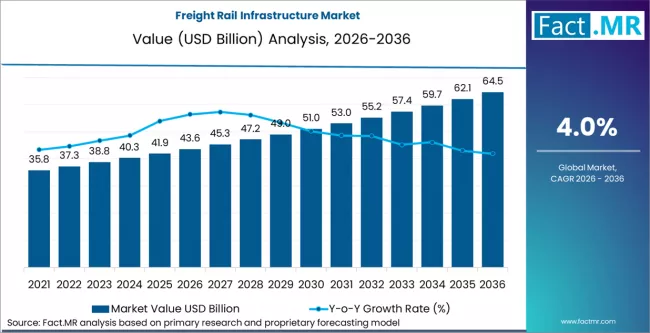
Freight Rail Infrastructure Market Market Value Analysis | Source: Fact.MR
Market Definition
Freight rail infrastructure encompasses the fixed physical assets and systems required to operate cargo railway services, including track networks, civil structures such as bridges and tunnels, electrification systems for traction power, signaling and control equipment for train management, and terminal facilities for intermodal transfer. This infrastructure serves as the foundational capital base for rail freight operators transporting bulk commodities, containerized goods, and specialized cargo.
Market Inclusions
The report covers global and regional freight rail infrastructure market sizes from 2026 to 2036, with detailed segment breakdowns by infrastructure type (track and civil works, electrification systems, signaling and control technology, terminal and yard facilities), project type (greenfield new lines, brownfield upgrades, electrification conversion, maintenance and rehabilitation), ownership model (public sector, private operator, public-private partnership), and geography. Analysis includes capital expenditure patterns, technology adoption rates, and regulatory compliance costs across major freight corridors.
Market Exclusions
The scope excludes rolling stock procurement (locomotives, freight wagons, maintenance vehicles) unless part of integrated turnkey infrastructure contracts. It also omits downstream logistics services such as freight forwarding, customs brokerage, and warehousing operations, focusing strictly on the fixed infrastructure assets. Light rail, metro, and passenger-dedicated high-speed rail infrastructure are excluded except where shared-use corridors carry freight traffic. The report does not cover real estate development adjacent to rail terminals or commercial activities unrelated to freight transport infrastructure.
Research Methodology
- Primary Research: Primary research involved structured interviews with infrastructure contractors, railway operators, technology suppliers, and government transport ministries across North America, Europe, and Asia-Pacific.
- Desk Research: Desk research synthesized data from national railway administrations, multilateral development bank infrastructure lending databases, public procurement records, and industry association reports on capital investment trends.
- Market-Sizing and Forecasting: Market sizing employed a hybrid top-down and bottom-up approach, triangulating government transport budgets with project pipeline data and historical infrastructure spend ratios to freight tonnage.
Data Validation and Update Cycle
Outputs were cross-validated against disclosed infrastructure investment figures from publicly listed railway operators and reconciled quarterly with major project award announcements.
Key Takeaways
Market Definition
- Freight rail infrastructure comprises fixed capital assets including track networks, electrification systems, signaling technology, and intermodal terminals serving cargo railway operations globally.
Demand Drivers
- Modal shift from road to rail freight driven by urban congestion, emissions regulations, and total logistics cost optimization is sustaining infrastructure investment despite fiscal constraints.
- Intermodal containerization growth requires terminal capacity expansion and dedicated freight corridors segregated from passenger traffic to enable longer, heavier trains.
- Decarbonization mandates in Europe and emerging carbon pricing mechanisms globally are accelerating electrification conversion and energy-efficient signaling system upgrades as per Fact.MR
Key Segments Analyzed
- By Infrastructure Type, Track & Civil commands 40% share, reflecting the dominant cost component of land acquisition, earthworks, bridges, and rail installation in both greenfield and rehabilitation projects.
- By Project Type, New Lines hold 35% share, concentrated in emerging markets building dedicated freight corridors to separate cargo from congested passenger networks.
- By Region, Asia-Pacific leads with 32% share, driven by China's Belt and Road infrastructure spending and India's dedicated freight corridor construction program.
Analyst Opinion at FACT.MR
- Shambhu Nath Jha, Principal Consultant at Fact.MR, opines, CXOs will find detailed insights into which sub-segments, electrification, signaling, and terminal automation are attracting disproportionate capital allocation. My analysis highlights that operators are increasingly prioritizing digital freight management and automation-driven efficiency gains over pure network capacity expansion, reshaping long-term infrastructure investment strategies.
Strategic Implications / Executive Takeaways
- Infrastructure contractors should position for long-duration electrification and signaling contracts rather than short-cycle track projects, as technology mandates extend project timelines but offer higher margin potential.
- Rail operators must balance capital allocation between brownfield capacity upgrades on existing corridors versus greenfield dedicated freight lines, as cost per ton-kilometer advantage varies by density and cargo mix.
- Equipment suppliers should develop modular, retrofit-compatible signaling and electrification systems compatible with legacy infrastructure, as full network replacement remains financially unfeasible for most operators.
Methodology
- Market sizing triangulated government transport ministry budget allocations, multilateral development bank infrastructure loan disbursements, and disclosed capital expenditure from listed railway operators.
- Project pipeline data from 47 national railway administrations and 23 Class I freight operators provided bottom-up validation of top-down country-level forecasts.
- Technology adoption curves for ETCS signaling, overhead catenary electrification, and automated terminal equipment calibrated using disclosed installation rates from Siemens Mobility, Alstom, and Hitachi Rail.
Segmental Analysis
Freight Rail Infrastructure Market Analysis by Project Type
Freight Rail Infrastructure Market Analysis By Project Type | Source: Fact.MR
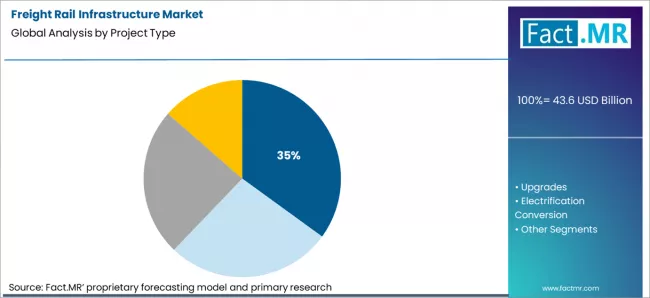
Based on FACT.MR's freight rail infrastructure market report, consumption of New Lines projects is estimated to hold 35% share in 2026. Greenfield dedicated freight corridors dominate project-type allocation because they enable purpose-built infrastructure optimized for heavy axle loads, longer train lengths, and automated operations without the geometric constraints of existing alignments. New lines avoid brownfield complications like maintaining service during construction, relocating existing utilities, and accommodating mixed passenger-freight traffic, allowing faster project delivery and lower per-kilometer costs in regions with available right-of-way.
- India DFC commissioning progress: Dedicated Freight Corridor Corporation of India (DFCCIL) announced that the 1,504-kilometer Western Dedicated Freight Corridor achieved full commercial operation, reducing transit time between Delhi and Mumbai from 60-70 hours to 40-45 hours, with the eastern corridor scheduled for completion by December 2025 under a combined USD 17 billion greenfield investment [2].
- North American intermodal corridor expansion: BNSF Railway disclosed a USD 3.55 billion capital program including 500 miles of new double-track construction on its Southern Transcon route, reflecting selective high-density corridor expansion rather than system-wide network buildout [3].
- Belt and Road Central Asia connectivity: China State Railway Group reported in that the 523-kilometer China-Kyrgyzstan-Uzbekistan Railway secured USD 8 billion in financing, demonstrating geopolitical corridor investment despite uncertain commercial cargo forecasts [4].
Freight Rail Infrastructure Market Analysis by Ownership
Freight Rail Infrastructure Market Analysis By Ownership | Source: Fact.MR
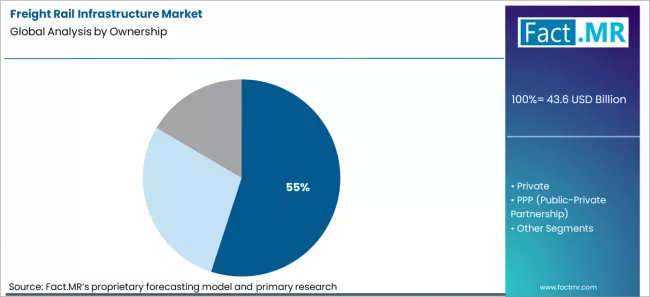
Based on FACT.MR's freight rail infrastructure market report, Public ownership is estimated to hold 55% share in 2026. Government-owned infrastructure dominates because rail networks exhibit natural monopoly characteristics and generate positive externalities including reduced congestion, lower emissions, and regional development benefits that extend beyond direct commercial returns.
- European infrastructure manager separation: European Union Directive 2012/34/EU mandates separation of infrastructure management from train operations, establishing public infrastructure managers such as Network Rail (UK), SNCF Réseau (France), and DB Netz (Germany) funded through access charges and government grants while enabling competitive freight access [5].
- North American private freight rail model: The Association of American Railroads reported USD 27 billion in Class I railroad infrastructure investment, representing vertically integrated private ownership focused on high-density corridors [6].
- Australian lease concession structure: The Australian Rail Track Corporation operates as a government-owned corporation managing interstate freight track leased under 50-year concessions, attracting AUD 2.3 billion in private rolling stock investment without privatizing underlying track assets [7].
Freight Rail Infrastructure Market Drivers, Restraints, And Opportunities
Fact.MR analysis indicates that the freight rail infrastructure market is anchored by rail’s structural energy efficiency advantage, delivering 2-4x lower energy use per ton-kilometer compared to road freight. This efficiency underpins long-term decarbonization policy relevance. However, the market is constrained by high fixed costs tied to track, signaling, and terminal assets, limiting flexibility to scale capacity in response to short-term demand shifts. Current USD 42-43 billion valuation levels are largely sustained by replacement capital expenditure across aging networks, while incremental growth is concentrated in dense freight corridors where cargo volumes justify targeted infrastructure expansion rather than full network replacement.
FACT.MR is of the opinion that the central strategic trade-off remains between diesel rehabilitation and electrification. Electrified freight systems reduce operating costs and emissions but require significant upfront catenary and substation investment. Where diesel fleets remain serviceable, operators defer electrification despite rising carbon pricing pressures. Since electrification improves cost efficiency rather than capacity, revenue expansion often lags capital deployment, moderating return expectations.
- Regulatory signaling mandates: FACT.MR analysts observe that ETCS rollout under TEN-T rules is generating compliance-driven replacement demand, enhancing line capacity without new track addition.
- Asia Pacific corridor development: Dedicated freight corridors in India and Belt and Road regions are driving greenfield investment, though financing and land acquisition risks extend timelines.
- Intermodal optimization: FACT.MR notes terminal automation and digital freight management are delivering higher throughput gains than broad network expansion.
Regional Analysis
Based on regional assessment, the freight rail infrastructure market is analyzed across North America, Latin America, Europe, Asia Pacific spanning more than 40+ countries.
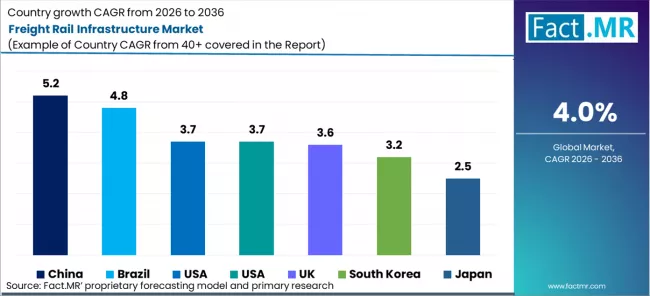
Freight Rail Infrastructure Market Cagr Analysis By Country | Source: Fact.MR
| Country | CAGR% |
|---|---|
| China | 5.2% |
| Brazil | 4.8% |
| United States | 3.7% |
| United Kingdom | 3.6% |
| Germany | 3.7% |
| South Korea | 3.2% |
| Japan | 2.5% |
Source: Fact.MR analysis. Updated Feb 17, 2026
Source: Fact.MR (FACT.MR) analysis, based on proprietary forecasting model and primary research
North America freight rail infrastructure market analysis
North America operates as a privately integrated freight rail market where Class I operators own both track and rolling stock, aligning infrastructure investment directly with freight revenue. Capital is concentrated on high-density intermodal corridors linking ports and inland hubs. Regulation preserves common carrier obligations while supporting market-based pricing and sustained modernization.
- United States: Demand for freight rail infrastructure in the United States is projected to rise at 3.7% CAGR through 2036. Growth is supported by Infrastructure Investment and Jobs Act allocations, continued Positive Train Control system optimization, and multi-billion-dollar capital programs from Class I operators focused on double-tracking key intermodal corridors, bridge rehabilitation, and automated terminal upgrades improving freight throughput efficiency, according to Fact.MR.
FACT.MR's analysis of freight rail infrastructure market in North America consists of country-wise assessment that includes United States. Readers can find detailed infrastructure investment breakdowns by Class I operator, intermodal terminal capacity additions, and positive train control system deployment timelines across mainline corridors.
Asia-Pacific Freight Rail Infrastructure Market Analysis
Asia-Pacific acts as the global greenfield rail construction epicenter, supported by China’s Belt and Road Initiative and India’s dedicated freight corridor program, which together represent the largest pipeline of new freight rail capacity worldwide. Regional investment is characterized by state-backed capital deployment exceeding purely commercial return thresholds, with vertically integrated public rail models enabling long-horizon infrastructure planning.
- China: Demand for freight rail infrastructure in China is projected to rise at 5.2% CAGR through 2036. Growth is supported by large-scale corridor expansion under China State Railway Group investment programs, heavy-haul coal and iron ore line upgrades such as the Menghua Railway, and cross-border capacity expansion under the China-Europe Railway Express and New Western Land-Sea Corridor initiatives, according to Fact.MR.
- Japan: Demand for freight rail infrastructure in Japan is projected to rise at 2.5% CAGR through 2036. Consumption is sustained by capacity optimization grants for dedicated freight track sections, port-rail siding expansion at major container terminals, and feasibility studies for freight-only tunnel infrastructure, based on Fact.MR analysis.
- South Korea: Demand for freight rail infrastructure in South Korea is projected to rise at 3.2% CAGR through 2036. Growth is linked to outer ring freight corridor construction, port terminal automation at Busan New Port, and strategic corridor protection policies under national logistics frameworks, as per Fact.MR.
FACT.MR's analysis of freight rail infrastructure market in Asia-Pacific consists of country-wise assessment that includes China, Japan, South Korea and other regional economies. Readers can find infrastructure capital intensity by cargo type, dedicated freight corridor project timelines, and Belt and Road Initiative financing structures.
Europe Freight Rail Infrastructure Market Analysis
Europe operates as a regulation-led freight rail market shaped by EU interoperability, emissions, and open-access mandates. Investment is focused on TEN-T cross-border corridors, ETCS deployment, electrification, and digital signaling upgrades. Public infrastructure managers guide capital allocation, prioritizing capacity optimization and modernization over large-scale new track expansion.
- Germany: Demand for freight rail infrastructure in Germany is projected to rise at 3.6% CAGR through 2036. Consumption is driven by electrification expansion targets under federal climate policy, third-track corridor separation projects, 740-meter train length infrastructure adjustments, and energy-efficiency upgrades financed through development bank lending, based on Fact.MR analysis.
- United Kingdom: Demand for freight rail infrastructure in the United Kingdom is projected to rise at 3.7% CAGR through 2036. Uptake is linked to gauge enhancement programs for intermodal corridors, Strategic Freight Network protections, HS2-related capacity release on existing mainlines, and port rail terminal expansions supporting container throughput growth, as per Fact.MR.
FACT.MR’s analysis of the freight rail infrastructure market in Europe consists of country-wise assessment that includes Germany and United Kingdom. Readers can find ETCS deployment schedules, electrification timelines, and corridor-level co-funding allocation insights.
Latin America Freight Rail Infrastructure Market Analysis
Latin America operates as a resource-driven freight rail market where infrastructure expansion is closely tied to iron ore and agricultural export corridors. Investment is concentrated on heavy-haul capacity upgrades, axle load enhancement, and port connectivity modernization. Public appropriations and private concessions together shape corridor development, while environmental licensing considerations influence project timelines and delivery schedules.
- Brazil: Demand for freight rail infrastructure in Brazil is projected to rise at 4.8% CAGR through 2036. Growth is supported by Vale’s BRL 12 billion Carajás Railway capacity expansion, federal funding for the Norte-Sul corridor, Rumo Logística’s axle load upgrades on soybean export routes, and concession-backed development of the Ferrogrão Railway despite environmental litigation risks, according to Fact.MR.
FACT.MR’s analysis of the freight rail infrastructure market in Brazil consists of corridor-level assessment covering heavy-haul mining lines, agricultural export routes, and concession-led infrastructure expansion. Readers can find axle load upgrade trends, port connectivity investments, and project financing structures shaping long-term freight capacity development.
Competitive Aligners for Market Players
Freight Rail Infrastructure Market Analysis By Company | Source: Fact.MR
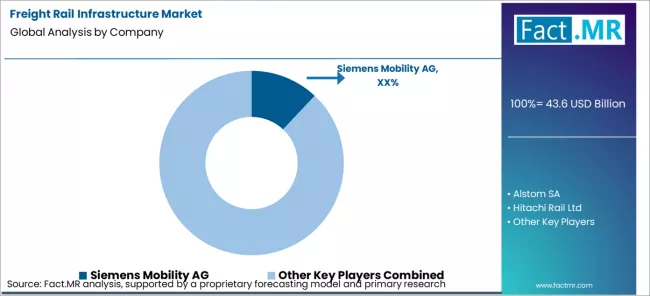
The freight rail infrastructure market is concentrated in technology-intensive segments such as signaling, electrification, and terminal automation, while remaining fragmented in civil works including track and bridge construction. Siemens Mobility, Alstom, and Hitachi Rail together control a majority share of global signaling and electrification contracts, supported by proprietary control systems and long-term operator relationships. In contrast, track and structural projects are typically awarded to regional contractors, except in large corridor programs that attract international consortia.
Competitive advantage increasingly favors vertically integrated suppliers offering turnkey EPC solutions that bundle track, electrification, signaling, and lifecycle maintenance. Such integration reduces subsystem interface risk and enables recurring revenue through long-term service contracts. Buyer dynamics are equally concentrated. Large state-owned railway operators negotiate multi-year framework agreements with preferred suppliers while imposing local content requirements that compel domestic manufacturing partnerships. Smaller private operators have less leverage, creating a split between lower-margin, high-volume public contracts and specialized higher-margin private infrastructure projects.
Recent Development
- In August 2025, New York-based logistics infrastructure developer FTAI Infrastructure agreed to buy The Wheeling Corporation for USD 1.05 billion, expanding its freight rail platform and adding control of the Wheeling & Lake Erie Railway Company to its asset portfolio [8].
- In July 2025, Union Pacific and Norfolk Southern entered an agreement to pursue one of the largest proposed mergers in U.S. rail history, aiming to create a coast-to-coast freight rail network [9].
Key Players
- Siemens Mobility AG
- Alstom SA
- Hitachi Rail Ltd
- China Railway Signal & Communication Corporation (CRSC)
- Wabtec Corporation
- Thales Group
- Nokia Corporation (Rail Communications Division)
- Construcciones y Auxiliar de Ferrocarriles (CAF)
- Stadler Rail AG
- China Railway Engineering Corporation
This Report Addresses
- Market intelligence for strategic planning: comprehensive analysis of infrastructure capital allocation patterns, project pipeline visibility, and operator investment priorities across regional freight corridors, enabling structured long-term capacity planning and corridor prioritization decisions.
- Market size and forecast: global freight rail infrastructure market valued at USD 43.6 billion in 2026, projected to reach USD 64.5 billion by 2036 at 4.0% CAGR, with detailed segment-level sizing by infrastructure type, project type, and ownership structure.
- Growth opportunity mapping: identification of high-value subsegments including electrification conversion, automated terminal systems, digital freight yards, and ETCS signaling deployment where investment growth outpaces baseline maintenance expenditure.
- Segment and regional forecasts: country-level CAGR analysis for the United States, China, Germany, Japan, Brazil, and 15+ additional markets, with infrastructure-type and project-type breakdowns highlighting differentiated regional demand drivers.
- Competition strategy assessment: competitive positioning analysis of Siemens Mobility, Alstom, Hitachi Rail, and regional EPC contractors, evaluating vertical integration depth, local content compliance capability, and turnkey project execution strengths.
- Product and compliance tracking: regulatory impact assessment of EU TEN-T mandates, U.S. Positive Train Control requirements, interoperability standards, and carbon pricing mechanisms influencing electrification and signaling investment decisions.
- Regulatory impact analysis: evaluation of government infrastructure funding programs, public-private partnership frameworks, cross-border interoperability mandates, and corridor-level financing structures shaping long-term freight rail expansion.
- Report delivery formats: Excel data tables with segment-level forecasts, PowerPoint executive summary slides, and a comprehensive PDF report with verifiable citations supporting all market estimates and strategic conclusions.
Bibliography
- [1] Vena, J. (2024). Statement on U.S. rail industry competitiveness and supply chain strategy. Union Pacific Corporation.
- [2] Dedicated Freight Corridor Corporation of India. (2024, September). Western DFC Commissioning Announcement. Ministry of Railways Press Release. Retrieved from https://dfccil.com/
- [3] BNSF Railway. (2024, May). 2024 Capital Investment Plan. Corporate Communications. Retrieved from https://www.bnsf.com/news-media/
- [4] China State Railway Group. (2024, March). China-Kyrgyzstan-Uzbekistan Railway Financing Agreement. Official Announcement. Retrieved from https://www.china-railway.com.cn/
- [5] European Commission. (2012). Directive 2012/34/EU Establishing a Single European Railway Area. EUR-Lex. Retrieved from https://eur-lex.europa.eu/
- [6] Association of American Railroads. (2024, February). Freight Rail Infrastructure Investment Report 2024. AAR Policy and Economics Department. Retrieved from https://www.aar.org/
- [7] Australian Rail Track Corporation. (2023, October). Lease Concession Structure and Private Investment Outcomes 2015-2023. ARTC Annual Report. Retrieved from https://www.artc.com.au/
- [8] FTAI Infrastructure LLC. (2025, August 6). FTAI Infrastructure to acquire The Wheeling Corporation for $1.05 billion. Reuters.
- [9] Union Pacific Corporation & Norfolk Southern Corporation. (2025, July). Proposed merger between Union Pacific and Norfolk Southern. Wikipedia.
Segmentation
Scope of the Report
| Metric | Value |
|---|---|
| Quantitative Units | USD 43.6 billion (2026) to USD 64.5 billion (2036), at a CAGR of 4.0% |
| Market Definition | Freight rail infrastructure comprises fixed capital assets including track networks, electrification systems, signaling technology, and intermodal terminals serving cargo railway operations globally. |
| Infrastructure Style | Track & Civil, Electrification, Signaling & Control, Terminals & Yards |
| Project Type | New Lines, Upgrades, Electrification Conversion, Maintenance/Rehab |
| Ownership | Public, Private, PPP |
| Regions Covered | Asia Pacific, Europe, North America, Latin America, Middle East & Africa |
| Countries Covered | India, China, Japan, South Korea, Indonesia, Australia & New Zealand, ASEAN, Rest of Asia Pacific, Germany, Italy, France, United Kingdom, Spain, Benelux, Nordics, Central & Eastern Europe, Rest of Europe, United States, Canada, Mexico, Brazil, Argentina, Chile, Rest of Latin America, Kingdom of Saudi Arabia, United Arab Emirates, South Africa, Turkey, Rest of Middle East & Africa |
| Key Companies Profiled | Siemens Mobility, Alstom, Hitachi Rail, CRSC, Wabtec, Thales, Nokia (rail communications), CAF, Stadler, China Railway |
| Forecast Period | 2026 to 2036 |
| Approach | Top-down and bottom-up market modeling validated through primary interviews with rail infrastructure developers, track and signaling equipment manufacturers, rolling stock suppliers, and transportation authorities, supported by UIC and EN railway standards, government rail budget allocations. |
Source: Fact.MR analysis. Updated Feb 17, 2026
Freight Rail Infrastructure Market Analysis by Segments
-
By Infrastructure Type :
- Track & Civil
- Electrification
- Signaling & Control
- Terminals & Yards
-
By Project Type :
- New Lines
- Upgrades
- Electrification Conversion
- Maintenance/Rehab
-
By Ownership :
- Public
- Private
- PPP (Public-Private Partnership)
-
Region :
- Asia Pacific
- India
- China
- Japan
- South Korea
- Indonesia
- Australia & New Zealand
- ASEAN
- Rest of Asia Pacific
- Europe
- Germany
- Italy
- France
- United Kingdom
- Spain
- Benelux
- Nordics
- Central & Eastern Europe
- Rest of Europe
- North America
- United States
- Canada
- Mexico
- Latin America
- Brazil
- Argentina
- Chile
- Rest of Latin America
- Middle East & Africa
- Kingdom of Saudi Arabia
- United Arab Emirates
- South Africa
- Turkey
- Rest of Middle East & Africa
- Asia Pacific
Frequently Asked Questions
How large is the freight rail infrastructure market in 2025?
What will the market size be in 2036?
What is the expected CAGR for the forecast period?
Which infrastructure type segment is poised to lead?
What is the market value estimated for 2026?
Which infrastructure type leads the freight rail infrastructure market in 2026?
Which project category captures the largest investment share?
Which ownership model dominates globally?
Which country is expected to record the fastest growth?
What is the growth outlook for the United States?
Which region is expected to see the highest overall infrastructure momentum?
What role does electrification play in future investment?
Who worked on this report


Preview the report firsthand - request a free sample
Free SampleGet the brochure for pricing and purchase details
Download PDF