- Market Value (2025): USD 751.8 Mn
- Estimated Value (2026): USD 830.0 Mn
- Forecast Value (2036): USD 2232.4 Mn
- CAGR (2026-2036): 10.4%
What is the Fruit-Waste Liquid Pectins Market forecast to be worth by 2036?
The Fruit-Waste Liquid Pectins Market is projected to reach USD 2,232.4 million by 2036, from USD 830.0 million in 2026, at a 10.4% CAGR.
- The market stood at USD 751.8 million in 2025.
- Demand is valued at USD 830.0 million in 2026 and is forecast to reach USD 2,232.4 million by 2036.
- Growth is projected at 10.4% CAGR from 2026 to 2036. Repeated orders depend on consistent gel performance and reliable handling of liquid concentrates.
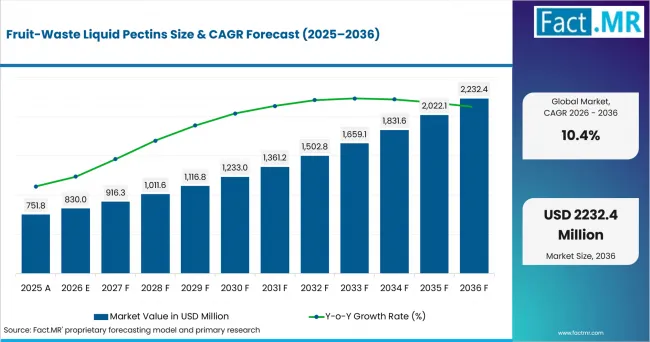
Fruit Waste Liquid Pectins Value Analysis | Source: Fact.MR
What are the defining numbers behind Fruit-Waste Liquid Pectins Market growth?
The absolute opportunity between 2026 and 2036 is USD 1,402.4 million. The commercial opening lies in converting suitable peel and pomace into standardized liquid ingredients. Revenue expansion requires customers to move beyond samples and qualify those ingredients on production equipment.
- Demand Drivers in the Market
- Jam and filling plants with frequent recipe changes need to shorten preparation between batches. A liquid pectin can remove a separate powder-wetting step when its concentration matches the receiving plant's mixing and pumping arrangement.
- Fruit processors can seek additional revenue from food-grade peel and pomace. Ingredient recovery creates demand for extraction and concentration capacity, although the feedstock must remain suitable for food use throughout collection and storage.
- Reformulation changes the balance between sugar, acid and gel strength. Buyers of food stabilizers therefore need application-specific pectin grades rather than a single liquid specification for every recipe.
- The European Food Safety Authority identifies citrus peel and apple pomace as principal materials for pectin production. This established technical route gives residue-based procurement a practical starting point, while finished-ingredient quality still determines acceptance.
- Key Segments Analyzed
- Within Fruit Source, the Citrus peel segment holds a 42.0% share in 2026. Citrus peel provides a familiar extraction feedstock with established quality-control practices.
- The HM liquid pectin segment leads Liquid Grade with 35.0% of 2026 revenue. Conventional sweet, acidic preserves can use the gel-forming behavior of HM pectin without redesigning the entire recipe.
- For Application, 34.0% of 2026 revenue comes from the Jams / fillings segment. Fillers need a repeatable set after pumping, depositing and cooling.
- The leading Processing segment is Acid extraction + concentration, accounting for 39.0% in 2026. An established extraction sequence gives producers a controllable route from wet residues to concentrated pectin.
- Analyst Opinion at Fact.MR
- Shambhu Nath Jha, Senior Consultant, Fact.MR. “The value of a liquid pectin is decided at the customer's kettle and filling head. A concentrate that saves preparation time but varies in gel strength will struggle to retain the account. Suppliers need to sell a repeatable processing result alongside the fruit-waste origin.”
- Strategic Implications
- Concentrate producers should specify pectin activity, viscosity, preservation conditions and usable life together. A quoted price per tonne is insufficient when two liquids contain different amounts of functional polymer.
- Jam manufacturers should trial the ingredient at actual addition points. Changing the order of acid, sugar and pectin addition can alter the time available for pumping and filling.
- Fruit processors should secure an outlet for the extracted ingredient before expanding recovery capacity. Seasonal residue availability and year-round customer demand need a workable storage plan.
How does the Fruit-Waste Liquid Pectins Market break down by segment?
The market is segmented by Fruit Source, Liquid Grade, Application, and Processing.
Why does the Citrus peel segment lead Fruit Source?
The Citrus peel segment holds a 42.0% share of the Fruit Source category in 2026. Its commercial advantage comes from the ability to collect peel at a juice-processing site and control the interval before extraction. That interval matters because degradation of the starting material can change the properties of the recovered pectin.
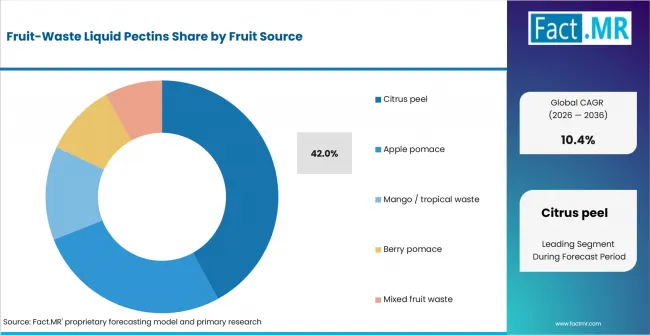
Fruit Waste Liquid Pectins Analysis By Fruit Source | Source: Fact.MR
Apple pomace and other fruit residues remain relevant alternatives, with different color, composition and handling requirements. Within citrus pectin, the buyer's useful comparison is delivered gel performance at a specified dose. A residue-origin claim does not eliminate that comparison.
Why does the HM liquid pectin segment lead Liquid Grade?
The HM liquid pectin segment holds a 35.0% share of the Liquid Grade category in 2026.
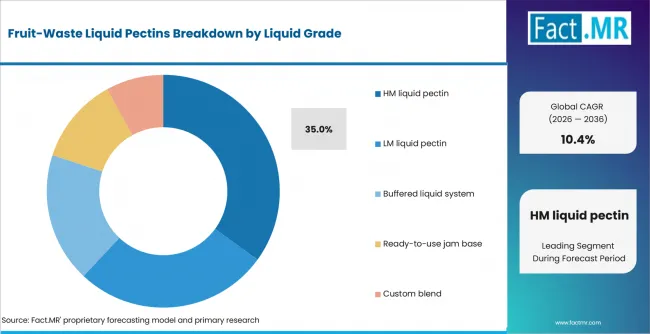
Fruit Waste Liquid Pectins Analysis By Liquid Grade | Source: Fact.MR
HM means high methoxyl. This grade is suited to sufficiently sweet, acidic systems, whereas low-methoxyl pectin is commonly selected when calcium-mediated gelling is needed. The chemical distinction governs the recipe that can be sold with the liquid.
A conventional preserve producer can qualify HM liquid pectin against an existing texture specification. A reduced-sugar developer may need a different grade and tighter calcium control. Suppliers retain business by making those choices clear before a plant trial.
Why does the Jams / fillings segment lead Application?
The Jams / fillings segment holds a 34.0% share of the Application category in 2026.
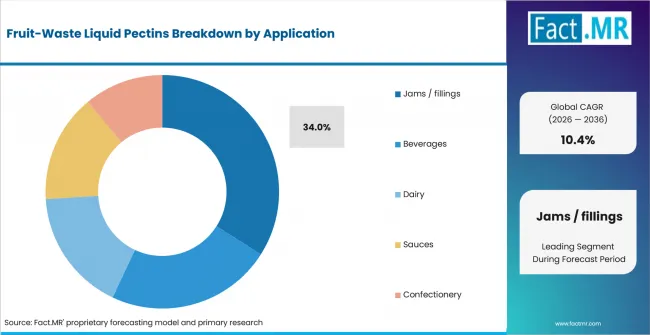
Fruit Waste Liquid Pectins Analysis By Application | Source: Fact.MR
A filling must move through a pump and depositor before it develops the texture required in the finished product. Dissolved pectin gives the production team a defined addition step, but the formulation still needs the correct setting window.
The attraction is particularly practical where undispersed powder causes rework or variable texture. These customers compare liquid pectin with other thickening agents on pumpability, fruit compatibility and resistance to water separation. Performance after baking or freezing must be established separately for the intended filling.
Why does the Acid extraction + concentration segment lead Processing?
The Acid extraction + concentration segment holds a 39.0% share of the Processing category in 2026.
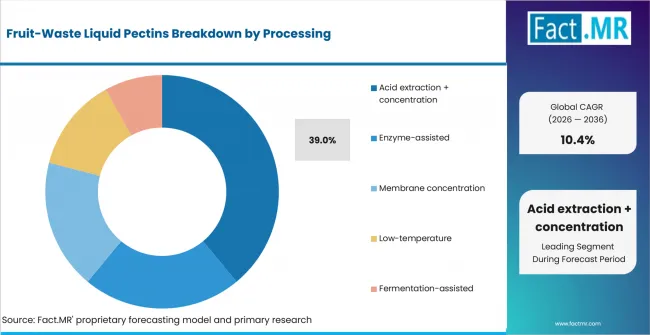
Fruit Waste Liquid Pectins Analysis By Processing | Source: Fact.MR
The route combines extraction, separation and concentration in a sequence that processors can control through acidity, temperature and residence time. Excessive treatment can damage polymer functionality, so yield alone is an incomplete production target.
Enzyme-assisted and membrane-based options offer different process choices. Their adoption depends on retaining useful pectin characteristics while managing fouling, cleaning and processing cost. Buyers of pomace pectin will reward a reproducible ingredient more readily than an extraction method with an attractive laboratory yield but unstable factory output.
What is accelerating Fruit-Waste Liquid Pectins Market adoption, and what is holding it back?
The move toward liquid supply is strongest where ingredient preparation is a measurable bottleneck. A customer with automated liquid dosing may find a concentrate straightforward to integrate, while a plant built around dry premixes may see little benefit from changing format.
Freight and preservation constrain the addressable business. Lower concentration raises transport cost per unit of functional pectin; higher concentration can make pumping more difficult. Fact.MR expects commercial specifications to be negotiated around this operating compromise.
Fact.MR estimates the following directional effects on CAGR. The factors interact, so their impacts should not be added together.
Drivers Impact Analysis
| Factor | (~) % Impact on CAGR | Geographic Relevance | Impact Timeline |
|---|---|---|---|
| Eliminating powder-wetting delays | +1.2% | Europe, USA | 2026 to 2029 |
| Food-grade peel and pomace recovery | +1.0% | Europe | 2026 to 2031 |
| Fruit-preparation recipe reformulation | +0.8% | UK, France, USA | 2027 to 2032 |
These demand effects assume that liquid supply removes a real processing step. Where the customer already makes pectin solution efficiently on site, the supplier has less room to charge for convenience.
Opportunity Impact Analysis
| Factor | (~) % Impact on CAGR | Geographic Relevance | Impact Timeline |
|---|---|---|---|
| Concentrates for automated liquid dosing | +0.7% | Germany, USA | 2027 to 2031 |
| Buffered systems for variable fruit acidity | +0.6% | Europe | 2026 to 2030 |
| Local processor-to-factory supply agreements | +0.5% | Spain, France | 2028 to 2036 |
Buffered products can reduce formulation work, but a supplier must match buffering to the fruit and process. Regional supply agreements are attractive when they combine dependable quality with manageable transport distances.
Restraints Impact Analysis
| Factor | (~) % Impact on CAGR | Geographic Relevance | Impact Timeline |
|---|---|---|---|
| Freight burden of liquid formulations | -0.8% | Global | 2026 to 2036 |
| Shelf-life and microbial control costs | -0.6% | Global | 2026 to 2032 |
| Seasonal variation in residue quality | -0.5% | Europe, USA | 2026 to 2036 |
Inventory cannot be evaluated by volume alone. Buyers need an agreed usable-life specification after delivery and after a container is opened, as well as a plan for holding partially consumed material.
Which countries are scaling the Fruit-Waste Liquid Pectins Market through 2036?
- Germany: Application laboratories and industrial fruit-preparation plants create an entry route for liquid grades qualified against tightly specified textures.
- UK: Reformulation of sweet foods brings attention to pectin grades that can accommodate a changed sugar balance.
- USA: Commercial jam and filling manufacturers weigh liquid dosing convenience against storage, freight and ingredient compliance.
- Spain: Connecting citrus processing with local extraction can improve the economics of collecting wet peel before it deteriorates.
- France: Fruit-rich preserves and bakery preparations require separate setting behavior, creating demand for application-specific concentrates.
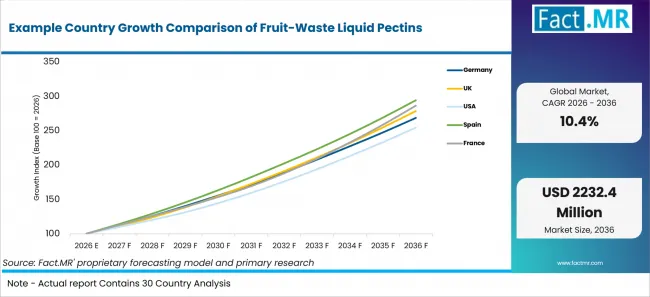
Example Country Growth Comparison Of Fruit Waste Liquid Pectins | Source: Fact.MR
Country CAGR (2026-2036)
| Country | CAGR (2026-2036) |
|---|---|
| Germany | 10.4% |
| UK | 10.8% |
| USA | 9.8% |
| Spain | 11.4% |
| France | 11.1% |
What is driving Germany's growth through 2036?
Germany is projected to record 10.4% CAGR through 2036. The buying process is likely to favor suppliers that can demonstrate performance in a customer's existing fruit preparation. Herbstreith & Fox documents pectin applications in jams, bakery goods, dairy products and fruit preparations, illustrating the range of technical support already available to formulators.
Liquid suppliers must fit into that application-led procurement environment. Batch viscosity, setting time and compatibility with fruit solids carry more weight than origin claims alone. Successful qualification can produce recurring purchases across multiple recipes, but each liquid grade needs its own operating limits.
What is driving UK's growth through 2036?
The UK market is forecast to grow at 10.8% CAGR from 2026 to 2036.
The Office for Health Improvement and Disparities' sugar-reduction assessment documents reformulation across foods and drinks. It provides context for continuing recipe work, rather than evidence of a direct requirement to use pectin.
Reducing sugar can change the structure of a preserve. A producer may need LM liquid pectin or a buffered system, depending on the intended texture. Suppliers that help customers re-establish the setting window have an opportunity to turn a reformulation project into a continuing supply contract.
What is driving USA's growth through 2036?
Demand in the USA is expected to expand at 9.8% CAGR through 2036.
The FDA's pectin provision recognizes use under specified good manufacturing practice conditions. Compliance with the ingredient's identity and use conditions supports commercial qualification; fruit-waste origin does not create a separate exemption.
For a regional filling manufacturer, the practical attraction is a predictable liquid addition that can be metered into several batch sizes. The decision becomes less favorable when transport distance, refrigeration or container handling absorbs the preparation savings. Regional distribution and appropriate concentration therefore matter to account economics.
What is driving Spain's growth through 2036?
Spain's projected CAGR is 11.4% for 2026 to 2036. The supply-side opportunity is to integrate peel collection with extraction close to fruit processing. Shorter movement of wet material can make quality control easier, but collection volume must be matched to ingredient demand.
EU Directive 2024/1438 revises the framework for fruit jams and related products. For Spanish producers serving that market, changes to preserve composition create occasions to reassess pectin addition and texture. Fact.MR sees local concentrate supply as a potential response where customers want technical adjustments without taking on extraction themselves.
What is driving France's growth through 2036?
France is forecast to advance at 11.1% CAGR through 2036. The revised EU framework for jams places renewed attention on fruit composition, while finished-product quality still depends on the interaction between fruit solids, acid and the gelling system.
A spread and a bakery filling can require different textures even when both contain the same fruit. French ingredient customers therefore offer suppliers a route through application development: a concentrate must deliver the required spreadability or deposit behavior after the customer's heating and cooling cycle. That favors differentiated grades over an undifferentiated liquid pectin offer.
Who Leads the Fruit-Waste Liquid Pectins Market?
Key players in the Fruit-Waste Liquid Pectins Market include CP Kelco, Cargill, Herbstreith & Fox, Silvateam, Andre Pectin, and Ceamsa.
Competition concerns extraction consistency, liquid preservation, technical service and the delivered cost of functional pectin. Herbstreith & Fox's application portfolio demonstrates how established pectin suppliers compete across several food processes. CP Kelco became part of Tate & Lyle in 2024 and remains an ingredient brand within that business.
Liquid specialists also compete with dry pectin that a customer hydrates on site. In the broader gum hydrocolloid business, customers can change the stabilizing system as well as the supplier. Retention depends on maintaining a processing advantage over those alternatives.
Which companies are the key providers?
The key providers are CP Kelco, Cargill, Herbstreith & Fox, Silvateam, Andre Pectin, and Ceamsa.
- CP Kelco
- Cargill
- Herbstreith & Fox
- Silvateam
- Andre Pectin
- Ceamsa
Bibliography
- European Food Safety Authority. (2017). Re-evaluation of pectin (E 440i) and amidated pectin (E 440ii) as food additives. EFSA Journal, 15(7), 4866.
- Herbstreith & Fox. (n.d.). The Specialists for Pectin: applications and functional pectins. Herbstreith & Fox.
- Office for Health Improvement and Disparities. (2022). Sugar reduction programme: industry progress 2015 to 2020. UK Government.
- U.S. Food and Drug Administration. (n.d.). 21 CFR 184.1588: Pectins. Electronic Code of Federal Regulations.
- European Parliament and Council of the European Union. (2024). Directive (EU) 2024/1438 amending the directives on honey, fruit juices, fruit jams and preserved milk. Official Journal of the European Union.
- Tate & Lyle. (n.d.). Corporate information on the integration of CP Kelco. Tate
This Report Answers
- How does liquid pectin change ingredient preparation and dosing in jam and filling plants?
- Which fruit sources, liquid grades, applications and processing routes lead revenue in 2026?
- How do freight distance and concentrate viscosity affect the economics of liquid supply?
- What purchasing conditions shape demand in Germany, the UK, the USA, Spain and France?
- Where do pectin supplier capabilities influence repeat qualification and account retention?
What does the Fruit-Waste Liquid Pectins Market cover?
The market covers commercial liquid pectin ingredients recovered from fruit-processing residues and sold for gelling, thickening or stabilization in food manufacture. Revenue relates to the liquid ingredient or functional liquid system, rather than to the finished food that contains it.
What is included in the scope?
Included products encompass HM and LM liquid pectin, buffered liquid systems, ready-to-use jam bases and custom blends. Fruit sources include citrus peel, apple pomace, tropical fruit residues, berry pomace and mixed fruit waste. Applications comprise jams and fillings, beverages, dairy, sauces and confectionery.
Commercial processing routes include acid extraction with concentration, enzyme assistance, membrane concentration, low-temperature processing and fermentation assistance. Products must be sold as liquid pectin ingredients within these applications.
What is excluded from the scope?
Dry pectin sold as powder, standalone fruit fiber, whole fruit, juice and ordinary fruit puree are outside the liquid-ingredient total. Extraction machinery, waste collection services and finished jam or confectionery sales are also excluded.
A liquid pectin made from calamansi peel can overlap the calamansi gelling-agent category. Revenues from overlapping ingredient categories should not be added without removing the overlap.
How Was the Analysis Built?
- Primary Research: Relevant respondent groups include pectin process engineers, fruit processors, jam and filling technologists, liquid-ingredient distributors and plant purchasing teams. Commercial questions concern gel specification, handling time, storage conditions and repeat-order criteria.
- Desk Research: The assessment uses pectin chemistry and safety publications, food-composition rules and first-party ingredient application information. These sources inform explanations of extraction, recipe compatibility and commercial qualification.
- Market Sizing and Forecasting: The commercial framework considers liquid-ingredient sales, active pectin concentration, application volumes, replacement of on-site hydration and delivered pricing. Forecast interpretation distinguishes ingredient revenue from fruit-processing and finished-food revenue.
- Data Validation and Update Cycle: The numerical review checks growth consistency and the distribution of revenue across each segment category. Technical review examines ingredient identity, grade suitability, company ownership and differences between liquid and dry supply.
What is the report's scope and coverage?
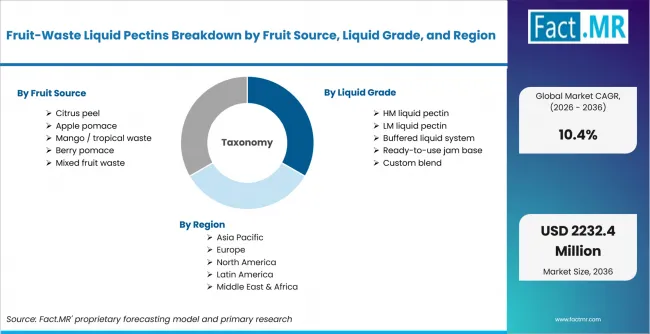
Fruit Waste Liquid Pectins Breakdown By Fruit Source, Liquid Grade, And Region | Source: Fact.MR
| Attribute | Details |
|---|---|
| Quantitative Units | USD million |
| Market Definition | Liquid pectin ingredients recovered from fruit-processing residues for food gelling and stabilization. |
| Segments Covered | Fruit Source; Liquid Grade; Application; Processing |
| Regions Covered | Global |
| Countries Covered | Germany; UK; USA; Spain; France |
| Key Companies | CP Kelco, Cargill, Herbstreith & Fox, Silvateam, Andre Pectin, and Ceamsa |
| Historical Period | 2021 to 2025 |
| Base Year | 2025 |
| Forecast Period | 2026 to 2036 |
| Market Value, 2026 | USD 830.0 million |
| Market Value, 2036 | USD 2,232.4 million |
| CAGR, 2026-2036 | 10.4% |
| Absolute Opportunity | USD 1,402.4 million |
| Approach | Ingredient revenue assessment with application, concentration, processing and delivery-cost analysis. |
How is the market segmented?
-
By Fruit Source
- Citrus peel
- Apple pomace
- Mango / tropical waste
- Berry pomace
- Mixed fruit waste
-
By Liquid Grade
- HM liquid pectin
- LM liquid pectin
- Buffered liquid system
- Ready-to-use jam base
- Custom blend
-
By Application
- Jams / fillings
- Beverages
- Dairy
- Sauces
- Confectionery
-
By Processing
- Acid extraction + concentration
- Enzyme-assisted
- Membrane concentration
- Low-temperature
- Fermentation-assisted
-
By Region
- North America
- Latin America
- Western Europe
- Eastern Europe
- East Asia
- South Asia and Pacific
- Middle East & Africa