Fuel Cell Powertrain Market (2026 - 2036)

Fuel Cell Powertrain Market is segmented by Component Outlook (Fuel Cell Module (Stack + BoP), Hydrogen Storage System, Electric Drive Unit (EDU), Power Electronics & Control), Product Outlook (Fuel Cell Electric Powertrain, Fuel Cell Stack, Fuel Cell System), Application Outlook (Commercial Trucks & Buses, Material Handling, Passenger Vehicles), End-User Outlook (Commercial Vehicle Manufacturers & Fleets, Automotive OEMs, Logistics & Warehouse Operators), and Region. Forecast for 2026 to 2036.

Core Findings

    Fuel Cell Powertrain Market Forecast 2026 to 2036

    In 2025, the fuel cell powertrain market was valued at USD 1 billion. Based on Fact MR's analysis, demand for fuel cell powertrains is estimated to grow to USD 1.5 billion in 2026 and USD 77.5 billion by 2036. FMR projects a CAGR of 48.3% during the forecast period.

    The absolute dollar growth from 2026 to 2036 is USD 76 billion. This explosive growth is driven by the increasing shift toward clean energy solutions, especially in the automotive sector, where fuel cell technology is becoming a viable alternative to conventional internal combustion engines. The market is supported by government policies and incentives aimed at reducing carbon emissions and promoting sustainable transportation technologies. However, challenges such as high production costs, infrastructure development for fuel cell stations, and the need for technological advancements in fuel cell efficiency may impact growth in certain regions.

    As Ted Ogawa, President and Chief Executive Officer of Toyota Motor North America, Inc., noted regarding the company’s vision for hydrogen and fuel cell powertrain technologies in future mobility solutions, “Work at H2HQ will enable Toyota to localize its global hydrogen work on both light and heavy‑duty fuel cells and fuel cell vehicles, on hydrogen fueling, and on stationary fuel cell power plants, thus creating real‑world products to help reduce carbon emissions.”

    China leads with a staggering CAGR of 65.2%, driven by heavy investments in clean energy technologies and the rapid adoption of hydrogen fuel cell vehicles. India follows with a 60.4% CAGR, supported by strong government policies promoting clean and renewable energy sources. Germany grows at 55.5%, fueled by the country’s leadership in green technologies and sustainable transportation initiatives. France follows with 50.7% growth, reflecting strong demand for fuel cell-powered vehicles as part of their environmental strategies. The UK grows at 45.9%, driven by aggressive carbon reduction goals and advancements in hydrogen infrastructure. The USA grows at 41.1%, with substantial investments in the clean energy sector. Brazil grows at 36.2%, benefiting from government-backed initiatives in renewable energy and eco-friendly vehicle adoption.
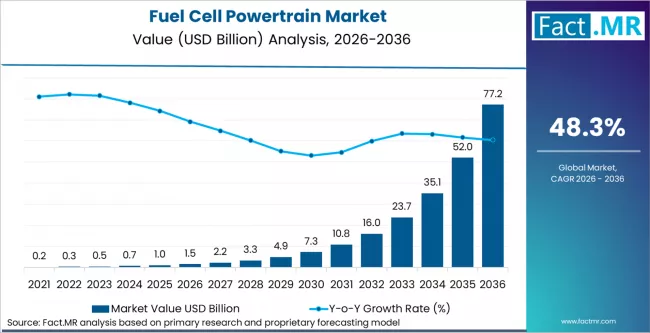
    Fuel Cell Powertrain Market Market Value Analysis

    Fuel Cell Powertrain Market

    Metric Value
    Estimated Value in (2026E) USD 1.5 billion
    Forecast Value in (2036F) USD 77.5 billion
    Forecast CAGR (2026 to 2036) 48.3%

    Fuel Cell Powertrain Market Definition

    The Fuel Cell Powertrain Market involves the development, manufacture, and sale of powertrain systems that use fuel cells to generate electricity for propulsion in vehicles and stationary applications.

    Market Inclusions

    This report covers global and regional market sizes for fuel cell powertrains over a defined forecast period, including system types (PEMFC, SOFC), applications (passenger vehicles, commercial vehicles, buses, material handling), and end‑use segments.

    Market Exclusions

    The scope excludes internal combustion and battery‑only electric powertrains, fuel cell stack components sold separately without integration, and unrelated propulsion systems.

    Research Methodology

    • Primary Research: Interviews were conducted with powertrain engineers, OEM specialists, and industry analysts.
    • Desk Research: Data was sourced from industry reports, technology publications, and trade association statistics.
    • Market‑Sizing and Forecasting: A hybrid model combining top‑down transport energy forecasts with bottom‑up production and shipment data was used.
    • Data Validation and Update Cycle: Findings were validated through expert review and aligned with recent production, adoption, and trade figures.

    Summary of the Fuel Cell Powertrain Market

    • Market Definition
      • The Fuel Cell Powertrain Market involves the development, manufacture, and sale of powertrain systems that use fuel cells to generate electricity for propulsion in vehicles and stationary applications.
    • Demand Drivers
      • Increasing shift towards clean energy solutions, especially in the automotive sector, with fuel cell technology becoming a viable alternative to conventional internal combustion engines.
      • Government policies and incentives aimed at reducing carbon emissions and promoting sustainable transportation technologies.
      • Rising demand for zero-emission vehicles, particularly in the commercial transport sector, including trucks and buses.
      • Development of hydrogen infrastructure and advancements in fuel cell efficiency.
    • Key Segments Analyzed
      • Application: Commercial trucks and buses are projected to account for 87% of the market share by 2026 due to their long-range capabilities and quick refueling times.
      • Component: The fuel cell module (stack + Balance of Plant, or BoP) is expected to capture 34% of the market share by 2026, being the core component of the fuel cell powertrain.
      • Geography: China leads with the highest growth, followed by India, Germany, France, and the UK.
    • Analyst Opinion at FMR
      • Shambhu Nath Jha, Principal Consultant at Future Market Insights, states, "The fuel cell powertrain market is witnessing an explosive growth trajectory, driven by strong governmental support, advancements in fuel cell technologies, and the ongoing transition towards decarbonized mobility. The growing adoption of hydrogen-powered vehicles in commercial transportation is accelerating the market expansion."
    • Strategic Implications/Executive Takeaways
      • Invest in hydrogen infrastructure development to support the scaling up of fuel cell vehicle adoption.
      • Focus on increasing the efficiency and reducing the cost of fuel cell modules to enhance the commercial viability of hydrogen-powered vehicles.
      • Leverage government incentives and policies promoting sustainable transport solutions, especially in regions with strong regulatory support for zero-emission vehicles.
      • Explore partnerships with automakers and commercial fleets to accelerate the rollout of fuel cell-powered trucks and buses.
    • Methodology
      • Primary research through interviews with powertrain engineers, OEM specialists, and industry analysts.
      • Data sourced from industry reports, technology publications, and trade association statistics.
      • Market sizing and forecasting using a hybrid model combining top-down transport energy forecasts with bottom-up production and shipment data.

    Segmental Analysis

    Fuel Cell Powertrain Market Analysis by Application Outlook
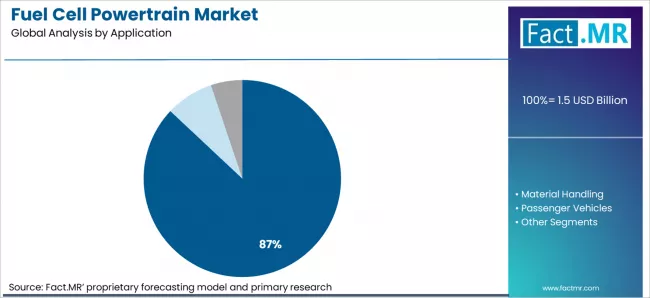
    Fuel Cell Powertrain Market Analysis By Application

    • Market Overview: Commercial trucks and buses are projected to capture 87% of the fuel cell powertrain market by 2026. Fuel cell powertrains are increasingly being adopted in the commercial transport sector due to their zero-emission capabilities, long driving ranges, and the growing demand for sustainable transportation solutions in logistics and public transportation.
    • Demand Drivers:
      • Regulatory Pressure and Emission Standards: Stricter emissions regulations and the push for reducing carbon footprints are driving the demand for zero-emission commercial vehicles. Fuel cell powertrains offer a viable alternative to diesel and gasoline engines, making them an attractive option for commercial trucks and buses.
      • Long Range and Refueling Convenience: Fuel cell-powered vehicles are favored for their long range and quick refueling times, which are essential for commercial trucks and buses that require continuous, high-mileage operations. These features give fuel cell vehicles an edge over battery-electric vehicles, which may have longer refueling times and range limitations.
      • Government Support and Incentives: Government policies promoting clean energy solutions, including subsidies and incentives for adopting fuel cell vehicles, are accelerating their deployment in the commercial truck and bus sector.

    Fuel Cell Powertrain Market Analysis by Component Outlook
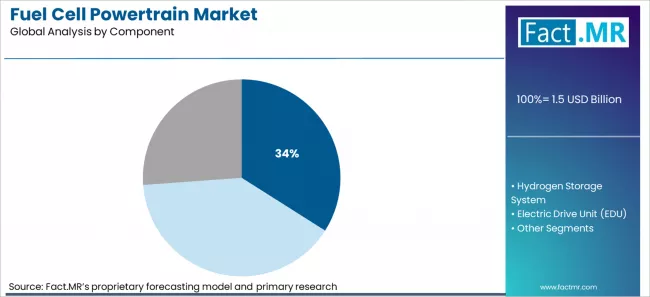
    Fuel Cell Powertrain Market Analysis By Component

    • Market Overview: The fuel cell module (stack + Balance of Plant, or BoP) is expected to capture 34% of the market share by 2026. The fuel cell module is the core component of the fuel cell powertrain, converting hydrogen into electricity through an electrochemical process, making it critical for the functionality and performance of fuel cell vehicles.
    • Demand Drivers:
      • Technological Advancements in Fuel Cells: Improvements in fuel cell efficiency, durability, and power density are driving the demand for fuel cell modules. As the technology continues to evolve, fuel cell stacks are becoming more reliable and capable of meeting the power demands of commercial vehicles.
      • Integration into Commercial Vehicles: The fuel cell stack, combined with the Balance of Plant (BoP), is central to the operation of fuel cell powertrains. As commercial trucks and buses increasingly adopt fuel cell powertrains, the demand for high-performance fuel cell modules grows to support their power needs.
      • Hydrogen Infrastructure Development: As hydrogen refueling infrastructure expands, the demand for fuel cell modules increases, as they are necessary to power vehicles that rely on hydrogen as a clean energy source. This development supports the growing deployment of fuel cell vehicles in the commercial sector.

    Fuel Cell Powertrain Market Drivers, Restraints, and Opportunities

    FMR analysts observe that the fuel cell powertrain market is a growth‑aligned transitional segment driven by the push for decarbonized mobility beyond battery‑electric alone. Historically, internal combustion engines dominated vehicle powertrains; as regulators tighten tailpipe emission limits and fleets pursue zero‑emission solutions, structural demand has emerged for hydrogen fuel cell systems that offer fast refueling and long range in heavy vehicles, buses, and select passenger segments. The 2026 valuation reflects this shift, with adoption linked to supportive policy frameworks, infrastructure investment, and commercial fleet deployments rather than mass passenger uptake.

    While battery‑electric powertrains remain the leading zero‑emission choice in light vehicles, fuel cell systems are gaining share where weight, range, and uptime are critical. These systems carry higher per‑unit costs and infrastructure requirements, contributing to net value growth even as unit volumes grow gradually with hydrogen station rollout. The market exists because certain use cases - heavy freight, long‑haul transit, and industrial equipment - find fuel cells operationally advantageous over alternatives.

    • Zero‑Emission Policy Pressure: Stricter emission standards and zero‑tailpipe mandates push fleets and OEMs to adopt fuel cell powertrains in segments where electric batteries pose range or weight limits.
    • Infrastructure & Standards Influence: Hydrogen refueling network investments and protocols such as ISO 19880 for hydrogen fueling safety drive specification and regional readiness for fuel cell deployment.
    • Regional Adoption Dynamics: In regions like Europe and Asia‑Pacific where supportive policies and hydrogen hubs are emerging, fuel cell powertrain uptake outpaces areas with slower infrastructure development.

    Regional Analysis

    The market analysis covers key global regions, including East Asia, South Asia, Western Europe, North America, and Latin America. It is segmented geographically, with specific market dynamics for each region. The full report provides a detailed market attractiveness analysis.
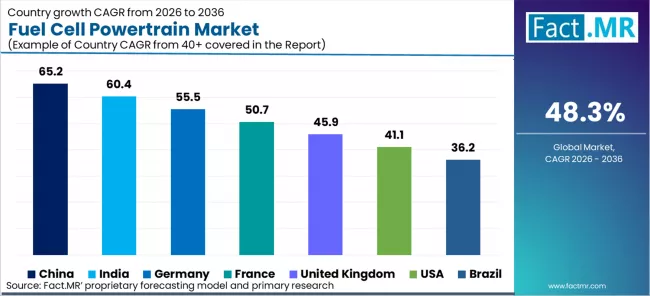
    Fuel Cell Powertrain Market Cagr Analysis By Country

    Country CAGR (%)
    China 65.2%
    India 60.4%
    Germany 55.5%
    France 50.7%
    United Kingdom 45.9%
    USA 41.1%
    Brazil 36.2%

    Source: Fact MR (FMR) analysis, based on proprietary forecasting model and primary research.

    East Asia:

    In East Asia, China is the largest market for fuel cell powertrains, driven by government policies supporting clean energy, large-scale production of fuel cell vehicles, and the development of green hydrogen infrastructure.

    • China: Demand for fuel cell powertrains in China is projected to rise at 65.2% CAGR through 2036. China’s strong commitment to clean energy and rapid adoption of hydrogen fuel cell vehicles continue to drive market growth at an exceptional rate.

    South Asia:

    In South Asia, India is witnessing rapid growth in the fuel cell powertrain market, supported by increasing investments in clean energy and government initiatives to promote sustainable transport solutions.

    • India: Demand for fuel cell powertrains in India is projected to rise at 60.4% CAGR through 2036. India’s growing push for sustainable energy solutions and expansion of electric and fuel cell vehicle infrastructure continue to contribute to market growth.

    Western Europe:

    In Western Europe, Germany and France lead the demand for fuel cell powertrains, driven by strong automotive sectors and increased government investments in hydrogen technology for sustainable mobility.

    • Germany: Demand for fuel cell powertrains in Germany is projected to rise at 55.5% CAGR through 2036. Germany’s focus on hydrogen infrastructure development and expansion of fuel cell-powered vehicles continue to drive strong market growth.
    • France: Demand for fuel cell powertrains in France is projected to rise at 50.7% CAGR through 2036. France’s government incentives for clean energy and focus on reducing carbon emissions continue to contribute to steady market expansion.
    • United Kingdom: Demand for fuel cell powertrains in the UK is projected to rise at 45.9% CAGR through 2036. The UK’s rising focus on hydrogen as a clean energy source and strong commitment to carbon-neutral goals drive the demand for fuel cell technologies.

    North America:

    In North America, the USA is a significant market for fuel cell powertrains, supported by growing government support for clean energy, technological advancements, and the demand for green transportation solutions.

    • USA: Demand for fuel cell powertrains in the U.S. is projected to rise at 41.1% CAGR through 2036. The USA’s investment in hydrogen infrastructure and expansion of fuel cell vehicle adoption continue to drive market growth.

    Latin America:

    In Latin America, Brazil leads the demand for fuel cell powertrains, driven by increasing interest in sustainable transport solutions and growing adoption of clean energy technologies.

    • Brazil: Demand for fuel cell powertrains in Brazil is projected to rise at 36.2% CAGR through 2036. Brazil’s renewable energy focus and emphasis on reducing carbon emissions support the steady growth of fuel cell technologies in the transport sector.

    Fact MR's analysis of the Fuel Cell Powertrain Market in East Asia, South Asia, Western Europe, North America, and Latin America consists of country-wise assessments that include China, India, Germany, France, the United Kingdom, the USA, and Brazil. Readers can find detailed trends, regulatory updates, and company-specific investments shaping the market’s growth in these countries.

    How Are Key Players Competing in the Fuel Cell Powertrain Market?
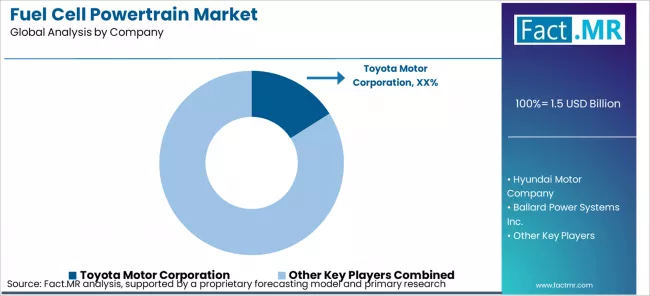
    Fuel Cell Powertrain Market Analysis By Company

    The Fuel Cell Powertrain Market is driven by innovation in clean energy solutions for vehicles, with Toyota Motor Corporation and Hyundai Motor Company at the forefront, integrating hydrogen fuel cell technology into their commercial and passenger vehicles. Ballard Power Systems Inc. and Plug Power Inc. are expanding their fuel cell systems for various applications, including trucks and stationary power generation. Cummins Inc. and Bosch Hydrogen Powertrain Systems (Robert Bosch GmbH) are advancing fuel cell integration in heavy-duty transportation and industrial uses. Companies like Symbio (Symbio FCell S.A.), AVL List GmbH, and Horizon Fuel Cell Technologies Pte. Ltd. focus on partnerships, offering advanced hydrogen systems for commercial fleets. Meanwhile, Sinosynergy Hydrogen Energy Technology Co., Ltd. is capitalizing on its regional market presence, making significant strides in China’s growing hydrogen infrastructure. The market is competitive due to continuous technological advancements, cost reductions, and expanding fuel cell vehicle adoption.

    Recent Industry Developments

    • Hyundai XCIENT 20-Million-Kilometer Milestone: Hyundai’s XCIENT Fuel Cell heavy-duty truck fleet surpassed 20 million kilometers of real-world driving across Europe as of January 2026, confirming the long-term durability of its 180-kW powertrain.
    • 2026 Hyundai Nexo Second-Generation Launch: The second-generation 2026 Hyundai Nexo debuted at the Seoul Mobility Show with a significantly upgraded powertrain delivering 201 hp (up from 161 hp) and an estimated range of 436 miles.
    • Mercedes-Benz NextGenH2 Small-Series Production: Daimler Truck announced in January 2026 that it will begin a small-series production run of 100 Mercedes-Benz NextGenH2 trucks by late 2026, utilizing liquid hydrogen to achieve a 1,000-km range.

    Key Players of the Fuel Cell Powertrain Market

    • Toyota Motor Corporation
    • Hyundai Motor Company
    • Ballard Power Systems Inc.
    • Plug Power Inc.
    • Cummins Inc.
    • Symbio (Symbio FCell S.A.)
    • Bosch Hydrogen Powertrain Systems (Robert Bosch GmbH)
    • AVL List GmbH
    • Horizon Fuel Cell Technologies Pte. Ltd.
    • Sinosynergy Hydrogen Energy Technology Co., Ltd.

    Report Scope

    Metric Value
    Quantitative Units USD 1.5 billion (2026) to USD 77.5 billion (2036), at a CAGR of 48.3%
    Market Definition The Fuel Cell Powertrain Market includes fuel cell-based systems used in vehicles, including fuel cell stacks, hydrogen storage systems, and electric drive units, catering to various transportation and material handling applications.
    By Component Outlook Fuel Cell Module (Stack + BoP), Hydrogen Storage System, Electric Drive Unit (EDU), Power Electronics & Control
    By Product Outlook Fuel Cell Electric Powertrain, Fuel Cell Stack, Fuel Cell System
    By Application Outlook Commercial Trucks & Buses, Material Handling, Passenger Vehicles
    By End-User Outlook Commercial Vehicle Manufacturers & Fleets, Automotive OEMs, Logistics & Warehouse Operators
    Regions Covered North America, Latin America, Europe, East Asia, South Asia, Oceania, Middle East and Africa
    Countries Covered United States, Canada, Mexico, Brazil, Argentina, Germany, France, United Kingdom, Italy, Spain, China, India, Japan, South Korea, Indonesia, Australia, and 40+ countries
    Key Companies Profiled Toyota Motor Corporation, Hyundai Motor Company, Ballard Power Systems Inc., Plug Power Inc., Cummins Inc., Symbio (Symbio FCell S.A.), Bosch Hydrogen Powertrain Systems (Robert Bosch GmbH), AVL List GmbH, Horizon Fuel Cell Technologies Pte. Ltd., Sinosynergy Hydrogen Energy Technology Co., Ltd.
    Forecast Period 2026 to 2036
    Approach Hybrid top-down and bottom-up market modeling validated through primary interviews with manufacturers and supported by trade data benchmarking and market research.

    Fuel Cell Powertrain Market Key Segments

    • By Component Outlook :

      • Fuel Cell Module (Stack + BoP)
      • Hydrogen Storage System
      • Electric Drive Unit (EDU)
      • Power Electronics & Control
    • By Product Outlook :

      • Fuel Cell Electric Powertrain
      • Fuel Cell Stack
      • Fuel Cell System
    • By Application Outlook :

      • Commercial Trucks & Buses
      • Material Handling
      • Passenger Vehicles
    • By End-User Outlook :

      • Commercial Vehicle Manufacturers & Fleets
      • Automotive OEMs
      • Logistics & Warehouse Operators
    • Region :

      • North America
        • USA
        • Canada
        • Mexico
      • Europe
        • Germany
        • UK
        • France
        • Italy
        • Spain
        • Nordic Countries
        • BENELUX
        • Rest of Europe
      • Asia Pacific
        • China
        • Japan
        • South Korea
        • India
        • Australia
        • Rest of Asia Pacific
      • Latin America
        • Brazil
        • Argentina
        • Rest of Latin America
      • Middle East and Africa
        • Kingdom of Saudi Arabia
        • United Arab Emirates
        • South Africa
        • Rest of Middle East and Africa
      • Other Regions
        • Oceania
        • Central Asia
        • Other Markets

    Bibliographies

    • Hyundai Newsroom. (2026, February). Hyundai XCIENT fuel cell truck fleet surpasses 20 million kilometers in real-world driving across Europe [Press release]. Hyundai Newsroom.
    • Car and Driver. (2025/2026). 2026 Hyundai Nexo second-generation launch with upgraded powertrain and 436-mile range at Seoul Mobility Show. Car and Driver.
    • Cummins Inc. (2024). Fuel cell powertrain integration for heavy-duty transportation. Cummins Inc.
    • Horizon Fuel Cell Technologies Pte. Ltd. (2024). Hydrogen fuel cell solutions for commercial fleets. Horizon Fuel Cell Technologies Pte. Ltd.
    • Hyundai Motor Company. (2024). Advancements in hydrogen fuel cell technology for sustainable transportation. Hyundai Motor Company.
    • Mercedes-Benz (Daimler Truck). (2026, January). Small-series production of 100 Mercedes-Benz NextGenH2 trucks with liquid hydrogen technology [Press release]. Daimler Truck.
    • Plug Power Inc. (2024). Hydrogen fuel cell solutions for logistics and material handling applications. Plug Power Inc.
    • Symbio FCell S.A. (2024). Hydrogen fuel cell technologies for fleet and commercial vehicle applications. Symbio FCell S.A.
    • Toyota Motor Corporation. (2024). Fuel cell technology and powertrain solutions for commercial vehicles. Toyota Motor Corporation.

    This report addresses:

    • Market Intelligence enabling comprehensive assessment of leading countries and service segments across the Fuel Cell Powertrain Market globally.
    • Market Volume (Sales Units) estimates and 10-year revenue forecasts from 2026 to 2036, validated through manufacturer shipment data, channel partner surveys, and country-level demand modeling.
    • Growth Opportunity Mapping across component categories (fuel cell modules, hydrogen storage systems, electric drive units, power electronics & control), applications (commercial trucks and buses, material handling, passenger vehicles), end-users (commercial vehicle manufacturers & fleets, automotive OEMs, logistics & warehouse operators), and regions.
    • Segment and Regional Revenue Forecasts by component, application, end-user, and geography across 40+ countries.
    • Competition Strategy Analysis covering dealer network structure, recent developments, product portfolio, USPs, and market share analysis.
    • Product and Regulatory Compliance Tracking aligned with hydrogen refueling infrastructure development, fuel cell efficiency standards, and hydrogen fueling protocols.
    • Regulatory Impact Analysis addressing global market compliance, fuel cell vehicle standards, and evolving clean energy policies for fuel cell powertrains.
    • Report Delivery in PDF, Excel, PowerPoint, and interactive dashboard formats for executive, procurement, and operational planning use.

    Table of Content

    1. Executive Summary
      • Global Market Outlook
      • Demand to side Trends
      • Supply to side Trends
      • Technology Roadmap Analysis
      • Analysis and Recommendations
    2. Market Overview
      • Market Coverage / Taxonomy
      • Market Definition / Scope / Limitations
    3. Research Methodology
      • Chapter Orientation
      • Analytical Lens and Working Hypotheses
        • Market Structure, Signals, and Trend Drivers
        • Benchmarking and Cross-market Comparability
        • Market Sizing, Forecasting, and Opportunity Mapping
      • Research Design and Evidence Framework
        • Desk Research Programme (Secondary Evidence)
          • Company Annual and Sustainability Reports
          • Peer-reviewed Journals and Academic Literature
          • Corporate Websites, Product Literature, and Technical Notes
          • Earnings Decks and Investor Briefings
          • Statutory Filings and Regulatory Disclosures
          • Technical White Papers and Standards Notes
          • Trade Journals, Industry Magazines, and Analyst Briefs
          • Conference Proceedings, Webinars, and Seminar Materials
          • Government Statistics Portals and Public Data Releases
          • Press Releases and Reputable Media Coverage
          • Specialist Newsletters and Curated Briefings
          • Sector Databases and Reference Repositories
          • FMR Internal Proprietary Databases and Historical Market Datasets
          • Subscription Datasets and Paid Sources
          • Social Channels, Communities, and Digital Listening Inputs
          • Additional Desk Sources
        • Expert Input and Fieldwork (Primary Evidence)
          • Primary Modes
            • Qualitative Interviews and Expert Elicitation
            • Quantitative Surveys and Structured Data Capture
            • Blended Approach
          • Why Primary Evidence is Used
          • Field Techniques
            • Interviews
            • Surveys
            • Focus Groups
            • Observational and In-context Research
            • Social and Community Interactions
          • Stakeholder Universe Engaged
            • C-suite Leaders
            • Board Members
            • Presidents and Vice Presidents
            • R&D and Innovation Heads
            • Technical Specialists
            • Domain Subject-matter Experts
            • Scientists
            • Physicians and Other Healthcare Professionals
          • Governance, Ethics, and Data Stewardship
            • Research Ethics
            • Data Integrity and Handling
        • Tooling, Models, and Reference Databases
      • Data Engineering and Model Build
        • Data Acquisition and Ingestion
        • Cleaning, Normalisation, and Verification
        • Synthesis, Triangulation, and Analysis
      • Quality Assurance and Audit Trail
    4. Market Background
      • Market Dynamics
        • Drivers
        • Restraints
        • Opportunity
        • Trends
      • Scenario Forecast
        • Demand in Optimistic Scenario
        • Demand in Likely Scenario
        • Demand in Conservative Scenario
      • Opportunity Map Analysis
      • Product Life Cycle Analysis
      • Supply Chain Analysis
      • Investment Feasibility Matrix
      • Value Chain Analysis
      • PESTLE and Porter’s Analysis
      • Regulatory Landscape
      • Regional Parent Market Outlook
      • Production and Consumption Statistics
      • Import and Export Statistics
    5. Global Market Analysis 2021 to 2025 and Forecast, 2026 to 2036
      • Historical Market Size Value (USD Million) Analysis, 2021 to 2025
      • Current and Future Market Size Value (USD Million) Projections, 2026 to 2036
        • Y to o to Y Growth Trend Analysis
        • Absolute $ Opportunity Analysis
    6. Global Market Pricing Analysis 2021 to 2025 and Forecast 2026 to 2036
    7. Global Market Analysis 2021 to 2025 and Forecast 2026 to 2036, By Application
      • Introduction / Key Findings
      • Historical Market Size Value (USD Million) Analysis By Application , 2021 to 2025
      • Current and Future Market Size Value (USD Million) Analysis and Forecast By Application , 2026 to 2036
        • Commercial Trucks and Buses
        • Material Handling
        • Passenger Vehicles
      • Y to o to Y Growth Trend Analysis By Application , 2021 to 2025
      • Absolute $ Opportunity Analysis By Application , 2026 to 2036
    8. Global Market Analysis 2021 to 2025 and Forecast 2026 to 2036, By Component
      • Introduction / Key Findings
      • Historical Market Size Value (USD Million) Analysis By Component, 2021 to 2025
      • Current and Future Market Size Value (USD Million) Analysis and Forecast By Component, 2026 to 2036
        • Fuel Cell Module
        • Hydrogen Storage System
        • Electric Drive Value (USD Million) (EDU)
      • Y to o to Y Growth Trend Analysis By Component, 2021 to 2025
      • Absolute $ Opportunity Analysis By Component, 2026 to 2036
    9. Global Market Analysis 2021 to 2025 and Forecast 2026 to 2036, By Region
      • Introduction
      • Historical Market Size Value (USD Million) Analysis By Region, 2021 to 2025
      • Current Market Size Value (USD Million) Analysis and Forecast By Region, 2026 to 2036
        • North America
        • Latin America
        • Western Europe
        • Eastern Europe
        • East Asia
        • South Asia and Pacific
        • Middle East & Africa
      • Market Attractiveness Analysis By Region
    10. North America Market Analysis 2021 to 2025 and Forecast 2026 to 2036, By Country
      • Historical Market Size Value (USD Million) Trend Analysis By Market Taxonomy, 2021 to 2025
      • Market Size Value (USD Million) Forecast By Market Taxonomy, 2026 to 2036
        • By Country
          • USA
          • Canada
          • Mexico
        • By Application
        • By Component
      • Market Attractiveness Analysis
        • By Country
        • By Application
        • By Component
      • Key Takeaways
    11. Latin America Market Analysis 2021 to 2025 and Forecast 2026 to 2036, By Country
      • Historical Market Size Value (USD Million) Trend Analysis By Market Taxonomy, 2021 to 2025
      • Market Size Value (USD Million) Forecast By Market Taxonomy, 2026 to 2036
        • By Country
          • Brazil
          • Chile
          • Rest of Latin America
        • By Application
        • By Component
      • Market Attractiveness Analysis
        • By Country
        • By Application
        • By Component
      • Key Takeaways
    12. Western Europe Market Analysis 2021 to 2025 and Forecast 2026 to 2036, By Country
      • Historical Market Size Value (USD Million) Trend Analysis By Market Taxonomy, 2021 to 2025
      • Market Size Value (USD Million) Forecast By Market Taxonomy, 2026 to 2036
        • By Country
          • Germany
          • UK
          • Italy
          • Spain
          • France
          • Nordic
          • BENELUX
          • Rest of Western Europe
        • By Application
        • By Component
      • Market Attractiveness Analysis
        • By Country
        • By Application
        • By Component
      • Key Takeaways
    13. Eastern Europe Market Analysis 2021 to 2025 and Forecast 2026 to 2036, By Country
      • Historical Market Size Value (USD Million) Trend Analysis By Market Taxonomy, 2021 to 2025
      • Market Size Value (USD Million) Forecast By Market Taxonomy, 2026 to 2036
        • By Country
          • Russia
          • Poland
          • Hungary
          • Balkan & Baltic
          • Rest of Eastern Europe
        • By Application
        • By Component
      • Market Attractiveness Analysis
        • By Country
        • By Application
        • By Component
      • Key Takeaways
    14. East Asia Market Analysis 2021 to 2025 and Forecast 2026 to 2036, By Country
      • Historical Market Size Value (USD Million) Trend Analysis By Market Taxonomy, 2021 to 2025
      • Market Size Value (USD Million) Forecast By Market Taxonomy, 2026 to 2036
        • By Country
          • China
          • Japan
          • South Korea
        • By Application
        • By Component
      • Market Attractiveness Analysis
        • By Country
        • By Application
        • By Component
      • Key Takeaways
    15. South Asia and Pacific Market Analysis 2021 to 2025 and Forecast 2026 to 2036, By Country
      • Historical Market Size Value (USD Million) Trend Analysis By Market Taxonomy, 2021 to 2025
      • Market Size Value (USD Million) Forecast By Market Taxonomy, 2026 to 2036
        • By Country
          • India
          • ASEAN
          • Australia & New Zealand
          • Rest of South Asia and Pacific
        • By Application
        • By Component
      • Market Attractiveness Analysis
        • By Country
        • By Application
        • By Component
      • Key Takeaways
    16. Middle East & Africa Market Analysis 2021 to 2025 and Forecast 2026 to 2036, By Country
      • Historical Market Size Value (USD Million) Trend Analysis By Market Taxonomy, 2021 to 2025
      • Market Size Value (USD Million) Forecast By Market Taxonomy, 2026 to 2036
        • By Country
          • Kingdom of Saudi Arabia
          • Other GCC Countries
          • Turkiye
          • South Africa
          • Other African Union
          • Rest of Middle East & Africa
        • By Application
        • By Component
      • Market Attractiveness Analysis
        • By Country
        • By Application
        • By Component
      • Key Takeaways
    17. Key Countries Market Analysis
      • USA
        • Pricing Analysis
        • Market Share Analysis, 2025
          • By Application
          • By Component
      • Canada
        • Pricing Analysis
        • Market Share Analysis, 2025
          • By Application
          • By Component
      • Mexico
        • Pricing Analysis
        • Market Share Analysis, 2025
          • By Application
          • By Component
      • Brazil
        • Pricing Analysis
        • Market Share Analysis, 2025
          • By Application
          • By Component
      • Chile
        • Pricing Analysis
        • Market Share Analysis, 2025
          • By Application
          • By Component
      • Germany
        • Pricing Analysis
        • Market Share Analysis, 2025
          • By Application
          • By Component
      • UK
        • Pricing Analysis
        • Market Share Analysis, 2025
          • By Application
          • By Component
      • Italy
        • Pricing Analysis
        • Market Share Analysis, 2025
          • By Application
          • By Component
      • Spain
        • Pricing Analysis
        • Market Share Analysis, 2025
          • By Application
          • By Component
      • France
        • Pricing Analysis
        • Market Share Analysis, 2025
          • By Application
          • By Component
      • India
        • Pricing Analysis
        • Market Share Analysis, 2025
          • By Application
          • By Component
      • ASEAN
        • Pricing Analysis
        • Market Share Analysis, 2025
          • By Application
          • By Component
      • Australia & New Zealand
        • Pricing Analysis
        • Market Share Analysis, 2025
          • By Application
          • By Component
      • China
        • Pricing Analysis
        • Market Share Analysis, 2025
          • By Application
          • By Component
      • Japan
        • Pricing Analysis
        • Market Share Analysis, 2025
          • By Application
          • By Component
      • South Korea
        • Pricing Analysis
        • Market Share Analysis, 2025
          • By Application
          • By Component
      • Russia
        • Pricing Analysis
        • Market Share Analysis, 2025
          • By Application
          • By Component
      • Poland
        • Pricing Analysis
        • Market Share Analysis, 2025
          • By Application
          • By Component
      • Hungary
        • Pricing Analysis
        • Market Share Analysis, 2025
          • By Application
          • By Component
      • Kingdom of Saudi Arabia
        • Pricing Analysis
        • Market Share Analysis, 2025
          • By Application
          • By Component
      • Turkiye
        • Pricing Analysis
        • Market Share Analysis, 2025
          • By Application
          • By Component
      • South Africa
        • Pricing Analysis
        • Market Share Analysis, 2025
          • By Application
          • By Component
    18. Market Structure Analysis
      • Competition Dashboard
      • Competition Benchmarking
      • Market Share Analysis of Top Players
        • By Regional
        • By Application
        • By Component
    19. Competition Analysis
      • Competition Deep Dive
        • Toyota Motor Corporation
          • Overview
          • Product Portfolio
          • Profitability by Market Segments (Product/Age /Sales Channel/Region)
          • Sales Footprint
          • Strategy Overview
            • Marketing Strategy
            • Product Strategy
            • Channel Strategy
        • Hyundai Motor Company
        • Ballard Power Systems Inc.
        • Plug Power Inc.
        • Cummins Inc.
        • Symbio (Symbio FCell S.A.)
    20. Assumptions & Acronyms Used

    List Of Table

    • Table 1: Global Market Value (USD Million) Forecast by Region, 2021 to 2036
    • Table 2: Global Market Value (USD Million) Forecast by Application, 2021 to 2036
    • Table 3: Global Market Value (USD Million) Forecast by Component, 2021 to 2036
    • Table 4: North America Market Value (USD Million) Forecast by Country, 2021 to 2036
    • Table 5: North America Market Value (USD Million) Forecast by Application, 2021 to 2036
    • Table 6: North America Market Value (USD Million) Forecast by Component, 2021 to 2036
    • Table 7: Latin America Market Value (USD Million) Forecast by Country, 2021 to 2036
    • Table 8: Latin America Market Value (USD Million) Forecast by Application, 2021 to 2036
    • Table 9: Latin America Market Value (USD Million) Forecast by Component, 2021 to 2036
    • Table 10: Western Europe Market Value (USD Million) Forecast by Country, 2021 to 2036
    • Table 11: Western Europe Market Value (USD Million) Forecast by Application, 2021 to 2036
    • Table 12: Western Europe Market Value (USD Million) Forecast by Component, 2021 to 2036
    • Table 13: Eastern Europe Market Value (USD Million) Forecast by Country, 2021 to 2036
    • Table 14: Eastern Europe Market Value (USD Million) Forecast by Application, 2021 to 2036
    • Table 15: Eastern Europe Market Value (USD Million) Forecast by Component, 2021 to 2036
    • Table 16: East Asia Market Value (USD Million) Forecast by Country, 2021 to 2036
    • Table 17: East Asia Market Value (USD Million) Forecast by Application, 2021 to 2036
    • Table 18: East Asia Market Value (USD Million) Forecast by Component, 2021 to 2036
    • Table 19: South Asia and Pacific Market Value (USD Million) Forecast by Country, 2021 to 2036
    • Table 20: South Asia and Pacific Market Value (USD Million) Forecast by Application, 2021 to 2036
    • Table 21: South Asia and Pacific Market Value (USD Million) Forecast by Component, 2021 to 2036
    • Table 22: Middle East & Africa Market Value (USD Million) Forecast by Country, 2021 to 2036
    • Table 23: Middle East & Africa Market Value (USD Million) Forecast by Application, 2021 to 2036
    • Table 24: Middle East & Africa Market Value (USD Million) Forecast by Component, 2021 to 2036

    List Of Figures

    • Figure 1: Global Market Pricing Analysis
    • Figure 2: Global Market Value (USD Million) Forecast 2021 to 2036
    • Figure 3: Global Market Value Share and BPS Analysis by Application, 2026 and 2036
    • Figure 4: Global Market Y to o to Y Growth Comparison by Application, 2026 to 2036
    • Figure 5: Global Market Attractiveness Analysis by Application
    • Figure 6: Global Market Value Share and BPS Analysis by Component, 2026 and 2036
    • Figure 7: Global Market Y to o to Y Growth Comparison by Component, 2026 to 2036
    • Figure 8: Global Market Attractiveness Analysis by Component
    • Figure 9: Global Market Value (USD Million) Share and BPS Analysis by Region, 2026 and 2036
    • Figure 10: Global Market Y to o to Y Growth Comparison by Region, 2026 to 2036
    • Figure 11: Global Market Attractiveness Analysis by Region
    • Figure 12: North America Market Incremental Dollar Opportunity, 2026 to 2036
    • Figure 13: Latin America Market Incremental Dollar Opportunity, 2026 to 2036
    • Figure 14: Western Europe Market Incremental Dollar Opportunity, 2026 to 2036
    • Figure 15: Eastern Europe Market Incremental Dollar Opportunity, 2026 to 2036
    • Figure 16: East Asia Market Incremental Dollar Opportunity, 2026 to 2036
    • Figure 17: South Asia and Pacific Market Incremental Dollar Opportunity, 2026 to 2036
    • Figure 18: Middle East & Africa Market Incremental Dollar Opportunity, 2026 to 2036
    • Figure 19: North America Market Value Share and BPS Analysis by Country, 2026 and 2036
    • Figure 20: North America Market Value Share and BPS Analysis by Application, 2026 and 2036
    • Figure 21: North America Market Y to o to Y Growth Comparison by Application, 2026 to 2036
    • Figure 22: North America Market Attractiveness Analysis by Application
    • Figure 23: North America Market Value Share and BPS Analysis by Component, 2026 and 2036
    • Figure 24: North America Market Y to o to Y Growth Comparison by Component, 2026 to 2036
    • Figure 25: North America Market Attractiveness Analysis by Component
    • Figure 26: Latin America Market Value Share and BPS Analysis by Country, 2026 and 2036
    • Figure 27: Latin America Market Value Share and BPS Analysis by Application, 2026 and 2036
    • Figure 28: Latin America Market Y to o to Y Growth Comparison by Application, 2026 to 2036
    • Figure 29: Latin America Market Attractiveness Analysis by Application
    • Figure 30: Latin America Market Value Share and BPS Analysis by Component, 2026 and 2036
    • Figure 31: Latin America Market Y to o to Y Growth Comparison by Component, 2026 to 2036
    • Figure 32: Latin America Market Attractiveness Analysis by Component
    • Figure 33: Western Europe Market Value Share and BPS Analysis by Country, 2026 and 2036
    • Figure 34: Western Europe Market Value Share and BPS Analysis by Application, 2026 and 2036
    • Figure 35: Western Europe Market Y to o to Y Growth Comparison by Application, 2026 to 2036
    • Figure 36: Western Europe Market Attractiveness Analysis by Application
    • Figure 37: Western Europe Market Value Share and BPS Analysis by Component, 2026 and 2036
    • Figure 38: Western Europe Market Y to o to Y Growth Comparison by Component, 2026 to 2036
    • Figure 39: Western Europe Market Attractiveness Analysis by Component
    • Figure 40: Eastern Europe Market Value Share and BPS Analysis by Country, 2026 and 2036
    • Figure 41: Eastern Europe Market Value Share and BPS Analysis by Application, 2026 and 2036
    • Figure 42: Eastern Europe Market Y to o to Y Growth Comparison by Application, 2026 to 2036
    • Figure 43: Eastern Europe Market Attractiveness Analysis by Application
    • Figure 44: Eastern Europe Market Value Share and BPS Analysis by Component, 2026 and 2036
    • Figure 45: Eastern Europe Market Y to o to Y Growth Comparison by Component, 2026 to 2036
    • Figure 46: Eastern Europe Market Attractiveness Analysis by Component
    • Figure 47: East Asia Market Value Share and BPS Analysis by Country, 2026 and 2036
    • Figure 48: East Asia Market Value Share and BPS Analysis by Application, 2026 and 2036
    • Figure 49: East Asia Market Y to o to Y Growth Comparison by Application, 2026 to 2036
    • Figure 50: East Asia Market Attractiveness Analysis by Application
    • Figure 51: East Asia Market Value Share and BPS Analysis by Component, 2026 and 2036
    • Figure 52: East Asia Market Y to o to Y Growth Comparison by Component, 2026 to 2036
    • Figure 53: East Asia Market Attractiveness Analysis by Component
    • Figure 54: South Asia and Pacific Market Value Share and BPS Analysis by Country, 2026 and 2036
    • Figure 55: South Asia and Pacific Market Value Share and BPS Analysis by Application, 2026 and 2036
    • Figure 56: South Asia and Pacific Market Y to o to Y Growth Comparison by Application, 2026 to 2036
    • Figure 57: South Asia and Pacific Market Attractiveness Analysis by Application
    • Figure 58: South Asia and Pacific Market Value Share and BPS Analysis by Component, 2026 and 2036
    • Figure 59: South Asia and Pacific Market Y to o to Y Growth Comparison by Component, 2026 to 2036
    • Figure 60: South Asia and Pacific Market Attractiveness Analysis by Component
    • Figure 61: Middle East & Africa Market Value Share and BPS Analysis by Country, 2026 and 2036
    • Figure 62: Middle East & Africa Market Value Share and BPS Analysis by Application, 2026 and 2036
    • Figure 63: Middle East & Africa Market Y to o to Y Growth Comparison by Application, 2026 to 2036
    • Figure 64: Middle East & Africa Market Attractiveness Analysis by Application
    • Figure 65: Middle East & Africa Market Value Share and BPS Analysis by Component, 2026 and 2036
    • Figure 66: Middle East & Africa Market Y to o to Y Growth Comparison by Component, 2026 to 2036
    • Figure 67: Middle East & Africa Market Attractiveness Analysis by Component
    • Figure 68: Global Market - Tier Structure Analysis
    • Figure 69: Global Market - Company Share Analysis

    - FAQs -

    How large is the demand for Fuel Cell Powertrains in the global market in 2026?

    Demand for Fuel Cell Powertrains in the global market is estimated to be valued at USD 1.5 billion in 2026.

    What will be the market size of Fuel Cell Powertrains in the global market by 2036?

    The market size for Fuel Cell Powertrains is projected to reach USD 77.5 billion by 2036.

    What is the expected demand growth for Fuel Cell Powertrains in the global market between 2026 and 2036?

    Demand for Fuel Cell Powertrains in the global market is expected to grow at a CAGR of 48.3% between 2026 and 2036.

    Which application is expected to dominate the market?

    Commercial Trucks & Buses are expected to dominate the market, accounting for 87% of the market share in 2026, driven by the growing demand for clean, efficient, and sustainable transportation solutions in the commercial sector.

    Which region is expected to show the highest growth rate for Fuel Cell Powertrains?

    China is projected to show the highest regional CAGR at 65.2% during the forecast period, driven by aggressive investments in clean energy, government support for hydrogen infrastructure, and growing adoption of fuel cell-powered vehicles.

    How significant is the growth outlook for India in this market?

    India is expected to grow at a CAGR of 60.4%, supported by the country’s expanding commercial vehicle market, increasing focus on reducing carbon emissions, and the government’s push toward sustainable transportation solutions.

    What is the growth outlook for Germany in the Fuel Cell Powertrain market?

    Germany is expected to grow at a CAGR of 55.5%, driven by the country's leadership in clean technology innovation, strong automotive industry, and commitment to hydrogen fuel cell adoption in commercial vehicles.

    What is the growth forecast for France in the Fuel Cell Powertrain market?

    France is expected to grow at a CAGR of 50.7%, with increasing government incentives for hydrogen fuel cell vehicles and a strong focus on transitioning to sustainable, zero-emission transportation solutions.

    What is the growth forecast for the United Kingdom in the Fuel Cell Powertrain market?

    The United Kingdom is expected to grow at a CAGR of 45.9%, supported by growing investments in hydrogen technology, infrastructure development, and increasing demand for clean energy solutions in transportation.

    What is the growth forecast for the United States in the Fuel Cell Powertrain market?

    The United States is projected to grow at a CAGR of 41.1% from 2026 to 2036, driven by increasing demand for fuel-efficient and eco-friendly transportation solutions, particularly in the commercial vehicle sector.

    What is the growth forecast for Brazil in the Fuel Cell Powertrain market?

    Brazil is expected to grow at a CAGR of 36.2%, supported by rising demand for sustainable transportation solutions and government initiatives to adopt hydrogen fuel cell technology in commercial fleets.

    Which company is identified as a leading player in the Fuel Cell Powertrain market?

    Toyota Motor Corporation is recognized as a leading player in this market, offering cutting-edge fuel cell technology for commercial vehicles, including trucks and buses, and driving the global adoption of hydrogen fuel cell powertrains.

    What are Fuel Cell Powertrains used for?

    Fuel Cell Powertrains are used to power hydrogen fuel cell vehicles, including commercial trucks and buses, providing a clean and efficient alternative to conventional internal combustion engine vehicles by generating electricity through a chemical reaction between hydrogen and oxygen.

    What does the Fuel Cell Powertrain market include in this report?

    The market scope includes fuel cell powertrains used in commercial trucks and buses, focusing on hydrogen fuel cell technology as a clean and sustainable solution for the commercial transportation sector, aiming to reduce emissions and improve fuel efficiency.

    How is the market forecast developed in this report?

    The forecast is developed using historical data on the adoption of fuel cell technology in transportation, government policies supporting hydrogen infrastructure, and insights from key industry players involved in the development and deployment of fuel cell powertrains.

    What is meant by the Fuel Cell Powertrain market in this report?

    The market refers to the global production, trade, and consumption of fuel cell powertrains, particularly in commercial trucks and buses, focusing on the adoption of hydrogen fuel cell technology to drive the transition to zero-emission transportation.

    Fuel Cell Powertrain Market