- Base Value(2026): 1.9 Bn
- Estimated Value(2026): 1.9 Bn
- Forecast Value (2036): 3.4 Bn
- CAGR (2026 - 2036): 5.6%
Fuel Delivery Control Units Market Forecast Outlook 2026 to 2036
The fuel delivery control units market is likely to be valued at USD 1.9 billion in 2026 and is projected to reach USD 3.4 billion by 2036, expanding at a 5.6% compound annual growth rate (CAGR).
Key Takeaways from Fuel Delivery Control Units Market
- Fuel Delivery Control Units Market Value (2026): USD 1.9 billion
- Fuel Delivery Control Units Market Forecast Value (2036): USD 3.4 billion
- Fuel Delivery Control Units Market Forecast CAGR (2026-2036): 5.6%
- Leading Segment in Fuel Delivery Control Units Market: Passenger Vehicle Segment (51%)
- Key Growth Region in Fuel Delivery Control Units Market: Asia Pacific
- Key Players in Fuel Delivery Control Units Market: Robert Bosch GmbH (Bosch), Denso Corporation, Continental AG, Delphi Technologies (brand now under BorgWarner Inc.), Hitachi Astemo Ltd., Marelli Holdings Co., Ltd., Nidec Corporation, Weifu High-Technology Group Co., Ltd., Cummins Inc., Rheinmetall AG
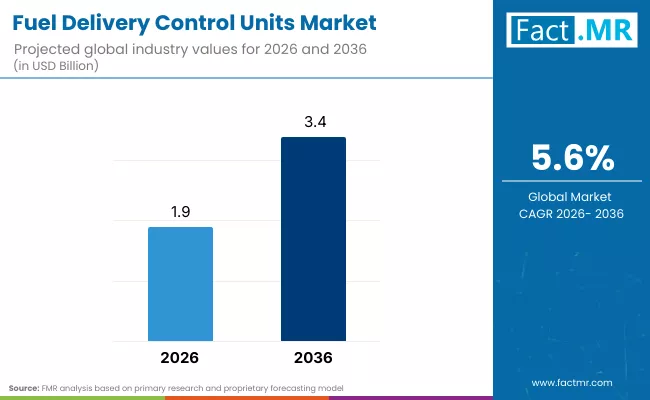
Fuel Delivery Control Units Market By Industry | Source: Fact.MR
Within the automotive and industrial sectors, this category has evolved into a high-stakes intelligence layer responsible for reconciling the conflicting demands of peak engine performance and aggressive net-zero mandates. Control points in this market have shifted from mechanical hardware to sophisticated software algorithms that manage high-pressure injection and multi-fuel blending in real time.
Dependency factors are currently dictated by the rise of hybrid and hydrogen-ICE platforms, where the control unit must serve as a bridge between traditional combustion and emerging zero-emission technologies. Strategic trade-offs involve balancing the extreme precision required for lean-burn efficiency against the material durability needed to handle corrosive alternative fuels. Consequently, value is concentrating among Tier 1 innovators who can provide integrated "smart" management systems that de-risk the transition for OEMs navigating the complexity of 2030 emissions cycles.
Fuel Delivery Control Units Market
| Metric | Value |
|---|---|
| Estimated Value in (2026E) | USD 1.9 billion |
| Forecast Value in (2036F) | USD 3.4 billion |
| Forecast CAGR (2026 to 2036) | 5.6% |
Source: Fact.MR analysis. Updated Feb 6, 2026
Category
| Category | Sub-Segment |
|---|---|
| By Control Unit Type | Fuel Pump Control Modules; Injector Driver Units; Rail Pressure Control Units; Other |
| By Powertrain | Gasoline ICE; Diesel ICE; Hybrid; Other |
| By Integration Level | Standalone ECU Module; Integrated Powertrain ECU; Domain Controller Integration; Other |
| By Vehicle Segment | Passenger; LCV; HD; Other |
| Region | North America; Europe; Asia Pacific; Latin America; Middle East & Africa |
Source: Fact.MR analysis. Updated Feb 6, 2026
Segmental Analysis
What is Driving the Dominance of Passenger Vehicles in the Fuel Delivery Control Units Market?
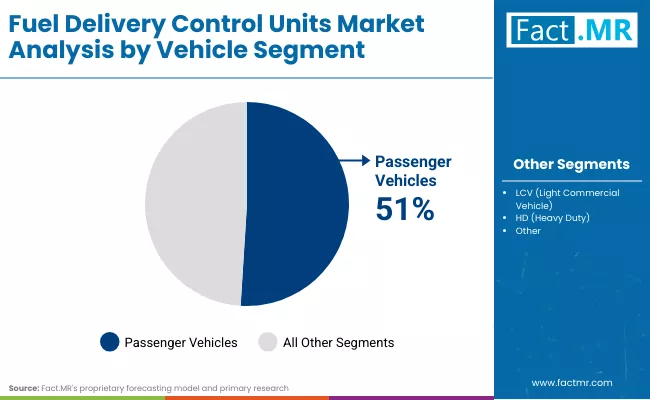
Fuel Delivery Control Units Market By Vehicle Segment | Source: Fact.MR
Passenger vehicles lead the fuel delivery control units market with 51% of the market share in 2026. This segment's dominance is driven by the high volume of passenger car production globally, particularly those using internal combustion engines (ICE). Fuel delivery control units are critical for managing fuel flow, ensuring optimal engine performance, and complying with environmental regulations. As passenger vehicle production continues to grow, the need for more efficient and reliable fuel delivery systems remains strong, especially in regions with strict emissions standards.
What is the Role of Gasoline ICE in the Fuel Delivery Control Units Market?
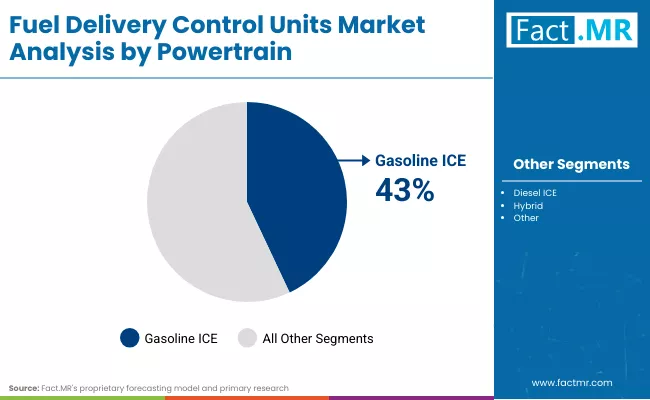
Fuel Delivery Control Units Market By Powertrain | Source: Fact.MR
Gasoline ICE (Internal Combustion Engine) powertrains hold 43% of the market share in 2026. Gasoline engines continue to dominate the fuel delivery control units market, as they remain the standard in passenger vehicles. These engines require sophisticated control units to regulate fuel delivery efficiently, optimizing performance, fuel economy, and emissions. Although the market is shifting toward electrification, gasoline ICE vehicles still represent a significant portion of global vehicle production, driving ongoing demand for fuel delivery control units.
What are the Drivers, Restraints, and Key Trends in the Fuel Delivery Control Units Market?
Demand for fuel delivery control units is shaped by automotive OEM and powertrain supplier requirements to manage precise fuel injection, pressure regulation, and flow control in internal combustion engines (ICE) and hybrid powertrains. Engineers specify control units that integrate with engine management systems to support optimized combustion, reduced emissions, and responsiveness under varied load conditions, closely aligned with components used in the automotive fuel injection system market. Procurement teams prioritize suppliers that can deliver units with consistent performance, robust diagnostics, and compliance with global emissions and safety standards. Growth in commercial and passenger vehicle production influences sourcing strategies and volume forecasts for fuel delivery components.
High development and validation costs constrain adoption in cost‑sensitive segments, and increasing regulatory pressure on emissions and fuel efficiency necessitates frequent redesigns. Variability in engine architectures and fuel types affects specification complexity and calibration effort. Key trends include development of adaptive control logic that supports multi‑mode operating profiles and expansion of compact, lightweight units that integrate pressure sensors and actuators to enhance system efficiency and support connected engine diagnostics.
Analysis of the Fuel Delivery Control Units Market by Key Country
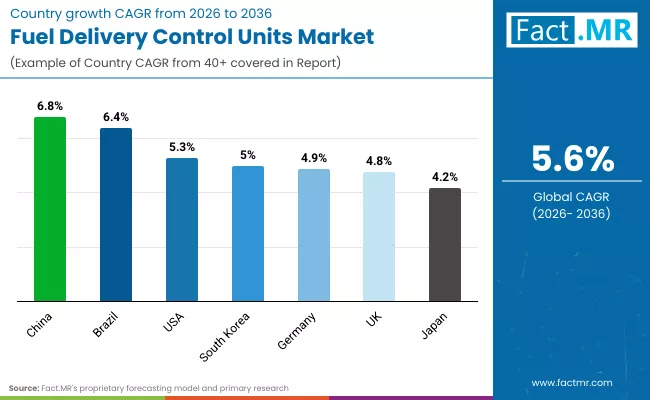
Fuel Delivery Control Units Market By Country | Source: Fact.MR
| Country | CAGR (2026-2036) |
|---|---|
| USA | 5.3% |
| Japan | 4.2% |
| South Korea | 5.0% |
| Germany | 4.9% |
| China | 6.8% |
| UK | 4.8% |
| Brazil | 6.4% |
Source: Fact.MR analysis. Updated Feb 6, 2026
The report covers an in-depth analysis of 40+ countries; top-performing countries are highlighted below.
What Drives the Growth in the USA Fuel Delivery Control Units Market?
The USA Fuel Delivery Control Units market is expanding at 5.3%, driven by the increasing demand for high-efficiency and environmentally friendly fuel systems in the automotive sector. With rising fuel efficiency standards and stricter emissions regulations, automakers are adopting advanced fuel delivery control units to optimize fuel consumption and reduce carbon emissions. The continued growth of hybrid and electric vehicle technologies, along with a focus on performance and reliability, further drives the demand for advanced fuel delivery systems. Government regulations and consumer preferences for fuel-efficient vehicles also contribute to the market's steady growth.
How Does the Japan Fuel Delivery Control Units Market Expand?
The Japan Fuel Delivery Control Units market is growing at 4.2%, supported by Japan’s focus on automotive innovation and the adoption of cleaner technologies. Japanese automakers, such as Toyota and Honda, are increasingly integrating fuel delivery control units to enhance fuel efficiency and reduce emissions, particularly in hybrid and internal combustion engine vehicles. The country’s commitment to environmental sustainability and technological advancements, including the development of electric and hybrid vehicles, drives the demand for these advanced fuel control systems. Japan's stringent emissions regulations and focus on energy-efficient technologies ensure continued market growth.
What Factors Support the Growth of the South Korea Fuel Delivery Control Units Market?
The South Korea Fuel Delivery Control Units market is expanding at 5.0%, driven by the country's thriving automotive industry, particularly in electric and hybrid vehicles. South Korea's automakers, such as Hyundai and Kia, are adopting advanced fuel delivery control units to meet stringent emissions standards and improve fuel efficiency. The increasing demand for eco-friendly vehicles and the government’s support for green technologies contribute to the growth of the market. Additionally, South Korea's focus on innovation in automotive technologies, including enhanced fuel delivery and engine control systems, ensures the market's continued expansion.
How Does the Germany Fuel Delivery Control Units Market Expand?
The Germany Fuel Delivery Control Units market is growing at a rate of 4.9%, driven by Germany’s strong automotive industry and emphasis on environmental performance. As one of the largest automotive manufacturers in the world, German automakers like Volkswagen and BMW are increasingly integrating advanced fuel delivery control units to enhance fuel efficiency and reduce emissions. Germany’s commitment to sustainability and compliance with European Union emissions standards further boosts the adoption of these systems. The country's focus on energy-efficient and high-performance vehicles, including electric and hybrid models, supports the continued growth of the fuel delivery control units market.
What Drives the Growth in the China Fuel Delivery Control Units Market?
The China Fuel Delivery Control Units market is expanding at 6.8%, driven by the country's rapid automotive industry growth and increasing demand for more efficient fuel management systems. As China becomes a major hub for vehicle production and consumption, the need for advanced fuel delivery control units to meet stricter emissions standards and improve fuel efficiency is rising. The shift toward electric and hybrid vehicles further drives the market, with Chinese automakers increasingly adopting these advanced systems. China’s governmental policies supporting environmental sustainability and energy-efficient technologies also play a significant role in driving the market’s growth.
How Does the UK Fuel Delivery Control Units Market Expand?
The UK Fuel Delivery Control Units market is growing at 4.8%, influenced by the country’s commitment to reducing vehicle emissions and improving fuel efficiency. UK automakers are increasingly adopting advanced fuel delivery control units to comply with stringent environmental regulations and meet consumer demand for fuel-efficient vehicles. The rise in hybrid and electric vehicle adoption, along with government initiatives supporting eco-friendly technologies, further supports the market’s expansion. The UK’s automotive industry continues to prioritize the development of advanced systems to enhance vehicle performance and fuel economy, contributing to the steady growth of the fuel delivery control units market.
What Influences the Growth of the Brazil Fuel Delivery Control Units Market?
The Brazil Fuel Delivery Control Units market is expanding at 6.4%, driven by the country’s growing automotive sector and the demand for more fuel-efficient vehicles. As Brazil continues to embrace greener technologies and stricter emissions standards, automakers are increasingly integrating advanced fuel delivery control units into their vehicles. The rise of electric and hybrid vehicles in Brazil, along with a focus on reducing carbon emissions, boosts the demand for these systems. Brazil's automotive industry, which is increasingly focusing on efficiency and sustainability, further supports the market's growth, making it a key player in the Latin American region.
How Are Key Players Competing in the Fuel Delivery Control Units Market?
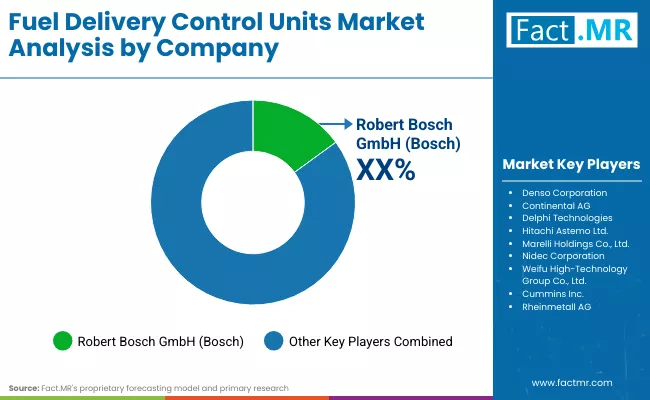
Fuel Delivery Control Units Market By Company | Source: Fact.MR
In the fuel delivery control units market, Robert Bosch GmbH and Denso Corporation lead with their advanced fuel management systems integrating precise fuel flow control and real-time diagnostics to meet stringent emissions regulations. Continental AG and Delphi Technologies are focused on enhancing fuel injection control through innovative electronic and mechanical integration, optimizing fuel efficiency and vehicle performance. Hitachi Astemo Ltd. and Marelli Holdings Co., Ltd. leverage their expertise in automotive electronics to improve fuel system reliability and advanced control algorithms for hybrid and electric platforms. Nidec Corporation and Weifu High-Technology Group Co., Ltd. focus on cost-efficient solutions for emissions compliance and fuel delivery optimization. Cummins Inc. and Rheinmetall AG bring innovation through next-gen fuel control technology aimed at both conventional and alternative fuel engines, ensuring performance and environmental compliance across a variety of powertrains.
Recent Industry Developments
- Patent - Adaptive Fuel Delivery Control Logic (Published Feb 29, 2024): A patent was published covering an adaptive fuel delivery control unit that adjusts fuel injection and pressure delivery based on real-time engine operating conditions using feedback sensors. This invention enhances fuel efficiency and emissions control in internal-combustion engines.
- Patent - Integrated Fuel Pump & Control Module for EV Range Extenders (Published Oct 15, 2023): A patent application describes a fuel delivery control module integrated with a high-pressure pump designed for use in range-extender systems (internal combustion generators for EVs), combining pressure regulation and electronic control for smoother delivery.
- Supplier Product Update - Bosch High-Pressure Fuel Delivery Controllers (2025): Bosch Mobility Solutions updated its portfolio of high-pressure fuel delivery control units for modern gasoline direct-injection and turbocharged engines, featuring advanced pressure sensing and rapid electronic actuator control to improve response and emissions compliance.
Key Players of the Fuel Delivery Control Units Market
- Robert Bosch GmbH (Bosch)
- Denso Corporation
- Continental AG
- Delphi Technologies
- Hitachi Astemo Ltd.
- Marelli Holdings Co., Ltd.
- Nidec Corporation
- Weifu High-Technology Group Co., Ltd.
- Cummins Inc.
- Rheinmetall AG
Bibliographies
- European Commission. (2023). Regulation (EU) 2023/443 on type-approval of motor vehicles with respect to emissions (Euro 7) and on-board diagnostics requirements. Official Journal of the European Union.
- United Nations Economic Commission for Europe. (2024). UN Regulation No. 154 - Worldwide harmonized Light vehicles Test Procedure (WLTP) and OBD requirements. UNECE.
- U.S. Environmental Protection Agency. (2023). 40 CFR Part 86 - Emission control systems and fuel system requirements for light-duty vehicles. EPA.
- California Air Resources Board. (2023). OBD and evaporative emission control requirements for fuel systems. CARB.
- Society of Automotive Engineers. (2023). Fuel injection pressure control, diagnostics, and emission compliance in modern engines. SAE Technical Paper Series.
Segmentation
Scope of the Report
| Items | Values |
|---|---|
| Quantitative Units (2026) | USD Billion |
| By Control Unit Type | Fuel Pump Control Modules, Injector Driver Units, Rail Pressure Control Units, Other |
| By Powertrain | Gasoline ICE, Diesel ICE, Hybrid, Other |
| By Integration Level | Standalone ECU Module, Integrated Powertrain ECU, Domain Controller Integration, Other |
| By Vehicle Segment | Passenger, LCV, HD, Other |
| Regions Covered | North America, Europe, Asia Pacific, Latin America, Middle East & Africa |
| Countries Covered | United States, Canada, Mexico, Germany, United Kingdom, France, Japan, South Korea, China, India, Brazil, and other countries |
| Key Companies Profiled | Robert Bosch GmbH (Bosch), Denso Corporation, Continental AG, Delphi Technologies, Hitachi Astemo Ltd., Marelli Holdings Co., Ltd., Nidec Corporation, Weifu High-Technology Group Co., Ltd., Cummins Inc., Rheinmetall AG |
| Additional Attributes | Dollar revenue by control unit type, powertrain, integration level, vehicle segment, and region; regional demand trends, competitive landscape, technological advancements in fuel delivery control units, operational performance optimization initiatives, and product development strategies |
Source: Fact.MR analysis. Updated Feb 6, 2026
Fuel Delivery Control Units Market Key Segments
-
By Control Unit Type :
- Fuel Pump Control Modules
- Injector Driver Units
- Rail Pressure Control Units
- Other
-
By Powertrain :
- Gasoline ICE
- Diesel ICE
- Hybrid
- Other
-
By Integration Level :
- Standalone ECU Module
- Integrated Powertrain ECU
- Domain Controller Integration
- Other
-
By Vehicle Segment :
- Passenger
- LCV (Light Commercial Vehicle)
- HD (Heavy Duty)
- Other
-
Region :
- North America
- USA
- Canada
- Mexico
- Europe
- Germany
- UK
- France
- Italy
- Spain
- Nordic Countries
- BENELUX
- Rest of Europe
- Asia Pacific
- China
- Japan
- South Korea
- India
- Australia
- Rest of Asia Pacific
- Latin America
- Brazil
- Argentina
- Rest of Latin America
- Middle East and Africa
- Kingdom of Saudi Arabia
- United Arab Emirates
- South Africa
- Rest of Middle East and Africa
- Other Regions
- Oceania
- Central Asia
- Other Markets
- North America
Frequently Asked Questions
What is the projected market size for fuel delivery control units in 2026?
What value is expected for fuel delivery control units in 2036?
At what rate will the fuel delivery control unit market progress from 2026 to 2036?
Which vehicle segment dominates demand and what share does it hold?
Who are the major players in the fuel delivery control units market?
Who worked on this report


Preview the report firsthand - request a free sample
Free SampleGet the brochure for pricing and purchase details
Download PDF