- Base Value(2025): 1.3 Bn
- Estimated Value(2026): 1.5 Bn
- Forecast Value (2036): 8.2 Bn
- CAGR (2026 - 2036): 18.2%
Hydrogen Fuel Cell Control Unit Platforms for Vehicles Market Forecast and Outlook By Fact.MR
- In 2025, the hydrogen fuel cell control unit platforms for vehicles market was valued at USD 1.3 billion.
- Based on Fact.MR analysis, demand for hydrogen fuel cell control unit platforms is estimated to grow to USD 1.5 billion in 2026 and USD 8.2 billion by 2036.
- FACT.MR projects a CAGR of 18.2% during the forecast period.
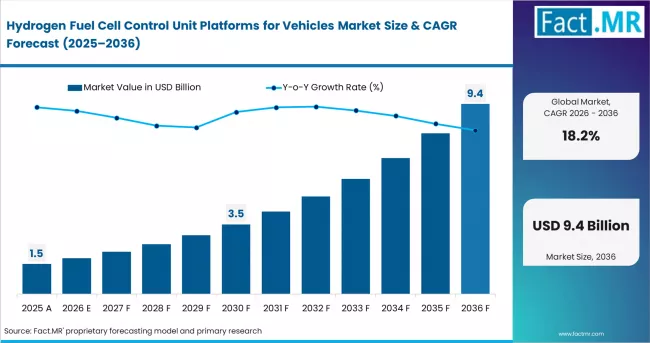
Hydrogen Fuel Cell Control Unit Platforms For Vehicles Market Market Value Analysis | Source: Fact.MR
| Metric | Value |
|---|---|
| Estimated Value in 2026 | USD 1.5 billion |
| Forecast Value in 2036 | USD 8.2 billion |
| Forecast CAGR (2026 to 2036) | 18.2% |
Source: Fact.MR analysis. Updated May 11, 2026
Summary of Hydrogen Fuel Cell Control Unit Platforms for Vehicles Market
- Market Definition
- The market covers integrated and modular ECU platforms that manage hydrogen fuel cell stack operation, energy distribution, and thermal control in commercial and passenger fuel cell vehicles globally.
- Demand Drivers
- China MIIT fuel cell vehicle quotas and state hydrogen corridor programmes are scaling ECU procurement across bus and truck OEM supply chains.
- EU Clean Hydrogen Partnership funding is mandating zero-emission heavy vehicle targets, accelerating integrated control unit adoption in European commercial vehicle programmes.
- U.S. DOE clean hydrogen hub investments are supporting heavy-duty fuel cell fleet pilots, creating structured ECU procurement cycles for certified Tier 1 suppliers.
- Key Segments Analyzed
- By Platform Type: Integrated fuel cell control units lead at 40% in 2026. Critical for stack-level power and system management in heavy commercial vehicle deployments.
- By Component: Hardware ECUs and controllers lead at 45% in 2026. Driven by OEM sourcing requirements for certified, ASIL-D-compliant embedded control hardware.
- By Region: Asia Pacific leads in 2026. Supported by China and Japan fuel cell vehicle programme scale and South Korea integrated powertrain investments.
- Analyst Opinion at FACT.MR
- Shambhu Nath Jha, Principal Consultant at Fact.MR, opines, 'CXOs will find that integrated FCU platform suppliers with ISO 26262 ASIL-D certification and real-time diagnostics compatibility are capturing disproportionate contract value in commercial vehicle OEM programmes globally.'
- Strategic Implications
- Invest in integrated fuel cell control unit platforms targeting ASIL-D certification for heavy-duty bus and truck OEM programme qualification.
- Develop modular ECU architectures compatible with hydrogen corridor fleet deployments under EU Clean Hydrogen and U.S. DOE hydrogen hub frameworks.
- Separate premium integrated platform lines from standard energy management ECU products. Capture OEM preferred supplier contracts through performance validation data.
- Methodology
- Market sizing based on ECU unit revenues and fuel cell vehicle deployment volumes. Validated with 2024-2025 OEM financial and procurement data.
- Supported by DOE hydrogen hub programme records, EU Clean Hydrogen Partnership filings, and China MIIT fuel cell vehicle quota data.
Forecasts include fuel cell vehicle production ramp schedules, control unit adoption curves, and primary expert inputs from OEM and Tier 1 supplier teams.
The market is expected to generate USD 6.7 billion in incremental revenue during the forecast period. Growth is transformation-grade and driven by commercial vehicle electrification, hydrogen corridor deployment, and regulatory mandates on zero-emission heavy transport. System complexity and calibration requirements are the primary capacity constraints limiting faster adoption.
China leads at 19.5% CAGR through 2036, anchored by state-backed hydrogen bus and truck corridor deployments and MIIT-mandated fuel cell vehicle quotas. Japan follows at 18.8%, driven by Toyota and Honda fuel cell programme expansions and the national hydrogen strategy. India grows at 18.1%, supported by early-stage hydrogen mobility pilots under the National Green Hydrogen Mission. South Korea records 18.4%, powered by Hyundai's integrated fuel cell powertrain investments. Germany records 17.6%, supported by EU hydrogen infrastructure fund commitments and commercial vehicle OEM programmes. The United States follows at 17.2%, driven by DOE clean hydrogen hubs and heavy-duty fleet pilot investments.
Segmental Analysis
Hydrogen Fuel Cell Control Unit Platforms for Vehicles Market Analysis by Platform Type
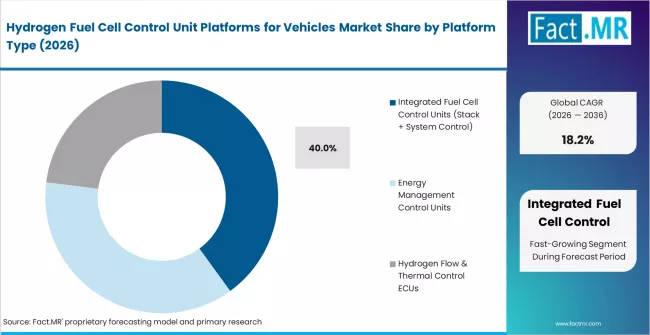
Hydrogen Fuel Cell Control Unit Platforms For Vehicles Market Analysis By Platform Type | Source: Fact.MR
Based on FACT.MR analysis, integrated fuel cell control units hold 40% share in 2026. This platform consolidates stack control and system management. It supports real-time diagnostics and cybersecurity compliance. OEMs prefer integrated units for programme simplification. ASIL-D-certified systems are standard for heavy commercial vehicle sourcing.
- Bosch Investment: Robert Bosch GmbH announced expansion of its hydrogen powertrain electronics development programme in Q2 2024. Focus areas include integrated FCU stack management systems for European bus and truck OEM customers [4].
- Toyota Technology: Toyota Motor Corporation introduced its second-generation fuel cell system with updated integrated control unit architecture in early 2025. The system targets commercial truck and bus applications with enhanced thermal management control [5].
- Demand Trend: Integrated fuel cell ECU procurement in commercial vehicle OEM programmes grew approximately 28% in 2024, driven by fuel cell bus fleet orders in China and hydrogen truck pilot programmes in Germany [6].
Hydrogen Fuel Cell Control Unit Platforms for Vehicles Market Analysis by Component
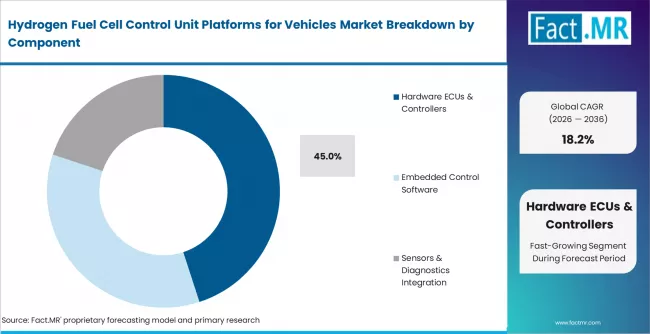
Hydrogen Fuel Cell Control Unit Platforms For Vehicles Market Analysis By Component | Source: Fact.MR
Based on FACT.MR analysis, hardware ECUs and controllers hold 45% share in 2026. This segment leads because OEM sourcing requires certified embedded control hardware. ISO 26262 ASIL-D compliance is mandatory. Automotive-grade processors and CAN/Ethernet communication stacks are standard requirements.
- Denso Development: Denso Corporation launched a next-generation fuel cell ECU hardware platform in Q3 2024, incorporating enhanced diagnostics integration and functional safety certification targeting hydrogen commercial vehicle OEM programmes in Japan and Europe [7].
- Aptiv Partnership: Aptiv PLC announced a technology collaboration with a European hydrogen truck OEM in early 2025 for embedded control software integration within a certified FCU hardware platform targeting EU zero-emission vehicle mandates [8].
- Sensors Trend: Hydrogen flow and pressure sensor integration into FCU platforms grew approximately 31% in 2024, driven by OEM requirements for real-time stack diagnostics in commercial fleet management systems [6].
Drivers, Restraints, and Opportunities
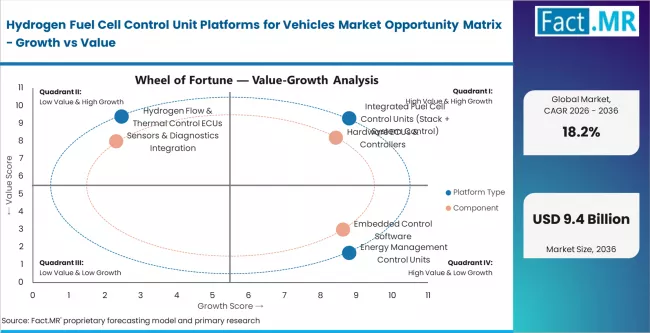
Hydrogen Fuel Cell Control Unit Platforms For Vehicles Market Opportunity Matrix Growth Vs Value | Source: Fact.MR
FACT.MR analysts observe that the market is in an early high-growth phase, anchored by commercial vehicle OEM programmes and government hydrogen mobility investments. Demand is concentrated in integrated control unit platforms for fuel cell buses and trucks. These segments are supported by zero-emission transport mandates. ECU complexity requirements are rising with hydrogen corridor scale-up. Critical mineral-free power electronics and embedded cybersecurity compliance are adding cost to system development. Growth is regulation-led and consistent across major hydrogen vehicle markets.
Standalone energy management and thermal control ECU segments are losing differentiation. OEMs prefer integrated stack-and-system platforms that consolidate control architecture. Suppliers of modular legacy ECUs face displacement risk. High-performance integrated units command premium pricing. Calibration and validation complexity limits the pace of new entrants. A mid-tier segment is emerging for light commercial and passenger fuel cell vehicle applications.
- EU Clean Hydrogen Partnership Mandate: The EU Clean Hydrogen Joint Undertaking allocated EUR 1 billion in 2024 for hydrogen transport and infrastructure projects. Commercial vehicle OEMs are accelerating ECU sourcing for fuel cell truck and bus programmes. Bosch and Continental reported increased development activity in Q3 2024 [1].
- U.S. DOE Hydrogen Hub Investment: The U.S. DOE announced USD 7 billion in Regional Clean Hydrogen Hub grants in late 2023, with fleet deployment phases launching in 2024-2025. Heavy-duty fuel cell vehicle programmes within hub boundaries require certified ECU platforms. Plug Power and Ballard expanded supply agreements in 2024 [2].
- China MIIT Fuel Cell Vehicle Expansion: China's MIIT extended fuel cell vehicle demonstration city clusters in 2024, adding Chengdu and Chongqing. State bus operators are scaling hydrogen fleet procurement, requiring standardised ECU platforms. Hyundai and domestic suppliers reported increased tendering activity in mid-2024 [3].
Regional Analysis
The hydrogen fuel cell control unit platforms for vehicles market is assessed across Asia Pacific, North America, Europe, Latin America, and Middle East and Africa, covering 40+ countries with demand profiles shaped by hydrogen vehicle deployment programmes, commercial fleet electrification mandates, and fuel cell infrastructure investment levels. The full report offers market attractiveness analysis by region and country.
.webp "Top Country Growth Comparison Hydrogen Fuel Cell Control Unit Platforms For Vehicles Market Cagr (2026 2036)")
Top Country Growth Comparison Hydrogen Fuel Cell Control Unit Platforms For Vehicles Market Cagr (2026 2036) | Source: Fact.MR
| Country | CAGR (2026 to 2036) |
|---|---|
| China | 19.5% |
| Japan | 18.8% |
| South Korea | 18.4% |
| India | 18.1% |
| Germany | 17.6% |
| United States | 17.2% |
Source: Fact.MR analysis. Updated May 11, 2026
Source: Fact.MR (FACT.MR) analysis, based on proprietary forecasting model and primary research
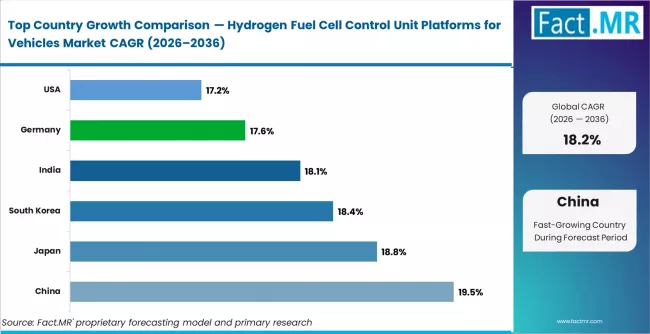
Hydrogen Fuel Cell Control Unit Platforms For Vehicles Market Cagr Analysis By Country | Source: Fact.MR
Asia Pacific Hydrogen Fuel Cell Control Unit Platforms for Vehicles Market Analysis
Asia Pacific serves as the core production and deployment hub for hydrogen fuel cell vehicle platforms. Policy momentum remains strong across major economies. OEMs are scaling investments in fuel cell systems. Supply chains are becoming vertically integrated and localized. Platform development is increasingly system-centric.
- China: Adoption of hydrogen fuel cell control unit platforms in China is projected to expand at 19.5% CAGR through 2036. Expansion is supported by MIIT-led demonstration clusters. Chengdu and Chongqing were added in 2024. Beijing, Shanghai, and Guangdong remain key hubs. State-backed bus fleets are issuing uniform ECU tenders. These specify real-time stack diagnostics and CAN architecture. National hydrogen targets are accelerating platform deployment.
- South Korea: Expansion of hydrogen fuel cell control unit platforms in South Korea is estimated at 18.4% CAGR through 2036. Momentum is led by Hyundai Motor Group. Its commercial fuel cell programme is a central driver. XCIENT truck exports require high-level safety-certified ECUs. National hydrogen policies are enforcing deployment targets. This is creating repeat procurement cycles. Hyundai is increasing investment in next-generation FCU integration. Municipal hydrogen bus projects are scaling. Procurement follows structured and standardized tenders.
- Japan: Progress of hydrogen fuel cell control unit platforms in Japan is forecast at 18.8% CAGR through 2036. Activity is driven by Toyota Motor Corporation and Honda Motor Co., Ltd. Both are expanding fuel cell vehicle programmes. National hydrogen strategy is backed by long-term capital allocation. OEM sourcing emphasizes validation rigor and lifecycle durability. Calibration documentation is essential. Functional safety certification is non-negotiable. Supplier switching remains difficult. Contract cycles are extended.
- India: Development of hydrogen fuel cell control unit platforms in India is projected at 18.1% CAGR through 2036. Policy backing comes from the National Green Hydrogen Mission. Pilot hydrogen bus deployments are underway. NTPC Limited and Indian Oil Corporation are leading early investments. Initial focus is on cost-efficient ECU systems. Compatibility with imported stacks is required. Procurement remains pilot-driven. Scaled contracts are expected as deployments increase post-2026.
FACT.MR’s analysis of the Asia Pacific market includes China, Japan, South Korea, India, ASEAN, and Australia and New Zealand. It covers hydrogen vehicle deployment, OEM sourcing patterns, investment benchmarks, and ECU platform adoption trends across countries.
Europe Hydrogen Fuel Cell Control Unit Platforms for Vehicles Market Analysis
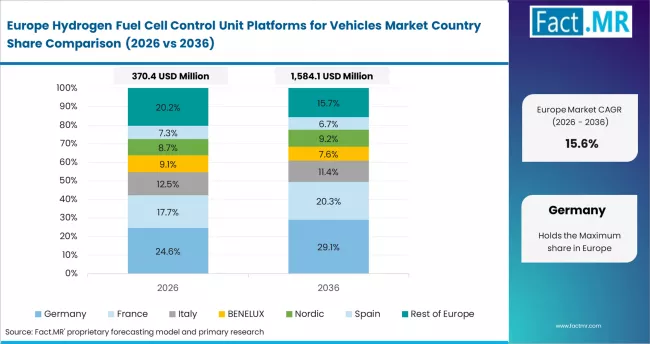
Hydrogen Fuel Cell Control Unit Platforms For Vehicles Market Europe Country Market Share Analysis, 2026 & 2036 | Source: Fact.MR
Europe functions as the regulatory benchmark for hydrogen fuel cell vehicle control systems. Growth is tied to EU emission mandates and funding programmes. Commercial vehicle timelines are clearly defined. ECU sourcing is documentation-heavy. Qualification requires strict performance validation.
- Germany: Deployment of hydrogen fuel cell control unit platforms in Germany is projected at 17.6% CAGR through 2036. Infrastructure rollout is guided by EU corridor mandates. Hydrogen refuelling networks are expanding along TEN-T routes. Robert Bosch has announced major investments in fuel cell electronics. OEM programmes by Daimler Truck and Traton are progressing.
FACT.MR covers Germany, France, the UK, Italy, Spain, Nordic Countries, and BENELUX. It includes regulatory frameworks, OEM timelines, and ECU sourcing standards for fuel cell vehicles.
North America Hydrogen Fuel Cell Control Unit Platforms for Vehicles Market Analysis
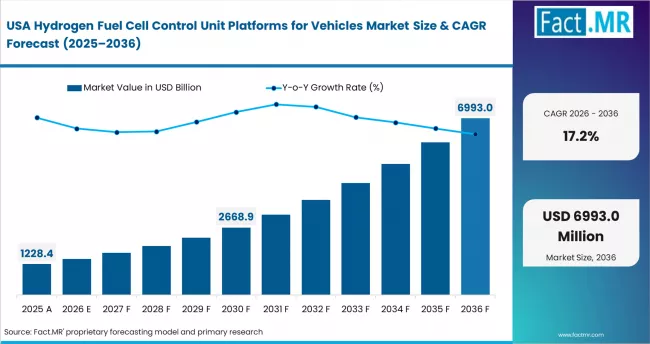
Hydrogen Fuel Cell Control Unit Platforms For Vehicles Market Country Value Analysis | Source: Fact.MR
North America represents a policy-funded and infrastructure-led market for hydrogen fuel cell ECU platforms. Federal investments are accelerating deployment. Heavy-duty fleet mandates are shaping adoption. Procurement is linked to funding eligibility. Domestic content rules influence supplier selection.
- United States: Growth trajectory of hydrogen fuel cell control unit platforms in the United States is projected at 17.2% CAGR through 2036. Expansion is supported by DOE hydrogen hub programmes. Fleet deployment phases began in 2024. Structured ECU sourcing is emerging for certified platforms. Federal tax incentives are supporting hydrogen production and usage. Plug Power and Ballard Power Systems are expanding commercial partnerships. These require compliant integrated ECU systems. Domestic sourcing preferences are influencing qualification criteria.
FACT.MR covers the United States, Canada, and Mexico. It includes funding impacts, deployment timelines, regulatory policies, and ECU sourcing benchmarks for hydrogen vehicle platforms.
Competitive Aligners for Market Players
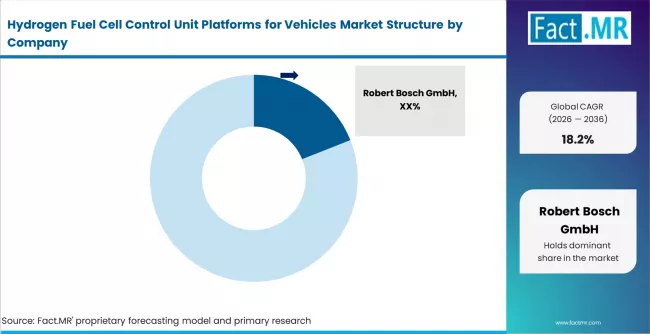
Hydrogen Fuel Cell Control Unit Platforms For Vehicles Market Analysis By Company | Source: Fact.MR
Competitive aligners in the hydrogen fuel cell control unit platforms market are increasingly defined by system integration depth, certification readiness, and OEM programme alignment. Suppliers are shifting from component-level offerings to fully integrated control platforms. This includes tight coupling of stack control, power electronics, and vehicle-level software. End-to-end capability is becoming a key qualification criterion.
Software architecture is a primary differentiator. OEMs expect advanced diagnostics, predictive maintenance capability, and seamless CAN or Ethernet communication integration. OTA update readiness is also becoming standard. Suppliers that can deliver stable, upgradeable software stacks gain stronger programme positioning. Functional safety compliance, particularly ASIL-D and ISO 26262, is now a baseline requirement rather than a value-add.
Vertical integration is strengthening competitive advantage. Companies that control both hardware and control algorithms reduce integration risk for OEMs. This improves validation timelines and lowers system complexity. Players such as Bosch and Continental AG leverage existing OEM relationships and validation ecosystems. This creates high entry barriers for new participants.
Co-development partnerships are becoming standard practice. OEMs are engaging suppliers early in the design phase. This ensures platform-level alignment and long-term sourcing visibility. Companies like Hyundai Motor Group and Toyota Motor Corporation are investing in dedicated fuel cell ecosystems. This drives consistent demand for aligned ECU platforms. Regional compliance capability is another critical aligner. Suppliers must meet diverse regulatory frameworks across Asia, Europe, and North America. Certification agility and documentation depth directly influence supplier selection and contract duration.
Key Players
- Robert Bosch GmbH
- Denso Corporation
- Continental AG
- Aptiv PLC
- Hyundai Motor Group
- Toyota Motor Corporation
- Ballard Power Systems Inc.
- Plug Power Inc.
Bibliography
- [1] European Commission / Clean Hydrogen Joint Undertaking. (2024). Clean Hydrogen Partnership Work Programme 2024: Transport and Infrastructure Funding Allocations Including Hydrogen Commercial Vehicle ECU Platform Development Grants. clean-hydrogen.europa.eu
- [2] U.S. Department of Energy. (2024). Regional Clean Hydrogen Hubs Programme: Fleet Deployment Phase Launch and Fuel Cell Commercial Vehicle ECU Procurement Requirements Under IRA Clean Hydrogen Production Tax Credit Framework. energy.gov/clean-hydrogen
- [3] Ministry of Industry and Information Technology, China. (2024). Fuel Cell Vehicle Demonstration City Cluster Expansion: Chengdu and Chongqing Inclusion, Standardised ECU Procurement Specifications, and CAN Communication Architecture Requirements for State Bus Fleet Operators. miit.gov.cn/english
- [4] Robert Bosch GmbH. (Q2 2024). Investor and Technology Update: Hydrogen Powertrain Electronics Development Programme Expansion Including Integrated Fuel Cell Control Unit Platform Investment Targeting European Bus and Truck OEM Customers. bosch.com/investor-relations
- [5] Toyota Motor Corporation. (Early 2025). Product Announcement: Second-Generation Fuel Cell System Launch Featuring Updated Integrated Control Unit Architecture for Commercial Truck and Bus Applications with Enhanced Thermal Management Control. global.toyota/newsroom
- [6] International Energy Agency. (2024). Global Hydrogen Review 2024: Fuel Cell Vehicle Deployment Data, Commercial Vehicle Programme Investment Volumes, and ECU Platform Adoption Trends in Major Hydrogen Mobility Markets. iea.org/reports/global-hydrogen-review
- [7] Denso Corporation. (Q3 2024). Product Development Announcement: Next-Generation Fuel Cell ECU Hardware Platform Launch Incorporating Enhanced Diagnostics Integration and ISO 26262 Functional Safety Certification for Hydrogen Commercial Vehicle OEM Programmes. denso.com/global/en/news
- [8] Aptiv PLC. (Early 2025). Technology Collaboration Announcement: Embedded Control Software Integration Partnership with European Hydrogen Truck OEM for Certified FCU Hardware Platform Targeting EU Zero-Emission Vehicle Mandates. aptiv.com/newsroom
This Report Addresses
- Strategic intelligence on hydrogen fuel cell control unit platform demand across integrated stack-control, energy management, and thermal control ECU architectures for commercial and passenger fuel cell vehicle programmes globally.
- Market forecast from USD 1.5 billion in 2026 to USD 8.2 billion by 2036, at a CAGR of 18.2%.
- Growth opportunity mapping across China hydrogen bus and truck corridor scale-up, Japan national hydrogen strategy OEM investments, South Korea Hyundai powertrain programmes, India Green Hydrogen Mission pilots, Germany EU Clean Hydrogen commercial vehicle deployment, and U.S. DOE hydrogen hub fleet integration.
- Segment analysis by platform type (integrated FCU, energy management ECU, thermal control ECU) and component (hardware ECUs, embedded software, sensors and diagnostics).
- Regional outlook covering Asia Pacific OEM programme volume growth, Europe regulation-led ECU certification demand, and North America incentive-funded heavy-duty fleet deployments.
- Competitive analysis of Bosch, Denso, Continental, Aptiv, Hyundai, Toyota, Ballard, and Plug Power. Focus on ASIL-D certification depth, integrated platform capability, and OEM programme alignment.
- Regulatory analysis covering EU Clean Hydrogen Partnership mandates, U.S. DOE hydrogen hub grant requirements, China MIIT fuel cell vehicle demonstration cluster standards, India National Green Hydrogen Mission, and South Korea Hydrogen Economy Roadmap.
- Report delivered in PDF, Excel, and presentation formats. Supported by primary OEM interviews, fuel cell vehicle registration data, regulatory records, and programme procurement benchmarks.
Hydrogen Fuel Cell Control Unit Platforms for Vehicles Market Definition
The market covers electronic control unit platforms used to manage hydrogen fuel cell stack operation in commercial and passenger vehicles. These systems regulate power output, thermal management, hydrogen flow control, and energy distribution.
Hydrogen Fuel Cell Control Unit Platforms for Vehicles Market Inclusions
Covers global and regional forecasts from 2026 to 2036. Includes platform type, component, and geography segments. Covers OEM-integrated and aftermarket ECU supply channels across fuel cell buses, trucks, and light commercial vehicles.
Hydrogen Fuel Cell Control Unit Platforms for Vehicles Market Exclusions
Excludes hydrogen storage tanks, fuel cell stack hardware, and electric drivetrain components not embedded within control unit platforms. Omits stationary fuel cell power systems. Also excludes general-purpose automotive ECUs not adapted for hydrogen fuel cell applications.
Hydrogen Fuel Cell Control Unit Platforms for Vehicles Market Research Methodology
- Primary Research:Interviews with fuel cell ECU suppliers and commercial vehicle OEM procurement teams. Covers hydrogen bus fleet operators, Tier 1 automotive electronics suppliers, and fuel cell stack integrators.
- Desk Research:Uses Bosch, Denso, Continental, and Ballard Power Systems disclosure data. Includes hydrogen vehicle deployment statistics and fuel cell programme investment records from 2024-2025.
- Market-Sizing and Forecasting:Uses a hybrid top-down and bottom-up model. Based on ECU unit revenues and vehicle deployment volumes segmented by platform type and end use application.
- Data Validation and Update Cycle:Validated using OEM programme data and fuel cell vehicle registration statistics. Cross-checked with supplier financial disclosures and expert interviews. Updated regularly.
Segmentation
Scope of Report
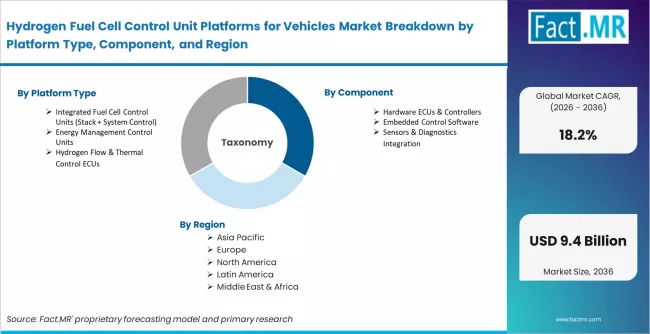
Hydrogen Fuel Cell Control Unit Platforms For Vehicles Market Breakdown By Platform Type, Component, And Region | Source: Fact.MR
| Attribute | Details |
|---|---|
| Quantitative Units | USD 1.5 billion (2026) to USD 8.2 billion (2036), at a CAGR of 18.2% |
| Market Definition | Electronic control unit platforms managing hydrogen fuel cell stack operation, thermal regulation, hydrogen flow, and energy distribution in commercial and passenger fuel cell vehicles globally. |
| Platform Type Segmentation | Integrated Fuel Cell Control Units, Energy Management Control Units, Hydrogen Flow & Thermal Control ECUs |
| Component Segmentation | Hardware ECUs & Controllers, Embedded Control Software, Sensors & Diagnostics Integration |
| Application Coverage | Fuel cell bus and truck OEM programmes, hydrogen corridor fleet deployments, light commercial vehicle fuel cell integration, and hydrogen mobility pilot programmes. |
| Regions Covered | North America, Europe, Asia Pacific, Latin America, Middle East and Africa |
| Countries Covered | USA, Canada, Mexico, Germany, UK, France, Italy, Spain, Nordic, BENELUX, China, Japan, South Korea, India, ASEAN, Australia and New Zealand, Brazil, Argentina, Chile, Saudi Arabia, GCC, Turkey, South Africa, Rest of MEA |
| Key Companies Profiled | Robert Bosch GmbH, Denso Corporation, Continental AG, Aptiv PLC, Hyundai Motor Group, Toyota Motor Corporation, Ballard Power Systems Inc., Plug Power Inc. |
| Forecast Period | 2026 to 2036 |
| Approach | Hybrid top-down and bottom-up model using ECU platform revenues, fuel cell vehicle deployment volumes by platform type, average selling prices by component segment, OEM programme procurement benchmarks, and primary interviews with fuel cell vehicle OEMs and Tier 1 electronics suppliers. |
Source: Fact.MR analysis. Updated May 11, 2026
Hydrogen Fuel Cell Control Unit Platforms for Vehicles Market by Segments
-
By Platform Type:
- Integrated Fuel Cell Control Units (Stack + System Control)
- Energy Management Control Units
- Hydrogen Flow & Thermal Control ECUs
-
By Component:
- Hardware ECUs & Controllers
- Embedded Control Software
- Sensors & Diagnostics Integration
-
By Region:
- North America
- United States
- Canada
- Mexico
- Latin America
- Brazil
- Argentina
- Chile
- Rest of Latin America
- Western Europe
- Germany
- United Kingdom
- France
- Italy
- Spain
- Nordic Countries
- BENELUX
- Rest of Western Europe
- Eastern Europe
- Russia
- Poland
- Hungary
- Balkan and Baltic
- Rest of Eastern Europe
- East Asia
- China
- Japan
- South Korea
- South Asia and Pacific
- India
- ASEAN
- Australia and New Zealand
- Rest of South Asia and Pacific
- Middle East and Africa
- Kingdom of Saudi Arabia
- Other GCC Countries
- Turkey
- South Africa
- Rest of Middle East and Africa
- North America
Frequently Asked Questions
How large is the hydrogen fuel cell control unit platforms for vehicles market in 2025?
What will the market size be in 2026?
What is the projected market size by 2036?
What is the expected CAGR of the hydrogen fuel cell control unit platforms for vehicles market?
What is the absolute dollar opportunity in this market?
Which platform type segment leads the market?
Which component segment is poised to lead?
Which country shows the fastest growth?
Who worked on this report


Preview the report firsthand - request a free sample
Free SampleGet the brochure for pricing and purchase details
Download PDF