Fuel Injector Tester Market (2026 - 2036)
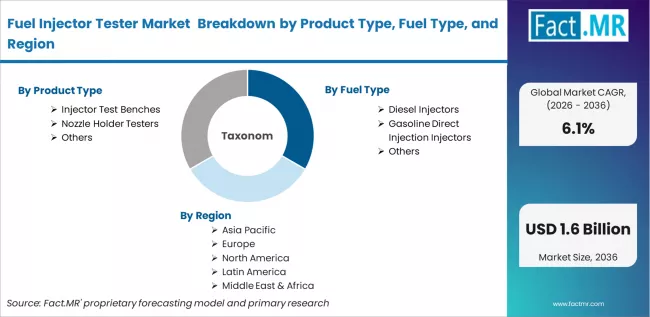
Fuel injector tester market is segmented by Product Type (Injector Test Benches, Nozzle Holder Testers, On-vehicle Electronic Testers, Portable Diagnostic Kits, Others), Fuel Type (Diesel Injectors, Gasoline Direct Injection Injectors, Alternative Fuel Injectors, Others), End Use (Authorized Service Centers, Independent Workshops, Fleet Maintenance, Remanufacturing Facilities, Others), and Region. Forecast for 2026 to 2036.
Core Findings
Fuel Injector Tester Market Forecast and Outlook By Fact.MR
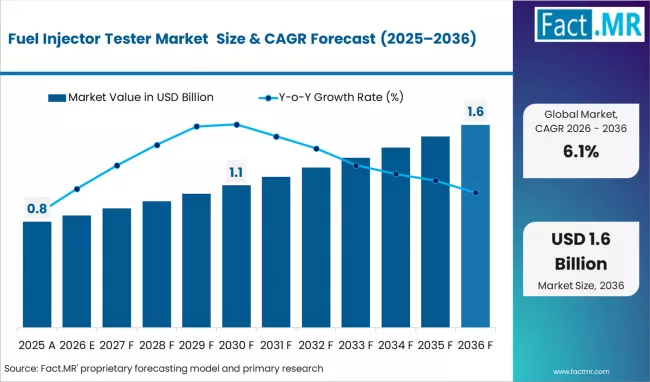
The fuel injector tester market was valued at USD 0.8 billion in 2025 and is projected to reach USD 0.9 billion in 2026 and USD 1.6 billion by 2036, expanding at a CAGR of 6.1%. Injector Test Benches leads product type at 37.8% share in 2026. Diesel Injectors holds the top fuel type position at 51.4%, with Independent Workshops leading end use demand at 34.6% in 2026. The electrification transition creates a common assumption that aftermarket powertrain diagnostics are in structural decline, but the installed base reality is more nuanced. The global stock of diesel and GDI vehicles is enormous, it ages slowly, and modern high-pressure injection systems fail in ways that require increasingly precise diagnostic equipment to resolve. The fuel injector tester market is not immune to long-term electrification headwinds, but it has a longer and more commercially robust runway than the narrative suggests.
Key Drivers
- Installed Base: Diesel and gasoline direct injection vehicles continue to require service, diagnosis, and remanufacturing support across a long service horizon.
- Precision Servicing: Modern injectors operate at high pressures and tight tolerances, increasing the need for reliable and accurate test equipment.
- Workshop Specialization: Independent diesel centers and remanufacturers continue to invest in dedicated injector benches and diagnostic tools.
Key Segments Analyzed in the Report
- Product Type: Injector Test Benches, Nozzle Holder Testers, On-Vehicle Electronic Testers, Portable Diagnostic Kits, And Others
- Fuel Type: Diesel Injectors, Gasoline Direct Injection Injectors, Alternative Fuel Injectors, And Others
- End Use: Authorized Service Centers, Independent Workshops, Fleet Maintenance, Remanufacturing Facilities, And Others
- Region: North America, Latin America, Europe, Asia Pacific, And Middle East & Africa
Analyst Opinion
Shambhu Nath Jha, Principal Consultant, Fact.MR says the fuel injector tester market survives electrification because repair complexity is rising in the remaining combustion fleet. Workshops servicing high-pressure injectors need equipment accuracy, software support, and OE-aligned test routines. The market is shrinking in some regions and growing in others, and the suppliers who understand that geographic divergence will position their portfolios accordingly.
Fuel Injector Tester Market Definition
The fuel injector tester market covers equipment and systems used to evaluate, calibrate, diagnose, or validate fuel injectors and related injection components in automotive, commercial vehicle, and remanufacturing environments.
Fuel Injector Tester Market Inclusions
- Revenue from injector test benches, nozzle holder testers, portable and electronic diagnostic systems, and associated injector testing equipment.
- Demand from authorized workshops, independent service providers, fleets, and remanufacturing facilities.
- Demand across North America, Latin America, Europe, Asia Pacific, and the Middle East & Africa.
Fuel Injector Tester Market Exclusions
- General scan tools without dedicated injector testing functionality.
- Injector replacement parts sold without testing or calibration equipment revenue.
- Broad engine diagnostic software revenue not attributable to injector test systems.
Fuel Injector Tester Market Research Methodology
This study evaluates the fuel injector tester market across product type, fuel type, end use, and region, using 2025 as the base year and 2026 to 2036 as the forecast period. Market value is expressed in USD billion. Evidence inputs include first-party injector testing product portfolios, aftermarket service networks, remanufacturing needs, and workshop-equipment literature from Bosch, PHINIA Hartridge, and other diagnostic equipment suppliers. Triangulation aligns serviceable vehicle parc, injector failure and maintenance rates, equipment replacement cycles, and workshop investment intensity to derive segment and regional estimates.
Key Drivers, Restraints, and Trends in Fuel Injector Tester Market
Drivers
The fuel injector tester market is supported by the long tail of internal combustion service demand. Even where new EV penetration is rising, the stock of vehicles already on the road still needs injector diagnosis, cleaning, calibration, and remanufacturing support. That is especially true in diesel-heavy commercial and developing-market vehicle fleets.
Restraints
Electrification is a real long-term headwind. Injector service will not disappear quickly, but it is not a structural growth story in all regions. Smaller workshops also face capital constraints and may prefer outsourcing complex injector work over buying specialized benches and software.
Trends
The market is concentrating around more software-enabled, OE-aligned, and pressure-capable systems. Common-rail and high-pressure injection technologies demand more exact testing procedures, while remanufacturing and professional diesel service centers continue to anchor the most sophisticated equipment demand.
Segmental Analysis
Fuel Injector Tester Market Analysis by Product Type
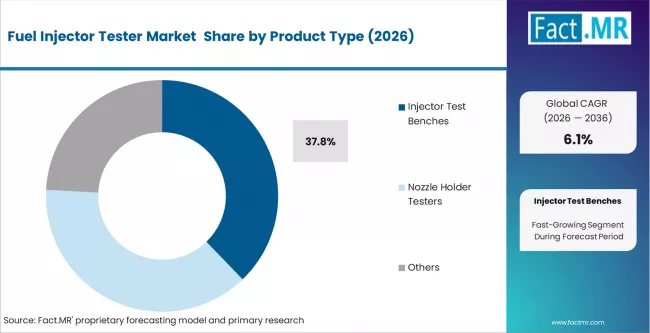
The Injector Test Benches segment is expected to lead the product type category with a 37.8% share in 2026. Test benches lead because they provide the most comprehensive injector validation environment, including flow behavior, leakage, pressure, and calibration checks. They are central to professional diesel service and remanufacturing operations where precision matters.
Fuel Injector Tester Market Analysis by Fuel Type
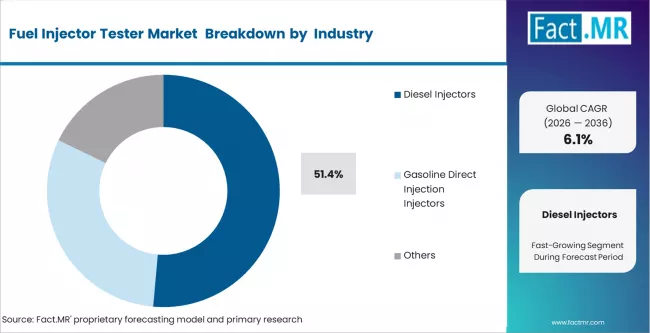
The Diesel Injectors segment is expected to lead the fuel type category with a 51.4% share in 2026. Diesel injectors lead because diesel systems remain highly dependent on specialist workshop servicing, especially in commercial vehicles, agricultural equipment, and mature installed fleets. Their high-pressure operating environment makes dedicated testing more valuable than in simpler injection systems.
Competitive Aligners for Market Players
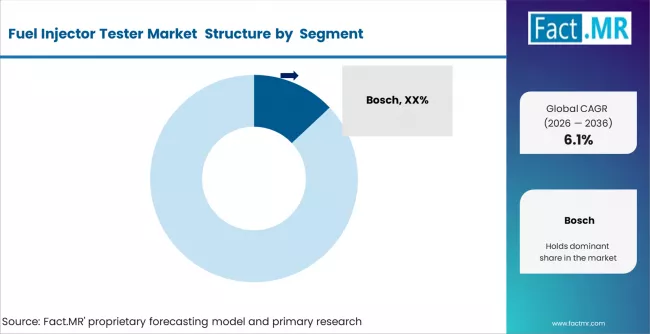
The competitive dynamics in fuel injector testing are shaped by two things that do not appear on a spec sheet: OE credibility and aftermarket reach. Bosch's position in this market is a direct extension of its position as the dominant common-rail injection system manufacturer. When workshops trust the injector brand, they also trust the test equipment that comes with that ecosystem. That brand-to-tool credibility transfer is enormously difficult for an independent equipment maker to replicate, because it is not about the test bench itself. It is about the decades of injection system engineering knowledge embedded in the test parameters and software.
PHINIA Hartridge occupies a distinct competitive position by focusing specifically on test equipment without being tied to a particular injection system brand. That independence can be an advantage when customers are working across multiple injection platforms and do not want to invest in multiple proprietary test ecosystems. The commercial viability of that position depends on staying ahead of OEM test routines through close technical engagement with injection system evolution, particularly as common-rail pressures continue to rise and injector tolerances tighten.
For equipment suppliers trying to grow share in developing markets, the competitive variable is not product sophistication but total cost of capability. Workshops in South Asia, Southeast Asia, and Sub-Saharan Africa are managing large and aging diesel fleets with limited capex budgets. The winning product in those markets is one that provides reliable, OE-aligned test results on the most common diesel platforms at a capital cost that a professional independent workshop can justify without requiring outside financing. Suppliers that have designed products specifically for that price-capability threshold, rather than simply discounting their premium products, have a meaningful advantage in the fastest-growing geographic segments.
Key Players in Fuel Injector Tester Market
- Bosch
- PHINIA Hartridge
- TEXA
- Snap-on
- ACTIA Group
- Maha
- Launch Tech
- AVL DiTEST
- DENSO
- Continental
Strategic Outlook by Fact.MR on Fuel Injector Tester Market
Fact.MR expects fuel injector testers to post measured growth. The market should stay healthy in professional service, remanufacturing, and diesel-intensive fleets, even as the broader powertrain mix shifts. Geographic divergence will intensify: mature markets with high EV penetration will see demand plateau, while developing markets with large diesel installed bases will continue to grow. Suppliers that position their portfolio for that divergence, rather than treating it as a single global market, will manage the transition more effectively.
Scope of the Report

| Metric | Value |
|---|---|
| Market Value | USD 0.8 billion in 2025 to USD 1.6 billion by 2036 |
| CAGR | 6.1% from 2026 to 2036 |
| Base Year | 2025 |
| Forecast Period | 2026 to 2036 |
| Product Type Segmentation | Injector Test Benches, Nozzle Holder Testers, On-vehicle Electronic Testers, Portable Diagnostic Kits, Others |
| Fuel Type Segmentation | Diesel Injectors, Gasoline Direct Injection Injectors, Alternative Fuel Injectors, Others |
| End Use Segmentation | Authorized Service Centers, Independent Workshops, Fleet Maintenance, Remanufacturing Facilities, Others |
| Regional Coverage | North America, Latin America, Europe, Asia Pacific, and Middle East & Africa |
Bibliography
- Bosch Automotive Aftermarket. (n.d.). EPS 100 nozzle holder tester.
- Hartridge. (n.d.). World-leading fuel injection testing technology.
- Hartridge. (n.d.). Fuel injection testing solutions.
- DENSO. (n.d.). Diesel service network.
- DENSO. (n.d.). Common rail injector.
- AVL DiTEST. (n.d.). Company.
Table of Content
- Executive Summary
- Global Market Outlook
- Demand to side Trends
- Supply to side Trends
- Technology Roadmap Analysis
- Analysis and Recommendations
- Market Overview
- Market Coverage / Taxonomy
- Market Definition / Scope / Limitations
- Research Methodology
- Chapter Orientation
- Analytical Lens and Working Hypotheses
- Market Structure, Signals, and Trend Drivers
- Benchmarking and Cross-market Comparability
- Market Sizing, Forecasting, and Opportunity Mapping
- Research Design and Evidence Framework
- Desk Research Programme (Secondary Evidence)
- Company Annual and Sustainability Reports
- Peer-reviewed Journals and Academic Literature
- Corporate Websites, Product Literature, and Technical Notes
- Earnings Decks and Investor Briefings
- Statutory Filings and Regulatory Disclosures
- Technical White Papers and Standards Notes
- Trade Journals, Industry Magazines, and Analyst Briefs
- Conference Proceedings, Webinars, and Seminar Materials
- Government Statistics Portals and Public Data Releases
- Press Releases and Reputable Media Coverage
- Specialist Newsletters and Curated Briefings
- Sector Databases and Reference Repositories
- Fact.MR Internal Proprietary Databases and Historical Market Datasets
- Subscription Datasets and Paid Sources
- Social Channels, Communities, and Digital Listening Inputs
- Additional Desk Sources
- Expert Input and Fieldwork (Primary Evidence)
- Primary Modes
- Qualitative Interviews and Expert Elicitation
- Quantitative Surveys and Structured Data Capture
- Blended Approach
- Why Primary Evidence is Used
- Field Techniques
- Interviews
- Surveys
- Focus Groups
- Observational and In-context Research
- Social and Community Interactions
- Stakeholder Universe Engaged
- C-suite Leaders
- Board Members
- Presidents and Vice Presidents
- R&D and Innovation Heads
- Technical Specialists
- Domain Subject-matter Experts
- Scientists
- Physicians and Other Healthcare Professionals
- Governance, Ethics, and Data Stewardship
- Research Ethics
- Data Integrity and Handling
- Primary Modes
- Tooling, Models, and Reference Databases
- Desk Research Programme (Secondary Evidence)
- Data Engineering and Model Build
- Data Acquisition and Ingestion
- Cleaning, Normalisation, and Verification
- Synthesis, Triangulation, and Analysis
- Quality Assurance and Audit Trail
- Market Background
- Market Dynamics
- Drivers
- Restraints
- Opportunity
- Trends
- Scenario Forecast
- Demand in Optimistic Scenario
- Demand in Likely Scenario
- Demand in Conservative Scenario
- Opportunity Map Analysis
- Product Life Cycle Analysis
- Supply Chain Analysis
- Investment Feasibility Matrix
- Value Chain Analysis
- PESTLE and Porter’s Analysis
- Regulatory Landscape
- Regional Parent Market Outlook
- Production and Consumption Statistics
- Import and Export Statistics
- Market Dynamics
- Global Market Analysis 2021 to 2025 and Forecast, 2026 to 2036
- Historical Market Size Value (USD Million) Analysis, 2021 to 2025
- Current and Future Market Size Value (USD Million) Projections, 2026 to 2036
- Y to o to Y Growth Trend Analysis
- Absolute $ Opportunity Analysis
- Global Market Pricing Analysis 2021 to 2025 and Forecast 2026 to 2036
- Global Market Analysis 2021 to 2025 and Forecast 2026 to 2036, By Product Type
- Introduction / Key Findings
- Historical Market Size Value (USD Million) Analysis By Product Type, 2021 to 2025
- Current and Future Market Size Value (USD Million) Analysis and Forecast By Product Type, 2026 to 2036
- Injector Test Benches
- Nozzle Holder Testers
- Others
- Injector Test Benches
- Y to o to Y Growth Trend Analysis By Product Type, 2021 to 2025
- Absolute $ Opportunity Analysis By Product Type, 2026 to 2036
- Global Market Analysis 2021 to 2025 and Forecast 2026 to 2036, By Fuel Type
- Introduction / Key Findings
- Historical Market Size Value (USD Million) Analysis By Fuel Type, 2021 to 2025
- Current and Future Market Size Value (USD Million) Analysis and Forecast By Fuel Type, 2026 to 2036
- Diesel Injectors
- Gasoline Direct Injection Injectors
- Others
- Diesel Injectors
- Y to o to Y Growth Trend Analysis By Fuel Type, 2021 to 2025
- Absolute $ Opportunity Analysis By Fuel Type, 2026 to 2036
- Global Market Analysis 2021 to 2025 and Forecast 2026 to 2036, By Region
- Introduction
- Historical Market Size Value (USD Million) Analysis By Region, 2021 to 2025
- Current Market Size Value (USD Million) Analysis and Forecast By Region, 2026 to 2036
- North America
- Latin America
- Western Europe
- Eastern Europe
- East Asia
- South Asia and Pacific
- Middle East & Africa
- Market Attractiveness Analysis By Region
- North America Market Analysis 2021 to 2025 and Forecast 2026 to 2036, By Country
- Historical Market Size Value (USD Million) Trend Analysis By Market Taxonomy, 2021 to 2025
- Market Size Value (USD Million) Forecast By Market Taxonomy, 2026 to 2036
- By Country
- USA
- Canada
- Mexico
- By Product Type
- By Fuel Type
- By Country
- Market Attractiveness Analysis
- By Country
- By Product Type
- By Fuel Type
- Key Takeaways
- Latin America Market Analysis 2021 to 2025 and Forecast 2026 to 2036, By Country
- Historical Market Size Value (USD Million) Trend Analysis By Market Taxonomy, 2021 to 2025
- Market Size Value (USD Million) Forecast By Market Taxonomy, 2026 to 2036
- By Country
- Brazil
- Chile
- Rest of Latin America
- By Product Type
- By Fuel Type
- By Country
- Market Attractiveness Analysis
- By Country
- By Product Type
- By Fuel Type
- Key Takeaways
- Western Europe Market Analysis 2021 to 2025 and Forecast 2026 to 2036, By Country
- Historical Market Size Value (USD Million) Trend Analysis By Market Taxonomy, 2021 to 2025
- Market Size Value (USD Million) Forecast By Market Taxonomy, 2026 to 2036
- By Country
- Germany
- UK
- Italy
- Spain
- France
- Nordic
- BENELUX
- Rest of Western Europe
- By Product Type
- By Fuel Type
- By Country
- Market Attractiveness Analysis
- By Country
- By Product Type
- By Fuel Type
- Key Takeaways
- Eastern Europe Market Analysis 2021 to 2025 and Forecast 2026 to 2036, By Country
- Historical Market Size Value (USD Million) Trend Analysis By Market Taxonomy, 2021 to 2025
- Market Size Value (USD Million) Forecast By Market Taxonomy, 2026 to 2036
- By Country
- Russia
- Poland
- Hungary
- Balkan & Baltic
- Rest of Eastern Europe
- By Product Type
- By Fuel Type
- By Country
- Market Attractiveness Analysis
- By Country
- By Product Type
- By Fuel Type
- Key Takeaways
- East Asia Market Analysis 2021 to 2025 and Forecast 2026 to 2036, By Country
- Historical Market Size Value (USD Million) Trend Analysis By Market Taxonomy, 2021 to 2025
- Market Size Value (USD Million) Forecast By Market Taxonomy, 2026 to 2036
- By Country
- China
- Japan
- South Korea
- By Product Type
- By Fuel Type
- By Country
- Market Attractiveness Analysis
- By Country
- By Product Type
- By Fuel Type
- Key Takeaways
- South Asia and Pacific Market Analysis 2021 to 2025 and Forecast 2026 to 2036, By Country
- Historical Market Size Value (USD Million) Trend Analysis By Market Taxonomy, 2021 to 2025
- Market Size Value (USD Million) Forecast By Market Taxonomy, 2026 to 2036
- By Country
- India
- ASEAN
- Australia & New Zealand
- Rest of South Asia and Pacific
- By Product Type
- By Fuel Type
- By Country
- Market Attractiveness Analysis
- By Country
- By Product Type
- By Fuel Type
- Key Takeaways
- Middle East & Africa Market Analysis 2021 to 2025 and Forecast 2026 to 2036, By Country
- Historical Market Size Value (USD Million) Trend Analysis By Market Taxonomy, 2021 to 2025
- Market Size Value (USD Million) Forecast By Market Taxonomy, 2026 to 2036
- By Country
- Kingdom of Saudi Arabia
- Other GCC Countries
- Turkiye
- South Africa
- Other African Union
- Rest of Middle East & Africa
- By Product Type
- By Fuel Type
- By Country
- Market Attractiveness Analysis
- By Country
- By Product Type
- By Fuel Type
- Key Takeaways
- Key Countries Market Analysis
- USA
- Pricing Analysis
- Market Share Analysis, 2025
- By Product Type
- By Fuel Type
- Canada
- Pricing Analysis
- Market Share Analysis, 2025
- By Product Type
- By Fuel Type
- Mexico
- Pricing Analysis
- Market Share Analysis, 2025
- By Product Type
- By Fuel Type
- Brazil
- Pricing Analysis
- Market Share Analysis, 2025
- By Product Type
- By Fuel Type
- Chile
- Pricing Analysis
- Market Share Analysis, 2025
- By Product Type
- By Fuel Type
- Germany
- Pricing Analysis
- Market Share Analysis, 2025
- By Product Type
- By Fuel Type
- UK
- Pricing Analysis
- Market Share Analysis, 2025
- By Product Type
- By Fuel Type
- Italy
- Pricing Analysis
- Market Share Analysis, 2025
- By Product Type
- By Fuel Type
- Spain
- Pricing Analysis
- Market Share Analysis, 2025
- By Product Type
- By Fuel Type
- France
- Pricing Analysis
- Market Share Analysis, 2025
- By Product Type
- By Fuel Type
- India
- Pricing Analysis
- Market Share Analysis, 2025
- By Product Type
- By Fuel Type
- ASEAN
- Pricing Analysis
- Market Share Analysis, 2025
- By Product Type
- By Fuel Type
- Australia & New Zealand
- Pricing Analysis
- Market Share Analysis, 2025
- By Product Type
- By Fuel Type
- China
- Pricing Analysis
- Market Share Analysis, 2025
- By Product Type
- By Fuel Type
- Japan
- Pricing Analysis
- Market Share Analysis, 2025
- By Product Type
- By Fuel Type
- South Korea
- Pricing Analysis
- Market Share Analysis, 2025
- By Product Type
- By Fuel Type
- Russia
- Pricing Analysis
- Market Share Analysis, 2025
- By Product Type
- By Fuel Type
- Poland
- Pricing Analysis
- Market Share Analysis, 2025
- By Product Type
- By Fuel Type
- Hungary
- Pricing Analysis
- Market Share Analysis, 2025
- By Product Type
- By Fuel Type
- Kingdom of Saudi Arabia
- Pricing Analysis
- Market Share Analysis, 2025
- By Product Type
- By Fuel Type
- Turkiye
- Pricing Analysis
- Market Share Analysis, 2025
- By Product Type
- By Fuel Type
- South Africa
- Pricing Analysis
- Market Share Analysis, 2025
- By Product Type
- By Fuel Type
- USA
- Market Structure Analysis
- Competition Dashboard
- Competition Benchmarking
- Market Share Analysis of Top Players
- By Regional
- By Product Type
- By Fuel Type
- Competition Analysis
- Competition Deep Dive
- Bosch
- Overview
- Product Portfolio
- Profitability by Market Segments (Product/Age /Sales Channel/Region)
- Sales Footprint
- Strategy Overview
- Marketing Strategy
- Product Strategy
- Channel Strategy
- PHINIA Hartridge
- TEXA
- Snap-on
- ACTIA Group
- Maha
- Bosch
- Competition Deep Dive
- Assumptions & Acronyms Used
List Of Table
- Table 1: Global Market Value (USD Million) Forecast by Region, 2021 to 2036
- Table 2: Global Market Value (USD Million) Forecast by Product Type, 2021 to 2036
- Table 3: Global Market Value (USD Million) Forecast by Fuel Type, 2021 to 2036
- Table 4: North America Market Value (USD Million) Forecast by Country, 2021 to 2036
- Table 5: North America Market Value (USD Million) Forecast by Product Type, 2021 to 2036
- Table 6: North America Market Value (USD Million) Forecast by Fuel Type, 2021 to 2036
- Table 7: Latin America Market Value (USD Million) Forecast by Country, 2021 to 2036
- Table 8: Latin America Market Value (USD Million) Forecast by Product Type, 2021 to 2036
- Table 9: Latin America Market Value (USD Million) Forecast by Fuel Type, 2021 to 2036
- Table 10: Western Europe Market Value (USD Million) Forecast by Country, 2021 to 2036
- Table 11: Western Europe Market Value (USD Million) Forecast by Product Type, 2021 to 2036
- Table 12: Western Europe Market Value (USD Million) Forecast by Fuel Type, 2021 to 2036
- Table 13: Eastern Europe Market Value (USD Million) Forecast by Country, 2021 to 2036
- Table 14: Eastern Europe Market Value (USD Million) Forecast by Product Type, 2021 to 2036
- Table 15: Eastern Europe Market Value (USD Million) Forecast by Fuel Type, 2021 to 2036
- Table 16: East Asia Market Value (USD Million) Forecast by Country, 2021 to 2036
- Table 17: East Asia Market Value (USD Million) Forecast by Product Type, 2021 to 2036
- Table 18: East Asia Market Value (USD Million) Forecast by Fuel Type, 2021 to 2036
- Table 19: South Asia and Pacific Market Value (USD Million) Forecast by Country, 2021 to 2036
- Table 20: South Asia and Pacific Market Value (USD Million) Forecast by Product Type, 2021 to 2036
- Table 21: South Asia and Pacific Market Value (USD Million) Forecast by Fuel Type, 2021 to 2036
- Table 22: Middle East & Africa Market Value (USD Million) Forecast by Country, 2021 to 2036
- Table 23: Middle East & Africa Market Value (USD Million) Forecast by Product Type, 2021 to 2036
- Table 24: Middle East & Africa Market Value (USD Million) Forecast by Fuel Type, 2021 to 2036
List Of Figures
- Figure 1: Global Market Pricing Analysis
- Figure 2: Global Market Value (USD Million) Forecast 2021 to 2036
- Figure 3: Global Market Value Share and BPS Analysis by Product Type, 2026 and 2036
- Figure 4: Global Market Y-o-Y Growth Comparison by Product Type, 2026 to 2036
- Figure 5: Global Market Attractiveness Analysis by Product Type
- Figure 6: Global Market Value Share and BPS Analysis by Fuel Type, 2026 and 2036
- Figure 7: Global Market Y-o-Y Growth Comparison by Fuel Type, 2026 to 2036
- Figure 8: Global Market Attractiveness Analysis by Fuel Type
- Figure 9: Global Market Value (USD Million) Share and BPS Analysis by Region, 2026 and 2036
- Figure 10: Global Market Y-o-Y Growth Comparison by Region, 2026 to 2036
- Figure 11: Global Market Attractiveness Analysis by Region
- Figure 12: North America Market Incremental Dollar Opportunity, 2026 to 2036
- Figure 13: Latin America Market Incremental Dollar Opportunity, 2026 to 2036
- Figure 14: Western Europe Market Incremental Dollar Opportunity, 2026 to 2036
- Figure 15: Eastern Europe Market Incremental Dollar Opportunity, 2026 to 2036
- Figure 16: East Asia Market Incremental Dollar Opportunity, 2026 to 2036
- Figure 17: South Asia and Pacific Market Incremental Dollar Opportunity, 2026 to 2036
- Figure 18: Middle East & Africa Market Incremental Dollar Opportunity, 2026 to 2036
- Figure 19: North America Market Value Share and BPS Analysis by Country, 2026 and 2036
- Figure 20: North America Market Value Share and BPS Analysis by Product Type, 2026 and 2036
- Figure 21: North America Market Y-o-Y Growth Comparison by Product Type, 2026 to 2036
- Figure 22: North America Market Attractiveness Analysis by Product Type
- Figure 23: North America Market Value Share and BPS Analysis by Fuel Type, 2026 and 2036
- Figure 24: North America Market Y-o-Y Growth Comparison by Fuel Type, 2026 to 2036
- Figure 25: North America Market Attractiveness Analysis by Fuel Type
- Figure 26: Latin America Market Value Share and BPS Analysis by Country, 2026 and 2036
- Figure 27: Latin America Market Value Share and BPS Analysis by Product Type, 2026 and 2036
- Figure 28: Latin America Market Y-o-Y Growth Comparison by Product Type, 2026 to 2036
- Figure 29: Latin America Market Attractiveness Analysis by Product Type
- Figure 30: Latin America Market Value Share and BPS Analysis by Fuel Type, 2026 and 2036
- Figure 31: Latin America Market Y-o-Y Growth Comparison by Fuel Type, 2026 to 2036
- Figure 32: Latin America Market Attractiveness Analysis by Fuel Type
- Figure 33: Western Europe Market Value Share and BPS Analysis by Country, 2026 and 2036
- Figure 34: Western Europe Market Value Share and BPS Analysis by Product Type, 2026 and 2036
- Figure 35: Western Europe Market Y-o-Y Growth Comparison by Product Type, 2026 to 2036
- Figure 36: Western Europe Market Attractiveness Analysis by Product Type
- Figure 37: Western Europe Market Value Share and BPS Analysis by Fuel Type, 2026 and 2036
- Figure 38: Western Europe Market Y-o-Y Growth Comparison by Fuel Type, 2026 to 2036
- Figure 39: Western Europe Market Attractiveness Analysis by Fuel Type
- Figure 40: Eastern Europe Market Value Share and BPS Analysis by Country, 2026 and 2036
- Figure 41: Eastern Europe Market Value Share and BPS Analysis by Product Type, 2026 and 2036
- Figure 42: Eastern Europe Market Y-o-Y Growth Comparison by Product Type, 2026 to 2036
- Figure 43: Eastern Europe Market Attractiveness Analysis by Product Type
- Figure 44: Eastern Europe Market Value Share and BPS Analysis by Fuel Type, 2026 and 2036
- Figure 45: Eastern Europe Market Y-o-Y Growth Comparison by Fuel Type, 2026 to 2036
- Figure 46: Eastern Europe Market Attractiveness Analysis by Fuel Type
- Figure 47: East Asia Market Value Share and BPS Analysis by Country, 2026 and 2036
- Figure 48: East Asia Market Value Share and BPS Analysis by Product Type, 2026 and 2036
- Figure 49: East Asia Market Y-o-Y Growth Comparison by Product Type, 2026 to 2036
- Figure 50: East Asia Market Attractiveness Analysis by Product Type
- Figure 51: East Asia Market Value Share and BPS Analysis by Fuel Type, 2026 and 2036
- Figure 52: East Asia Market Y-o-Y Growth Comparison by Fuel Type, 2026 to 2036
- Figure 53: East Asia Market Attractiveness Analysis by Fuel Type
- Figure 54: South Asia and Pacific Market Value Share and BPS Analysis by Country, 2026 and 2036
- Figure 55: South Asia and Pacific Market Value Share and BPS Analysis by Product Type, 2026 and 2036
- Figure 56: South Asia and Pacific Market Y-o-Y Growth Comparison by Product Type, 2026 to 2036
- Figure 57: South Asia and Pacific Market Attractiveness Analysis by Product Type
- Figure 58: South Asia and Pacific Market Value Share and BPS Analysis by Fuel Type, 2026 and 2036
- Figure 59: South Asia and Pacific Market Y-o-Y Growth Comparison by Fuel Type, 2026 to 2036
- Figure 60: South Asia and Pacific Market Attractiveness Analysis by Fuel Type
- Figure 61: Middle East & Africa Market Value Share and BPS Analysis by Country, 2026 and 2036
- Figure 62: Middle East & Africa Market Value Share and BPS Analysis by Product Type, 2026 and 2036
- Figure 63: Middle East & Africa Market Y-o-Y Growth Comparison by Product Type, 2026 to 2036
- Figure 64: Middle East & Africa Market Attractiveness Analysis by Product Type
- Figure 65: Middle East & Africa Market Value Share and BPS Analysis by Fuel Type, 2026 and 2036
- Figure 66: Middle East & Africa Market Y-o-Y Growth Comparison by Fuel Type, 2026 to 2036
- Figure 67: Middle East & Africa Market Attractiveness Analysis by Fuel Type
- Figure 68: Global Market - Tier Structure Analysis
- Figure 69: Global Market - Company Share Analysis
- FAQs -
What is the projected size of the Fuel Injector Tester Market by 2036?
The fuel injector tester market is projected to reach USD 1.6 billion by 2036.
What is the CAGR of the Fuel Injector Tester Market from 2026 to 2036?
The fuel injector tester market is projected to expand at a CAGR of 6.1% from 2026 to 2036.
Which product type segment leads the Fuel Injector Tester Market?
The Injector Test Benches segment leads the fuel injector tester market with a 37.8% share in 2026.
Which fuel type segment dominates the Fuel Injector Tester Market?
The Diesel Injectors segment holds the leading position in the fuel injector tester market with a 51.4% share in 2026.
Which end use segment leads the Fuel Injector Tester Market?
The Independent Workshops segment is expected to account for the largest share of the fuel injector tester market at 34.6% in 2026.
Who are the key companies in the Fuel Injector Tester Market?
Key companies active in the fuel injector tester market include Bosch, PHINIA Hartridge, TEXA, Snap-on, ACTIA Group, Maha, and other specialized participants.
What is driving demand in the Fuel Injector Tester Market?
Demand in the fuel injector tester market is being driven by continued service needs in combustion fleets, rising injector precision requirements, and workshop demand for professional test benches and software.