- Market Value (2025): USD 286.7 Mn
- Estimated Value (2026): USD 318.0 Mn
- Forecast Value (2036): USD 894.8 Mn
- CAGR (2026-2036): 10.9%
What is the Functional Fonio Grains Market forecast to be worth by 2036?
USD 318.0 million in 2026 to USD 894.8 million by 2036 at a 10.9% CAGR.
- The Functional Fonio Grains Market was valued at approximately USD 286.7 million in 2025.
- Demand is projected to increase from USD 318.0 million in 2026 to USD 894.8 million by 2036.
- The market is forecast to record 10.9% CAGR from 2026 to 2036 as gluten-free grain use, faster-cooking formats and traceable West African supply broaden commercial adoption.
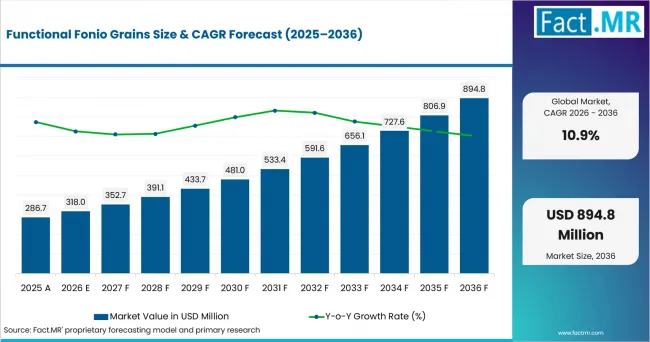
Functional Fonio Grains Value Analysis | Source: Fact.MR
What are the defining numbers behind Functional Fonio Grains Market growth?
An absolute opportunity of USD 576.8 million is expected between 2026 and 2036.
- Demand Drivers in the Market
- Gluten-free positioning gives fonio a direct route into specialty grain, breakfast and packaged-food categories. The U.S. FDA permits naturally gluten-free grains to carry a gluten-free claim when products meet its less-than-20-ppm requirement, making contamination control and documented handling important for commercial suppliers.
- Fast preparation lowers the barrier to trial. Parboiled and quick-cook fonio can fit grain bowls, breakfast formats and ready-meal applications where buyers compare preparation time with rice, couscous and quinoa.
- Food manufacturers are evaluating fonio for more than whole-grain retail packs. Research indexed by PubMed describes fonio as gluten free and examines its nutritional and techno-functional properties, supporting development work in cereal, bakery and specialty-food formulations.
- Traceable smallholder sourcing supports procurement narratives around origin and farmer participation. IFAD-backed agricultural programs in Senegal and Guinea explicitly include fonio value chains, showing continued institutional focus on production, commercialization and market access.
- Related demand can also be seen in adjacent categories such as gluten-free food, whole grain and high fiber foods and healthy snacks, where grain identity and health-oriented positioning influence product development.
- Key Segments Analyzed
- By Product Form: Whole cleaned grain accounts for 39.0% share in 2026 because it preserves fonio’s familiar grain format while supporting retail packs, foodservice and home preparation.
- By Functional Positioning: Gluten-free staple accounts for 37.0% share in 2026 because the positioning gives buyers a clear dietary use and an easy comparison with other naturally gluten-free grains.
- By End-use: Retail grain packs account for 34.0% share in 2026 as packaged whole-grain formats provide the simplest route from traditional consumption to mainstream specialty retail.
- By Sourcing Model: West African conventional accounts for 42.0% share in 2026 because established regional supply remains the main commercial base for fonio procurement.
- Analyst Opinion at Fact.MR
- Shambhu Nath Jha, Principal Consultant at Fact.MR, states, “Functional fonio grains can expand where suppliers solve practical buying issues around cleaning, consistency, cooking time and traceability. Demand is likely to move beyond novelty when grain processors can offer dependable specifications for retail packs and food-manufacturing applications while preserving the sourcing story that differentiates fonio.”
- Strategic Implications
- Processors should treat cleaning and dehulling as commercial specifications rather than back-end farm operations. Grain uniformity and contamination control directly affect whether food brands can use fonio in repeat production.
- Retail brands should give consumers simple preparation guidance. Quick-cook formats can reduce trial friction, while whole-grain packs can retain the heritage and staple-food identity that supports repeat purchase.
- Ingredient suppliers should develop specifications for cereal, bakery and snack applications. Adjacent breakfast cereal and ambient ready meals markets show how convenience and formulation requirements shape grain procurement.
- Exporters should make sourcing documentation easy to audit. Traceable smallholder programs, lot identification and food-safety records can help buyers assess supply continuity before widening listings or formulation use.
- The USA records 13.6% CAGR, supported by defined gluten-free labeling rules and an established specialty-food channel. France grows at 11.3% as organic and premium grocery categories provide room for origin-led grains. Germany reaches 10.9% through health-focused retail and demand for alternative grains. Nigeria expands at 9.9% because fonio, also known as acha, already has cultural familiarity and can move into cleaner packaged formats. The UK grows at 8.4% as regulated gluten-free claims and specialty retail support naturally gluten-free grain products.
How does the Functional Fonio Grains Market break down by segment?
The market is segmented by Product Form, Functional Positioning, End-use and Sourcing Model.
Why does Whole cleaned grain lead Product Form?
Whole cleaned grain accounts for 39.0% share of Product Form in 2026.
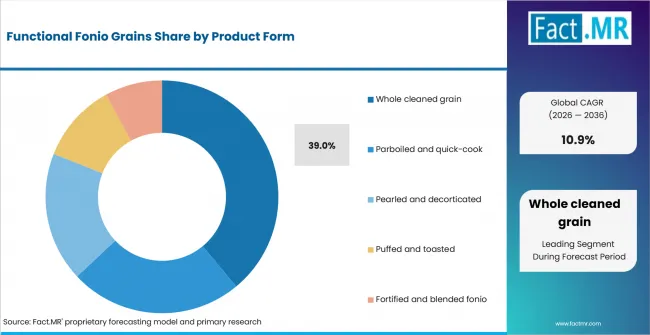
Functional Fonio Grains Analysis By Product Form | Source: Fact.MR
The format keeps preparation close to familiar grain use while avoiding the formulation changes required for flour or highly processed inclusions. Consumers can use it in bowls, side dishes and breakfast preparations, while foodservice operators can treat it as an alternative grain rather than a new ingredient system.
Parboiled and quick-cook fonio reduces preparation time and is suited to convenience formats. Pearled and decorticated grain provides a lighter appearance. Puffed and toasted fonio fits snacks and cereal inclusions, while fortified and blended formats target products that need additional nutrition or processing functionality.
Why does Gluten-free staple lead Functional Positioning?
Gluten-free staple accounts for 37.0% share of Functional Positioning in 2026.
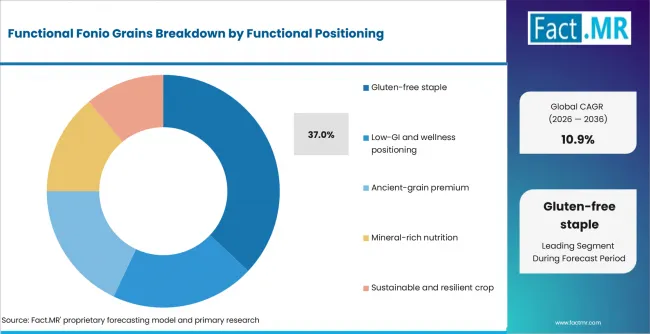
Functional Fonio Grains Analysis By Functional Positioning | Source: Fact.MR
The claim gives fonio a clear purchase reason because it can replace wheat-linked staples in meals without forcing consumers into unfamiliar preparation. FDA guidance in the United States allows grains outside wheat, rye and barley to use a gluten-free claim when cross-contact remains below the regulatory threshold.
Low-GI and wellness positioning can support health-oriented products, while ancient-grain and mineral-rich narratives add differentiation. Sustainable and resilient crop positioning is useful where buyers also assess sourcing practices and production conditions.
Why do Retail grain packs lead End-use?
Retail grain packs account for 34.0% share of End-use in 2026.
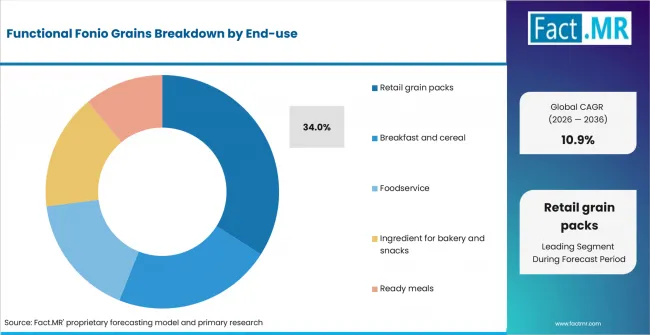
Functional Fonio Grains Analysis By End Use | Source: Fact.MR
Packaged grain is the most direct commercial format because the product can be sold without changing its basic identity. Retailers can place fonio beside rice, quinoa or specialty cereals, while brands can provide cooking instructions and origin information on pack.
Breakfast and cereal applications account for 22.0%, giving fonio a path into porridge and cereal mixes. Foodservice represents 17.0%, ingredient use in bakery and snacks 16.0%, and ready meals 11.0%, each requiring progressively tighter consistency and processing specifications.
Why does West African conventional lead Sourcing Model?
West African conventional accounts for 42.0% share of Sourcing Model in 2026.
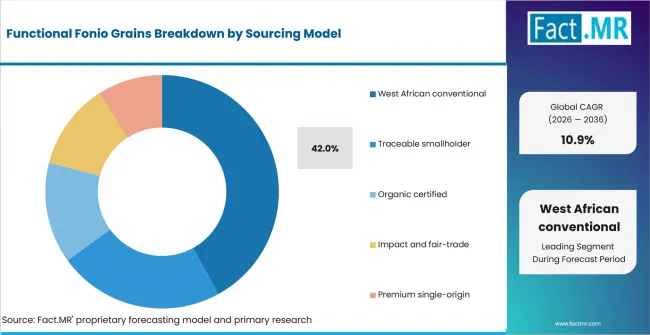
Functional Fonio Grains Analysis By Sourcing Model | Source: Fact.MR
Fonio production is rooted in West Africa, so conventional regional supply provides the broadest procurement base. FAO resources identify fonio across countries including Benin, Burkina Faso, Côte d’Ivoire, Guinea, Mali, Niger, Nigeria and Senegal.
Traceable smallholder sourcing accounts for 23.0% and can gain where buyers require documented farmer relationships. Organic certified supply holds 14.0%, impact and fair-trade supply 12.0%, and premium single-origin supply 9.0%, each adding more verification requirements to procurement.
What is accelerating Functional Fonio Grains Market adoption, and what is holding it back?
Adoption is supported by gluten-free use, convenient preparation, ingredient experimentation and traceable West African sourcing. Constraints come from cleaning complexity, uneven processing capacity, higher prices than common grains and limited consumer familiarity outside core markets.
Drivers Impact Analysis
| Factor | (~) % Impact on CAGR | Geographic Relevance | Impact Timeline |
|---|---|---|---|
| Gluten-free staple positioning | Not quantified | USA, UK, Europe | Short term (<= 2 years) |
| Quick-cook and convenient grain formats | Not quantified | North America, Europe | Short term (<= 2 years) |
| Commercial cereal, bakery and snack applications | Not quantified | Global | Medium term (2-4 years) |
| Traceable West African sourcing | Not quantified | West Africa, Europe, North America | Medium term (2-4 years) |
Opportunity Impact Analysis
| Factor | (~) % Impact on CAGR | Geographic Relevance | Impact Timeline |
|---|---|---|---|
| Retail grain and meal-kit formats | Not quantified | USA, France, UK, Germany | Short term (<= 2 years) |
| Breakfast cereal and porridge applications | Not quantified | North America, Europe | Medium term (2-4 years) |
| Puffed, toasted and bakery inclusions | Not quantified | Global | Medium term (2-4 years) |
| Organic and single-origin sourcing | Not quantified | France, Germany, UK | Long term (>= 4 years) |
Restraints Impact Analysis
| Factor | (~) % Impact on CAGR | Geographic Relevance | Impact Timeline |
|---|---|---|---|
| Cleaning and dehulling complexity | Not quantified | West Africa | Short term (<= 2 years) |
| Price premium versus common grains | Not quantified | Global | Short term (<= 2 years) |
| Limited consumer familiarity | Not quantified | North America, Europe | Medium term (2-4 years) |
| Certification and cross-contact controls | Not quantified | USA, UK, Europe | Medium term (2-4 years) |
Which countries are scaling fastest?
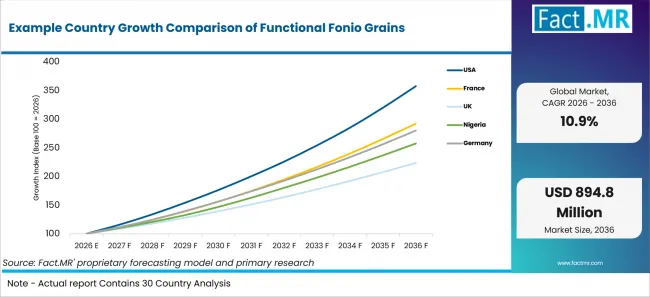
Example Country Growth Comparison Of Functional Fonio Grains | Source: Fact.MR
| Country | CAGR (2026-2036) |
|---|---|
| USA | 13.6% |
| France | 11.3% |
| Germany | 10.9% |
| Nigeria | 9.9% |
| UK | 8.4% |
What is driving the USA's growth through 2036?
Demand in the USA is projected to grow at a 13.6% CAGR through 2036.
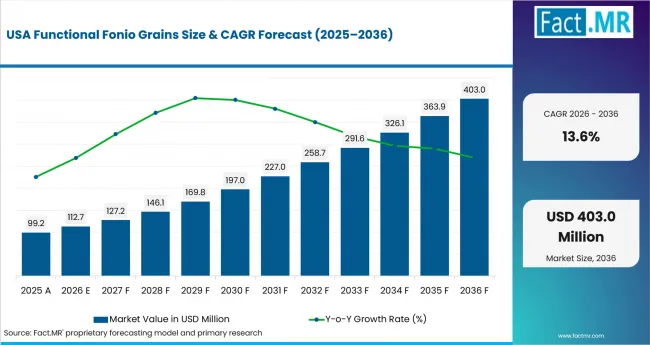
Functional Fonio Grains Country Value Analysis | Source: Fact.MR
One factor supporting this expansion is the established regulatory framework around gluten-free foods. It gives consumers a familiar way to identify suitable products while requiring manufacturers to control cross-contact throughout handling and processing.
Fonio already has a visible route into commercial food applications. Yolélé supplies whole grain, flour and crisps to food and beverage manufacturers in the USA. This gives formulators options for using fonio across snacks and cereals as well as bakery products and foodservice menus. Wider availability of ingredient formats can make it easier for manufacturers to test fonio without building new processing capabilities around the grain.
For suppliers, repeat demand will depend on consistency as much as novelty. Reliable cleaning, documented gluten controls and predictable cooking performance can help fonio move from a specialty ingredient into regular product development programs.
What is driving France's growth through 2036?
Demand in France is projected to grow at an 11.3% CAGR through 2036.
The opportunity is closely tied to the country's established market for organic and origin-specific foods. Agence BIO reports that the French organic market reached EUR 13 billion in 2025. The Ministry of Agriculture also reported 25,105 certified downstream organic enterprises in 2024.
This gives fonio several possible commercial routes. Certified retail packs can appeal to shoppers looking for traceable grains, while ingredient suppliers can work with specialty food manufacturers seeking alternatives to more familiar cereals. Its West African origin can also support product differentiation when sourcing claims are backed by clear documentation.
Growth will therefore depend on how effectively suppliers connect provenance with practical use. Retailers and manufacturers need grain that is cleaned consistently, easy to prepare and supported by dependable supply rather than a product sold mainly on its unfamiliarity.
What is driving Germany's growth through 2036?
Demand in Germany is projected to grow at a 10.9% CAGR through 2036.
The commercial opening is strongest where fonio can fit existing purchasing behavior around specialty grains and gluten-free foods.
For many buyers, the main barrier is likely to be familiarity. Consumers may encounter fonio as a new grain but still need clear guidance on preparation, taste and everyday use before it becomes a repeat purchase. This gives suppliers an incentive to focus on practical product formats rather than relying primarily on heritage or novelty positioning.
Consistent cleaning and transparent sourcing can also influence procurement by retailers and food manufacturers. If suppliers can reduce uncertainty around quality and preparation, fonio has a better chance of moving from trial purchases into regular pantry and formulation use.
What is driving Nigeria's growth through 2036?
Demand in Nigeria is projected to grow at a 9.9% CAGR through 2036.
Unlike markets where fonio requires consumer introduction, the grain already has local familiarity in parts of Nigeria, where it is commonly known as acha.
This changes the commercial challenge. Growth is less dependent on explaining what the grain is and more dependent on making it easier to buy and prepare. Better-cleaned packaged products can reduce preparation time, while formal retail distribution can make acha more accessible to urban consumers who may value convenience alongside traditional food preferences.
FAO's 2026 work with Nigeria on food and nutrition security also points to continued policy attention on resilient domestic food systems. For the fonio value chain, this can support interest in better processing and stronger links between growers and formal food channels. Commercial gains are therefore likely to come from upgrading the way an already familiar grain reaches consumers.
What is driving the UK's growth through 2036?
Demand in the UK is projected to grow at an 8.4% CAGR through 2036.
Gluten-free positioning provides one clear route into the market. The Food Standards Agency states that foods marketed as gluten free must contain no more than 20 mg/kg of gluten, giving manufacturers a defined threshold for product claims.
For fonio suppliers, that framework creates both an opportunity and an operational requirement. The grain is naturally gluten free, but commercial products still need appropriate controls during processing and handling if they are to carry the claim reliably.
Convenience is another part of the proposition. Aduna currently sells pre-washed fonio in the UK as a quick-cooking grain sourced from small-scale farmers in Burkina Faso. That format reduces preparation effort while retaining the sourcing story behind the product. Similar combinations of convenience and traceability can make fonio easier to introduce through specialty food retail and everyday cooking occasions.
Who leads the Functional Fonio Grains Market?
Key players in the Functional Fonio Grains Market include Yolélé, Aduna, Farafena, Mamma Africa, La Vivrière and Teranga Foods.
Competition is shaped by reliable grain cleaning, preparation convenience, sourcing documentation, food-safety controls and the ability to serve both retail and ingredient buyers. Yolélé currently supports commercial-scale food and beverage applications, while Aduna and Farafena maintain active packaged fonio offerings. Suppliers with stronger processing consistency and buyer-ready documentation can reduce qualification work for retailers and food manufacturers.
Which companies are the key providers?
Yolélé, Aduna, Farafena, Mamma Africa, La Vivrière, Teranga Foods
- Yolélé
- Aduna
- Farafena
- Mamma Africa
- La Vivrière
- Teranga Foods
Bibliography
- Food and Agriculture Organization of the United Nations. (2023). Key descriptors for fonio millets. FAO Knowledge Repository.
- European Commission, Directorate-General for Health and Food Safety. (n.d.). Summary of applications and notifications: Digitaria exilis (Fonio). European Commission.
- Zhu, F. (2020). Fonio grains: Physicochemical properties, nutritional potential, and food applications. Comprehensive Reviews in Food Science and Food Safety.
- Deriu, A. G., et al. (2022). Techno-functional and gelling properties of acha (fonio) flour. Foods.
- International Fund for Agricultural Development. (2025). Senegal and IFAD partner to promote climate-resilient agriculture and rural entrepreneurship. IFAD.
- International Fund for Agricultural Development. (2026). IFAD partners with the World Bank to accelerate agricultural transformation in Guinea through AgriConnect. IFAD.
- U.S. Food and Drug Administration. (2024). Questions and answers on the gluten-free food labeling final rule. FDA.
- Food Standards Agency. (2025). Allergen information for non-prepacked foods: Best practice on voluntary information. UK Food Standards Agency.
- Ministère de l’Agriculture, de l’Agro-alimentaire et de la Souveraineté alimentaire. (2026). Infographie - L’agriculture biologique (chiffres 2024). Government of France.
- Agence BIO. (2026). Observatoire de la consommation bio. Agence BIO.
- Food and Agriculture Organization of the United Nations. (2026). Nigeria advances national food and nutrition crisis preparedness plans. FAO Nigeria.
This Report Answers
- The report explains demand for functional fonio grains across product form, functional positioning, end-use and sourcing model.
- Segment analysis explains why whole cleaned grain, gluten-free staple positioning, retail grain packs and West African conventional sourcing lead their respective categories.
- Country analysis examines the USA, France, Germany, Nigeria and the UK using the forecast growth rates supplied for the market.
- Competitive analysis reviews the source-controlled company set without publishing company market share.
- Application analysis covers packaged grain, breakfast and cereal, foodservice, bakery and snack ingredients, and ready meals.
What does the Functional Fonio Grains Market cover?
The Functional Fonio Grains Market covers commercially sold fonio grain formats positioned for dietary, wellness and food applications. It includes cleaned whole grain, quick-cook grain, decorticated grain, puffed or toasted grain and fortified or blended fonio.
The assessment focuses on fonio sold as a functional grain or ingredient. It does not broaden into unrelated millet, rice, quinoa or other grain markets except where those categories provide a relevant comparison for buyer behavior or formulation use.
What is included in the scope?
The scope includes retail grain packs, breakfast and cereal use, foodservice, bakery and snack ingredients, and ready-meal applications. It covers conventional West African supply together with traceable smallholder, organic, impact and premium single-origin sourcing models.
What is excluded from the scope?
The scope excludes fonio flour sold primarily as a flour ingredient, finished restaurant dishes where fonio is only one menu component, and non-food uses. Other cereals are excluded unless they are part of a blended fonio product within the supplied segmentation.
How Was the Analysis Built?
- Primary Research: Interviews with grain processors, food manufacturers, ingredient buyers, retailers, distributors and sourcing specialists are used to assess purchasing criteria, preparation requirements, supplier qualification and adoption barriers.
- Desk Research: Analysis draws on agricultural sources, food-safety guidance, peer-reviewed research, regulatory publications, trade information and company product evidence relevant to fonio production, processing and use.
- Market Sizing and Forecasting: Market estimates combine annual value trends with segment shares, country growth patterns, product-form adoption, retail expansion, ingredient use and sourcing development.
- Data Validation and Update Cycle: Findings are cross-checked against company activity, regulatory requirements, agricultural programs and current commercial product availability. Updates review changes in processing capacity, retail listings, sourcing programs and new food applications.
What is the report’s scope and coverage?
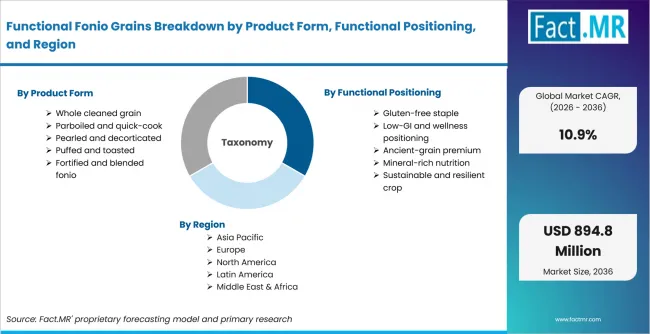
Functional Fonio Grains Breakdown By Product Form, Functional Positioning, And Region | Source: Fact.MR
| Attribute | Details |
|---|---|
| Quantitative Units | USD 318.0 million in 2026 to USD 894.8 million by 2036 at a 10.9% CAGR |
| Market Definition | Commercial whole and processed fonio grain products positioned for dietary, wellness, retail and food-manufacturing applications. |
| Product Form | Whole cleaned grain; Parboiled and quick-cook; Pearled and decorticated; Puffed and toasted; Fortified and blended fonio |
| Functional Positioning | Gluten-free staple; Low-GI and wellness positioning; Ancient-grain premium; Mineral-rich nutrition; Sustainable and resilient crop |
| End-use | Retail grain packs; Breakfast and cereal; Foodservice; Ingredient for bakery and snacks; Ready meals |
| Sourcing Model | West African conventional; Traceable smallholder; Organic certified; Impact and fair-trade; Premium single-origin |
| Countries Highlighted | USA; France; Germany; Nigeria; UK |
| Key Companies | Yolélé; Aduna; Farafena; Mamma Africa; La Vivrière; Teranga Foods |
| Forecast Period | 2026 to 2036 |
How is the market segmented?
-
By Product Form
- Whole cleaned grain
- Parboiled and quick-cook
- Pearled and decorticated
- Puffed and toasted
- Fortified and blended fonio
-
By Functional Positioning
- Gluten-free staple
- Low-GI and wellness positioning
- Ancient-grain premium
- Mineral-rich nutrition
- Sustainable and resilient crop
-
By End-use
- Retail grain packs
- Breakfast and cereal
- Foodservice
- Ingredient for bakery and snacks
- Ready meals
-
By Sourcing Model
- West African conventional
- Traceable smallholder
- Organic certified
- Impact and fair-trade
- Premium single-origin