- Market Value (2025): USD 613.0 Mn
- Estimated Value (2026): USD 645.9 Mn
- Forecast Value (2036): USD 1089.8 Mn
- CAGR (2026-2036): 5.4%
What is the Furfural Solvent Market forecast to be worth by 2036?
USD 645.9 million in 2026 to USD 1089.8 million by 2036 at a 5.4% CAGR.
- As per Fact.MR analysis, the Furfural Solvent Market was valued at USD 613.0 million in 2025.
- Demand will grow from USD 645.9 million in 2026 to USD 1089.8 million by 2036.
- The forecast records a 5.4% CAGR from 2026 to 2036, supported by demand across the specified application and end-user categories.
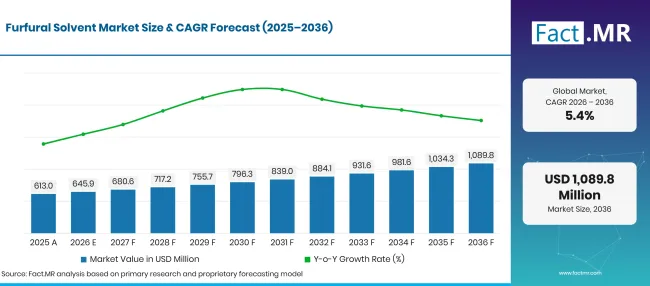
Furfural Solvent Market Forecast Global | Source: Fact.MR
| Year | Basis | Market Value (USD million) |
|---|---|---|
| 2025 | Actual | 613.0 |
| 2026 | Estimate | 645.9 |
| 2036 | Forecast | 1,089.8 |
| CAGR 2026 to 2036 | Forecast period | 5.4% |
Source: Fact.MR analysis. Updated Oct 23, 2026
What are the defining numbers behind Furfural Solvent Market growth?
USD 443.9 million absolute opportunity between 2026 and 2036.
- Demand Drivers in the Market
- Agricultural residue availability has supported the growth of the market. Furfural production depends on biomass feedstocks, including corncobs, rice husks, and sugarcane bagasse. Brazil’s National Supply Company (Conab) estimated 705.2 million tonnes of sugarcane production for the 2026/27 season, up 4.7% from the previous season, indicating a substantial agricultural resource base for potential residue utilization [1].
- Industrial chemical processing and derivatives increase the demand for the furfural solvent. Furfural is used as a chemical intermediate in downstream manufacturing, including the production of resins and other chemical derivatives. Demand from industrial processors supports market opportunities as manufacturers seek suitable raw materials for specialized chemical applications.
- Expanding agricultural production and biomass utilization has driven the market growth. Growth in agricultural output can increase the potential availability of biomass residues for furfural manufacturing. Conab projected Brazilian grain production at 361.7 million tonnes in the 2025/26 season, an increase of 2.6% year over year, in its September 2026 report. Actual furfural feedstock availability depends on residue collection, competing uses, and processing economics [2].
- Key Segments Analyzed
- By Application, Pharmaceuticals leads with a 32.4%.
- By Source, Rice Husk accounts for 34.4%, connecting furfural production with agricultural-residue sourcing.
- By End-User Industry, Chemical holds a 42.8% share, highlighting its position in the downstream demand structure.
- Analyst Opinion at Fact.MR
- Shambhu Nath Jha, Principal Consultant at Fact.MR, states, “Furfural suppliers are positioned to benefit from demand for biomass-derived chemical intermediates where feedstock sourcing, processing economics, and product specifications remain commercially attractive. Manufacturers need to evaluate agricultural-residue availability alongside the requirements of chemical processors and other downstream users.”
- Strategic Implications
- Manufacturers need to evaluate the availability of rice husk, corncobs, and sugarcane bagasse when assessing feedstock sourcing and production economics.
- Chemical suppliers must maintain consistent product specifications and technical documentation to meet downstream customer requirements.
- Procurement teams can account for seasonal feedstock availability, collection costs, transportation, and raw-material consistency when planning supply.
- Distributors need to verify the suitability of the furfural grade for the intended application and customer specifications.
- Market participants can prioritize Brazil and Germany for further investigation based on their comparatively higher CAGRs.
- Companies benefit from validating application-specific demand and the market positions of individual competitors before making investment or production-capacity decisions.
Germany is projected to record a 6.2% CAGR through 2036. Brazil is forecast to post 6.6%, followed by the USA at 4.9%. The UK is estimated to advance at 5.3%, while Japan is forecast at 4.5%.
How does the Furfural Solvent Market break down by segment?
Fact.MR’s analysis identifies Pharmaceuticals as the leading application at 32.4%, Rice Husk as the leading source at 34.4%, and the Chemical industry as the leading end-user category at 42.8%.
Which Application dominates?
Pharmaceuticals holds 32.4% share in 2026.
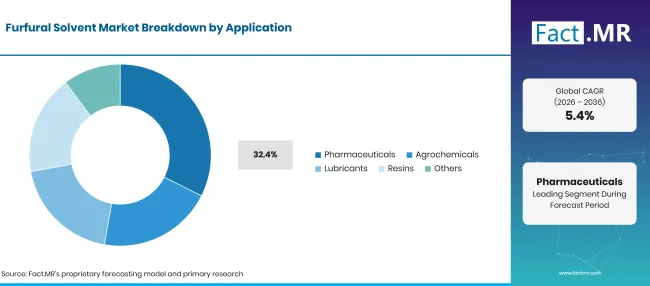
Furfural Solvent Market Breakdown Application | Source: Fact.MR
| Application | Share (2026) |
|---|---|
| Pharmaceuticals (Leading segment) | 32.4% |
| Other segments combined | 67.6%* |
| Total | 100.0% |
Source: Fact.MR analysis. Updated Oct 23, 2026
Pharmaceuticals represent the leading application segment in the market. Furfural serves as a chemical intermediate in the production of furan derivatives and pharmaceutical-related compounds. Beyond pharmaceuticals, it is used as a selective solvent in lubricant refining and as a feedstock for furfuryl alcohol, which is further processed into furan resins used in industrial applications. Its derivatives also support the production of agrochemicals, including pesticides and herbicides, as well as specialty chemicals and solvents. These diverse applications connect furfural demand with pharmaceutical manufacturing, chemical processing, petroleum refining, and resin production [3].
Which Source leads the market?
Rice Husk is set to account for a 34.4% share of the segmentation.
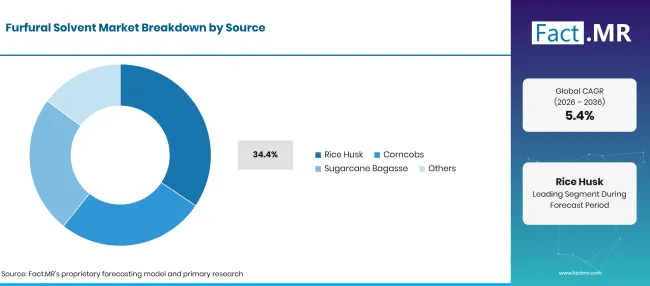
Furfural Solvent Market Breakdown Source | Source: Fact.MR
| Source | Share (2026) |
|---|---|
| Rice Husk (Leading segment) | 34.4% |
| Other segments combined | 65.6%* |
| Total | 100.0% |
Source: Fact.MR analysis. Updated Oct 23, 2026
Rice husk is the leading source segment over the forecast period. Furfural production from agricultural waste links the market with biomass availability and feedstock processing. Corncobs and sugarcane bagasse represent additional source categories, while other feedstocks may contribute according to local availability and conversion suitability. Procurement decisions depend on factors such as residue quality, collection costs, transport, and production requirements.
How does End-User Industry shape demand?
The Chemical industry leads with a 42.8% share of the end-user segmentation in 2026.
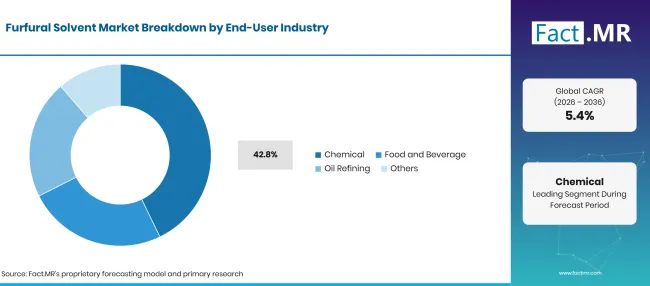
Furfural Solvent Market Breakdown End User Industry | Source: Fact.MR
| End-User Industry | Share (2026) |
|---|---|
| Chemical (Leading segment) | 42.8% |
| Other segments combined | 57.2%* |
| Total | 100.0% |
| End-User Industry | Share (2026) |
Source: Fact.MR analysis. Updated Oct 23, 2026
The chemical industry’s leading position connects the market with downstream processing and chemical-derivative production. Oil refining provides another relevant industrial application, while food and beverage coverage should be interpreted according to the exact market definition and applicable product specifications. The dataset does not provide individual shares for these other end-user categories.
What is accelerating Furfural Solvent Market adoption, and what is holding it back?
Demand from downstream chemical applications and the use of agricultural residues can support market expansion. Feedstock variability, transport costs, production economics, and application-specific quality requirements may constrain suppliers.
Drivers Impact Analysis
| DRIVER | (~) % IMPACT ON CAGR | GEOGRAPHIC RELEVANCE | IMPACT TIMELINE |
|---|---|---|---|
| Demand for furfural derivatives in chemical processing | +1.0% | Asia, Europe | Medium term (2–4 years) |
| Industrial demand for solvent-based refining applications | +0.9% | Global | Short term (≤ 2 years) |
| Use of furfural in lubricant refining and purification | +0.7% | Europe, Asia | Medium term (2–4 years) |
| Growing interest in bio-based chemical feedstocks | +0.5% | Europe, Americas | Long term (≥ 4 years) |
Source: Fact.MR analysis. Updated Oct 23, 2026
Opportunity Impact Analysis
| OPPORTUNITY | (~) % IMPACT ON CAGR | GEOGRAPHIC RELEVANCE | IMPACT TIMELINE |
|---|---|---|---|
| Development of bio-based solvent applications | +0.8% | Europe, Americas | Medium term (2–4 years) |
| Improved furfural recovery and purification technologies | +0.6% | Asia, Europe | Medium term (2–4 years) |
| Integration with lubricant refining processes | +0.5% | Global | Long term (≥ 4 years) |
| Expansion of agricultural residue-based feedstock processing | +0.4% | Asia, Latin America | Long term (≥ 4 years) |
Source: Fact.MR analysis. Updated Oct 23, 2026
Restraints Impact Analysis
| RESTRAINT | (~) % IMPACT ON CAGR | GEOGRAPHIC RELEVANCE | IMPACT TIMELINE |
|---|---|---|---|
| High production and purification costs | -0.8% | Global | Short term (≤ 2 years) |
| Dependence on agricultural residue availability | -0.6% | Asia, Latin America | Medium term (2–4 years) |
| Competition from alternative industrial solvents | -0.5% | Global | Short term (≤ 2 years) |
| Feedstock quality and supply-chain variability | -0.4% | Global | Medium term (2–4 years) |
Source: Fact.MR analysis. Updated Oct 23, 2026
Which countries are scaling the Furfural Solvent Market through 2036?
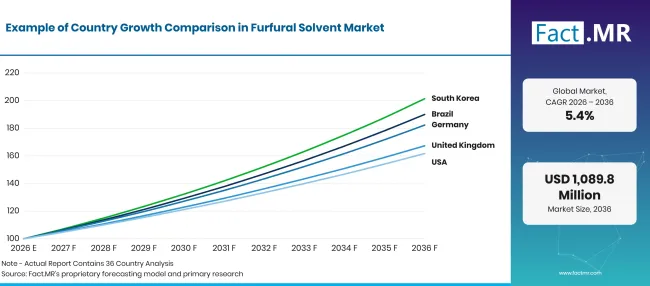
Furfural Solvent Market Growth Index | Source: Fact.MR
| Country | CAGR (2026–2036) |
|---|---|
| Germany | 6.2% |
| Brazil | 6.6% |
| USA | 4.9% |
| UK | 5.3% |
| Japan | 4.5% |
Source: Fact.MR analysis. Updated Oct 23, 2026
What supports the Germany outlook?
6.2% CAGR, supported by established chemical manufacturing and demand for specialized industrial solvents.
Germany is projected to record comparatively strong growth in the furfural solvent market among the countries covered. Market development will depend on demand from the chemical processing industry, lubricant refining, resin manufacturing, and other relevant downstream applications. Companies evaluating opportunities in Germany can assess industrial purchasing requirements, supplier competitiveness, product quality standards, and the reliability of feedstock sourcing and supply chains.
How is Brazil developing in the Furfural Solvent Market?
Brazil is projected to record a 6.6% CAGR, driven by agricultural-residue availability and opportunities for biomass-based chemical production.
Brazil is projected to be the fastest-growing market in the country comparison, highlighting its potential for furfural solvent market expansion. The country’s substantial sugarcane industry generates agricultural residues, including sugarcane bagasse, which may offer feedstock opportunities for biomass-based chemical production. The commercial viability of these opportunities depends on residue availability, competing uses, processing infrastructure, and transportation costs.
What supports United States adoption?
The US is projected to record a 4.9% CAGR by 2036, supported by established chemical manufacturing and industrial solvent applications.
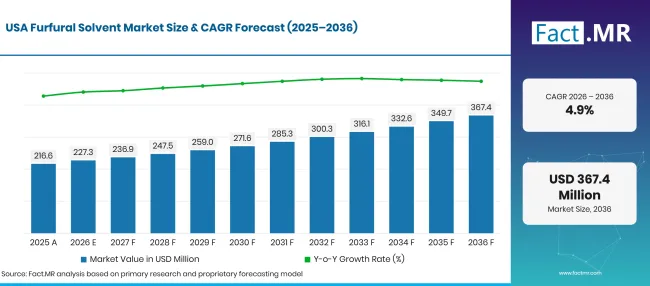
Furfural Solvent Market Forecast Usa | Source: Fact.MR
The US furfural solvent market is projected to grow at a comparatively moderate pace. Market opportunities will depend on demand from chemical manufacturing, pharmaceutical-related applications, lubricant refining, resin production, and agrochemical processing. Suppliers can strengthen their market position by maintaining consistent product quality, competitive pricing, reliable supply chains, and compliance with applicable industry requirements. Companies evaluating expansion opportunities in the United States can assess purchasing patterns across downstream industries, customer-specific specifications, and the availability of suitable biomass-derived feedstocks.
How is the United Kingdom building market demand?
The UK is projected to record a 5.3% CAGR from 2026 to 2036, shaped by industrial solvent requirements and interest in bio-based chemical alternatives.
The UK furfural solvent market is expected to develop in line with demand from chemical manufacturing and other downstream industrial applications. Market opportunities will depend on purchasing requirements across pharmaceutical-related applications, lubricant refining, resin production, and agrochemical processing. Suppliers can strengthen their competitiveness by offering consistent product specifications, reliable supply arrangements, and pricing aligned with customer requirements. Companies evaluating expansion opportunities in the UK can assess demand across relevant end-user industries, the availability and cost of imported feedstocks and finished products, and the competitiveness of established suppliers.
What supports Japan’s outlook?
Japan is projected to record a 4.5% CAGR through 2036, supported by established chemical manufacturing and demand for specialized industrial applications.
Japan’s furfural solvent market is expected to be influenced by demand from the chemical processing, pharmaceutical, lubricant refining, and resin manufacturing industries. Market development will depend on the availability of reliable product supplies, consistent quality standards, competitive pricing, and the technical requirements of downstream manufacturers. Companies exploring opportunities in Japan can evaluate demand for furfural and its derivatives across industrial applications, alongside import dependence, sourcing costs, and supplier capabilities.
Who leads the Furfural Solvent Market?
Fact.MR finds that Hongye Holding Group, Silvateam S.p.A., International Furan Chemicals (IFC), Sri Kusuma Haranadha Agro Fural Private Limited are profiled across the furfural production and supply chain.
Hongye Holding Group and Silvateam S.p.A. are relevant to furfural manufacturing and industrial solvent applications. International Furan Chemicals (IFC) participates in the commercial supply and distribution of furfural. Sri Kusuma Haranadha Agro Fural Private Limited is associated with furfural production from agricultural feedstocks. Product portfolios and current manufacturing status should be checked before treating all five companies as direct competitors.
Commercial competition depends on product purity, feedstock availability, production efficiency, pricing, and supply reliability. Industrial buyers require consistent specifications and dependable deliveries. Suppliers serving lubricant refining and chemical processing applications must also meet application-specific performance requirements.
Which companies are covered?
Key companies include Hongye Holding Group; Silvateam S.p.A.; International Furan Chemicals (IFC); Sri Kusuma Haranadha Agro Fural Private Limited.
- Hongye Holding Group
- Silvateam S.p.A.
- International Furan Chemicals (IFC)
- Sri Kusuma Haranadha Agro Fural Private Limited
Bibliography
- [1] Companhia Nacional de Abastecimento. (2026, August 20). Nova estimativa de cana-de-açúcar traz produção de 705,2 milhões de toneladas na safra 2026/27.
- [2] Companhia Nacional de Abastecimento. (2026, September 15). Conab estima produção de 361,7 milhões de toneladas de grãos na safra 2025/26.
- [3] Hongye Holding Group. (n.d.). Furfural.
- [4] Press Information Bureau, Government of India. (2026, February 17).
This Report Answers
- The report describes how furfural solvents are used across industrial refining, chemical processing, and related applications.
- Segment analysis compares the specified product categories and their 2026 market shares.
- Country analysis discusses Germany, Brazil, USA, UK, and Japan alongside relevant industrial and chemical production indicators.
- The competitive overview profiles Hongye Holding Group, Silvateam S.p.A., International Furan Chemicals (IFC), Sri Kusuma Haranadha Agro Fural Private Limited.
- Application analysis examines furfural use in lubricant refining, extraction, and other relevant industrial processes.
What does the Furfural Solvent Market cover?
The market covers furfural used as an industrial solvent in refining, extraction, and chemical processing applications. It tracks demand across lubricant-oil refining and other relevant industrial uses. Product coverage focuses on furfural grades suitable for solvent applications, while application coverage distinguishes industrial refining, extraction, and related chemical processes. Purchasing decisions depend on product purity, solvent performance, feedstock availability, and compatibility with industrial requirements.
What is included in the scope?
Included products comprise furfural sold for industrial solvent applications, including lubricant-oil refining, extraction, and other specified chemical processing uses. The market value boundary covers sales of furfural intended for these applications across the defined geographic markets. The segmentation also covers the specified product categories, applications, end-use industries, and regional markets.
What is excluded from the scope?
The analysis excludes furfural derivatives, such as furfuryl alcohol, when sold as separate products rather than as furfural solvent. It also excludes unrelated agricultural, food-flavouring, pharmaceutical, and laboratory applications unless explicitly included in the defined market. Downstream products manufactured from furfural and sales of industrial processing equipment are outside the defined product revenue boundary.
How Was the Analysis Built?
The analysis draws on 120+ sources, 35+ company portfolios, 25+ countries, and more than 20 industry interviews.
- Primary Research: Primary research includes discussions with manufacturers, service providers, technology developers, distributors, end users, and subject-matter experts. These conversations examine purchasing priorities, product adoption, operational challenges, approval requirements, competitive positioning, and the factors that influence wider market acceptance.
- Desk Research: Desk research covers government statistics, regulatory publications, company filings, trade data, technical studies, industry associations, standards, public policy, and other authoritative sources. Every source used in the analysis is documented in the bibliography.
- Market Sizing and Forecasting: Market estimates combine historical performance, demand indicators, pricing and volume trends, segment shares, company participation, country-level growth, adoption patterns, investment activity, and barriers to market expansion.
- Data Validation and Update Cycle: Findings are validated by comparing primary interviews with public data, company activity, regulatory changes, trade patterns, and industry developments. Regular updates review new product launches, capacity changes, partnerships, approvals, and shifts in commercial adoption.
Segmentation
What is the report’s scope and coverage?
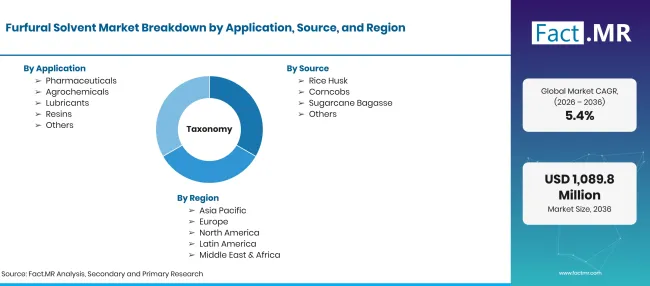
Furfural Solvent Market Taxonomy | Source: Fact.MR
| Attribute | Details |
|---|---|
| Quantitative units | USD million in 2026 to USD million by 2036, at CAGR |
| Market definition | Furfural solvent market activity within the scope of the market dataset |
| Application | Pharmaceuticals; Agrochemicals; Lubricants; Resins; Others |
| Source | Rice Husk; Corncobs; Sugarcane Bagasse; Others |
| End-User Industry | Chemical; Food and Beverage; Oil Refining; Others |
| Countries covered | Germany; Brazil; USA; UK; Japan |
| Companies profiled | Hongye Holding Group; Silvateam S.p.A.; International Furan Chemicals (IFC); Sri Kusuma Haranadha Agro Fural Private Limited |
| Forecast period | 2026 to 2036 |
| Approach | Market segmentation and forecast analysis based on market indicators, with company and technical background references |
Source: Fact.MR analysis. Updated Oct 23, 2026
How is the market segmented?
-
By Application
- Pharmaceuticals
- Agrochemicals
- Lubricants
- Resins
- Others
-
By Source
- Rice Husk
- Corncobs
- Sugarcane Bagasse
- Others
-
By End-User Industry
- Chemical
- Food and Beverage
- Oil Refining
- Others
-
By Region
- North America
- Latin America
- Western Europe
- Eastern Europe
- East Asia
- South Asia & Pacific
- Middle East & Africa
Frequently Asked Questions
How big is the Furfural Solvent Market in 2026?
What is the CAGR from 2026 to 2036?
Which application has the largest stated share?
Which source leads the market?
Which end-user industry leads?
Which country has the highest projected CAGR?
Which companies are covered?
Who worked on this report


Preview the report firsthand - request a free sample
Free SampleGet the brochure for pricing and purchase details
Download PDF