- Market Value (2025): USD 1189.8 Mn
- Estimated Value (2026): USD 1310.0 Mn
- Forecast Value (2036): USD 3428.8 Mn
- CAGR (2026-2036): 10.1%
What is the Solvent-Free UV Additives Market forecast to be worth by 2036?
USD 1,310.0 million in 2026 to USD 3428.8 million by 2036, at 10.1% CAGR.
- The Solvent-Free UV Additives Market crossed a valuation of USD 1189.8 million in 2025.
- Demand is projected to increase from USD 1310.0 million in 2026 to USD 3428.8 million by 2036.
- The market is forecast to record a 10.1% CAGR from 2026 to 2036 as coating formulators and ink producers move toward solvent-free curing systems.
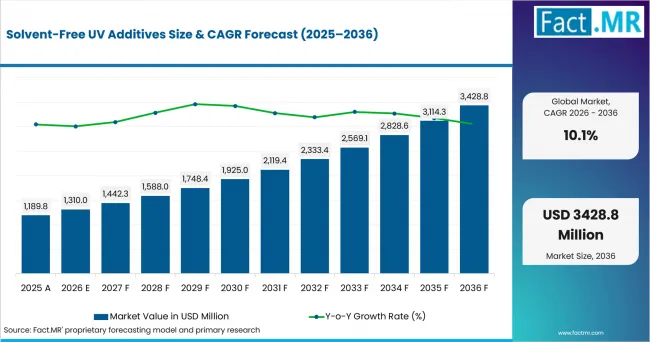
Solvent Free Uv Additives Value Analysis | Source: Fact.MR
What are the defining numbers behind Solvent-Free UV Additives Market growth?
USD 2,118.8 million absolute opportunity by 2036, led by dispersants, acrylate oligomer systems and wood coatings.
- Demand Drivers in the Market
- Formulators need dispersants that keep silica and pigments stable in high-solids UV blends. Related wetting and dispersing agents work supports tighter gloss and viscosity targets.
- Ink producers need wetting additives that maintain adhesion and reprintability in radiation-cured packaging and industrial printing systems.
- Wood-coating applicators need low-foam and leveling control because fast line speeds leave little room for surface defects.
- Electronics coaters need additive compatibility across UV LED and mercury cure systems as smaller parts require controlled film thickness.
- Key Segments Analyzed
- By Additive Type: Dispersants are expected to hold 26.0% share in 2026 due to their role in pigment wetting and matting-agent stability.
- By UV Chemistry: Acrylate oligomer systems are projected to account for 42.0% share in 2026 owing to broad use in solvent-free curing platforms.
- By Application: Wood coatings are anticipated to capture 27.0% share in 2026 because furniture and flooring lines need fast cure with clean surfaces.
- By Cure Type: Mercury UV is estimated to represent 38.0% share in 2026, supported by a large installed base of curing equipment.
- Analyst Opinion at Fact.MR
- Shambhu Nath Jha, Principal Consultant at Fact.MR, states, "Solvent-free UV additives are moving earlier in formulation trials because they decide line usability. Demand is projected to shift toward suppliers that prove stability before scale-up. Vendors should pair chemistry breadth with application testing."
- Strategic Implications
- Formulation teams should qualify dispersants and defoamers together because one additive choice often changes surface flow and foam behavior.
- Curing-system suppliers should align additive guidance with mercury UV, LED-UV and EB cure windows used by coating lines.
- Technical-service teams should build application notes for wood coatings, printing inks and plastic substrates to shorten reformulation cycles.
South Korea is expected to record 11.6% CAGR through 2036, led by electronics coating demand. The UK is projected to post 11.3% CAGR as solvent-emission pressure favors lower-solvent systems. The USA is anticipated to advance at 10.7% CAGR due to coating output. Japan is estimated to hold 10.4% CAGR, supported by electronics demand. Germany is forecast to record 10.1% CAGR, shaped by EU criteria.
How does the Solvent-Free UV Additives Market break down by segment?
Acrylate oligomer systems lead at 42.0%; Mercury UV leads at 38.0%.
Which Additive Type dominates?
Dispersants hold 26.0% share in 2026.
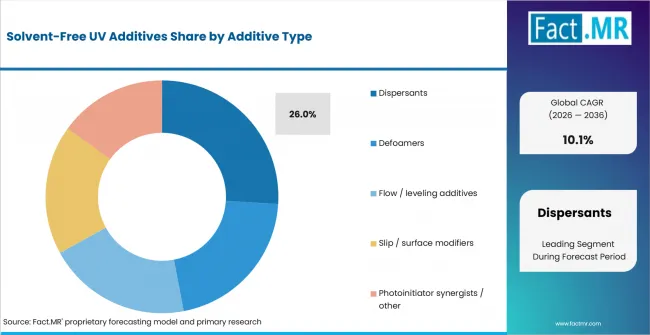
Solvent Free Uv Additives Analysis By Additive Type | Source: Fact.MR
Dispersants are expected to hold 26.0% share in 2026 because solvent-free UV blends need stable pigments and silica at low viscosity. Defoamers control trapped air before cure. Flow additives support cleaner films. BYK lists DISPERBYK-2159 for UV-curing solvent-free systems with silica matting agents.
What leads the UV Chemistry segment?
Acrylate oligomer systems lead with 42.0% share in 2026.
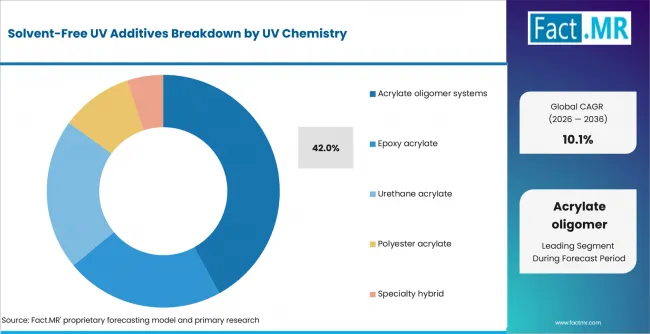
Solvent Free Uv Additives Analysis By Uv Chemistry | Source: Fact.MR
Acrylate oligomer systems are projected to account for 42.0% share in 2026 owing to broad use in 100% solids UV formulations. Epoxy acrylate supports hardness. Urethane acrylate adds flexibility for plastics and wood. allnex describes EBECRYL LED 03 for UV LED packaging coatings and inks.
How does Application shape demand?
Wood coatings lead with 27.0% share in 2026.
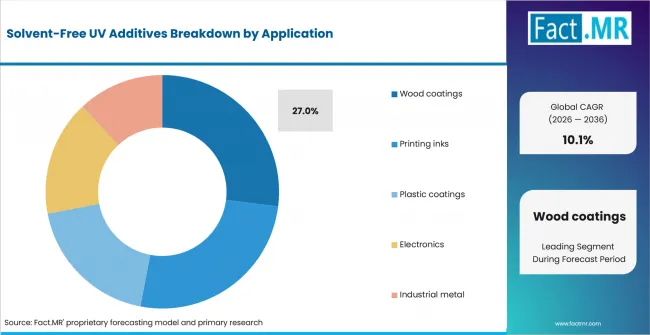
Solvent Free Uv Additives Analysis By Application | Source: Fact.MR
Wood coatings are anticipated to capture 27.0% share in 2026 as furniture and flooring lines shorten cure time. Printing inks follow where surface cure and wetting influence packaging quality. Plastic coatings require slip control. The U.S. Bureau of Labor Statistics reported sectoral output of USD 52,405.806 million in 2025 for U.S. paint, coating, and adhesive manufacturing.
What supports Mercury UV within Cure Type?
Mercury UV leads with 38.0% share in 2026.
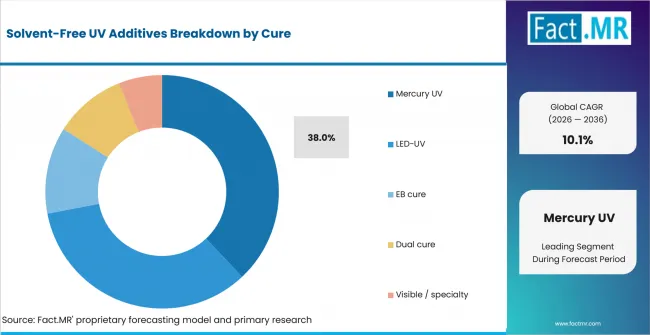
Solvent Free Uv Additives Analysis By Cure | Source: Fact.MR
Mercury UV is estimated to represent 38.0% share in 2026 due to installed curing lines in wood, metal and printing. The U.S. EPA lists UV-cured coatings among examples of low- and no-VOC/HAP coatings.
What is accelerating Solvent-Free UV Additives Market adoption, and what is holding it back?
Solvent-free reformulation drives it; compatibility and compliance testing restrain it.
Drivers Impact Analysis
| Driver | (~) % Impact on CAGR | Geographic Relevance | Impact Timeline |
|---|---|---|---|
| 100% solids reformulation in coatings | +1.8% | North America, Europe, East Asia | Short term (<= 2 years) |
| Dispersant qualification for UV matting systems | +1.5% | Germany, USA, UK | Medium term (2-4 years) |
| Wood and flooring line-speed requirements | +1.2% | Europe, Japan, South Korea | Short term (<= 2 years) |
| Printing ink and packaging cure control | +0.9% | USA, UK, Japan | Medium term (2-4 years) |
| LED-UV and EB cure conversion | +0.7% | South Korea, Japan, USA | Long term (>= 4 years) |
Source: Fact.MR analysis. Updated Sep 10, 2026
Opportunity Impact Analysis
| Opportunity | (~) % Impact on CAGR | Geographic Relevance | Impact Timeline |
|---|---|---|---|
| LED-UV additive packages | +1.2% | Japan, South Korea, USA | Medium term (2-4 years) |
| Ultra-matte wood coatings | +1.0% | Germany, UK, USA | Short term (<= 2 years) |
| Low-migration printing inks | +0.8% | UK, Germany, Japan | Medium term (2-4 years) |
| Electronics protective coatings | +0.6% | South Korea, Japan, USA | Long term (>= 4 years) |
Source: Fact.MR analysis. Updated Sep 10, 2026
Restraints Impact Analysis
| Restraint | (~) % Impact on CAGR | Geographic Relevance | Impact Timeline |
|---|---|---|---|
| Compatibility testing across cure windows | -0.6% | Global | Short term (<= 2 years) |
| Migration and food-contact documentation | -0.5% | Europe, UK, Japan | Medium term (2-4 years) |
| Mercury lamp transition uncertainty | -0.4% | USA, Germany, UK | Medium term (2-4 years) |
| Specialty raw-material cost swings | -0.3% | Global | Long term (>= 4 years) |
Source: Fact.MR analysis. Updated Sep 10, 2026
Which countries are scaling Solvent-Free UV Additives Market through 2036?
- The country comparison spans 1.5 percentage points and forms a tight growth band across the forecast period.
- South Korea remains 0.3 percentage point above the UK through electronics coating and LED-UV formulation demand.
- The UK remains 0.6 percentage point above the USA as industrial coating users work under solvent-emission controls.
- The USA remains 0.3 percentage point above Japan through paint, coating and adhesive manufacturing activity.
- Japan remains 0.3 percentage point above Germany through electronics coating demand and precision film requirements.
- Germany closes the displayed range through local additive expertise and EU coating documentation needs.
Comparable CAGRs create different entry conditions because each country has a separate mix of electronics output, coating regulation, cure-system base and formulator testing behavior. Full report coverage includes North America, Latin America, Western Europe, Eastern Europe, East Asia, South Asia & Pacific, Middle East & Africa.
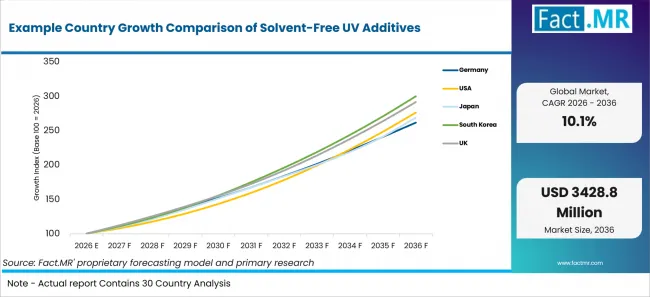
Example Country Growth Comparison Of Solvent Free Uv Additives | Source: Fact.MR
| Country | CAGR |
|---|---|
| South Korea | 11.6% |
| United Kingdom | 11.3% |
| United States | 10.7% |
| Japan | 10.4% |
| Germany | 10.1% |
Source: Fact.MR analysis. Updated Sep 10, 2026
What supports South Korea adoption?
11.6% CAGR through 2036, driven by electronics coating and LED-UV formulation demand.
South Korea is expected to record 11.6% CAGR as electronics coaters require low-foam and wetting additives for compact components. MOTIR and MSIT reported in January 2026 that Korea’s ICT exports reached USD 264.3 billion in 2025. That export base gives UV additive suppliers a clear route into electronics coatings where film control and line reliability guide selection.
How is the UK scaling demand?
11.3% CAGR through 2036, supported by manufacturing sales and solvent-emission pressure.
The UK is projected to post 11.3% CAGR as industrial coaters review solvent use across wood, metal and plastic finishing. DEFRA reported in February 2026 that industrial coating applications represented 7% of UK NMVOC emissions in 2024. Solvent-free UV additives are therefore positioned around compliance records, surface quality and lower rework on coating lines.
What supports the USA outlook?
10.7% CAGR through 2036, led by coating output and VOC-control documentation.
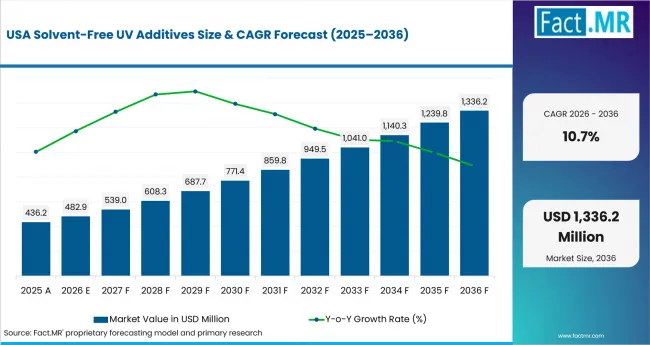
Solvent Free Uv Additives Country Value Analysis | Source: Fact.MR
The USA is anticipated to advance at 10.7% CAGR as surface-coating producers maintain a sizeable industrial base for additives. U.S. Census Bureau M3 data published through FRED show that the not-seasonally-adjusted value of shipments for U.S. paint, coating, and adhesive manufacturing totaled USD 4,467 million in May 2026. This scale supports dispersant, defoamer and surface-control testing for solvent-free UV coating systems.
How does Japan perform?
10.4% CAGR through 2036, shaped by electronics output and precision coating demand.
Japan is estimated to hold 10.4% CAGR as electronics producers use thin protective films and compact component coatings. JEITA, using METI data, reported 2025 Japanese electronics production of ¥11,764,621 million. Additive selection is expected to focus on wetting control, surface uniformity and compatibility with low-heat curing routes.
What is supporting Germany’s adoption?
10.1% CAGR through 2036, supported by additive launches and EU coating criteria.
Germany is forecast to record 10.1% CAGR as local additive producers target solvent-free radiation-cure formulations. The German Environment Agency identifies coating applications as a key source category for NMVOC emissions and includes industrial coating applications within that category. This supports continued attention to solvent use in industrial coating operations.
Who leads the Solvent-Free UV Additives Market?
BYK and BASF provide direct dispersant products for UV-curing systems, while Evonik provides substrate-wetting technology and allnex supplies acrylate-based radiation-curing chemistry.
BYK participates through DISPERBYK wetting and dispersing additives, including products designed for solvent-free UV-curing coatings and printing inks. Substrate wetting additives are also relevant to surface-tension control and uniform coating application. BASF provides Efka PX 4720, a high-performance dispersing agent designed for ultra-matte, solvent-free UV coating formulations. Evonik provides TEGO Wet 288 for substrate wetting in waterborne and radiation-curing inks and coatings.
allnex provides EBECRYL radiation-curable resins and additives, including EBECRYL LED 03 for UV LED packaging coatings and inks. Lubrizol supplies Solsperse polymeric dispersants for pigment dispersion and stabilization, including grades suitable for UV-cured inks and coatings. Wetting and dispersing additives support pigment stabilization and particle distribution in coating formulations.
Which companies are the key providers?
BYK and BASF are key providers. Evonik and allnex are also profiled. Lubrizol completes the company set.
- BYK
- BASF
- Evonik
- allnex
- Lubrizol
Bibliography
- BASF. (2026, May 13). American Coatings Show 2026: BASF debuts Efka® PX 4720 to power ultra-matte UV coatings with CFRP technology.
- Clariant. (2025, June 5). Hostavin™ VSU powder.
- Department for Environment, Food & Rural Affairs. (2026, February 12). Emissions of air pollutants in the UK – Non-methane volatile organic compounds (NMVOCs). GOV.UK.
- U.S. Environmental Protection Agency. (2025, November 10). Monitoring by control technique – Compliant (low/no VOC/HAP) inks and coatings.
- Evonik. (2025, April 11). Evonik launches TEGO® Wet 288 for substrate wetting of waterborne and radiation-curing formulations.
- German Environment Agency. (2025). 2.D.3.d – Coating application. In German Informative Inventory Report.
- Japan Electronics and Information Technology Industries Association. (2026, March 19). December 2025 production by the Japanese electronics industry.
- Lubrizol. (2024, December 5). Solsperse™ 74000 [Product data sheet].
- Ministry of Trade, Industry and Resources. (2026, January 15). ICT exports post record annual performance in 2025.
- U.S. Bureau of Labor Statistics. (2026, June 29). Sectoral output for manufacturing: Paint, coating, and adhesive manufacturing (NAICS 3255) in the United States [Data set]. FRED, Federal Reserve Bank of St. Louis.
- U.S. Census Bureau. (2026, September 2). Manufacturers' value of shipments: Paint, coating, and adhesive, manufacturing [Data set]. FRED, Federal Reserve Bank of St. Louis.
This Report Answers
- The report explains solvent-free UV additives by additive type, UV chemistry, application and cure type.
- Segment analysis identifies the listed 2026 share leaders across all four dimensions.
- Country analysis examines Germany, USA, Japan, South Korea and the UK.
- Competitive analysis reviews BYK, BASF, Evonik, allnex, and Lubrizol.
- Technology assessment covers dispersants, defoamers, flow additives, slip modifiers and synergists.
- Application assessment covers wood coatings, printing inks, plastic coatings, electronics and industrial metal.
- Primary interviews, provider checks and official sources support the forecast logic.
What does the Solvent-Free UV Additives Market cover?
Dispersants, defoamers, flow additives and cure synergists used in solvent-free UV formulations.
The Solvent-Free UV Additives Market covers specialty additives that improve processing and film quality in 100% solids UV coatings and inks. It includes products that stabilize pigments and reduce foam.
The assessment differs from broader coating additives because revenue is counted only when additives are qualified for solvent-free UV systems. Finished coatings, lamps and base resins are outside scope unless sold as part of a qualified package.
What is included in the scope?
Solvent-free UV additive systems used in coatings, inks and radiation-cure formulation packages.
The scope includes dispersants, defoamers, flow additives, slip modifiers and cure synergists for solvent-free UV coatings and inks. Adjacent coating additives are counted only when qualified for radiation cure. Related UV cure lacquers, biomass-balanced coating additives and UV cured hardcoats frame adjacent demand without entering finished-coating revenue.
What is excluded from the scope?
Finished coatings and standalone UV curing equipment are outside the scope.
The scope excludes pigments, binders, monomers, solvents and finished paints or inks sold without solvent-free UV additive function. Standalone curing equipment is excluded when revenue falls outside additive chemistry. Conventional solvent-borne additives are excluded unless qualified for solvent-free UV systems.
How was the analysis built?
120+ sources, 35+ company portfolios, 25+ countries, and more than 20 interviews.
- Primary Research: Primary research included coating formulators, ink producers, additive suppliers and industrial coating users. Discussions covered cure choice, qualification time and documentation needs.
- Desk Research: Desk research covered government statistics, VOC guidance, EU criteria, product pages and company releases. The review prioritized first-hand sources.
- Market-Sizing and Forecasting: Market estimates combined coating output, ink use, UV-cure penetration, dosage patterns, segment shares and country CAGRs.
- Data Validation and Update Cycle: Findings were checked against portfolios, product documents, regulatory records and country statistics. Updates review launches and cure shifts.
Segmentation
What is the report’s scope and coverage?
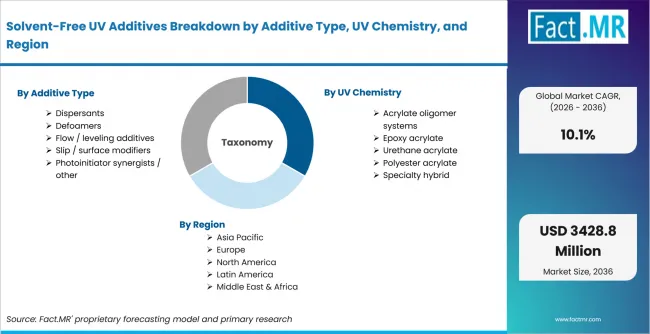
Solvent Free Uv Additives Breakdown By Additive Type, Uv Chemistry, And Region | Source: Fact.MR
| Attribute | Details |
|---|---|
| Quantitative Units | USD million |
| Market Definition | Specialty additives used in solvent-free UV and radiation-cure coating or ink formulations to control dispersion, foam, surface flow, slip, cure response and film quality. |
| Additive Type | Dispersants; Defoamers; Flow / leveling additives; Slip / surface modifiers; Photoinitiator synergists / other |
| UV Chemistry | Acrylate oligomer systems; Epoxy acrylate; Urethane acrylate; Polyester acrylate; Specialty hybrid |
| Application | Wood coatings; Printing inks; Plastic coatings; Electronics; Industrial metal |
| Cure Type | Mercury UV; LED-UV; EB cure; Dual cure; Visible / specialty |
| Regions Covered | North America; Latin America; Western Europe; Eastern Europe; East Asia; South Asia & Pacific; Middle East & Africa |
| Countries Covered | Germany; USA; Japan; South Korea; UK |
| Companies Profiled | BYK; BASF; Evonik; allnex; Lubrizol |
| Forecast Period | 2026 to 2036 |
| Approach | Hybrid top-down and bottom-up approach using coating output, ink demand, cure-system use, formulation intensity, supplier portfolio review and country-level adoption indicators. |
Source: Fact.MR analysis. Updated Sep 10, 2026
How is the market segmented?
-
By Additive Type
- Dispersants
- Defoamers
- Flow / leveling additives
- Slip / surface modifiers
- Photoinitiator synergists / other
-
By UV Chemistry
- Acrylate oligomer systems
- Epoxy acrylate
- Urethane acrylate
- Polyester acrylate
- Specialty hybrid
-
By Application
- Wood coatings
- Printing inks
- Plastic coatings
- Electronics
- Industrial metal
-
By Cure Type
- Mercury UV
- LED-UV
- EB cure
- Dual cure
- Visible / specialty
-
By Region
- North America
- Latin America
- Western Europe
- Eastern Europe
- East Asia
- South Asia & Pacific
- Middle East & Africa
Frequently Asked Questions
How big is the Solvent-Free UV Additives Market in 2026?
What is the CAGR of the Solvent-Free UV Additives Market from 2026 to 2036?
Which additive type leads the Solvent-Free UV Additives Market?
Which UV chemistry leads the Solvent-Free UV Additives Market?
Who are the leading companies in the Solvent-Free UV Additives Market?
Who worked on this report


Preview the report firsthand - request a free sample
Free SampleGet the brochure for pricing and purchase details
Download PDF