- Market Value (2025): USD 130.4 Mn
- Estimated Value (2026): USD 137.0 Mn
- Forecast Value (2036): USD 225.0 Mn
- CAGR (2026-2036): 5.1%
What is the Solvent-Stable Blue Pigments Market forecast to be worth by 2036?
USD 137.0 million in 2026 to USD 225.0 million by 2036, at 5.1% CAGR.
- The USD 130.4 million valuation in 2025 shows that solvent-stable blues already serve an established base of ink, coating, and plastics formulations rather than a narrow specialty niche.
- Demand is projected to move from USD 137.0 million in 2026 to USD 225.0 million by 2036 as converters seek consistent color strength across longer runs and more varied solvent packages.
- The 5.1% CAGR is supported by qualification work around bleed resistance, solvent fastness, and dispersion stability in packaging inks and industrial finishes.
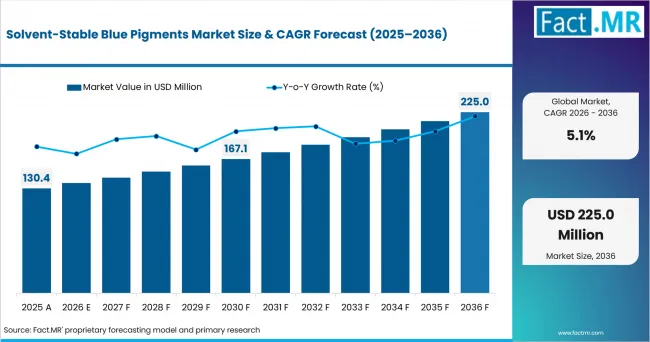
Solvent Stable Blue Pigments Market Value Analysis | Source: Fact.MR
What are the defining numbers behind Solvent-Stable Blue Pigments Market growth?
USD 88.0 million absolute opportunity by 2036, led by Beta phthalo blue and Aromatic solvents within their respective segments.
- Demand Drivers in the Market
- Flexible-packaging printers need blue pigments that retain shade and rheology in gravure and flexographic solvent systems.
- Industrial coating formulators are tightening pigment approval around solvent resistance because color drift can appear after let-down, storage, or application.
- Masterbatch producers value grades that combine heat stability with reliable dispersion when a blue colorant must cross several polymer families.
- Customers are asking pigment suppliers for application-specific data and easier-to-use dispersions instead of treating every phthalocyanine blue as interchangeable.
- Key Segments Analyzed
- By Blue Pigment Type: Alpha Phthalo Blue is expected to hold 26.0% share in 2026 due to its stable crystal form and dependable color performance across inks, coatings, and plastics.
- By Solvent System: Aromatic Solvents are projected to account for 28.0% share in 2026 because they provide strong pigment solvency and compatibility with industrial formulations.
- By Application: Solvent-Based Inks are anticipated to capture 30.0% share in 2026 through their use in long print runs that require stable viscosity, bleed control, and consistent shade.
- By Performance Requirement: Bleed Resistance is estimated to represent 30.0% share in 2026 since control over color migration is essential for print clarity and coating uniformity.
- By Supply Form: Dry Pigment is forecast to account for 39.0% share in 2026 due to its storage efficiency, lower freight burden, and flexibility across resin systems.
- Analyst Opinion at Fact.MR
- Shambhu Nath Jha, Senior Analyst at Fact.MR, states, the commercial issue is not simply whether a pigment looks blue in the laboratory; it is whether that shade survives the customer's solvent package and processing sequence. Suppliers that connect crystal form, surface treatment, and dispersion guidance to the actual ink or coating system should convert trials into repeat orders more reliably."
- Strategic Implications
- Pigment manufacturers should separate solvent-stability claims by resin and solvent family rather than publish a single broad compatibility statement.
- Ink producers can reduce press-side corrections by qualifying color strength, bleed, and viscosity retention in the same trial protocol.
- Coating companies should compare dry pigment economics with the milling time and batch risk avoided by liquid dispersions or flush colors.
- Distributors need application records that distinguish beta blue, stabilized alpha grades, and solvent-stable blends for the formulations common in each territory.
DIC's official printing-ink pigment portfolio lists several phthalocyanine blue crystal forms, including PB15, PB15:3, PB15:4, and PB15:6. That breadth illustrates why formulators buy against solvent system and performance target rather than a generic blue designation.
United States 5.1% CAGR. China 6.1% CAGR. Germany 4.8% CAGR. Japan 4.9% CAGR. South Korea 5.3% CAGR.
How does the Solvent-Stable Blue Pigments Market break down by segment?
Alpha Phthalo Blue leads at 26% by Blue Pigment Type, while Dry Pigment leads at 39% by Supply Form in 2026.
How does Blue Pigment Type shape demand?
Alpha Phthalo Blue holds 26.0% share in 2026.
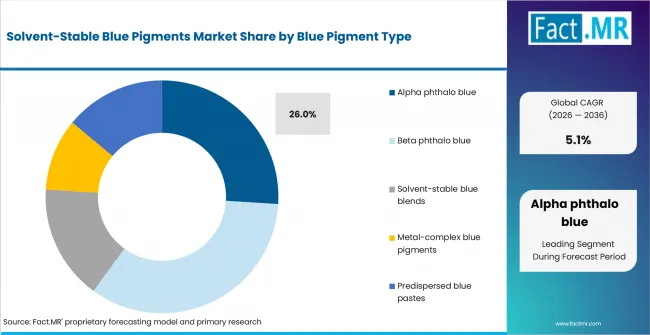
Solvent Stable Blue Pigments Market Analysis By Blue Pigment Type | Source: Fact.MR
Beta phthalo blue leads demand, ahead of alpha phthalo blue. Its greener shade, crystal stability, and broad application history make it a practical starting point for solvent-borne formulations that cannot tolerate shade drift. Alpha grades remain important where a redder blue is wanted, while solvent-stable blends address customers that need a narrower performance window without developing a custom dispersion.
Which solvent environment creates the largest addressable demand?
Aromatic Solvents accounts for 28.0% share in 2026.
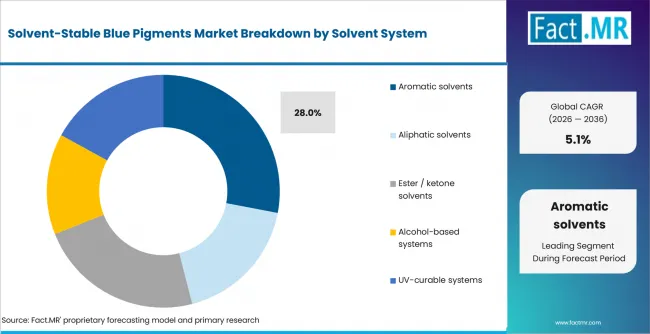
Solvent Stable Blue Pigments Market Analysis By Solvent System | Source: Fact.MR
Aromatic solvents lead, with ester and ketone systems following. Strong solvency makes pigment crystal stability and surface treatment highly visible during storage and application, which keeps qualification standards demanding. UV-curable systems represent a different route, reflecting interest in lower-volatility processing, but dispersion and cure compatibility replace evaporation behavior as the central formulation concern.
What keeps solvent-based inks at the front of application demand?
Solvent-Based Inks holds 30.0% share in 2026.
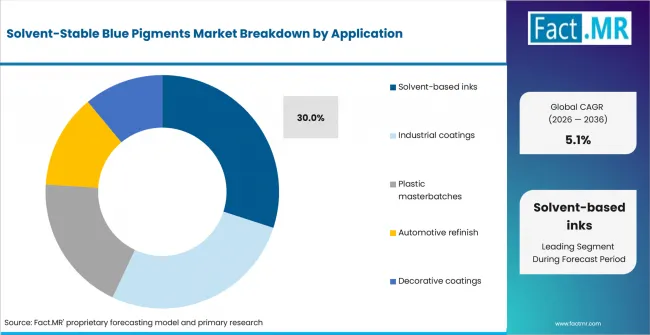
Solvent Stable Blue Pigments Market Analysis By Application | Source: Fact.MR
Solvent-based inks lead, narrowly ahead of industrial coatings. Gravure and flexographic printers require reproducible strength and flow through repeated solvent addition, drying, and recirculation, so a failed pigment choice carries press-time consequences. Industrial coatings use many of the same stability attributes, whereas plastic masterbatches place greater weight on heat history and melt dispersion.
Why is bleed resistance the first performance gate?
Bleed Resistance lead with 30.0% share in 2026.
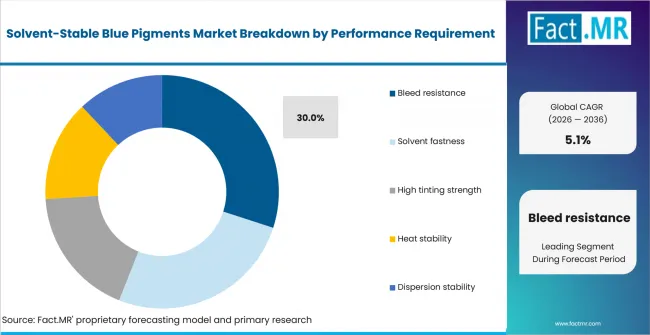
Solvent Stable Blue Pigments Market Analysis By Performance Requirement | Source: Fact.MR
Bleed resistance leads stated performance demand, followed by solvent fastness. The two requirements are related but not identical: a pigment may resist chemical attack yet still migrate into an adjacent layer or binder. High tinting strength matters for formulation cost, while heat and dispersion stability become decisive in plastics and high-solids coatings.
Why does dry pigment remain the preferred supply form?
Dry Pigment holds 39.0% share in 2026.
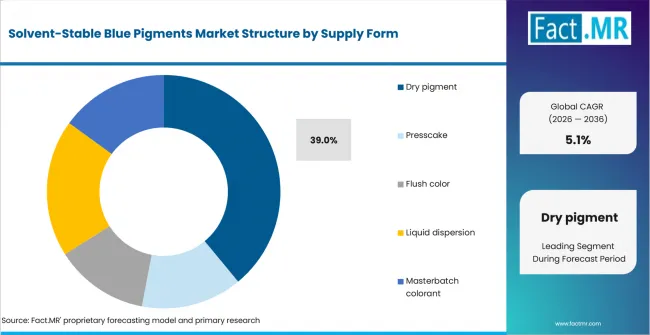
Solvent Stable Blue Pigments Market Analysis By Supply Form | Source: Fact.MR
Dry pigment leads demand and remains the default for producers with established milling assets. Liquid dispersion follows and appeals where faster incorporation and predictable rheology justify paying for a formulated intermediate. Presscake and flush color serve more specialized process routes, while masterbatch colorant shifts dispersion work upstream for plastics customers.
What is accelerating Solvent-Stable Blue Pigments Market adoption, and what is holding it back?
The strongest accelerator is the need for blue shades that remain stable through solvent exposure and high-throughput conversion. The main restraint is the time and cost required to prove compatibility across each customer's resin, solvent, and process conditions.
Drivers Impact Analysis
| DRIVER | (~) % IMPACT ON CAGR | GEOGRAPHIC RELEVANCE | IMPACT TIMELINE |
|---|---|---|---|
| Packaging ink qualification | +0.8% | Asia Pacific, North America, and Europe | Medium term (2-4 years) |
| Industrial coating durability | +0.7% | Europe, North America, and East Asia | Long term (>= 4 years) |
| Masterbatch process consistency | +0.6% | United States, Germany, and France | Medium term (2-4 years) |
| Application-specific grade portfolios | +0.5% | Global | Short term (<= 2 years) |
| Lower-loss color processing | +0.4% | Japan, South Korea, Germany, and United States | Long term (>= 4 years) |
Source: Fact.MR analysis. Updated Jul 17, 2026
- Packaging ink qualification: Packaging printers need blue pigments that keep strength and flow in gravure and flexographic systems. Approval expands when a supplier can document behavior in the customer's solvent and binder combination rather than offer only generic fastness data.
- Industrial coating durability: Machinery, metal, and maintenance coatings expose pigments to solvents during formulation and service. Stable color and predictable dispersion reduce rework when the same blue is used across primers, topcoats, and repair systems.
- Masterbatch process consistency: Compounders favor pigments that disperse without excessive filter pressure or heat-driven shade change. Repeatable powder quality also helps them carry one approved blue across several customer recipes.
Opportunity Impact Analysis
| OPPORTUNITY | (~) % IMPACT ON CAGR | GEOGRAPHIC RELEVANCE | IMPACT TIMELINE |
|---|---|---|---|
| Predispersed solvent concentrates | +0.4% | Asia Pacific and Europe | Medium term (2-4 years) |
| Low-VOC formulation support | +0.4% | North America, Europe, Japan, and South Korea | Long term (>= 4 years) |
| Cross-application beta blue grades | +0.3% | Global | Medium term (2-4 years) |
| Technical-service-led conversion | +0.3% | Southeast Asia and Latin America | Short term (<= 2 years) |
Source: Fact.MR analysis. Updated Jul 17, 2026
- Predispersed solvent concentrates: Ready-to-use concentrates can shorten milling and reduce variability for small and mid-sized ink plants. The opportunity is strongest where suppliers tailor the carrier to common nitrocellulose, polyurethane, or polyamide ink systems.
- Low-VOC formulation support: Rules and customer targets around organic solvent emissions are pushing printers to reconsider solvent choice and solids content. Pigment suppliers can add value by proving that color strength and rheology remain manageable as formulators reduce volatile components.
- Cross-application beta blue grades: A grade qualified for both solvent inks and selected coatings can simplify inventory for regional formulators. Success depends on transparent limits, because performance in one binder does not guarantee stability in every solvent package.
Restraints Impact Analysis
- Formulation-specific approval burden: Solvent stability must be proven in the customer's full formulation, including resin, additives, and drying conditions. Repeating that work for multiple platforms slows substitution even when a new grade appears attractive.
- Raw-material and energy variability: Phthalocyanine pigment economics depend on chemical inputs, process control, and energy-intensive finishing. Cost volatility can disrupt the balance between commodity dry powder and higher-value treated grades.
- Dispersion equipment differences: A pigment that performs well in one bead mill or disperser may behave differently under another plant's energy input and residence time. This equipment dependence makes laboratory comparisons harder to translate directly into production.
| RESTRAINT | (~) % IMPACT ON CAGR | GEOGRAPHIC RELEVANCE | IMPACT TIMELINE |
|---|---|---|---|
| Formulation-specific approval burden | -0.4% | Global | Short term (<= 2 years) |
| Raw-material and energy variability | -0.3% | Asia Pacific and Europe | Medium term (2-4 years) |
| Dispersion equipment differences | -0.2% | Global | Medium term (2-4 years) |
| Shift away from solvent-borne systems | -0.2% | North America, Europe, Japan, and South Korea | Long term (>= 4 years) |
Source: Fact.MR analysis. Updated Jul 17, 2026
Where is solvent-stable blue pigment demand anchored?
United States 5.1% CAGR. China 6.1% CAGR. Germany 4.8% CAGR. Japan 4.9% CAGR. South Korea 5.3% CAGR.
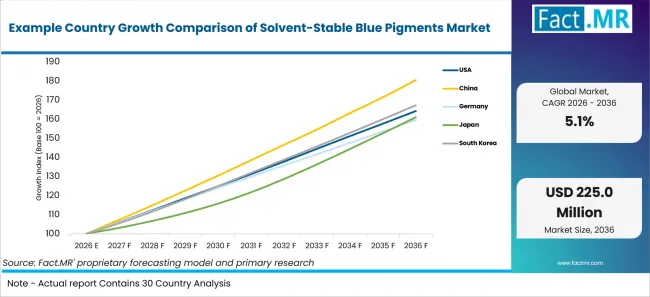
Example Country Growth Comparison Of Solvent Stable Blue Pigments Market | Source: Fact.MR
Regional analysis covers country chapters on United States, China, Germany, Japan, and South Korea. Analysis on more than 30 countries is included in the full report.
| COUNTRY | CAGR |
|---|---|
| United States | 5.1% |
| Germany | 4.8% |
| Japan | 4.9% |
| South Korea | 5.3% |
Source: Fact.MR analysis. Updated Jul 17, 2026
How is the United States market likely to develop?
A 5.1% CAGR is projected for United States during 2026-2036.
The United States remains an important market because coatings, industrial inks, plastics, and packaging manufacturers continue to demand pigments that deliver consistent color under demanding production conditions. EPA oversight and customer qualification programs encourage buyers to select suppliers that can demonstrate long-term performance, regulatory documentation, and batch-to-batch consistency. Demand is expected to remain strongest for grades that withstand solvents while maintaining color stability in automotive, industrial, and specialty coating applications.
How is the Germany market likely to develop?
A 4.8% CAGR is projected for Germany during 2026-2036.
Germany's market is supported by its advanced coatings, automotive, and industrial manufacturing sectors, where pigment reliability directly affects finished-product quality. REACH compliance and stringent quality systems mean manufacturers rarely change pigment suppliers without extensive validation. Growth will therefore favor producers that combine strong regulatory documentation with highly consistent dispersion, heat resistance, and solvent stability for precision manufacturing.
How is the Japan market likely to develop?
A 4.9% CAGR is projected for Japan during 2026-2036.
Japanese manufacturers emphasize product consistency, long production runs, and premium visual quality across printing inks, electronics, and specialty coatings. Purchasing decisions often prioritize stable color reproduction and exceptionally low variation rather than simply reducing material cost. Suppliers capable of delivering uniform pigment quality with strong technical support are expected to strengthen their position as manufacturers continue focusing on premium finished products.
How is the South Korea market likely to develop?
A 5.3% CAGR is projected for South Korea during 2026-2036.
South Korea is expected to see steady demand as exports of electronics, packaging, automotive components, and industrial products continue requiring durable color systems. Manufacturers frequently introduce new products, making rapid technical support and reliable qualification increasingly important. Suppliers that can provide consistent pigment performance while supporting fast production cycles and export-quality standards are likely to gain market share.
Who leads the Solvent-Stable Blue Pigments Market?
Sudarshan Chemical Industries Limited, DIC, Solar Organics, and Meghmani Organics compete through product specialization, manufacturing capability, and technical support.
The competitive landscape remains fragmented, with no single producer dominating global supply. Sudarshan Chemical Industries Limited has built a broad portfolio serving coatings, plastics, and printing applications, while DIC leverages its global pigment business and formulation expertise. Solar Organics and Meghmani Organics strengthen competition through phthalocyanine-based pigment manufacturing and expanding export presence. Future competition is expected to depend less on price alone and more on application-specific grades, regulatory compliance, dependable supply, and technical collaboration with customers during product qualification.
Which companies are the key providers?
The company set includes Solar Organics, Sudarshan Chemical Industries Limited, DIC, and Meghmani Organics.
- Solar Organics
- Sudarshan Chemical Industries Limited
- DIC
- Meghmani Organics
These five names front the competitive review, while the full report profiles more than 30 companies in phthalocyanine and specialty blue supply.
Bibliography
- DIC Corporation. (2025, March 27). Annual securities report 2025.
- Sudarshan Chemical Industries Limited. (2025). Colorants for special applications.
- Sun Chemical Corporation. (2025, November 3). Sun Chemical and DIC to showcase latest color materials and resin technologies at CHINACOAT 2025.
- DIC Corporation. (2025, November 4). DIC and Sun Chemical to showcase latest resin and color-material technologies at CHINACOAT 2025.
This Report Addresses
- The report evaluates how solvent exposure, crystal form, and dispersion quality shape blue-pigment purchasing decisions.
- It reviews United States, China, Germany, Japan, and South Korea, within coverage that reaches more than 30 countries.
- Five-company benchmarking spans Solar Organics, Sudarshan Chemical Industries Limited, DIC, and Meghmani Organics.
- Product analysis distinguishes alpha blue, beta blue, blends, metal-complex grades, and predispersed pastes across five solvent systems.
- Application assessment covers solvent-based inks, industrial coatings, plastic masterbatches, automotive refinish, and decorative coatings.
- Forecast evidence links shipment value to bleed resistance, solvent fastness, supply form, formulation approval, and regional conversion activity.
What does the Solvent-Stable Blue Pigments Market cover?
Solvent-stable blue pigment materials used where carriers or processing conditions can disturb color, crystal form, or dispersion.
The report measures pigment and prepared-colorant sales into solvent-based inks, industrial and decorative coatings, automotive refinish, and plastic masterbatches. It follows the five reported segmentation dimensions without adding unsupported categories.
Coverage runs across more than 30 countries, led by the United States and Europe, with 30+ suppliers reviewed and the forecast expressed in USD million from 2026 through 2036.
What is included in the scope?
Covered products range from dry alpha and beta phthalocyanine blues to formulated dispersions and solvent-stable blends.
The product boundary includes pigments sold for aromatic, aliphatic, ester or ketone, alcohol-based, and UV-curable systems. Performance analysis considers bleed resistance, solvent fastness, tinting strength, heat stability, and dispersion stability.
Supply-form coverage includes dry pigment, presscake, flush color, liquid dispersion, and masterbatch colorant where the pigment remains the value-bearing color component.
What is excluded from the scope?
Finished formulations and soluble blue dyes are excluded from pigment-market revenue.
The analysis does not count the full selling value of completed ink, paint, coating, or colored-plastic products. It also excludes unrelated inorganic, natural, food, and cosmetic blues unless they fall within the reported solvent-stable pigment taxonomy.
How Was the Analysis Built?
The analysis draws on 120+ sources, 35+ company portfolios, 25+ countries, and more than 20 industry interviews.
- Primary Research: Primary research includes discussions with manufacturers, service providers, technology developers, distributors, end users, procurement teams, and subject-matter experts. These conversations examine purchasing priorities, product adoption, operational challenges, approval requirements, competitive positioning, and the factors that influence wider market acceptance.
- Desk Research: Desk research covers government statistics, regulatory publications, company filings, trade data, technical studies, industry associations, standards, public policy, and other authoritative sources. Every source used in the analysis is documented in the bibliography.
- Market Sizing and Forecasting: Market estimates combine historical performance, demand indicators, pricing and volume trends, segment shares, company participation, country-level growth, adoption patterns, investment activity, and barriers to market expansion.
- Data Validation and Update Cycle: Findings are validated by comparing primary interviews with public data, company activity, regulatory changes, trade patterns, and industry developments. Regular updates review new product launches, capacity changes, partnerships, approvals, procurement trends, and shifts in commercial adoption.
Segmentation
What is the report's scope and coverage?
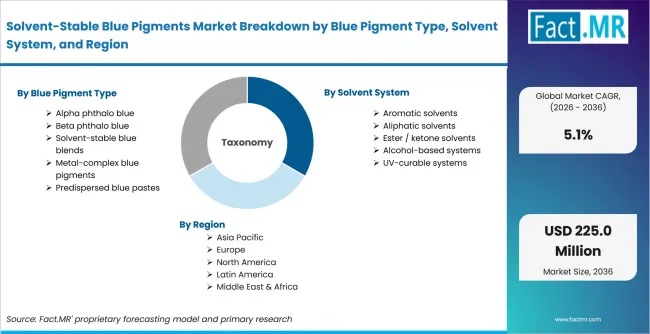
Solvent Stable Blue Pigments Market Breakdown By Blue Pigment Type, Solvent System, And Region | Source: Fact.MR
| ATTRIBUTE | DETAILS |
|---|---|
| Quantitative Units | USD million in 2026 to USD million by 2036 at CAGR |
| Market Definition | The market covers organic blue pigment powders, presscakes, flush colors, dispersions, blends, and masterbatch colorants engineered to retain shade and performance in solvent-containing inks, coatings, and plastics processing. |
| Blue Pigment Type | Alpha phthalo blue; Beta phthalo blue; Solvent-stable blue blends; Metal-complex blue pigments; Predispersed blue pastes |
| Solvent System | Aromatic solvents; Aliphatic solvents; Ester / ketone solvents; Alcohol-based systems; UV-curable systems |
| Application | Solvent-based inks; Industrial coatings; Plastic masterbatches; Automotive refinish; Decorative coatings |
| Performance Requirement | Bleed resistance; Solvent fastness; High tinting strength; Heat stability; Dispersion stability |
| Supply Form | Dry pigment; Presscake; Flush color; Liquid dispersion; Masterbatch colorant |
| Regions Covered | North America; Europe; Asia Pacific |
| Countries Covered | United States; China; Germany; Japan; South Korea (analysis extends to 30+ countries) |
| Key Companies Profiled | Solar Organics; Sudarshan Chemical Industries Limited; DIC; Meghmani Organics |
| Forecast Period | 2026 to 2036 |
| Approach | Demand is evaluated using colored paraffin output, application-specific dye loading, concentrate strength, delivery-form mix, supplier pricing, and buyer purchasing patterns. |
Source: Fact.MR analysis. Updated Jul 17, 2026
How is the market segmented?
-
By Blue Pigment Type
- Alpha phthalo blue
- Beta phthalo blue
- Solvent-stable blue blends
- Metal-complex blue pigments
- Predispersed blue pastes
-
By Solvent System
- Aromatic solvents
- Aliphatic solvents
- Ester / ketone solvents
- Alcohol-based systems
- UV-curable systems
-
By Application
- Solvent-based inks
- Industrial coatings
- Plastic masterbatches
- Automotive refinish
- Decorative coatings
-
By Performance Requirement
- Bleed resistance
- Solvent fastness
- High tinting strength
- Heat stability
- Dispersion stability
-
By Supply Form
- Dry pigment
- Presscake
- Flush color
- Liquid dispersion
- Masterbatch colorant
-
By Region
- North America
- United States
- Europe
- Germany
- Asia Pacific
- Japan
- South Korea
- South Asia
- Latin America
- Brazil
- Middle East and Africa
- Morocco
- Saudi Arabia
- Russia
- United Arab Emirates
- Italy
- United Kingdom
- North America
Frequently Asked Questions
What is the Solvent-Stable Blue Pigments Market forecast for 2036?
Which blue pigment type leads demand?
Which solvent system has the largest share?
Which supply form is most widely used?
Which countries take the lead?
How does South Korea perform?
What is the primary market driver?
What is the main restraint?
Who worked on this report


Preview the report firsthand - request a free sample
Free SampleGet the brochure for pricing and purchase details
Download PDF