- Market Value (2025): USD 39.6 Bn
- Estimated Value (2026): USD 42.1 Bn
- Forecast Value (2036): USD 76.8 Bn
- CAGR (2026-2036): 6.2%
What is the Fuses and Circuit Breakers Market forecast to be worth by 2036?
USD 42.1 billion in 2026 to USD 76.8 billion by 2036, at a 6.20% CAGR.
- As per Fact.MR analysis, the fuses and circuit breakers market reached USD 39.6 billion in 2025.
- Demand will increase from USD 42.1 billion in 2026 to USD 76.8 billion in 2036.
- The market is forecast to record a 6.2% CAGR during 2026 to 2036 as renewable energy grid integration, electric vehicle fast-charging infrastructure, and industrial electrification accelerate circuit protection installations.
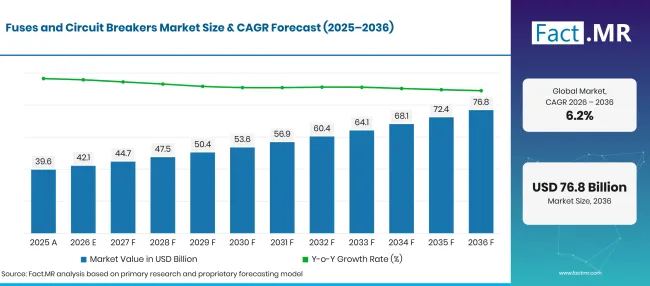
Factmr Fuses And Circuit Breakers Market Forecast Global | Source: Fact.MR
| Year | Basis | Market Value (USD billion) |
|---|---|---|
| 2025 | Actual | 39.6 |
| 2026 | Estimate | 42.1 |
| 2036 | Forecast | 76.8 |
| CAGR 2026 to 2036 | Forecast period | 6.2% |
Source: Fact.MR analysis. Updated Oct 19, 2026
What are the defining numbers behind Fuses and Circuit Breakers Market growth?
USD 34.7 billion absolute chance between 2026 and 2036, with low-voltage circuit protection devices and industrial electrification projects driving the largest procurement volume.
- Demand Drivers in the Market
- Electric utility operators are modernizing high-voltage transmission lines and interconnecting utility-scale solar and wind farms to regional transmission grids. The U.S. Department of Energy announced USD 8 million in high-voltage direct-current grid modernization funding to accelerate next-generation circuit breaker technologies capable of handling bidirectional direct current fault currents [1]. Power utilities replace aging oil-filled breakers with modern vacuum and eco-efficient gas-insulated switchgear.
- Grid resilience initiatives and extreme weather events compel municipal utilities to reinforce substation protection schemes against catastrophic electrical cascading failures. The U.S. Department of Energy established dedicated funding rounds under the Grid Resilience and Innovation Partnerships program to harden electrical distribution substations against thermal overstress and physical line faults [2]. Substation operators upgrade switchgear cabinets with intelligent electronic relays that isolate localized faults in milliseconds.
- Electrified transportation networks and megawatt-scale battery energy storage systems require ultra-fast solid-state circuit interruption to prevent thermal runaway propagation. Department of Energy advanced research assessments confirmed that resonant solid-state breaker designs achieve microsecond fault clearance, preventing catastrophic arc flashes across direct current busbars [3]. Automotive manufacturers integrate dedicated pyrotechnic disconnect fuses into high-voltage battery enclosures to isolate lithium-ion packs during collision events.
- Industrial plant managers install arc-resistant switchgear enclosures and current-limiting fuses to protect factory personnel from high-energy arcing faults. Joint testing by the National Institute of Standards and Technology and international nuclear authorities demonstrated that high-energy arcing faults in electrical bus ducts release destructive pressure waves and copper plasma, requiring robust circuit containment barriers [4]. Factory automation engineers mandate certified circuit breakers with integrated arc-fault detection algorithms.
- Key Segments Analyzed
- By Product Type: Low Voltage holds 48.2% share in 2026, driven by continuous deployment across residential load centers, commercial building distribution panels, and industrial motor control circuits.
- By Application: Industrial accounts for 35.5% share in 2026 as automated factories, continuous processing plants, and energy-intensive manufacturing hubs expand machinery circuit protection.
- By End-User: Automotive represents 28.3% share in 2026, propelled by vehicle electrification, onboard high-voltage direct current fuses, and public charging station networks.
- By Distribution Channel: Offline accounts for 72.4% share in 2026, maintained through established electrical equipment distributor networks, engineering contracting houses, and direct utility supply frameworks.
- Analyst Opinion at Fact.MR
- Shambhu Nath Jha, Lead Consultant at Fact.MR, states, “The global circuit protection landscape is undergoing a structural paradigm shift driven by the transition from alternating current grids to bidirectional direct current architectures. Renewable energy sources, battery storage, and electric vehicle charging hubs demand circuit interruption devices that clear high-energy faults in fractions of a cycle. Manufacturers that pioneer solid-state hybrid breakers and SF6-free eco-gas switchgear will capture the most valuable multi-year procurement contracts across utilities and industrial operators.”
- Strategic Implications
- Switchgear manufacturers are phasing out sulfur hexafluoride (SF6) greenhouse gas insulation in favor of fluoronitrile-based gas mixtures and clean air vacuum interrupters. National laboratory electrical cabinet assessments confirmed that modern thermal monitoring and sealed arc barriers prevent switchboard fire spread under severe electrical fault conditions [5].
- Original equipment manufacturers are embedding IoT-enabled thermal sensors and acoustic monitoring nodes inside breaker chassis to support condition-based predictive maintenance. Sourcing directors procure high-permeability transformer steel to optimize internal electromagnetic cores.
- Industrial facility developers are installing prefabricated modular substations that integrate circuit breakers, disconnectors, and transformers within factory-tested weatherproof enclosures. Engineering procurement teams regularly specify compact substation modules to compress onsite civil installation timelines.
- Automotive tier-one suppliers are developing microsecond-speed pyrotechnic fuses and silicon carbide solid-state switches for 800-volt vehicle battery platforms. Rapid electrical disconnection safeguards expensive inverter electronics and passenger safety during short circuits.
Germany is projected to record a 7.13% CAGR, while Brazil advances at 6.51%, fueled by heavy industrial automation and electrical grid modernization. The United States achieves a 5.89% CAGR, sustained by hyperscale datacenter construction and utility transmission upgrades. The United Kingdom expands at 5.27%, driven by offshore wind substation installations and urban rail electrification. Japan registers a 4.65% CAGR, supported by earthquake-resistant switchgear retrofits and advanced semiconductor fab power distribution.
How does the Fuses and Circuit Breakers Market break down by segment?
Low Voltage 48.2%; Industrial 35.5%; Automotive 28.3%; Offline 72.4% in 2026.
Which Product Type dominates?
Low Voltage holds 48.2% share in 2026.
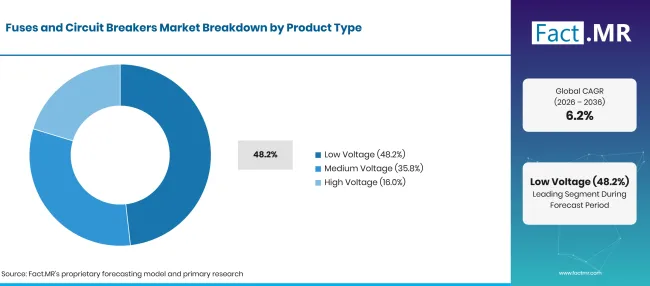
Factmr Fuses And Circuit Breakers Market Breakdown Product Type | Source: Fact.MR
| Product Type | Share (2026) |
|---|---|
| Low Voltage (Leading segment) | 48.2% |
| Other segments combined | 51.8%* |
| Total | 100.0% |
Source: Fact.MR analysis. Updated Oct 19, 2026
Low-voltage fuses and circuit breakers command the leading market share due to their ubiquitous presence across residential consumer units, commercial distribution panels, and industrial motor control centers. Miniature circuit breakers (MCBs), molded case circuit breakers (MCCBs), and residual current devices (RCDs) protect billions of connected appliances, lighting circuits, and industrial machines against overcurrents. Medium-voltage switchgear captures substantial value across municipal distribution substations, industrial plants, and utility-scale solar farms. High-voltage gas-insulated and air-insulated circuit breakers operate at critical bulk transmission substations managing multi-hundred-kilovolt interconnections. Grid planners routinely pair circuit breakers with high-capacity power transformer installations to maintain voltage stability. Substation protection engineers also deploy precision current transformer units to feed measurement signals into protective tripping relays.
What leads the Application segment?
Industrial accounts for 35.5% share in 2026.
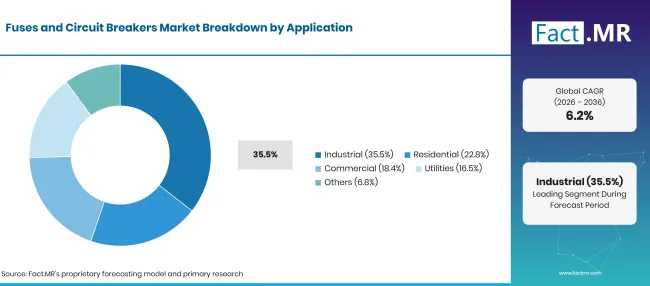
Factmr Fuses And Circuit Breakers Market Breakdown Application | Source: Fact.MR
| Application | Share (2026) |
|---|---|
| Industrial (Leading segment) | 35.5% |
| Other segments combined | 64.5%* |
| Total | 100.0% |
Source: Fact.MR analysis. Updated Oct 19, 2026
Industrial facilities represent the primary application sector, driven by the massive continuous power requirements of chemical processing plants, automotive assembly factories, pulp and paper mills, and metal refining complexes. Industrial plant engineers mandate ruggedized circuit breakers and heavy-duty current-limiting fuses to protect multi-thousand-horsepower electric motors, variable frequency drives, and automated assembly robotics. Residential applications absorb steady volume for consumer electrical service panels and home renovations. Commercial real estate installations expand as high-rise office towers, modern hospitals, and hyperscale cloud datacenters require uninterruptible power distribution architecture. Electric utilities deploy specialized circuit breakers across regional distribution grids. Substation engineers install advanced gas insulated switchgears in space-constrained industrial zones. Rural distribution networks frequently utilize outdoor air insulated switchgears for economical circuit protection.
How does End-User drive procurement?
Automotive represents 28.3% share in 2026.
| End-User | Share (2026) |
|---|---|
| Automotive (Leading segment) | 28.3% |
| Other segments combined | 71.7%* |
| Total | 100.0% |
Source: Fact.MR analysis. Updated Oct 19, 2026
The automotive sector represents the leading end-user vertical, propelled by the swift global transition toward electric vehicles and high-power direct-current charging plazas. Electric passenger cars incorporate complex electrical architectures requiring specialized high-voltage DC fuses, electronic circuit protection chips, and pyrofuses to safeguard traction batteries and onboard charging modules. The construction industry represents a massive secondary consumer, requiring millions of circuit breakers for new residential buildings, commercial complexes, and urban infrastructure developments. Electronics and electrical manufacturing facilities consume compact miniature fuses and surface-mount circuit protectors for consumer appliances and computing hardware. Energy utilities procure high-capacity transmission breakers. Grid operators deploy heavy-duty vacuum circuit breaker mechanisms for reliable medium-voltage switching. Substation operators connect these breakers to a central substation monitoring system to monitor real-time contact wear.
What is accelerating Fuses and Circuit Breakers Market adoption, and what is holding it back?
Renewable grid interconnection mandates, datacenter power expansion, and automotive electrification accelerate circuit protection demand. Elevated switchgear capital costs, extended lead times for high-voltage ceramic and polymer bushings, and strict environmental phase-outs of SF6 gas challenge equipment manufacturers.
Drivers Impact Analysis
| DRIVER | (~) % IMPACT ON CAGR | GEOGRAPHIC RELEVANCE | IMPACT TIMELINE |
|---|---|---|---|
| Renewable energy grid interconnection and substation expansions | +1.2% | Global | Short term (<= 2 years) |
| Datacenter server power density driving high-current breaker needs | +1.1% | North America, Europe | Short term (<= 2 years) |
| Automotive electrification requiring high-voltage DC pyrofuses | +0.9% | Europe, East Asia, USA | Medium term (2–4 years) |
| Industrial factory automation and arc-flash safety mandates | +0.8% | Global | Medium term (2–4 years) |
| Aging electrical grid replacement programs in mature economies | +0.6% | North America, Western Europe | Long term (>= 4 years) |
Source: Fact.MR analysis. Updated Oct 19, 2026
Opportunity Impact Analysis
| OPPORTUNITY | (~) % IMPACT ON CAGR | GEOGRAPHIC RELEVANCE | IMPACT TIMELINE |
|---|---|---|---|
| Solid-state hybrid circuit breakers for DC microgrids and storage | +1.1% | USA, Europe | Short term (<= 2 years) |
| SF6-free eco-efficient gas-insulated switchgear installations | +1.0% | Western Europe, North America | Medium term (2–4 years) |
| Smart IoT breakers with integrated predictive thermal analytics | +0.7% | Global | Medium term (2–4 years) |
| Megawatt-scale electric heavy truck charging station protection | +0.6% | Europe, USA | Long term (>= 4 years) |
Source: Fact.MR analysis. Updated Oct 19, 2026
Restraints Impact Analysis
| RESTRAINT | (~) % IMPACT ON CAGR | GEOGRAPHIC RELEVANCE | IMPACT TIMELINE |
|---|---|---|---|
| Extended delivery lead times for specialized high-voltage components | -0.9% | Global | Short term (<= 2 years) |
| High initial capital costs for digital and solid-state switchgear | -0.7% | Developing Markets | Medium term (2–4 years) |
| Regulatory compliance costs for phasing out SF6 insulating gases | -0.6% | Europe, USA | Medium term (2–4 years) |
| Shortage of certified high-voltage electrical commissioning technicians | -0.4% | North America, Europe | Long term (>= 4 years) |
Source: Fact.MR analysis. Updated Oct 19, 2026
Which countries are scaling the Fuses and Circuit Breakers Market through 2036?
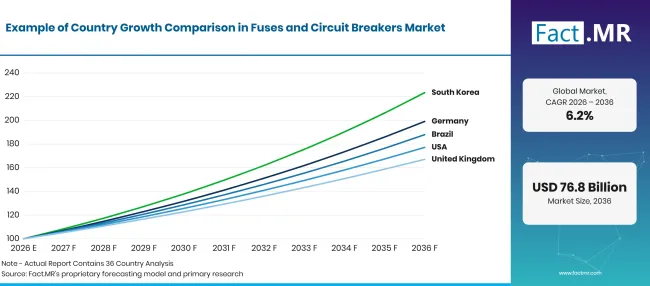
Factmr Fuses And Circuit Breakers Market Growth Index | Source: Fact.MR
| Country | CAGR (2026–2036) |
|---|---|
| Germany | 7.13% |
| Brazil | 6.51% |
| USA | 5.89% |
| UK | 5.27% |
| Japan | 4.65% |
Source: Fact.MR analysis. Updated Oct 19, 2026
Why is Germany leading European circuit protection growth?
7.13% CAGR, driven by the Energiewende renewable grid transition, strict industrial safety standards, and expanding automotive battery production.
German electrical transmission grid operators are investing billions of dollars to connect North Sea offshore wind power to industrial consumption centers in southern Germany, requiring massive installations of high-voltage circuit breakers and gas-insulated substations. German industrial machinery manufacturers in Baden-Württemberg and Bavaria mandate state-of-the-art arc-fault circuit interrupters and low-voltage switchboards to protect automated factory floors. Germany also leads European adoption of eco-efficient, SF6-free switchgear technology to comply with aggressive European Union greenhouse gas regulations.
How is Brazil expanding its transmission and distribution protection?
6.51% CAGR, propelled by hydroelectric and solar grid expansions, regional infrastructure investments, and industrial modernization.
Brazil's national electrical operator is expanding transmission corridors to evacuate renewable power from northeastern solar and wind installations to major metropolitan centers in São Paulo and Rio de Janeiro. Brazilian utility contractors procure medium and high-voltage circuit breakers to build out new regional distribution substations. Industrial mining, pulp and paper, and agribusiness facilities across Minas Gerais and Mato Grosso upgrade their electrical switchgear to ensure operational continuity. Electrical equipment distributors expand local inventories of low-voltage breakers to supply residential construction across growing urban hubs.
What factors sustain massive procurement across the United States?
5.89% CAGR, supported by hyperscale AI datacenter power demands, federal grid resilience funding, and electric vehicle charging buildouts.
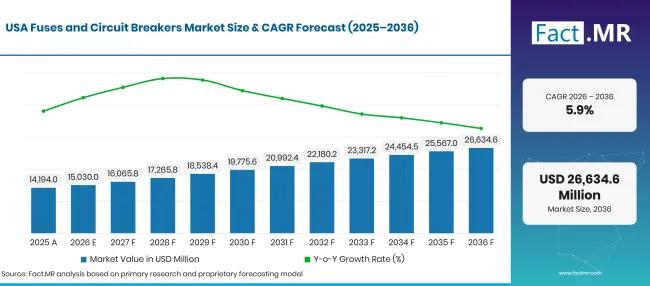
Factmr Fuses And Circuit Breakers Market Forecast Usa | Source: Fact.MR
The United States represents a massive commercial market for circuit protection, fueled by unprecedented power requirements from AI computing datacenters across Virginia, Texas, and Oregon. Commercial datacenter operators install high-amperage low-voltage circuit breakers and ultra-fast current-limiting fuses to safeguard dense server racks from electrical overloads. Federal infrastructure funding drives electric utilities to replace aging mid-century substation switchgear with modern digital circuit breakers. American automotive manufacturers expand domestic procurement of high-voltage DC fuses to supply expanding electric truck and SUV assembly lines.
Why does the United Kingdom maintain active switchgear procurement?
5.27% CAGR, backed by North Sea offshore wind interconnections, commercial building retrofits, and urban railway electrification programs.
British transmission operators are modernizing coastal grid substations to integrate gigawatts of incoming offshore wind generation from Dogger Bank and Scottish waters. UK distribution network operators invest heavily in intelligent circuit breakers equipped with automated fault detection, isolation, and service restoration capabilities. Urban commercial developers across London and Manchester install smart circuit protection panels to manage solar photovoltaic arrays, heat pumps, and electric vehicle charging bays in low-carbon commercial buildings.
How is Japan driving demand for earthquake-resilient circuit breakers?
4.65% CAGR, steered by seismic-hardened switchgear retrofits, nuclear restart safety protocols, and semiconductor fab electrical installations.
Japanese electric utilities prioritize seismic-resistant circuit breakers and gas-insulated switchgear engineered to withstand severe seismic vibrations without mechanical tripping or gas leakage. Nuclear and thermal power plants across Japan execute electrical safety upgrades, procuring certified emergency disconnect breakers. Leading Japanese semiconductor manufacturers constructing advanced wafer fabrication facilities in Kyushu and Hokkaido procure high-reliability vacuum circuit breakers to protect cleanrooms from microsecond power interruptions.
Who leads the Fuses and Circuit Breakers Market?
Schneider Electric SE holds a leading global position across low-voltage and medium-voltage electrical protection, delivering EcoStruxure-connected digital switchgear and miniature circuit breakers worldwide. ABB Ltd. provides a comprehensive portfolio of high-voltage gas-insulated breakers, vacuum circuit interrupters, and solid-state protection systems for utilities and heavy industry. Siemens AG leads in electrical transmission technologies, engineering eco-efficient Blue GIS switchgear that utilizes clean air insulation instead of SF6.
Eaton Corporation and GE Vernova Inc. deliver advanced power distribution panels, arc-resistant switchgear, and utility-scale substation breakers. Mitsubishi Electric and Hitachi Ltd. supply high-voltage gas-insulated switchgear and power grid control infrastructure across East Asia and the Americas. Larsen & Toubro, Legrand SA, and Rockwell Automation deliver integrated motor control centers, industrial fuses, and smart building electrical distribution boards. Grid operators routinely install high-voltage surge arrester units alongside breakers to protect transformers against atmospheric lightning strikes. Engineers continuously adopt efficient power switchgear modules to contain substation footprint requirements.
Which companies are the key providers?
Key companies include Schneider Electric SE; ABB Ltd.; Siemens AG; Eaton Corporation; GE Vernova Inc.; Mitsubishi Electric; Larsen & Toubro; Legrand SA; Rockwell Automation; and Hitachi Ltd.
- Schneider Electric SE
- ABB Ltd.
- Siemens AG
- Eaton Corporation
- GE Vernova Inc.
- Mitsubishi Electric
- Larsen & Toubro
- Legrand SA
- Rockwell Automation
- Hitachi Ltd.
Bibliography
- [1] U.S. Department of Energy. (2024, December 05). Funding notice: $8 million for new high voltage direct current grid modernization technologies.
- [2] U.S. Department of Energy. (2024, December 12). DOE announces funding opportunities to ensure electricity grid resilience and reliable switchgear.
- [3] U.S. Department of Energy. (2025, January 15). Categorical exclusion CX-033009: Resonant solid-state breaker-based wireless coupling and fault management.
- [4] National Institute of Standards and Technology. (2024, July 22). Technical Note 2290: High-energy arcing fault experiments in electrical bus ducts.
- [5] National Institute of Standards and Technology. (2024, August 14). Nuclear Regulatory Commission electrical cabinet fire and circuit containment experiments.
This Report Answers
- The report evaluates technology adoption and cost trajectories across low, medium, and high-voltage circuit protection platforms.
- Application assessments detail why heavy industrial plants and automotive electrification represent the fastest value expansion sectors.
- Country-level analysis investigates the grid modernization and regulatory mandates enabling Germany and Brazil to achieve elevated growth rates.
- Arc physics evaluations examine the transition from SF6 greenhouse gas insulation toward vacuum interrupters and solid-state silicon carbide switches.
- Competitive profiling benchmarks manufacturing capacity, switchgear modularity, and smart IoT sensor integration across top electrical equipment conglomerates.
What does the Fuses and Circuit Breakers Market cover?
The market encompasses commercial shipments of electrical overcurrent protection devices, including miniature circuit breakers, molded case circuit breakers, vacuum breakers, air insulated and gas insulated switchgear, and thermal and high-voltage fuses. It evaluates hardware deployed across municipal power transmission grids, commercial office complexes, industrial factory lines, residential consumer panels, and electric vehicle powertrains. The analysis evaluates value creation across direct utility contracting channels and commercial electrical equipment distributors.
What is included in the scope?
The scope covers merchant sales of completed circuit breaker units, retrofitted trip units, replaceable fuse links, and factory-assembled switchgear cabinets sold to electrical contractors, utilities, and industrial end users. Revenues reflect factory-gate and wholesale distribution pricing recognized by switchgear manufacturers and authorized distributors. Embedded digital trip units and smart communication modules are fully evaluated within the market revenue boundaries.
What is excluded from the scope?
The scope excludes electrical cables, bare wire conductors, metal conduit pipes, and raw copper busbars sold without integrated circuit switching mechanisms. Software-only energy management platforms and utility power billing meters are excluded from protection hardware totals. High-voltage transmission steel towers, civil substation foundations, and excavation labor costs are outside the scope of this hardware report.
How Was the Analysis Built?
The analysis draws on 120+ sources, 35+ company portfolios, 25+ countries, and more than 20 industry interviews.
- Primary Research: Primary research includes discussions with manufacturers, service providers, technology developers, distributors, end users, and subject-matter experts. These conversations examine purchasing priorities, product adoption, operational challenges, approval requirements, competitive positioning, and the factors that influence wider market acceptance.
- Desk Research: Desk research covers government statistics, regulatory publications, company filings, trade data, technical studies, industry associations, standards, public policy, and other authoritative sources. Every source used in the analysis is documented in the bibliography.
- Market Sizing and Forecasting: Market estimates combine historical performance, demand indicators, pricing and volume trends, segment shares, company participation, country-level growth, adoption patterns, investment activity, and barriers to market expansion.
- Data Validation and Update Cycle: Findings are validated by comparing primary interviews with public data, company activity, regulatory changes, trade patterns, and industry developments. Regular updates review new product launches, capacity changes, partnerships, approvals, and shifts in commercial adoption.
Segmentation
What is the report’s scope and coverage?
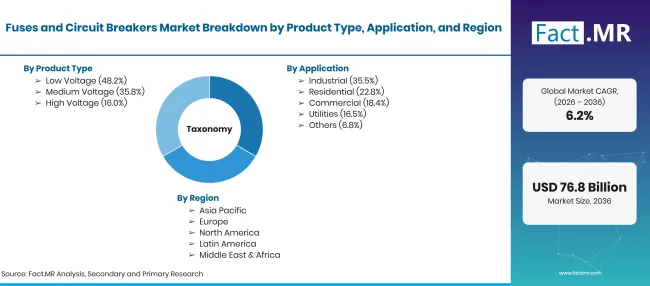
Factmr Fuses And Circuit Breakers Market Taxonomy | Source: Fact.MR
| Attribute | Details |
|---|---|
| Quantitative Units | USD billion in 2026 to USD billion by 2036 at 6.20% CAGR |
| Market Definition | Electrical circuit protection devices including mechanical and solid-state circuit breakers, high-voltage switchgear, and sacrificial fuses designed to interrupt fault currents and protect electrical infrastructure. |
| Product Type | Low Voltage; Medium Voltage; High Voltage |
| Application | Industrial; Residential; Commercial; Utilities; Others |
| End-User | Construction; Automotive; Electronics and Electrical; Energy; Others |
| Distribution Channel | Offline; Online |
| Regions Covered | North America; Latin America; Western Europe; Eastern Europe; East Asia; South Asia & Pacific; Middle East & Africa |
| Countries Covered | Germany; Brazil; USA; UK; Japan |
| Companies Profiled | Schneider Electric SE; ABB Ltd.; Siemens AG; Eaton Corporation; GE Vernova Inc.; Mitsubishi Electric; Larsen & Toubro; Legrand SA; Rockwell Automation; Hitachi Ltd. |
| Forecast Period | 2026 to 2036 |
| Approach | Primary interviews with utility transmission planners, switchgear manufacturing directors, industrial facility electrical engineers, and electrical equipment distributors combined with national energy regulatory filings |
Source: Fact.MR analysis. Updated Oct 19, 2026
How is the market segmented?
-
By Product Type
- Low Voltage
- Medium Voltage
- High Voltage
-
By Application
- Industrial
- Residential
- Commercial
- Utilities
- Others
-
By End-User
- Construction
- Automotive
- Electronics and Electrical
- Energy
- Others
-
By Distribution Channel
- Offline
- Online
-
By Region
- North America
- Latin America
- Western Europe
- Eastern Europe
- East Asia
- South Asia & Pacific
- Middle East & Africa
Frequently Asked Questions
How big is the fuses and circuit breakers market in 2026?
What is the CAGR from 2026 to 2036?
Which product type leads?
Which application leads?
Which companies participate in fuses and circuit breakers?
Who worked on this report


Preview the report firsthand - request a free sample
Free SampleGet the brochure for pricing and purchase details
Download PDF