- Market Value (2025): USD 1.24 Bn
- Estimated Value (2026): USD 1.3 Bn
- Forecast Value (2036): USD 2.06 Bn
- CAGR (2026-2036): 4.7%
What is the Garden Vacuums Market forecast to be worth by 2036?
USD 1.30 billion in 2026 to USD 2.06 billion by 2036, at a 4.7% CAGR.
- As per Fact.MR analysis, the garden vacuums market reached USD 1.24 billion in 2025.
- Demand will increase from USD 1.3 billion in 2026 to USD 2.06 billion in 2036.
- The market is forecast to record a 4.7% CAGR during 2026 to 2036 as property owners and municipal maintenance crews invest in outdoor power equipment.
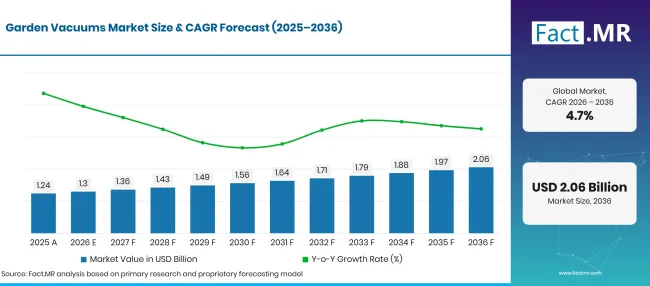
Factmr Garden Vacuums Market Forecast Global | Source: Fact.MR
| Year | Basis | Market Value (USD billion) |
|---|---|---|
| 2025 | Actual | 1.24 |
| 2026 | Estimate | 1.3 |
| 2036 | Forecast | 2.06 |
| CAGR 2026 to 2036 | Forecast period | 4.7% |
Source: Fact.MR analysis. Updated Oct 15, 2026
What are the defining numbers behind Garden Vacuums Market growth?
USD 0.76 billion absolute chance between 2026 and 2036, with wheeled debris vacuums and residential landscaping forming the main purchasing base.
- Demand Drivers in the Market
- Residential homeowners increasingly rely on high-velocity garden vacuums to clear fallen leaves and yard debris during seasonal transitions. Built-in shredding impellers reduce organic waste volume by up to ten to one, simplifying composting and curbside bag collection. Property owners favor machines with variable speed controls to prevent gravel ingestion while cleaning garden pathways.
- Municipal park management teams require commercial-grade leaf collectors to maintain public recreation grounds and urban sidewalks. Stricter municipal noise ordinances drive procurement toward quiet electric motors that operate within suburban decibel limits. Reliable equipment construction ensures that municipal maintenance crews complete clean-up tasks without unexpected mechanical breakdowns.
- Power equipment manufacturers introduce high-efficiency brushless motors that deliver petrol-equivalent suction power using interchangeable lithium-ion batteries. Unified battery platforms allow consumers to operate garden vacuums using the same power pack as their electric lawn maintenance tools. Rapid dual-port charging stations minimize downtime during extensive autumn yard clearing.
- Commercial landscaping businesses select heavy-duty wheeled and backpack vacuums to reduce manual labor costs across contracted commercial properties. Durable steel impellers handle wet foliage, pinecones, and twigs without clogging the vacuum intake chute. Documented service intervals and widespread spare parts availability influence equipment purchasing decisions for commercial fleet operators.
- Key Segments Analyzed
- By Product Type: Wheeled holds 38.5% share in 2026, as expansive estates and municipal maintenance operations deploy high-capacity wheeled debris vacuums.
- By Application: Residential accounts for 64.0% share in 2026 because suburban homeowners purchase personal yard maintenance equipment.
- By Power Source: Electric represents 58.1% share in 2026, reflecting strong consumer adoption of cordless battery-powered garden tools.
- By Distribution Channel: Offline Retail captures 52.1% share in 2026, reflecting customer preferences for equipment demonstrations at home improvement centers and machinery dealerships.
- Analyst Opinion at Fact.MR
- Shambhu Nath Jha, Principal Consultant at Fact.MR, states, “Garden vacuum sales depend heavily on motor weight balance and impeller durability against abrasive grit. Residential buyers increasingly reject loud two-stroke petrol engines in favor of high-voltage cordless tools. Manufacturers that integrate metal mulching blades with balanced ergonomic handles are gaining market share among retail homeowners seeking low-vibration yard tools.”
- Strategic Implications
- Outdoor power tool manufacturers are expanding 36-volt and 56-volt cordless battery systems to eliminate fossil fuel emissions across suburban neighborhoods. Advanced battery management electronics protect battery cells against overheating during sustained high-suction vacuum cycles.
- Commercial landscape contractors are replacing legacy two-stroke blowers with quiet electric models before entering zero-emission municipal contract zones. Early fleet electrification confirms that contractors meet city noise limits without sacrificing daily acreage clearance rates.
- Specialty hardware retailers and dealership networks are dedicating larger floor displays to ergonomic garden vacuums with integrated leaf shredder systems. In-store hands-on demonstration areas help customers assess machine balance, noise levels, and collection bag emptying ease before purchase.
- Equipment design teams are optimizing impeller airflow dynamics using reinforced composite materials to withstand incidental pebble impacts. Durable housing construction lowers warranty return rates and protects manufacturer brand reputation across competitive retail channels.
Germany is poised to record a 6.0% CAGR, while Brazil reaches 5.5% as suburban landscaping investments expand across residential communities. The United States posts 4.9% growth, supported by large suburban lawn footprints and investments in leaf blowers and vacs. The United Kingdom records 4.4%, while Japan reaches 3.9%, backed by compact residential garden maintenance needs and municipal noise restrictions.
How does the Garden Vacuums Market break down by segment?
Wheeled 38.5%; Residential 64.0%; Electric 58.1%; Offline Retail 52.1% in 2026.
Which Product Type dominates?
Wheeled holds 38.5% share in 2026.
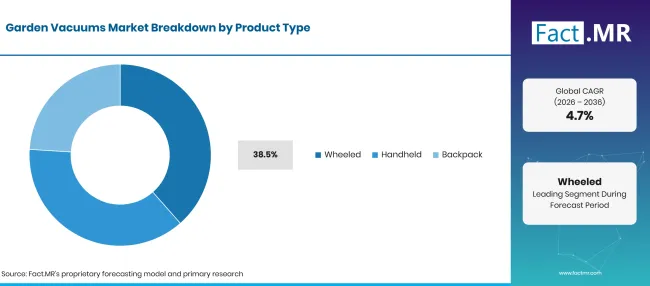
Factmr Garden Vacuums Market Breakdown Product Type | Source: Fact.MR
| Product Type | Share (2026) |
|---|---|
| Wheeled (Leading segment) | 38.5% |
| Other segments combined | 61.5%* |
| Total | 100.0% |
Source: Fact.MR analysis. Updated Oct 15, 2026
Wheeled garden vacuums lead equipment spending because their wide collection nozzles clear expansive lawn acreage efficiently without user fatigue. Integrated collection bags hold substantial debris volumes, making them ideal for parks, sports turf, and commercial properties. Handheld vacuums provide nimble maneuverability around tight flower beds and patio steps. Backpack blower equipment configurations distribute weight evenly across the operator's torso during extended professional leaf-clearing sessions.
What leads the Application segment?
Residential accounts for 64.0% share in 2026.
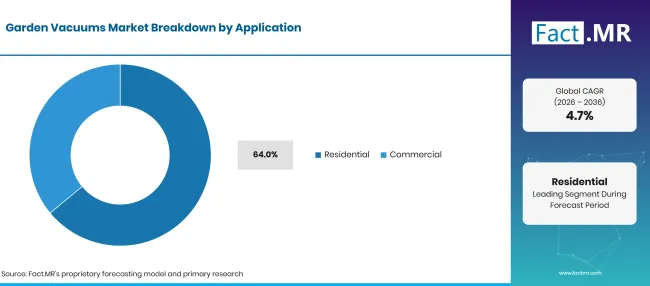
Factmr Garden Vacuums Market Breakdown Application | Source: Fact.MR
| Application | Share (2026) |
|---|---|
| Residential (Leading segment) | 64.0% |
| Other segments combined | 36.0%* |
| Total | 100.0% |
Source: Fact.MR analysis. Updated Oct 15, 2026
Homeowners use garden vacuums to remove leaves, hedge clippings, and lawn thatch from domestic driveways and turf. Mulching mechanisms create nutrient-rich garden mulch, helping homeowners reduce yard waste bag disposal costs. Commercial contractors utilize heavy-duty lawn mower machinery and industrial vacuums to clear retail parking lots and corporate office grounds. Municipal grounds departments maintain city public parks and heritage gardens using specialized collection machinery.
What leads the Power Source segment?
Electric represents 58.1% share in 2026.
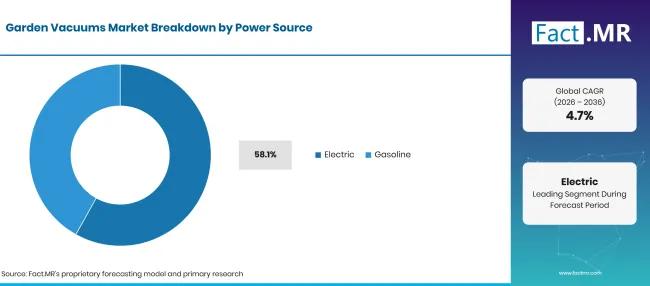
Factmr Garden Vacuums Market Breakdown Power Source | Source: Fact.MR
| Power Source | Share (2026) |
|---|---|
| Electric (Leading segment) | 58.1% |
| Other segments combined | 41.9%* |
| Total | 100.0% |
Source: Fact.MR analysis. Updated Oct 15, 2026
Electric power sources dominate equipment purchases as lithium-ion battery technology matches the suction power of entry-level petrol engines. Electric garden vacuums operate with zero direct exhaust emissions, low operational vibration, and push-button starting. Gasoline models remain preferred by commercial landscaping crews managing remote acreage without immediate access to battery charging infrastructure. Other hybrid designs cater to niche commercial turf applications.
Which Distribution Channel serves the largest share?
Offline Retail captures 52.1% share in 2026.
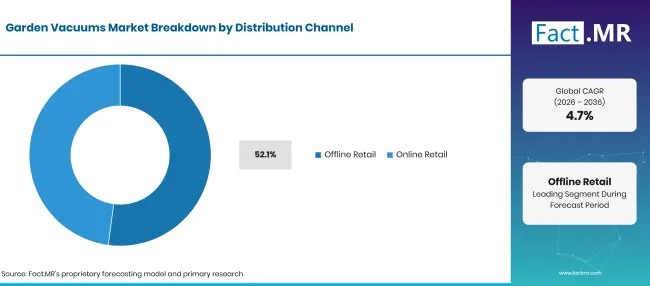
Factmr Garden Vacuums Market Breakdown Distribution Channel | Source: Fact.MR
| Distribution Channel | Share (2026) |
|---|---|
| Offline Retail (Leading segment) | 52.1% |
| Other segments combined | 47.9%* |
| Total | 100.0% |
Source: Fact.MR analysis. Updated Oct 15, 2026
Home improvement centers, authorized equipment dealers, and garden centers serve the majority of equipment buyers. Physical store visits allow buyers to evaluate machine heft, harness comfort, and bag attachment mechanisms. Online retail channels capture steady sales among price-conscious consumers purchasing replacement batteries and standard handheld vacuums. Dealership networks remain crucial for commercial contractors needing repair services and certified replacement parts.
What is accelerating Garden Vacuums Market adoption, and what is holding it back?
Growing suburban homeownership and zero-emission battery power innovations accelerate garden vacuum adoption. Heavy unit weight during damp debris collection and high battery pack replacement costs can restrain market growth.
Drivers Impact Analysis
| DRIVER | (~) % IMPACT ON CAGR | GEOGRAPHIC RELEVANCE | IMPACT TIMELINE |
|---|---|---|---|
| Cordless lithium-ion battery innovation | +1.0% | North America, Europe | Short term (<= 2 years) |
| Suburban lawn and garden care participation | +0.8% | North America, Europe | Medium term (2–4 years) |
| Integrated waste-reducing mulching impellers | +0.7% | Global | Medium term (2–4 years) |
| Municipal restrictions on fossil fuel blowers | +0.5% | Europe, United States | Short term (<= 2 years) |
| Brushless motor energy efficiency | +0.4% | Global | Long term (>= 4 years) |
Source: Fact.MR analysis. Updated Oct 15, 2026
Opportunity Impact Analysis
| OPPORTUNITY | (~) % IMPACT ON CAGR | GEOGRAPHIC RELEVANCE | IMPACT TIMELINE |
|---|---|---|---|
| Unified cross-brand battery platforms | +0.8% | Europe, North America | Medium term (2–4 years) |
| High-capacity commercial landscaping equipment | +0.6% | North America, Japan | Medium term (2–4 years) |
| Compact ultra-light handheld designs | +0.5% | East Asia, Europe | Short term (<= 2 years) |
| Digital direct-to-consumer machinery sales | +0.4% | Global | Medium term (2–4 years) |
Source: Fact.MR analysis. Updated Oct 15, 2026
Restraints Impact Analysis
| RESTRAINT | (~) % IMPACT ON CAGR | GEOGRAPHIC RELEVANCE | IMPACT TIMELINE |
|---|---|---|---|
| Impeller clogging in wet foliage conditions | -0.8% | Global | Short term (<= 2 years) |
| Premium initial cost of high-voltage battery kits | -0.6% | Latin America, Asia | Medium term (2–4 years) |
| Limited run-time under continuous high-power suction | -0.5% | Global | Short term (<= 2 years) |
| Competition from conventional rakes and blowers | -0.4% | Global | Long term (>= 4 years) |
Source: Fact.MR analysis. Updated Oct 15, 2026
Which countries are scaling the Garden Vacuums Market through 2036?
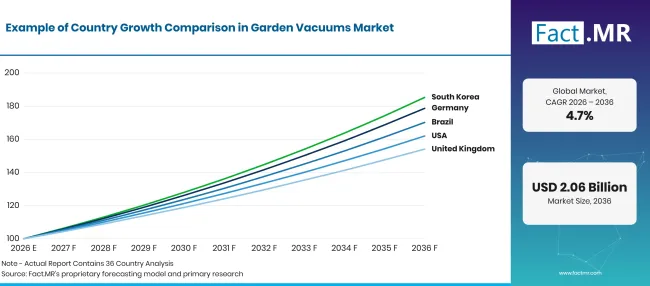
Factmr Garden Vacuums Market Growth Index | Source: Fact.MR
| Country | CAGR (2026–2036) |
|---|---|
| Germany | 6.0% |
| Brazil | 5.5% |
| United States | 4.9% |
| United Kingdom | 4.4% |
| Japan | 3.9% |
Source: Fact.MR analysis. Updated Oct 15, 2026
Why is Germany leading garden vacuum adoption?
6.0% CAGR, driven by strict residential quiet hours and high consumer demand for eco-certified garden tools.
German homeowners and municipal contractors invest in quiet electric lawn machinery to comply with local noise requirements. Industrieverband Garten reported that Germany’s overall garden market generated approximately 19.7 billion in 2025, despite a 0.6% nominal year-on-year decline [3]. The market’s scale supports continued product development and retail availability for multi-function blowing, vacuuming, and leaf-shredding equipment.
How is Brazil expanding garden vacuum use?
5.5% CAGR, shaped by commercial facility landscaping and expanding residential gated developments.
Brazilian commercial landscaping contractors and estate managers use powered leaf-collection tools to maintain large parklands and private clubs. ABIMAQ reported that Brazil’s machinery and equipment industry generated significant net revenue in 2025, up 7.3% year on year, while domestic-market revenue increased 8.4% [4]. This broader expansion in domestic machinery demand supports equipment availability and investment across landscaping and other end-use sectors.
What is driving garden vacuum sales in the United States?
4.9% CAGR, linked to extensive suburban lawn ownership and regulatory transitions toward zero-emission outdoor power tools.
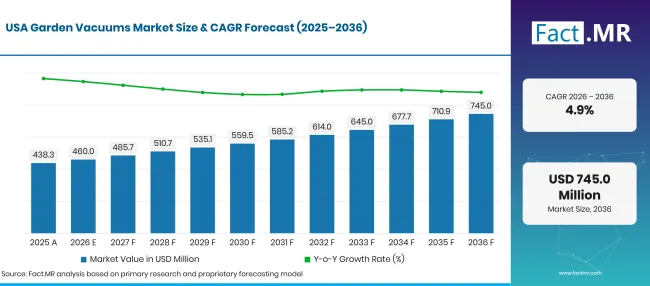
Factmr Garden Vacuums Market Forecast Usa | Source: Fact.MR
American suburban homeowners purchase cordless garden vacuums to manage autumn leaf fall across expansive yards. The Outdoor Power Equipment Institute reported that 21 million of the 38 million outdoor power equipment products shipped in the United States in 2021 were zero-emission products, equal to 56% of shipments [1]. California’s small off-road engine rules and related incentives further reinforce the shift toward zero-emission lawn and garden equipment.
How is the United Kingdom developing garden vacuum demand?
4.4% CAGR, influenced by damp climate garden clearing and domestic green waste reduction goals.
British gardeners use vacuum shredders to reduce damp leaves into compostable material for residential garden beds. The Horticultural Trades Association reported that UK households spent approximately 9 billion on retail garden products in 2025 and that 77% of British adults had access to a private garden [2]. This large household gardening base supports demand for compact tools suited to routine garden clearing and storage.
Why is Japan maintaining steady garden vacuum growth?
3.9% CAGR, influenced by compact residential gardens and municipal grounds maintenance standards.
Japanese property owners and grounds-maintenance teams use compact, low-noise cordless equipment around homes, courtyards, and public spaces. Makita reported that its outdoor power equipment sales increased 5% in yen terms and 2% in local-currency terms in the fiscal year ended March 31, 2025, supported by favorable weather, new products, and its expanding 40Vmax range [5]. The result provides direct company evidence of continued demand for battery-operated outdoor equipment.
Who leads the Garden Vacuums Market?
Husqvarna Group and The Toro Company lead commercial and high-end residential landscaping machinery, where motor durability and cutting-edge battery management drive brand loyalty. Bosch Power Tools and Black+Decker supply wide consumer retail networks with lightweight electric and cordless handheld vacuums. STIHL Inc. and ECHO Incorporated manufacture rugged petrol and high-voltage battery vacuums engineered for professional arborists and municipal crews.
Makita Corporation, Ryobi Limited, Greenworks Tools, and WORX produce diverse multi-tool battery platforms that allow consumers to interchange batteries across lawn tools. Competition centers on battery energy density, shredding ratio performance, nozzle ergonomics, and warranty service support.
Which companies are the key providers?
Key companies include Husqvarna Group; The Toro Company; Bosch Power Tools; Black+Decker; STIHL Inc.; Ryobi Limited; Greenworks Tools; Makita Corporation; ECHO Incorporated; and WORX.
- Husqvarna Group
- The Toro Company
- Bosch Power Tools
- Black+Decker
- STIHL Inc.
- Ryobi Limited
- Greenworks Tools
- Makita Corporation
- ECHO Incorporated
- WORX
Bibliography
- [1] Outdoor Power Equipment Institute. (n.d.). Zero- and low-emission equipment.
- [2] Horticultural Trades Association. (2025). Garden industry statistics.
- [3] Industrieverband Garten e.V. (2026). Aktuelle Marktzahlen: Entwicklung des deutschen Gartenmarktes 2025.
- [4] Associação Brasileira da Indústria de Máquinas e Equipamentos. (2026, January 29). Setor de máquinas e equipamentos: Desempenho em 2025 e perspectivas 2026.
- [5] Makita Corporation. (2025, April 28). FYE2025 operating results (fiscal year ended March 31, 2025) [Presentation].
This Report Answers
- The report assesses technical consumer choice between wheeled high-volume collection units and compact handheld garden vacuums.
- Application analysis details why residential suburban homeowners represent the commanding share of global unit demand.
- The country comparison evaluates how municipal noise regulations and clean air mandates accelerate equipment electrification.
- Competitive benchmarking reviews battery platform compatibility, impeller durability, and dealership distribution presence.
- Channel analysis explores why brick-and-mortar home centers maintain leadership over digital e-commerce channels.
What does the Garden Vacuums Market cover?
The market covers motorized equipment engineered to vacuum fallen leaves, organic clippings, and ground debris, incorporating collection receptacles and mulching impellers. It evaluates machinery used across suburban gardens, public parks, golf courses, and commercial properties. The analysis links with related Fact.MR studies on garden power equipment and outdoor power equipment.
What is included in the scope?
The scope includes dedicated garden vacuums, combination blower-vacuums operating in vacuum mode, and heavy-duty tow-behind or walk-behind wheeled debris collectors. Battery packs and chargers bundled with initial equipment purchases are included. Sales represent finished machinery wholesale and retail market values.
What is excluded from the scope?
The scope excludes standalone leaf blowers lacking vacuum or mulching capability, commercial street sweepers, and agricultural combine harvesters. Replacement collection bags, standalone batteries purchased separately, and post-sale servicing fees are excluded. Agricultural crop gathering equipment is outside the study boundary.
How Was the Analysis Built?
The analysis draws on 120+ sources, 35+ company portfolios, 25+ countries, and more than 20 industry interviews.
- Primary Research: Primary research includes discussions with manufacturers, service providers, technology developers, distributors, end users, and subject-matter experts. These conversations examine purchasing priorities, product adoption, operational challenges, approval requirements, competitive positioning, and the factors that influence wider market acceptance.
- Desk Research: Desk research covers government statistics, regulatory publications, company filings, trade data, technical studies, industry associations, standards, public policy, and other authoritative sources. Every source used in the analysis is documented in the bibliography.
- Market Sizing and Forecasting: Market estimates combine historical performance, demand indicators, pricing and volume trends, segment shares, company participation, country-level growth, adoption patterns, investment activity, and barriers to market expansion.
- Data Validation and Update Cycle: Findings are validated by comparing primary interviews with public data, company activity, regulatory changes, trade patterns, and industry developments. Regular updates review new product launches, capacity changes, partnerships, approvals, and shifts in commercial adoption.
Segmentation
What is the report’s scope and coverage?
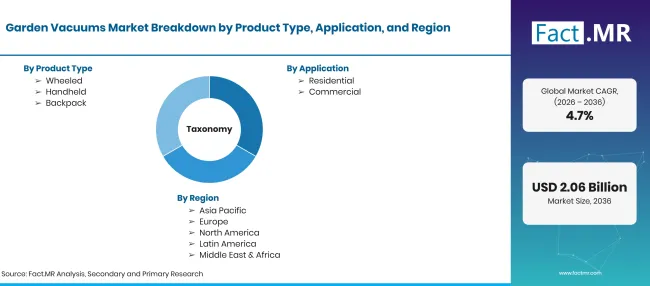
Factmr Garden Vacuums Market Taxonomy | Source: Fact.MR
| Attribute | Details |
|---|---|
| Quantitative Units | USD billion |
| Market Definition | Powered outdoor equipment specifically designed to vacuum, collect, and mulch leaves and garden debris from outdoor surfaces. |
| Product Type | Wheeled; Handheld; Backpack; Others |
| Application | Residential; Commercial; Others |
| Power Source | Electric; Gasoline; Others |
| Distribution Channel | Offline Retail; Online Retail; Others |
| Regions Covered | North America; Latin America; Western Europe; Eastern Europe; East Asia; South Asia & Pacific; Middle East & Africa |
| Countries Covered | Germany; Brazil; United States; United Kingdom; Japan |
| Companies Profiled | Husqvarna; Toro; Bosch; Black+Decker; STIHL; Ryobi; Greenworks; Makita; ECHO; WORX |
| Forecast Period | 2026 to 2036 |
| Approach | Quantitative synthesis of manufacturer factory gate shipments, retail point-of-sale data, distributor inventories, and trade data |
Source: Fact.MR analysis. Updated Oct 15, 2026
How is the market segmented?
-
By Product Type:
- Wheeled
- Handheld
- Backpack
- Others
-
By Application:
- Residential
- Commercial
- Others
-
By Power Source:
- Electric
- Gasoline
- Others
-
By Distribution Channel:
- Offline Retail
- Online Retail
- Others
-
By Region:
- North America
- Latin America
- Western Europe
- Eastern Europe
- East Asia
- South Asia & Pacific
- Middle East & Africa
Frequently Asked Questions
How big is the garden vacuums market in 2026?
What is the CAGR from 2026 to 2036?
Which product type leads?
Which power source leads?
Which companies participate in garden vacuums?
Who worked on this report


Preview the report firsthand - request a free sample
Free SampleGet the brochure for pricing and purchase details
Download PDF