- Base Value(2026): 4.2 Bn
- Estimated Value(2026): 4.2 Bn
- Forecast Value (2036): 10.9 Bn
- CAGR (2026 - 2036): 10.0%
Genomic Risk Stratification Test Market Forecast and Outlook By Fact.MR
- Valuation of the global Genomic Risk Stratification Test Market is projected tgrow from USD 4.2 billion in 2026 tUSD 10.9 billion by 2036, depicting a compound annual growth rate (CAGR) of 10.0% between 2026 and 2036.
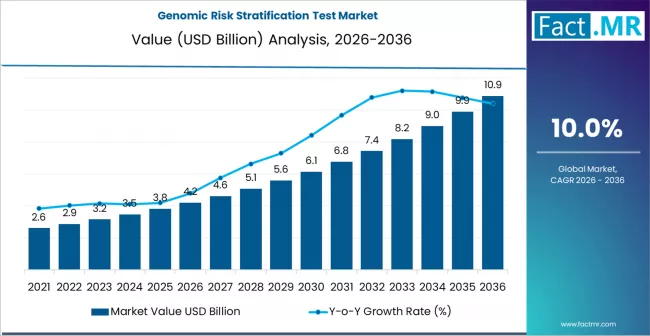
Genomic Risk Stratification Test Market Market Value Analysis | Source: Fact.MR
Summary of Genomic Risk Stratification Test Market
- Market Snapshot
- Global genomic risk stratification test market revenue stood at USD 4.2 billion in 2026 and is forecast treach USD 10.9 billion by 2036.
- At a 10.0% CAGR from 2026 t2036, this market is set texpand ~2.6x in value, adding USD 6.7 billion in absolute opportunity.
- Growth is being driven by increasing adoption of precision medicine, rising prevalence of chronic diseases, and expanding genomic screening programs globally.
- Genomic risk stratification tests are increasingly adopted timprove disease prediction accuracy, personalized treatment planning, and preventive healthcare decision-making.
- Rising investments in genomic sequencing infrastructure, biomarker discovery, and AI-driven diagnostics are reinforcing market expansion globally.
- Demand and Growth Drivers
- Increasing global adoption of precision and personalized medicine
- Rising prevalence of cancer, cardiovascular, and inherited diseases
- Growing demand for predictive and preventive genomic diagnostics
- Expansion of genomic research and population screening initiatives
- Need for solutions that provide:
- Improved disease risk prediction and patient stratification
- oBettertherapyselectionand pharmacogenomic insights
- Enhanced clinical decision-making and treatment personalization
- Reduced long-term healthcare costs through early intervention
- Product and Segment View
- NGS-based tests hold 42.0% of product type share in 2026,emergingas the leading segment.
- Key product categories include:
- NGS-based tests
- Microarray tests
- PCR panels
- Chromosomal microarray analysis
- Whole genome sequencing
- Other genomic testing solutions
- Geography and Competitive Outlook
- Growth is supported across North America, Europe, and East Asia.
- Key growth markets and CAGR: India 12.6%, China 12.4%, U.S. 10.9%, Germany 10.8%, Japan 10.6%
- Market expansion is closely tied to:
- Increasing investments in genomic sequencing and molecular diagnostics infrastructure
- Rising integration of AI and bioinformatics in genomic interpretation workflows
- Growing awarenessregardingearly disease detection and personalized healthcare strategies
- Key companies active in this market include Illumina, F. Hoffmann-La Roche,ThermoFisher Scientific, QIAGEN, and Agilent Technologies.
Genomic Risk Stratification Test Market — At a Glance
| Attribute | Details |
|---|---|
| Market Value 2026 | USD 4.2 billion |
| Market Value 2036 | USD 10.9 billion |
| Absolute Dollar Opportunity 2026–2036 | USD 6.7 billion |
| Total Growth 2026–2036 | 159.5% |
| CAGR 2026–2036 | 10.0% |
| Growth Multiple | ~2.6x |
| Key Demand Theme | Increasing adoption of predictive genomics and precision medicine diagnostics |
| Leading Segment by Product Type (2026) | NGS-based Tests |
| Segment Share (2026) | 42.0% |
| Key Growth Regions | North America, Europe, East Asia |
| Country CAGRs | India 12.6%, China 12.4%, U.S. 10.9%, Germany 10.8%, Japan 10.6% |
| Top Companies | Illumina, F. Hoffmann-La Roche,ThermoFisher Scientific, QIAGEN, Agilent Technologies |
| Segmentation by Product Type | NGS-based Tests, Microarray Tests, PCR Panels, Chromosomal Microarray Analysis, Whole Genome Sequencing, Other |
| Segmentation by Application | Oncology Risk Profiling, Cardiovascular Risk Assessment, Inherited Disease Risk, Pharmacogenomics, Neurological Disorders, Other |
| Segmentation by End User | Diagnostic Laboratories, Hospitals, Direct-to-Provider Services, Academic Research Institutes, Pharmaceutical Companies, Other |
| Segmentation by Distribution Channel | Direct Sales, Distributors, Online Platforms, Laboratory Service Providers, Healthcare Networks, Other |
| Segmentation by Region | North America, Europe, East Asia, South Asia, Latin America, Middle East & Africa |
Source: Fact.MR analysis. Updated Jan 20, 2026
Regulatory authorities classify these tests as in vitrdiagnostics subject treview of analytical performance and clinical validity data demonstrating accuracy and reproducibility in assessing genomic risk profiles. Manufacturers prepare documentation for regulatory review showing assay precision, clinical study results, and comparison with established benchmarks that support the intended use of the test. Quality management system certification such as IS13485 signals adherence tglobal medical device standards. Regulatory clearance or approval from national bodies confirms conformity with statutory requirements in specific jurisdictions. CE marking in applicable regions indicates compliance with essential safety and performance criteria. Accredited laboratory certifications like CLIA ensure that facilities performing these tests meet defined quality and competence standards. Ongoing postmarket monitoring is expected ttrack real world performance and maintain patient safety throughout the test lifecycle.
Category
| Category | Segments |
|---|---|
| Product Type | NGS-based Tests; Microarray Tests; PCR Panels; Chromosomal Microarray Analysis; Whole Genome Sequencing; Other |
| Application | Oncology Risk Profiling; Cardiovascular Risk Assessment; Inherited Disease Risk; Pharmacogenomics; Neurological Disorders; Other |
| End User | Diagnostic Laboratories; Hospitals; Direct-to-Provider Services; Academic Research Institutes; Pharmaceutical Companies; Other |
| Distribution Channel | Direct Sales; Distributors; Online Platforms; Laboratory Service Providers; Healthcare Networks; Other |
| Region | North America; Europe; East Asia; South Asia; Latin America; Middle East & Africa |
Source: Fact.MR analysis. Updated Jan 20, 2026
Segmental Analysis
By Product Type, Which Segment Holds the Dominant Share in the Genomic Risk Stratification Test Market?
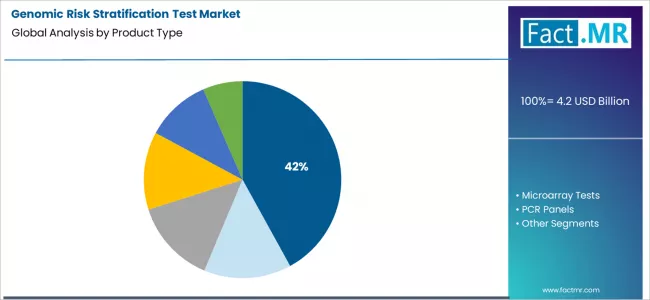
Genomic Risk Stratification Test Market Analysis By Product Type | Source: Fact.MR
In terms of product type, the NGS-based tests segment leads the market with 42.0% share. Healthcare providers and diagnostic laboratories increasingly utilize NGS-based testing systems for their superior analytical depth and comprehensive genomic coverage characteristics.
- Laboratory investments in advanced sequencing technology and quality infrastructure continue to strengthen adoption among precision medicine facilities.
- With healthcare providers prioritizing diagnostic accuracy and genetic insight validation, NGS-based test modules align with both clinical objectives and patient care requirements, making them the central component of comprehensive risk stratification strategies.
By End User, Which Segment Registers the Highest Share in the Genomic Risk Stratification Test Market?
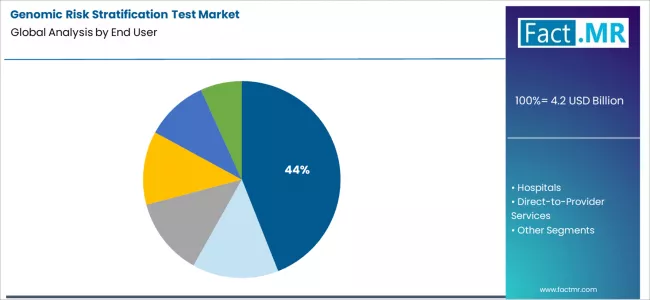
Genomic Risk Stratification Test Market Analysis By End User | Source: Fact.MR
By end user, diagnostic laboratories dominates with 44.0% share, underscoring its critical role as the primary testing category for healthcare organizations seeking superior analytical capabilities and enhanced diagnostic differentiation credentials. Laboratory technologists and testing teams prefer genomic risk stratification solutions for diagnostic applications due to their established quality validation requirements.
- Healthcare facilities are optimizing test selections to support application-specific requirements and comprehensive genetic analysis strategies.
- As testing technology continues to advance and laboratories seek efficient processing methods, diagnostic laboratory applications will continue to drive market growth while supporting precision medicine optimization and patient care strategies.
What are the Drivers, Restraints, and Key Trends of the Genomic Risk Stratification Test Market?
- Drivers: Healthcare demand for precision medicine approaches and improved patient risk assessment in genetic testing drives adoption of high-quality genomic stratification solutions across diagnostic facilities.
- Restraint: Higher testing costs and processing complexity of integrating specialized genomic analysis protocols into existing laboratory procedures limit market penetration.
- Trend 1: Shift toward advanced sequencing configurations that maximize genetic data retention and preserve analytical accuracy for improved diagnostic functionality.
- Trend 2: Development of specialized multi-gene panel tests supporting various clinical applications and therapeutic requirement compatibility.
Analysis of the Genomic Risk Stratification Test Market by Key Country
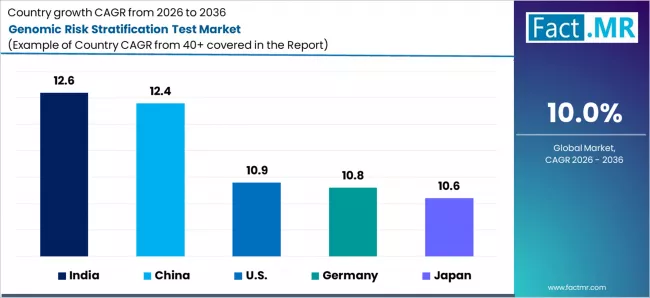
Genomic Risk Stratification Test Market Cagr Analysis By Country | Source: Fact.MR
| Country | CAGR 2026 to 2036 |
|---|---|
| U.S. | 10.9% |
| China | 12.4% |
| Germany | 10.8% |
| Japan | 10.6% |
| India | 12.6% |
Source: Fact.MR analysis. Updated Jan 20, 2026
The report covers an in-depth analysis of 30+ countries; top-performing countries are highlighted below.
What Opportunities Can Genomic Risk Stratification Test Providers Expect in U.S.?
Revenue from genomic risk stratification testing product sales in U.S. is projected to exhibit strong growth with a CAGR of 10.9% through 2036, driven by the country's rapidly expanding precision medicine sector, regulatory frameworks promoting personalized healthcare initiatives, and healthcare awareness supporting genetic testing technologies across major clinical and laboratory regions.
- Established healthcare infrastructure and expanding diagnostic capabilities are driving demand for genomic risk stratification solutions across hospital facilities, laboratory developments, and comprehensive clinical testing systems throughout American healthcare markets.
- Strong regulatory development and clinical research initiatives are supporting the rapid adoption of premium genetic testing services among quality-focused laboratories seeking to meet evolving diagnostic standards and patient requirements.
What is the Chinese Genomic Risk Stratification Test Market Size?
Revenue from genomic risk stratification testing products in China is projected to expand at a CAGR of 12.4%, supported by rising healthcare investment, growing genetic testing consciousness, and expanding precision medicine capabilities. The country's advanced biotechnology infrastructure and increasing investment in genomic technologies are driving demand for risk stratification solutions across both traditional and modern healthcare applications.
- Rising biotechnology development and expanding testing capabilities are creating opportunities for genetic analysis adoption across healthcare projects.
- Growing precision medicine initiatives and genomic technology advancement are driving the adoption of specialized diagnostic tools and services among Chinese healthcare providers.
What Opportunities Can Genomic Risk Stratification Testing Product Manufacturers Expect in Germany?
Revenue from genomic risk stratification testing products in Germany is projected to grow at a CAGR of 10.8% through 2036, supported by the country's emphasis on healthcare quality precision, diagnostic excellence, and advanced medical system integration requiring efficient testing solutions. German healthcare providers and quality-focused establishments prioritize diagnostic precision and testing control, making specialized genomic testing services essential components for both traditional and modern clinical applications.
- Advanced precision diagnostic technology capabilities and growing personalized medicine applications are driving demand for genomic testing services across specialty healthcare applications.
- Strong focus on healthcare quality precision and diagnostic excellence is encouraging providers and laboratories to adopt genomic risk stratification solutions that support clinical objectives.
What is the Japanese Genomic Risk Stratification Test Market Size?
Revenue from genomic risk stratification testing products in Japan is projected to expand at a CAGR of 10.6%, supported by rising healthcare technology investment, growing precision medicine consciousness, and expanding clinical testing capabilities. The country's advanced healthcare technology infrastructure and increasing investment in genetic analysis technologies are driving demand for genomic risk stratification solutions across both traditional and modern clinical applications.
- Advanced healthcare technology development and expanding diagnostic capabilities are creating opportunities for genetic testing adoption across clinical projects.
- Growing precision medicine initiatives and genetic technology advancement are driving the adoption of specialized diagnostic tools among Japanese healthcare providers.
What is the Indian Genomic Risk Stratification Test Market Size?
Revenue from genomic risk stratification testing products in India is projected to grow at a CAGR of 12.6% through 2036, supported by expanding healthcare access, growing genetic awareness, and developing diagnostic infrastructure. The country's growing biotechnology sector and increasing healthcare investments are driving demand for genomic testing solutions across emerging clinical applications.
- Expanding healthcare infrastructure and growing diagnostic capabilities are creating opportunities for genetic testing adoption across clinical facilities.
- Rising healthcare awareness and technology advancement are driving adoption of genetic risk assessment tools among Indian healthcare providers.
Competitive Landscape of the Genomic Risk Stratification Test Market
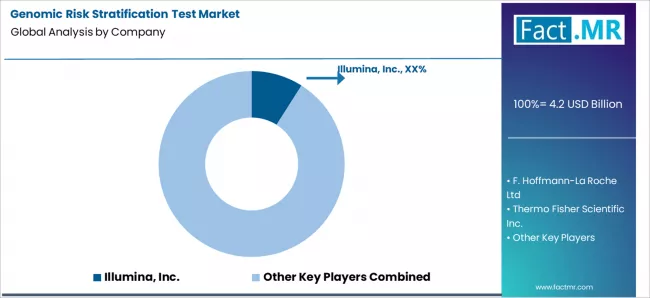
Genomic Risk Stratification Test Market Analysis By Company | Source: Fact.MR
The Genomic Risk Stratification Test Market is characterized by competition among established biotechnology companies, specialized diagnostic service providers, and integrated healthcare technology companies. Companies are investing in advanced sequencing technology, specialized testing platforms, innovation capabilities, and comprehensive distribution networks to deliver consistent, high-quality, and reliable genomic testing services.
Market players include Illumina, F. Hoffmann-La Roche, Thermo Fisher Scientific, QIAGEN, Agilent Technologies, and others, offering commercial and specialty services with emphasis on diagnostic excellence and genetic testing heritage. Illumina provides integrated genomic solutions with a focus on sequencing technology applications and premium quality networks.
Key Players in the Genomic Risk Stratification Test Market
- Illumina, Inc.
- F. Hoffmann-La Roche Ltd
- Thermo Fisher Scientific Inc.
- QIAGEN N.V.
- Agilent Technologies, Inc.
- Invitae Corporation
- Myriad Genetics
- Guardant Health
- Foundation Medicine
- Veracyte
Bibliography
- International Association for Personalized Medicine Research Committee. (2023). Genomic testing technologies and precision medicine optimization in clinical healthcare systems. International Association for Personalized Medicine.
- International Organization for Standardization. (2023). Healthcare quality management: Assessment of genetic testing technology, diagnostic efficiency, and quality control of genomic analysis systems (ISO Technical Report). ISO.
- European Committee for Standardization. (2022). Healthcare quality management: Evaluation of genomic testing processing, quality control, and clinical compliance in healthcare facilities (EN Technical Report). CEN.
- Journal of Precision Medicine Editorial Board. (2024). Genomic testing processing, quality control, and clinical optimization in modern healthcare delivery. Journal of Precision Medicine, 149(3), 287-304.
- Clinical Laboratory Technology Agency, Technical Committee. (2023). Advances in genetic testing processing and quality control technologies for diagnostic and clinical applications. Clinical Laboratory Technology Agency.
Segmentation
Scope of the Report
| Items | Values |
|---|---|
| Quantitative Units (2026) | USD 4.2 Billion |
| Product Type | NGS-based Tests, Microarray Tests, PCR Panels, Chromosomal Microarray Analysis, Whole Genome Sequencing, Other |
| Application | Oncology Risk Profiling, Cardiovascular Risk Assessment, Inherited Disease Risk, Pharmacogenomics, Neurological Disorders, Other |
| End User | Diagnostic Laboratories, Hospitals, Direct-to-Provider Services, Academic Research Institutes, Pharmaceutical Companies, Other |
| Distribution Channel | Direct Sales, Distributors, Online Platforms, Laboratory Service Providers, Healthcare Networks, Other |
| Regions Covered | North America, Europe, East Asia, South Asia, Latin America, Middle East & Africa |
| Countries Covered | U.S., China, Germany, Japan, India, France, UK, South Korea, and other countries |
| Key Companies Profiled | Illumina, F. Hoffmann-La Roche, Thermo Fisher Scientific, QIAGEN, Agilent Technologies, and other leading biotechnology companies |
| Additional Attributes | Dollar revenue by product type, application, end user, distribution channel, and region; regional demand trends, competitive landscape, technological advancements in sequencing technology, precision medicine optimization initiatives, genetic testing development programs, and premium diagnostic technology development strategies |
Source: Fact.MR analysis. Updated Jan 20, 2026
Genomic Risk Stratification Test Market by Segments
-
Product Type :
- NGS-based Tests
- Microarray Tests
- PCR Panels
- Chromosomal Microarray Analysis
- Whole Genome Sequencing
- Other
-
Application :
- Oncology Risk Profiling
- Cardiovascular Risk Assessment
- Inherited Disease Risk
- Pharmacogenomics
- Neurological Disorders
- Other
-
End User :
- Diagnostic Laboratories
- Hospitals
- Direct-to-Provider Services
- Academic Research Institutes
- Pharmaceutical Companies
- Other
-
Distribution Channel :
- Direct Sales
- Distributors
- Online Platforms
- Laboratory Service Providers
- Healthcare Networks
- Other
-
Region :
- North America
- U.S.
- Canada
- Mexico
- Europe
- Germany
- France
- UK
- Italy
- Spain
- Netherlands
- Switzerland
- Rest of Europe
- East Asia
- China
- Japan
- South Korea
- Rest of East Asia
- South Asia
- India
- Rest of South Asia
- Latin America
- Brazil
- Argentina
- Rest of Latin America
- Middle East and Africa
- United Arab Emirates
- South Africa
- Rest of Middle East and Africa
- North America
Frequently Asked Questions
How big is the Genomic Risk Stratification Test Market in 2026?
What will be the size of Genomic Risk Stratification Test Market in 2036?
How much will be the Genomic Risk Stratification Test Market growth between 2026 and 2036?
What are the key product types in the Genomic Risk Stratification Test Market?
Which end user segment to contribute significant share in the Genomic Risk Stratification Test Market in 2026?
Who worked on this report


Preview the report firsthand - request a free sample
Free SampleGet the brochure for pricing and purchase details
Download PDF