- Market Value (2025): USD 3.73 Bn
- Estimated Value (2026): USD 3.98 Bn
- Forecast Value (2036): USD 7.71 Bn
- CAGR (2026-2036): 6.8%
What is the GPS Receiver Market forecast to be worth by 2036?
USD 4.0 billion in 2026 to USD 7.7 billion by 2036, at a 6.8% CAGR.
- As per Fact.MR analysis, the GPS receiver market reached USD 3.73 billion in 2025.
- The market is forecast to increase from USD 3.98 billion in 2026 to USD 7.71 billion by 2036.
- The market is forecast to record a 6.8% CAGR during 2026 to 2036 as vehicle manufacturers and precision-measurement users buy location equipment.
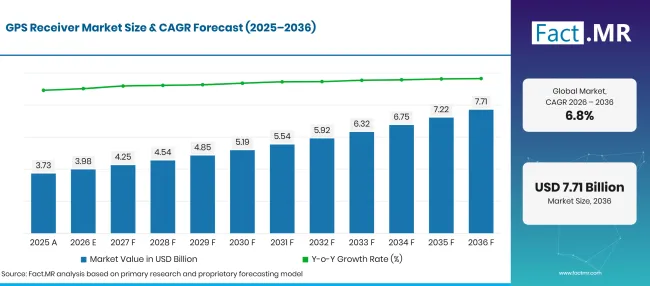
Gps Receiver Market Forecast Global | Source: Fact.MR
| Year | Basis | Market Value (USD billion) |
|---|---|---|
| 2025 | Actual | 3.73 |
| 2026 | Estimate | 3.98 |
| 2036 | Forecast | 7.71 |
| CAGR 2026 to 2036 | Forecast period | 6.8% |
Source: Fact.MR analysis. Updated Oct 26, 2026
What are the defining numbers behind GPS Receiver Market growth?
USD 3.7 billion absolute opportunity between 2026 and 2036, with differential-grade receivers and automotive use shaping purchases.
- Demand Drivers in the Market
- Surveying contractors choose receivers that reduce repeat visits to a site. Their purchasing decision depends on positioning precision and compatibility with correction services used by field crews. The National Institute of Standards and Technology explains that GPS can determine location within approximately 4.9 meters, while additional signals and processing methods can improve positioning accuracy [1].
- Automotive design teams need compact location hardware that works beside vehicle electronics. The receiver needs to provide steady location data for navigation and fleet systems while fitting the vehicle’s electronics. Vehicle-platform replacement cycles make board size and software support important parts of supplier selection.
- Agricultural machinery makers use positioning data to guide equipment along repeatable routes. Receiver purchases depend on accuracy under normal field conditions and how easily the unit connects to steering controls. Dealers also weigh field service access since downtime during planting or harvesting directly affects the operator.
- Industrial device designers seek compact receivers that retain reliable positioning inside machines with tight space limits.
- Key Segments Analyzed
- By Type: Differential Grade holds 42.5% share in 2026 as correction-assisted positioning serves equipment that needs consistent location measurements.
- By Industry Vertical: Automotive represents 28.6% share in 2026 because receivers are built into vehicle navigation and location functions.
- By Frequency: Dual Frequency captures 41.2% share in 2026 as two-signal designs help users address positioning errors.
- Analyst Opinion at Fact.MR
- Shambhu Nath Jha, Principal Consultant at Fact.MR, states, “For GPS receiver manufacturers, the important test is whether strong signal specifications translate into accurate positions during real field work. A receiver that performs well in an open test area still has to cope with blocked signals and equipment integration.”
- Strategic Implications
- Receiver designers should test positioning performance across the specific field conditions faced by surveying crews instead of relying on open-sky accuracy alone.
- Vehicle electronics teams should assess receiver size and software integration early in the design cycle to avoid later changes to navigation hardware. In March 2026, NASA described a laser-reflecting instrument on GPS III SV-09 designed to aid measurement of its orbital position [3].
- Equipment distributors should train service teams to diagnose antenna placement and correction-link problems before replacing working receivers.
- Industrial customers should compare total installation work as well as receiver price because positioning hardware often needs an antenna and integration support.
The United Kingdom is forecast to post an 8.7% CAGR through 2036, followed by Germany at 7.2%. Japan is projected to reach 6.7%, while the United States is anticipated to record 6.3%. Brazil is forecast to advance at 4.8%, with the purchasing mix varying between professional mapping equipment and location hardware fitted to vehicles.
How does the GPS Receiver Market break down by segment?
Differential Grade 42.5%; Automotive 28.6%; Dual Frequency 41.2% in 2026.
Which receiver Type leads purchasing?
Differential Grade holds 42.5% share in 2026.
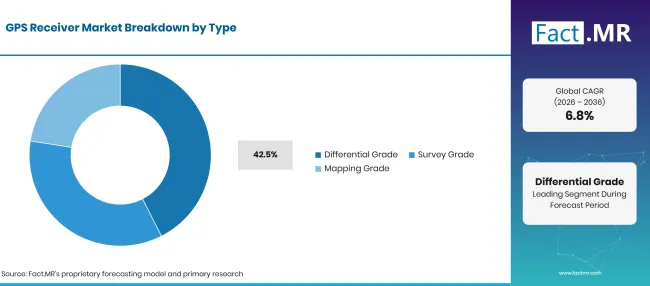
Gps Receiver Market Breakdown Type | Source: Fact.MR
| Type | Share (2026) |
|---|---|
| Differential Grade (Leading segment) | 42.5% |
| Other segments combined | 57.5% |
| Total | 100.0% |
Source: Fact.MR analysis. Updated Oct 26, 2026
Surveying crews use differential correction to improve the position recorded by a receiver. Their equipment choice depends on reliable field measurements and the correction services available at the worksite. Survey Grade models serve high-precision work where measurement records must remain repeatable. Mapping Grade units meet projects that need dependable coordinates without the same instrument setup.
How does Industry Vertical influence purchasing?
Automotive accounts for 28.6% share in 2026.
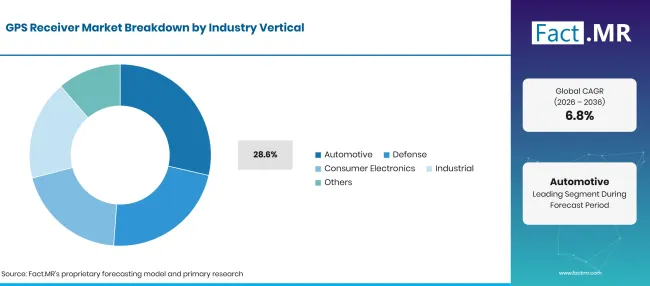
Gps Receiver Market Breakdown Industry Vertical | Source: Fact.MR
| Industry Vertical | Share (2026) |
|---|---|
| Automotive (Leading segment) | 28.6% |
| Other segments combined | 71.4% |
| Total | 100.0% |
Source: Fact.MR analysis. Updated Oct 26, 2026
Automotive firms fit location receivers into navigation equipment and related vehicle electronics. Industrial equipment makers have different needs because their receivers must operate near machinery and within established control systems. Consumer electronics designers focus on small size and power use, while defense customers put more weight on operational continuity. Each industry assesses a different combination of antenna design and software support before accepting a receiver platform.
Which Frequency configuration attracts more spending?
Dual Frequency leads with 41.2% share in 2026.
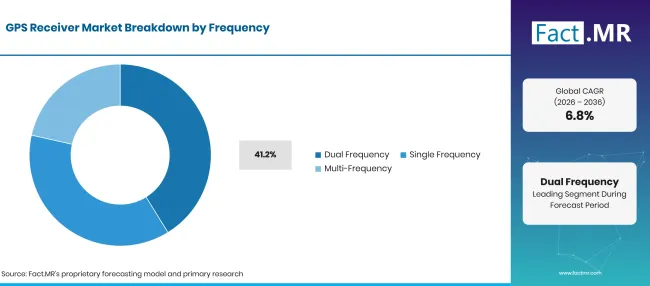
Gps Receiver Market Breakdown Frequency | Source: Fact.MR
| Frequency | Share (2026) |
|---|---|
| Dual Frequency (Leading segment) | 41.2% |
| Other segments combined | 58.8% |
| Total | 100.0% |
Source: Fact.MR analysis. Updated Oct 26, 2026
Dual Frequency receivers process signals on two frequency bands to help compensate for disturbances that change the apparent travel time of satellite signals. Single Frequency models remain useful when equipment cost and basic positioning are the main concerns. Multi-Frequency designs suit professional use where the receiver must handle several signals and operating environments. Antenna placement and surrounding conditions still affect accuracy, even when a receiver supports several frequencies.
What is accelerating GPS Receiver Market adoption, and what is holding it back?
Precision requirements and compact modules support sales; signal interference and integration costs restrict deployment.
Drivers Impact Analysis
| DRIVER | (~) % IMPACT ON CAGR | GEOGRAPHIC RELEVANCE | IMPACT TIMELINE |
|---|---|---|---|
| Survey correction workflows | +1.0% | Global | Medium term (2–4 years) |
| Vehicle navigation integration | +0.8% | Europe, North America | Medium term (2–4 years) |
| Compact industrial modules | +0.7% | Global | Short term (<= 2 years) |
| Farm guidance systems | +0.5% | Americas, Europe | Medium term (2–4 years) |
| Satellite modernization | +0.4% | Global | Long term (>= 4 years) |
Source: Fact.MR analysis. Updated Oct 26, 2026
Opportunity Impact Analysis
| OPPORTUNITY | (~) % IMPACT ON CAGR | GEOGRAPHIC RELEVANCE | IMPACT TIMELINE |
|---|---|---|---|
| Receiver replacement programs | +0.8% | Global | Medium term (2–4 years) |
| Compact unmanned platforms | +0.6% | Global | Medium term (2–4 years) |
| Timing applications | +0.5% | Global | Long term (>= 4 years) |
| Survey support services | +0.4% | Europe, Americas | Short term (<= 2 years) |
Source: Fact.MR analysis. Updated Oct 26, 2026
Restraints Impact Analysis
| RESTRAINT | (~) % IMPACT ON CAGR | GEOGRAPHIC RELEVANCE | IMPACT TIMELINE |
|---|---|---|---|
| Signal obstruction | -0.8% | Urban and industrial areas | Short term (<= 2 years) |
| Interference exposure | -0.6% | Global | Medium term (2–4 years) |
| Installation and correction cost | -0.5% | Global | Short term (<= 2 years) |
| Approval and integration work | -0.4% | Automotive, aviation | Medium term (2–4 years) |
Source: Fact.MR analysis. Updated Oct 26, 2026
Which countries are scaling the GPS Receiver Market through 2036?
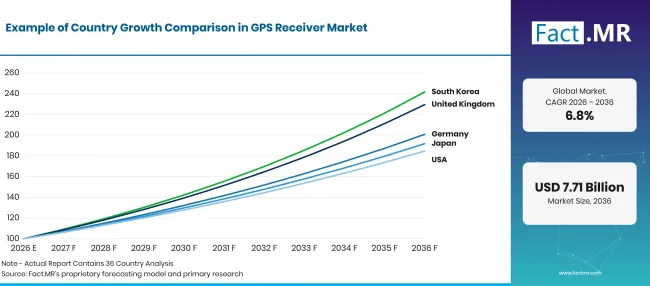
Gps Receiver Market Growth Index | Source: Fact.MR
| Country | CAGR (2026–2036) |
|---|---|
| United Kingdom | 8.7% |
| Germany | 7.2% |
| Japan | 6.7% |
| United States | 6.3% |
| Brazil | 4.8% |
Source: Fact.MR analysis. Updated Oct 26, 2026
How is the United Kingdom developing GPS receiver purchases?
8.7% CAGR, influenced by vehicle electronics and professional equipment use.
Vehicle navigation and professional field measurement give the United Kingdom two different receiver purchasing channels. According to the UK Department for Transport, 2.617 million vehicles were registered for the first time in 2025, covering multiple vehicle types [4]. Automotive system designers compare compact receiver modules by installation cost and support for the vehicle electronics platform.
Why does Germany remain an active receiver market?
7.2% CAGR, associated with vehicle production systems and precision surveying.
German industrial machine builders and vehicle electronics suppliers consider how receivers fit established equipment designs. The Federal Statistical Office published motor-vehicle stock figures in March 2026 and reported 49.3392 million passenger cars at the start of 2025 [5]. The vehicle base gives navigation equipment an established application setting.
What shapes GPS receiver use in Japan?
6.7% CAGR, linked to compact hardware and precise positioning needs.
Japan has a specialised receiver customer base in compact industrial products and professional positioning equipment. Designers assess receiver dimensions and power use before integrating modules into robots or mobile devices. Surveying contractors require consistent measurements in streets where buildings affect satellite reception. Japan’s QZSS system adds a regional signal option for compatible devices.
How is the United States supporting receiver sales?
6.3% CAGR, shaped by GPS modernization and precision field applications.
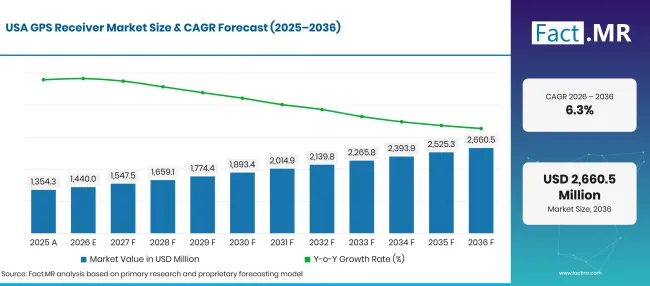
Gps Receiver Market Forecast Usa | Source: Fact.MR
The United States has extensive professional GPS receiver use in surveying and field equipment. The U.S. Space Force reported in April 2026 that the final GPS III satellite entered orbit and completed an active 32-satellite constellation [2].
What determines GPS receiver uptake in Brazil?
4.8% CAGR, influenced by agricultural guidance and vehicle tracking.
Brazilian farming and road-transport users require GPS receiver hardware suited to long operating routes and changing field conditions. Equipment makers evaluate positioning stability when adding satellite guidance to agricultural machines. Fleet-system installers generally compare setup effort and device compatibility alongside the price of the receiver.
Who leads the GPS Receiver Market?
Garmin Ltd. supplies navigation products used in consumer and professional settings, while Trimble Inc. serves precision positioning and surveying users. Hexagon AB has a position in measurement and geospatial technology through its businesses. Topcon Corporation supplies positioning equipment for surveying and construction work. These companies operate across different device categories, which makes a single company-share comparison inappropriate for this report.
Furuno Electric Co. Ltd. serves maritime navigation applications, while JAVAD GNSS Inc. supplies receivers for precision positioning. Hexagon AB serves professional measurement applications. Navico Group (Brunswick Corporation) focuses on marine electronics, and TomTom International BV supplies navigation-related technologies across connected mobility products.
Which companies are the key providers?
Key companies include Garmin Ltd.; Trimble Inc.; Hexagon AB; Topcon Corporation; TomTom International BV; Furuno Electric Co. Ltd.; Navico Group (Brunswick Corporation); JAVAD GNSS Inc.
- Garmin Ltd.
- Trimble Inc.
- Hexagon AB
- Topcon Corporation
- TomTom International BV
- Furuno Electric Co. Ltd.
- Navico Group (Brunswick Corporation)
- JAVAD GNSS Inc.
Bibliography
- [1] National Institute of Standards and Technology. (2026, May 27). How do you measure your location using GPS?
- [2] U.S. Space Force. (2026, April 21). Space Force delivers final GPS III satellite to orbit. GPS.gov.
- [3] National Aeronautics and Space Administration. (2026, March 19). NASA laser reflecting instrument makes GPS satellite more accurate.
- [4] Department for Transport. (2026, April 29). Vehicle licensing statistics: 2025.
- [5] Statistisches Bundesamt (Destatis). (2026, March 23). Bestand an Kraftfahrzeugen und Schienenfahrzeugen für die Jahre 2021 bis 2025.
This Report Answers
- The report reviews how correction-supported receivers affect purchases in field measurement and mapping.
- Frequency analysis compares the fit of single-frequency hardware with dual-frequency and multi-frequency configurations.
- The country outlook examines five national markets with different equipment purchasing conditions.
- Competitive analysis distinguishes embedded receiver modules from finished navigation products.
What does the GPS Receiver Market cover?
The market covers hardware that receives satellite navigation signals and calculates usable position or timing information. It includes standalone professional receivers and receiver modules installed inside larger products. Multi-constellation GNSS capability is relevant when offered in the receiver products being assessed.
What is included in the scope?
The scope includes receiver hardware sold for mapping and survey equipment.
It also covers modules used in navigation devices and vehicle electronics. Industrial and marine applications enter the scope when a receiving component forms part of the product sold. Systems are grouped according to the stated Type, Industry Vertical and Frequency classifications.
What is excluded from the scope?
The scope excludes satellite construction and ground-control networks.
Navigation software subscriptions and mapping-content services are outside receiver hardware sales unless directly bundled into the defined receiver product. A complete connected vehicle or vessel is not treated as a GPS receiver.
How Was the Analysis Built?
The analysis draws on 120+ sources, 35+ company portfolios, 25+ countries, and more than 20 industry interviews.
- Primary Research: Primary research includes discussions with manufacturers, service providers, technology developers, distributors, end users, and subject-matter experts. These conversations examine purchasing priorities, product adoption, operational challenges, approval requirements, competitive positioning, and the factors that influence wider market acceptance.
- Desk Research: Desk research covers government statistics, regulatory publications, company filings, trade data, technical studies, industry associations, standards, public policy, and other authoritative sources. Every source used in the analysis is documented in the bibliography.
- Market Sizing and Forecasting: Market estimates combine historical performance, demand indicators, pricing and volume trends, segment shares, company participation, country-level growth, adoption patterns, investment activity, and barriers to market expansion.
- Data Validation and Update Cycle: Findings are validated by comparing primary interviews with public data, company activity, regulatory changes, trade patterns, and industry developments. Regular updates review new product launches, capacity changes, partnerships, approvals, and shifts in commercial adoption.
Segmentation
What is the report’s scope and coverage?
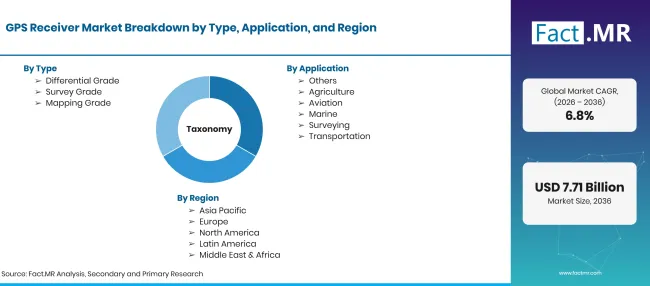
Gps Receiver Market Taxonomy | Source: Fact.MR
| Attribute | Details |
|---|---|
| Quantitative Units | USD billion |
| Market Definition | Receivers and integrated receiver modules used to derive position or timing from satellite navigation signals. |
| Type | Differential Grade; Survey Grade; Mapping Grade |
| Industry Vertical | Automotive; Defense; Consumer Electronics; Industrial; Others |
| Frequency | Single Frequency; Dual Frequency; Multi-Frequency |
| Regions Covered | North America; Latin America; Western Europe; Eastern Europe; East Asia; South Asia & Pacific; Middle East & Africa |
| Countries Covered | United Kingdom; Germany; Japan; United States; Brazil |
| Companies Profiled | Garmin Ltd.; Trimble Inc.; Hexagon AB; Topcon Corporation; TomTom International BV; Furuno Electric Co. Ltd.; Navico Group (Brunswick Corporation); JAVAD GNSS Inc. |
| Forecast Period | 2026 to 2036 |
| Approach | Application assessment and review of official GNSS documentation and manufacturer products |
Source: Fact.MR analysis. Updated Oct 26, 2026
How is the market segmented?
-
By Type
- Differential Grade
- Survey Grade
- Mapping Grade
-
By Industry Vertical
- Automotive
- Defense
- Consumer Electronics
- Industrial
- Others
-
By Frequency
- Single Frequency
- Dual Frequency
- Multi-Frequency
-
By Region
- North America
- Latin America
- Western Europe
- Eastern Europe
- East Asia
- South Asia & Pacific
- Middle East & Africa
Frequently Asked Questions
How big is the GPS receiver market in 2026?
What is the CAGR from 2026 to 2036?
Which receiver type leads?
Which industry vertical has the leading share?
Which companies supply GPS receiver products?
Who worked on this report


Preview the report firsthand - request a free sample
Free SampleGet the brochure for pricing and purchase details
Download PDF