- Base Value(2025): 2.9 Bn
- Estimated Value(2026): 3 Bn
- Forecast Value (2036): 4.5 Bn
- CAGR (2026 - 2036): 4%
IR Emitters and Receivers Market Forecast By Fact.MR
In 2025, the IR emitters and receivers market was valued at USD 2.9 billion. Based on Fact MR analysis, demand for IR emitters and receivers is estimated to grow to USD 3 billion in 2026 and USD 4.5 billion by 2036. FMR projects a CAGR of 4.0% during the forecast period.
The absolute dollar growth from 2026 to 2036 is USD 1.5 billion. This increase reflects gradual demand expansion across sensing and optical communication components rather than a structural transformation of the semiconductor industry. IR emitters and receivers are widely deployed in consumer electronics, industrial automation systems, proximity sensing modules, and remote control devices. Demand continues across automotive safety systems, smart appliances, and industrial sensing applications. Growth pace remains moderated by component price competition, shifts toward alternative sensing technologies such as LiDAR and radar modules, and semiconductor supply chain fluctuations.
India leads with a projected CAGR of 9.3%, supported by expanding electronics manufacturing and rising demand for optical sensing components in consumer devices. China follows with a CAGR of 9.0%, driven by large scale semiconductor component production and strong consumer electronics output. The United States records a CAGR of 8.5%, supported by demand from automotive electronics and industrial automation equipment. Japan shows a CAGR of 8.2%, reflecting steady integration of optical sensing modules across precision electronics manufacturing. Germany records a CAGR of 7.8%, supported by automotive electronics production. Australia shows the slowest growth at 7.6%, reflecting a smaller semiconductor manufacturing base. Mature electronics markets generate a significant share of replacement demand as sensor modules are upgraded within existing electronic systems.
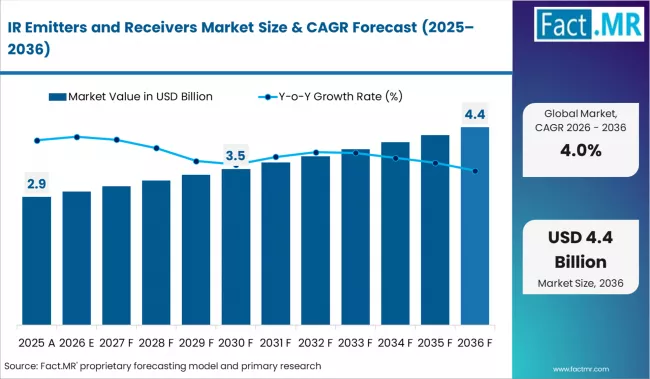
Ir Emitters And Receivers Market Market Value Analysis | Source: Fact.MR
| Metric | Details |
|---|---|
| Industry Size (2026E) | USD 3 billion |
| Industry Value (2036F) | USD 4.5 billion |
| CAGR (2026 to 2036) | 4% |
Source: Fact.MR analysis. Updated Mar 23, 2026
IR Emitters and Receivers Market Definition
The IR Emitters and Receivers Market includes electronic components that transmit and detect infrared radiation for sensing, communication, and control functions. IR emitters generate infrared light signals using semiconductor devices such as light emitting diodes, while IR receivers detect these signals and convert them into electrical responses. These components are widely used in consumer electronics, remote control systems, security sensors, industrial automation, and optical communication devices. Their primary function is to enable short range wireless communication, object detection, and signal transmission using infrared light within electronic and automated systems.
IR Emitters and Receivers Market Inclusions
This report covers global and regional market sizes for infrared emitters and receivers with forecast analysis for the study period. The market is segmented by component type including IR emitters and IR receivers. Application segments include consumer electronics, automotive systems, industrial automation equipment, security and surveillance devices, and optical communication systems. End users include electronics manufacturers, automotive component suppliers, industrial equipment producers, and security system providers. The report also evaluates pricing structures, production patterns, and selected trade flow analysis across major semiconductor manufacturing regions.
IR Emitters and Receivers Market Exclusions
The report excludes other optical components such as lasers, photodiodes used for visible light detection, and fiber optic communication transmitters. Complete electronic devices such as televisions, smartphones, or remote control units are not included. The scope also excludes infrared imaging systems and thermal cameras used for temperature measurement. General semiconductor devices not designed for infrared emission or detection are outside the defined market scope.
IR Emitters and Receivers Market Research Methodology
- Primary Research: Interviews were conducted with semiconductor manufacturers, electronics component suppliers, system integrators, and industrial equipment developers.
- Desk Research: Public information was collected from semiconductor industry publications, company reports, government trade statistics, and electronics market databases.
- Market-Sizing and Forecasting: A hybrid model combining bottom up component shipment analysis with top down demand assessment across consumer electronics and industrial sectors was applied.
- Data Validation and Update Cycle: Findings were cross verified using multiple semiconductor industry sources and expert inputs, with periodic updates conducted as new market data becomes available.
Summary of the IR Emitters and Receivers Market
- Market Definition
- The market comprises optoelectronic components that transmit and detect infrared radiation for sensing, communication, and control functions in electronic systems. IR emitters generate infrared light signals through semiconductor devices such as infrared light emitting diodes, while IR receivers detect these signals and convert them into electrical responses. These components enable short range wireless communication, proximity sensing, and signal transmission in consumer electronics, industrial automation systems, automotive electronics, and security devices.
- Demand Drivers
- Increasing integration of infrared sensing components in consumer electronics such as televisions, remote controls, and home entertainment systems.
- Rising demand for proximity sensing and gesture recognition modules in smartphones and smart appliances.
- Expansion of automotive electronics and driver assistance systems incorporating optical sensing technologies.
- Growing deployment of infrared components in industrial automation equipment and security monitoring systems.
- Key Segments Analyzed
- Type: Diode based components account for about 45% share due to efficient infrared signal transmission and compact semiconductor design.
- End Use: Consumer electronics represent roughly 30% share supported by widespread use of IR communication and sensing modules.
- Application Scope: Infrared emitters and receivers are deployed across remote control systems, proximity sensors, automation equipment, and optical communication devices.
- Geography: India records the fastest expansion supported by rising electronics manufacturing and growing demand for semiconductor components.
- Analyst Opinion at Fact MR
- Shambhu Nath Jha, Principal Consultant, Fact MR, opines, "In this updated edition of the IR Emitters and Receivers Market report, industry participants will observe that infrared optoelectronic components remain widely used in sensing and communication systems across consumer electronics and industrial equipment. IR emitters and receivers enable reliable short range optical communication and signal detection within electronic devices. Companies maintaining strong semiconductor fabrication capabilities and optoelectronic design expertise will retain stable positions within the global sensing component supply chain."
- Strategic Implications or Executive Takeaways
- Expand semiconductor manufacturing capabilities for infrared sensing and communication components.
- Strengthen integration of infrared modules within consumer electronics, automotive electronics, and automation equipment.
- Invest in development of advanced optical sensing components with improved signal sensitivity and energy efficiency.
- Maintain stable semiconductor supply chains supporting global electronics manufacturing and component distribution.
- Methodology
- Primary interviews conducted with semiconductor manufacturers, electronics component suppliers, system integrators, and industrial equipment developers.
- Desk research based on semiconductor industry publications, company financial reports, government trade statistics, and electronics market databases.
- Market sizing developed through a hybrid approach combining bottom up component shipment analysis and top down demand assessment across consumer electronics and industrial sectors.
- Findings validated through multiple semiconductor industry sources and expert consultations following Fact MR internal modeling standards.
Segmental Analysis
IR Emitters and Receivers Market Analysis by Type
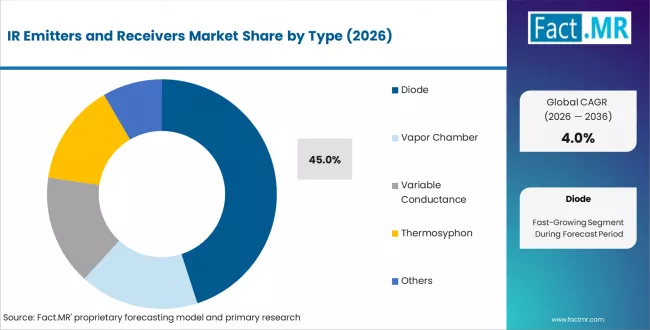
Ir Emitters And Receivers Market Analysis By Type | Source: Fact.MR
- Market Overview: Diode based components are projected to account for around 45% share of the IR emitters and receivers market by 2026. Infrared diodes are widely used as emitters and receivers in electronic systems that require short range optical communication and sensing capabilities. These components operate by transmitting and detecting infrared radiation, enabling data transfer and signal detection in various electronic devices. Manufacturers integrate IR diodes in consumer electronics, security systems, industrial automation equipment, and remote control devices. Their compact design, reliability, and efficient signal transmission support their widespread use in infrared communication systems.
- Demand Drivers:
- Infrared Communication Systems: IR diodes are used in devices that transmit and receive infrared signals for short range communication and control functions.
- Compact Electronic Components: Diode based infrared components offer compact form factors suitable for integration in modern electronic devices.
- Energy Efficient Operation: Infrared diodes operate with relatively low power consumption, making them suitable for battery powered electronic products.
IR Emitters and Receivers Market Analysis by End Use
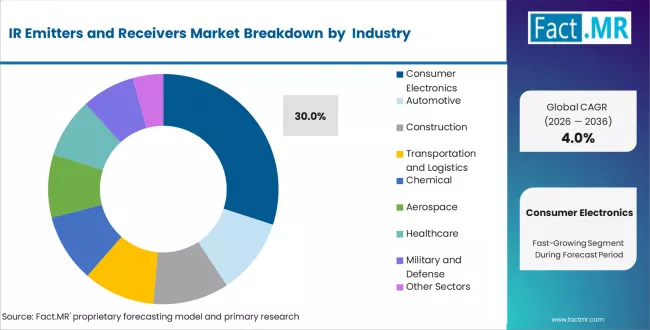
Ir Emitters And Receivers Market Analysis By End Use | Source: Fact.MR
- Market Overview: Consumer electronics are expected to represent approximately 30% share of the IR emitters and receivers market in 2026. Infrared emitters and receivers are commonly integrated into electronic devices such as televisions, remote controls, smartphones, and home entertainment systems. These components enable remote control functionality, gesture sensing, and proximity detection within electronic products. Consumer electronics manufacturers incorporate infrared components to support wireless device control and short range sensing capabilities.
- Demand Drivers:
- Remote Control Applications: Infrared emitters and receivers are widely used in television and home entertainment systems to enable wireless remote control functionality.
- Proximity and Gesture Detection: Consumer electronic devices integrate infrared sensors to detect user movement and proximity.
- Home Entertainment Systems: Televisions, set top boxes, and audio systems rely on infrared components to support device communication and control operations.
IR Emitters and Receivers Market Drivers, Restraints, and Opportunities
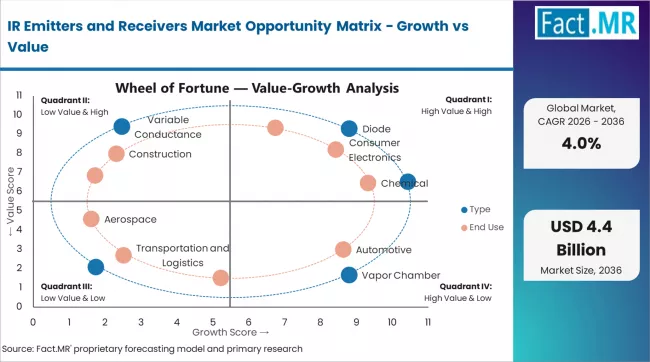
Ir Emitters And Receivers Market Opportunity Matrix Growth Vs Value | Source: Fact.MR
Fact MR analysis indicates that the IR emitters and receivers market developed alongside the expansion of optoelectronic components used in consumer electronics, industrial sensing, and communication systems. Early infrared devices were widely adopted in remote control systems for televisions and audio equipment where simple optical signal transmission enabled wireless command functions. The current market valuation reflects the integration of infrared components across automotive electronics, industrial automation systems, and security monitoring devices. Demand persists because infrared emitters and receivers enable reliable short-range optical communication and non-contact sensing within electronic equipment.
A structural shift is occurring as conventional infrared communication components face competition from alternative wireless technologies and advanced optical sensing systems. Traditional IR transmitters and receivers remain widely used in consumer electronics and industrial sensors where low cost and simple operation remain critical. At the same time, advanced infrared components designed for proximity detection, gesture recognition, and optical sensing applications command higher unit prices due to improved sensitivity and integrated semiconductor design. Even when shipment volumes for basic components remain stable, higher-value infrared sensing modules contribute to gradual market value expansion.
- Consumer Electronics Integration: Television remote controls, set-top boxes, and home entertainment systems continue to incorporate infrared emitters and receivers for device communication.
- Electronics Safety Standards: Compliance frameworks such as IEC 60825 laser and optical radiation safety standards influence the design and certification of infrared optical components.
- Asia Semiconductor Production: China, Taiwan, and South Korea maintain large semiconductor manufacturing industries that produce infrared optoelectronic components for global electronics supply chains.
Regional Analysis
The market analysis covers key global regions, including North America, East Asia, South Asia, Europe, and Oceania. It is segmented geographically, with specific market dynamics for each region. The full report provides a detailed market attractiveness analysis.
.webp "Top Country Growth Comparison Ir Emitters And Receivers Market Cagr (2026 2036)")
Top Country Growth Comparison Ir Emitters And Receivers Market Cagr (2026 2036) | Source: Fact.MR
| Country | CAGR (2026-2036) |
|---|---|
| USA | 8.5% |
| China | 9.0% |
| Germany | 7.8% |
| Japan | 8.2% |
| India | 9.3% |
| Australia | 7.6% |
Source: Fact.MR analysis. Updated Mar 23, 2026
Source: Fact MR (FMR) analysis, based on proprietary forecasting model and primary research
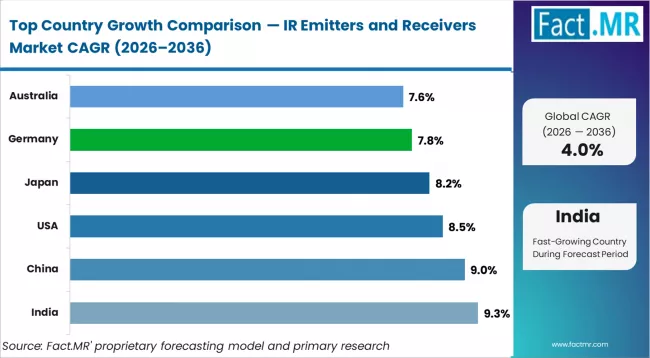
Ir Emitters And Receivers Market Cagr Analysis By Country | Source: Fact.MR
North America
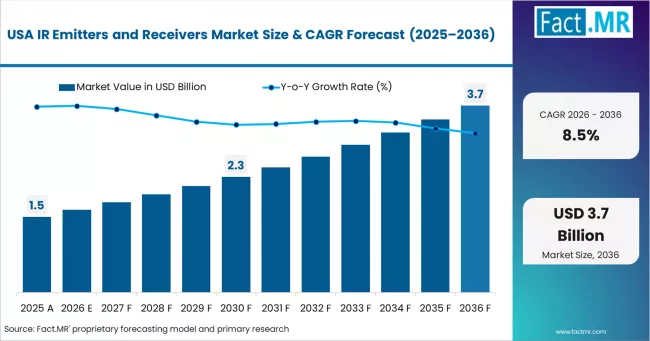
Ir Emitters And Receivers Market Country Value Analysis | Source: Fact.MR
The USA represents a major market supported by consumer electronics manufacturing, automotive sensing technologies, and industrial automation applications. Key companies include Texas Instruments, Broadcom Inc., and ON Semiconductor.
- USA: Demand for IR emitters and receivers in the U.S. is projected to rise at 8.5% CAGR through 2036. Growth is supported by semiconductor innovation programs promoted by the Department of Commerce (04-2025) and expansion of optoelectronic sensor production by Texas Instruments (08-2025).
East Asia
China and Japan represent key markets supported by electronics manufacturing, automotive sensing technologies, and optical communication devices.
- China: Demand for IR emitters and receivers in China is projected to rise at 9.0% CAGR through 2036. Growth is supported by semiconductor manufacturing initiatives promoted by the Ministry of Industry and Information Technology (03-2025) and expansion of optoelectronic component production by Huawei (07-2025).
- • Japan: Demand for IR emitters and receivers in Japan is projected to rise at 8.2% CAGR through 2036. Growth is supported by optoelectronics research initiatives promoted by the Ministry of Economy, Trade and Industry (04-2025) and component development by Sony Group Corporation (08-2025).
South Asia
India represents a rapidly growing market supported by electronics manufacturing expansion, consumer electronics demand, and automotive electronics production.
- India: Demand for IR emitters and receivers in India is projected to rise at 9.3% CAGR through 2036. Growth is supported by semiconductor manufacturing initiatives promoted by the Ministry of Electronics and Information Technology (05-2025) and component production expansion by ON Semiconductor (09-2025).
Europe
Germany represents an important market supported by automotive electronics production, industrial automation technologies, and sensor development.
- • Germany: Demand for IR emitters and receivers in Germany is projected to rise at 7.8% CAGR through 2036. Growth is supported by automotive electronics innovation programs promoted by the Federal Ministry for Economic Affairs (03-2025) and optoelectronic component development by Infineon Technologies (07-2025).
Oceania
Australia represents a smaller but significant market supported by industrial sensing technologies, mining automation, and security systems.
- Australia: Demand for IR emitters and receivers in Australia is projected to rise at 7.6% CAGR through 2036. Growth is supported by industrial automation initiatives (04-2025) and expansion of sensor technology distribution by Broadcom Inc. (08-2025).
Fact MR's analysis of the IR emitters and receivers market in North America, East Asia, South Asia, Europe, and Oceania consists of country-wise assessments that include the USA, China, Germany, Japan, India, and Australia. Readers can find detailed trends, regulatory updates, and company-specific investments shaping market growth in these countries.
Competitive Structure and Buyer Dynamics in the IR Emitters and Receivers Market
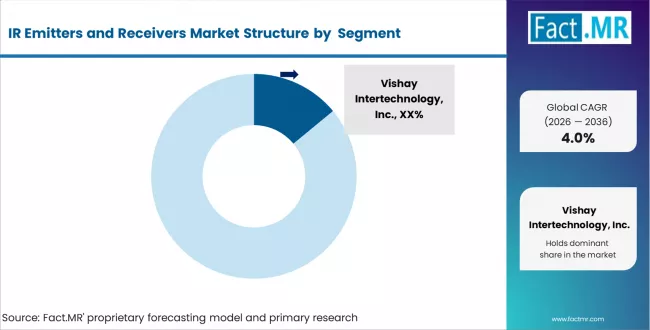
Ir Emitters And Receivers Market Analysis By Company | Source: Fact.MR
The competitive structure of the IR Emitters and Receivers Market is moderately fragmented, with a mix of global semiconductor manufacturers and specialized optoelectronic component producers participating in supply. Companies such as Vishay Intertechnology, Inc., ams-OSRAM AG, ROHM Co., Ltd., Everlight Electronics Co., Ltd., and Lite-On Technology Corporation maintain strong market positions through established semiconductor manufacturing capabilities and global component distribution networks. These firms supply infrared emitters and receivers used in consumer electronics, automotive systems, industrial sensing, and security devices. Additional participants including Kingbright Electronic Co., Ltd., Excelitas Technologies Corp., Stanley Electric Co., Ltd., Hamamatsu Photonics K.K., Lumileds Holding B.V., and Kodenshi Corporation contribute through specialized optoelectronic components and application specific infrared technologies. Competition in the market is primarily influenced by component reliability, signal sensitivity, energy efficiency, and compatibility with electronic control systems.
Several companies maintain structural advantages through advanced semiconductor fabrication infrastructure and expertise in optoelectronic component engineering. Firms such as ams-OSRAM AG, Vishay Intertechnology, Inc., and ROHM Co., Ltd. benefit from vertically integrated semiconductor production and established research capabilities in infrared sensing technologies. Hamamatsu Photonics K.K. and Excelitas Technologies Corp. maintain strong expertise in high precision photonics and sensing components used in industrial and scientific applications. Electronics manufacturers often adopt multi supplier sourcing strategies to reduce dependence on a single component provider and maintain supply continuity. Procurement teams evaluate suppliers based on component quality, production consistency, and long term supply reliability. This purchasing behavior moderates supplier pricing leverage across the market. Manufacturers with specialized optoelectronic technologies and large scale semiconductor production maintain stronger negotiating positions in electronics supply agreements.
Key Players of the IR Emitters and Receivers Market
- Vishay Intertechnology, Inc.
- ams-OSRAM AG
- Everlight Electronics Co., Ltd.
- ROHM Co., Ltd.
- Lite-On Technology Corporation
- Kingbright Electronic Co., Ltd.
- Excelitas Technologies Corp.
- Stanley Electric Co., Ltd.
- Hamamatsu Photonics K.K.
- Lumileds Holding B.V.
- Kodenshi Corporation
Report Scope
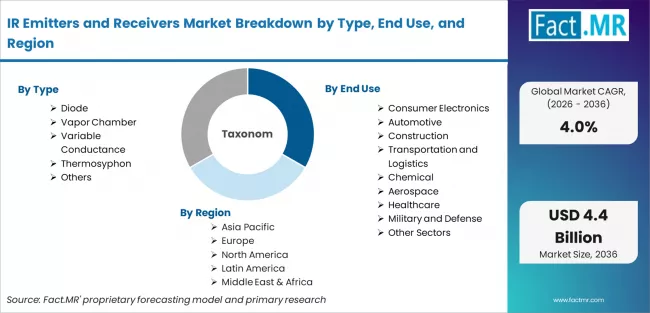
Ir Emitters And Receivers Market Breakdown By Type, End Use, And Region | Source: Fact.MR
| Metric | Value |
|---|---|
| Quantitative Units | USD 3 billion (2026) to USD 4.5 billion (2036), at a CAGR of 4% |
| Market Definition | The IR emitters and receivers market includes the global production and deployment of infrared optoelectronic components that transmit and detect infrared radiation for sensing, communication, and control functions across electronic devices, industrial systems, and automotive applications. |
| Type Segmentation | Vapor Chamber, Variable Conductance, Diode, Thermosyphon, Others |
| End-Use Segmentation | Consumer Electronics, Automotive, Construction, Transportation and Logistics, Chemical, Aerospace, Healthcare, Military and Defense, Other Sectors |
| Regions Covered | North America, Latin America, Europe, East Asia, South Asia, Oceania, Middle East and Africa |
| Countries Covered | United States, Canada, Mexico, Brazil, Germany, United Kingdom, France, Italy, Spain, China, India, Japan, South Korea, Australia, and 40+ countries |
| Key Companies Profiled | Broadcom Inc., Vishay Intertechnology Inc., OSRAM Opto Semiconductors GmbH, Everlight Electronics Co., Ltd., Lite-On Technology Corporation, ROHM Semiconductor, Hamamatsu Photonics K.K., Sharp Corporation, TT Electronics plc, Excelitas Technologies Corp. |
| Forecast Period | 2026 to 2036 |
| Approach | Hybrid top-down and bottom-up market modeling supported by semiconductor shipment data, optoelectronic component production analysis, end-use device integration trends, and validation through interviews with component manufacturers, electronics suppliers, and system integrators. |
Source: Fact.MR analysis. Updated Mar 23, 2026
Bibliographies
- [1] Department of Commerce, USA. (2025). Semiconductor innovation programs.
- [2] Ministry of Industry and Information Technology, China. (2025). Semiconductor manufacturing initiatives.
- [3] Federal Ministry for Economic Affairs, Germany. (2025). Automotive electronics innovation programs.
- [4] Ministry of Electronics and Information Technology, India. (2025). Semiconductor manufacturing initiatives.
- [5] Ministry of Economy, Trade and Industry, Japan. (2025). Optoelectronics research initiatives.
- [6] Texas Instruments. (2025). Optoelectronic sensor production expansion.
- [7] Broadcom Inc. (2025). Sensor technology distribution expansion.
- [8] Infineon Technologies. (2025). Optoelectronic component development.
- [9] International Electrotechnical Commission. (2023). IEC 60825 optical radiation safety standards.
This Report Addresses
- Market size estimation and revenue forecasts for the IR Emitters and Receivers Market from 2026 to 2036, supported by semiconductor component shipment benchmarks and optoelectronic sensor integration indicators across electronic systems.
- Growth opportunity analysis across infrared diode based emitters and receivers and other optoelectronic component configurations used in optical communication and sensing modules.
- Segment and regional revenue forecasts covering consumer electronics, automotive systems, industrial automation, healthcare devices, aerospace equipment, and military and defense applications using infrared sensing and communication components.
- Competitive strategy assessment including optoelectronic semiconductor manufacturing capability, infrared sensor performance development, and component integration benchmarking among global semiconductor and photonics component producers.
- Regulatory and compliance evaluation covering frameworks such as IEC optical radiation safety standards and international electronic component certification requirements governing the design and deployment of infrared optoelectronic devices.
- Market report delivery in PDF, Excel, PPT, and interactive dashboard formats designed for semiconductor procurement planning, optoelectronic component evaluation, and electronics manufacturing strategy assessment.
- Supply chain and operational risk analysis identifying semiconductor fabrication dependencies, price competition in commodity infrared components, and substitution pressure from alternative sensing technologies such as radar and LiDAR modules affecting IR emitter and receiver demand.
Segmentation
IR Emitters and Receivers Market Key Segments
-
Type :
- Vapor Chamber
- Variable Conductance
- Diode
- Thermosyphon
- Others
-
End Use :
- Consumer Electronics
- Automotive
- Construction
- Transportation and Logistics
- Chemical
- Aerospace
- Healthcare
- Military and Defense
- Other Sectors
-
Region :
- North America
- USA
- Canada
- Mexico
- Europe
- Germany
- UK
- France
- Italy
- Spain
- Nordic Countries
- BENELUX
- Rest of Europe
- Asia Pacific
- China
- Japan
- South Korea
- India
- Australia
- Rest of Asia Pacific
- Latin America
- Brazil
- Argentina
- Rest of Latin America
- Middle East and Africa
- Kingdom of Saudi Arabia
- United Arab Emirates
- South Africa
- Rest of Middle East and Africa
- Other Regions
- Oceania
- Central Asia
- Other Markets
- North America
Frequently Asked Questions
How large is the demand for IR Emitters and Receivers in the global market in 2026?
What will be the market size of IR Emitters and Receivers in the global market by 2036?
What is the expected demand growth for IR Emitters and Receivers in the global market between 2026 and 2036?
Which Type Segment is poised to lead global demand by 2026?
Which Company is Identified as a Leading Participant in the IR Emitters and Receivers Market?
What is Driving IR Emitters and Receivers Demand in the United States?
What is the United States Growth Outlook in this Report?
Why is China an Important Market for IR Emitters and Receivers?
What is the China Growth Outlook in this Report?
Why is Germany Considered an Important Market for IR Emitters and Receivers in Europe?
What is the Germany Growth Outlook in this Report?
Why is Japan an Important Market for IR Emitters and Receivers?
What is the Japan Growth Outlook in this Report?
What Factors Support IR Emitters and Receivers Demand in India?
What is the India Growth Outlook in this Report?
Why is Australia Included in the IR Emitters and Receivers Market Outlook?
What is the Australia Growth Outlook in this Report?
What are IR Emitters and Receivers and What are They Mainly Used For?
What does IR Emitters and Receivers Market Mean in this Report?
What is Included in the Scope of this IR Emitters and Receivers Market Report?
What is Excluded from the Scope of this Report?
What does Market Forecast Mean on this Page?
How is the IR Emitters and Receivers Market Forecast Developed in this Report?
Who worked on this report


Preview the report firsthand - request a free sample
Free SampleGet the brochure for pricing and purchase details
Download PDF