- Market Value (2025): USD 1.49 Bn
- Estimated Value (2026): USD 1.56 Bn
- Forecast Value (2036): USD 2.51 Bn
- CAGR (2026-2036): 4.9%
What is the Traveling Wave Tubes (TWT) Market forecast to be worth by 2036?
USD 1.56 Billion in 2026 to USD 2.56 Billion by 2036, at a 4.9% CAGR.
- As per Fact.MR analysis, the traveling wave tubes (TWT) market reached USD 1.49 Billion in 2025.
- Demand will increase from USD 1.56 Billion in 2026 to USD 2.51 Billion in 2036.
- The market is forecast to record a 4.9% CAGR during 2026 to 2036 driven by expanding low-Earth-orbit (LEO) and geostationary (GEO) commercial satellite communications constellations, widespread retrofitting of active electronically scanned array (AESA) radar transmitters, airborne electronic attack pod upgrades, and deep-space interplanetary exploration missions.
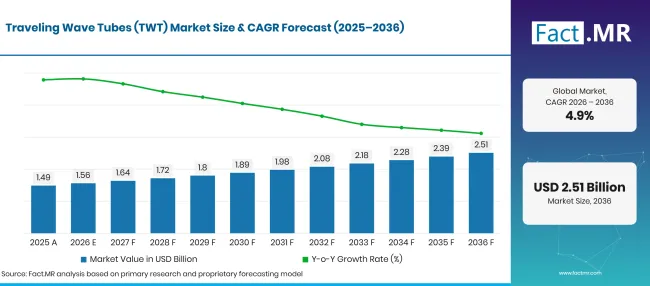
Traveling Wave Tubes Twt Market Forecast Global | Source: Fact.MR
| Year | Basis | Market Value (USD Billion) |
|---|---|---|
| 2025 | Actual | 1.49 |
| 2026 | Estimate | 1.56 |
| 2036 | Forecast | 2.51 |
| CAGR 2026 to 2036 | Forecast period | 4.9% |
Source: Fact.MR analysis. Updated Oct 24, 2026
What are the defining numbers behind Traveling Wave Tubes (TWT) Market growth?
USD 0.9 Billion absolute chance between 2026 and 2036, with helix TWTs, aerospace and defense applications, and military end-users generating the dominant procurement revenue.
- Demand Drivers in the Market
- FCC licensing activity for satellite and earth stations is increasing in both complexity and volume. In August 2025, the Commission adopted a 30-day review target for earth-station renewal applications and seven new exemptions from satellite-license modification filings, reinforcing a faster regulatory pathway for communication payload and ground-station deployment [1]. This expansion supports demand for reliable RF amplification across space and earth-station links.
- U.S. defense exports remain subject to case-by-case licensing, end-use monitoring, and restrictions on unauthorized retransfers. A January 2025 State Department fact sheet reports that up to 1 million U.S. jobs rely on defense exports, underscoring the scale of the regulated defense industrial base serving radar, electronic-warfare, and related RF systems [2].
- NASA’s Deep Space Network uses three globally distributed complexes to maintain continuous communications as Earth rotates. Each site includes one 70-meter antenna, one 26-meter antenna, and multiple 34-meter antennas capable of tracking spacecraft tens of billions of miles from Earth [3]. The scale of this network sustains demand for high-reliability microwave amplification and deep-space communications hardware.
- ESA’s April 2025 advanced-payload workshop brought together 130 satellite-communications stakeholders from about 20 countries. Participants focused on reconfigurable payloads, active antenna arrays, photonic integration, and technologies that increase data throughput while reducing size and power consumption [4]. These development priorities favor efficient, compact RF power subsystems for flexible satellite architectures.
- Key Segments Analyzed
- By Type: Helix TWT holds 61.4% share in 2026, preferred across satellite communications and broadband electronic warfare for its exceptional octave bandwidth capability and compact periodic permanent magnet packaging.
- By Application: Aerospace and Defense accounts for 47.8% share in 2026, driven by high-value military radar programs, airborne electronic countermeasures, missile seekers, and naval surface surveillance.
- By Frequency Band: X Band holds 26.3% share in 2026, maintaining foundational dominance in fire-control radar, weather surveillance, and military satellite communications due to optimal atmospheric transmission.
- By End-User: Military accounts for 52.4% share in 2026, supported by national defense modernization budgets, fighter aircraft radar upgrades, and electronic warfare threat mitigation.
- Analyst Opinion at Fact.MR
- Shambhu Nath Jha, Lead Consultant at Fact.MR, states, “While solid-state power amplifiers continue to penetrate low-frequency, low-power niches, traveling wave tubes maintain an unassailable performance advantage in high-frequency, high-power space and airborne defense applications. At frequencies above 10 GHz and power levels exceeding 100 watts, TWTs deliver unmatched power-added efficiency, thermal survivability, and radiation hardness that solid-state gallium nitride devices cannot match in space vacuum conditions. Vacuum tube manufacturers who invest in automated cathode deposition, additive manufacturing of slow-wave structures, and standardized electronic power conditioner interfaces will secure robust, multi-decade defense and aerospace contracts.”
- Strategic Implications
- The FCC’s 2025 satellite-licensing reforms respond to increasingly complex space- and earth-station applications. The order created a notification-based process for adding or removing points of communication, adopted seven license-modification exemptions, and established a 30-day review target for earth-station renewals [5]. These measures should shorten deployment cycles for ground stations and satellite communications equipment.
- Aerospace primes are consolidating the integration of Traveling Wave Tube Amplifiers (TWTAs) by co-packaging the vacuum tube directly with high-voltage Electronic Power Conditioners (EPCs) into unified modules. Sourcing managers establish forward supply contracts for precision ceramic dielectric rods, samarium-cobalt permanent magnets, and high-purity molybdenum collector electrodes, ensuring reliable assembly throughput.
- Commercial satellite fleet operators are launching flexible software-defined satellites that utilize multi-band TWTAs capable of switching between Ku-band and Ka-band frequencies in orbit. Flexible frequency agile tube architectures allow telecom operators to dynamically reallocate satellite capacity in response to regional broadband demand shifts.
- Defense electronics manufacturers are developing standardized sub-tier maintenance and cathode re-gunning programs for legacy naval and airborne radar installations. Refurbishing operational TWTs with modern barium-calcium-aluminate dispenser cathodes provides armed forces with cost-effective fleet sustainment while mitigating obsolete component supply risks.
Germany is projected to record an industry-leading 5.7% CAGR, propelled by defense aerospace radar modernization, European Space Agency payload integration, and precision microwave tube manufacturing. Japan advances at a 5.3% CAGR, driven by satellite communications transponder production, meteorological radar networks, and defense electronic systems. The United States records a 4.8% CAGR, anchored by massive defense modernization funding, commercial satellite constellation expansion, and deep-space NASA exploration programs. Brazil registers a 4.5% CAGR, supported by national satellite communications expansion, air traffic surveillance radar upgrades, and defense aerospace modernization. The United Kingdom expands at a 3.6% CAGR, underpinned by military satellite communications programs, aerospace defense manufacturing, and radar research clusters.
How does the Traveling Wave Tubes (TWT) Market break down by segment?
Helix TWT 61.4%; Aerospace and Defense 47.8%; Military 52.4%; X Band 26.3% in 2026.
Which Type dominates?
Helix TWT holds 61.4% share in 2026.
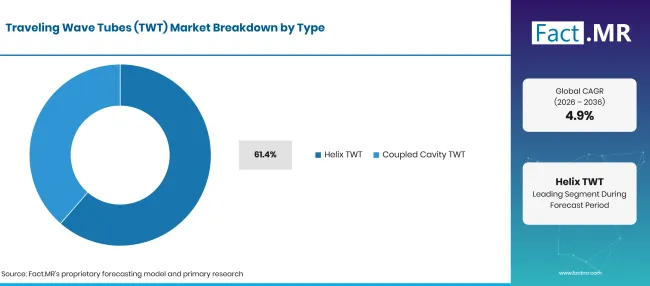
Traveling Wave Tubes Twt Market Breakdown Type | Source: Fact.MR
| Type | Share (2026) |
|---|---|
| Helix TWT (Leading segment) | 61.4% |
| Other segments combined (Coupled Cavity TWT) | 38.6%* |
| Total | 100.0% |
Source: Fact.MR analysis. Updated Oct 24, 2026
Helix traveling wave tubes represent over six-tenths of total market value, serving as the industry standard for wideband microwave amplification. In a helix TWT, the slow-wave structure consists of a wire helix that slows the RF electromagnetic wave to match the velocity of the axial electron beam, enabling broadband interaction over multi-octave bandwidths. Satellite communication transponders and electronic warfare jamming pods rely heavily on helix tubes to operate across multiple communication channels simultaneously without mechanical retuning. Concurrently, coupled cavity TWTs account for the remaining 38.6% share, favored in high-power pulsed military radar, particle accelerators, and high-energy physics where peak output powers exceed hundreds of kilowatts. Satellite systems engineers deploy helix tubes to support high-throughput spaceborne satellite communications links. Defense primes integrate wideband tubes inside airborne electronic warfare pods for jamming radar threats. Communications technicians install these amplifiers within high-capacity microwave transmitters for long-haul ground backhaul. Defense contractors also specify ruggedized miniature tubes inside radar-guided weapon systems for terminal missile seeker guidance.
What leads the Application segment?
Aerospace and Defense accounts for 47.8% share in 2026.
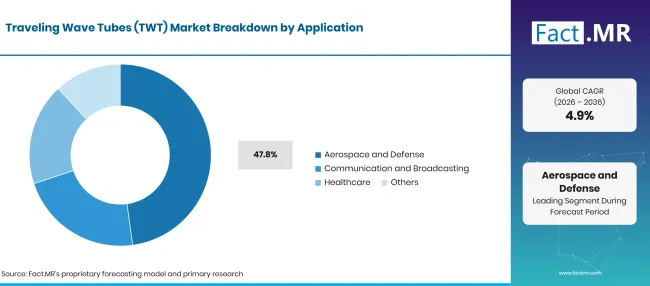
Traveling Wave Tubes Twt Market Breakdown Application | Source: Fact.MR
| Application | Share (2026) |
|---|---|
| Aerospace and Defense (Leading segment) | 47.8% |
| Other segments combined | 52.2%* |
| Total | 100.0% |
Source: Fact.MR analysis. Updated Oct 24, 2026
Aerospace and defense represents the preeminent application segment, contributing nearly half of global market demand through extensive deployment across military aviation, naval combat vessels, space exploration vehicles, and missile systems. Fighter aircraft rely on traveling wave tube transmitters to drive long-range airborne intercept radars and synthetic aperture ground-mapping sensors capable of penetrating dense cloud cover. Satellite communication and broadcasting represents the second-largest application, deploying tens of thousands of space-qualified TWTAs across commercial direct-to-home (DTH) television satellites and broadband communication constellations. Commercial air traffic control networks and marine radar navigation comprise additional key demand verticals. Systems integrators package these tubes within complete traveling wave tube amplifiers alongside dedicated high-voltage power supplies. Radar calibration labs utilize precision radar signal synthesizers to evaluate phase noise performance. Equipment assemblers mount amplifier sub-assemblies onto ruggedized transmitter chassis hardware to withstand naval shock vibrations. Surveillance installations also integrate high-frequency radar tracking arrays for perimeter threat detection. Microwave engineers specify ceramic vacuum envelope materials to ensure vacuum integrity across orbital operating lifespans. Earth station operators deploy satellite uplink optical feeds to route IF signals from ground processing hubs to antenna dish transmitters.
Which Frequency Band captures the largest market share?
X Band holds 26.3% share in 2026.
| Frequency Band | Share (2026) |
|---|---|
| X Band (Leading segment) | 26.3% |
| Other segments combined (Ku, Ka, C, S, L Bands, Others) | 73.7%* |
| Total | 100.0% |
Source: Fact.MR analysis. Updated Oct 24, 2026
X-band frequencies (8.0 GHz to 12.0 GHz) represent the largest single frequency band segment, commanding 26.3% of total market value. Military fire-control radar, maritime navigation radar, terrestrial defense tracking, and deep-space telemetry rely on X-band due to its optimal balance between high angular target resolution and minimal rain attenuation. Concurrently, Ku-band (12.0 GHz to 18.0 GHz) and Ka-band (26.5 GHz to 40.0 GHz) represent the fastest-growing frequency bands, propelled by surging bandwidth requirements in high-throughput satellite constellations and commercial in-flight aircraft connectivity. L-band, S-band, and C-band tubes serve legacy tactical communications, air traffic surveillance, and tropical satellite transponders requiring heavy rain-fade resistance.
What is accelerating Traveling Wave Tubes (TWT) Market adoption, and what is holding it back?
Commercial satellite communications expansion, defense military radar modernizations, and space exploration programs accelerate market growth. Solid-state gallium nitride (GaN) power amplifier competition in low-frequency bands, lengthy tube manufacturing cycles, and scarcity of specialized vacuum tube engineering talent restrict market acceleration.
Drivers Impact Analysis
| DRIVER | (~) % IMPACT ON CAGR | GEOGRAPHIC RELEVANCE | IMPACT TIMELINE |
|---|---|---|---|
| Proliferation of commercial LEO and GEO communication satellite constellations | +1.5% | North America, Europe | Short term (<= 2 years) |
| Modernization of military airborne radar and electronic warfare jamming suites | +1.3% | North America, East Asia | Short term (<= 2 years) |
| Expansion of deep-space scientific probes requiring high-efficiency Ka-band downlinks | +1.0% | Global | Medium term (2–4 years) |
| Superior thermal and radiation hardness of vacuum tubes over solid-state devices in space | +0.8% | Global | Medium term (2–4 years) |
| Replacement of legacy naval surveillance radar transmitters with modernized TWTAs | +0.6% | Europe, Asia-Pacific | Long term (>= 4 years) |
Source: Fact.MR analysis. Updated Oct 24, 2026
Opportunity Impact Analysis
| OPPORTUNITY | (~) % IMPACT ON CAGR | GEOGRAPHIC RELEVANCE | IMPACT TIMELINE |
|---|---|---|---|
| Additive manufacturing of complex coupled cavity slow-wave structures reducing fabrication costs | +1.4% | USA, Western Europe | Short term (<= 2 years) |
| Development of ultra-compact millimeter-wave TWTs operating at Q-band and V-band | +1.2% | North America, Europe | Medium term (2–4 years) |
| Automated cathode deposition techniques extending vacuum tube operating life past 20 years | +1.0% | East Asia, USA | Medium term (2–4 years) |
| Dual-band space-qualified TWTAs allowing dynamic on-orbit orbital frequency reconfiguration | +0.7% | Global | Long term (>= 4 years) |
Source: Fact.MR analysis. Updated Oct 24, 2026
Restraints Impact Analysis
| RESTRAINT | (~) % IMPACT ON CAGR | GEOGRAPHIC RELEVANCE | IMPACT TIMELINE |
|---|---|---|---|
| Increasing competition from solid-state GaN power amplifiers below 15 GHz and 100 watts | -1.4% | Global | Short term (<= 2 years) |
| Highly labor-intensive precision manual assembly and high-temperature brazing processes | -1.1% | North America, Europe | Short term (<= 2 years) |
| Strict international export control regulations (ITAR) restricting cross-border defense sales | -0.9% | USA, Europe | Medium term (2–4 years) |
| Severe aging workforce and shortage of trained radio-frequency vacuum electronics engineers | -0.6% | Global | Long term (>= 4 years) |
Source: Fact.MR analysis. Updated Oct 24, 2026
Which countries are scaling the Traveling Wave Tubes (TWT) Market through 2036?
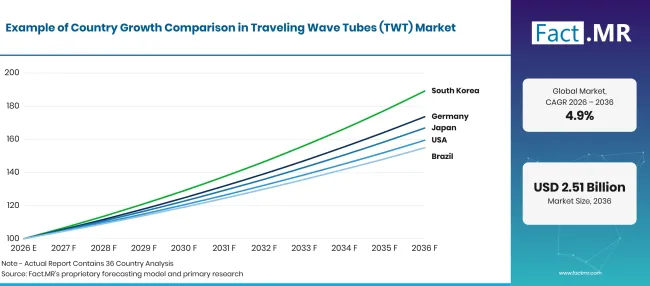
Traveling Wave Tubes Twt Market Growth Index | Source: Fact.MR
| Country | CAGR (2026–2036) |
|---|---|
| Germany | 5.7% |
| Japan | 5.3% |
| USA | 4.8% |
| Brazil | 4.5% |
| UK | 3.6% |
Source: Fact.MR analysis. Updated Oct 24, 2026
What sustains engineering leadership in Germany?
5.7% CAGR, propelled by defense aerospace radar modernization, European Space Agency payload integration, and precision microwave tube manufacturing.
Germany’s space and radar ecosystem combines operational capability with advanced communications research. DLR reports that the SARah military radar-reconnaissance system comprises three satellites and that its German Space Operations Center operates German military satellites. DLR also identifies satellite communications as essential where terrestrial infrastructure is absent or damaged [6]. This installed base and research capacity support continuing demand for high-reliability microwave components used in radar and satellite payloads.
What opportunities are unfolding across Brazil?
4.5% CAGR, backed by national satellite communications expansion, air traffic surveillance radar upgrades, and defense aerospace modernization.
Brazil’s current satellite-market oversight includes a public Anatel dashboard that tracks Brazilian and foreign satellites in commercial operation by radiofrequency band, operator, and orbital position. Anatel defines a Brazilian satellite as one using orbital and spectrum resources notified or assigned by Brazil and controlled from a station installed in the country [7]. This active regulatory and operating framework supports continuing demand for satellite ground equipment and high-frequency RF components.
Why does the United States maintain substantial commercial market valuation?
4.8% CAGR, propelled by massive defense modernization funding, commercial satellite constellation expansion, and deep-space NASA exploration programs.
The United States maintains a large operational base for deep-space communications. NASA’s Deep Space Network uses three globally spaced complexes for continuous coverage; each complex includes one 70-meter antenna, one 26-meter antenna, and multiple 34-meter antennas capable of tracking spacecraft tens of billions of miles from Earth [8]. This infrastructure sustains demand for high-reliability X-band and Ka-band transmit and receive chains across government and commercial space programs.
How is the United Kingdom modernizing defense and space telecommunications?
3.6% CAGR, supported by military satellite communications programs, aerospace defense manufacturing, and radar research clusters.
The United Kingdom’s SKYNET 6 program is its largest national space initiative. The Ministry of Defence reports that SKYNET 6A is designed to provide secure communications for at least 15 years and that the project directly sustains 550 highly skilled jobs; the broader program uses X-band and military Ka-band payloads for resilient global communications [9]. The program therefore supports long-term demand for space-qualified microwave amplification, payload electronics, and ground infrastructure.
Why does Japan maintain elite technological and manufacturing prowess?
5.3% CAGR, anchored by world-class vacuum electron device manufacturing, satellite transponder production, and defense electronic systems.
Japan continues to operate a broad Earth-observation and satellite-data infrastructure. In 2025, JAXA published operational updates covering ALOS-2, ALOS-4, GCOM-W, GOSAT-GW, EarthCARE, and other missions, while its G-Portal provides access to data from 15 satellites and 751 products [10]. This active mission portfolio supports continuing requirements for dependable space communications, radar payloads, and high-frequency RF components.
Who leads the Traveling Wave Tubes (TWT) Market?
Thales Group commands the leading global market share at 12.4% in 2026 through its specialized Thales Electron Devices (TED) division, operating advanced manufacturing facilities in France and Germany that supply premier space-qualified TWTAs to commercial satellite operators and military forces worldwide. L3Harris Technologies stands as the foremost American titan in military vacuum electronics, manufacturing high-power coupled cavity and helix tubes for airborne radar, electronic countermeasures, and naval defense systems. Teledyne e2v and Communications and Power Industries (CPI) represent elite transatlantic vacuum tube manufacturers, providing extensive catalogs of space-qualified, airborne, and ground radar traveling wave tubes.
TMD Technologies Ltd. (a subsidiary of CPI) specializes in ruggedized miniature TWTs, high-voltage power supplies, and microwave power modules (MPMs) tailored for compact airborne radar and missile applications. NEC Corporation and Mitsubishi Electric Corporation provide world-class Japanese engineering, manufacturing ultra-reliable space-qualified TWTAs deployed extensively across Asian and international satellite communication networks. Toshiba Corporation and L3 Narda-MITEQ supply high-performance microwave amplification components, radar transmitter tubes, and satellite ground station equipment. Qorvo Inc. delivers specialized microwave components and hybrid amplifier systems bridging solid-state and vacuum electronics across high-frequency defense applications.
Which companies are the key providers?
Key companies include Thales Group; L3Harris Technologies; Teledyne e2v; Communications and Power Industries (CPI); TMD Technologies; NEC Corporation; Mitsubishi Electric Corporation; Toshiba Corporation; L3 Narda-MITEQ; and Qorvo Inc.
- Thales Group
- L3Harris Technologies
- Teledyne e2v
- Communications and Power Industries (CPI)
- TMD Technologies
- NEC Corporation
- Mitsubishi Electric Corporation
- Toshiba Corporation
- L3 Narda-MITEQ
- Qorvo Inc.
Bibliography
- [1] Federal Communications Commission. (2025, August 8). Expediting initial processing of satellite and earth station applications; Space innovation: Second report and order (FCC 25-48).
- [2] U.S. Department of State. (2025, January 20). U.S. arms sales and defense trade.
- [3] National Aeronautics and Space Administration. (2025). Deep Space Network.
- [4] European Space Agency. (2025, April 16). ESA-hosted workshop drives technological leadership for telecom payloads.
- [5] Federal Communications Commission. (2025, July 17). Expediting initial processing of satellite and earth station applications and Space Innovation second report and order [Fact sheet].
- [6] German Aerospace Center. (2025). SARah (satellite-based radar reconnaissance system).
- [7] Agência Nacional de Telecomunicações. (2026). Espectro e órbita [Data dashboard].
- [8] National Aeronautics and Space Administration. (2025). Deep Space Network.
- [9] UK Ministry of Defence. (2025, March 7). Military satellite SKYNET 6A passes initial phase of testing.
- [10] Japan Aerospace Exploration Agency. (2025). Updates on Earth: 2025.
This Report Answers
- How does the global traveling wave tubes (TWT) market expand from USD 1.6 Billion in 2026 to USD 2.5 Billion by 2036?
- What technological innovations in CVD diamond support rods and scandate cathodes extend vacuum tube lifespans beyond 150,000 hours?
- Why do helix traveling wave tubes command 61.4% of total market revenue in 2026?
- How are space-qualified traveling wave tube amplifiers maintaining performance superiority over solid-state GaN amplifiers in deep-space exploration?
- What factors support Germany achieving a 5.7% CAGR across European defense and space sectors?
- How are military defense forces modernizing legacy naval and airborne radar transmitters with advanced TWTAs?
- What role do multi-band TWTAs play in enabling flexible on-orbit frequency reconfiguration across commercial communications satellites?
What does the Traveling Wave Tubes (TWT) Market cover?
The market covers commercial shipments of helix and coupled-cavity traveling wave tubes used for high-power radio-frequency amplification in space, military, scientific, and commercial systems. Demand is assessed across aerospace and defense, communication and broadcasting, healthcare, and other qualified applications.
Revenue is tracked by tube type, application, operating frequency band, end-user group, and the seven regions included in the forecast.
What is included in the scope?
Space-qualified, airborne, shipborne, ground-based, and laboratory traveling wave tubes sold as standalone devices or as the tube component of an integrated amplifier are included. Helix and coupled-cavity designs across X, L, S, C, Ku, Ka, and other frequency bands are counted.
Commercial shipments for satellite payloads, earth stations, military radar, electronic warfare, broadcasting, healthcare equipment, and scientific research are included at the first invoiced point of sale.
What is excluded from the scope?
Klystrons, magnetrons, gyrotrons, crossed-field amplifiers, solid-state RF power amplifiers, and passive microwave components are excluded. Electronic power conditioners, high-voltage supplies, cooling hardware, antennas, and complete radar or satellite systems are not counted unless their value is inseparable from the invoiced TWT assembly.
Repair-only services, cathode re-gunning, resale of used tubes, internal prototypes, and non-commercial research devices are outside the market revenue boundary.
How Was the Analysis Built?
The analysis draws on 120+ sources, 35+ company portfolios, 25+ countries, and more than 20 industry interviews.
- Primary Research: Primary research includes discussions with manufacturers, service providers, technology developers, distributors, end users, and subject-matter experts. These conversations examine purchasing priorities, product adoption, operational challenges, approval requirements, competitive positioning, and the factors that influence wider market acceptance.
- Desk Research: Desk research covers government statistics, regulatory publications, company filings, trade data, technical studies, industry associations, standards, public policy, and other authoritative sources. Every source used in the analysis is documented in the bibliography.
- Market Sizing and Forecasting: Market estimates combine historical performance, demand indicators, pricing and volume trends, segment shares, company participation, country-level growth, adoption patterns, investment activity, and barriers to market expansion.
- Data Validation and Update Cycle: Findings are validated by comparing primary interviews with public data, company activity, regulatory changes, trade patterns, and industry developments. Regular updates review new product launches, capacity changes, partnerships, approvals, and shifts in commercial adoption.
Segmentation
What is the report's scope and coverage?
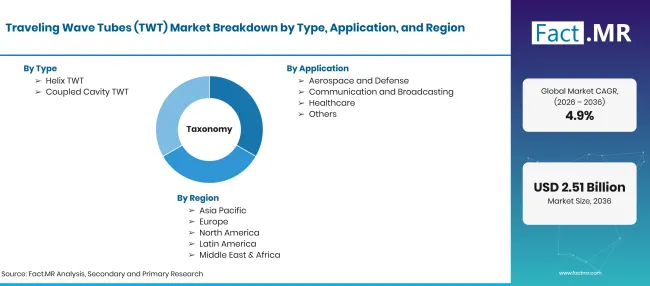
Traveling Wave Tubes Twt Market Taxonomy | Source: Fact.MR
| Attribute | Details |
|---|---|
| Quantitative Units | USD Billion |
| Market Definition | Commercial manufacturing and shipment of traveling wave tubes (TWTs), including helix and coupled cavity microwave vacuum electron tubes utilized for high-power RF amplification across space, military, and commercial systems. |
| Type | Helix TWT; Coupled Cavity TWT |
| Application | Aerospace and Defense; Communication and Broadcasting; Healthcare; Others |
| Frequency Band | X Band; L Band; S Band; C Band; Ku Band; Ka Band; Others |
| End-User | Military; Commercial; Scientific Research |
| Regions Covered | North America; Latin America; Western Europe; Eastern Europe; East Asia; South Asia & Pacific; Middle East & Africa |
| Countries Covered | Germany; Brazil; USA; UK; Japan |
| Companies Profiled | Thales Group; L3Harris Technologies; Teledyne e2v; Communications and Power Industries (CPI); TMD Technologies; NEC Corporation; Mitsubishi Electric Corporation; Toshiba Corporation; L3 Narda-MITEQ; Qorvo Inc. |
| Forecast Period | 2026 to 2036 |
| Approach | Primary interviews with satellite payload engineers, military radar procurement officers, and vacuum tube manufacturing metallurgists combined with defense procurement budget audits. |
Source: Fact.MR analysis. Updated Oct 24, 2026
How is the market segmented?
-
By Type
- Helix TWT
- Coupled Cavity TWT
-
By Application
- Aerospace and Defense
- Communication and Broadcasting
- Healthcare
- Others
-
By Frequency Band
- X Band
- L Band
- S Band
- C Band
- Ku Band
- Ka Band
- Others
-
By End-User
- Military
- Commercial
- Scientific Research
-
By Region
- North America
- Latin America
- Western Europe
- Eastern Europe
- East Asia
- South Asia & Pacific
- Middle East & Africa
Frequently Asked Questions
What is the projected value of the Traveling Wave Tubes (TWT) Market by 2036?
Which product type represents the largest revenue share in the market?
What is the primary application driving traveling wave tube adoption?
Which country is projected to experience the highest growth rate during the forecast period?
Who are the dominant manufacturers in the global traveling wave tube market?
Who worked on this report


Preview the report firsthand - request a free sample
Free SampleGet the brochure for pricing and purchase details
Download PDF