- Market Value (2025): USD 3.1 Bn
- Estimated Value (2026): USD 3.6 Bn
- Forecast Value (2036): USD 13.8 Bn
- CAGR (2026-2036): 14.4%
What is the GPU Architecture and Compute IP Licensing Market forecast to be worth by 2036?
USD 3.6 billion in 2026 to USD 13.8 billion by 2036 at 14.4% CAGR.
- The GPU Architecture and Compute IP Licensing market reached USD 3.1 billion in 2025 as chip designers widened their use of reusable graphics and compute blocks.
- Demand is forecast to increase from USD 3.6 billion in 2026 to USD 13.8 billion by 2036.
- The market is projected to expand at 14.4% CAGR from 2026 to 2036.
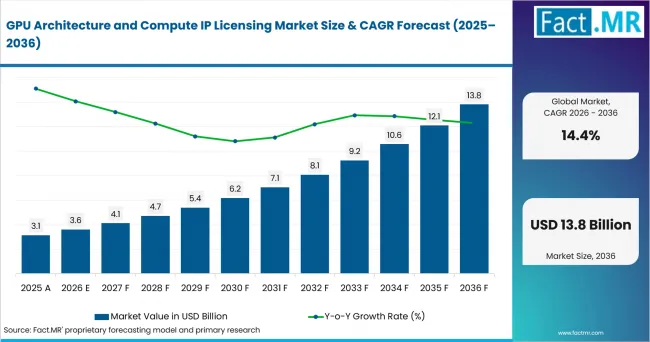
Gpu Architecture And Compute Ip Licensing Market Value Analysis | Source: Fact.MR
What are the defining numbers behind GPU Architecture and Compute IP Licensing Market growth?
USD 10.2 billion absolute opportunity by 2036.
- Demand Drivers in the Market
- AI training and inference workloads are expected to raise the value of licensed GPU IP because chip designers need parallel compute performance without extending development cycles.
- Chiplet design and advanced packaging are anticipated to increase demand for reusable compute blocks that can work with high-bandwidth memory.
- Cloud accelerator programs are expected to make data center accelerators a useful reference point when buyers evaluate GPU-class design assets.
- Automotive compute platforms are projected to widen licensing use where safety and cockpit workloads require predictable graphics and AI processing.
- Key Segments Analyzed
- By IP Portfolio: GPU IP Cores are expected to hold 46.0% share in 2026 because they remain the main licensable block for graphics and accelerator designs.
- By Target Workload: Artificial Intelligence Accelerators are projected to account for 42.0% share in 2026 as training and inference shape compute design decisions.
- By Licensee Category: Fabless Semiconductor Companies are anticipated to capture 41.0% share in 2026 since external IP shortens chip development timelines.
- By Licensing Model: Perpetual Licensing is estimated to represent 48.0% share in 2026 due to its fit with long product cycles and reuse plans.
- By Compute Architecture: Scalable Parallel Compute Architecture is forecast to hold 44.0% share in 2026 as AI and graphics workloads need higher thread-level parallelism.
- Analyst Opinion at Fact.MR
- Shambhu Nath Jha, Senior Consultant at Fact.MR, states, “GPU architecture licensing is moving from a graphics-led decision to a broader compute strategy. Chip designers are expected to favor IP partners that can support AI accelerators and memory bandwidth. Software tooling and system-level integration are expected to decide supplier fit across several product cycles.”
- Strategic Implications
- Chip designers should assess GPU IP Cores against software toolchain maturity before selecting a licensing partner.
- IP providers can strengthen account retention by supporting chiplet integration and verification through the full design cycle.
- Fabless Semiconductor Companies should align license terms with reuse plans because Perpetual Licensing holds the highest listed share in 2026.
The USA leads at 15.5% CAGR through AI infrastructure buildout and domestic semiconductor investment. Taiwan follows at 14.9% as foundry scale supports compute IP qualification. South Korea reaches 14.2% through memory leadership and accelerator-focused chip programs. Japan records 13.7% through materials and design-support depth. Germany posts 13.0%, while China reaches 12.4% and Singapore closes at 11.8% through regional engineering and specialty compute support.
How does the GPU Architecture and Compute IP Licensing Market break down by segment?
GPU IP Cores are expected to lead IP Portfolio at 46.0% share in 2026. Artificial Intelligence Accelerators are projected to lead Target Workload at 42.0%.
Why do GPU IP Cores lead IP Portfolio?
GPU IP Cores hold 46.0% share in 2026.
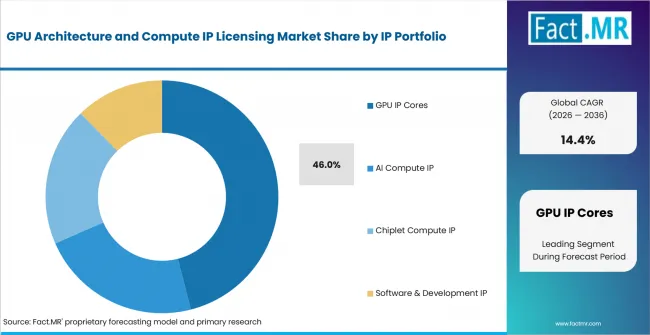
Gpu Architecture And Compute Ip Licensing Market Analysis By Ip Portfolio | Source: Fact.MR
Their lead comes from their role as the core building block for graphics and AI acceleration. Instead of creating every architecture layer internally, licensees use these cores to shorten development work and reduce design risk. The same IP family can also be reused across consumer electronics, automotive processors and accelerator programs, making it valuable for companies managing several chip roadmaps.
Why do Artificial Intelligence Accelerators lead Target Workload?
Artificial Intelligence Accelerators are projected to account for 42.0% share in 2026.
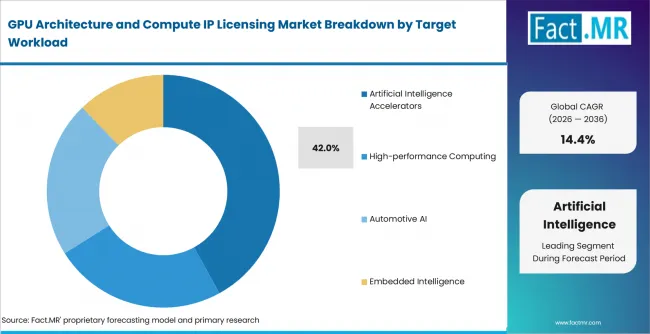
Gpu Architecture And Compute Ip Licensing Market Analysis By Target Workload | Source: Fact.MR
Training and inference workloads place heavy pressure on memory bandwidth, compute density and software support. This makes AI accelerators the strongest workload category for GPU architecture licensing. Buyers are likely to review whether the IP connects well with compilers, AI operators and system-level power limits before selecting a design partner.
Why do Fabless Semiconductor Companies lead Licensee Category?
Fabless Semiconductor Companies account for 41.0% share in 2026.
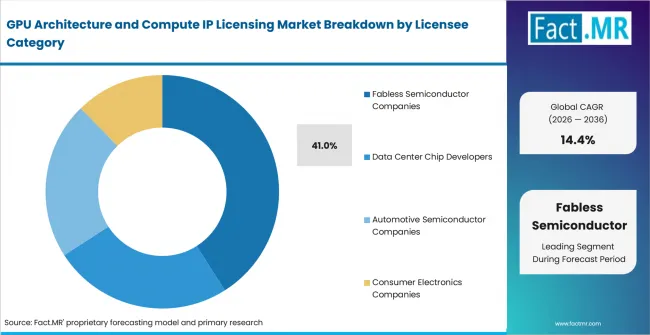
Gpu Architecture And Compute Ip Licensing Market Analysis By Licensee Category | Source: Fact.MR
For fabless firms, external GPU IP helps protect launch timelines while internal teams focus on product differentiation. These companies often compete through architecture choices, software readiness and use-case fit rather than manufacturing ownership. As release windows tighten, licensed compute blocks give them a practical way to manage cost, speed and technical complexity.
Why does Perpetual Licensing lead Licensing Model?
Perpetual Licensing leads with 48.0% share in 2026.
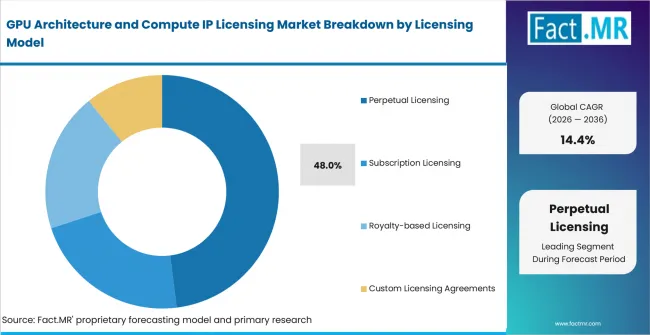
Gpu Architecture And Compute Ip Licensing Market Analysis By Licensing Model | Source: Fact.MR
Long semiconductor product cycles make stable reuse rights important. A perpetual model allows chip designers to carry one licensed GPU block across multiple product generations without renegotiating every program. This structure fits companies that need predictable rights, repeat qualification and continuity across SoC platforms.
Why does Scalable Parallel Compute Architecture lead Compute Architecture?
Scalable Parallel Compute Architecture holds 44.0% share in 2026.
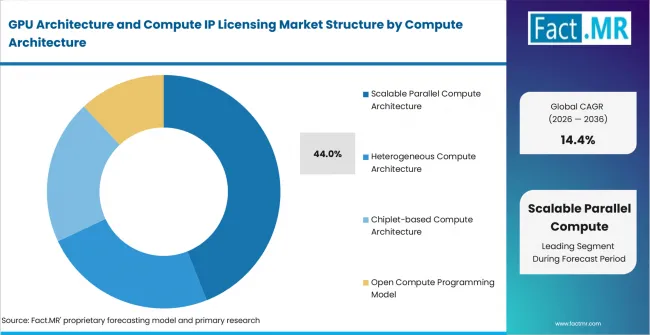
Gpu Architecture And Compute Ip Licensing Market Analysis By Compute Architecture | Source: Fact.MR
AI and graphics workloads benefit from architectures that expand processing resources while keeping the software model manageable. Scalable parallel designs meet this requirement by supporting higher thread-level performance across accelerator and graphics use cases. Their value increases when buyers plan dense compute systems where power, heat and workload distribution must be reviewed together.
What is accelerating GPU Architecture and Compute IP Licensing Market adoption, and what is holding it back?
Demand is expected to rise as AI compute workloads and reusable IP strategies move deeper into semiconductor planning. Growth is likely to be limited by licensing cost and integration difficulty.
Drivers Impact Analysis
| DRIVER | IMPACT ON CAGR | GEOGRAPHIC RELEVANCE | IMPACT TIMELINE |
|---|---|---|---|
| AI workload expansion | High | USA, Taiwan, South Korea | 2026-2036 |
| Chiplet and packaging integration | High | USA, Taiwan, Japan | 2026-2036 |
| Fabless design model | Medium-high | Global design hubs | 2026-2032 |
| Automotive compute demand | Medium | Germany, Japan, China | 2026-2036 |
| Software ecosystem depth | Medium | North America, East Asia | 2026-2036 |
Source: Fact.MR analysis. Updated Aug 7, 2026
- AI workload expansion: Training and edge deployment are expected to raise demand for GPU-class IP that supports high parallel throughput.
- Chiplet and packaging integration: Licensed compute blocks are anticipated to gain value when designers align GPU execution with memory planning.
- Fabless design model: External compute IP is expected to help design teams reduce architecture risk before tape-out.
Opportunity Impact Analysis
| OPPORTUNITY | IMPACT ON CAGR | GEOGRAPHIC RELEVANCE | IMPACT TIMELINE |
|---|---|---|---|
| AI accelerator customization | High | USA, Taiwan, South Korea | 2026-2036 |
| Automotive and cockpit processors | Medium-high | Germany, Japan, China | 2026-2036 |
| Edge and embedded compute | Medium | Global | 2026-2032 |
| Chiplet-ready IP portfolios | Medium | Foundry and OSAT clusters | 2026-2036 |
Source: Fact.MR analysis. Updated Aug 7, 2026
- AI accelerator customization: Configurable GPU and AI compute blocks are expected to win more design evaluations.
- Automotive and cockpit processors: Safety-aware graphics workloads are expected to create licensing opportunities beyond data center use.
- Chiplet-ready IP portfolios: Compute IP that works with 3D packaging is expected to improve supplier selection.
Restraints Impact Analysis
| RESTRAINT | IMPACT ON CAGR | GEOGRAPHIC RELEVANCE | IMPACT TIMELINE |
|---|---|---|---|
| Licensing cost and royalties | Medium | Emerging licensee markets | 2026-2030 |
| Integration and verification burden | Medium | Global | 2026-2036 |
| Software ecosystem dependence | Medium | AI and automotive platforms | 2026-2036 |
| Export-control exposure | Low-medium | China and cross-border programs | 2026-2032 |
Source: Fact.MR analysis. Updated Aug 7, 2026
- Licensing cost and royalties: Smaller chip designers are likely to delay adoption when fees weaken product economics.
- Integration and verification burden: GPU IP must pass timing and software checks before a chip moves toward tape-out.
- Software ecosystem dependence: A licensed architecture can lose value when drivers and compilers are not mature enough.
Which countries are scaling the GPU Architecture and Compute IP Licensing Market fastest?
- The country comparison spans 3.7 percentage points and forms three practical growth bands across the forecast period.
- The USA remains 0.6 percentage point above Taiwan through AI infrastructure buildout and domestic semiconductor investment.
- Taiwan remains 0.7 percentage point above South Korea because foundry scale supports compute IP qualification.
- South Korea remains 0.5 percentage point above Japan with memory leadership and accelerator-oriented semiconductor programs.
- Japan remains 0.7 percentage point above Germany due to materials depth and design-support capability.
- Germany remains 0.6 percentage point above China where automotive semiconductor demand supports compute architecture evaluation.
- China remains 0.6 percentage point above Singapore through domestic semiconductor self-sufficiency initiatives.
Comparable CAGRs can create different entry conditions because each country has a different mix of design capability and foundry access. Full report coverage includes North America and Latin America. Europe and East Asia are included. South Asia and Pacific is covered with Middle East and Africa.
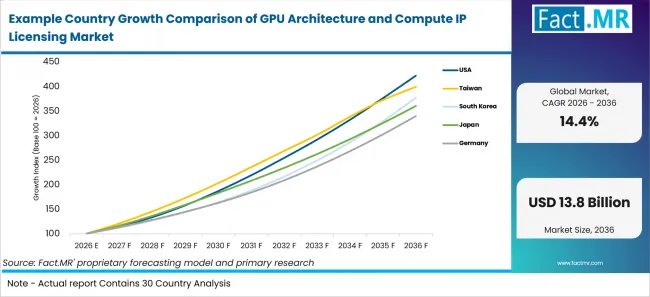
Example Country Growth Comparison Of Gpu Architecture And Compute Ip Licensing Market | Source: Fact.MR
| Country | CAGR (2026-2036) |
|---|---|
| USA | 15.5% |
| Taiwan | 14.9% |
| South Korea | 14.2% |
| Japan | 13.7% |
| Germany | 13.0% |
| China | 12.4% |
| Singapore | 11.8% |
Source: Fact.MR analysis. Updated Aug 7, 2026
What supports USA adoption?
15.5% CAGR, supported by CHIPS Act investments and AI infrastructure buildout.
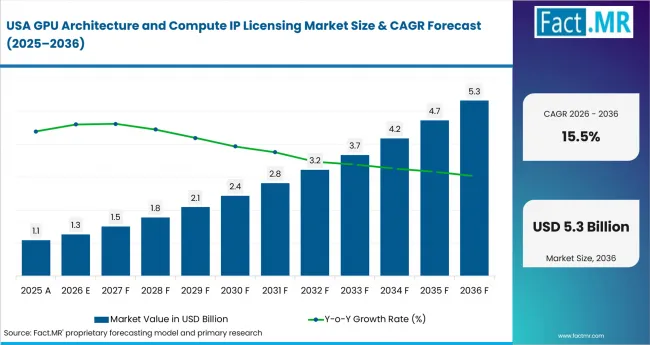
Gpu Architecture And Compute Ip Licensing Market Country Value Analysis | Source: Fact.MR
AI hardware suppliers in the USA evaluate GPU architecture assets through software support and integration risk. Domestic chip programs are expected to favor IP providers that can help design teams qualify compute blocks early. This creates a market where licensing decisions often happen before final manufacturing plans are locked.
How is Taiwan scaling demand?
14.9% CAGR, backed by its dominant semiconductor foundry ecosystem.
Taiwan’s foundry base gives licensees a practical route from design validation to advanced-node production. GPU architecture licensing is expected to benefit where customers need IP that can move into manufacturing without long redesign cycles. Local ecosystem depth supports testing and design enablement.
How is South Korea developing demand?
14.2% CAGR, supported by its leadership in memory manufacturing.
South Korea’s memory strength makes bandwidth planning central to accelerator design. AI chip programs are expected to place more attention on package fit and memory-facing architecture. GPU compute IP gains relevance when licensees need verified blocks that work beside high-bandwidth memory roadmaps.
How does Japan perform?
13.7% CAGR, led by advanced materials and equipment supply-chain depth.
Japan’s semiconductor base gives buyers access to process knowledge and design-support discipline. Licensees are expected to value GPU IP that can meet reliability and package requirements. Automotive and industrial electronics demand supports careful evaluation of compute behavior, power needs and thermal limits.
What supports Germany’s growth?
13.0% CAGR, backed by automotive semiconductor and industrial IoT demand.
Germany’s demand is shaped by automotive electronics and industrial automation. GPU architecture licensing is expected to gain relevance where cockpit systems and machine-vision applications need graphics and AI capability. Suppliers must support longer validation cycles because automotive platforms carry strict release requirements.
How is China scaling demand?
12.4% CAGR, driven by domestic semiconductor self-sufficiency initiatives.
China’s growth reflects domestic AI chip design activity and a stronger focus on local technology capability. Licensing demand is expected to persist where firms need compute architecture options that shorten design time. Export controls are expected to affect some advanced design choices.
What supports Singapore’s growth?
11.8% CAGR, supported by advanced packaging and regional distribution.
Singapore’s semiconductor base combines manufacturing support with regional engineering services. GPU architecture licensing demand is expected to be selective among firms serving edge and specialty compute needs. Local support can help customers handle integration work before wider commercial release.
Who leads the GPU Architecture and Compute IP Licensing Market?
Arm and Imagination Technologies carry the strongest fit in GPU architecture licensing, while Rambus adds memory-interface IP relevance.
Cadence and Synopsys strengthen the ecosystem through verification and design tools that support integration. SiFive, VeriSilicon and Andes Technology widen compute IP coverage. Ceva and Tenstorrent add AI and processor-design depth as licensees compare software readiness, customization support and long-cycle architecture reuse.
Which companies are the key providers?
Key companies profiled in the GPU Architecture and Compute IP Licensing market include Arm Limited, Imagination Technologies Limited, Rambus Inc., Cadence Design Systems, Inc., Synopsys, Inc., SiFive, Inc., VeriSilicon Microelectronics Co., Ltd., Andes Technology Corporation, Ceva, Inc., and Tenstorrent Inc.
- Arm Limited
- Imagination Technologies Limited
- Rambus Inc.
- Cadence Design Systems, Inc.
- Synopsys, Inc.
- SiFive, Inc.
- VeriSilicon Microelectronics Co., Ltd.
- Andes Technology Corporation
- Ceva, Inc.
- Tenstorrent Inc.
Bibliography
- U.S. Department of Commerce. (2024, December 20). Biden-Harris Administration Announces CHIPS Incentives Award with Samsung Electronics to Solidify U.S. Leadership in Leading-Edge Semiconductor Production.
- Bureau of Industry and Security. (2025, January 15). Commerce strengthens restrictions on advanced computing semiconductors to enhance foundry due diligence and prevent diversion to PRC. U.S. Department of Commerce.
- Department of Statistics, Ministry of Finance. (2025, October 30). Taiwan’s DRAM exports and imports doubled in the first nine months of 2025, both reaching record-high values for the period (Statistical Bulletin No. 20).
- Synopsys, Inc. (2025, September 24). Synopsys collaborates with TSMC to drive the next wave of AI and multi-die innovation.
This Report Answers
- The report provides strategic intelligence on IP Portfolio and Target Workload choices that shape AI and graphics compute design programs.
- Segment analysis covers GPU IP Cores and Artificial Intelligence Accelerators as the 2026 share leaders.
- Country outlook evaluates the USA and Taiwan. It also covers South Korea and Japan. Germany and China are reviewed with Singapore.
- Competitive analysis profiles the full provider set without assigning company shares.
- Architecture assessment covers Scalable Parallel Compute Architecture, SIMT Compute Architecture and related compute designs.
What does the GPU Architecture and Compute IP Licensing Market cover?
GPU architecture and compute IP licensing covers reusable design assets that allow semiconductor companies to add graphics and AI capability. It also supports parallel compute capability without requiring every block to be created internally.
The GPU Architecture and Compute IP Licensing Market covers GPU IP Cores and software-facing IP used in AI accelerators and data center GPUs. Automotive AI processors and mobile graphics are included where licensable GPU IP is used. Coverage extends to shader compiler IP and graphics driver stack IP.
What is included in the scope?
GPU architecture licensing is used by fabless semiconductor companies and integrated device manufacturers. Automotive SoC developers, cloud ASIC teams and consumer electronics chip vendors are included.
The scope includes IP Portfolio and Target Workload. Licensee Category, Licensing Model and Compute Architecture are included. Coverage spans GPU IP Cores and Artificial Intelligence Accelerators. Data center and automotive workloads are covered. Mobile and edge workloads are covered too.
What is excluded from the scope?
Finished graphics cards and standalone GPU servers remain outside the scope of this market. Unrelated semiconductor equipment is excluded.
The scope excludes physical GPUs sold as end products and server systems without licensable architecture rights. It excludes generic EDA software unless the purchase is tied to GPU or compute IP integration. Foundry wafer revenue and memory sales remain outside the scope unless they directly support licensing decisions.
How Was the Analysis Built?
The analysis draws on 120+ sources, 35+ company portfolios, 25+ countries, and more than 20 interviews.
- Primary Research: Interviews with manufacturers, retailers, salon operators, and experts examine purchase priorities, adoption, approval requirements, and competitive positioning.
- Desk Research: Desk research covers government statistics, regulatory publications, company filings, trade data, technical studies, industry associations, standards, and public policy.
- Market Sizing and Forecasting: Estimates combine historical performance, demand indicators, pricing, segment shares, company participation, country growth, adoption patterns, and barriers to expansion.
- Data Validation and Update Cycle: Findings are validated against public data, company activity, regulatory changes, product launches, recalls, and adoption shifts.
Segmentation
What is the report’s scope and coverage?
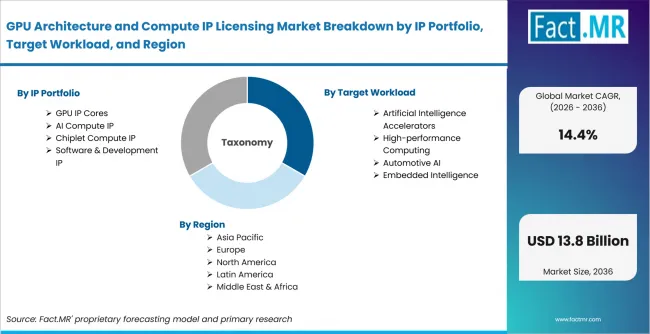
Gpu Architecture And Compute Ip Licensing Market Breakdown By Ip Portfolio, Target Workload, And Region | Source: Fact.MR
| Attribute | Details |
|---|---|
| Quantitative Units | USD billion in 2026 to USD billion by 2036 at CAGR |
| Market Definition | Licensable GPU architecture, compute IP blocks, software-facing design rights, and integration support used by chip designers that need parallel processing capability without building every graphics or accelerator block internally |
| IP Portfolio | GPU IP Cores; Shader Compiler IP; Graphics Driver Stack IP; Ray-Tracing IP Blocks; Memory-Interface Compute IP |
| Target Workload | Artificial Intelligence Accelerators; Data Center GPUs; Automotive AI Processors; Mobile and Edge Graphics; Embedded Vision and Robotics |
| Licensee Category | Fabless Semiconductor Companies; Integrated Device Manufacturers; Automotive SoC Developers; Cloud and Hyperscale ASIC Teams; Consumer Electronics Chip Vendors |
| Licensing Model | Perpetual Licensing; Royalty-Based Licensing; Subscription Licensing; Joint Development Licensing; Architecture Customization Licensing |
| Compute Architecture | Scalable Parallel Compute Architecture; Tile-Based Rendering Architecture; SIMT Compute Architecture; Vector Processing Architecture; Heterogeneous CPU-GPU Architecture |
| Regions Covered | North America; Latin America; Europe; East Asia; South Asia and Pacific; Middle East and Africa |
| Countries Covered | USA; Taiwan; South Korea; Japan; Germany; China; Singapore |
| Key Companies Profiled | Arm Limited; Imagination Technologies Limited; Rambus Inc.; Cadence Design Systems, Inc.; Synopsys, Inc.; SiFive, Inc.; VeriSilicon Microelectronics Co., Ltd.; Andes Technology Corporation; Ceva, Inc.; Tenstorrent Inc. |
| Forecast Period | 2026 to 2036 |
| Approach | Hybrid top-down and bottom-up approach using semiconductor IP demand; GPU and AI accelerator design activity; licensee category analysis; licensing model review; compute architecture adoption; country growth patterns; company portfolio review |
Source: Fact.MR analysis. Updated Aug 7, 2026
How is the market segmented?
-
By IP Portfolio
- GPU IP Cores
- Graphics Processing IP
- Compute Acceleration IP
- AI Compute IP
- Tensor Processing IP
- Matrix Compute IP
- Chiplet Compute IP
- Multi-chiplet GPU IP
- Heterogeneous Chiplet IP
- Software & Development IP
- GPU Driver Stack
- Development Toolkit
- GPU IP Cores
-
By Target Workload
- Artificial Intelligence Accelerators
- AI Training
- AI Inference
- High-performance Computing
- Exascale Computing
- Scientific Computing
- Automotive AI
- Autonomous Driving
- Robotics Processing
- Embedded Intelligence
- Embedded Vision
- Industrial Edge AI
- Artificial Intelligence Accelerators
-
By Licensee Category
- Fabless Semiconductor Companies
- System-on-Chip Designers
- Integrated Device Manufacturers
- Data Center Chip Developers
- Hyperscale Infrastructure Providers
- Edge AI Chip Vendors
- Automotive Semiconductor Companies
- Automotive Tier 1 Suppliers
- Industrial Automation Companies
- Consumer Electronics Companies
- Device Manufacturers
- Research Organizations
- Fabless Semiconductor Companies
-
By Licensing Model
- Perpetual Licensing
- One-time License
- Lifetime License
- Subscription Licensing
- Annual Subscription
- Royalty-based Subscription
- Royalty-based Licensing
- Per-unit Royalty
- Revenue Sharing
- Custom Licensing Agreements
- Technology Transfer Agreements
- Joint Development Agreements
- Perpetual Licensing
-
By Compute Architecture
- Scalable Parallel Compute Architecture
- SIMD Architecture
- Vector Compute Units
- Heterogeneous Compute Architecture
- Tensor Acceleration Engine
- Multi-core Compute Clusters
- Chiplet-based Compute Architecture
- High-speed Interconnect Fabric
- Scalable Chiplet Design
- Open Compute Programming Model
- Open Software Stack
- Runtime Optimization Framework
- Scalable Parallel Compute Architecture
-
By Region
- North America
- Latin America
- Western Europe
- Eastern Europe
- East Asia
- South Asia and Pacific
- Middle East & Africa
Frequently Asked Questions
How big is the GPU architecture and compute IP licensing market in 2026?
What is the CAGR of the GPU architecture and compute IP licensing market from 2026 to 2036?
Which IP portfolio leads the GPU architecture and compute IP licensing market?
Which target workload leads the GPU architecture and compute IP licensing market?
Who are the leading companies in the GPU architecture and compute IP licensing market?
Who worked on this report


Preview the report firsthand - request a free sample
Free SampleGet the brochure for pricing and purchase details
Download PDF