- Market Value (2025): USD 2.4 Bn
- Estimated Value (2026): USD 2.8 Bn
- Forecast Value (2036): USD 10.7 Bn
- CAGR (2026-2036): 14.3%
What is the GPU and HPC Silicon Interposer Market forecast to be worth by 2036?
USD 2.8 billion in 2026 to USD 10.7 billion by 2036 at 14.3% CAGR.
- The GPU and HPC Silicon Interposer market reached USD 2.4 billion in 2025 as AI accelerator programs moved toward larger memory packages.
- Demand is projected to increase from USD 2.8 billion in 2026 to USD 10.7 billion by 2036.
- The market is forecast to record 14.3% CAGR from 2026 to 2036.
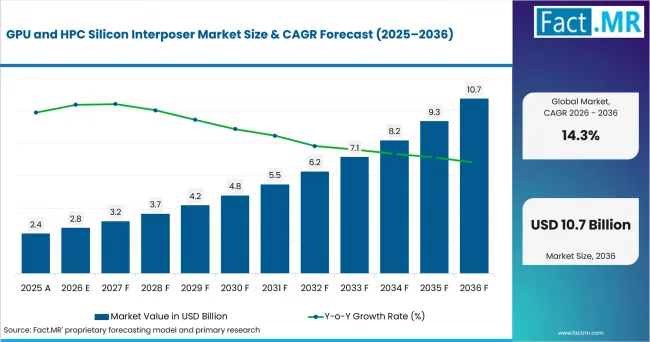
Gpu And Hpc Silicon Interposer Market Value Analysis | Source: Fact.MR
What are the defining numbers behind GPU and HPC Silicon Interposer Market growth?
USD 7.8 billion absolute dollar opportunity by 2036.
- Demand Drivers in the Market
- AI training and inference workloads require memory bandwidth that standard package routing cannot deliver at scale.
- Chiplet-based processors are expected to raise interposer use because processor and memory dies must work as one package.
- Data center accelerator procurement is moving toward dense GPU modules that keep compute and memory close together.
- Supply-chain planning is expected to favor qualified packaging partners with reliable wafer-level processing.
- Key Segments Analyzed
- By Interposer Architecture: 2.5D Silicon Interposer is expected to hold 58.0% share in 2026 because it supports proven GPU and HBM integration routes.
- By Target Application: GPU Accelerators are projected to account for 46.0% share in 2026 as AI clusters place heavy value on memory bandwidth.
- By End-use Industry: Data Centers are anticipated to capture 44.0% share in 2026 since hyperscale systems require repeatable high bandwidth memory packaging.
- By Customer Type: Integrated Device Manufacturers are estimated to represent 39.0% share in 2026 due to their role in qualification and supply planning.
- By Packaging Technology: Through-Silicon Via Technology is forecast to hold 63.0% share in 2026 as stacked memory depends on vertical interconnect control.
- Analyst Opinion at Fact.MR
- Shambhu Nath Jha, Senior Consultant at Fact.MR, states, “GPU and HPC silicon interposer demand is moving with the packaging needs of AI accelerators and high-bandwidth memory. Suppliers that can support large interposers and TSV stability are expected to shape qualification decisions.”
- Strategic Implications
- Packaging teams should treat interposer design as an early architecture decision instead of a late-stage assembly choice.
- Foundries and OSAT providers can improve customer acceptance by proving route density and TSV yield before volume ramps.
- Thermal teams should coordinate interposer and substrate choices with thermal interface materials before GPU cluster designs are frozen.
- Suppliers should prepare capacity plans for AI compute programs where high-performance packaging overlaps with qualification risk.
Taiwan leads at 15.6% CAGR through foundry scale and advanced packaging capacity. USA follows at 15.0% as AI infrastructure supports package qualification. South Korea reaches 14.5% through HBM depth. Japan posts 13.8% through materials and equipment expertise. Germany records 13.2%, China reaches 12.5% and Singapore closes the displayed range at 11.9%.
How does the GPU and HPC Silicon Interposer Market break down by segment?
2.5D Silicon Interposer is expected to lead Interposer Architecture at 58.0% share in 2026. GPU Accelerators are projected to lead Target Application at 46.0% share in 2026.
Which interposer architecture dominates?
2.5D Silicon Interposer is projected to account for 58.0% share in 2026.
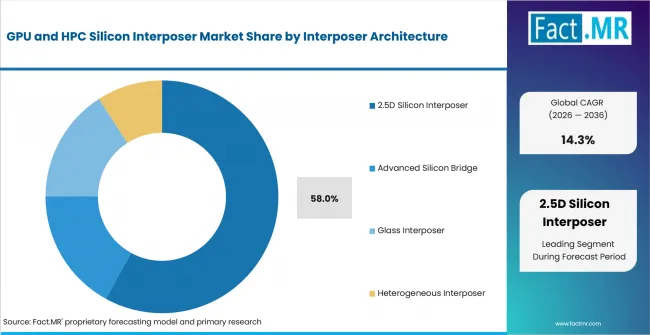
Gpu And Hpc Silicon Interposer Market Analysis By Interposer Architecture | Source: Fact.MR
This architecture gives GPU designers a qualified route for placing compute dies and HBM close together. It supports dense routing and mature OSAT handling. Other package formats remain useful where cost or substrate flexibility matters. 2.5D designs still carry the broadest use case for high-end AI processors.
What leads the Target Application segment?
GPU Accelerators are expected to hold 46.0% share in 2026.
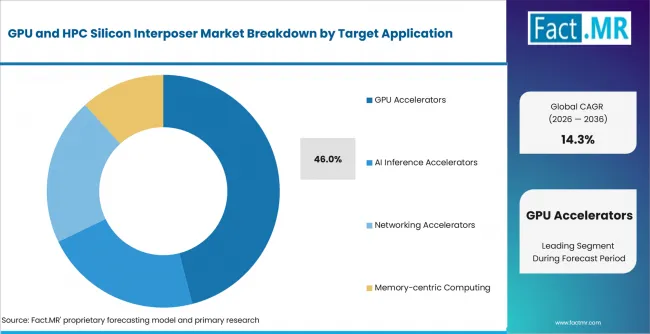
Gpu And Hpc Silicon Interposer Market Analysis By Target Application | Source: Fact.MR
GPU accelerator packages create the highest pressure for short signal paths between compute die and HBM stacks. Training clusters need predictable bandwidth before server platforms are approved. This keeps qualification work centered on accelerator-class products.
How do Data Centers shape demand?
Data Centers are anticipated to lead End-use Industry with 44.0% share in 2026.
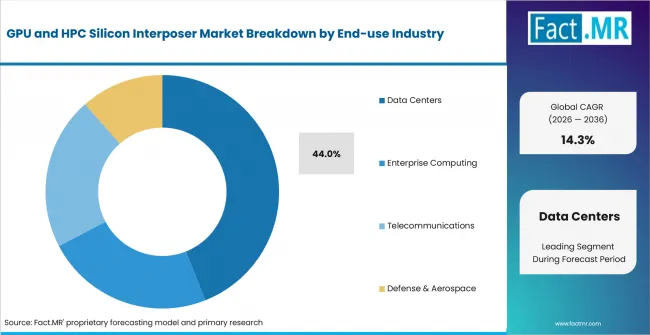
Gpu And Hpc Silicon Interposer Market Analysis By End Use Industry | Source: Fact.MR
Data center buyers approve hardware only after package reliability and rack cooling units planning are clear. Silicon interposers matter because they affect bandwidth and heat flow inside dense GPU modules. Interposer selection is reviewed with AI server chassis choices during platform planning.
What supports Integrated Device Manufacturers?
Integrated Device Manufacturers are estimated to represent 39.0% share in 2026.
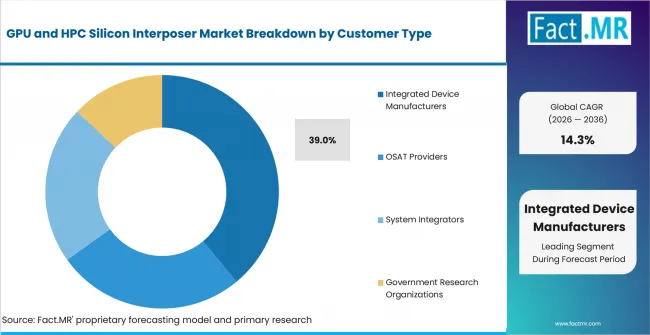
Gpu And Hpc Silicon Interposer Market Analysis By Customer Type | Source: Fact.MR
IDMs lead because design and qualification decisions often stay inside one roadmap. Their packaging choices are tied to memory supply and thermal budgets. This structure can reduce handoff risk when new GPU and HPC packages move toward production.
Why does Through-Silicon Via Technology lead Packaging Technology?
Through-Silicon Via Technology is forecast to hold 63.0% share in 2026.
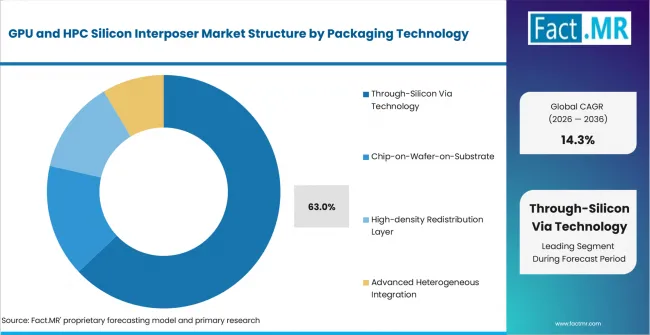
Gpu And Hpc Silicon Interposer Market Analysis By Packaging Technology | Source: Fact.MR
TSV technology leads because HBM stacks and interposer structures need vertical electrical paths with tight geometry control. Package designers use TSVs to connect stacked memory and support high signal density.
What is accelerating GPU and HPC Silicon Interposer Market adoption, and what is holding it back?
Demand is expected to rise through AI accelerator complexity and HBM integration. Growth is expected to face limits from capital intensity and yield risk.
Drivers Impact Analysis
| DRIVER | (~) IMPACT ON CAGR | GEOGRAPHIC RELEVANCE | IMPACT TIMELINE |
|---|---|---|---|
| AI accelerator package complexity | High | Taiwan, USA, South Korea | Short term (<= 2 years) |
| Chiplet and HBM integration | High | Taiwan, South Korea, Japan | Short term (<= 2 years) |
| Hyperscale data center expansion | Medium-High | USA, China, Germany | Medium term (2-4 years) |
| Regional supply-chain planning | Medium | USA, Europe, East Asia | Medium term (2-4 years) |
| Thermal and power-density control | Medium | Global | Long term (>= 4 years) |
Source: Fact.MR analysis. Updated Aug 7, 2026
- AI accelerator package complexity: Larger GPU modules are expected to increase the value of qualified interposer routing and package validation.
- Chiplet and HBM integration: Interposers help compute and memory dies work as one package when bandwidth and latency requirements tighten.
- Hyperscale data center expansion: Accelerator clusters are expected to increase demand for qualified packages that combine compute density with memory bandwidth.
Opportunity Impact Analysis
| OPPORTUNITY | (~) IMPACT ON CAGR | GEOGRAPHIC RELEVANCE | IMPACT TIMELINE |
|---|---|---|---|
| Large-format interposer qualification | High | Taiwan and USA | Medium term (2-4 years) |
| OSAT-foundry partnership models | Medium-High | Taiwan, Singapore, South Korea | Medium term (2-4 years) |
| Thermal co-design for GPU clusters | Medium | USA, Germany, Japan | Long term (>= 4 years) |
| Advanced IC substrate coordination | Medium | East Asia and North America | Long term (>= 4 years) |
Source: Fact.MR analysis. Updated Aug 7, 2026
- Large-format interposer qualification: Suppliers that prove stability on larger packages are expected to receive earlier design consideration.
- OSAT-foundry partnership models: Customers benefit when wafer processing and assembly schedules are planned together.
- Advanced IC substrate coordination: Interposer choices are expected to be reviewed with advanced IC substrates to manage routing and yield.
Restraints Impact Analysis
| RESTRAINT | (~) IMPACT ON CAGR | GEOGRAPHIC RELEVANCE | IMPACT TIMELINE |
|---|---|---|---|
| Capital intensity and long qualification | Medium-High | Developing packaging markets | Short term (<= 2 years) |
| Yield loss on large interposers | Medium | Global | Short term (<= 2 years) |
| HBM supply and material constraints | Medium | East Asia and North America | Medium term (2-4 years) |
| Thermal validation complexity | Low-Medium | Data center clusters | Long term (>= 4 years) |
Source: Fact.MR analysis. Updated Aug 7, 2026
- Capital intensity and long qualification: Buyers are expected to delay awards when packaging lines lack proven capacity and process history.
- Yield loss on large interposers: Larger package formats increase inspection burden and make defect escape more expensive.
- Thermal validation complexity: GPU packages must align with AI power supply units and direct-to-chip cold plate choices before system approval.
Which countries are scaling GPU and HPC Silicon Interposer Market fastest?
- The country comparison spans 3.7 percentage points and shows Taiwan at the top of the displayed forecast range.
- Taiwan remains 0.6 percentage point above USA through foundry scale and advanced packaging concentration.
- USA remains 0.5 percentage point above South Korea as AI infrastructure supports package qualification.
- South Korea remains 0.7 percentage point above Japan through memory manufacturing and HBM supply depth.
- Japan remains 0.6 percentage point above Germany through materials and process-control expertise.
- Germany remains 0.7 percentage point above China as automotive semiconductor demand supports adoption.
- China remains 0.6 percentage point above Singapore through domestic semiconductor capacity planning.
Comparable CAGRs can still create different entry conditions. Foundry density and memory supply vary by country. Qualification depth and local engineering support also differ. Full report coverage includes North America, Latin America, Europe, East Asia, South Asia and Pacific, Middle East and Africa.
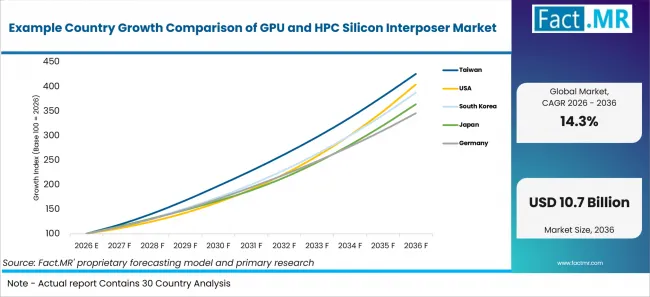
Example Country Growth Comparison Of Gpu And Hpc Silicon Interposer Market | Source: Fact.MR
| Country | CAGR (2026-2036) |
|---|---|
| Taiwan | 15.6% |
| USA | 15.0% |
| South Korea | 14.5% |
| Japan | 13.8% |
| Germany | 13.2% |
| China | 12.5% |
| Singapore | 11.9% |
Source: Fact.MR analysis. Updated Aug 7, 2026
What supports Taiwan adoption?
15.6% CAGR, supported by foundry scale and advanced packaging concentration.
Taiwan’s foundry base gives accelerator customers a close route from package design to qualification. Local packaging depth helps teams test interposer routing near commercial wafer production. This reduces transfer risk when GPU and HBM packages move from engineering lots into larger programs.
How is USA scaling demand?
15.0% CAGR, backed by AI infrastructure and domestic semiconductor investment.
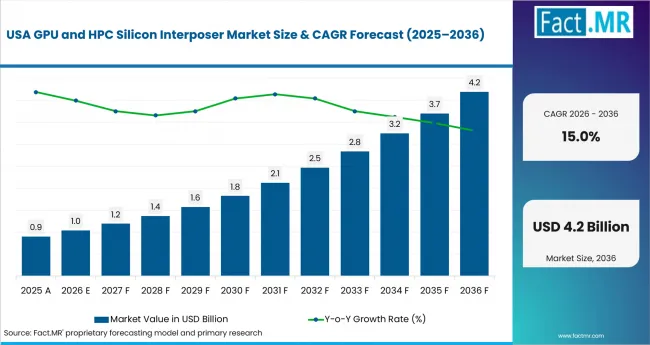
Gpu And Hpc Silicon Interposer Market Country Value Analysis | Source: Fact.MR
USA demand starts with accelerator design activity and cloud-scale compute procurement. Buyers are expected to value secure package capacity where interposer supply affects launch timing. Domestic packaging plans can make qualification work easier for customers that need closer engineering support.
What is driving South Korea’s growth from 2026 to 2036?
14.5% CAGR, led by HBM manufacturing and memory-package expertise.
South Korea’s position reflects the role of memory suppliers in GPU and HPC package design. HBM production and TSV process knowledge create a strong base for interposer demand. Suppliers must show stable memory-stack behavior before package approval expands.
How does Japan perform?
13.8% CAGR, supported by materials and equipment capability.
Japan’s growth is shaped by semiconductor materials and process-control strength. Customers are expected to value inspection quality during qualification. This gives Japanese supplier a practical role where package reliability matters more than fast procurement alone.
What supports Germany’s adoption?
13.2% CAGR, driven by automotive semiconductor and industrial compute demand.
Germany’s outlook reflects demand from automotive electronics and high-reliability computing. Interposer adoption is expected to remain selective because many programs require long reliability proof. The strongest use cases are expected where industrial compute needs dense memory access.
How is China developing demand?
12.5% CAGR, supported by domestic semiconductor capacity planning.
China’s growth is connected to local semiconductor self-sufficiency efforts and domestic packaging routes. Demand is expected to favor suppliers that can support recipe transfer and equipment availability. Engineering support remains a commercial factor when access to advanced packaging tools is uneven.
What supports Singapore’s growth?
11.9% CAGR, backed by specialty packaging and regional support.
Singapore’s compact electronics base gives it a practical role in specialty packaging and regional coordination. The market is likely to favor flexible package flows. Reliable customer support is expected to matter because many programs serve mixed production needs.
Who leads the GPU and HPC Silicon Interposer Market?
TSMC and Samsung Electronics hold the strongest position in GPU and HPC silicon interposers, while Intel adds advanced packaging depth.
ASE and Amkor strengthen assembly and qualification support for AI accelerator packages. UMC, GlobalFoundries and JCET broaden the supplier field through semiconductor manufacturing and packaging capacity. Competition is expected to center on TSV reliability, HBM integration and large-format interposer yield.
Which companies are the key providers?
Key companies include Taiwan Semiconductor Manufacturing Company Limited; Samsung Electronics Co., Ltd.; Intel Corporation; Advanced Semiconductor Engineering, Inc.; Amkor Technology, Inc.; United Microelectronics Corporation; GlobalFoundries Inc.; and JCET Group Co., Ltd.
- Taiwan Semiconductor Manufacturing Company Limited
- Samsung Electronics Co., Ltd.
- Intel Corporation
- Advanced Semiconductor Engineering, Inc.
- Amkor Technology, Inc.
- United Microelectronics Corporation
- GlobalFoundries Inc.
- JCET Group Co., Ltd.
Bibliography
- Advanced Semiconductor Engineering, Inc. (2026, May 26). ASE launches automated 310mm panel-level packaging to accelerate AI innovation.
- Amkor Technology, Inc. (2026, July 23). Amkor Technology announces strategic partnership with NVIDIA to expand advanced packaging and test for next-generation AI infrastructure.
- GlobalFoundries Inc. (2024, December 5). Broadcom delivers industry’s first 3.5D F2F technology for AI XPUs.
- Intel Corporation. (2026, May 28). Meet the Intel pioneer behind EMIB chip packaging.
This Report Answers
- The report provides strategic intelligence on the GPU and HPC Silicon Interposer Market across Interposer Architecture and Target Application choices that shape advanced semiconductor packaging programs.
- Segment analysis covers 2.5D Silicon Interposer and GPU Accelerators as the share leaders within the 2026 market.
- Country outlook evaluates Taiwan and the USA alongside South Korea and Japan. Germany, China and Singapore complete the growth comparison across the profiled markets.
- Competitive analysis profiles Taiwan Semiconductor Manufacturing Company Limited and Samsung Electronics Co., Ltd. alongside Intel Corporation and Advanced Semiconductor Engineering, Inc. Amkor Technology, SK hynix, Broadcom, AMD, NVIDIA and Micron complete the provider set.
- Packaging assessment covers Through-Silicon Via Technology and Chip-on-Wafer-on-Substrate. High-density Redistribution Layer and Advanced Heterogeneous Integration complete the process view alongside interposer architecture choices.
What does the GPU and HPC Silicon Interposer Market cover?
Silicon interposer platforms connect GPU accelerators, HPC chiplets and high-bandwidth memory inside advanced semiconductor packages where short interconnect paths, bandwidth and package reliability shape production approval.
The GPU and HPC Silicon Interposer Market covers interposer platforms used in GPU accelerators and HPC packages. Coverage extends to AI inference accelerators, networking accelerators and memory-centric computing. The market includes 2.5D silicon interposers, advanced silicon bridges, glass interposers and heterogeneous interposers. It also covers packaging technologies such as through-silicon vias, chip-on-wafer-on-substrate, high-density redistribution layers and advanced heterogeneous integration.
What is included in the scope?
GPU and HPC silicon interposers are used across data centers, enterprise computing, telecommunications and defense and aerospace applications. Integrated device manufacturers, OSAT providers, system integrators and government research organizations are also included.
The scope includes Interposer Architecture and Target Application alongside End-use Industry, Customer Type and Packaging Technology. Coverage spans 2.5D silicon interposers, advanced silicon bridges, glass interposers and heterogeneous interposers. It includes GPU accelerators, AI inference accelerators, networking accelerators and memory-centric computing. Through-silicon via technology and chip-on-wafer-on-substrate are included when they support high-bandwidth advanced packages.
What is excluded from the scope?
General semiconductor packaging equipment and unrelated chip-assembly spending remain outside the scope of this market.
The scope excludes platforms that do not connect GPU accelerators, HPC chiplets or high-bandwidth memory inside advanced packages. General substrate, deposition, metrology and assembly spending is excluded unless directly tied to silicon interposer qualification. Standard package routing that does not depend on advanced interposer structures is outside the scope. Company revenue without a clear connection to GPU, HPC, chiplet or HBM packaging is also excluded.
How Was the Analysis Built?
The analysis draws on 120+ sources, 35+ company portfolios, 25+ countries, and more than 20 industry interviews.
- Primary Research: Primary research includes discussions with manufacturers, packaging providers, technology developers, procurement teams, end users and subject-matter experts. These conversations examine qualification priorities, packaging adoption, operational challenges, approval requirements, competitive positioning and factors influencing wider market acceptance.
- Desk Research: Desk research covers government statistics, regulatory publications, company filings, trade data, technical studies, industry associations, standards, public policy and other authoritative sources. Every source used in the analysis is documented in the bibliography.
- Market Sizing and Forecasting: Market estimates combine historical performance, demand indicators, pricing and volume trends, segment shares, company participation, country-level growth, adoption patterns, investment activity and barriers to market expansion.
- Data Validation and Update Cycle: Findings are validated by comparing primary interviews with public data, company activity, regulatory changes, technology launches, packaging partnerships, capacity shifts, procurement trends and changes in commercial adoption.
Segmentation
What is the report’s scope and coverage?
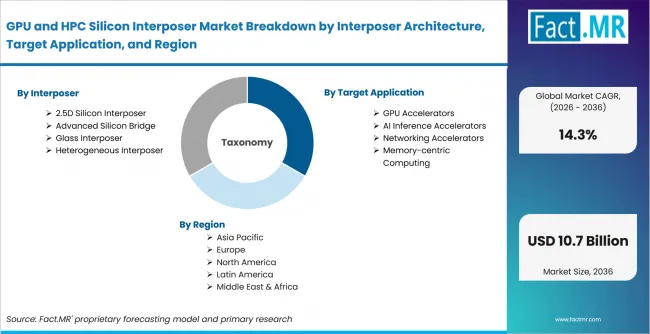
Gpu And Hpc Silicon Interposer Market Breakdown By Interposer Architecture, Target Application, And Region | Source: Fact.MR
| Attribute | Details |
|---|---|
| Quantitative Units | USD billion in 2026 to USD billion by 2036 at CAGR |
| Market Definition | Silicon interposer platforms used to connect GPU accelerators, HPC chiplets and high-bandwidth memory inside advanced semiconductor packages |
| Interposer Architecture | 2.5D Silicon Interposer; Advanced Silicon Bridge; Glass Interposer; Heterogeneous Interposer |
| Target Application | GPU Accelerators; AI Inference Accelerators; Networking Accelerators; Memory-centric Computing |
| End-use Industry | Data Centers; Enterprise Computing; Telecommunications; Defense & Aerospace |
| Customer Type | Integrated Device Manufacturers; OSAT Providers; System Integrators; Government Research Organizations |
| Packaging Technology | Through-Silicon Via Technology; Chip-on-Wafer-on-Substrate; High-density Redistribution Layer; Advanced Heterogeneous Integration |
| Regions Covered | North America; Latin America; Europe; East Asia; South Asia and Pacific; Middle East and Africa |
| Countries Covered | Taiwan; USA; South Korea; Japan; Germany; China; Singapore |
| Key Companies Profiled | Taiwan Semiconductor Manufacturing Company Limited; Samsung Electronics Co., Ltd.; Intel Corporation; Advanced Semiconductor Engineering, Inc.; Amkor Technology, Inc.; United Microelectronics Corporation; GlobalFoundries Inc.; JCET Group Co., Ltd. |
| Forecast Period | 2026 to 2036 |
| Approach | Hybrid top-down and bottom-up approach using GPU accelerator demand; HBM integration; TSV adoption; country CAGR review; and company portfolio validation |
Source: Fact.MR analysis. Updated Aug 7, 2026
How is the market segmented?
-
By Interposer Architecture
- 2.5D Silicon Interposer
- High-density Interposer
- Multi-chip Interposer
- Advanced Silicon Bridge
- Embedded Silicon Bridge
- Multi-die Bridge
- Glass Interposer
- Thin Glass Interposer
- Through-glass Via Interposer
- Heterogeneous Interposer
- Chiplet Interposer
- Hybrid Interposer
- 2.5D Silicon Interposer
-
By Target Application
- GPU Accelerators
- AI Training Accelerators
- HPC Processors
- AI Inference Accelerators
- Generative AI Processors
- High-bandwidth Memory Integration
- Networking Accelerators
- SmartNIC Accelerators
- Data Processing Units
- Memory-centric Computing
- High-bandwidth Memory Stacking
- Exascale Computing
- GPU Accelerators
-
By End-use Industry
- Data Centers
- Hyperscale Computing
- Supercomputing
- Enterprise Computing
- Cloud Computing
- Research Computing
- Telecommunications
- 5G Infrastructure
- Edge AI Infrastructure
- Defense & Aerospace
- Defense Supercomputing
- National Research Laboratories
- Data Centers
-
By Customer Type
- Integrated Device Manufacturers
- Fabless Semiconductor Companies
- High-performance Computing System Vendors
- OSAT Providers
- GPU Manufacturers
- Semiconductor Foundries
- System Integrators
- Network Equipment Manufacturers
- Cloud Service Providers
- Government Research Organizations
- Defense Contractors
- Academic Research Institutions
- Integrated Device Manufacturers
-
By Packaging Technology
- Through-Silicon Via Technology
- Fine-pitch TSV Integration
- Micro-bump Packaging
- Chip-on-Wafer-on-Substrate
- Hybrid Bonding
- Wafer-level Packaging
- High-density Redistribution Layer
- Ultra-fine Redistribution Layer
- Multi-layer Interconnect
- Advanced Heterogeneous Integration
- 3D Package Integration
- High-density Wafer Bonding
- Through-Silicon Via Technology
-
By Region
- North America
- Latin America
- Western Europe
- Eastern Europe
- East Asia
- South Asia and Pacific
- Middle East & Africa
Frequently Asked Questions
How big is the GPU and HPC silicon interposer market in 2026?
What is the CAGR of the GPU and HPC silicon interposer market from 2026 to 2036?
Which interposer architecture leads the GPU and HPC silicon interposer market?
Which target application leads the GPU and HPC silicon interposer market?
Who are the leading companies in the GPU and HPC silicon interposer market?
Who worked on this report


Preview the report firsthand - request a free sample
Free SampleGet the brochure for pricing and purchase details
Download PDF