- Forecast Value (2036): 22.5 Bn
- CAGR (2036): 41.5%
What is the GPU asset lifecycle and refurbishment services market forecast to be worth by 2036?
USD 0.7 billion in 2026 to USD 22.5 billion by 2036, at 41.5% CAGR.
- The GPU asset lifecycle and refurbishment services market crossed a valuation of USD 0.5 billion in 2025.
- Demand is expected to increase from USD 0.7 billion in 2026 to USD 22.5 billion by 2036.
- The market is forecast to record 41.5% CAGR during 2026 to 2036 as data-center GPU fleets move from first deployment into refresh and redeployment cycles.
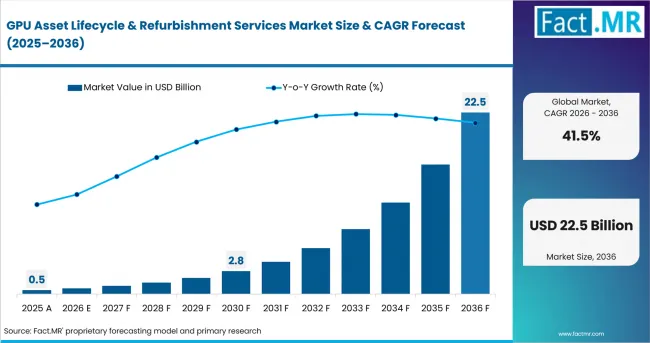
Gpu Asset Lifecycle & Refurbishment Services Market Value Analysis | Source: Fact.MR
What are the defining numbers behind GPU asset lifecycle and refurbishment services growth?
USD 21.8 billion absolute opportunity by 2036, led by the United States and Singapore.
- Demand Drivers in the Market
- AI infrastructure operators need refresh planning as H100-era clusters age.
- GPU owners need certified testing to protect resale value in secondary markets.
- Data-center operators need secure decommissioning for accelerator servers and attached storage.
- Enterprises need chain-of-custody records before retired AI hardware leaves controlled facilities.
- Key Segments Analyzed
- By Service Type: Certified Refurbishment and Testing is expected to hold 34.0% share in 2026 because resale needs verified accelerator condition.
- By Asset Type: Data-Center GPUs lead because H100, A100 and successor cards carry high residual value. The share is projected at 52.0% in 2026.
- By Customer Type: Hyperscalers and AI Cloud Operators lead because they operate large GPU fleets. This customer group is likely to account for 41.0% share in 2026.
- By Delivery Model: ITAD-Plus-Resale Programs lead as clients need secure recovery and value return. The model is projected to hold 38.0% share in 2026.
- By End Use: Secondary-Market Resale and Redeployment is expected to hold 36.0% share in 2026 because older GPUs can still serve inference and batch workloads.
- By Geography: The United States is projected to record 44.1% CAGR through 2036 as hyperscalers, neoclouds and AI infrastructure owners refresh GPU fleets.
- Analyst Opinion at Fact.MR
- Shambhu Nath Jha, Senior Analyst at Fact.MR, states, “AI hardware will create a new asset recovery cycle. We see GPU owners asking how to protect residual value, certify used accelerators and redeploy equipment securely. Providers that combine data-center ITAD, accelerator testing and secondary-market execution will gain stronger access to AI infrastructure budgets.”
- Strategic Implications
- AI infrastructure owners should plan residual value before GPU refresh decisions are finalized.
- ITAD providers need accelerator testing capabilities beyond standard server handling.
- GPU brokers should build inspection and chain-of-custody processes to win enterprise trust.
- Data-center operators need secure decommissioning plans for liquid-cooled and high-density AI systems.
Services that manage the next phase of AI hardware include GPU fleet refresh planning, certified refurbishment, secondary-market resale, and secure accelerator decommissioning. NVIDIA stated in 2025 that Blackwell Ultra-based products were expected from partners in the second half of 2025. [1] This supports refresh planning as newer GPU generations enter production and first H100-era deployments move closer to a 2026-2028 refresh window.
The United States is projected to record 44.1% CAGR from 2026 to 2036 as hyperscalers, neoclouds and AI infrastructure owners refresh GPU fleets. Singapore will gain from regional data-center activity and lifecycle service hubs. The country is expected to post 42.6% CAGR through 2036. Germany is likely to record 41.2% CAGR as industrial AI and data-center decommissioning programs expand. The United Kingdom is forecast to advance at 39.8% CAGR by 2036 as enterprise AI infrastructure and secure ITAD needs rise. South Korea is set to record 38.7% CAGR as AI hardware investment and SK-linked lifecycle capabilities support growth.
How does the GPU asset lifecycle and refurbishment services market break down by segment?
Certified Refurbishment and Testing leads at 34.0%; Data-Center GPUs lead at 52.0%.
Which service type dominates?
Certified Refurbishment and Testing holds 34.0% share in 2026.
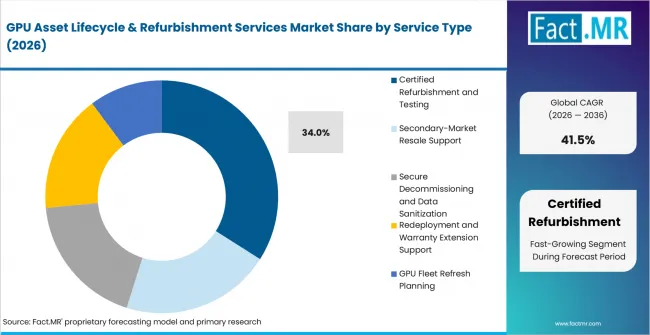
Gpu Asset Lifecycle & Refurbishment Services Market Analysis By Service Type | Source: Fact.MR
Certified Refurbishment and Testing is expected to hold 34.0% share in 2026 because resale needs verified accelerator condition. The service checks working status, thermal behavior, firmware, component integrity and packaging readiness. SK Tes lists refurbishment and equipment remarketing as part of its ITAD service coverage. [3] Testing leads because clients need proof before redeploying or reselling high-value GPUs.
Which asset type dominates?
Data-Center GPUs lead because they carry the strongest residual value.
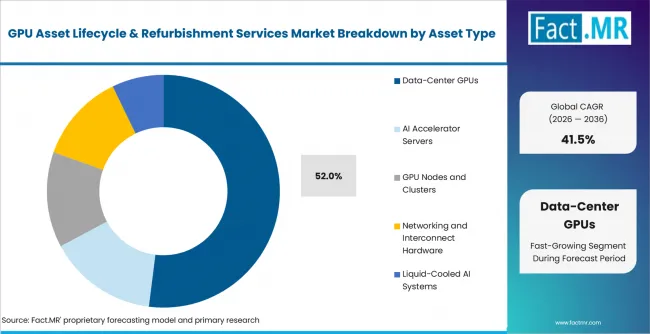
Gpu Asset Lifecycle & Refurbishment Services Market Analysis By Asset Type | Source: Fact.MR
Data-Center GPUs lead because H100, A100 and successor cards are costly assets with continued use in inference, fine-tuning and batch workloads. Operators also need board-level condition checks before resale or redeployment. The asset type is projected to capture 52.0% share in 2026. NVIDIA’s H100 launch created the first major accelerator generation now approaching refresh planning. [1]
Which customer type dominates?
Hyperscalers and AI Cloud Operators lead because they operate large GPU fleets.
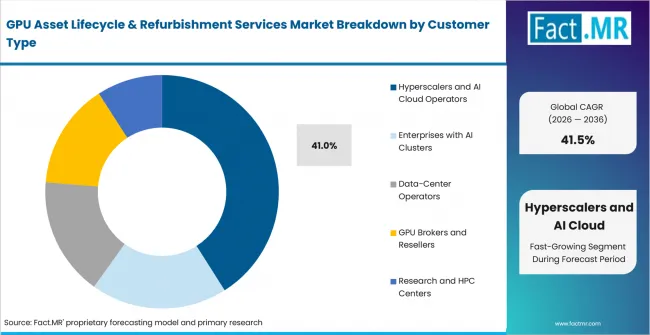
Gpu Asset Lifecycle & Refurbishment Services Market Analysis By Customer Type | Source: Fact.MR
Hyperscalers and AI Cloud Operators lead because they manage concentrated AI accelerator fleets across dense data-center environments. These clients need refresh planning, asset recovery and secure decommissioning at scale. This customer type is likely to account for 41.0% share in 2026. Demand rises as operators move newer GPU generations into frontier training while older assets shift into lower-cost compute roles.
Which delivery model dominates?
ITAD-Plus-Resale Programs lead because clients need secure recovery and value return.
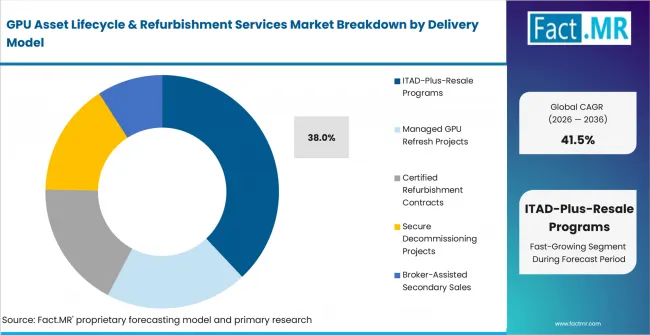
Gpu Asset Lifecycle & Refurbishment Services Market Analysis By Delivery Model | Source: Fact.MR
ITAD-Plus-Resale Programs lead because GPU retirement requires both security control and residual-value capture. The model is projected to hold 38.0% share in 2026. Sims Lifecycle Services states that decommissioned data-center equipment can be sanitized, refurbished, resold or responsibly recycled. [4] This model leads because GPU owners want fewer handoffs and clear audit trails.
Which end use dominates?
Secondary-Market Resale and Redeployment holds 36.0% share in 2026.
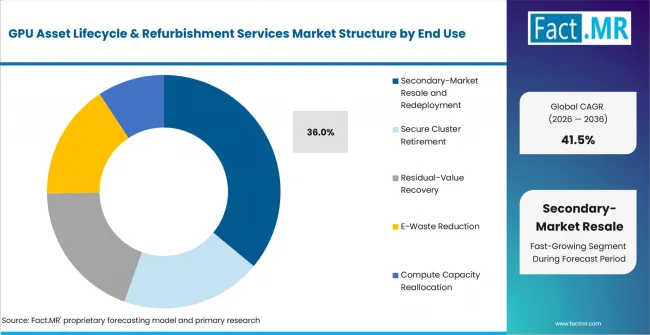
Gpu Asset Lifecycle & Refurbishment Services Market Analysis By End Use | Source: Fact.MR
Secondary-Market Resale and Redeployment leads because older accelerators can still support inference, research and cost-sensitive AI workloads. SF Compute states that clients can use large-scale vetted GPU clusters and sell back capacity they do not need. [6] The end use is expected to hold 36.0% share in 2026. Demand is strongest for certified assets that can move from frontier training fleets into secondary compute use.
What is accelerating GPU asset lifecycle and refurbishment demand, and what is holding it back?
H100-era refresh timing, residual-value pressure and secure decommissioning needs drive demand; testing complexity restrains adoption.
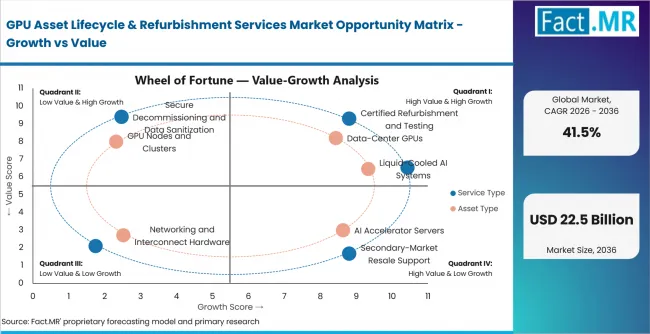
Gpu Asset Lifecycle & Refurbishment Services Market Opportunity Matrix Growth Vs Value | Source: Fact.MR
H100-era refresh timing is the main driver. NVIDIA introduced H100 in 2022, and AI infrastructure owners are already planning next-generation deployments. [1] This creates a service window for refurbishing, redeploying and reselling earlier accelerator fleets.
Lifecycle pressure adds a second driver. AI data-center lifecycle research states that new hardware is released every 2 to 3 years, with older servers replaced in phased cycles. [2] This supports demand for asset planning before large decommissioning events.
Secure decommissioning also supports the market. Iron Mountain states that its data-center decommissioning services include asset packing, collection, reuse and responsible disposition. [5] Sims Lifecycle Services also describes data-center ITAD work that includes sanitization, refurbishment and resale. [4]
The main restraint is testing complexity. AI accelerators can require firmware checks, thermal validation, compatibility review and stress testing before resale. Liquid-cooled systems also add handling requirements. Providers must build technical testing depth before enterprise clients trust refurbished GPUs for production workloads.
Where do the biggest GPU asset lifecycle and refurbishment opportunities sit?
Certified refurbishment, secondary resale and secure AI-cluster decommissioning.
- Certified Refurbishment: Providers can test and certify GPUs before resale or redeployment.
- Secondary Resale: Brokers can place refurbished accelerators into cost-sensitive AI compute markets.
- Secure Decommissioning: ITAD firms can manage chain-of-custody for retired AI clusters.
Which countries are scaling GPU asset lifecycle and refurbishment services fastest?
United States 44.1%, Singapore 42.6%, Germany 41.2%, United Kingdom 39.8%, South Korea 38.7%.
Based on regional analysis, the GPU asset lifecycle and refurbishment services market is segmented into North America, Southeast Asia, Western Europe, East Asia, Latin America, and Middle East and Africa.
.webp "Top Country Growth Comparison Gpu Asset Lifecycle & Refurbishment Services Market Cagr (2026 2036)")
Top Country Growth Comparison Gpu Asset Lifecycle & Refurbishment Services Market Cagr (2026 2036) | Source: Fact.MR
| Country | CAGR |
|---|---|
| United States | 44.1% |
| Singapore | 42.6% |
| Germany | 41.2% |
| United Kingdom | 39.8% |
| South Korea | 38.7% |
Source: Fact.MR analysis. Updated Jun 22, 2026
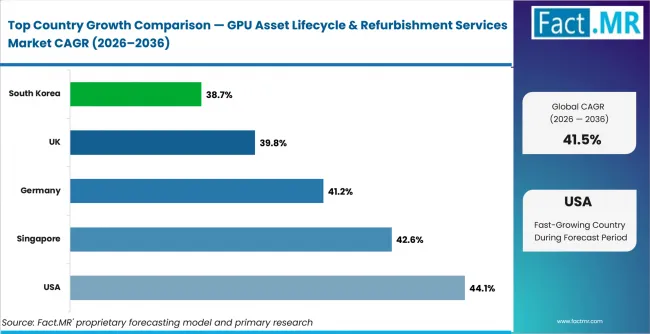
Gpu Asset Lifecycle & Refurbishment Services Market Cagr Analysis By Country | Source: Fact.MR
What is powering the United States lead?
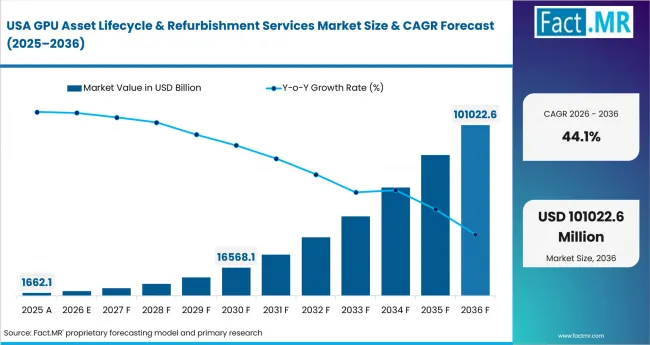
Gpu Asset Lifecycle & Refurbishment Services Market Country Value Analysis | Source: Fact.MR
The United States is projected to record 44.1% CAGR through 2036 as hyperscalers, neoclouds and AI infrastructure owners refresh GPU fleets. Large AI clusters create a high-value pool of accelerators that can be redeployed or resold. Service demand will focus on certified testing, secure removal and resale strategy. GPU brokers will gain from liquid secondary-market activity. ITAD providers with data-center scale and chain-of-custody processes will capture early contracts.
How is Singapore scaling GPU lifecycle demand?
Singapore benefits from regional data-center density and cross-border technology lifecycle services. AI infrastructure owners use the country as an Asia Pacific hub for cloud, finance and digital services. The country is expected to post 42.6% CAGR through 2036. Demand will focus on secure decommissioning, export-ready asset handling and refurbishment for regional resale. Service providers with global logistics and compliant data-destruction workflows will be better placed.
What underpins Germany’s growth?
Germany is likely to record 41.2% CAGR through 2036 as industrial AI and data-center decommissioning programs expand. Manufacturers, cloud operators and enterprise data centers are adding accelerated compute for engineering and automation workloads. These clients need secure retirement and resale planning as newer GPU generations arrive. German demand will emphasize audit trails, environmental reporting and certified disposition. Growth will favor providers that combine hardware testing with strict compliance processes.
What supports the United Kingdom outlook?
The United Kingdom is forecast to advance at 39.8% CAGR through 2036 as enterprise AI infrastructure and secure ITAD needs rise. Financial institutions, AI startups and cloud operators are increasing accelerator use across model development and inference. Older GPUs will need secure handling before resale or redeployment. Data-center operators will seek partners that can protect data, recover value and reduce e-waste. Demand will favor lifecycle providers with national logistics and resale channels.
How is South Korea scaling GPU asset lifecycle services?
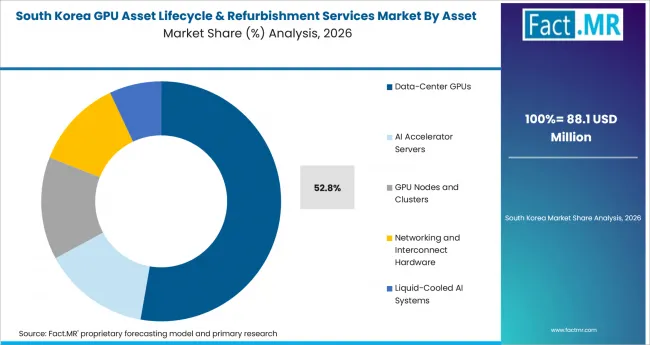
Gpu Asset Lifecycle & Refurbishment Services Market South Korea Market Share Analysis By Asset Type | Source: Fact.MR
South Korea is set to record 38.7% CAGR through 2036 as AI hardware investment and SK-linked lifecycle capabilities support growth. Local data-center operators, technology groups and semiconductor-linked ecosystems are expanding AI compute. As accelerator fleets mature, clients will need testing, refurbishment and certified disposition. Service demand will focus on high-value asset recovery and secure handling. Growth will favor providers that combine electronics lifecycle expertise with AI data-center knowledge.
Who leads the GPU asset lifecycle and refurbishment services landscape?
SK Tes, Sims Lifecycle Services and Iron Mountain ALM lead through ITAD, decommissioning and asset recovery.
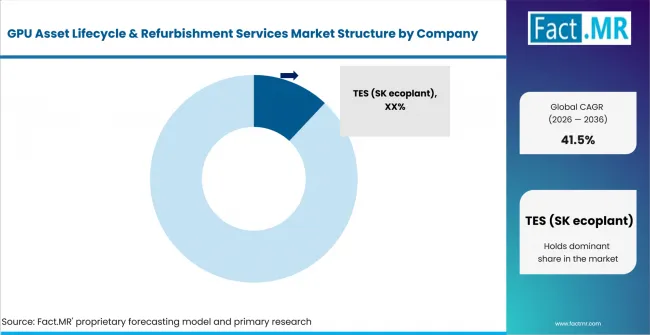
Gpu Asset Lifecycle & Refurbishment Services Market Analysis By Company | Source: Fact.MR
GPU asset lifecycle and refurbishment services are used by hyperscalers, AI cloud operators and enterprises that need to manage high-value accelerator fleets. SK Tes provides ITAD services covering refurbishment, remarketing, asset tracking, logistics and secure transportation. Sims Lifecycle Services supports data-center decommissioning, sanitization, refurbishment, resale and responsible recycling.
Iron Mountain Asset Lifecycle Management provides secure data-center decommissioning and IT asset disposition services. Procurri, including SF Compute-style markets, support resale and redeployment of AI compute capacity. Competition through 2036 will depend on accelerator testing, global logistics and secondary-market execution.
Providers that combine ITAD with GPU resale will be better placed. Secure decommissioning firms can win large data-center refresh projects. Refurbishment specialists can protect residual value. Procurri can help retired accelerators move into lower-cost AI compute use.
Which companies are the key players?
SK Tes, Sims Lifecycle Services, Iron Mountain ALM and Procurri.
- TES (SK ecoplant)
- Sims Lifecycle Services
- Iron Mountain Asset Lifecycle Management
- Procurri
Bibliography
- [1] NVIDIA. (2025, March 18). NVIDIA Blackwell Ultra AI factory platform paves way for age of AI reasoning. NVIDIA Newsroom.
- [2] Stojkovic, J., Zhang, C., Goiri, Í., & Bianchini, R. (2025, September 30). Rearchitecting datacenter lifecycle for AI: A TCO-driven framework. arXiv.
- [3] SK Tes. (n.d.). IT Asset Disposition (ITAD) Services.
- [4] Sims Lifecycle Services. (n.d.). What happens to decommissioned data center equipment?
- [5] Iron Mountain. (n.d.). Secure Data Center Decommissioning.
This Report Address
- Strategic intelligence on GPU asset lifecycle and refurbishment services across service type, asset type and customer type.
- Segment analysis covering Certified Refurbishment and Testing, Data-Center GPUs, Hyperscalers and AI Cloud Operators, ITAD-Plus-Resale Programs and Secondary-Market Resale.
- Regional outlook covering the United States, Singapore, Germany, United Kingdom and South Korea.
- Competitive analysis of TES, Sims Lifecycle Services, Iron Mountain ALM and Procurri.
- Service assessment covering refresh planning, certified refurbishment, secondary resale and secure decommissioning.
- Asset assessment covering data-center GPUs, AI accelerator servers, GPU nodes, interconnect hardware and liquid-cooled systems.
- Primary interviews, provider checks, official source review and GPU lifecycle validation support the forecast.
What does the GPU asset lifecycle and refurbishment services market cover?
Services that plan and resell AI accelerator hardware.
The GPU asset lifecycle and refurbishment services market covers lifecycle services for data-center GPUs and AI compute clusters. It includes refresh planning, secure decommissioning, certified refurbishment, performance testing, resale support and redeployment planning. The market differs from broad ITAD because the focus is AI accelerator value recovery, chain-of-custody security and secondary-market placement.
What is included in the scope?
GPU refresh planning, refurbishment, resale and secure decommissioning.
The scope includes asset discovery, refresh schedules and residual-value planning for AI accelerators. It covers secure removal, data sanitization, component testing and certified refurbishment. It includes resale brokerage, redeployment planning and warranty-extension support. It also includes recycling and responsible recovery for GPUs, servers and attached infrastructure that cannot be reused.
What is excluded from the scope?
General ITAD with no accelerator-specific handling or resale support.
The scope excludes standard office-device ITAD without GPU or data-center accelerator handling. It excludes new GPU sales and cloud compute rental unless lifecycle resale or asset recovery is included. It excludes generic data-center migration projects with no decommissioning or refurbishment work. It also excludes e-waste recycling that does not include testing, resale or value recovery.
How was the analysis built?
100+ sources, 45+ company portfolios, 25+ countries, 20+ interviews.
- Primary Research:
- Primary research includes interviews with data-center ITAD providers and AI infrastructure operators. It includes input from GPU brokers, asset recovery teams and secure decommissioning specialists.
- Desk Research:
- Desk research reviews GPU launch timelines and AI data-center lifecycle evidence. It covers official ITAD provider pages, data-center decommissioning services and GPU marketplace disclosures.
- Market-Sizing and Forecasting:
- Forecasting uses installed data-center GPU fleets, refresh timing and value-recovery service attachment. GPU resale activity, refurbishment intensity and decommissioning volumes support the market assessment.
- Data Validation and Update Cycle:
- Forecasts are validated through provider checks and secondary-market feedback. GPU generation changes, hyperscaler capex cycles and ITAD facility expansion help confirm market direction.
Segmentation
What is the report’s scope and coverage?
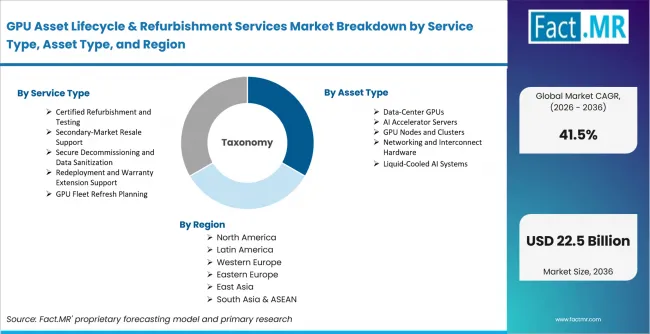
Gpu Asset Lifecycle & Refurbishment Services Market Breakdown By Service Type, Asset Type, And Region | Source: Fact.MR
| Attribute | Details |
|---|---|
| Quantitative Units | USD Billion in services in 2026 to USD Billion by 2036 |
| Market Definition | Services that manage GPU refresh planning, certified refurbishment, secondary-market resale and secure decommissioning of accelerators |
| Service Type | GPU Fleet Refresh Planning, Certified Refurbishment and Testing, Secondary-Market Resale Support, Secure Decommissioning and Data Sanitization, Redeployment and Warranty Extension Support |
| Asset Type | Data-Center GPUs, AI Accelerator Servers, GPU Nodes and Clusters, Networking and Interconnect Hardware, Liquid-Cooled AI Systems |
| Customer Type | Hyperscalers and AI Cloud Operators, Enterprises with AI Clusters, Data-Center Operators, GPU Brokers and Resellers, Research and HPC Centers |
| Delivery Model | ITAD-Plus-Resale Programs, Managed GPU Refresh Projects, Certified Refurbishment Contracts, Secure Decommissioning Projects, Broker-Assisted Secondary Sales |
| End Use | Secondary-Market Resale and Redeployment, Secure Cluster Retirement, Residual-Value Recovery, E-Waste Reduction, Compute Capacity Reallocation |
| Regions Covered | North America, Southeast Asia, Western Europe, East Asia, Latin America, Middle East and Africa |
| Countries Covered | United States, Singapore, Germany, United Kingdom, South Korea |
| Key Companies Profiled | TES (SK ecoplant), Sims Lifecycle Services, Iron Mountain Asset Lifecycle Management and Procurri |
| Forecast Period | 2026 to 2036 |
| Approach | Hybrid top-down and bottom-up approach using installed GPU fleets, refresh timing, ITAD project intensity, resale activity and provider validation |
Source: Fact.MR analysis. Updated Jun 22, 2026
How is the market segmented?
-
By Service Type:
- GPU Fleet Refresh Planning
- Certified Refurbishment and Testing
- Secondary-Market Resale Support
- Secure Decommissioning and Data Sanitization
- Redeployment and Warranty Extension Support
-
By Asset Type:
- Data-Center GPUs
- AI Accelerator Servers
- GPU Nodes and Clusters
- Networking and Interconnect Hardware
- Liquid-Cooled AI Systems
-
By Customer Type:
- Hyperscalers and AI Cloud Operators
- Enterprises with AI Clusters
- Data-Center Operators
- GPU Brokers and Resellers
- Research and HPC Centers
-
By Delivery Model:
- ITAD-Plus-Resale Programs
- Managed GPU Refresh Projects
- Certified Refurbishment Contracts
- Secure Decommissioning Projects
- Broker-Assisted Secondary Sales
-
By End Use:
- Secondary-Market Resale and Redeployment
- Secure Cluster Retirement
- Residual-Value Recovery
- E-Waste Reduction
- Compute Capacity Reallocation
-
Region:
- North America
- United States
- Canada
- Europe
- Germany
- United Kingdom
- France
- Netherlands
- Ireland
- Asia Pacific
- Singapore
- South Korea
- Japan
- Australia
- Taiwan
- Latin America
- Brazil
- Mexico
- Chile
- Middle East & Africa
- GCC Countries
- South Africa
- Israel
- North America
Frequently Asked Questions
Which service type leads the GPU Asset Lifecycle & Refurbishment Services Market?
Which country expands faster in the GPU Asset Lifecycle & Refurbishment Services Market?
How does Singapore perform in the GPU Asset Lifecycle & Refurbishment Services Market?
How does Germany perform in the GPU Asset Lifecycle & Refurbishment Services Market?
How does the United Kingdom perform in the GPU Asset Lifecycle & Refurbishment Services Market?
How does South Korea perform in the GPU Asset Lifecycle & Refurbishment Services Market?
What is the primary driver in the GPU Asset Lifecycle & Refurbishment Services Market?
What is the main restraint in the GPU Asset Lifecycle & Refurbishment Services Market?
Why are data-center GPUs important in this market?
Who worked on this report


Preview the report firsthand - request a free sample
Free SampleGet the brochure for pricing and purchase details
Download PDF