- Market Value (2025): USD 82.2 Mn
- Estimated Value (2026): USD 90 Mn
- Forecast Value (2036): USD 223 Mn
- CAGR (2026-2036): 9.5%
What is the GPU cable retriever market forecast to be worth by 2036?
USD 90 million in 2026 to USD 223 million by 2036, at 9.5% CAGR.
- The GPU cable retriever market crossed a valuation of USD 82.2 million in 2025.
- Demand is expected to increase from USD 90 million in 2026 to USD 223 million by 2036.
- The market is forecast to record a 9.5% CAGR from 2026 to 2036 as airports add cable protection and trip-hazard reduction to gate power systems.
- These deployments also support airport operation workflows when aircraft ground power must be connected quickly during turnaround.
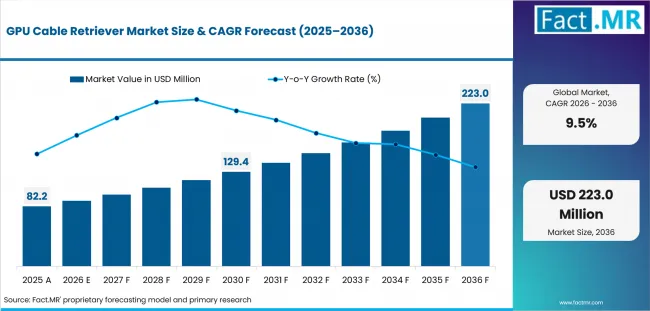
Gpu Cable Retriever Market Market Value Analysis | Source: Fact.MR
What are the defining numbers behind GPU cable retriever market growth?
USD 130 million absolute opportunity by 2036, led by motorized retrievers, 400Hz cables and PBB installations.
- Demand Drivers in the Market
- Airport operators need cable handling that reduces trip hazards around active stands.
- PBB integrators need retrievers that protect ground power cables during bridge movement.
- Electrical contractors need clean installation options for fixed gate cabinets and apron pits.
- GSE suppliers need cable-management options that support electric GPU and charging workflows.
- Key Segments Analyzed
- By Retriever Type: Motorized retrievers are expected to hold 34.0% share in 2026 because high-use gates need powered cable return.
- By Cable Type: 400Hz cable leads because most commercial gate power relies on this aircraft supply standard. The segment is projected to capture 44.0% share in 2026.
- By Installation: Passenger boarding bridge installations are likely to account for 41.0% share in 2026 because contact gates need organized cable reach.
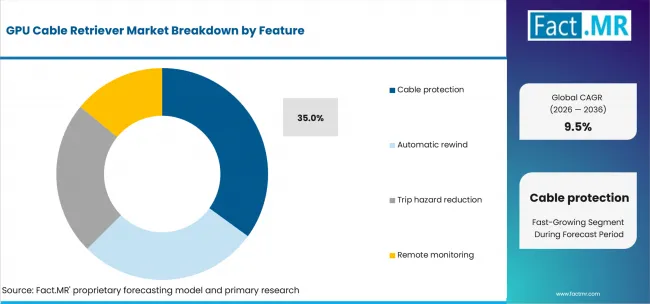
- By Feature: Cable protection is expected to hold 35.0% share in 2026 because ground power cables face repeated bending and abrasion.
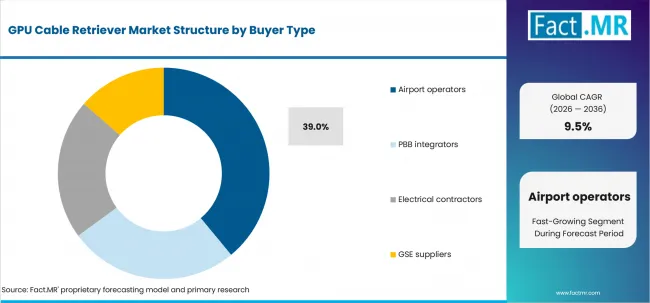
- By Buyer Type: Airport operators are projected to record 39.0% share in 2026 because they own gate safety and asset uptime.
- Analyst Opinion at Fact.MR
- Shambhu Nath Jha, Senior Analyst at Fact.MR, states, “GPU cable retrievers are practical gate electrification hardware. The market will grow where airports need cleaner cable routing, safer ramp movement and longer cable life. Suppliers that combine simple operation with bridge compatibility and rugged cable protection will be better placed than vendors selling generic cable accessories.”
- Strategic Implications
- Cable retriever suppliers should position products around cable life and apron safety.
- Airport operators should prioritize high-use gates and remote stands with frequent GPU movement.
- PBB integrators should design retriever placement with bridge movement and aircraft mix in mind.
- Electrical contractors should align cable retrievers with fixed 400Hz power and battery GPU charging layouts.
ITW GSE states that its 2400 Cable Retriever can connect to any 400Hz source and works with bridge-mounted or free-standing installations. This supports the market boundary because the product is a dedicated cable handling device used to protect aircraft ground power cables. Cable retriever planning also connects with air start unit replacement cycles when airports modernize aircraft support equipment around lower-emission ramp operations.
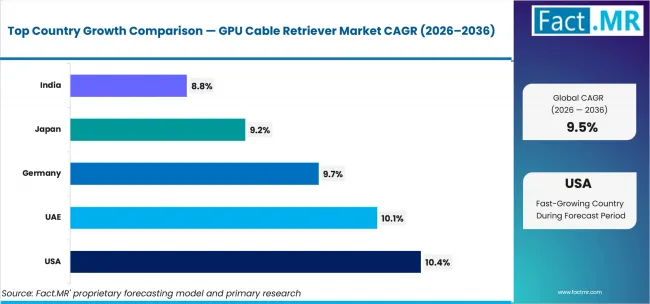
The United States is projected to record a 10.4% CAGR through 2036 as large airports and FBOs upgrade gate power handling. The UAE is expected to post a 10.1% CAGR through 2036 as Dubai-style electric GPU deployment increases cable-management needs. Germany is likely to record 9.7% CAGR as airports and electrical contractors modernize fixed gate power systems. Japan is forecast to advance at 9.2% CAGR as lithium-ion eGPU use and compact gate operations expand. India is set to record 8.8% CAGR as new terminal projects add PBBs, fixed gate cabinets and apron pits.
How does the GPU cable retriever market break down by segment?
Motorized retrievers lead at 34.0%; 400Hz cable leads at 44.0%.
Which retriever type dominates?
Motorized retrievers hold 34.0% share in 2026.
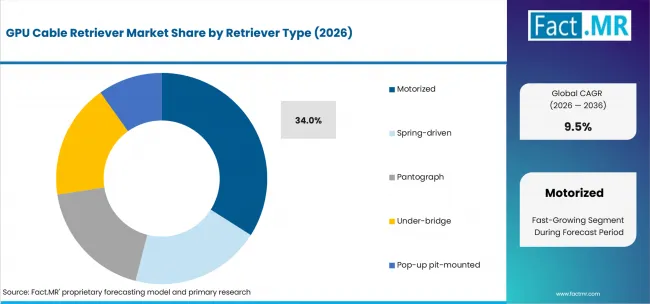
Gpu Cable Retriever Market Analysis By Retriever Type | Source: Fact.MR
Motorized retrievers are expected to hold 34.0% share in 2026 because high-use gates need repeatable cable rewind with less manual effort. Spring-driven systems follow where lower-cost cable return is enough. Pantograph units support structured cable movement near fixed gate cabinets. Under-bridge retrievers fit PBB-mounted power systems. Pop-up pit-mounted units are useful where airports want a cleaner apron surface.
Which cable type dominates?
400Hz cable holds 44.0% share in 2026.
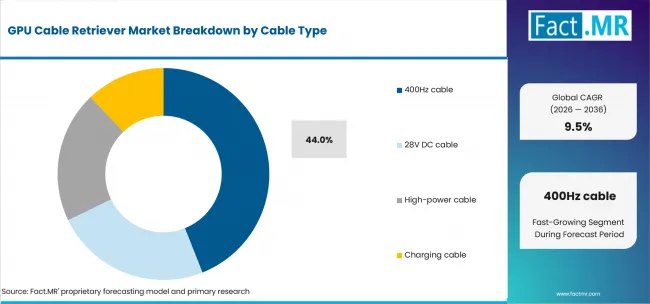
Gpu Cable Retriever Market Analysis By Cable Type | Source: Fact.MR
400Hz cable leads because commercial aircraft at contact gates need stable alternating current while parked. The cable type segment is projected to capture 44.0% share in 2026 as airports protect expensive aircraft power cables from dragging and ground damage. 28V DC cable supports regional aircraft and business aviation. High-power cable grows with larger aircraft power demand. Charging cable gains traction as eGSE and battery GPU charging points expand. ITW GSE states that its aircraft cable product line includes 400Hz cable assemblies, cable retrievers and related kits.
Which installation dominates?
Passenger boarding bridge installations hold 41.0% share in 2026.
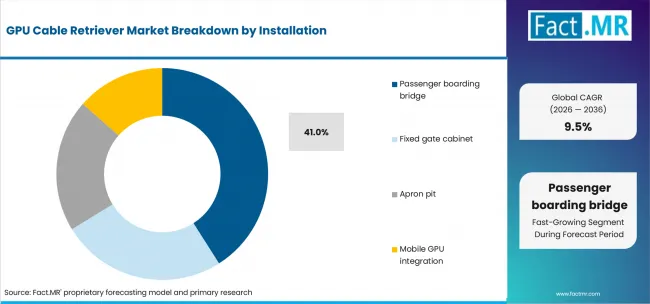
Gpu Cable Retriever Market Analysis By Installation | Source: Fact.MR
Passenger boarding bridge installations lead because contact gates need cable reach without cluttering the apron. The installation segment is likely to account for 41.0% share in 2026 as airports mount cable retrievers on bridges or near bridge power systems. Fixed gate cabinets follow where airports use point-of-use converters. Apron pits are important where underground systems keep cables away from vehicle paths. Mobile GPU integration supports flexible stand operations. Higher traffic at contact gates also raises cable wear, as ACI World projected passenger traffic to reach 9.5 billion in 2024.
Which feature dominates?
Cable protection holds 35.0% share in 2026.
Gpu Cable Retriever Market Analysis By Feature | Source: Fact.MR
Cable protection leads because 400Hz and 28V DC aircraft cables face repeated movement, abrasion and plug handling. The feature segment is expected to hold 35.0% share in 2026 as airports use retrievers to extend cable life and reduce damage. Automatic rewind follows because it saves ramp time. Trip hazard reduction is important near bridge and service lanes. Remote monitoring is smaller today but grows where airports track equipment health. Cleaner cable routing also supports safer sequencing with belt loaders after aircraft power is connected.
Which buyer type dominates?
Airport operators hold 39.0% share in 2026.
Gpu Cable Retriever Market Analysis By Buyer Type | Source: Fact.MR
Airport operators lead because they manage gate safety, equipment uptime and airside electrical infrastructure. The buyer-type segment is projected to record 39.0% share in 2026 as airports add cable retrievers during gate upgrades and GPU electrification. PBB integrators follow because cable routing must work with bridge movement. Electrical contractors handle fixed gate cabinet and apron pit projects. GSE suppliers add retrievers to GPU packages. IATA highlighted safety and sustainability as ground handling priorities in 2025.
What is accelerating GPU Cable Retriever Market adoption, and what is holding it back?
Gate electrification and cable protection drive it; retrofit complexity and upfront cost restrain it.
Drivers Impact Analysis
| DRIVER | (~) % IMPACT ON CAGR | GEOGRAPHIC RELEVANCE | IMPACT TIMELINE |
|---|---|---|---|
| Gate electrification increasing cable-management needs | +1.1% | United States, UAE, Germany, Japan | Short term (≤ 2 years) |
| Cable protection reducing damage to expensive aircraft power cables | +0.9% | Large hubs and high-use regional airports | Medium term (2–4 years) |
| Trip hazard reduction improving ramp safety around contact gates | +0.8% | Global, strongest in busy terminals | Short term (≤ 2 years) |
| Battery GPU and eGSE charging increasing cable clutter | +0.7% | North America, Europe, East Asia | Medium term (2–4 years) |
| Remote monitoring supporting preventive maintenance | +0.5% | Large hubs and premium terminals | Long term (≥ 4 years) |
Source: Fact.MR analysis. Updated Jul 6, 2026
- Gate electrification
- Gate electrification is the strongest driver because more aircraft power and charging cables are appearing around stands. Cable retrievers help store these cables safely after each aircraft turn. They also reduce manual dragging across the apron. This driver also supports cleaner workflows around aircraft tugs when ramp fleets are modernized together.
- Cable protection
- Cable protection supports demand because aircraft power cables are costly and exposed to repeated mechanical stress. Retrievers reduce ground contact and uncontrolled bending. This helps airports extend cable life and reduce service disruption. The driver is strongest at contact gates with frequent aircraft turns.
- Trip hazard reduction
- Trip hazard reduction improves the safety case for cable retrievers. Loose ground power cables can interfere with ramp staff and service equipment. Retrieval systems keep cables organized and reduce clutter near the aircraft. This benefit is important where several service tasks happen in a short turnaround window.
- Battery GPU and eGSE charging
- Battery GPU and eGSE charging increase cable-management needs because charging cables add more movement around gates and service areas. Airports need organized routing so charging does not create ramp hazards. Cable retrievers and coilers can support safer charging routines. Charging infrastructure expansion can also support aircraft tow tractors when multiple GSE categories electrify together.
- Remote monitoring
- Remote monitoring supports long-term value because airports can track cable use, current levels and retriever condition. This helps maintenance teams find wear before failure. Monitoring is most useful at high-use gates. It can also support preventive maintenance for PBB-mounted cable systems.
Opportunity Impact Analysis
| OPPORTUNITY | (~) % IMPACT ON CAGR | GEOGRAPHIC RELEVANCE | IMPACT TIMELINE |
|---|---|---|---|
| Under-bridge retrievers for PBB-mounted power systems | +0.8% | United States, Germany, UAE, Japan | Short term (≤ 2 years) |
| Pop-up pit-mounted systems for cleaner apron surfaces | +0.7% | Europe, Middle East, Singapore | Medium term (2–4 years) |
| Charging cable retrievers for battery GPU and eGSE zones | +0.6% | North America, Europe, India | Medium term (2–4 years) |
| Remote monitoring modules for high-use contact gates | +0.4% | Large hub airports globally | Long term (≥ 4 years) |
Source: Fact.MR analysis. Updated Jul 6, 2026
- Under-bridge retrievers
- Under-bridge retrievers create opportunity because many contact gates already use PBB-mounted ground power. The retriever can follow bridge movement and keep the cable stored when not in use. This reduces apron clutter near the aircraft stand. It also supports smoother bridge and power coordination.
- Pop-up pit-mounted systems
- Pop-up pit-mounted systems create opportunity where airports want a cleaner apron surface. Cables can be stored below grade and pulled out only when needed. This can reduce vehicle interference and weather exposure. Fixed gate upgrades can align with airfield ground lighting programs when airports modernize airside electrical infrastructure together.
- Charging cable retrievers
- Charging cable retrievers create opportunity as airports add battery GPUs and other eGSE charging points. Charging cables need safe storage between shifts. Retriever systems can reduce damage and improve charging station housekeeping. This opportunity grows where ground handlers use mixed electric fleets.
- Remote monitoring modules
- Remote monitoring modules create opportunity at high-use gates where cable failure can delay aircraft servicing. Sensors can track cable position, current and usage cycles. Maintenance teams can schedule service before a retriever fails. This fits airports that already monitor PBB and gate equipment.
Restraints Impact Analysis
| RESTRAINT | (~) % IMPACT ON CAGR | GEOGRAPHIC RELEVANCE | IMPACT TIMELINE |
|---|---|---|---|
| Retrofit complexity on older passenger boarding bridges | -0.8% | Global, strongest in brownfield terminals | Short term (≤ 2 years) |
| Upfront cost versus manual cable handling | -0.7% | Regional airports and budget-constrained terminals | Medium term (2–4 years) |
| Harsh apron conditions increasing maintenance needs | -0.6% | Global | Medium term (2–4 years) |
| Limited standardization across cable lengths and gate layouts | -0.5% | Global | Long term (≥ 4 years) |
Source: Fact.MR analysis. Updated Jul 6, 2026
- Retrofit complexity
- Retrofit complexity is the main restraint because older PBBs and fixed gate cabinets may not have space for a cable retriever. Installation can require structural checks and electrical work. Gate downtime also matters during retrofit. This slows deployment in brownfield terminals.
- Upfront cost
- Upfront cost slows adoption where manual cable handling is still accepted. Regional airports may see retrievers as optional hardware. Suppliers need to show cable-life savings and safety value. The business case is strongest where cable damage is frequent.
- Apron durability
- Apron durability matters because retrievers operate in heat, cold, jet blast and water exposure. Moving parts must tolerate repeated use. Cable drums and guides need simple field service. Poor durability can reduce confidence in the system.
- Layout standardization
- Layout standardization is difficult because gate geometry, bridge type, aircraft mix and cable length differ by airport. A retriever that fits one stand may need modification at another. This raises installation effort. Modular mounting and adjustable cable paths can reduce the issue.
Which countries are scaling GPU cable retrievers fastest?
United States 10.4%; UAE 10.1%; Germany 9.7%; Japan 9.2%; India 8.8%.
Based on regional analysis, the GPU cable retriever market is segmented into North America, Western Europe, East Asia, South Asia, Latin America, and Middle East and Africa.
| Country | CAGR |
|---|---|
| United States | 10.4% |
| UAE | 10.1% |
| Germany | 9.7% |
| Japan | 9.2% |
| India | 8.8% |
Source: Fact.MR analysis. Updated Jul 6, 2026
Gpu Cable Retriever Market Cagr Analysis By Country | Source: Fact.MR
What is powering the United States lead?
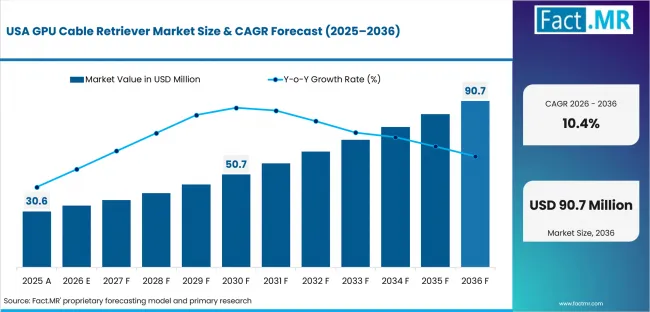
10.4% CAGR, driven by FBO upgrades and large hub gate electrification.
Gpu Cable Retriever Market Country Value Analysis | Source: Fact.MR
The United States is projected to record 10.4% CAGR from 2026 to 2036 as airports and FBOs add cable retrievers to contact gates, hangars and fixed ground power cabinets. Growth will favor motorized retrievers, 400Hz cable systems and remote monitoring. Cable-management planning can also coordinate with aircraft refueler movement where ramp teams organize service equipment around the aircraft.
How is UAE scaling GPU cable retriever demand?
UAE is at 10.1%, scaling through electric GPU deployment and high-use hub gates.
UAE is expected to post 10.1% CAGR through 2036 as major hubs electrify ramp equipment and increase fixed gate power use. Cable retrievers will be important where electric GPUs and bridge-mounted power systems operate under tight turnaround schedules. Heat-resistant cables and durable retriever housings will shape adoption.
What supports Germany’s outlook?
9.7% CAGR, driven by airport electrical upgrades and PBB modernization.
Germany is likely to record a 9.7% CAGR by 2036 as airports modernize 400Hz ground power and bridge-mounted equipment. Demand will focus on under-bridge retrievers, fixed cabinets and cable-protection systems. Electrical contractors and PBB service firms will support retrofit activity.
What underpins Japan’s growth?
Japan is at 9.2%, scaling through lithium-ion eGPU use and compact gate layouts.
Japan is forecast to advance at a 9.2% CAGR through 2036 as airlines and airports adopt cleaner ground power equipment. Cable retrievers will support compact apron operations where cable clutter affects safety and timing. Growth will favor reliable rewind systems and 28V DC cable handling for smaller aircraft.
How is India scaling GPU cable retriever adoption?
8.8% CAGR, driven by new airport projects and passenger boarding bridge expansion.
India is set to record an 8.8% CAGR through 2036 as terminal expansion adds PBBs and apron power systems. New-build terminals will support easier retriever installation than brownfield sites. Growth will favor cost-effective motorized and spring-driven systems.
Who leads the GPU cable retriever market?
ITW GSE leads direct cable retriever coverage, while Dabico Airport Solutions and PBB integrators support gate power cable-management pathways.
GPU cable retrievers are supplied by aircraft ground power specialists, PBB integrators and airport electrical equipment companies. ITW GSE is the clearest direct provider through the 2400 Cable Retriever and aircraft cable portfolio. Dabico Airport Solutions is relevant through airport connection and electrification systems.
Unitron Power Systems is relevant where gate systems, docking and apron operations connect with ground power coordination. Oshkosh AeroTech is the current pathway for former JBT AeroTech airside equipment activity, so it is better listed in place of JBT AeroTech. Cable retriever demand can also align with ground support equipment tires replacement cycles when airports modernize airside GSE and gate equipment together.
Competition through 2036 will be shaped by cable life, installation flexibility, bridge compatibility, safety features and service support. Vendors that offer retrievers with aircraft cables, ground power units and gate integration support will be better placed than suppliers selling stand-alone reels.
Which companies are the key providers?
ITW GSE and Dabico Airport Solutions are key providers. TK Airport Solutions are also profiled. Unitron Power Systems and Oshkosh AeroTech complete the company set.
- Dabico Airport Solutions
- ITW GSE
- TK Airport Solutions
- Unitron Power Systems
- Oshkosh AeroTech
Bibliography
- ITW GSE. (2026). 2400 Cable Retriever - 79 feet (24 m) of symmetrical cable. ITW GSE.
- ITW GSE. (2026). Aircraft cables. ITW GSE. Retrieved July 6, 2026.
- Airports Council International World. (2024, September 18). ACI World projects 10% growth for passenger traffic in 2024 to reach 9.5 billion. ACI World.
- International Air Transport Association. (2025, May 13). Ground handling priorities: Safety, baggage, global standardization and sustainability. International Air Transport Association.
- ADELTE. (2026). Passenger boarding bridges. ADELTE.
- TK Airport Solutions. (2026). Passenger boarding bridges. TK Elevator.
- Dabico FMT. (2026). Airport passenger service. Dabico FMT.
- ADB SAFEGATE. (2026). Search products and solutions from airfield, apron, tower, terminal and weather. ADB SAFEGATE.
- Oshkosh AeroTech. (2026). Comprehensive ground support equipment (GSE). Oshkosh AeroTech.
This Report Addresses
- Strategic intelligence on GPU cable retrievers across retriever type and cable type.
- Segment analysis covering Motorized Retrievers and 400Hz Cable.
- Regional outlook covering the United States, UAE, Germany, Japan and India.
- Competitive analysis of Dabico Airport Solutions, ITW GSE, TK Airport Solutions, Unitron Power Systems and Oshkosh AeroTech.
- Technology assessment covering spring-driven, motorized, pantograph, under-bridge and pop-up pit-mounted systems.
- Use case assessment covering automatic rewind, cable protection, trip hazard reduction and remote monitoring.
- Scope screening separates cable retrievers from GPU power conversion hardware.
- Primary interviews, provider checks and official source review support the forecast.
What does the GPU cable retriever market cover?
Cable retrieval and management systems used with aircraft ground power equipment.
The GPU cable retriever market covers spring-driven, motorized, pantograph, under-bridge and pop-up pit-mounted retrievers. These systems manage 400Hz cable, 28V DC cable, high-power cable and charging cable.
The market differs from broad GPU coverage because it focuses on cable movement and protection. It excludes ground power units and passenger boarding bridges unless cable retriever revenue is separately specified.
What is included in the scope?
Cable retrievers and aircraft ground power cable handling equipment.
The scope includes retrievers installed on passenger boarding bridges and mobile GPU systems. Feature coverage includes automatic rewind and remote monitoring.
Buyer-type coverage includes airport operators and GSE suppliers. GPU cable retrievers can also operate near passenger boarding bridge systems when bridge-mounted cables must reach aircraft safely.
What is excluded from the scope?
GPU power conversion hardware and ordinary electrical cables are outside the scope.
The scope excludes diesel GPUs and generic airport cabling unless a cable retrieval device is part of the supplied system. It also excludes manual cable hangers and simple cable trays without retrieval or protection functionality.
How was the analysis built?
100+ sources, 40+ company portfolios, 25+ countries, 20+ interviews.
- Primary Research:
- Primary research includes interviews with airport electrical teams, PBB integrators and GSE suppliers. It includes input from ground handlers, gate equipment OEMs, electrical contractors and airport maintenance teams.
- Desk Research:
- Desk research reviews official cable retriever product pages, aircraft cable portfolios, electric GPU deployments, passenger boarding bridge systems and ground handling safety guidance.
- Market-Sizing and Forecasting:
- Forecasting uses gate count, GPU fleet conversion, PBB installation rates, 400Hz cable replacement cycles and airport electrification projects.
- Data Validation and Update Cycle:
- Forecasts are validated through provider checks and technical interviews. Installation type, cable length, retriever type and power-system compatibility help confirm market direction.
Segmentation
What is the report’s scope and coverage?
| Attribute | Details |
|---|---|
| Quantitative Units | USD Million in 2026 to USD Million by 2036 at CAGR |
| Market Definition | Cable retrieval and management systems used with aircraft ground power equipment |
| Retriever Type | Spring-driven; motorized; pantograph; under-bridge; pop-up pit-mounted |
| Cable Type | 400Hz cable; 28V DC cable; high-power cable; charging cable |
| Installation | Passenger boarding bridge; fixed gate cabinet; apron pit; mobile GPU integration |
| Feature | Automatic rewind; cable protection; trip hazard reduction; remote monitoring |
| Buyer Type | Airport operators; PBB integrators; electrical contractors; GSE suppliers |
| Regions Covered | North America; Western Europe; East Asia; South Asia; Latin America; Middle East and Africa |
| Countries Covered | United States; UAE; Germany; Japan; India |
| Key Companies Profiled | Dabico Airport Solutions; ITW GSE; TK Airport Solutions; Unitron Power Systems; Oshkosh AeroTech |
| Forecast Period | 2026 to 2036 |
| Approach | Hybrid top-down and bottom-up approach using gate electrification, PBB installations, GPU fleet conversion, cable replacement cycles and provider validation |
Source: Fact.MR analysis. Updated Jul 6, 2026
How is the market segmented?
By Retriever Type:
- Spring-driven
- Motorized
- Pantograph
- Under-bridge
- Pop-up pit-mounted
By Cable Type:
- 400Hz cable
- 28V DC cable
- High-power cable
- Charging cable
By Installation:
- Passenger boarding bridge
- Fixed gate cabinet
- Apron pit
- Mobile GPU integration
By Feature:
- Automatic rewind
- Cable protection
- Trip hazard reduction
- Remote monitoring
By Buyer Type:
- Airport operators
- PBB integrators
- Electrical contractors
- GSE suppliers
Region:
- North America
- United States
- Canada
- Western Europe
- Germany
- United Kingdom
- France
- Netherlands
- Spain
- East Asia
- Japan
- China
- South Korea
- South Asia
- India
- Singapore
- Thailand
- Latin America
- Brazil
- Mexico
- Chile
- Middle East & Africa
- UAE
- Saudi Arabia
- South Africa
Frequently Asked Questions
Which retriever type leads the GPU Cable Retriever Market?
Which cable type leads the GPU Cable Retriever Market?
Which installation leads the GPU Cable Retriever Market?
Which feature leads the GPU Cable Retriever Market?
Which buyer type leads the GPU Cable Retriever Market?
Which country expands fastest in the GPU Cable Retriever Market?
How does UAE perform in the GPU Cable Retriever Market?
How does Germany perform in the GPU Cable Retriever Market?
How does Japan perform in the GPU Cable Retriever Market?
How does India perform in the GPU Cable Retriever Market?
What is the primary driver in the GPU Cable Retriever Market?
What is the main restraint in the GPU Cable Retriever Market?
Why are motorized retrievers important?
Why do airport operators dominate demand?
Who worked on this report


Preview the report firsthand - request a free sample
Free SampleGet the brochure for pricing and purchase details
Download PDF