- Market Value (2025): USD 315.4 Mn
- Estimated Value (2026): USD 410.0 Mn
- Forecast Value (2036): USD 5652.0 Mn
- CAGR (2026-2036): 30.0%
What is the Graphene Sensing Chips Market forecast to be worth by 2036?
USD 410.0 million in 2026 to USD 5652.0 million by 2036 at a 30.0% CAGR.
- The graphene sensing chips market reached USD 315.4 million in 2025.
- Demand is projected to increase from USD 410.0 million in 2026 to USD 5652.0 million by 2036.
- The market is forecast to record 30.0% CAGR from 2026 to 2036 as edge AI devices, automotive electronics and biosensor developers test graphene-enabled detection paths.
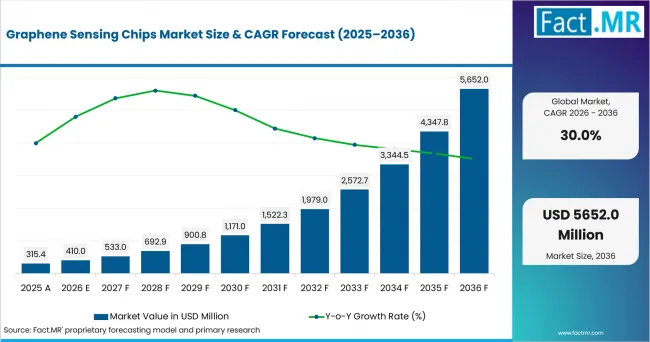
Graphene Sensing Chips Market Value Analysis | Source: Fact.MR
What are the defining numbers behind Graphene Sensing Chips Market growth?
An absolute opportunity of USD 5242.0 million is expected between 2026 and 2036.
- Demand Drivers in the Market
- Automotive electronics teams need compact sensing elements that read current, gas and pressure changes inside power modules and cabin systems.
- Edge device designers need low-power signal capture near the source, so inference processors receive cleaner inputs before sending selected results onward.
- Medical-device developers need high-sensitivity biosensing surfaces where graphene field-effect transistors detect charge changes close to the channel.
- The International Energy Agency's Energy and AI report projects electricity consumption in accelerated servers, mainly driven by AI adoption, to grow 30% annually in its Base Case from 2024 to 2030.
- Key Segments Analyzed
- By Architecture: Edge AI is expected to hold 38.0% share in 2026 because sensing at the device edge reduces delay and limits raw data movement.
- By Packaging: 2.5D is projected to account for 41.0% share in 2026 as chip designers place sensing dies closer to processors and interconnect features.
- By Function: Inference is anticipated to capture 44.0% share in 2026 owing to local decisions that need clean sensor input before a model acts.
- By End use: Automotive is estimated to represent 39.0% share in 2026, supported by battery, cabin and external-environment sensing requirements.
- Analyst Opinion at Fact.MR
- Shambhu Nath Jha, Principal Consultant at Fact.MR, states, “Graphene sensing chips are drawing attention because material quality and package behavior are being judged together. Demand is expected to favor devices that show repeatable wafer response and useful signal gain under normal production tests. Suppliers should combine graphene growth control, CMOS integration evidence and customer-ready evaluation kits.”
- Strategic Implications
- Chip designers should document graphene channel stability and package behavior before asking customers to change a sensor architecture.
- Automotive suppliers should align graphene sensing claims with battery, cabin and ADAS validation routes that electronics teams already understand.
- Medical-device developers should connect biosensor evidence with analytical performance requirements and keep claims within validated test boundaries.
- For sensor applications requiring advanced multi-die integration, packaging partners can support 2.5D package layouts, board- and system-level test capabilities, and reliability characterization to facilitate customer qualification and integration.
The USA is expected to post 35.4% CAGR through 2036, supported by advanced packaging funding and electronics qualification routes. Japan is projected to reach 30.3% as semiconductor policy and machinery orders support chip trials. The UK is anticipated to record 27.8% through AI hardware support and local graphene device work. South Korea is estimated to hold 24.7% as electronics exports and automation needs sustain edge-sensing routes. Germany is forecast to reach 23.7% through industrial electronics and graphene research infrastructure.
How does the Graphene Sensing Chips Market break down by segment?
Edge AI leads Architecture at 38.0%; 2.5D leads Packaging at 41.0%.
Which Architecture dominates?
Edge AI is expected to hold 38.0% share in 2026.
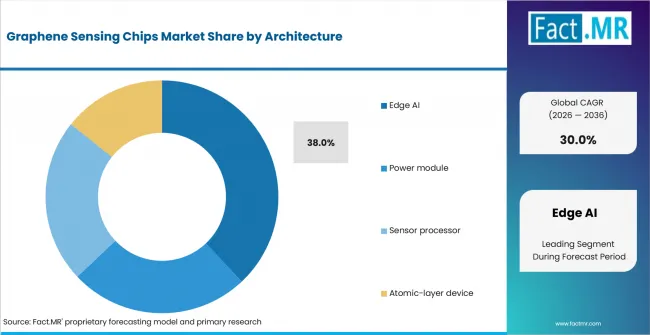
Graphene Sensing Chips Market Analysis By Architecture | Source: Fact.MR
Edge AI leads because a sensing chip gains value when it turns a physical signal into a cleaner decision near the device. Automotive platforms and factory equipment need fast local response when a leak, current shift or thermal event appears.
Graphene channels fit this role because the exposed surface reacts close to the signal source. Device teams evaluate repeatability first, since a fast sensor loses commercial value when its output changes across lots.
What leads the Packaging segment?
2.5D is projected to account for 41.0% share in 2026.
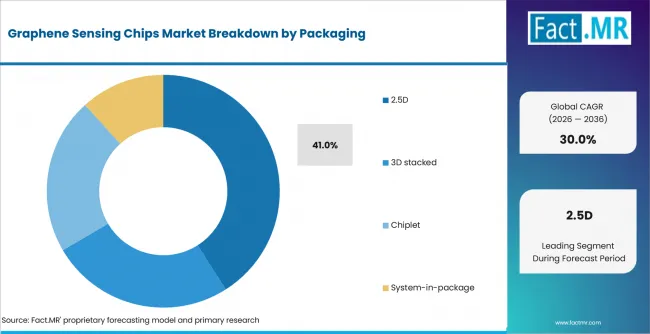
Graphene Sensing Chips Market Analysis By Packaging | Source: Fact.MR
2.5D packaging leads because graphene sensing surfaces need short paths to control logic and power-management elements. The format gives test teams a route to combine sensing dies with CMOS readout and system boards.
Paragraf introduced the PMF2000 GFET on May 12, 2026, expanding its graphene field-effect transistor product line. The company describes the device as designed for reliable, repeatable sensing and customer-configured applications.
How does Function shape demand?
Inference is anticipated to lead with 44.0% share in 2026.
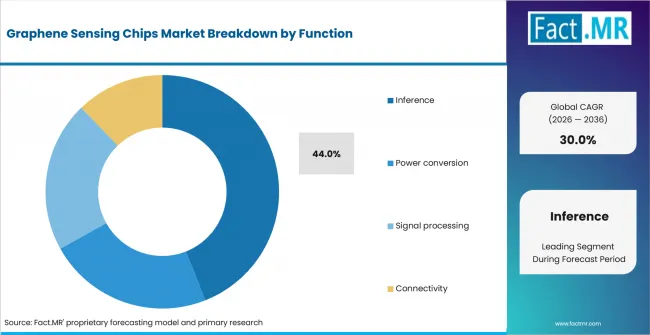
Graphene Sensing Chips Market Analysis By Function | Source: Fact.MR
Inference leads because the sensor signal increasingly feeds a local decision model. Better signal quality helps edge processors classify a biological event, gas exposure or power fault with fewer repeated measurements.
Graphenea Semiconductor and Melexis announced a strategic collaboration on November 21, 2025 to evaluate an integrated GFET-on-CMOS platform for advanced biosensing. The collaboration combines Melexis' semiconductor-integration expertise with Graphenea's graphene-transistor capabilities.
What supports Automotive within End use?
Automotive is estimated to represent 39.0% share in 2026.
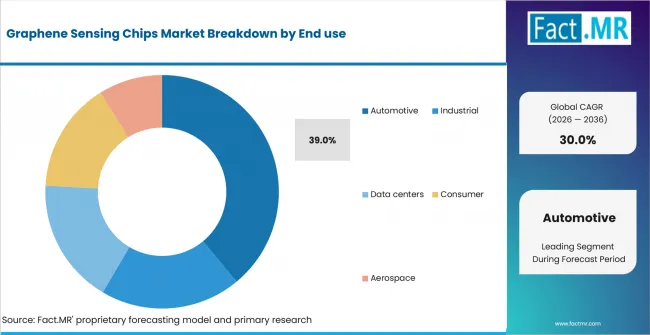
Graphene Sensing Chips Market Analysis By End Use | Source: Fact.MR
Automotive leads because electric and assisted-driving platforms need more sensing points inside compact electronics. Graphene sensing chips fit current, pressure, gas and environmental monitoring where space and power budgets are tight.
What is accelerating Graphene Sensing Chips Market adoption, and what is holding it back?
Demand is expected to rise through edge electronics, 2.5D packaging and biosensing work. Adoption is constrained by wafer repeatability, qualification cycles and production test cost.
Drivers Impact Analysis
| DRIVER | (~) % IMPACT ON CAGR | GEOGRAPHIC RELEVANCE | IMPACT TIMELINE |
|---|---|---|---|
| GFET-on-CMOS biosensing integration | +2.6% | North America, Europe | Short term (<= 2 years) |
| 2.5D packaging and heterogeneous integration | +2.1% | Global | Medium term (2-4 years) |
| Automotive battery and cabin sensing needs | +1.7% | USA, UK, Japan | Medium term (2-4 years) |
| Data center and industrial power monitoring | +1.2% | USA, East Asia, Western Europe | Long term (>= 4 years) |
Source: Fact.MR analysis. Updated Aug 27, 2026
- GFET-on-CMOS biosensing integration: Developers are moving graphene sensing surfaces closer to CMOS readout logic. This narrows the gap between material tests and chip evaluation.
- 2.5D packaging and heterogeneous integration: Compact packaging lets sensing, signal conditioning and processing operate near each other. Shorter paths improve signal handling in space-limited devices.
- Automotive battery and cabin sensing needs: Electric vehicles create sensing points around current, gas and pressure. Chip-level graphene devices suit small spaces where repeatability is tested often.
- Data center and industrial power monitoring: AI infrastructure and factory automation raise demand for fast power and fault signals. Graphene sensing chips address high-response monitoring where discrete sensors add delay.
Opportunity Impact Analysis
| OPPORTUNITY | (~) % IMPACT ON CAGR | GEOGRAPHIC RELEVANCE | IMPACT TIMELINE |
|---|---|---|---|
| Evaluation kits for graphene biosensor developers | +1.5% | USA, UK, Europe | Short term (<= 2 years) |
| Chiplet and system-in-package sensor formats | +1.2% | Global | Medium term (2-4 years) |
| Industrial inspection and robot sensing modules | +1.0% | Germany, Japan, South Korea | Medium term (2-4 years) |
Source: Fact.MR analysis. Updated Aug 27, 2026
- Evaluation kits for graphene biosensor developers: Standard kits shorten early testing and reduce custom design work. Customers can compare graphene response before a dedicated product program.
- Chiplet and system-in-package sensor formats: Sensor chips can pair with processing and power functions in modular packages. This route suits applications where a full single-die redesign is expensive.
- Industrial inspection and robot sensing modules: Robots and machine tools need compact sensors near moving parts. Graphene surfaces give developers another route for gas, pressure and electrical detection.
Restraints Impact Analysis
| RESTRAINT | (~) % IMPACT ON CAGR | GEOGRAPHIC RELEVANCE | IMPACT TIMELINE |
|---|---|---|---|
| Wafer uniformity and graphene transfer repeatability | -0.8% | Global | Short term (<= 2 years) |
| Automotive and medical qualification cycles | -0.6% | USA, Europe, Japan | Medium term (2-4 years) |
| Packaging and production test cost | -0.5% | Global | Medium term (2-4 years) |
Source: Fact.MR analysis. Updated Aug 27, 2026
- Wafer uniformity and graphene transfer repeatability: Customers need stable performance across wafers and lots. Variability raises test cost and slows the shift from samples to qualified supply.
- Automotive and medical qualification cycles: Sensor chips enter systems where reliability evidence is reviewed carefully. Graphene devices must show performance under existing product approval routines.
- Packaging and production test cost: New materials add process checks that conventional sensors avoid. Higher test effort delays volume orders until yields become predictable.
Which countries are scaling the Graphene Sensing Chips Market through 2036?
- The country comparison spans 11.7 percentage points between the USA and Germany across the forecast period.
- The USA remains 5.1 percentage points above Japan as advanced packaging funding supports early graphene-chip qualification.
- Japan remains 2.5 percentage points above the UK through semiconductor policy and precision manufacturing demand.
- The UK remains 3.1 percentage points above South Korea as AI hardware funding and graphene device work support commercialization.
- South Korea remains 1.0 percentage point above Germany through electronics exports and automation-linked edge sensing.
- Germany closes the displayed range as industrial orders and graphene research infrastructure keep adoption tied to factory validation.
Comparable CAGRs create different entry conditions due to packaging access, qualification culture, vehicle electronics depth and local graphene supply. Full report coverage includes North America, Latin America, Western Europe, Eastern Europe, East Asia, South Asia & Pacific, Middle East & Africa.
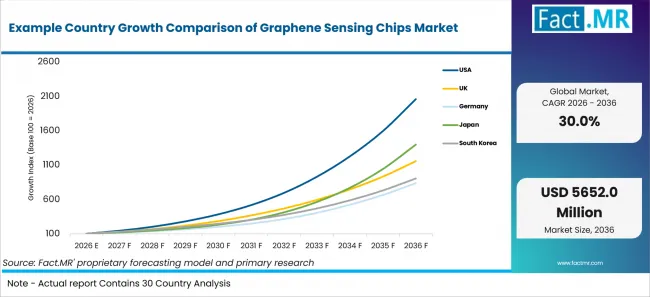
Example Country Growth Comparison Of Graphene Sensing Chips Market | Source: Fact.MR
| Country | CAGR (2026-2036) |
|---|---|
| United States | 35.4% |
| Japan | 30.3% |
| United Kingdom | 27.8% |
| South Korea | 24.7% |
| Germany | 23.7% |
Source: Fact.MR analysis. Updated Aug 27, 2026
What supports USA adoption?
35.4% CAGR, supported by advanced packaging capacity and electronics qualification routes.
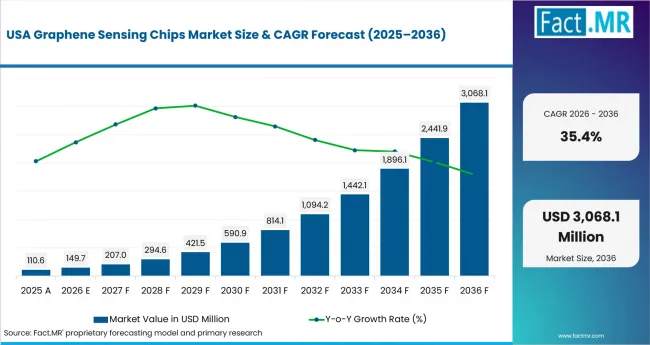
Graphene Sensing Chips Market Country Value Analysis | Source: Fact.MR
On January 16, 2025, the U.S. Department of Commerce announced USD 1.4 billion in final CHIPS National Advanced Packaging Manufacturing Program awards to support advanced-packaging R&D, technology validation and piloting, and the transition of new technologies at scale to U.S. manufacturing.
How is Japan scaling demand?
30.3% CAGR, led by semiconductor policy and precision manufacturing demand.
Japan's electronics customers favor sensor chips with repeatable performance and long reliability records. The Cabinet Office published its June 2026 Machinery Orders release on August 19, 2026; total machinery orders received by 280 manufacturers rose 11.3% in April-June 2026 from the previous quarter.
What supports the United Kingdom’s growth?
27.8% CAGR, backed by AI hardware funding and local graphene device work.
The UK has a clear route from graphene research into packaged sensing products because domestic device firms are active in GFET platforms. The UK government announced a £1.1 billion AI Hardware Plan on June 8, 2026, to support British AI-hardware and semiconductor companies, expand AI computing infrastructure and strengthen relevant skills and workforce capabilities.
How is South Korea developing demand?
24.7% CAGR, supported by electronics exports and automation use.
South Korea's electronics export base provides a broad commercialization environment for advanced sensing devices. MOTIR and MSIT announced on August 14, 2026 that Korea's ICT exports reached USD 53.36 billion in July 2026, up 140.6% year on year.
What is supporting Germany’s adoption?
23.7% CAGR, shaped by industrial electronics and graphene research infrastructure.
Germany's industrial electronics base creates demand for reliable sensing in machines, vehicles and factory systems. Destatis reported on August 6, 2026 that real new orders in manufacturing rose 3.1% in June 2026 from the previous month on a seasonally and calendar-adjusted basis. The release also shows that large-scale orders materially influenced the headline result.
Who leads the Graphene Sensing Chips Market?
Paragraf is a leading commercialization participant in graphene electronics, supported by commercially available GFET devices, evaluation kits and molecular-sensing platforms. On August 18, 2026, Paragraf launched the PMF2002 GFET Platform and Enterprise Reader for applications including water quality, soil analysis, gas detection and molecular biosensing. The company positions the combined platform as a streamlined pathway from concept to measurement results and real-time analysis.
Graphenea Semiconductor supplies GFET chips and graphene foundry services and participates in biosensing collaborations, including its GFET-on-CMOS work with Melexis. Emberion, acquired by Exosens in April 2026, developed VIS-SWIR imaging sensors based on colloidal-quantum-dot photodiodes integrated with CMOS readout electronics. GraphWear Technologies develops investigational needle-free continuous-glucose-monitoring technology, while Haydale supplies functionalised graphene biosensor inks and related sensor materials.
Competition centers on wafer control, GFET sensitivity and evidence that graphene devices can work with CMOS readout. Packaging support and evaluation boards are becoming as relevant as the graphene layer itself, since customers need a testable product before moving into automotive, medical or industrial design programs.
Which companies are the key providers?
Key companies include Paragraf; Graphenea Semiconductor; Emberion; GraphWear Technologies.
- Paragraf
- Graphenea Semiconductor
- Emberion
- GraphWear Technologies
Bibliography
- International Energy Agency. (2025, April 10). Energy and AI.
- U.S. Department of Commerce. (2025, January 16). U.S. Department of Commerce announces $1.4 billion in final awards to support the next generation of U.S. semiconductor advanced packaging.
- Paragraf. (2025, November 17). Paragraf debuts new GFET Discovery Kit at I2DM2025 Summit.
- Paragraf. (2026, May 12). Paragraf introduces PMF2000 GFET.
- Paragraf. (2026, August 18). Paragraf launches PMF2002 GFET Platform and Enterprise Reader, expanding sensing portfolio.
- Graphenea Semiconductor. (2025, November 21). Melexis and Graphenea accelerate graphene biosensor development.
- Department for Transport. (2026, April 29). Vehicle licensing statistics, United Kingdom: 2025. GOV.UK.
- Economic and Social Research Institute. (2026, August 19). Machinery orders in June, 2026 and forecast for Jul.-Sep. 2026. Cabinet Office, Government of Japan.
- Ministry of Trade, Industry and Resources, & Ministry of Science and ICT. (2026, August 14). Korea’s ICT exports reach record $53.36 billion for July.
- Department for Science, Innovation and Technology. (2026, June 8). A decisive shift to power British AI: New £1.1 billion plan to back chip firms, boost computing power and skills for the AI revolution. GOV.UK.
- Federal Statistical Office (Destatis). (2026, August 6). New orders in manufacturing in June 2026: +3.1% on the previous month.
- Exosens. (2026, April 27). Exosens delivers strong Q1 2026 performance, with accelerating defense momentum in digital imaging and night vision: Fully on track to deliver on 2026 guidance.
This Report Answers
- The report explains where graphene sensing chips are used across architecture and packaging. It also covers function and end use.
- Segment analysis identifies the main subsegments and the operating reasons customers prioritize them.
- Country analysis examines the listed markets and the policy, electronics and manufacturing mechanisms supporting adoption.
- Competitive analysis reviews current providers across GFET platforms, graphene foundry services, photodetection and functionalized sensor materials.
- Application analysis assesses how signal stability, packaging density and qualification evidence influence purchase decisions.
What does the Graphene Sensing Chips Market cover?
The Graphene Sensing Chips Market covers chip-level devices that use graphene as an active sensing layer or transducer. It includes GFET devices, graphene-linked photodetectors and sensing dies used near signal-processing electronics. Related demand is assessed alongside graphene materials and 2D materials graphene where material quality influences chip outcomes.
The assessment covers edge AI architecture, 2.5D packaging, inference functions and automotive end use. It also considers adjacent routes in graphene ADAS sensors, graphene spoilage sensors and graphene VOC sensors where sensing surface behavior affects customer selection.
What is included in the scope?
The scope includes graphene field-effect transistor sensing chips, graphene photodetector chips, packaged sensor platforms and evaluation kits tied to chip-level development. It also includes designs that connect graphene layers with graphene electrodes or graphene interconnects when they support sensing functions.
Included products must have a chip, die, package or board-level route for electronics integration. The scope covers adjacent packaging links with 3D semiconductor packaging and electronic monitoring routes connected to the current sensor category.
What is excluded from the scope?
The scope excludes bulk graphene powders, coatings and composite additives sold without a chip-level sensing function. It also excludes general semiconductor components that lack a graphene sensing layer, even when they serve the wider automotive semiconductor supply chain.
Research-only devices are excluded when they lack a credible route to packaged evaluation or production testing. General sensors are excluded when the graphene role is limited to an external coating or passive material input.
How Was the Analysis Built?
The analysis draws on 120+ sources, 35+ company portfolios, 25+ countries, and more than 20 industry interviews.
- Primary Research: Primary research includes discussions with manufacturers, service providers, technology developers, distributors, end users, procurement teams, and subject-matter experts. These conversations examine purchasing priorities, product adoption, operational challenges, approval requirements, competitive positioning, and the factors that influence wider market acceptance.
- Desk Research: Desk research covers government statistics, regulatory publications, company filings, trade data, technical studies, industry associations, standards, public policy, and other authoritative sources. Every source used in the analysis is documented in the bibliography.
- Market Sizing and Forecasting: Market estimates combine historical performance, demand indicators, pricing and volume trends, segment shares, company participation, country-level growth, adoption patterns, investment activity, and barriers to market expansion.
- Data Validation and Update Cycle: Findings are validated by comparing primary interviews with public data, company activity, regulatory changes, trade patterns, and industry developments. Regular updates review new product launches, capacity changes, partnerships, approvals, procurement trends, and shifts in commercial adoption.
Segmentation
What is the report’s scope and coverage?
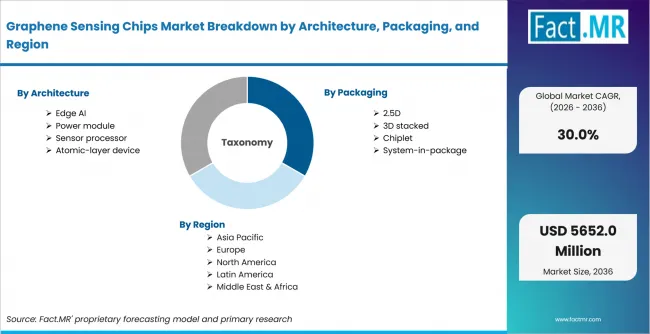
Graphene Sensing Chips Market Breakdown By Architecture, Packaging, And Region | Source: Fact.MR
| Attribute | Details |
|---|---|
| Quantitative Units | USD million in 2026 to USD million by 2036 at a CAGR |
| Market Definition | Graphene sensing chips are chip-level sensing devices that use graphene channels, graphene layers or graphene-linked transducers to detect electrical, chemical, optical or physical signals. |
| Architecture | Edge AI; Power module; Sensor processor; Atomic-layer device |
| Packaging | 2.5D; 3D stacked; Chiplet; System-in-package |
| Function | Inference; Power conversion; Signal processing; Connectivity |
| End use | Automotive; Industrial; Data centers; Consumer; Aerospace |
| Regions Covered | North America; Latin America; Western Europe; Eastern Europe; East Asia; South Asia & Pacific; Middle East & Africa |
| Countries Covered | United States; United Kingdom; Germany; Japan; South Korea |
| Key Companies Profiled | Paragraf; Graphenea Semiconductor; Emberion; GraphWear Technologies |
| Forecast Period | 2026 to 2036 |
| Approach | Hybrid top-down and bottom-up approach using device demand, chip packaging routes, country adoption, segment shares and provider portfolio review. |
Source: Fact.MR analysis. Updated Aug 27, 2026
How is the market segmented?
-
By Architecture:
- Edge AI
- Power module
- Sensor processor
- Atomic-layer device
-
By Packaging:
- 2.5D
- 3D stacked
- Chiplet
- System-in-package
-
By Function:
- Inference
- Power conversion
- Signal processing
- Connectivity
-
By End use:
- Automotive
- Industrial
- Data centers
- Consumer
- Aerospace
-
By Region:
- North America
- Latin America
- Western Europe
- Eastern Europe
- East Asia
- South Asia & Pacific
- Middle East & Africa
Frequently Asked Questions
How big is the graphene sensing chips market in 2026?
What is the CAGR of the graphene sensing chips market from 2026 to 2036?
Which architecture leads the graphene sensing chips market?
Which packaging segment leads the graphene sensing chips market?
Who are the leading companies in the graphene sensing chips market?
Who worked on this report


Preview the report firsthand - request a free sample
Free SampleGet the brochure for pricing and purchase details
Download PDF