- Market Value (2025): USD 1.7 Bn
- Estimated Value (2026): USD 1.9 Bn
- Forecast Value (2036): USD 6.4 Bn
- CAGR (2026-2036): 12.9%
What is the Green Bond and Sustainable Finance Reporting Software Market forecast to be worth by 2036?
USD 1.9 billion in 2026 to USD 6.4 billion by 2036 at 12.9% CAGR.
- The green bond and sustainable finance reporting software market reached USD 1.7 billion in 2025 as disclosure teams moved allocation and assurance records into controlled software workflows.
- Demand is projected to increase from USD 1.9 billion in 2026 to USD 6.4 billion by 2036.
- The market is forecast to record 12.9% CAGR from 2026 to 2036 as issuers need clearer evidence trails for sustainable finance reporting.
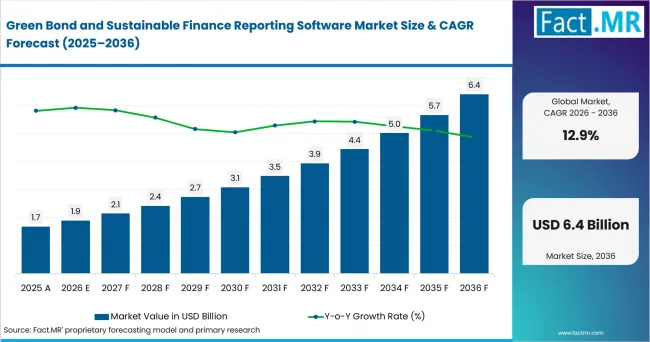
Green Bond And Sustainable Finance Reporting Software Market Value Analysis | Source: Fact.MR
What are the defining numbers behind Green Bond and Sustainable Finance Reporting Software Market growth?
USD 4.5 billion absolute opportunity is anticipated by 2036.
- Demand Drivers in the Market
- Issuers need audit-ready allocation records because green bond proceeds must be matched to eligible projects before investor reports are released.
- Banks and asset managers are expected to prefer platforms that join sustainable finance records with approval and portfolio monitoring workflows.
- Disclosure teams are anticipated to replace spreadsheet-based ESG reporting where data ownership and sign-off steps are hard to control.
- Funded climate and clean-energy projects are expected to lift demand for energy intelligence tools that turn operating data into finance-ready evidence.
- Sustainable finance teams need project-level carbon records before they can explain funded activities. The same requirement appears in digital decarbonization workflows.
- Key Segments Analyzed
- By Software Category: ESG Reporting Software is expected to hold 44.0% share in 2026 because it gives issuers a core system for disclosure and approval work.
- By Application: Green Bond Reporting is projected to account for 41.0% share in 2026 as issuers need records that support investor review.
- By End User: Banks & Financial Institutions are anticipated to capture 38.0% share in 2026 since lending and portfolio teams handle repeated reporting requests.
- By Deployment Model: Cloud-based Deployment is estimated to represent 63.0% share in 2026 due to faster rollout and easier shared access.
- By Technology Platform: Artificial Intelligence-enabled Analytics is forecast to hold 46.0% share in 2026 as users seek faster evidence review and disclosure mapping.
- Analyst Opinion at Fact.MR
- Shambhu Nath Jha, Senior Consultant at Fact.MR, states, “Green bond and sustainable finance reporting tools are moving from disclosure aids to finance controls. Adoption is expected to depend on how well vendors connect ESG evidence with project allocation. Buyers need assurance review in the same governed workflow.”
- Strategic Implications
- Product teams should design connector-ready data models so finance and sustainability users can work from one verified record.
- Vendors can improve adoption by building templates for green bond allocation and impact reporting. Assurance preparation needs the same workflow discipline.
- Investors should separate broad ESG data exposure from platforms that manage repeatable reporting workflows and disclosure controls.
The USA leads at 13.8% CAGR through enterprise software depth. The UK follows at 13.2% through sustainable finance activity. Germany reaches 12.8% through industrial reporting needs. Singapore records 12.3%. Canada reaches 11.7%. Japan posts 11.2%. France reaches 10.6%.
How does the Green Bond and Sustainable Finance Reporting Software Market break down by segment?
ESG Reporting Software is expected to lead Software Category at 44.0% share in 2026. Green Bond Reporting is projected to lead Application at 41.0% share in 2026.
Why does ESG Reporting Software lead Software Category?
ESG Reporting Software is projected to account for 44.0% share in 2026.
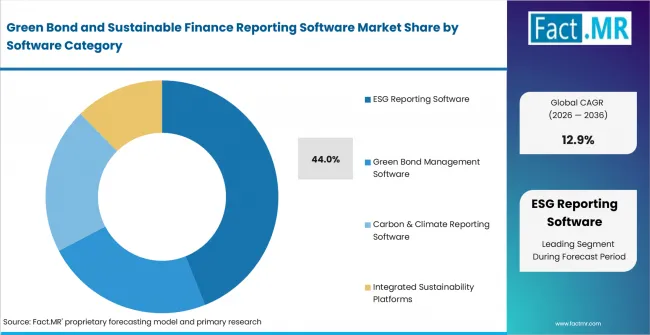
Green Bond And Sustainable Finance Reporting Software Market Analysis By Software Category | Source: Fact.MR
Its position is tied to the need for verified sustainability records before reports are shared with investors, lenders or regulators. The software gives teams a structured approval layer, making it easier to manage evidence, review cycles and recurring disclosure work. Sustainability advisory input may guide the roadmap, but the software remains the daily workflow engine.
Why does Green Bond Reporting lead Application?
Green Bond Reporting leads with 41.0% share in 2026.
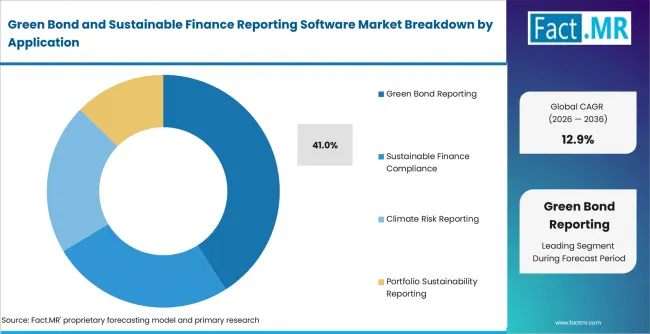
Green Bond And Sustainable Finance Reporting Software Market Analysis By Application | Source: Fact.MR
This application gains priority as issuers must show how proceeds are allocated and what impact funded projects deliver. Traceability is central here, especially when stakeholders expect clear links between commitments, eligible projects and reported outcomes. Use-of-proceeds tracking therefore becomes the main reason for repeated platform use.
Why do Banks & Financial Institutions lead End User?
Banks & Financial Institutions are projected to account for 38.0% share in 2026.
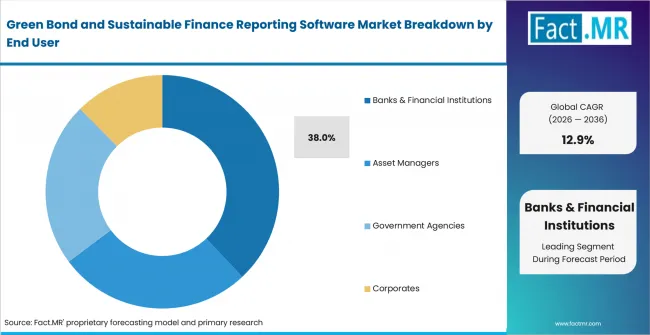
Green Bond And Sustainable Finance Reporting Software Market Analysis By End User | Source: Fact.MR
Financial institutions sit close to green bond issuance, portfolio review and sustainable finance disclosure. Their teams need controlled records that can support internal checks and external reporting. Audit trails, approval permissions and finance-grade documentation make these platforms useful for banks managing complex sustainability claims.
Why does Cloud-based Deployment lead Deployment Model?
Cloud-based Deployment holds 63.0% share in 2026.
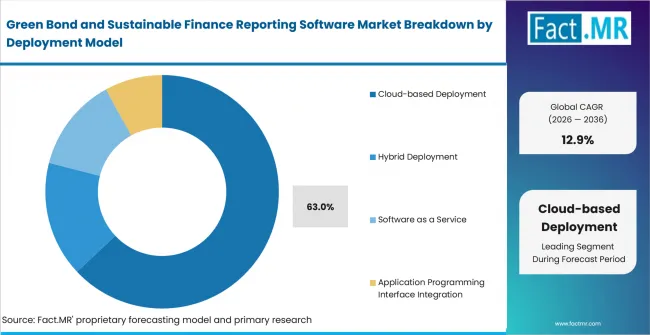
Green Bond And Sustainable Finance Reporting Software Market Analysis By Deployment Model | Source: Fact.MR
Cloud models fit reporting teams that need shared access across treasury, sustainability, finance and assurance users. Instead of moving files across separate systems, teams can review the same record in one managed environment. Hybrid deployment remains relevant where institutions require stricter data controls or internal hosting rules.
Why does Artificial Intelligence-enabled Analytics lead Technology Platform?
Artificial Intelligence-enabled Analytics account for 46.0% share in 2026.
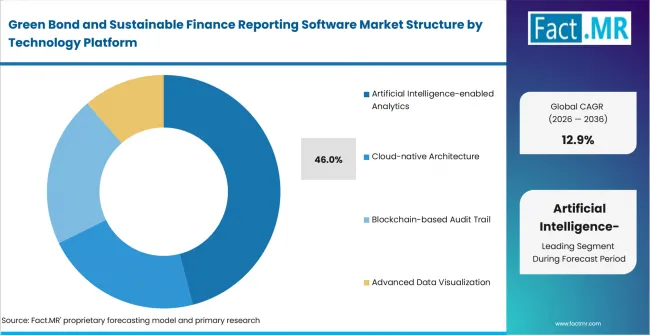
Green Bond And Sustainable Finance Reporting Software Market Analysis By Technology Platform | Source: Fact.MR
AI-enabled analytics adds value by helping users review project documents, disclosures and supporting evidence faster. The benefit is strongest when source data is reliable and well organized. Validation engines still remain important, since faster analysis must translate into defensible outputs that can withstand audit, assurance and investor review.
What is accelerating Green Bond and Sustainable Finance Reporting Software Market adoption, and what is holding it back?
Demand is expected to rise through green bond reporting obligations and ESG data consolidation. Finance teams need auditable evidence that can survive investor review.
Drivers Impact Analysis
| DRIVER | (~) % IMPACT ON CAGR |
GEOGRAPHIC RELEVANCE | IMPACT TIMELINE |
|---|---|---|---|
| Sustainability disclosure workflow digitization | +3.0% | Global | Short term (<= 2 years) |
| Green bond allocation and impact reporting | +2.7% | North America, Europe, Singapore | Short term (<= 2 years) |
| Bank and asset-manager ESG data integration | +2.3% | USA, UK, Germany | Medium term (2-4 years) |
| Cloud deployment and API integration | +1.9% | Global | Medium term (2-4 years) |
| AI-enabled disclosure analytics | +1.4% | Advanced finance hubs | Long term (>= 4 years) |
Source: Fact.MR analysis. Updated Aug 8, 2026
- Green bond allocation and impact reporting: Issuers are expected to need software that tracks eligible projects and reporting approvals from issuance through post-issuance updates.
- Cloud deployment and API integration: Reporting teams are anticipated to prefer platforms that connect treasury data and ESG records without rebuilding internal systems.
- AI-enabled disclosure analytics: Automated document checks are expected to improve first-pass review. Supplier quality workflows show why buyers value evidence checks before public reporting.
Opportunity Impact Analysis
| OPPORTUNITY | (~) % IMPACT ON CAGR |
GEOGRAPHIC RELEVANCE | IMPACT TIMELINE |
|---|---|---|---|
| Assurance-ready reporting modules | +1.5% | Europe and North America | Medium term (2-4 years) |
| Green bond project data connectors | +1.2% | USA, UK, Singapore | Medium term (2-4 years) |
| AI-assisted disclosure review | +0.9% | Advanced finance hubs | Long term (>= 4 years) |
| Mid-market sustainable finance workflows | +0.7% | Canada, France, Japan | Long term (>= 4 years) |
Source: Fact.MR analysis. Updated Aug 8, 2026
- Assurance-ready reporting modules: Vendors that record source files and approval trails are expected to become more useful to issuers preparing investor reports.
- Green bond project data connectors: Direct connections to treasury and emissions records are anticipated to reduce manual evidence checks. reconciliation software shows why finance users prefer controlled matching before external reporting.
- AI-assisted disclosure review: Platforms that identify missing evidence and inconsistent project labels are expected to reduce review time for repeat issuers.
Restraints Impact Analysis
| RESTRAINT | (~) % IMPACT ON CAGR |
GEOGRAPHIC RELEVANCE | IMPACT TIMELINE |
|---|---|---|---|
| Legacy financial and ESG data fragmentation | -1.4% | Global | Short term (<= 2 years) |
| Changing disclosure rule interpretation | -1.0% | Europe, North America | Short term (<= 2 years) |
| Implementation cost and user training | -0.8% | Mid-market buyers | Medium term (2-4 years) |
| Assurance and liability concerns | -0.6% | Banks and issuers | Long term (>= 4 years) |
Source: Fact.MR analysis. Updated Aug 8, 2026
- Legacy financial and ESG data fragmentation: Many issuers hold project spending and emissions records in separate systems. Integration work can delay deployment and reduce early user confidence.
- Changing disclosure rule interpretation: Sustainable finance reporting requirements can shift by region. Vendors must update templates before users rely on them for public reporting.
- Implementation cost and user training: Smaller issuers are expected to delay purchases when internal teams are not ready to manage data ownership and review responsibilities.
Which countries are scaling the Green Bond and Sustainable Finance Reporting Software Market fastest?
- The country comparison spans 3.2 percentage points and forms three practical growth bands across the forecast period.
- The USA remains 0.6 percentage point above the UK through enterprise software depth and financial reporting controls.
- The UK stays 0.4 percentage point above Germany through sustainable finance activity and advisory support.
- Germany remains 0.5 percentage point above Singapore through industrial disclosure needs and reporting modernization.
- Singapore stays 0.6 percentage point above Canada through regional finance hubs and cross-border reporting workflows.
- Canada remains 0.5 percentage point above Japan as bank and corporate reporting programs move toward structured data management.
- Japan stays 0.6 percentage point above France through enterprise modernization and steady institutional adoption.
Comparable CAGRs can create different entry conditions due to issuer maturity and local software procurement habits. Full report coverage includes North America; Europe; Asia Pacific; Latin America; Middle East & Africa.
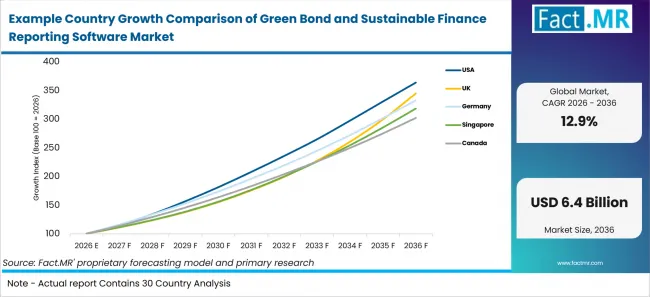
Example Country Growth Comparison Of Green Bond And Sustainable Finance Reporting Software Market | Source: Fact.MR
| COUNTRY | CAGR (2026-2036) |
|---|---|
| USA | 13.8% |
| UK | 13.2% |
| Germany | 12.8% |
| Singapore | 12.3% |
| Canada | 11.7% |
| Japan | 11.2% |
| France | 10.6% |
Source: Fact.MR analysis. Updated Aug 8, 2026
What supports USA adoption?
13.8% CAGR, supported by enterprise software depth and cloud-based compliance workflows.
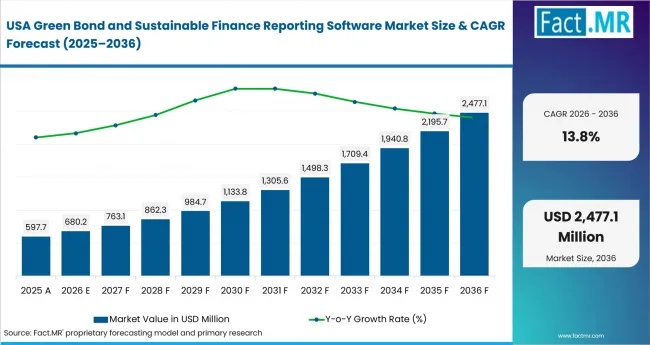
Green Bond And Sustainable Finance Reporting Software Market Country Value Analysis | Source: Fact.MR
The USA’s growth reflects a market where banks and large issuers already use complex reporting systems. Sustainable finance teams are expected to prefer platforms that connect green bond records with internal control processes.
How is the UK scaling demand?
13.2% CAGR, driven by sustainable finance activity and professional services support.
The UK’s growth is shaped by its financial services base and advisory ecosystem for labeled finance transactions. Issuers are expected to seek tools that reduce manual evidence collection and make post-issuance reporting easier to review.
What is driving Germany’s growth from 2026 to 2036?
12.8% CAGR, backed by industrial reporting needs and enterprise data modernization.
Germany’s growth reflects demand from industrial companies and banks that need structured sustainability data. Buyers are expected to place weight on system integration because project evidence often comes from finance systems.
How is Singapore developing demand?
12.3% CAGR, driven by regional finance hubs and cross-border reporting workflows.
Singapore’s growth reflects its role as a finance hub for Asia-based sustainable finance activity. Banks and issuers are expected to value platforms that manage several frameworks and investor formats.
What supports Canada’s growth?
11.7% CAGR, supported by bank adoption and corporate ESG data management.
Canada’s growth is expected to come from financial institutions and corporates that need reliable sustainable finance records. Mid-market adoption is expected to depend on clear implementation steps and simple data ownership.
How does Japan perform?
11.2% CAGR, led by enterprise technology modernization and institutional reporting discipline.
Japan’s growth reflects careful procurement behavior and the need for systems that fit established enterprise processes. Large financial institutions are expected to prefer controlled review and consistent evidence retention.
What supports France’s growth?
10.6% CAGR, backed by sustainable finance regulation and reporting workflow modernization.
France’s growth is supported by banks and corporates that must convert sustainability commitments into repeatable evidence routines. Issuers are expected to need localized templates and clear investor-reporting outputs.
Who leads the Green Bond and Sustainable Finance Reporting Software Market?
Workiva and MSCI appear most closely aligned with governed ESG and sustainable finance reporting, while S&P Global and Moody’s add financial data and risk assessment depth.
London Stock Exchange Group and Wolters Kluwer strengthen disclosure, market-data and compliance workflow coverage. Diligent, Benchmark Digital Partners, Persefoni and Novisto broaden the field through ESG controls, carbon-data management, assurance support and investor-ready reporting tools.
Which companies are the key providers?
The providers profiled Workiva Inc., MSCI Inc., S&P Global Inc., Moody's Corporation, London Stock Exchange Group plc, Wolters Kluwer N.V., Diligent Corporation, Benchmark Digital Partners LLC, Persefoni AI, Inc., and Novisto Inc.
- Workiva Inc.
- MSCI Inc.
- S&P Global Inc.
- Moody's Corporation
- London Stock Exchange Group plc
- Wolters Kluwer N.V.
- Diligent Corporation
- Benchmark Digital Partners LLC
- Persefoni AI, Inc.
- Novisto Inc.
Bibliography
- European Commission. (2025, July 25). Communication from the Commission establishing guidelines for pre-issuance disclosure templates for issuers of bonds marketed as environmentally sustainable or of sustainability-linked bonds (C/2025/2277). Official Journal of the European Union.
- European Securities and Markets Authority. (2025, October 14). ESMA announces 2025 European Common Enforcement Priorities and results of fact-finding on materiality considerations in sustainability reporting.
- Federal Ministry of Finance. (2026, May 13). Green bond allocation report 2025.
- Wolters Kluwer N.V. (2025, June 26). Wolters Kluwer expands CCH® Tagetik ESG & Sustainability to offer Carbon Border Adjustment Mechanism and Planning & Analytics capabilities.
This Report Answers
- The report explains how software category and application choices shape issuer reporting programs.
- Segment analysis covers ESG Reporting Software and Green Bond Reporting as 2026 share leaders.
- Country outlook compares the USA; UK; Germany; Singapore; Canada; Japan; and France.
- Competitive analysis profiles Workiva Inc.; MSCI Inc.; S&P Global Inc.; Moody's Corporation; London Stock Exchange Group plc; and Wolters Kluwer N.V.
- Workflow assessment covers allocation tracking and impact reporting. Assurance workflows and AI-enabled analytics complete the view.
What does the Green Bond and Sustainable Finance Reporting Software Market cover?
The market covers software used to organize sustainable finance records and prepare green bond reports. It supports ESG evidence review and assurance-ready disclosure workflows.
The Green Bond and Sustainable Finance Reporting Software Market covers platforms used before and after issuance. The scope includes project allocation records; use-of-proceeds tracking; impact reporting; and evidence review.
What is included in the scope?
Green bond reporting platforms are included when they manage allocation records and disclosure evidence. ESG reporting software is included when it supports sustainable finance workflows.
The scope includes banks and financial institutions. Asset managers and corporates are included. Public sector issuers and advisory firms follow the same use rule. It covers cloud-based deployment. On-premise and hybrid models are included where internal review and external disclosure need tighter control.
What is excluded from the scope?
General accounting software and standalone project management tools remain outside the scope of this market.
Basic spreadsheet templates are excluded because they do not provide governed workflows. Consulting services are excluded unless delivered through software. Pure emissions calculators are excluded unless they support allocation and assurance controls.
How Was the Analysis Built?
The analysis draws on 120+ sources and 35+ company portfolios. It uses 25+ countries and more than 20 industry interviews.
- Primary Research: Primary research includes discussions with software providers; sustainability teams; financial institutions; issuers; advisory firms; and subject-matter experts. These discussions examine purchasing priorities and reporting workflows.
- Desk Research: Desk research covers official publications; regulatory material; company filings; product documentation; industry associations; standards; public policy; and authoritative sources. Every retained third-party source is documented in the bibliography.
- Market Sizing and Forecasting: Market estimates combine historical performance; demand indicators; pricing trends; workflow trends; segment shares; company participation; country-level growth; and adoption barriers.
- Data Validation and Update Cycle: Findings are validated against public data; company activity; regulatory changes; and industry developments. Regular updates check product launches and procurement trends.
Segmentation
What is the report's scope and coverage?
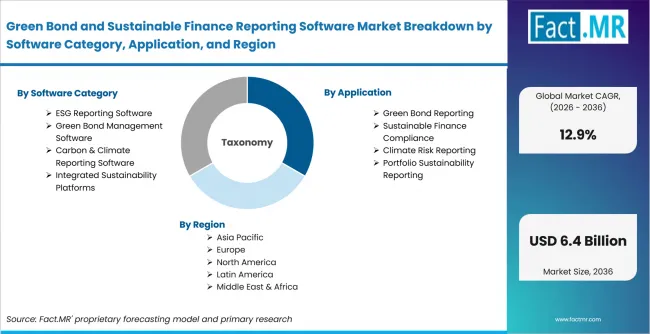
Green Bond And Sustainable Finance Reporting Software Market Breakdown By Software Category, Application, And Region | Source: Fact.MR
| Attribute | Details |
|---|---|
| Quantitative Units | USD billion in 2026 to USD billion by 2036 at CAGR |
| Market Definition | Software used to manage green bond allocation records, ESG disclosures, sustainable finance evidence, assurance workflows, and investor-ready reporting |
| Software Category | ESG Reporting Software; Climate Risk Analytics; Sustainable Finance Data Management; Regulatory Disclosure Management |
| Application | Green Bond Reporting; Use-of-Proceeds Tracking; Impact Reporting; Assurance Workflow Management |
| End User | Banks & Financial Institutions; Asset Managers; Corporates; Public Sector Issuers; Advisory Firms |
| Deployment Model | Cloud-based Deployment; On-premise Deployment; Hybrid Deployment |
| Technology Platform | Artificial Intelligence-enabled Analytics; Workflow Automation; API Integration; Data Validation Engines |
| Regions Covered | North America; Europe; Asia Pacific; Latin America; Middle East & Africa |
| Countries Covered | USA; UK; Germany; Singapore; Canada; Japan; France |
| Key Companies Profiled | Workiva Inc.; MSCI Inc.; S&P Global Inc.; Moody's Corporation; London Stock Exchange Group plc; Wolters Kluwer N.V.; Diligent Corporation; Benchmark Digital Partners LLC; Persefoni AI, Inc.; Novisto Inc. |
| Forecast Period | 2026 to 2036 |
| Approach | Hybrid top-down and bottom-up approach using sustainable finance software demand; green bond reporting workflows; ESG disclosure activity; issuer adoption patterns; cloud deployment requirements; AI-enabled analytics use; and company portfolio review |
Source: Fact.MR analysis. Updated Aug 8, 2026
How is the market segmented?
-
By Software Category
- ESG Reporting Software
- Climate Risk Analytics
- Sustainable Finance Data Management
- Regulatory Disclosure Management
-
By Application
- Green Bond Reporting
- Use-of-Proceeds Tracking
- Impact Reporting
- Assurance Workflow Management
-
By End User
- Banks & Financial Institutions
- Asset Managers
- Corporates
- Public Sector Issuers
- Advisory Firms
-
By Deployment Model
- Cloud-based Deployment
- On-premise Deployment
- Hybrid Deployment
-
By Technology Platform
- Artificial Intelligence-enabled Analytics
- Workflow Automation
- API Integration
- Data Validation Engines
-
By Region
- North America
- Europe
- Asia Pacific
- Latin America
- Middle East & Africa
Frequently Asked Questions
Green Bond Reporting Software Market, Sustainable Finance Reporting Software Market, Green Bond Software Market, Sustainable Finance Software Market, Green Finance Reporting Market, ESG Reporting Software Market, Green Bond Reporting Market Size, Sustainable Finance Software Market Share, Sustainable Finance Reporting Market Growth, Green Finance Software Market Forecast, Workiva, MSCI, S&P Global, Moody's, London Stock Exchange Group, Wolters Kluwer, Diligent, Benchmark Digital Partners, Persefoni, NovistoHow big is the green bond and sustainable finance reporting software market in 2026?
What is the CAGR of the green bond and sustainable finance reporting software market from 2026 to 2036?
Which software category leads the green bond and sustainable finance reporting software market?
Which application leads the green bond and sustainable finance reporting software market?
Who are the leading companies in the green bond and sustainable finance reporting software market?
Who worked on this report


Preview the report firsthand - request a free sample
Free SampleGet the brochure for pricing and purchase details
Download PDF