- Market Value (2025): USD 2.1 Bn
- Estimated Value (2026): USD 2.4 Bn
- Forecast Value (2036): USD 8.3 Bn
- CAGR (2026-2036): 13.2%
What is the Green IT Software for BFSI Sector Market forecast to be worth by 2036?
USD 2.4 billion in 2026 to USD 8.3 billion by 2036 at 13.2% CAGR.
- The green IT software for BFSI sector market was valued at USD 2.1 billion in 2025.
- Demand is projected to increase from USD 2.4 billion in 2026 to USD 8.3 billion by 2036.
- The market is forecast to record 13.2% CAGR from 2026 to 2036.
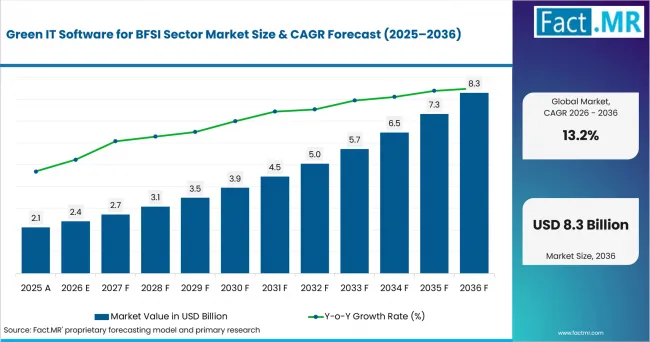
Green It Software For Bfsi Sector Market Value Analysis | Source: Fact.MR
What are the defining numbers behind Green IT Software for BFSI Sector Market growth?
USD 5.9 billion absolute opportunity by 2036.
- Demand Drivers in the Market
- BFSI institutions need auditable emissions records as sustainability reporting moves closer to finance and technology governance.
- Financial institutions are anticipated to standardize data center carbon monitoring since cloud migration raises scrutiny over energy use and workload placement.
- Software buyers are expected to favor platforms that combine ESG reporting with IT asset control without adding another compliance silo.
- Key Segments Analyzed
- By Software Solution: Carbon Management Software is expected to hold 43.0% share in 2026 because BFSI firms need one emissions record for IT estates.
- By Primary Application: Data Center Carbon Monitoring is projected to account for 39.0% share in 2026 as banks track cloud and compute energy use.
- By End User: Commercial Banks are anticipated to capture 41.0% share in 2026 since branch and cloud networks create wider reporting needs.
- By Deployment Model: Cloud-based Deployment is estimated to represent 62.0% share in 2026 owing to easier rollout across banking teams.
- By Sustainability Technology: Artificial Intelligence Analytics is forecast to hold 46.0% share in 2026 as institutions need pattern detection across IT data sets.
- Analyst Opinion at Fact.MR
- Shambhu Nath Jha, Sr. Consultant at Fact.MR, opines: “Green IT software for BFSI is moving from a voluntary sustainability layer into a finance-grade data-control function. Banks and insurers are expected to select platforms that trace IT emissions and support audit evidence. The winning tools should connect sustainability metrics with daily operating decisions.”
- Strategic Implications
- BFSI technology teams should treat IT emissions data as enterprise risk-control evidence.
- Software vendors can improve adoption by connecting emissions calculation and reporting workflows with IT asset data.
- Advisory and cloud partners should prove how green controls reduce manual reporting work before banks expand deployments.
The USA leads at 14.3% CAGR through mature bank technology budgets. The UK follows at 13.8% because financial services firms prepare for disclosure needs. Germany reaches 13.3% through energy-aware software adoption. Singapore records 12.7% through regional financial headquarters. Canada posts 12.1%. Japan reaches 11.6% and Australia records 11.0% through cloud modernization.
How does the Green IT Software for BFSI Sector Market break down by segment?
Carbon Management Software is expected to lead Software Solution with 43.0% share in 2026. Data Center Carbon Monitoring is projected to lead Primary Application with 39.0% share in 2026.
Which Software Solution dominates?
Carbon Management Software is projected to account for 43.0% share in 2026.
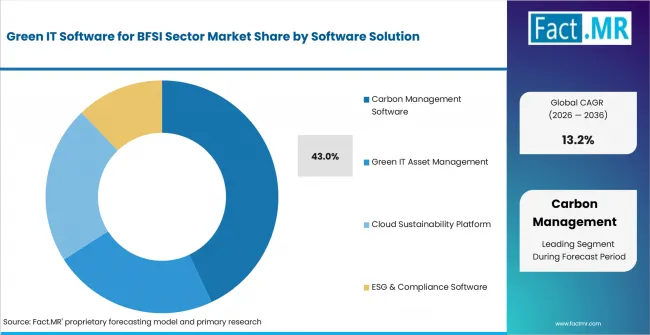
Green It Software For Bfsi Sector Market Analysis By Software Solution | Source: Fact.MR
Its dominance is linked to the need for BFSI firms to maintain defensible emissions records across cloud use, branch technology and internal operations. These platforms help connect IT energy data with carbon footprint management workflows. Once measurement becomes reliable, buyers can add reporting, optimization and advisory tools with more confidence.
What leads the Primary Application segment?
Data Center Carbon Monitoring is expected to hold 39.0% share in 2026.
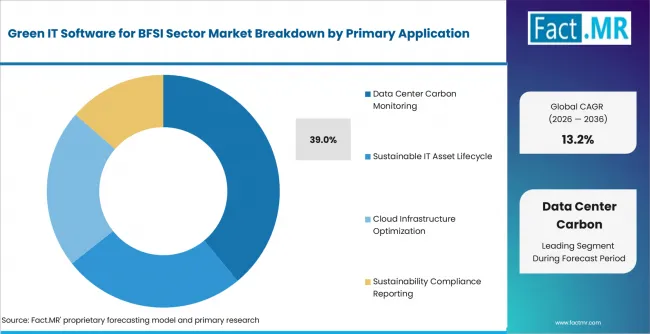
Green It Software For Bfsi Sector Market Analysis By Primary Application | Source: Fact.MR
Digital finance depends heavily on data centers for payments, processing, analytics and customer platforms. This makes carbon monitoring a practical operating requirement rather than only a facilities concern. Green IT tools help teams compare workload choices, server use and energy outcomes before procurement or optimization decisions are made.
How do Commercial Banks shape End User demand?
Commercial Banks are anticipated to lead with 41.0% share in 2026.
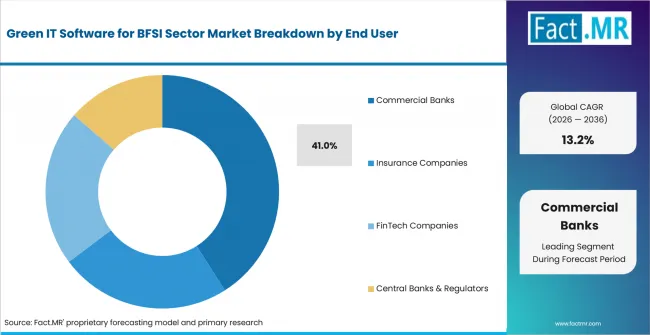
Green It Software For Bfsi Sector Market Analysis By End User | Source: Fact.MR
Commercial banks create the widest demand base because they manage branch networks, payment infrastructure and large technology estates. Each layer produces emissions data that must be organized for finance and sustainability teams. Green IT software supports this by linking sustainability records with internal controls and CFO-facing reporting workflows.
What supports Cloud-based Deployment?
Cloud-based Deployment is estimated to represent 62.0% share in 2026.
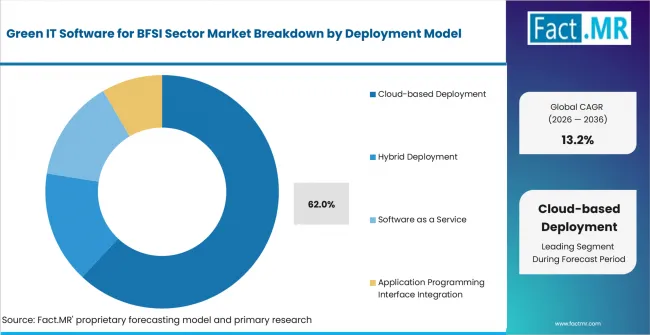
Green It Software For Bfsi Sector Market Analysis By Deployment Model | Source: Fact.MR
Cloud deployment fits banking groups that operate across many regions, entities and internal teams. A central platform can update dashboards and reporting methods without repeated local installations. This model also supports sustainability energy management workflows where common data methods are needed across business units.
Why does Artificial Intelligence Analytics lead Sustainability Technology?
Artificial Intelligence Analytics is forecast to hold 46.0% share in 2026.
Green It Software For Bfsi Sector Market Analysis By Deployment Model | Source: Fact.MR
AI analytics gains importance as emissions data sits across cloud bills, branch assets, energy systems and IT inventories. These tools can help identify anomalies, compare usage patterns and prepare cleaner evidence before reporting deadlines. The value increases when BFSI teams need faster review without weakening audit readiness.
What is accelerating Green IT Software for BFSI Sector Market adoption, and what is holding it back?
Banks and insurers need a consistent record of IT energy use and emissions across data centers, cloud services, branch technology, and supplier relationships. The strongest demand is for tools that combine operational data with evidence suitable for sustainability and risk review.
Drivers
| Driver | Relative Impact | Geographic Relevance | Impact Timeline |
|---|---|---|---|
| BFSI institutions need traceable technology-emissions records for finance, audit, and sustainability processes. | High | USA, UK, Germany | 2026 to 2032 |
| Cloud and compute growth make workload energy more visible in technology procurement. | High | USA, Singapore, Canada | 2026 to 2036 |
| Centralized sustainability platforms reduce the effort of maintaining common reporting methods. | Medium | Global banking clusters | 2026 to 2036 |
| AI analytics can help identify anomalies and improve review of emissions data. | Medium | North America, Europe, East Asia | 2026 to 2036 |
Source: Fact.MR analysis. Updated Aug 10, 2026
Opportunities
| Opportunity | Relative Impact | Geographic Relevance | Impact Timeline |
|---|---|---|---|
| Integrated ESG and IT-operations dashboards | High | USA, UK, Singapore | 2026 to 2032 |
| Cloud carbon-optimization modules | Medium | USA, Canada, Australia | 2026 to 2036 |
| Supplier-emissions data exchange | Medium | Europe and North America | 2030 to 2036 |
| AI-assisted assurance workflows | Medium | Large banking groups | 2030 to 2036 |
Source: Fact.MR analysis. Updated Aug 10, 2026
Restraints
| Restraint | Relative Impact | Geographic Relevance | Impact Timeline |
|---|---|---|---|
| Legacy core-banking architecture can complicate infrastructure-to-emissions mapping. | Medium | Mature banking markets | 2026 to 2032 |
| Supplier and cloud data can arrive in inconsistent formats. | Medium | Global | 2026 to 2036 |
| Security and data-residency restrictions can delay deployment where sensitive infrastructure metadata is involved. | Medium | BFSI-heavy regulated markets | 2026 to 2036 |
| Limited sustainability-technology skills can slow adoption. | Low | Emerging markets | 2030 to 2036 |
Source: Fact.MR analysis. Updated Aug 10, 2026
Which countries are scaling the Green IT Software for BFSI Sector Market fastest?
The USA, UK, Germany, Singapore, and Canada are the countries shown in the comparative outlook. Their adoption paths differ according to cloud maturity, reporting expectations, technology-estate complexity, and procurement controls.
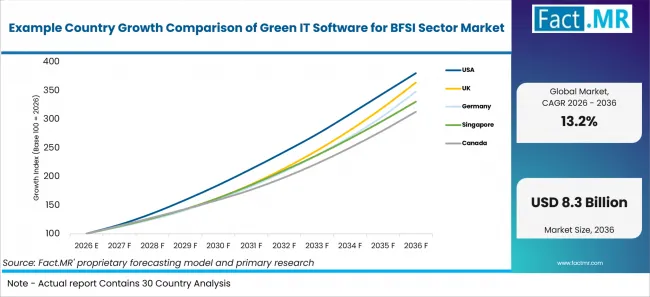
Example Country Growth Comparison Of Green It Software For Bfsi Sector Market | Source: Fact.MR
Country CAGR (2026-2036)
| Country | CAGR |
|---|---|
| USA | 14.3% |
| UK | 13.8% |
| Germany | 13.3% |
| Singapore | 12.7% |
| Canada | 12.1% |
| Japan | 11.6% |
| Australia | 11.0% |
Source: Fact.MR analysis. Updated Aug 10, 2026
What supports USA adoption?
USA is projected to register a 14.3% CAGR through 2036.
Large banks often treat technology operations as part of enterprise risk management. Green IT software must pass security review, fit cloud-governance processes, and provide evidence that audit and sustainability teams can use.
How is the UK scaling demand?
The UK is projected to register a 13.8% CAGR through 2036.
Financial institutions assess sustainability data as a reporting requirement. Platforms that reduce spreadsheet dependence and improve traceability fit banking and insurance procurement priorities.
What is driving Germany's growth from 2026 to 2036?
Germany is projected to register a 13.3% CAGR through 2036.
Buyers prioritize documented methods, data control, and integration with existing IT operations before approving wider deployment.
What supports Singapore's growth?
Singapore is projected to register a 12.7% CAGR through 2036.
Regional financial headquarters need visibility across cloud workloads and governance across multiple markets.
How is Canada developing demand?
Canada is projected to register a 12.1% CAGR through 2036.
Digital-channel upgrades and modernization of banking risk platforms shape how buyers evaluate green IT tools, compliance controls, and internal data-management requirements.
How does Japan perform?
Japan is projected to register an 11.6% CAGR through 2036.
Financial institutions modernize technology systems while protecting core-banking continuity. Emissions tracking, dependable support, and implementation guidance remain relevant evaluation criteria.
What supports Australia’s growth?
Australia is projected to register an 11.0% CAGR through 2036.
Banks assess green IT software for clearer cloud-migration and supplier-performance records, including dashboards that support procurement and sustainability review.
Who leads the Green IT Software for BFSI Sector Market?
Competition spans enterprise software providers, cloud-platform vendors, workflow specialists, and service firms. Buyers often combine these layers, placing value on integration with IT asset data, audit-ready reporting, security controls, and cloud-governance workflows.
Which companies are the key providers?
Key companies include IBM Corporation, Microsoft Corporation, ServiceNow, Inc., SAP SE, Oracle Corporation, Accenture plc, Amazon Web Services, Inc., Google LLC – Google Cloud, Deloitte Touche Tohmatsu Limited, and Capgemini SE.
- IBM Corporation
- Microsoft Corporation
- ServiceNow, Inc.
- SAP SE
- Oracle Corporation
- Accenture plc
- Amazon Web Services, Inc.
- Google LLC – Google Cloud
- Deloitte Touche Tohmatsu Limited
- Capgemini SE
Bibliography
- Amazon Web Services. (2025, June 24). Customer Carbon Footprint Tool now includes location-based emissions.
- Capgemini. (2025, March 28). A Green Software Engineering Playbook: A set of rules to ensure your application build process is sustainable.
- Google Cloud. (2025, March). Google Cloud measures its climate impact through life-cycle assessment.
- SAP SE. (2025, May 23). A new era of sustainable enterprise management, powered by applications, data, and AI.
- ServiceNow. (2026, March 12). Operational Sustainability Management (formerly Environmental, Social, and Governance) release notes.
This Report Answers
- The report examines Green IT Software for BFSI Sector Market performance by Software Solution, Primary Application, End User, Deployment Model, Sustainability Technology, and Region.
- Carbon Management Software leads Software Solution with a 43.0% share in 2026, while Data Center Carbon Monitoring leads Primary Application with a 39.0% share.
- The country outlook compares the USA, UK, Germany, Singapore, and Canada, with additional coverage of Japan and Australia.
- Competitive analysis profiles IBM Corporation, Microsoft Corporation, ServiceNow, Inc., SAP SE, Oracle Corporation, Accenture plc, Amazon Web Services, Inc., Google Cloud, Deloitte Touche Tohmatsu Limited, and Capgemini SE.
- The assessment evaluates market value and share across the defined segment groups.
What does the Green IT Software for BFSI Sector Market cover?
Green IT Software for BFSI Sector Market covers software and related services that help financial institutions measure, manage, and report the environmental impact of IT operations. The scope follows Software Solution, Primary Application, End User, Deployment Model, Sustainability Technology, and Region.
What is included in the scope?
Coverage includes carbon management, energy-efficiency management, sustainability reporting, green-cloud optimization, and IT asset-lifecycle management software. The report covers data-center carbon monitoring, cloud-carbon footprint tracking, ESG reporting support, IT energy optimization, sustainable-procurement analytics, and the end users, deployment models, sustainability technologies, and regions defined in the segmentation.
What is excluded from the scope?
General ESG consulting, unrelated enterprise software, and hardware-only data-center products are outside the scope unless they directly support a defined green IT software workflow for BFSI institutions.
How was the analysis built?
The analysis draws on public company disclosures, product documentation, regulatory and standards material, industry publications, and interviews with relevant market participants. These inputs are assessed alongside the report's defined market scope, segment structure, regional coverage, and forecast period.
Segmentation
What is the report’s scope and coverage?
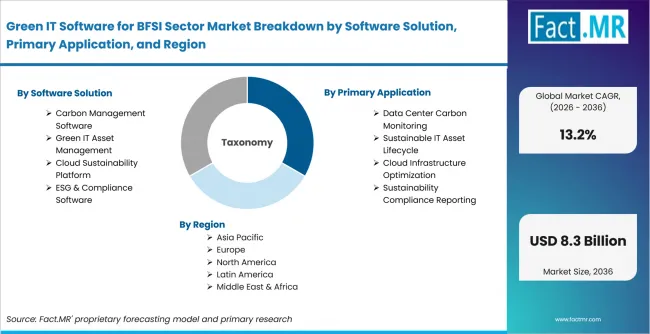
Green It Software For Bfsi Sector Market Breakdown By Software Solution, Primary Application, And Region | Source: Fact.MR
| Attribute | Details |
|---|---|
| Quantitative Units | USD 2.4 billion in 2026 to USD 8.3 billion by 2036 at 13.2% CAGR |
| Market Definition | Software and services used by BFSI institutions to measure and report IT-related environmental impact. The scope also includes tools that manage or reduce those impacts. |
| Software Solution | Carbon Management Software; Energy Efficiency Management Software; Sustainability Reporting Software; Green Cloud Optimization Software; IT Asset Lifecycle Management Software |
| Primary Application | Data Center Carbon Monitoring; Cloud Carbon Footprint Tracking; ESG Reporting Support; IT Energy Optimization; Sustainable Procurement Analytics |
| End User | Commercial Banks; Insurance Companies; Asset Management Firms; Payment Networks; Financial Technology Companies |
| Deployment Model | Cloud-based Deployment; On-premises Deployment; Hybrid Deployment |
| Sustainability Technology | Artificial Intelligence Analytics; IoT-based Monitoring; Cloud Optimization Engines; Reporting Automation; Digital Twin Modeling |
| Regions Covered | North America; Latin America; Europe; East Asia; South Asia and Pacific; Middle East and Africa |
| Countries Covered | USA; UK; Germany; Singapore; Canada; Japan; Australia |
| Key Companies Profiled | IBM Corporation; Microsoft Corporation; ServiceNow, Inc.; SAP SE; Oracle Corporation; Accenture plc; Amazon Web Services, Inc.; Google LLC – Google Cloud; Deloitte Touche Tohmatsu Limited; Capgemini SE |
| Forecast Period | 2026 to 2036 |
| Approach | Hybrid top-down and bottom-up approach using BFSI IT spending signals; cloud migration patterns; sustainability reporting needs; carbon management software adoption; data center monitoring demand; deployment-model preference; end-user readiness; country-level growth patterns; company portfolio review; and primary research validation |
Source: Fact.MR analysis. Updated Aug 10, 2026
How is the market segmented?
-
By Software Solution
- Carbon Management Software
- Enterprise Carbon Accounting
- ESG Reporting Platform
- Green IT Asset Management
- Device Lifecycle Management
- E-waste Management
- Cloud Sustainability Platform
- Cloud Carbon Dashboard
- Workload Optimization
- ESG & Compliance Software
- Regulatory ESG Reporting
- Sustainability Audit Management
- Carbon Management Software
-
By Primary Application
- Data Center Carbon Monitoring
- IT Energy Consumption Analysis
- Scope 3 IT Emissions Reporting
- Sustainable IT Asset Lifecycle
- Hardware Refresh Optimization
- Responsible IT Disposal
- Cloud Infrastructure Optimization
- Multi-cloud Resource Optimization
- Virtual Infrastructure Management
- Sustainability Compliance Reporting
- Green Finance Disclosure
- Climate Risk Reporting
- Data Center Carbon Monitoring
-
By End User
- Commercial Banks
- Retail Banks
- Investment Banks
- Insurance Companies
- Asset Management Firms
- Payment Service Providers
- FinTech Companies
- Digital Banks
- Neobanks
- Central Banks & Regulators
- Financial Regulatory Authorities
- Financial Market Infrastructure Providers
- Commercial Banks
-
By Deployment Model
- Cloud-based Deployment
- Public Cloud
- Private Cloud
- Hybrid Deployment
- On-premises Deployment
- Edge-enabled Infrastructure
- Software as a Service
- Managed Services
- Multi-tenant Platform
- Application Programming Interface Integration
- Low-code Integration
- Enterprise System Integration
- Cloud-based Deployment
-
By Sustainability Technology
- Artificial Intelligence Analytics
- Machine Learning Optimization
- Carbon Intelligence Engine
- Cloud-native Architecture
- Digital Twin Analytics
- Automated Sustainability Analytics
- Carbon-aware Workload Scheduling
- Intelligent Resource Allocation
- Real-time Energy Monitoring
- Predictive Sustainability Analytics
- Advanced ESG Intelligence
- Automated Compliance Engine
- Artificial Intelligence Analytics
-
By Region
- North America
- Latin America
- Western Europe
- Eastern Europe
- East Asia
- South Asia and Pacific
- Middle East & Africa
Frequently Asked Questions
How big is the green IT software for BFSI sector market in 2026?
What is the CAGR of the green IT software for BFSI sector market from 2026 to 2036?
Which software solution leads the green IT software for BFSI sector market?
Which primary application leads the green IT software for BFSI sector market?
Who are the leading companies in the green IT software for BFSI sector market?
Who worked on this report


Preview the report firsthand - request a free sample
Free SampleGet the brochure for pricing and purchase details
Download PDF