- Market Value (2025): USD 1.8 Bn
- Estimated Value (2026): USD 2.1 Bn
- Forecast Value (2036): USD 9.9 Bn
- CAGR (2026-2036): 16.8%
What is the Green Methanol Market forecast to be worth by 2036?
The Green Methanol Market is valued at USD 2.1 billion in 2026 and is projected to reach USD 9.9 billion by 2036, expanding at a 16.8% CAGR during the forecast period.
- 2025 market value: USD 1.8 billion
- 2026 market value: USD 2.1 billion; 2036 market value: USD 9.9 billion
- Forecast CAGR, 2026 to 2036: 16.8%
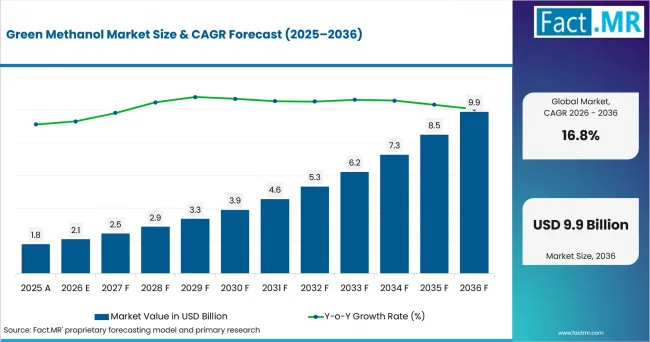
Green Methanol Market Value Analysis | Source: Fact.MR
What are the defining numbers behind Green Methanol Market growth?
The market is expected to add USD 7.8 billion in absolute opportunity between 2026 and 2036.
- Demand Drivers in the Market
- Marine lifecycle targets are converting emissions policy into fuel procurement. The IMO 2023 GHG Strategy calls for zero or near-zero GHG fuels and energy sources to represent at least 5%, striving for 10%, of international shipping energy by 2030. FuelEU Maritime also tightens the GHG intensity of energy used on ships calling at EU ports. These rules raise the value of marine methanol when producers can document renewable feedstock and lifecycle performance.
- Renewable hydrogen is becoming a dedicated methanol feedstock rather than a laboratory input. The EU Renewable Energy Directive sets RFNBO and industrial renewable-hydrogen targets, while national strategies are supporting electrolyzer and import infrastructure. This lowers development friction for e-methanol projects that combine captured CO2 with green hydrogen and renewable electricity.
- Biomass and waste-carbon routes broaden the available carbon pool. IRENA identifies forestry residues, agricultural waste, biogas, municipal solid waste and black liquor as potential renewable methanol feedstocks. Projects that can aggregate low-cost residues and secure year-round logistics create a practical pathway for renewable methanol without relying only on direct-air-captured carbon.
- Captured-carbon utilization is moving into industrial methanol synthesis. Carbon Recycling International reports commercial deployment of its CO2-to-methanol technology, and Johnson Matthey markets an e-methanol pathway based on captured CO2 and electrolytic hydrogen. This links methanol project development with investment in carbon capture and high-purity CO2 handling infrastructure.
- Methanol-capable vessel fleets create recurring offtake demand. Maersk placed its Berlin Maersk dual-fuel vessel into service in 2025 as part of a wider methanol-capable fleet program. For fuel suppliers, ship deployment converts alternative-fuel planning into contracted demand, port delivery schedules and bunker fuel logistics requirements.
- Key Segments Analyzed
- Product: Biomass Derived Green Methanol accounts for 74.6% of the market in 2026. Its position reflects access to agricultural residues, forestry by-products, waste-derived syngas and biogenic carbon streams that can be converted without depending entirely on green-hydrogen and captured-CO2 matching.
- Application: Fuel Applications account for 61.3% of the market in 2026. Marine operators and other transport users can consume methanol directly in compatible or dual-fuel engines, creating recurring volume demand tied to fuel specifications and emissions targets.
- End Use: Transportation Sector accounts for 69.8% of the market in 2026. Marine shipping and automotive fuel uses aggregate large recurring fuel volumes and face stronger pressure to reduce lifecycle emissions than many smaller industrial methanol applications.
- Technology: Electrolysis Based Methanol Technology accounts for 58.2% of the market in 2026. Electrolytic hydrogen paired with renewable electricity and a suitable carbon source directly supports e-methanol production and aligns with RFNBO policy frameworks.
- Formulation: Liquid Methanol Formulations account for 46.9% of the market in 2026. Methanol is handled as a liquid under ordinary storage conditions, allowing fuel-grade and chemical-grade products to use tanks, terminals and transfer systems that are familiar to bulk-liquid supply chains.
- Distribution Channel: Direct Industrial Sales account for 63.7% of the market in 2026. Large energy, shipping and chemical buyers need contracted volumes, lifecycle documentation, delivery scheduling and quality consistency that favor direct producer-to-buyer relationships.
- Analyst Opinion at Fact.MR
- Shambhu Nath Jha, Principal Consultant, Fact.MR, states, “Green methanol growth is becoming an infrastructure and contracting question rather than only a production-technology question. Shipping buyers need verified lifecycle carbon intensity, dependable fuel supply and bunkering access, while producers need renewable power, sustainable carbon feedstock and bankable offtake. Projects that integrate those requirements are more likely to move from announced capacity to delivered volume.”
- Strategic Implications
- Producers should secure more than one renewable-carbon source where practical because biomass quality, seasonal residue availability and captured-CO2 supply can become project bottlenecks.
- Marine buyers should contract against lifecycle GHG performance, fuel specification, delivery point and minimum volume rather than relying on a broad green-methanol label.
- Project developers benefit from co-locating renewable power, electrolysis, carbon feedstock and port or chemical-logistics access so that transport and compression costs do not erode project economics.
- Technology providers need to demonstrate high plant availability across electrolysis, syngas conditioning, CO2 purification and methanol synthesis because one weak subsystem can reduce utilization of the full project.
- Developers should phase capital commitments against permitting, offtake and policy milestones. The 2026 cessation of SunGas Renewables’ Beaver Lake project illustrates how slower fuel adoption, carbon-storage uncertainty and financing conditions can disrupt even technically advanced proposals.
How does the Green Methanol Market break down by segment?
The market is analyzed by Product, Application, End Use, Technology, Formulation and Distribution Channel.
Why does Biomass Derived Green Methanol lead Product?
Biomass Derived Green Methanol accounts for 74.6% of the Product segment in 2026.
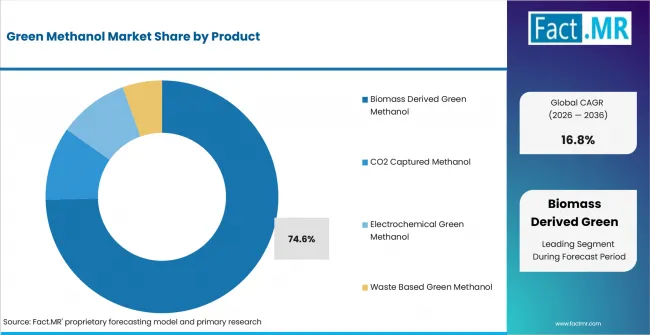
Green Methanol Market Analysis By Product | Source: Fact.MR
Its share is supported by the ability to use agricultural residues, forestry by-products, biogas, municipal waste and other renewable carbon sources in gasification or reforming routes that are already familiar to process-industry developers.
IRENA identifies forestry and agricultural waste, landfill gas, sewage, municipal solid waste and black liquor as potential renewable methanol feedstocks. For a project developer, those sources can reduce dependence on a separate captured-CO2 supply chain and can provide biogenic carbon with established regional logistics.
ABEL Energy’s Bell Bay project, for example, is designed around biomass-derived synthesis gas combined with renewable hydrogen, showing how biomass can be integrated with electrolysis rather than treated as a competing route.
Why do Fuel Applications lead Application?
Fuel Applications account for 61.3% of the Application segment in 2026.
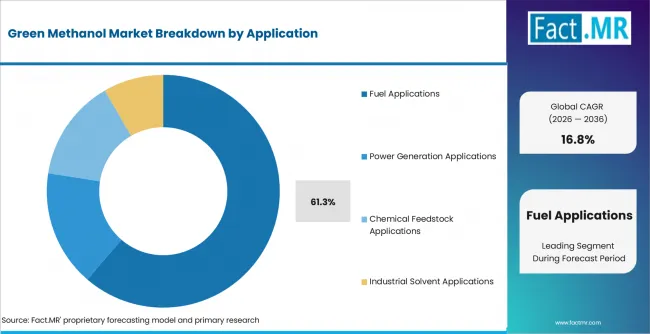
Green Methanol Market Analysis By Application | Source: Fact.MR
Shipping provides a clear demand mechanism because vessel owners can order dual-fuel engines and then purchase methanol across the operating life of the asset. The IMO 2023 strategy and FuelEU Maritime raise the value of fuels with verifiable well-to-wake emissions performance, increasing the incentive to secure renewable methanol rather than fossil methanol where compliance value is required.
Why does Transportation Sector lead End Use?
Transportation Sector accounts for 69.8% of the End Use segment in 2026.
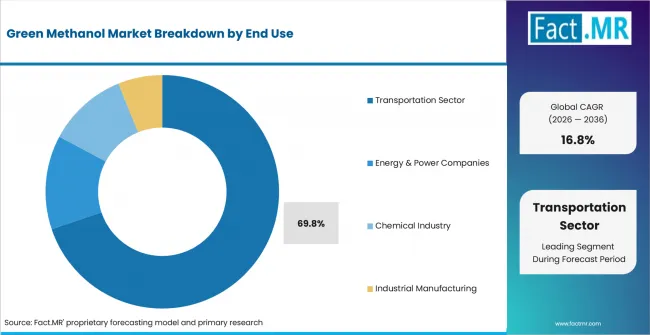
Green Methanol Market Analysis By End Use | Source: Fact.MR
The transport case is especially visible in shipping. Maersk’s 2025 Berlin Maersk deployment added another dual-fuel methanol vessel to its fleet, while Japan completed an at-anchor ship-to-ship methanol bunkering operation in Yokohama in February 2026. Vessel capability and bunkering practice need to develop together before fuel demand can scale reliably.
Why does Electrolysis Based Methanol Technology lead Technology?
Electrolysis Based Methanol Technology accounts for 58.2% of the Technology segment in 2026.
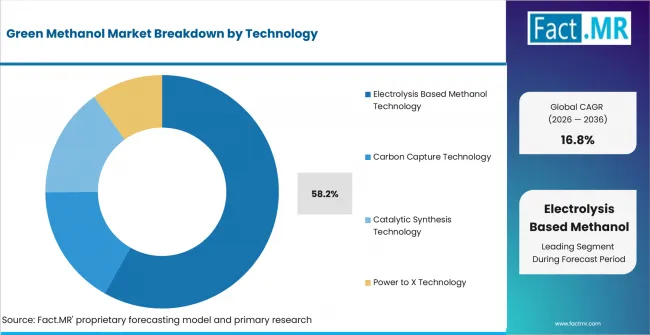
Green Methanol Market Analysis By Technology | Source: Fact.MR
Policy is strengthening the route. The European Commission states that renewable fuels of non-biological origin are expected to represent at least 1% of transport energy by 2030 and that renewable hydrogen should account for at least 42% of industrial hydrogen use in 2030, rising to 60% in 2035. Those rules create a defined compliance framework for renewable hydrogen and derived fuels.
Why do Liquid Methanol Formulations lead Formulation?
Liquid Methanol Formulations account for 46.9% of the Formulation segment in 2026.
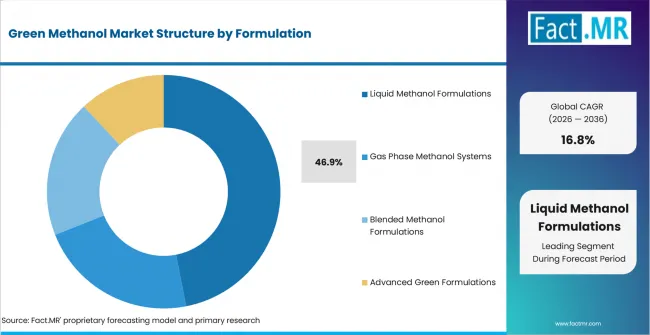
Green Methanol Market Analysis By Formulation | Source: Fact.MR
The commercial requirement is still demanding: water content, purity, contamination control and fuel specification must remain consistent across production, storage and delivery. Buyers therefore value suppliers that can manage the entire custody-transfer chain rather than treating formulation as a simple final blending step.
Why do Direct Industrial Sales lead Distribution Channel?
Direct Industrial Sales account for 63.7% of the Distribution Channel segment in 2026.
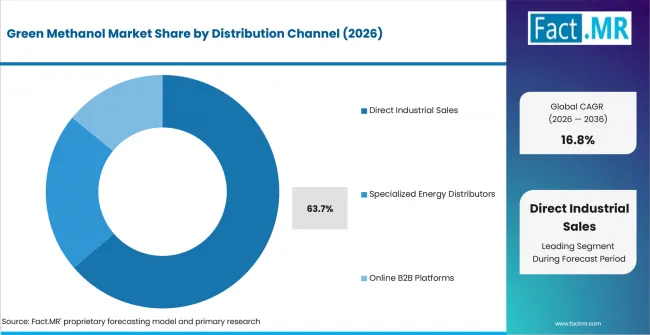
Green Methanol Market Analysis By Distribution Channel | Source: Fact.MR
Long-term contracts can support project finance by linking plant output to a defined buyer, while the buyer receives clearer visibility into carbon intensity, feedstock pathway, delivery location and production ramp-up. This contracting structure is particularly important for projects that require electrolysis, carbon capture or biomass gasification assets before first commercial production.
What is accelerating Green Methanol Market adoption, and what is holding it back?
Adoption is being accelerated by maritime lifecycle-emissions rules and commercial deployment of biomass and CO2-to-methanol technology. The main constraints are the green premium relative to conventional methanol, renewable-electricity and electrolytic-hydrogen cost, and sustainable biomass logistics.
Drivers Impact Analysis
| Factor | (~) % Impact on CAGR | Geographic Relevance | Impact Timeline |
|---|---|---|---|
| Marine lifecycle-GHG rules and fuel transition | +2.5% | Global, Europe and Japan | Short term (≤2 years) |
| Renewable-hydrogen and electrolyzer buildout | +2.0% | Europe, USA, Germany and Japan | Medium term (2–4 years) |
| Biomass and waste-carbon conversion | +1.6% | Brazil, USA and Europe | Medium term (2–4 years) |
| Long-term fuel offtake from transport buyers | +1.4% | Global shipping and port markets | Short term (≤2 years) |
| CO2-to-methanol synthesis integration | +1.1% | Europe, East Asia and North America | Medium term (2–4 years) |
Opportunity Impact Analysis
| Factor | (~) % Impact on CAGR | Geographic Relevance | Impact Timeline |
|---|---|---|---|
| Port methanol bunkering corridors | +1.3% | Europe, Japan, USA and Brazil | Medium term (2–4 years) |
| E-methanol from captured CO2 and renewable hydrogen | +1.2% | Germany, U.K., USA and Japan | Medium term (2–4 years) |
| Biomethanol from forestry and agricultural residues | +1.0% | Brazil and USA | Long term (≥4 years) |
| Renewable chemical-feedstock substitution | +0.8% | Europe, East Asia and North America | Long term (≥4 years) |
| Downstream synthetic-fuel pathways using methanol | +0.6% | Europe, U.K. and USA | Long term (≥4 years) |
Restraints Impact Analysis
| Factor | (~) % Impact on CAGR | Geographic Relevance | Impact Timeline |
|---|---|---|---|
| Green premium and project capital intensity | -1.8% | Global | Short term (≤2 years) |
| Renewable-electricity and electrolytic-hydrogen constraints | -1.4% | Europe, Japan and USA | Medium term (2–4 years) |
| Sustainable biomass and suitable CO2 feedstock limits | -1.0% | Global | Medium term (2–4 years) |
| Lifecycle-certification and accounting complexity | -0.8% | Cross-border Europe and Asia | Short to medium term |
| Project financing and offtake execution risk | -0.7% | Global | Short term (≤2 years) |
Which countries are scaling the Green Methanol Market through 2036?
- Germany: Hydrogen and derivative imports are becoming an explicit part of national energy planning. Germany expects 95 to 130 TWh of hydrogen and hydrogen-derivative demand by 2030, with 50% to 70% supplied through imports, creating a policy and infrastructure pathway for renewable methanol delivered into industrial and maritime demand.
- Brazil: The low-carbon hydrogen framework and port-linked renewable projects are creating a route from renewable electricity and biogenic resources into e-methanol. Pernambuco’s environmental agency issued preliminary approval in 2025 for a planned green-methanol facility at Suape with expected output of about 100,000 tonnes per year.
- USA: Clean-hydrogen hubs provide producer, consumer and connective-infrastructure clusters that can support e-methanol feedstock development. DOE has also identified clean methanol among the alternative energy sources relevant to sustainable maritime-fuel development.
- U.K.: The 2025 Maritime Decarbonisation Strategy sets lifecycle-GHG reduction milestones for domestic maritime activity, while RTFO guidance recognizes both bio-methanol and non-biological renewable methanol as renewable fuels. That gives transport suppliers a defined policy route for qualifying renewable methanol.
- Japan: Port fuel infrastructure is moving from planning into operating practice. In February 2026, an at-anchor ship-to-ship methanol bunkering operation was completed in Yokohama, including domestically produced biomethanol, giving ports and ship operators a practical reference for wider fuel handling.
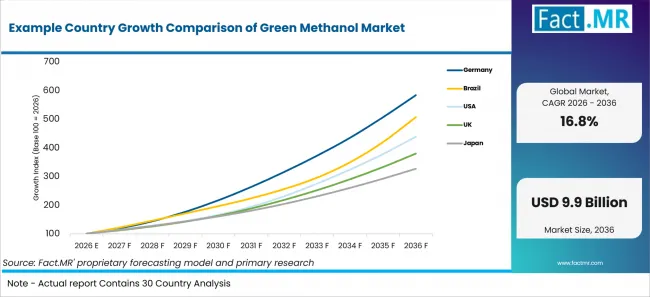
Example Country Growth Comparison Of Green Methanol Market | Source: Fact.MR
Country CAGR (2026-2036)
| Country | CAGR, 2026-2036 |
|---|---|
| Germany | 19.3% |
| Brazil | 17.6% |
| USA | 16.0% |
| U.K. | 14.3% |
| Japan | 12.6% |
What is driving Germany's growth through 2036?
Germany is projected to expand at a 19.3% CAGR from 2026 to 2036.
The federal hydrogen import strategy expects national demand for hydrogen and derivatives to reach 95 to 130 TWh by 2030, with 50% to 70% imported. That scale of planned imports creates a commercial role for transportable derivatives that can move through ports, terminals and industrial supply chains.
Green methanol also benefits from European shipping and renewable-fuel rules. FuelEU Maritime reduces permitted onboard-energy GHG intensity over time and allows an RFNBO multiplier through 2033, while EU renewable-hydrogen rules set industrial and transport targets. German project developers and importers therefore have incentives to combine renewable hydrogen, sustainable carbon and auditable lifecycle data in fuels sold to shipping and industry.
What is driving Brazil's growth through 2036?
Brazil is projected to expand at a 17.6% CAGR from 2026 to 2036.
Federal Law No. 14.948 of 2024 created the legal framework for low-emission hydrogen, including the Rehidro incentive regime and the PHBC development program. These mechanisms strengthen the investment environment for renewable hydrogen that can be converted into methanol and other derivatives.
Port-linked project development adds a direct demand and export route. Pernambuco’s environmental agency issued a preliminary license in 2025 for a green-methanol facility planned at the Suape industrial port complex, with expected output of about 100,000 tonnes per year for marine-fuel use. The project illustrates how renewable-power development, port access and e-methanol production can be integrated in one logistics cluster.
What is driving USA's growth through 2036?
The USA is projected to expand at a 16.0% CAGR from 2026 to 2036.
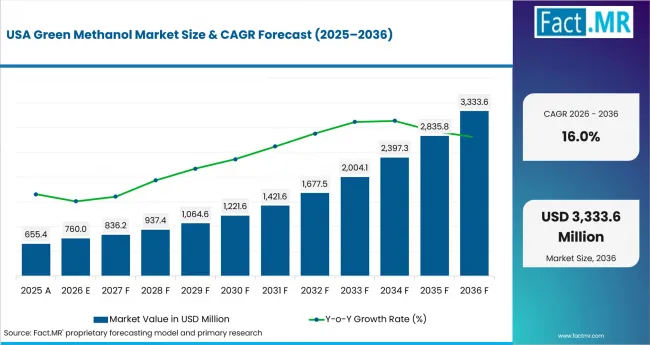
Green Methanol Market Country Value Analysis | Source: Fact.MR
The Department of Energy’s Regional Clean Hydrogen Hubs program is designed around networks of hydrogen producers, consumers and connective infrastructure. Such clusters can reduce the distance between renewable-hydrogen production and industrial users that may convert hydrogen with captured carbon into methanol.
DOE has also identified clean methanol among the alternative energy sources relevant to sustainable maritime-fuel development, linking methanol to port and vessel decarbonization. Project execution remains selective: SunGas Renewables ended development of the proposed Beaver Lake low-carbon methanol project in June 2026, citing fuel-adoption pace, carbon-storage uncertainty and financing conditions. This makes contracted offtake and policy durability important to the U.S. project pipeline.
What is driving U.K.'s growth through 2036?
The U.K. is projected to expand at a 14.3% CAGR from 2026 to 2036.
The Department for Transport’s 2025 Maritime Decarbonisation Strategy targets at least a 30% reduction in domestic maritime fuel-lifecycle GHG emissions by 2030 and an 80% reduction by 2040, relative to 2008. Fuel suppliers therefore have a policy signal to offer lower-lifecycle-carbon alternatives for vessels that cannot readily electrify.
The Renewable Transport Fuel Obligation provides a qualification route for the molecule itself: government guidance lists both bio-methanol and non-biological renewable methanol as 100% renewable fuel categories. That classification supports investment in biomass and power-to-methanol pathways when suppliers can meet the scheme’s sustainability and chain-of-custody requirements.
What is driving Japan's growth through 2036?
Japan is projected to expand at a 12.6% CAGR from 2026 to 2036.
The Ministry of Land, Infrastructure, Transport and Tourism reported an at-anchor ship-to-ship methanol bunkering operation in Yokohama in February 2026, carried out after work on legal procedures and safety measures for methanol bunkering. Part of the fuel supplied was domestically produced biomethanol.
Japan’s hydrogen strategy also targets about 12 million tonnes of hydrogen and hydrogen-equivalent supply by 2040 and calls for supply-chain and infrastructure support. That policy base can strengthen domestic and imported hydrogen availability for e-methanol while port demonstrations reduce operational uncertainty around receiving and transferring methanol as a marine fuel.
Who Leads the Green Methanol Market?
Key players in the Green Methanol Market include Methanex, KAPSOM plc, ABEL Energy, BioMCN, Carbon Recycling International (CRI), Enerkem Inc., GIDARA Energy.
Methanex completed its acquisition of OCI Global’s international methanol business on 27 June 2025, including a low-carbon methanol production and marketing business and an idled methanol facility in the Netherlands. Methanex’s transaction materials identify the BioMCN plants as part of the acquired asset package. BioMCN therefore remains relevant as a legacy asset name, but the Netherlands plants should be understood within Methanex’s acquired portfolio rather than as independently owned assets after the transaction.
CRI supplies CO2-to-methanol technology and reports 310,000 tonnes per year of global installed methanol-production capacity associated with its technology portfolio. Maersk provides a demand-side signal through continued deployment of dual-fuel methanol vessels. ABEL Energy is developing a biomass-and-electrolysis pathway at Bell Bay, while Johnson Matthey offers biomass and e-methanol technology routes. SunGas Renewables remains relevant as a biomass-conversion technology developer, although it ended the Beaver Lake project in June 2026, underscoring the importance of offtake and financing discipline.
Which companies are the key providers?
Methanex, KAPSOM plc, ABEL Energy, BioMCN, Carbon Recycling International (CRI), Enerkem Inc., GIDARA Energy, Hy2gen, Johnson Matthey group, KBR, Inc., Linde Engineering, Maersk, Proman, SunGas Renewables and thyssenkrupp Uhde GmbH.
- Methanex
- KAPSOM plc
- ABEL Energy
- BioMCN
- Carbon Recycling International (CRI)
- Enerkem Inc.
- GIDARA Energy
- Hy2gen
- Johnson Matthey group
- KBR, Inc.
- Linde Engineering
- Maersk
- Proman
- SunGas Renewables
- thyssenkrupp Uhde GmbH
Bibliography
- International Renewable Energy Agency and Methanol Institute. (2021). Innovation Outlook: Renewable Methanol. IRENA.
- International Maritime Organization. (2023). 2023 IMO Strategy on Reduction of GHG Emissions from Ships. IMO.
- International Maritime Organization. (2024). Framework on life cycle GHG intensity of marine fuels. IMO.
- European Union. (2023). Regulation (EU) 2023/1805 on the use of renewable and low-carbon fuels in maritime transport. Official Journal of the European Union.
- European Commission. (2023). Renewable hydrogen: Renewable Energy Directive targets for RFNBOs and industrial hydrogen. European Commission.
- Federal Ministry for Economic Affairs and Climate Action, Germany. (2024). Import Strategy for Hydrogen and Hydrogen Derivatives. Federal Government of Germany.
- Presidency of the Republic, Brazil. (2024). Law No. 14.948 establishing the low-emission hydrogen legal framework. Federal Government of Brazil.
- Agencia Estadual de Meio Ambiente de Pernambuco. (2025). Preliminary environmental license for the green methanol facility at Suape. Government of Pernambuco.
- U.S. Department of Energy. (2022). Regional Clean Hydrogen Hubs. U.S. Department of Energy.
- U.S. Department of Energy. (2024). Request for Information on Defining Sustainable Maritime Fuels in the United States. U.S. Department of Energy.
- UK Department for Transport. (2025). Maritime Decarbonisation Strategy. Government of the United Kingdom.
- UK Department for Transport. (2023). RTFO Renewable Fuels: Methanol fuel classifications. Government of the United Kingdom.
- Ministry of Land, Infrastructure, Transport and Tourism, Japan. (2026). Ship-to-ship methanol fuel supply at Yokohama anchorage. Government of Japan.
- Ministry of Economy, Trade and Industry, Japan. (2024). Basic Hydrogen Strategy targets and supply-chain development. Government of Japan.
- Methanex Corporation. (2025). Methanex completes acquisition of OCI Global’s methanol business. Methanex Corporation.
- Methanex Corporation. (2024). OCI Acquisition Presentation. Methanex Corporation.
- Carbon Recycling International. (2026). CO2-to-methanol technology and installed-capacity overview. Carbon Recycling International.
- A.P. Moller - Maersk. (2025). New Maersk vessel class to enter service. Maersk.
- ABEL Energy. (2026). Bell Bay Powerfuels green methanol project. ABEL Energy.
- Johnson Matthey. (2026). Sustainable methanol solutions. Johnson Matthey.
- SunGas Renewables. (2026). SunGas announces cessation of Beaver Lake Biofuels project. SunGas Renewables.
This Report Answers
- How are marine-fuel rules and renewable-hydrogen policy translating into contracted green-methanol demand?
- Why do biomass-derived routes retain a strong position even as e-methanol projects scale?
- Which operational requirements determine whether green methanol can move from production plant to marine or industrial buyer?
- How do Germany, Brazil, USA, U.K. and Japan differ in their policy, feedstock and infrastructure pathways?
- Which technology, project-development and offtake capabilities differentiate suppliers in the competitive landscape?
What does the Green Methanol Market cover?
The Green Methanol Market covers finished methanol whose production uses renewable energy and renewable, biogenic, waste-derived or recycled carbon pathways. Revenue is counted when green methanol is sold for fuel, power generation, chemical feedstock, solvent or other included applications, rather than when standalone production equipment is sold.
The assessment covers Product, Application, End Use, Technology, Formulation and Distribution Channel. It includes biomass-derived, CO2-captured, electrochemical and waste-based green methanol pathways, together with the specified fuel, power, chemical and industrial uses.
What is included in the scope?
Included products are Biomass Derived Green Methanol, CO2 Captured Methanol, Electrochemical Green Methanol and Waste Based Green Methanol, including agricultural-waste, wood-biomass, direct-air-capture, industrial-CO2-utilization, renewable-electricity, hybrid-electrochemical, municipal-waste and industrial-waste subsegments.
Included demand covers Fuel Applications, Power Generation Applications, Chemical Feedstock Applications and Industrial Solvent Applications across Transportation Sector, Energy & Power Companies, Chemical Industry and Industrial Manufacturing. The study also includes electrolysis, carbon-capture, catalytic-synthesis and power-to-X technology categories; liquid, gas-phase, blended and advanced formulation categories; and direct, specialized-distributor and online B2B channels.
What is excluded from the scope?
The scope excludes conventional methanol produced primarily from fossil natural gas or coal when it does not meet the green-methanol pathways defined in this assessment. Fossil-based low-carbon or blue methanol is excluded where its commercial value cannot be attributed to the renewable or waste-derived pathways included here.
Standalone electrolyzers, carbon-capture systems, methanol reactors, catalysts, EPC services, storage tanks and bunkering equipment are excluded as market revenue unless their value is embedded in the finished green methanol sold. Hydrogen, ammonia, synthetic methane and downstream fuels are also outside the market unless methanol is the commercial product being sold within an included application.
How Was the Analysis Built?
The analysis combines production-pathway economics, project and supplier activity, marine and industrial demand mechanisms, fuel policy, country infrastructure and primary industry input across the specified markets. Quantitative values, country growth, segment shares and segment structure are reconciled to one market model so that the forecast and narrative remain internally consistent.
- Primary Research: Commercial checks with methanol producers, renewable-hydrogen developers, biomass and waste-conversion specialists, EPC and synthesis-technology suppliers, marine-fuel buyers, chemical procurement teams, terminal operators and project-finance participants examine feedstock availability, plant utilization, offtake structure, lifecycle certification and delivery economics.
- Desk Research: The review covers international maritime policy, renewable-hydrogen frameworks, national hydrogen strategies, port and bunkering developments, environmental permitting, supplier technology disclosures, project announcements, acquisitions and current project-status updates. External evidence used in the article is recorded in the bibliography.
- Market Sizing and Forecasting: Estimates combine green-methanol project output, renewable-carbon availability, hydrogen and power requirements, application demand, product and technology mix, unit pricing, contracted offtake, port logistics and country-level policy conditions. The model distinguishes announced capacity from volumes likely to be commissioned and sold through the forecast period.
- Data Validation and Update Cycle: Findings are cross-checked against operating and planned capacity, project permitting, vessel and fuel-demand activity, acquisition status, technology deployment and regulatory changes. Updates account for project cancellations or delays, fuel qualification rules, renewable-power costs, hydrogen availability and the progress of port delivery infrastructure.
What is the report's scope and coverage?
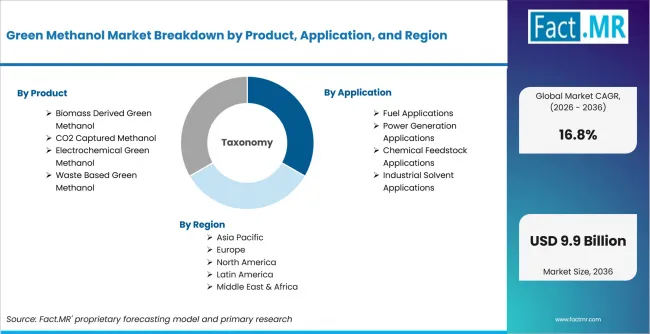
Green Methanol Market Breakdown By Product, Application, And Region | Source: Fact.MR
| Attribute | Details |
|---|---|
| Quantitative Units | USD billion |
| Market Definition | Finished green methanol produced through renewable or waste-derived carbon pathways and renewable-energy inputs, sold for included fuel and industrial applications |
| Segments Covered | Product; Application; End Use; Technology; Formulation; Distribution Channel |
| Regions Covered | North America; Latin America; Europe; East Asia; South Asia and Pacific; Middle East and Africa |
| Countries Covered | Germany; Brazil; USA; U.K.; Japan |
| Key Companies Profiled | Methanex; KAPSOM plc; ABEL Energy; BioMCN; Carbon Recycling International (CRI); Enerkem Inc.; GIDARA Energy; Hy2gen; Johnson Matthey group; KBR, Inc.; Linde Engineering; Maersk; Proman; SunGas Renewables; thyssenkrupp Uhde GmbH |
| Forecast Period | 2026 to 2036 |
| Base Year | 2025 |
| Market Value, 2026 | USD 2.1 billion |
| Market Value, 2036 | USD 9.9 billion |
| CAGR, 2026-2036 | 16.8% |
| Absolute Opportunity | USD 7.8 billion |
| Approach | Hybrid top-down and bottom-up model using green-methanol capacity, renewable-carbon and hydrogen pathways, application demand, contracted offtake, unit economics, port logistics and country-level policy conditions |
How is the market segmented?
-
By Product:
- Biomass Derived Green Methanol
- Agricultural Waste Based Methanol
- Wood Biomass Methanol
- CO2 Captured Methanol
- Direct Air Capture Methanol
- Industrial CO2 Utilization Methanol
- Electrochemical Green Methanol
- Renewable Electricity Based Methanol
- Hybrid Electrochemical Systems
- Waste Based Green Methanol
- Municipal Waste Methanol
- Industrial Waste Methanol
- Biomass Derived Green Methanol
-
By Application:
- Fuel Applications
- Marine Fuel Applications
- Automotive Fuel Applications
- Power Generation Applications
- Thermal Power Generation
- Fuel Cell Applications
- Chemical Feedstock Applications
- Formaldehyde Production
- Acetic Acid Production
- Industrial Solvent Applications
- Paint & Coating Solvents
- Pharmaceutical Solvents
- Fuel Applications
-
By End Use:
- Transportation Sector
- Marine Shipping Industry
- Automotive Industry
- Energy & Power Companies
- Power Utilities
- Fuel Cell Energy Firms
- Chemical Industry
- Bulk Chemical Manufacturers
- Specialty Chemical Firms
- Industrial Manufacturing
- Process Industries
- Heavy Industry
- Transportation Sector
-
By Technology:
- Electrolysis Based Methanol Technology
- Water Electrolysis Systems
- Hydrogen Synthesis Systems
- Carbon Capture Technology
- Direct Air Capture Systems
- Industrial Capture Systems
- Catalytic Synthesis Technology
- Methanol Synthesis Reactors
- Advanced Catalyst Systems
- Power to X Technology
- Power to Liquid Systems
- Hybrid Energy Systems
- Electrolysis Based Methanol Technology
-
By Formulation:
- Liquid Methanol Formulations
- Fuel Grade Methanol
- Chemical Grade Methanol
- Gas Phase Methanol Systems
- Vapor Phase Methanol
- Compressed Gas Methanol Systems
- Blended Methanol Formulations
- Fuel Blending Systems
- Industrial Blend Systems
- Advanced Green Formulations
- Zero Carbon Methanol Systems
- Next Gen Synthetic Fuels
- Liquid Methanol Formulations
-
By Distribution Channel:
- Direct Industrial Sales
- Energy Company Contracts
- Chemical Industry Contracts
- Specialized Energy Distributors
- Regional Fuel Distributors
- Chemical Logistics Providers
- Online B2B Platforms
- Digital Energy Marketplaces
- Manufacturer Direct Portals
- Direct Industrial Sales