HbA1c Analyzer Market Size, Share, Growth and Forecast (2026 - 2036)
HbA1c Analyzer Market is segmented by Product (Laboratory HbA1c Analyzers, Point-of-Care (POC) Devices, Reagents & Test Kits, Consumables & Accessories), Application (Diabetes Diagnosis, Diabetes Monitoring, Research Applications, Gestational Diabetes Testing), End Use (Hospitals, Diagnostic Laboratories, Point-of-Care Settings, Home Healthcare), and Region, with forecasts covering the period from 2026 to 2036.
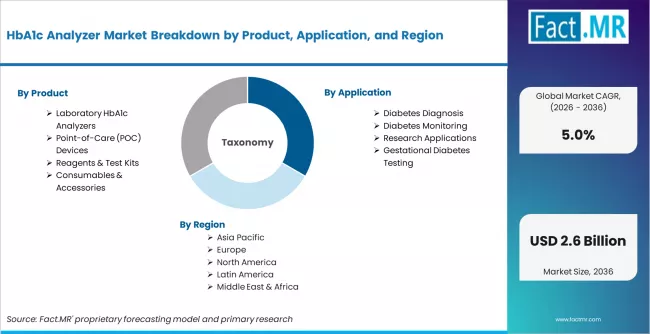
According to Fact.MR estimates, the global hba1c analyzer market market was valued at USD 1.5 billion in 2025. The market is projected to reach USD 1.6 billion in 2026 and is expected to grow to USD 2.6 billion by 2036, expanding at a CAGR of 5.0%. Laboratory HbA1c Analyzers is anticipated to account for 44.0% of the product segment in 2026, while Diabetes Diagnosis is expected to remain the leading application with around 41.0% share.
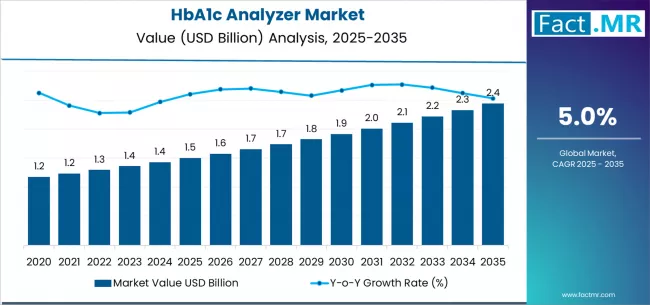
HbA1c Analyzer Market Analysis and Forecast by Fact.MR
According to Fact.MR estimates, the global hba1c analyzer market market was valued at USD 1.5 billion in 2025. The market is projected to reach USD 1.6 billion in 2026 and is expected to grow to USD 2.6 billion by 2036, expanding at a CAGR of 5.0%. Laboratory HbA1c Analyzers is anticipated to account for 44.0% of the product segment in 2026, while Diabetes Diagnosis is expected to remain the leading application with around 41.0% share.

Summary of HbA1c Analyzer Market
- Market Snapshot
- The HbA1c Analyzer market was valued at USD 1.5 billion in 2025.
- By 2036, the HbA1c Analyzer market is expected to be worth USD 2.57 billion.
- From 2026 to 2036, the market is projected to expand at a CAGR of 5.0%.
- The market is projected to create an incremental opportunity of USD 0.99 billion between 2026 and 2036.
- In 2026, Laboratory HbA1c Analyzers are expected to account for 44% of the product segment, driven by institutional demand for fully automated bench-top systems and high-throughput clinical analyzers in hospital and reference laboratory settings.
- India (7.0%) and China (6.2%) are two of the fastest-growing markets in the world.
- Demand and Growth Drivers
- Demand is shaped by the rising global diabetes burden, which is increasing testing volumes for HbA1c as the standard glycated hemoglobin assay used for diabetes diagnosis, long-term glycemic monitoring, and treatment effectiveness tracking.
- Growth reflects expanding point-of-care adoption, where portable HbA1c analyzers are decentralizing testing from reference laboratories to primary care clinics, diabetes care centers, and community health settings.
- Adoption is increasing due to national diabetes screening programs in high-prevalence markets such as India, China, and Mexico, where government health initiatives are scaling population-level HbA1c testing infrastructure.
- Product and Segment View
- Laboratory HbA1c Analyzers lead the product segment at 44% share in 2026, anchored by fully automated bench-top systems and high-throughput clinical analyzers installed in hospital and reference laboratory settings.
- Hospitals account for 45% of end-use demand in 2026, driven by concentrated testing volumes in diabetes clinics, multi-specialty hospitals, and inpatient glycemic management programs.
- HPLC Technology leads the technology segment at 45% share in 2026, reflecting the installed base of ion-exchange HPLC systems that remain the reference standard for clinical HbA1c measurement.
- Geography and Competitive Outlook
- Asia Pacific leads growth, with India at a 7.0% CAGR and China at 6.2%, driven by large diabetic populations, expanding healthcare infrastructure, and government diabetes screening programs.
- Latin America grows strongly with Mexico (4.8%), supported by rising diabetes prevalence and healthcare system investments in diagnostic testing capacity.
- Europe and North America contribute steadily, with Germany (4.5%), the United States (4.2%), South Korea (4.0%), and Japan (3.0%) growing on equipment replacement, point-of-care adoption, and reagent consumption. Leading players include Roche Diagnostics, Abbott, Bio-Rad, Siemens Healthineers, Tosoh Corporation, ARKRAY, Trinity Biotech, Beckman Coulter, Mindray, and Nihon Kohden.
- Analyst Opinion
- The HbA1c analyzer market is one of the most commercially predictable diagnostic device categories because it is tied to chronic disease prevalence, and diabetes populations are growing in virtually every major market. The strategic question is not whether demand grows, but where the testing volume shifts. Laboratory analyzers remain the clinical reference standard, but point-of-care devices are taking a growing share of routine monitoring volumes by enabling same-visit results in primary care, endocrinology, and community settings. The reagent and consumable revenue stream is the dominant margin driver, and firms that maximize their installed base of analyzers lock in multi-year consumable purchasing. India and China represent the largest growth vectors because their diabetic populations are large, underdiagnosed, and served by rapidly expanding diagnostic infrastructure.
Why is the HbA1c Analyzer Market Growing?
- Rising global diabetes prevalence is increasing the population requiring routine HbA1c testing for diagnosis, monitoring, and treatment management.
- Point-of-care HbA1c testing adoption is decentralizing volumes from reference laboratories to primary care, endocrinology, and community settings.
- National diabetes screening programs in high-prevalence emerging markets are scaling population-level HbA1c testing infrastructure.
Diabetes prevalence growth is the primary demand driver. The International Diabetes Federation estimates that global diabetes prevalence continues to rise, driven by aging populations, urbanization, dietary changes, and increasing obesity rates. Each diagnosed diabetes patient generates recurring HbA1c testing demand at recommended frequencies of two to four tests per year, creating a large and growing consumable revenue base.
Point-of-care adoption is the structural shift driver. Portable HbA1c analyzers that deliver results in minutes are being adopted in primary care clinics, endocrinology practices, diabetes care centers, and community health settings. Same-visit results improve clinical decision-making and patient compliance by eliminating the multi-day waiting period associated with reference laboratory testing. This shift creates net new analyzer placements and consumable demand that adds to rather than displaces laboratory testing volumes.
Emerging market infrastructure expansion is the third driver. India, China, Mexico, and other high-diabetes-prevalence markets are investing in diagnostic infrastructure through national screening programs, hospital laboratory expansion, and point-of-care device deployment in primary care settings. Each infrastructure investment creates analyzer procurement and sustained reagent consumption.
Segment-wise Analysis of HbA1c Analyzer Market
- Laboratory HbA1c Analyzers lead the product segment at 44% share in 2026, anchored by fully automated bench-top and high-throughput systems in hospital and reference laboratory settings.
- Diabetes Diagnosis leads the application segment at 41% share in 2026, reflecting population-level screening and early disease detection programs.
- HPLC Technology leads the technology segment at 45% share in 2026, sustained by the installed base of ion-exchange systems that remain the clinical reference method.
The market segments across product, application, end use, technology, distribution channel, and packaging. Product coverage includes laboratory analyzers, point-of-care devices, reagents and test kits, and consumables and accessories. Application coverage spans diabetes diagnosis, diabetes monitoring, research applications, and gestational diabetes testing. Technology coverage includes HPLC, immunoassay, biosensor-based, capillary electrophoresis, and microfluidic platforms.
Laboratory Analyzers Lead the Product Segment
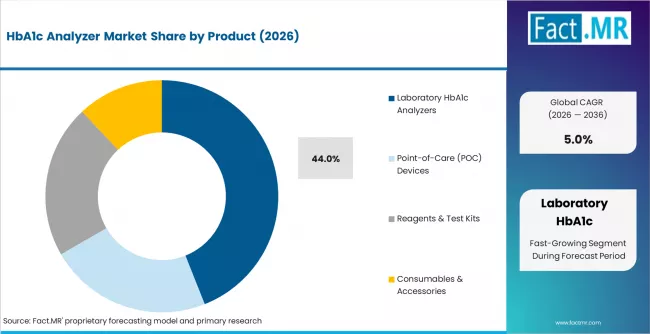
Laboratory HbA1c analyzers account for 44% of product revenue in 2026, including fully automated bench-top systems and high-throughput clinical analyzers. These instruments serve hospital central laboratories and reference testing facilities that process high daily test volumes. The installed base is large, and equipment replacement cycles every 5 to 8 years create predictable upgrade demand. Reagent and consumable revenue tied to each installed analyzer creates recurring revenue that exceeds capital equipment value within 2 to 3 years of placement.
Point-of-care devices represent the fastest-growing product subsegment. Portable analyzers and rapid bedside testing systems are being placed in primary care clinics, diabetes care centers, and community health settings. These devices carry lower per-unit capital cost but generate meaningful consumable revenue per placement and are driving net new testing volume growth.
Diabetes Diagnosis Leads the Application Segment
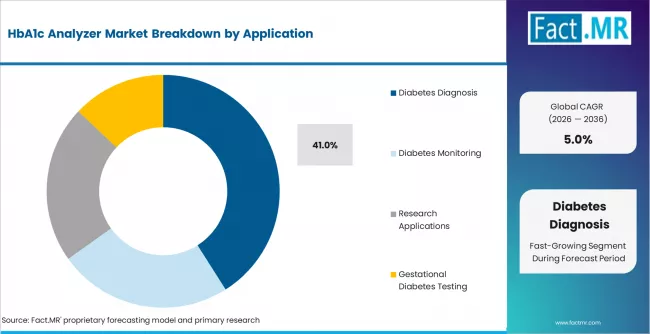
Diabetes diagnosis accounts for 41% of application demand in 2026, covering population screening programs, early disease detection, and diagnostic confirmation in clinical settings. Diabetes monitoring is the second largest application, covering long-term glycemic control tracking and treatment effectiveness assessment for diagnosed patients. Gestational diabetes testing and research applications represent additional demand pools with distinct testing frequency and clinical requirements.
The application mix is shifting as emerging markets scale population-level screening programs, which increases the relative weight of diagnosis over monitoring in high-growth markets like India and China.
Key Growth Drivers, Constraints, and Market Scope
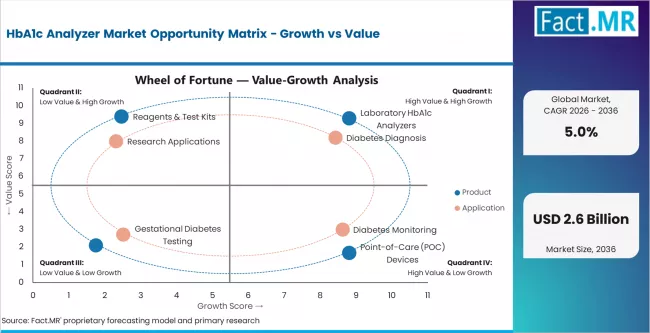
- Rising diabetes prevalence, point-of-care adoption, and emerging market infrastructure expansion create structural demand growth through the forecast period.
- Reagent pricing pressure from group purchasing organizations, competition from alternative biomarkers, and slow adoption in resource-limited settings constrain growth in some segments.
- The largest growth opportunity is in point-of-care placement in primary care and emerging market diabetes screening infrastructure.
The HbA1c analyzer market is a steady growth category with predictable demand tied to chronic disease prevalence and recommended testing guidelines.
Growth Drivers
Three primary forces drive growth. First, rising global diabetes prevalence increases the patient population requiring routine HbA1c testing. Second, point-of-care adoption creates net new testing sites and consumable demand. Third, emerging market infrastructure investment scales HbA1c testing from hospital laboratories into primary care and community health settings.
Constraints
Reagent pricing pressure from group purchasing organizations and hospital procurement systems limits per-test revenue growth in developed markets. Competition from alternative glycemic biomarkers and continuous glucose monitoring, while not directly replacing HbA1c, creates clinical workflow shifts that can reduce testing frequency for some patient populations. Resource-limited healthcare settings in parts of Africa, South Asia, and rural areas remain underserved for HbA1c testing infrastructure.
Opportunities
Point-of-care placement in primary care clinics, endocrinology practices, and diabetes care centers represents the largest near-term growth opportunity. Emerging market diabetes screening programs in India, China, Mexico, and other high-prevalence markets create large addressable market expansion. Analyzer-reagent bundled contracts and locked consumable business models secure long-term revenue per installed analyzer.
Regional Outlook Across Key Markets
.webp)
- Asia Pacific leads growth, with India at a 7.0% CAGR and China at 6.2%, driven by large diabetic populations and expanding diagnostic infrastructure.
- Latin America grows strongly with Mexico (4.8%), supported by rising diabetes prevalence and healthcare investment.
- Europe contributes steadily with Germany (4.5%) and South Korea (4.0%), sustained by equipment replacement and POC adoption.
- North America and Japan grow on established testing infrastructure, with the United States at 4.2% and Japan at 3.0%.
| Country | CAGR (2026-2036) |
|---|---|
| India | 7.0% |
| China | 6.2% |
| Mexico | 4.8% |
| Germany | 4.5% |
| United States | 4.2% |
| South Korea | 4.0% |
| Japan | 3.0% |
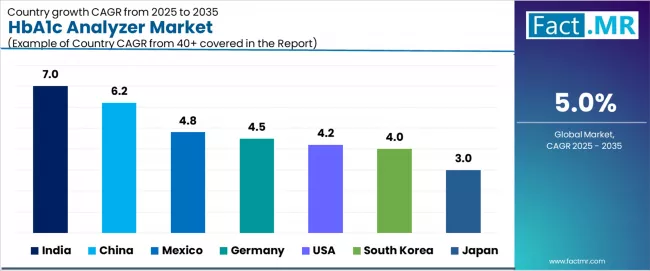
Regional performance reflects diabetes prevalence distribution, healthcare infrastructure maturity, and point-of-care adoption patterns. Asia Pacific leads growth because India and China combine large diabetic populations with rapidly expanding diagnostic infrastructure. Europe and North America grow on established testing infrastructure and POC adoption.
India
India is the fastest-growing major market with a 7.0% CAGR through 2036. The country has one of the largest diabetic populations globally, with substantial underdiagnosis, and government health programs are scaling HbA1c testing across hospital laboratories, primary care clinics, and community health centers.
- Large diabetic population with substantial underdiagnosis creates a growing testing demand base.
- Government diabetes screening programs are scaling HbA1c infrastructure in primary care settings.
- Hospital laboratory expansion and POC device deployment support sustained analyzer procurement.
China
China records a 6.2% CAGR through 2036. Demand is driven by a large and growing diabetic population, expanding hospital diagnostic infrastructure, and government healthcare reform programs investing in chronic disease management and diagnostic capacity.
- Large diabetic population sustains high testing volumes across hospital and clinic settings.
- Healthcare reform programs expand diagnostic infrastructure in lower-tier hospitals and community clinics.
- Mindray and domestic diagnostic companies are strengthening local production and distribution.
Mexico
Mexico records a 4.8% CAGR through 2036. Demand reflects high diabetes prevalence, growing public health investment in chronic disease management, and expanding laboratory and POC testing infrastructure across urban and peri-urban healthcare facilities.
- High diabetes prevalence drives growing testing volume demand.
- Public health investment in chronic disease programs supports diagnostic infrastructure expansion.
- POC device adoption in primary care settings creates net new testing capacity.
Germany
Germany posts a 4.5% CAGR through 2036. Demand reflects established hospital laboratory infrastructure, steady equipment replacement cycles, and growing point-of-care adoption in primary care and diabetes specialist practices.
- Established hospital laboratory infrastructure sustains steady reagent consumption and equipment replacement.
- POC adoption in primary care and diabetes practices creates additional testing demand.
- Siemens Healthineers, headquartered in Germany, anchors domestic diagnostic device supply.
United States
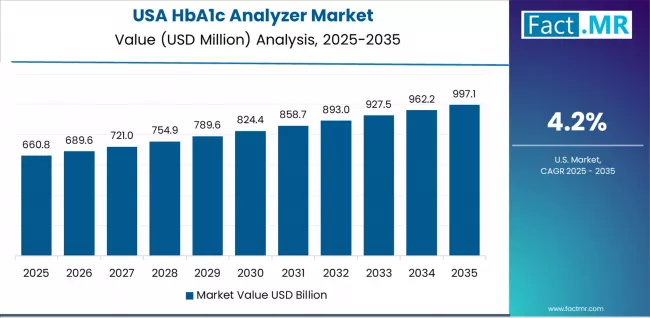
The United States records a 4.2% CAGR through 2036. Demand is sustained by large diabetic population, established testing guidelines, and growing POC adoption. The market is mature but continues to grow on reagent volume expansion and point-of-care placement.
- Large diabetic population and established testing guidelines sustain high testing volumes.
- POC device placement in endocrinology and primary care creates incremental testing demand.
- Reagent and consumable consumption tied to large installed analyzer base drives recurring revenue.
South Korea
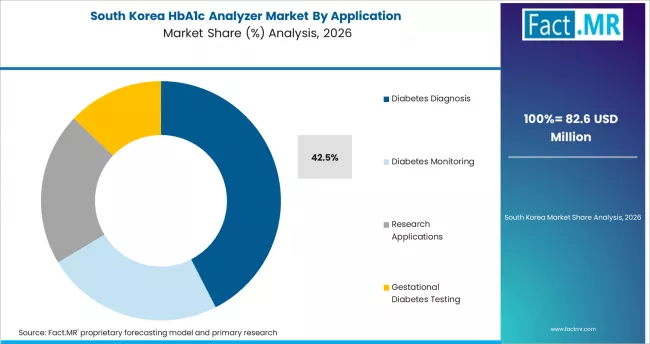
South Korea records a 4.0% CAGR through 2036. Demand is supported by national health screening programs, strong diagnostic infrastructure, and growing technology adoption across hospital and clinic settings.
- National health screening programs sustain HbA1c testing volumes.
- Strong diagnostic infrastructure supports steady equipment replacement and reagent consumption.
- Korean diagnostic companies support domestic device production and distribution.
Japan
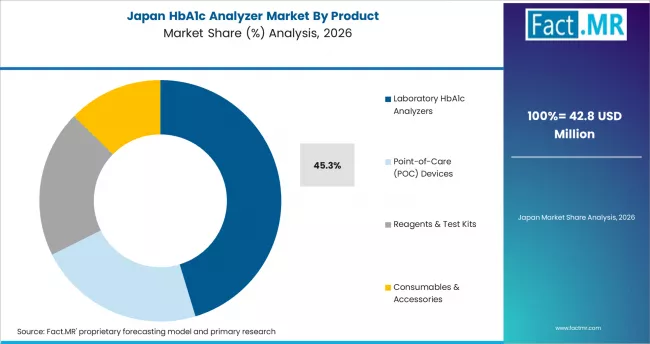
Japan records a 3.0% CAGR through 2036. Demand is sustained by an aging population with high diabetes prevalence, established hospital laboratory testing standards, and mature Tosoh and ARKRAY domestic diagnostic device ecosystems.
- Aging population with high diabetes prevalence sustains established testing demand.
- Tosoh and ARKRAY anchor domestic HbA1c analyzer manufacturing and supply.
- Established hospital laboratory standards maintain stable reagent consumption.
Competitive Benchmarking and Company Positioning
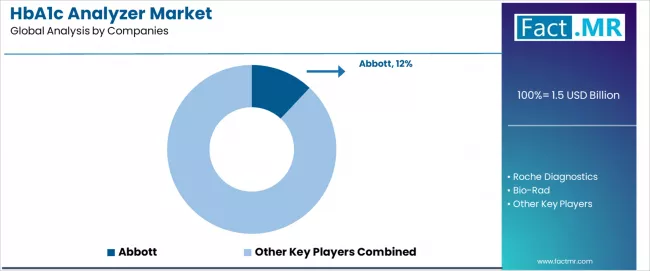
- Roche Diagnostics holds an estimated 34.8% share in 2026, anchored by its Cobas laboratory platform, broad reagent menu, and global diagnostic distribution infrastructure.
- Abbott, Bio-Rad, and Siemens Healthineers hold strong positions through established laboratory analyzer portfolios and institutional procurement relationships.
- Tosoh, ARKRAY, and Trinity Biotech compete through specialized HbA1c analyzer expertise and strong positioning in Japanese and European markets respectively.
The HbA1c analyzer market is moderately concentrated. Roche Diagnostics leads through its integrated Cobas laboratory platform, which bundles HbA1c with broader clinical chemistry testing and locks in reagent consumption. Abbott competes through its Architect and Alinity platforms and strong hospital procurement relationships. Bio-Rad holds a specialized position through its D-10 and VARIANT HPLC systems.
Siemens Healthineers participates through its Atellica and DCA Vantage platforms spanning laboratory and POC segments. Tosoh Corporation anchors the Japanese market through its G8 and G11 HPLC analyzers. ARKRAY and Trinity Biotech serve specialized segments with dedicated HbA1c instrumentation.
Beckman Coulter, Mindray, Nihon Kohden, Diazyme, Menarini, EKF, Sebia, and Randox participate across specific product niches, regional markets, and technology platforms. Mindray is gaining competitive traction in Chinese and emerging market segments through cost-competitive analyzer offerings.
Competitive dynamics are shaped by the reagent-to-analyzer revenue model. The analyzer itself is a capital placement, but multi-year reagent and consumable purchasing generates the majority of per-unit revenue. Firms that maximize installed base and lock in consumable contracts will capture the highest margin growth.
Competitive Analysis
Strategic positioning depends on the balance between laboratory breadth, POC reach, and reagent lock-in economics. Roche and Abbott lead on laboratory platform breadth and procurement bundling. Bio-Rad and Tosoh lead on HPLC method specialization. Siemens leads on dual laboratory-POC platform coverage. Mindray and ARKRAY compete on cost-competitive production for emerging market deployment.
Benchmarking Table
| Company | Lab Platform | POC Portfolio | Reagent Menu | Global Reach |
|---|---|---|---|---|
| Roche Diagnostics | Very High | Medium | Very High | Global |
| Abbott | Very High | Medium-High | Very High | Global |
| Bio-Rad | High (HPLC) | Low | High | Global |
| Siemens Healthineers | High | High | High | Global |
| Tosoh Corporation | High (HPLC) | Low | High | Japan/Asia |
Recent Developments
- Roche Diagnostics expanded its cobas HbA1c reagent portfolio in 2025, strengthening reagent lock-in economics across its global laboratory installed base.
- Siemens Healthineers launched updated DCA Vantage point-of-care system capabilities in 2025, enhancing workflow and connectivity for decentralized HbA1c testing.
- Mindray expanded its HbA1c analyzer distribution in emerging markets in 2026, broadening access to cost-competitive laboratory and POC diagnostic solutions.
Leading Companies Shaping HbA1c Analyzer Market
-
Major Players
- Roche Diagnostics
- Abbott
- Bio-Rad Laboratories
- Siemens Healthineers
- Tosoh Corporation
- ARKRAY Inc.
- Trinity Biotech
-
Emerging Players
- Beckman Coulter (Danaher)
- Mindray Medical International
- Nihon Kohden
- Diazyme Laboratories
- Menarini Diagnostics
- EKF Diagnostics
- Sebia
- Randox Laboratories
- PTS Diagnostics
- Erba Mannheim
Sources and Research References
- World Health Organization (WHO) diabetes prevalence data and HbA1c diagnostic guidelines
- International Diabetes Federation (IDF) Diabetes Atlas and global prevalence estimates
- U.S. Food and Drug Administration (FDA) in-vitro diagnostic device clearance database
- Roche Diagnostics, Abbott, Bio-Rad, Siemens Healthineers, and Tosoh corporate filings and investor presentations
- National diabetes screening program documentation from India (NPCDCS), China, and Mexico
- Peer-reviewed clinical chemistry and diabetes journals including Diabetes Care, Clinical Chemistry, and The Lancet Diabetes and Endocrinology
- Primary interviews with hospital laboratory directors, diabetes clinic administrators, POC testing coordinators, and diagnostic device manufacturer executives
This bibliography is provided for reader reference and is not exhaustive. The full report contains the complete reference list and detailed citations.
Key Questions This Report Addresses
- What is the size of the HbA1c analyzer market in 2026 and 2036?
- What CAGR is the market expected to record between 2026 and 2036?
- Which product and technology segments are projected to lead the market in 2026?
- Which application accounts for the largest share of demand?
- How is point-of-care adoption changing HbA1c testing workflows?
- Which countries are the fastest-growing markets through 2036?
- Who are the leading companies in HbA1c analyzers, and how are they competitively differentiated?
- How does Fact.MR estimate and validate the market forecast?
HbA1c Analyzer Market Definition
The HbA1c analyzer market covers analytical instruments, reagents, and consumables used to measure glycated hemoglobin levels in blood samples for diabetes diagnosis, long-term glycemic monitoring, treatment effectiveness assessment, and gestational diabetes testing. The scope includes laboratory analyzers, point-of-care devices, reagent kits, calibration materials, and sample collection accessories used across hospital, laboratory, clinic, and home healthcare settings.
HbA1c Analyzer Market Inclusions
The market includes fully automated laboratory HbA1c analyzers, high-throughput clinical analyzers, portable point-of-care HbA1c devices, rapid bedside testing systems, immunoassay cartridges, calibration and control kits, sample collection tubes, and analyzer maintenance kits. Technology coverage spans HPLC, immunoassay, biosensor-based, capillary electrophoresis, and microfluidic detection methods. Applications include diabetes diagnosis, diabetes monitoring, research applications, and gestational diabetes testing.
HbA1c Analyzer Market Exclusions
The market excludes continuous glucose monitoring systems, blood glucose meters and test strips, insulin delivery devices, and diabetes management software sold independently from analyzer hardware. General clinical chemistry analyzers not specifically designed for HbA1c measurement, point-of-care glucose testing devices, and non-hemoglobin-based diabetes biomarker assays fall outside the scope.
HbA1c Analyzer Market Research Methodology
- Primary Research: Interviews with hospital laboratory directors, diabetes clinic administrators, diagnostic device procurement leads, point-of-care testing coordinators, and HbA1c analyzer manufacturer sales and marketing executives.
- Desk Research: WHO and IDF diabetes prevalence data, national diabetes screening program documentation, FDA and CE mark diagnostic device databases, company annual reports for Roche, Abbott, Bio-Rad, and Siemens Healthineers, and peer-reviewed clinical chemistry literature.
- Market Sizing: Demand-side model built on diabetes prevalence, recommended HbA1c testing frequency, installed analyzer base, reagent consumption rates, point-of-care adoption curves, and regional healthcare infrastructure data.
- Data Validation: Triangulated across manufacturer reported IVD segment revenues, hospital procurement data, testing volume statistics, and primary interviews. Sensitivity testing on diabetes prevalence trajectories, POC adoption rates, and reagent pricing trends.
Scope of Analysis
| Parameter | Details |
|---|---|
| Quantitative Units | USD 1.575 billion in 2026 to USD 2.57 billion by 2036, at a CAGR of 5.0% |
| Market Definition | Analytical instruments, reagents, and consumables for measuring glycated hemoglobin in blood samples for diabetes diagnosis, monitoring, treatment assessment, and gestational diabetes testing. |
| Regions | North America, Latin America, Europe, East Asia, South Asia and Pacific, Middle East and Africa |
| Countries | India, China, Mexico, Germany, United States, South Korea, Japan, and 25+ additional countries |
| Companies | Roche Diagnostics, Abbott, Bio-Rad, Siemens Healthineers, Tosoh, ARKRAY, Trinity Biotech, Beckman Coulter, Mindray, Nihon Kohden |
| Forecast Period | 2026 to 2036 |
| Approach | Demand-side model built on diabetes prevalence, testing frequency guidelines, installed analyzer base, reagent consumption rates, POC adoption curves, and primary interviews with laboratory directors, procurement leads, and manufacturer executives. |
Analysis by Product, Application, End Use, Technology, Distribution Channel, and Region
-
HbA1c Analyzer Market Market Segmented by Product:
- Laboratory HbA1c Analyzers
- Fully Automated Bench-top Systems
- High-Throughput Clinical Analyzers
- Fully Automated Bench-top Systems
- Point-of-Care (POC) Devices
- Portable HbA1c Analyzers
- Rapid Bedside Testing Systems
- Portable HbA1c Analyzers
- Reagents & Test Kits
- Immunoassay Cartridges
- Calibration & Control Kits
- Immunoassay Cartridges
- Consumables & Accessories
- Sample Collection Tubes
- Analyzer Maintenance Kits
- Sample Collection Tubes
- Laboratory HbA1c Analyzers
-
HbA1c Analyzer Market Market Segmented by Application:
- Diabetes Diagnosis
- Early Disease Detection
- Screening Programs
- Early Disease Detection
- Diabetes Monitoring
- Long-Term Glycemic Control
- Treatment Effectiveness Tracking
- Long-Term Glycemic Control
- Research Applications
- Clinical Studies
- Drug Development Trials
- Clinical Studies
- Gestational Diabetes Testing
- Pregnancy Monitoring
- High-Risk Patient Screening
- Pregnancy Monitoring
- Diabetes Diagnosis
-
HbA1c Analyzer Market Market Segmented by End Use:
- Hospitals
- Diabetes Clinics
- Multi-Specialty Hospitals
- Diabetes Clinics
- Diagnostic Laboratories
- Reference Labs
- Independent Testing Centers
- Reference Labs
- Point-of-Care Settings
- Emergency Care Units
- Primary Care Clinics
- Emergency Care Units
- Home Healthcare
- Self-Monitoring Patients
- Remote Diabetes Management Programs
- Self-Monitoring Patients
- Hospitals
-
HbA1c Analyzer Market Market Segmented by Technology:
- High-Performance Liquid Chromatography (HPLC)
- Ion-Exchange HPLC Systems
- Automated Separation Technology
- Ion-Exchange HPLC Systems
- Immunoassay Technology
- Antibody-Based Detection
- Chemiluminescence Systems
- Antibody-Based Detection
- Biosensor-Based Technology
- Electrochemical Sensors
- Portable Diagnostic Chips
- Electrochemical Sensors
- Capillary Electrophoresis
- Protein Separation Systems
- Microfluidic Platforms
- Protein Separation Systems
- High-Performance Liquid Chromatography (HPLC)
-
HbA1c Analyzer Market Market Segmented by Distribution Channel:
- Direct Sales
- Manufacturer-to-Hospital Contracts
- Institutional Procurement
- Manufacturer-to-Hospital Contracts
- Distributors
- Medical Device Suppliers
- Regional Healthcare Vendors
- Medical Device Suppliers
- Online Procurement Platforms
- Digital Healthcare Marketplaces
- E-Tendering Systems
- Digital Healthcare Marketplaces
-
HbA1c Analyzer Market Market Segmented by Packaging:
- Instrument Packaging
- Protective Analyzer Crates
- Installation-Ready Kits
- Protective Analyzer Crates
- Reagent Packaging
- Sterile Cartridge Packs
- Temperature-Stable Containers
- Sterile Cartridge Packs
- Consumable Kits
- Test Kit Bundles
- Calibration Packs
- Test Kit Bundles
- Direct Sales
-
HbA1c Analyzer Market Market by Region:
- North America
- USA
- Canada
- Mexico
- Latin America
- Brazil
- Chile
- Rest of Latin America
- Western Europe
- Germany
- UK
- Italy
- Spain
- France
- Nordic
- BENELUX
- Rest of Western Europe
- Eastern Europe
- Russia
- Poland
- Hungary
- Balkan & Baltic
- Rest of Eastern Europe
- East Asia
- China
- Japan
- South Korea
- South Asia and Pacific
- India
- ASEAN
- Australia & New Zealand
- Rest of South Asia and Pacific
- Middle East & Africa
- Kingdom of Saudi Arabia
- Other GCC Countries
- Turkiye
- South Africa
- Other African Union
- Rest of Middle East & Africa
- North America

- Frequently Asked Questions -
How big is the HbA1c analyzer market in 2026?
The global HbA1c analyzer market is valued at USD 1.575 billion in 2026.
What will be the size of the HbA1c analyzer market in 2036?
The market is projected to reach USD 2.57 billion by 2036.
How fast is the HbA1c analyzer market expected to grow between 2026 and 2036?
The market is expected to expand at a CAGR of 5.0% between 2026 and 2036.
Which product segment leads the HbA1c analyzer market in 2026?
Laboratory HbA1c Analyzers lead the product segment with 44% share in 2026.
Which country is the fastest-growing market for HbA1c analyzers?
India is the fastest-growing major market with a 7.0% CAGR through 2036.
Which is the second-fastest-growing market?
China is the second-fastest-growing market, expanding at a 6.2% CAGR through 2036.
What does the HbA1c analyzer market include?
The market covers laboratory analyzers, point-of-care devices, reagents, test kits, and consumables used to measure glycated hemoglobin for diabetes diagnosis, monitoring, treatment assessment, and gestational diabetes testing.
How does Fact.MR estimate and validate the market forecast?
The forecast is built on a demand-side model using diabetes prevalence, testing frequency guidelines, installed analyzer base, reagent consumption rates, POC adoption curves, and primary interviews with laboratory directors, procurement leads, and manufacturer executives.
Table of Content
- Executive Summary
- Global Market Outlook
- Demand to side Trends
- Supply to side Trends
- Technology Roadmap Analysis
- Analysis and Recommendations
- Market Overview
- Market Coverage / Taxonomy
- Market Definition / Scope / Limitations
- Research Methodology
- Chapter Orientation
- Analytical Lens and Working Hypotheses
- Market Structure, Signals, and Trend Drivers
- Benchmarking and Cross-market Comparability
- Market Sizing, Forecasting, and Opportunity Mapping
- Research Design and Evidence Framework
- Desk Research Programme (Secondary Evidence)
- Company Annual and Sustainability Reports
- Peer-reviewed Journals and Academic Literature
- Corporate Websites, Product Literature, and Technical Notes
- Earnings Decks and Investor Briefings
- Statutory Filings and Regulatory Disclosures
- Technical White Papers and Standards Notes
- Trade Journals, Industry Magazines, and Analyst Briefs
- Conference Proceedings, Webinars, and Seminar Materials
- Government Statistics Portals and Public Data Releases
- Press Releases and Reputable Media Coverage
- Specialist Newsletters and Curated Briefings
- Sector Databases and Reference Repositories
- Fact.MR Internal Proprietary Databases and Historical Market Datasets
- Subscription Datasets and Paid Sources
- Social Channels, Communities, and Digital Listening Inputs
- Additional Desk Sources
- Expert Input and Fieldwork (Primary Evidence)
- Primary Modes
- Qualitative Interviews and Expert Elicitation
- Quantitative Surveys and Structured Data Capture
- Blended Approach
- Why Primary Evidence is Used
- Field Techniques
- Interviews
- Surveys
- Focus Groups
- Observational and In-context Research
- Social and Community Interactions
- Stakeholder Universe Engaged
- C-suite Leaders
- Board Members
- Presidents and Vice Presidents
- R&D and Innovation Heads
- Technical Specialists
- Domain Subject-matter Experts
- Scientists
- Physicians and Other Healthcare Professionals
- Governance, Ethics, and Data Stewardship
- Research Ethics
- Data Integrity and Handling
- Primary Modes
- Tooling, Models, and Reference Databases
- Desk Research Programme (Secondary Evidence)
- Data Engineering and Model Build
- Data Acquisition and Ingestion
- Cleaning, Normalisation, and Verification
- Synthesis, Triangulation, and Analysis
- Quality Assurance and Audit Trail
- Market Background
- Market Dynamics
- Drivers
- Restraints
- Opportunity
- Trends
- Scenario Forecast
- Demand in Optimistic Scenario
- Demand in Likely Scenario
- Demand in Conservative Scenario
- Opportunity Map Analysis
- Product Life Cycle Analysis
- Supply Chain Analysis
- Investment Feasibility Matrix
- Value Chain Analysis
- PESTLE and Porter’s Analysis
- Regulatory Landscape
- Regional Parent Market Outlook
- Production and Consumption Statistics
- Import and Export Statistics
- Market Dynamics
- Global Market Analysis 2021 to 2025 and Forecast, 2026 to 2036
- Historical Market Size Value (USD Million) Analysis, 2021 to 2025
- Current and Future Market Size Value (USD Million) Projections, 2026 to 2036
- Y to o to Y Growth Trend Analysis
- Absolute $ Opportunity Analysis
- Global Market Pricing Analysis 2021 to 2025 and Forecast 2026 to 2036
- Global Market Analysis 2021 to 2025 and Forecast 2026 to 2036, By Product
- Introduction / Key Findings
- Historical Market Size Value (USD Million) Analysis By Product , 2021 to 2025
- Current and Future Market Size Value (USD Million) Analysis and Forecast By Product , 2026 to 2036
- Laboratory HbA1c Analyzers
- Fully Automated Bench-top Systems
- _High-Throughput Clinical Analyzers
- Point-of-Care (POC) Devices
- Portable HbA1c Analyzers
- _Rapid Bedside Testing Systems
- Reagents & Test Kits
- Immunoassay Cartridges
- _Calibration & Control Kits
- Consumables & Accessories
- Sample Collection Tubes
- _Analyzer Maintenance Kits
- Laboratory HbA1c Analyzers
- Y to o to Y Growth Trend Analysis By Product , 2021 to 2025
- Absolute $ Opportunity Analysis By Product , 2026 to 2036
- Global Market Analysis 2021 to 2025 and Forecast 2026 to 2036, By Application
- Introduction / Key Findings
- Historical Market Size Value (USD Million) Analysis By Application, 2021 to 2025
- Current and Future Market Size Value (USD Million) Analysis and Forecast By Application, 2026 to 2036
- Diabetes Diagnosis
- Early Disease Detection
- _Screening Programs
- Diabetes Monitoring
- Long-Term Glycemic Control
- _Treatment Effectiveness Tracking
- Research Applications
- Clinical Studies
- _Drug Development Trials
- Gestational Diabetes Testing
- Pregnancy Monitoring
- _High-Risk Patient Screening
- Diabetes Diagnosis
- Y to o to Y Growth Trend Analysis By Application, 2021 to 2025
- Absolute $ Opportunity Analysis By Application, 2026 to 2036
- Global Market Analysis 2021 to 2025 and Forecast 2026 to 2036, By End Use
- Introduction / Key Findings
- Historical Market Size Value (USD Million) Analysis By End Use, 2021 to 2025
- Current and Future Market Size Value (USD Million) Analysis and Forecast By End Use, 2026 to 2036
- Hospitals
- Diabetes Clinics
- _Multi-Specialty Hospitals
- Diagnostic Laboratories
- Reference Labs
- _Independent Testing Centers
- Point-of-Care Settings
- Emergency Care Value (USD Million)s
- _Primary Care Clinics
- Home Healthcare
- Self-Monitoring Patients
- _Remote Diabetes Management Programs
- Hospitals
- Y to o to Y Growth Trend Analysis By End Use, 2021 to 2025
- Absolute $ Opportunity Analysis By End Use, 2026 to 2036
- Global Market Analysis 2021 to 2025 and Forecast 2026 to 2036, By Technology
- Introduction / Key Findings
- Historical Market Size Value (USD Million) Analysis By Technology, 2021 to 2025
- Current and Future Market Size Value (USD Million) Analysis and Forecast By Technology, 2026 to 2036
- High-Performance Liquid Chromatography (HPLC)
- Ion-Exchange HPLC Systems
- _Automated Separation Technology
- Immunoassay Technology
- Antibody-Based Detection
- _Chemiluminescence Systems
- Biosensor-Based Technology
- Electrochemical Sensors
- _Portable Diagnostic Chips
- Capillary Electrophoresis
- Protein Separation Systems
- _Microfluidic Platforms
- High-Performance Liquid Chromatography (HPLC)
- Y to o to Y Growth Trend Analysis By Technology, 2021 to 2025
- Absolute $ Opportunity Analysis By Technology, 2026 to 2036
- Global Market Analysis 2021 to 2025 and Forecast 2026 to 2036, By Distribution Channel
- Introduction / Key Findings
- Historical Market Size Value (USD Million) Analysis By Distribution Channel, 2021 to 2025
- Current and Future Market Size Value (USD Million) Analysis and Forecast By Distribution Channel, 2026 to 2036
- Direct Sales
- Manufacturer-to-Hospital Contracts
- _Institutional Procurement
- Distributors
- Medical Device Suppliers
- _Regional Healthcare Vendors
- Online Procurement Platforms
- Digital Healthcare Marketplaces
- _E-Tendering Systems
- Direct Sales
- Y to o to Y Growth Trend Analysis By Distribution Channel, 2021 to 2025
- Absolute $ Opportunity Analysis By Distribution Channel, 2026 to 2036
- Global Market Analysis 2021 to 2025 and Forecast 2026 to 2036, By Packaging
- Introduction / Key Findings
- Historical Market Size Value (USD Million) Analysis By Packaging, 2021 to 2025
- Current and Future Market Size Value (USD Million) Analysis and Forecast By Packaging, 2026 to 2036
- Instrument Packaging
- Protective Analyzer Crates
- _Installation-Ready Kits
- Reagent Packaging
- Sterile Cartridge Packs
- _Temperature-Stable Containers
- Consumable Kits
- Test Kit Bundles
- _Calibration Packs
- Instrument Packaging
- Y to o to Y Growth Trend Analysis By Packaging, 2021 to 2025
- Absolute $ Opportunity Analysis By Packaging, 2026 to 2036
- Global Market Analysis 2021 to 2025 and Forecast 2026 to 2036, By Region
- Introduction
- Historical Market Size Value (USD Million) Analysis By Region, 2021 to 2025
- Current Market Size Value (USD Million) Analysis and Forecast By Region, 2026 to 2036
- North America
- Latin America
- Western Europe
- Eastern Europe
- East Asia
- South Asia and Pacific
- Middle East & Africa
- Market Attractiveness Analysis By Region
- North America Market Analysis 2021 to 2025 and Forecast 2026 to 2036, By Country
- Historical Market Size Value (USD Million) Trend Analysis By Market Taxonomy, 2021 to 2025
- Market Size Value (USD Million) Forecast By Market Taxonomy, 2026 to 2036
- By Country
- USA
- Canada
- Mexico
- By Product
- By Application
- By End Use
- By Technology
- By Distribution Channel
- By Packaging
- By Country
- Market Attractiveness Analysis
- By Country
- By Product
- By Application
- By End Use
- By Technology
- By Distribution Channel
- By Packaging
- Key Takeaways
- Latin America Market Analysis 2021 to 2025 and Forecast 2026 to 2036, By Country
- Historical Market Size Value (USD Million) Trend Analysis By Market Taxonomy, 2021 to 2025
- Market Size Value (USD Million) Forecast By Market Taxonomy, 2026 to 2036
- By Country
- Brazil
- Chile
- Rest of Latin America
- By Product
- By Application
- By End Use
- By Technology
- By Distribution Channel
- By Packaging
- By Country
- Market Attractiveness Analysis
- By Country
- By Product
- By Application
- By End Use
- By Technology
- By Distribution Channel
- By Packaging
- Key Takeaways
- Western Europe Market Analysis 2021 to 2025 and Forecast 2026 to 2036, By Country
- Historical Market Size Value (USD Million) Trend Analysis By Market Taxonomy, 2021 to 2025
- Market Size Value (USD Million) Forecast By Market Taxonomy, 2026 to 2036
- By Country
- Germany
- UK
- Italy
- Spain
- France
- Nordic
- BENELUX
- Rest of Western Europe
- By Product
- By Application
- By End Use
- By Technology
- By Distribution Channel
- By Packaging
- By Country
- Market Attractiveness Analysis
- By Country
- By Product
- By Application
- By End Use
- By Technology
- By Distribution Channel
- By Packaging
- Key Takeaways
- Eastern Europe Market Analysis 2021 to 2025 and Forecast 2026 to 2036, By Country
- Historical Market Size Value (USD Million) Trend Analysis By Market Taxonomy, 2021 to 2025
- Market Size Value (USD Million) Forecast By Market Taxonomy, 2026 to 2036
- By Country
- Russia
- Poland
- Hungary
- Balkan & Baltic
- Rest of Eastern Europe
- By Product
- By Application
- By End Use
- By Technology
- By Distribution Channel
- By Packaging
- By Country
- Market Attractiveness Analysis
- By Country
- By Product
- By Application
- By End Use
- By Technology
- By Distribution Channel
- By Packaging
- Key Takeaways
- East Asia Market Analysis 2021 to 2025 and Forecast 2026 to 2036, By Country
- Historical Market Size Value (USD Million) Trend Analysis By Market Taxonomy, 2021 to 2025
- Market Size Value (USD Million) Forecast By Market Taxonomy, 2026 to 2036
- By Country
- China
- Japan
- South Korea
- By Product
- By Application
- By End Use
- By Technology
- By Distribution Channel
- By Packaging
- By Country
- Market Attractiveness Analysis
- By Country
- By Product
- By Application
- By End Use
- By Technology
- By Distribution Channel
- By Packaging
- Key Takeaways
- South Asia and Pacific Market Analysis 2021 to 2025 and Forecast 2026 to 2036, By Country
- Historical Market Size Value (USD Million) Trend Analysis By Market Taxonomy, 2021 to 2025
- Market Size Value (USD Million) Forecast By Market Taxonomy, 2026 to 2036
- By Country
- India
- ASEAN
- Australia & New Zealand
- Rest of South Asia and Pacific
- By Product
- By Application
- By End Use
- By Technology
- By Distribution Channel
- By Packaging
- By Country
- Market Attractiveness Analysis
- By Country
- By Product
- By Application
- By End Use
- By Technology
- By Distribution Channel
- By Packaging
- Key Takeaways
- Middle East & Africa Market Analysis 2021 to 2025 and Forecast 2026 to 2036, By Country
- Historical Market Size Value (USD Million) Trend Analysis By Market Taxonomy, 2021 to 2025
- Market Size Value (USD Million) Forecast By Market Taxonomy, 2026 to 2036
- By Country
- Kingdom of Saudi Arabia
- Other GCC Countries
- Turkiye
- South Africa
- Other African Union
- Rest of Middle East & Africa
- By Product
- By Application
- By End Use
- By Technology
- By Distribution Channel
- By Packaging
- By Country
- Market Attractiveness Analysis
- By Country
- By Product
- By Application
- By End Use
- By Technology
- By Distribution Channel
- By Packaging
- Key Takeaways
- Key Countries Market Analysis
- USA
- Pricing Analysis
- Market Share Analysis, 2025
- By Product
- By Application
- By End Use
- By Technology
- By Distribution Channel
- By Packaging
- Canada
- Pricing Analysis
- Market Share Analysis, 2025
- By Product
- By Application
- By End Use
- By Technology
- By Distribution Channel
- By Packaging
- Mexico
- Pricing Analysis
- Market Share Analysis, 2025
- By Product
- By Application
- By End Use
- By Technology
- By Distribution Channel
- By Packaging
- Brazil
- Pricing Analysis
- Market Share Analysis, 2025
- By Product
- By Application
- By End Use
- By Technology
- By Distribution Channel
- By Packaging
- Chile
- Pricing Analysis
- Market Share Analysis, 2025
- By Product
- By Application
- By End Use
- By Technology
- By Distribution Channel
- By Packaging
- Germany
- Pricing Analysis
- Market Share Analysis, 2025
- By Product
- By Application
- By End Use
- By Technology
- By Distribution Channel
- By Packaging
- UK
- Pricing Analysis
- Market Share Analysis, 2025
- By Product
- By Application
- By End Use
- By Technology
- By Distribution Channel
- By Packaging
- Italy
- Pricing Analysis
- Market Share Analysis, 2025
- By Product
- By Application
- By End Use
- By Technology
- By Distribution Channel
- By Packaging
- Spain
- Pricing Analysis
- Market Share Analysis, 2025
- By Product
- By Application
- By End Use
- By Technology
- By Distribution Channel
- By Packaging
- France
- Pricing Analysis
- Market Share Analysis, 2025
- By Product
- By Application
- By End Use
- By Technology
- By Distribution Channel
- By Packaging
- India
- Pricing Analysis
- Market Share Analysis, 2025
- By Product
- By Application
- By End Use
- By Technology
- By Distribution Channel
- By Packaging
- ASEAN
- Pricing Analysis
- Market Share Analysis, 2025
- By Product
- By Application
- By End Use
- By Technology
- By Distribution Channel
- By Packaging
- Australia & New Zealand
- Pricing Analysis
- Market Share Analysis, 2025
- By Product
- By Application
- By End Use
- By Technology
- By Distribution Channel
- By Packaging
- China
- Pricing Analysis
- Market Share Analysis, 2025
- By Product
- By Application
- By End Use
- By Technology
- By Distribution Channel
- By Packaging
- Japan
- Pricing Analysis
- Market Share Analysis, 2025
- By Product
- By Application
- By End Use
- By Technology
- By Distribution Channel
- By Packaging
- South Korea
- Pricing Analysis
- Market Share Analysis, 2025
- By Product
- By Application
- By End Use
- By Technology
- By Distribution Channel
- By Packaging
- Russia
- Pricing Analysis
- Market Share Analysis, 2025
- By Product
- By Application
- By End Use
- By Technology
- By Distribution Channel
- By Packaging
- Poland
- Pricing Analysis
- Market Share Analysis, 2025
- By Product
- By Application
- By End Use
- By Technology
- By Distribution Channel
- By Packaging
- Hungary
- Pricing Analysis
- Market Share Analysis, 2025
- By Product
- By Application
- By End Use
- By Technology
- By Distribution Channel
- By Packaging
- Kingdom of Saudi Arabia
- Pricing Analysis
- Market Share Analysis, 2025
- By Product
- By Application
- By End Use
- By Technology
- By Distribution Channel
- By Packaging
- Turkiye
- Pricing Analysis
- Market Share Analysis, 2025
- By Product
- By Application
- By End Use
- By Technology
- By Distribution Channel
- By Packaging
- South Africa
- Pricing Analysis
- Market Share Analysis, 2025
- By Product
- By Application
- By End Use
- By Technology
- By Distribution Channel
- By Packaging
- USA
- Market Structure Analysis
- Competition Dashboard
- Competition Benchmarking
- Market Share Analysis of Top Players
- By Regional
- By Product
- By Application
- By End Use
- By Technology
- By Distribution Channel
- By Packaging
- Competition Analysis
- Competition Deep Dive
- Roche Diagnostics
- Overview
- Product Portfolio
- Profitability by Market Segments (Product/Age /Sales Channel/Region)
- Sales Footprint
- Strategy Overview
- Marketing Strategy
- Product Strategy
- Channel Strategy
- Abbott
- Bio-Rad
- Siemens Healthineers
- Tosoh Corporation
- ARKRAY
- Trinity Biotech
- Beckman Coulter
- Mindray
- Nihon Kohden
- Diazyme
- Menarini Diagnostics
- EKF Diagnostics
- Sebia
- Randox
- Roche Diagnostics
- Competition Deep Dive
- Assumptions & Acronyms Used
List Of Table
- Table 1: Global Market Value (USD Million) Forecast by Region, 2021 to 2036
- Table 2: Global Market Value (USD Million) Forecast by Product , 2021 to 2036
- Table 3: Global Market Value (USD Million) Forecast by Application, 2021 to 2036
- Table 4: Global Market Value (USD Million) Forecast by End Use, 2021 to 2036
- Table 5: Global Market Value (USD Million) Forecast by Technology, 2021 to 2036
- Table 6: Global Market Value (USD Million) Forecast by Distribution Channel, 2021 to 2036
- Table 7: Global Market Value (USD Million) Forecast by Packaging, 2021 to 2036
- Table 8: North America Market Value (USD Million) Forecast by Country, 2021 to 2036
- Table 9: North America Market Value (USD Million) Forecast by Product , 2021 to 2036
- Table 10: North America Market Value (USD Million) Forecast by Application, 2021 to 2036
- Table 11: North America Market Value (USD Million) Forecast by End Use, 2021 to 2036
- Table 12: North America Market Value (USD Million) Forecast by Technology, 2021 to 2036
- Table 13: North America Market Value (USD Million) Forecast by Distribution Channel, 2021 to 2036
- Table 14: North America Market Value (USD Million) Forecast by Packaging, 2021 to 2036
- Table 15: Latin America Market Value (USD Million) Forecast by Country, 2021 to 2036
- Table 16: Latin America Market Value (USD Million) Forecast by Product , 2021 to 2036
- Table 17: Latin America Market Value (USD Million) Forecast by Application, 2021 to 2036
- Table 18: Latin America Market Value (USD Million) Forecast by End Use, 2021 to 2036
- Table 19: Latin America Market Value (USD Million) Forecast by Technology, 2021 to 2036
- Table 20: Latin America Market Value (USD Million) Forecast by Distribution Channel, 2021 to 2036
- Table 21: Latin America Market Value (USD Million) Forecast by Packaging, 2021 to 2036
- Table 22: Western Europe Market Value (USD Million) Forecast by Country, 2021 to 2036
- Table 23: Western Europe Market Value (USD Million) Forecast by Product , 2021 to 2036
- Table 24: Western Europe Market Value (USD Million) Forecast by Application, 2021 to 2036
- Table 25: Western Europe Market Value (USD Million) Forecast by End Use, 2021 to 2036
- Table 26: Western Europe Market Value (USD Million) Forecast by Technology, 2021 to 2036
- Table 27: Western Europe Market Value (USD Million) Forecast by Distribution Channel, 2021 to 2036
- Table 28: Western Europe Market Value (USD Million) Forecast by Packaging, 2021 to 2036
- Table 29: Eastern Europe Market Value (USD Million) Forecast by Country, 2021 to 2036
- Table 30: Eastern Europe Market Value (USD Million) Forecast by Product , 2021 to 2036
- Table 31: Eastern Europe Market Value (USD Million) Forecast by Application, 2021 to 2036
- Table 32: Eastern Europe Market Value (USD Million) Forecast by End Use, 2021 to 2036
- Table 33: Eastern Europe Market Value (USD Million) Forecast by Technology, 2021 to 2036
- Table 34: Eastern Europe Market Value (USD Million) Forecast by Distribution Channel, 2021 to 2036
- Table 35: Eastern Europe Market Value (USD Million) Forecast by Packaging, 2021 to 2036
- Table 36: East Asia Market Value (USD Million) Forecast by Country, 2021 to 2036
- Table 37: East Asia Market Value (USD Million) Forecast by Product , 2021 to 2036
- Table 38: East Asia Market Value (USD Million) Forecast by Application, 2021 to 2036
- Table 39: East Asia Market Value (USD Million) Forecast by End Use, 2021 to 2036
- Table 40: East Asia Market Value (USD Million) Forecast by Technology, 2021 to 2036
- Table 41: East Asia Market Value (USD Million) Forecast by Distribution Channel, 2021 to 2036
- Table 42: East Asia Market Value (USD Million) Forecast by Packaging, 2021 to 2036
- Table 43: South Asia and Pacific Market Value (USD Million) Forecast by Country, 2021 to 2036
- Table 44: South Asia and Pacific Market Value (USD Million) Forecast by Product , 2021 to 2036
- Table 45: South Asia and Pacific Market Value (USD Million) Forecast by Application, 2021 to 2036
- Table 46: South Asia and Pacific Market Value (USD Million) Forecast by End Use, 2021 to 2036
- Table 47: South Asia and Pacific Market Value (USD Million) Forecast by Technology, 2021 to 2036
- Table 48: South Asia and Pacific Market Value (USD Million) Forecast by Distribution Channel, 2021 to 2036
- Table 49: South Asia and Pacific Market Value (USD Million) Forecast by Packaging, 2021 to 2036
- Table 50: Middle East & Africa Market Value (USD Million) Forecast by Country, 2021 to 2036
- Table 51: Middle East & Africa Market Value (USD Million) Forecast by Product , 2021 to 2036
- Table 52: Middle East & Africa Market Value (USD Million) Forecast by Application, 2021 to 2036
- Table 53: Middle East & Africa Market Value (USD Million) Forecast by End Use, 2021 to 2036
- Table 54: Middle East & Africa Market Value (USD Million) Forecast by Technology, 2021 to 2036
- Table 55: Middle East & Africa Market Value (USD Million) Forecast by Distribution Channel, 2021 to 2036
- Table 56: Middle East & Africa Market Value (USD Million) Forecast by Packaging, 2021 to 2036
List Of Figures
- Figure 1: Global Market Pricing Analysis
- Figure 2: Global Market Value (USD Million) Forecast 2021-2036
- Figure 3: Global Market Value Share and BPS Analysis by Product, 2026 and 2036
- Figure 4: Global Market Y-o-Y Growth Comparison by Product,2026 to 2036
- Figure 5: Global Market Attractiveness Analysis by Product
- Figure 6: Global Market Value Share and BPS Analysis by Application, 2026 and 2036
- Figure 7: Global Market Y-o-Y Growth Comparison by Application,2026 to 2036
- Figure 8: Global Market Attractiveness Analysis by Application
- Figure 9: Global Market Value Share and BPS Analysis by End Use, 2026 and 2036
- Figure 10: Global Market Y-o-Y Growth Comparison by End Use,2026 to 2036
- Figure 11: Global Market Attractiveness Analysis by End Use
- Figure 12: Global Market Value Share and BPS Analysis by Technology, 2026 and 2036
- Figure 13: Global Market Y-o-Y Growth Comparison by Technology,2026 to 2036
- Figure 14: Global Market Attractiveness Analysis by Technology
- Figure 15: Global Market Value Share and BPS Analysis by Distribution Channel, 2026 and 2036
- Figure 16: Global Market Y-o-Y Growth Comparison by Distribution Channel,2026 to 2036
- Figure 17: Global Market Attractiveness Analysis by Distribution Channel
- Figure 18: Global Market Value Share and BPS Analysis by Packaging, 2026 and 2036
- Figure 19: Global Market Y-o-Y Growth Comparison by Packaging,2026 to 2036
- Figure 20: Global Market Attractiveness Analysis by Packaging
- Figure 21: Global Market Value (USD Million) Share and BPS Analysis by Region, 2026 and 2036
- Figure 22: Global Market Y-o-Y Growth Comparison by Region,2026 to 2036
- Figure 23: Global Market Attractiveness Analysis by Region
- Figure 24: North America Market Incremental Dollar Opportunity,2026 to 2036
- Figure 25: Latin America Market Incremental Dollar Opportunity,2026 to 2036
- Figure 26: Western Europe Market Incremental Dollar Opportunity,2026 to 2036
- Figure 27: Eastern Europe Market Incremental Dollar Opportunity,2026 to 2036
- Figure 28: East Asia Market Incremental Dollar Opportunity,2026 to 2036
- Figure 29: South Asia and Pacific Market Incremental Dollar Opportunity,2026 to 2036
- Figure 30: Middle East & Africa Market Incremental Dollar Opportunity,2026 to 2036
- Figure 31: North America Market Value Share and BPS Analysis by Country, 2026 and 2036
- Figure 32: North America Market Value Share and BPS Analysis by Product, 2026 and 2036
- Figure 33: North America Market Y-o-Y Growth Comparison by Product,2026 to 2036
- Figure 34: North America Market Attractiveness Analysis by Product
- Figure 35: North America Market Value Share and BPS Analysis by Application, 2026 and 2036
- Figure 36: North America Market Y-o-Y Growth Comparison by Application,2026 to 2036
- Figure 37: North America Market Attractiveness Analysis by Application
- Figure 38: North America Market Value Share and BPS Analysis by End Use, 2026 and 2036
- Figure 39: North America Market Y-o-Y Growth Comparison by End Use,2026 to 2036
- Figure 40: North America Market Attractiveness Analysis by End Use
- Figure 41: North America Market Value Share and BPS Analysis by Technology, 2026 and 2036
- Figure 42: North America Market Y-o-Y Growth Comparison by Technology,2026 to 2036
- Figure 43: North America Market Attractiveness Analysis by Technology
- Figure 44: North America Market Value Share and BPS Analysis by Distribution Channel, 2026 and 2036
- Figure 45: North America Market Y-o-Y Growth Comparison by Distribution Channel,2026 to 2036
- Figure 46: North America Market Attractiveness Analysis by Distribution Channel
- Figure 47: North America Market Value Share and BPS Analysis by Packaging, 2026 and 2036
- Figure 48: North America Market Y-o-Y Growth Comparison by Packaging,2026 to 2036
- Figure 49: North America Market Attractiveness Analysis by Packaging
- Figure 50: Latin America Market Value Share and BPS Analysis by Country, 2026 and 2036
- Figure 51: Latin America Market Value Share and BPS Analysis by Product, 2026 and 2036
- Figure 52: Latin America Market Y-o-Y Growth Comparison by Product,2026 to 2036
- Figure 53: Latin America Market Attractiveness Analysis by Product
- Figure 54: Latin America Market Value Share and BPS Analysis by Application, 2026 and 2036
- Figure 55: Latin America Market Y-o-Y Growth Comparison by Application,2026 to 2036
- Figure 56: Latin America Market Attractiveness Analysis by Application
- Figure 57: Latin America Market Value Share and BPS Analysis by End Use, 2026 and 2036
- Figure 58: Latin America Market Y-o-Y Growth Comparison by End Use,2026 to 2036
- Figure 59: Latin America Market Attractiveness Analysis by End Use
- Figure 60: Latin America Market Value Share and BPS Analysis by Technology, 2026 and 2036
- Figure 61: Latin America Market Y-o-Y Growth Comparison by Technology,2026 to 2036
- Figure 62: Latin America Market Attractiveness Analysis by Technology
- Figure 63: Latin America Market Value Share and BPS Analysis by Distribution Channel, 2026 and 2036
- Figure 64: Latin America Market Y-o-Y Growth Comparison by Distribution Channel,2026 to 2036
- Figure 65: Latin America Market Attractiveness Analysis by Distribution Channel
- Figure 66: Latin America Market Value Share and BPS Analysis by Packaging, 2026 and 2036
- Figure 67: Latin America Market Y-o-Y Growth Comparison by Packaging,2026 to 2036
- Figure 68: Latin America Market Attractiveness Analysis by Packaging
- Figure 69: Western Europe Market Value Share and BPS Analysis by Country, 2026 and 2036
- Figure 70: Western Europe Market Value Share and BPS Analysis by Product, 2026 and 2036
- Figure 71: Western Europe Market Y-o-Y Growth Comparison by Product,2026 to 2036
- Figure 72: Western Europe Market Attractiveness Analysis by Product
- Figure 73: Western Europe Market Value Share and BPS Analysis by Application, 2026 and 2036
- Figure 74: Western Europe Market Y-o-Y Growth Comparison by Application,2026 to 2036
- Figure 75: Western Europe Market Attractiveness Analysis by Application
- Figure 76: Western Europe Market Value Share and BPS Analysis by End Use, 2026 and 2036
- Figure 77: Western Europe Market Y-o-Y Growth Comparison by End Use,2026 to 2036
- Figure 78: Western Europe Market Attractiveness Analysis by End Use
- Figure 79: Western Europe Market Value Share and BPS Analysis by Technology, 2026 and 2036
- Figure 80: Western Europe Market Y-o-Y Growth Comparison by Technology,2026 to 2036
- Figure 81: Western Europe Market Attractiveness Analysis by Technology
- Figure 82: Western Europe Market Value Share and BPS Analysis by Distribution Channel, 2026 and 2036
- Figure 83: Western Europe Market Y-o-Y Growth Comparison by Distribution Channel,2026 to 2036
- Figure 84: Western Europe Market Attractiveness Analysis by Distribution Channel
- Figure 85: Western Europe Market Value Share and BPS Analysis by Packaging, 2026 and 2036
- Figure 86: Western Europe Market Y-o-Y Growth Comparison by Packaging,2026 to 2036
- Figure 87: Western Europe Market Attractiveness Analysis by Packaging
- Figure 88: Eastern Europe Market Value Share and BPS Analysis by Country, 2026 and 2036
- Figure 89: Eastern Europe Market Value Share and BPS Analysis by Product, 2026 and 2036
- Figure 90: Eastern Europe Market Y-o-Y Growth Comparison by Product,2026 to 2036
- Figure 91: Eastern Europe Market Attractiveness Analysis by Product
- Figure 92: Eastern Europe Market Value Share and BPS Analysis by Application, 2026 and 2036
- Figure 93: Eastern Europe Market Y-o-Y Growth Comparison by Application,2026 to 2036
- Figure 94: Eastern Europe Market Attractiveness Analysis by Application
- Figure 95: Eastern Europe Market Value Share and BPS Analysis by End Use, 2026 and 2036
- Figure 96: Eastern Europe Market Y-o-Y Growth Comparison by End Use,2026 to 2036
- Figure 97: Eastern Europe Market Attractiveness Analysis by End Use
- Figure 98: Eastern Europe Market Value Share and BPS Analysis by Technology, 2026 and 2036
- Figure 99: Eastern Europe Market Y-o-Y Growth Comparison by Technology,2026 to 2036
- Figure 100: Eastern Europe Market Attractiveness Analysis by Technology
- Figure 101: Eastern Europe Market Value Share and BPS Analysis by Distribution Channel, 2026 and 2036
- Figure 102: Eastern Europe Market Y-o-Y Growth Comparison by Distribution Channel,2026 to 2036
- Figure 103: Eastern Europe Market Attractiveness Analysis by Distribution Channel
- Figure 104: Eastern Europe Market Value Share and BPS Analysis by Packaging, 2026 and 2036
- Figure 105: Eastern Europe Market Y-o-Y Growth Comparison by Packaging,2026 to 2036
- Figure 106: Eastern Europe Market Attractiveness Analysis by Packaging
- Figure 107: East Asia Market Value Share and BPS Analysis by Country, 2026 and 2036
- Figure 108: East Asia Market Value Share and BPS Analysis by Product, 2026 and 2036
- Figure 109: East Asia Market Y-o-Y Growth Comparison by Product,2026 to 2036
- Figure 110: East Asia Market Attractiveness Analysis by Product
- Figure 111: East Asia Market Value Share and BPS Analysis by Application, 2026 and 2036
- Figure 112: East Asia Market Y-o-Y Growth Comparison by Application,2026 to 2036
- Figure 113: East Asia Market Attractiveness Analysis by Application
- Figure 114: East Asia Market Value Share and BPS Analysis by End Use, 2026 and 2036
- Figure 115: East Asia Market Y-o-Y Growth Comparison by End Use,2026 to 2036
- Figure 116: East Asia Market Attractiveness Analysis by End Use
- Figure 117: East Asia Market Value Share and BPS Analysis by Technology, 2026 and 2036
- Figure 118: East Asia Market Y-o-Y Growth Comparison by Technology,2026 to 2036
- Figure 119: East Asia Market Attractiveness Analysis by Technology
- Figure 120: East Asia Market Value Share and BPS Analysis by Distribution Channel, 2026 and 2036
- Figure 121: East Asia Market Y-o-Y Growth Comparison by Distribution Channel,2026 to 2036
- Figure 122: East Asia Market Attractiveness Analysis by Distribution Channel
- Figure 123: East Asia Market Value Share and BPS Analysis by Packaging, 2026 and 2036
- Figure 124: East Asia Market Y-o-Y Growth Comparison by Packaging,2026 to 2036
- Figure 125: East Asia Market Attractiveness Analysis by Packaging
- Figure 126: South Asia and Pacific Market Value Share and BPS Analysis by Country, 2026 and 2036
- Figure 127: South Asia and Pacific Market Value Share and BPS Analysis by Product, 2026 and 2036
- Figure 128: South Asia and Pacific Market Y-o-Y Growth Comparison by Product,2026 to 2036
- Figure 129: South Asia and Pacific Market Attractiveness Analysis by Product
- Figure 130: South Asia and Pacific Market Value Share and BPS Analysis by Application, 2026 and 2036
- Figure 131: South Asia and Pacific Market Y-o-Y Growth Comparison by Application,2026 to 2036
- Figure 132: South Asia and Pacific Market Attractiveness Analysis by Application
- Figure 133: South Asia and Pacific Market Value Share and BPS Analysis by End Use, 2026 and 2036
- Figure 134: South Asia and Pacific Market Y-o-Y Growth Comparison by End Use,2026 to 2036
- Figure 135: South Asia and Pacific Market Attractiveness Analysis by End Use
- Figure 136: South Asia and Pacific Market Value Share and BPS Analysis by Technology, 2026 and 2036
- Figure 137: South Asia and Pacific Market Y-o-Y Growth Comparison by Technology,2026 to 2036
- Figure 138: South Asia and Pacific Market Attractiveness Analysis by Technology
- Figure 139: South Asia and Pacific Market Value Share and BPS Analysis by Distribution Channel, 2026 and 2036
- Figure 140: South Asia and Pacific Market Y-o-Y Growth Comparison by Distribution Channel,2026 to 2036
- Figure 141: South Asia and Pacific Market Attractiveness Analysis by Distribution Channel
- Figure 142: South Asia and Pacific Market Value Share and BPS Analysis by Packaging, 2026 and 2036
- Figure 143: South Asia and Pacific Market Y-o-Y Growth Comparison by Packaging,2026 to 2036
- Figure 144: South Asia and Pacific Market Attractiveness Analysis by Packaging
- Figure 145: Middle East & Africa Market Value Share and BPS Analysis by Country, 2026 and 2036
- Figure 146: Middle East & Africa Market Value Share and BPS Analysis by Product, 2026 and 2036
- Figure 147: Middle East & Africa Market Y-o-Y Growth Comparison by Product,2026 to 2036
- Figure 148: Middle East & Africa Market Attractiveness Analysis by Product
- Figure 149: Middle East & Africa Market Value Share and BPS Analysis by Application, 2026 and 2036
- Figure 150: Middle East & Africa Market Y-o-Y Growth Comparison by Application,2026 to 2036
- Figure 151: Middle East & Africa Market Attractiveness Analysis by Application
- Figure 152: Middle East & Africa Market Value Share and BPS Analysis by End Use, 2026 and 2036
- Figure 153: Middle East & Africa Market Y-o-Y Growth Comparison by End Use,2026 to 2036
- Figure 154: Middle East & Africa Market Attractiveness Analysis by End Use
- Figure 155: Middle East & Africa Market Value Share and BPS Analysis by Technology, 2026 and 2036
- Figure 156: Middle East & Africa Market Y-o-Y Growth Comparison by Technology,2026 to 2036
- Figure 157: Middle East & Africa Market Attractiveness Analysis by Technology
- Figure 158: Middle East & Africa Market Value Share and BPS Analysis by Distribution Channel, 2026 and 2036
- Figure 159: Middle East & Africa Market Y-o-Y Growth Comparison by Distribution Channel,2026 to 2036
- Figure 160: Middle East & Africa Market Attractiveness Analysis by Distribution Channel
- Figure 161: Middle East & Africa Market Value Share and BPS Analysis by Packaging, 2026 and 2036
- Figure 162: Middle East & Africa Market Y-o-Y Growth Comparison by Packaging,2026 to 2036
- Figure 163: Middle East & Africa Market Attractiveness Analysis by Packaging
- Figure 164: Global Market - Tier Structure Analysis
- Figure 165: Global Market - Company Share Analysis