- Market Value (2025): USD 586.1 Mn
- Estimated Value (2026): USD 640.0 Mn
- Forecast Value (2036): USD 1543.1 Mn
- CAGR (2026-2036): 9.2%
What is the High-Solubility Protein Isolates Market forecast to be worth by 2036?
USD 640.0 million in 2026 to USD 1,543.1 million by 2036 at a 9.2% CAGR.
- The High-Solubility Protein Isolates Market crossed a valuation of USD 586.1 million in 2025.
- Demand is projected to increase from USD 640.0 million in 2026 to USD 1,543.1 million by 2036.
- The market is forecast to record 9.2% CAGR from 2026 to 2036 as beverage brands and nutrition formulators shift toward clean dispersion and higher protein loading.
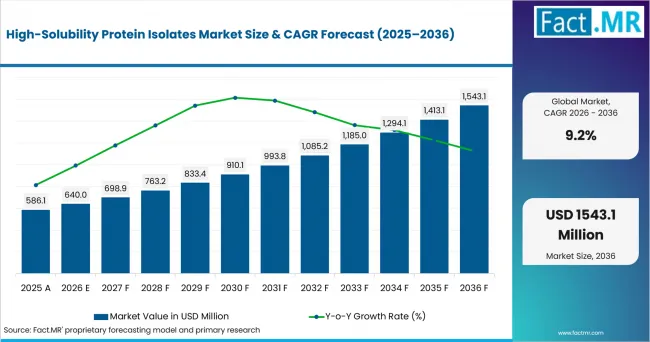
High Solubility Protein Isolates Market Value Analysis | Source: Fact.MR
What are the defining numbers behind High-Solubility Protein Isolates Market growth?
USD 903.1 million absolute opportunity by 2036, led by whey protein isolate, instant agglomeration and RTD beverages.
- Demand Drivers in the Market
- Beverage formulators need isolates that dissolve without grittiness because RTD products leave little room for sediment, haze or chalky mouthfeel.
- Sports nutrition brands need clean taste and reliable protein loading supported by powder and drink formats that consumers use daily.
- Clinical nutrition teams need high-protein inputs that disperse smoothly in small servings for older users and people managing nutritional intake.
- Food manufacturers need flexible dairy and plant proteins for mainstream high-protein foods.
- USDA ERS reported in June 2026 that inflation-adjusted U.S. food spending reached USD 2.51 trillion in 2025. That channel base gives fortified food and beverage brands more room to test premium protein formats.
- Key Segments Analyzed
- By Protein Source: Whey protein isolate is expected to hold 42.00% share in 2026 due to its amino-acid profile, clean taste and fit in beverage nutrition.
- By Solubility Enhancement: Instant agglomeration is projected to account for 35.00% share in 2026 because powder brands need faster wetting and lower clumping.
- By Application Format: RTD beverages are anticipated to capture 31.00% share in 2026 since clear bottles and single-serve drinks make solubility defects highly visible.
- By Solubility Grade: Cold-water dispersible formats are estimated to represent 38.00% share in 2026 owing to shaker use and ambient drink preparation.
- Analyst Opinion at Fact.MR
- Shambhu Nath Jha, Principal Consultant at Fact.MR, states, "This market is shaped by a simple product truth: protein has to disappear into the format. The next phase is expected to reward suppliers that prove solubility across pH, temperature and processing. Brands should compare isolates by drink behavior and sensory profile, alongside protein percentage."
- Strategic Implications
- Ingredient suppliers should publish solubility results by pH, temperature and processing route so formulators can compare isolate behavior before scale-up.
- Beverage brands should test cold-water dispersibility early because visible sediment can weaken repeat purchase even when protein claims are attractive.
- Plant protein developers should pair taste work with dispersion testing because better flavor alone cannot solve grittiness in high-protein beverages.
- Contract manufacturers should build separate handling protocols for milk, soy and pea proteins to reduce reformulation delays during commercial trials.
USA is projected to record 10.4% CAGR through 2036, supported by dairy scale and beverage nutrition channels. UK is expected to post 9.5% CAGR as sports nutrition brands rely on whey access. Germany is anticipated to reach 9.2% CAGR due to dairy processing depth. Japan is estimated to register 8.7% CAGR owing to compact clinical formats. Brazil is forecast to advance at 8.3% CAGR as soy availability widens the ingredient base.
How does the High-Solubility Protein Isolates Market break down by segment?
Whey protein isolate leads at 42.00%; cold-water dispersible leads at 38.00%.
Which Protein Source dominates?
Whey protein isolate is expected to hold 42.0% share in 2026.
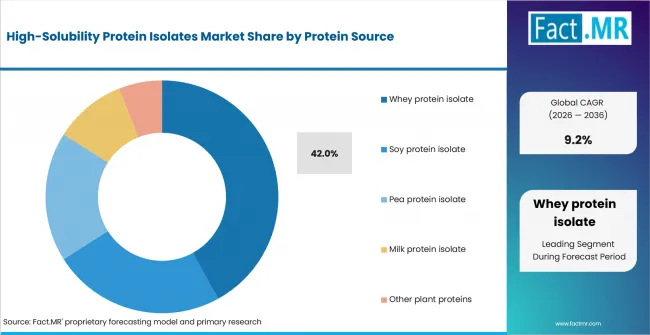
High Solubility Protein Isolates Market Analysis By Protein Source | Source: Fact.MR
Whey protein isolate is expected to lead Protein Source because it fits sports nutrition and clear beverage formats. Soy protein isolate, pea protein isolate, milk protein isolate, and other plant proteins remain relevant across different formulation needs. Arla Foods Ingredients reported in May 2025 that Lacprodan whey protein isolate contains at least 90% protein for RTD sports beverages, gels, powder shakes, and protein bars.
What leads the Solubility Enhancement segment?
Instant agglomeration is projected to account for 35.0% share in 2026.
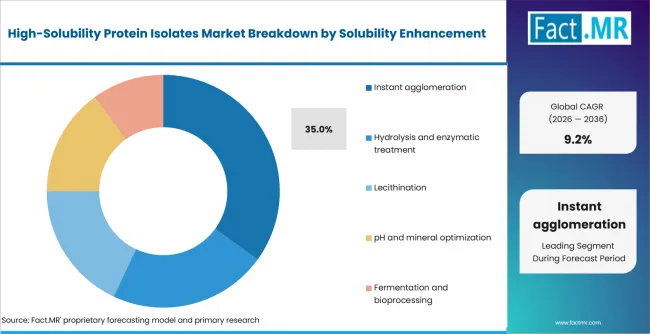
High Solubility Protein Isolates Market Analysis By Solubility Enhancement | Source: Fact.MR
Instant agglomeration is projected to lead Solubility Enhancement because it helps powders wet and disperse faster during preparation. Hydrolysis, enzymatic treatment, lecithination, pH and mineral optimization, and fermentation-based approaches remain relevant across sports and specialist nutrition applications. This makes instantization and surface treatment important factors in supplier selection.
How does Application Format shape demand?
RTD beverages are anticipated to capture 31.0% share in 2026.
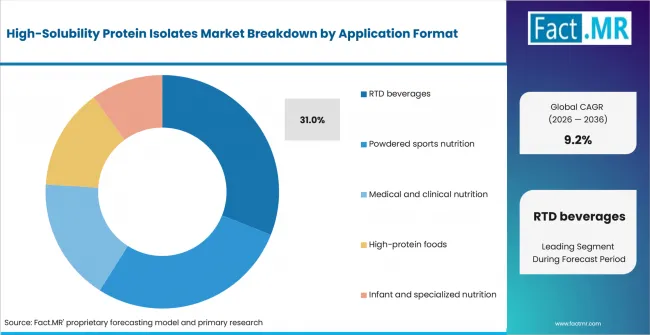
High Solubility Protein Isolates Market Analysis By Application Format | Source: Fact.MR
RTD beverages are anticipated to lead Application Format because they expose solubility defects directly to consumers. Powdered sports nutrition, medical and clinical nutrition, high-protein foods, and specialized nutrition also support demand for improved protein solubility. This application mix keeps RTD and powdered nutrition closely linked in supplier trials.
What supports Cold-water dispersible demand within Solubility Grade?
Cold-water dispersible formats are estimated to hold 38.0% share in 2026.
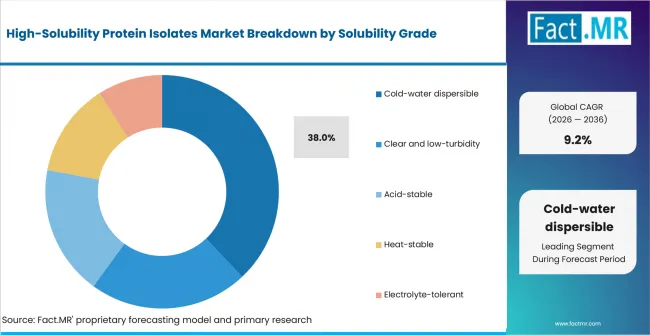
High Solubility Protein Isolates Market Analysis By Solubility Grade | Source: Fact.MR
Cold-water dispersible formats are estimated to lead Solubility Grade because consumers often prepare protein drinks without heating. Clear, low-turbidity, acid-stable, heat-stable, and electrolyte-tolerant grades remain important across specialized beverage formats. Roquette Frères launched NUTRALYS Pea 850F in February 2026 and highlighted its solubility for ready-to-mix and ready-to-drink applications.
What is accelerating High-Solubility Protein Isolates Market adoption, and what is holding it back?
RTD formulation drives it; allergen and texture control restrain it.
Drivers Impact Analysis
| Driver | (~) % IMPACT ON CAGR | Geographic Relevance | Impact Timeline |
|---|---|---|---|
| RTD protein beverage formulation | +1.6% | North America, Europe, East Asia | Short term (<= 2 years) |
| Cold-water powder dispersion | +1.3% | Global | Short term (<= 2 years) |
| Clinical and older-adult nutrition | +1.0% | Japan, Germany, USA | Medium term (2-4 years) |
| Plant protein reformulation | +0.8% | Brazil, USA, UK | Medium term (2-4 years) |
Source: Fact.MR analysis. Updated Sep 2, 2026
- RTD protein beverage formulation: RTD drinks make protein solubility visible at the shelf and during consumption. Beverage brands value isolates that reduce haze and sediment in clear or lightly flavored drinks. Finished-drink stability therefore supports repeat formulation trials and wider commercial use.
- Cold-water powder dispersion: Powder users often mix products in shakers without controlled temperature or specialized blending equipment. This supports demand for instant agglomeration and lecithination technologies. Brands that reduce clumping can improve preparation convenience and repeat use across sports nutrition and meal-support formats.
- Clinical and older-adult nutrition: Compact nutritional servings require high protein density without creating excessive thickness or poor mouthfeel. Specialist nutrition brands therefore focus on soluble dairy and plant protein formats that support easy preparation, consistent texture, and efficient protein delivery.
Opportunity Impact Analysis
| Opportunity | (~) % IMPACT ON CAGR | Geographic Relevance | Impact Timeline |
|---|---|---|---|
| Clear protein waters and juice-style drinks | +1.1% | USA, UK, Japan | Medium term (2-4 years) |
| Dual-source dairy and plant portfolios | +0.9% | Global | Medium term (2-4 years) |
| Specialized nutrition for ageing consumers | +0.7% | Japan, Germany | Long term (>= 4 years) |
| Faster formulation support for brands | +0.5% | North America, Europe | Short term (<= 2 years) |
Source: Fact.MR analysis. Updated Sep 2, 2026
- Clear protein waters and juice-style drinks: Clear beverage concepts create a premium route for whey and acid-stable proteins. Suppliers offering low-turbidity grades can gain more formulation trials where brands want strong protein positioning without the appearance or texture of a conventional thick shake.
- Dual-source dairy and plant portfolios: Formulators can combine whey, soy, and pea options to manage label requirements, application needs, and ingredient-cost changes. Broad portfolios help brands move between beverage and powder formats while maintaining their overall nutrition strategy, creating opportunities for suppliers with cross-application technical support.
- Specialized nutrition for ageing consumers: Older-adult nutrition requires easy-to-consume formats that maintain protein density without creating heavy texture. Clinical and everyday nutrition brands can respond with smaller serving formats, while smoothly dispersing protein isolates support convenient preparation, acceptable mouthfeel, and consistent nutrient delivery.
Restraints Impact Analysis
| Restraint | (~) % IMPACT ON CAGR | Geographic Relevance | Impact Timeline |
|---|---|---|---|
| Allergen labeling and cross-contact controls | -0.6% | USA, UK, Europe | Short term (<= 2 years) |
| Dairy input price variation | -0.5% | USA, UK, Germany | Medium term (2-4 years) |
| Taste and turbidity limits in plant proteins | -0.4% | Global | Short term (<= 2 years) |
| Heat and acid stability trade-offs | -0.3% | Japan, Europe | Long term (>= 4 years) |
Source: Fact.MR analysis. Updated Sep 2, 2026
- Allergen labeling and cross-contact controls: Milk and soy proteins require allergen risk assessment and appropriate cross-contact controls in mixed-source facilities. Cleaning, segregation, documentation, and clear consumer communication remain important when manufacturers handle multiple protein sources within the same production environment.
- Dairy input price variation: Whey-protein ingredient economics can shift with changes in dairy supply, demand, and availability of higher-protein fractions. Ingredient buyers therefore face cost uncertainty when sourcing whey concentrates and isolates, making supplier relationships and purchasing flexibility important for formulation planning.
- Taste and turbidity limits in plant proteins: Plant isolates can introduce beany notes, grittiness, or visible haze at higher protein loads. These characteristics create additional sensory and stability work for RTD beverages and clear formats, which can slow adoption where brands have limited time for masking and formulation trials.
Which countries are scaling the High-Solubility Protein Isolates Market through 2036?
- The country comparison spans 2.12 percentage points and forms a clear spread across the forecast period.
- USA remains 0.89 percentage point ahead of the UK due to dairy scale and sports nutrition retail depth.
- The UK remains 0.31 percentage point ahead of Germany as whey-based performance nutrition fits local quality expectations.
- Germany remains 0.46 percentage point ahead of Japan due to dairy processing depth and premium food manufacturing.
- Japan remains 0.46 percentage point ahead of Brazil as compact nutrition formats support specialist protein use.
Comparable CAGRs create different entry conditions because dairy supply, plant protein availability and clinical nutrition needs vary by country. Full report coverage includes North America, Latin America, Western Europe, Eastern Europe, East Asia, South Asia & Pacific, and Middle East & Africa.
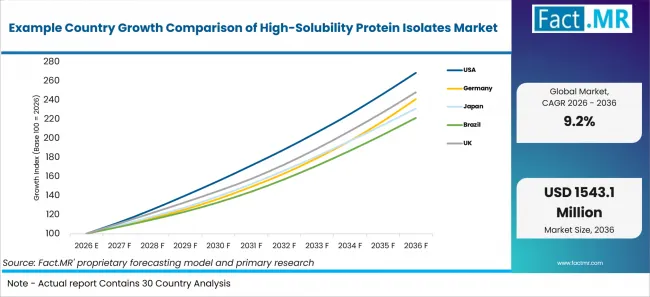
Example Country Growth Comparison Of High Solubility Protein Isolates Market | Source: Fact.MR
| Country | CAGR (2026-2036) |
|---|---|
| USA | 10.4% |
| UK | 9.5% |
| Germany | 9.2% |
| Japan | 8.7% |
| Brazil | 8.3% |
Source: Fact.MR analysis. Updated Sep 2, 2026
What supports USA adoption?
10.4% CAGR, supported by dairy scale and beverage nutrition channels.
U.S. dairy scale gives whey isolate suppliers a wide input base for instant and clear protein formats. USDA NASS reported in April 2026 that milk production increased 2.6% in 2025 to 232 billion pounds. USA is projected to record 10.4% CAGR through 2036 as beverage brands pull high-protein formats into mainstream retail.
How is the UK scaling demand?
9.5% CAGR, driven by milk output and performance nutrition standards.
The UK outlook is shaped by domestic milk flows and strict brand testing for performance nutrition. Defra reported on July 29, 2026 that milk production for human consumption increased 5.0% to 15.8 billion litres in 2025. The market is expected to post 9.5% CAGR through 2036 as RTD and powder brands require repeatable solubility data.
What supports Germany growth?
9.2% CAGR, shaped by dairy processing and premium food manufacturing.
Germany’s dairy manufacturing base supports isolate use in high-protein foods and specialist beverages. Destatis reported in December 2025 that German farms held about 3.6 million dairy cows on 3 November 2025. Germany is anticipated to reach 9.2% CAGR through 2036 as food manufacturers refine whey and milk protein formats for premium retail channels.
How does Japan perform?
8.7% CAGR, led by ageing nutrition and compact beverage formats.
Japan’s nutrition brands value soluble proteins that deliver high density in compact servings. MAFF reported in January 2026 that December 2025 raw milk production reached 616,047 tonnes. Japan is estimated to register 8.7% CAGR through 2036 as clinical nutrition and convenient beverage formats keep dispersion performance central to ingredient approval.
What supports Brazil adoption?
8.3% CAGR, supported by soy scale and inspected dairy collection.
Brazil combines soybean scale with inspected milk collection, giving plant and dairy isolate suppliers two practical routes. Conab estimated in August 2026 that Brazil’s 2025/26 soybean production would reach 180.5 million tonnes. Brazil is forecast to advance at 8.3% CAGR through 2036 as local processors support soy isolate and high-protein beverage trials.
Who leads the High-Solubility Protein Isolates Market?
Arla Foods Ingredients and ADM are active direct protein-isolate suppliers, while Fonterra Co-operative Group Limited (NZMP™) and Roquette Frères strengthen dairy and plant-protein capabilities.
Arla Foods Ingredients is active through dairy performance nutrition ingredients for RTD applications. ADM supports the market through soy protein isolates and a broad portfolio of pea protein ingredients. Fonterra Co-operative Group Limited (NZMP™) reported in July 2025 that its dairy proteins are used in applications ranging from ready-to-mix protein powders to medical nutrition and sports supplements.
Roquette Frères strengthens the plant protein side through pea isolate capabilities for ready-to-mix and ready-to-drink applications. Lactalis Ingredients and Ingredion Incorporated complete the provider set through dairy and nutrition ingredient portfolios. Competition is expected to center on solubility proof, taste control and application support across RTD beverages, powders and clinical nutrition.
Which companies are the key providers?
Key companies include Arla Foods Ingredients, Fonterra Co-operative Group Limited (NZMP™), Lactalis Ingredients, ADM, Roquette Frères, and Ingredion Incorporated.
- Arla Foods Ingredients
- Fonterra Co-operative Group Limited (NZMP™)
- Lactalis Ingredients
- ADM
- Roquette Frères
- Ingredion Incorporated
Bibliography
- ADM. (2026, May 20). ADM advances protein innovation with new ingredient solutions.
- Arla Foods Ingredients. (2025, May 27). Arla Foods Ingredients and Alchemy Agencies sign new distribution agreement.
- Companhia Nacional de Abastecimento. (2026, August 13). Estimativa aponta para uma produção de 360,8 milhões de toneladas na safra 2025/26.
- Department for Environment, Food & Rural Affairs. (2026, July 29). Chapter 8: Livestock.
- Statistisches Bundesamt (Destatis). (2025, December 22). Korrektur: Schweinebestand 2025 leicht gewachsen, Zahl der Betriebe weiterhin rückläufig.
- Fonterra Co-operative Group Limited. (2025, July 29). Fonterra meeting soaring demands of North Asia’s booming functional dairy ingredients market.
- Shillitoe, R., Clifford, R., Jenkins, M., & Murray, L. (2025, September 25). Food and You 2: Wave 10. Food Standards Agency.
- Cabinet Office, Japan. (2025, June). Annual report on the ageing society [Summary] FY2025.
- Roquette. (2026, February 23). Launch of breakthrough clean-tasting pea protein isolate.
- U.S. Department of Agriculture, Agricultural Marketing Service. (2026, June 12). Dairy Market News, June 8–12, 2026 (Vol. 93, Report 24).
- Zeballos, E., & Sinclair, W. (2026, June 11). Total U.S. food spending reached $2.51 trillion in 2025. U.S. Department of Agriculture, Economic Research Service.
- U.S. Department of Agriculture, National Agricultural Statistics Service. (2026, April 30). Milk production, disposition, and income 2025 summary.
- Ingredion Incorporated. (2024, October 24). Ingredion launches VITESSENCE® Pea 200 D, shaking up drinking experiences in nutritional beverages.
This Report Answers
- The report explains where high-solubility isolates fit within protein ingredients and how source choice affects formulation.
- Segment analysis identifies whey protein isolate and instant agglomeration, while adjacent plant protein ingredients coverage frames soy and pea isolate demand.
- Application analysis covers RTD beverages, powdered sports nutrition and clinical nutrition, with related sports nutrition ingredients context for use.
- Country analysis examines USA, UK, Germany, Japan and Brazil, including milk output and soy availability.
- Competitive analysis reviews Arla Foods Ingredients, Fonterra Co-operative Group Limited (NZMP™), Lactalis Ingredients, ADM, Roquette Frères and Ingredion Incorporated across dairy and plant isolates.
- Formulation analysis evaluates solubility, taste, turbidity and cold-water performance, with adjacent protein flavor masking agents coverage.
- Scope checks compare clear whey and pea beverage systems with acidified whey protein and acid-stable pea protein beverages coverage.
What does the High-Solubility Protein Isolates Market cover?
Whey, soy, pea and milk protein isolates used for clean dispersion in nutrition formats.
The High-Solubility Protein Isolates Market covers purified dairy and plant proteins designed to disperse in liquids or prepared foods with limited clumping. It includes isolates used in RTD beverages, powders, high-protein foods and clinical nutrition where solubility affects finished product quality.
The assessment focuses on isolate formats where solubility is a buying criterion. Broader powder dietary supplements and sports supplement coverage remains adjacent when finished products include broader protein blends.
What is included in the scope?
High-solubility isolate ingredients used in beverage, powder and specialized nutrition applications.
The scope includes whey protein isolate, soy protein isolate, pea protein isolate, milk protein isolate and other plant proteins when solubility is a defining performance requirement. It covers instant agglomeration, hydrolysis and enzymatic treatment, lecithination, pH and mineral optimization, and fermentation-linked enhancement. Application coverage includes RTD beverages, powdered sports nutrition, medical and clinical nutrition, high-protein foods, and infant and specialized nutrition. Adjacent ingredient context includes milk protein concentrate where dairy systems compete for formulation space.
What is excluded from the scope?
Finished branded nutrition products and non-isolate protein ingredients are outside the scope.
Finished shakes, bars, capsules and retail supplements are outside the scope unless the analysis is limited to the isolate ingredient used inside them. General flavors, sweeteners, stabilizers and masking systems are excluded except where they support isolate solubility or sensory performance. Related plant protein off-note masking systems coverage is adjacent to isolate formulation.
How Was the Analysis Built?
The analysis draws on 120+ sources, 35+ company portfolios, 25+ countries, and more than 20 industry interviews.
- Primary Research: Primary research includes discussions with manufacturers, service providers, technology developers, distributors, end users, and subject-matter experts. These conversations examine purchasing priorities, product adoption, operational challenges, approval requirements, competitive positioning, and the factors that influence wider market acceptance.
- Desk Research: Desk research covers government statistics, regulatory publications, company filings, trade data, technical studies, industry associations, standards, public policy, and other authoritative sources. Every source used in the analysis is documented in the bibliography.
- Market Sizing and Forecasting: Market estimates combine historical performance, demand indicators, pricing and volume trends, segment shares, company participation, country-level growth, adoption patterns, investment activity, and barriers to market expansion.
- Data Validation and Update Cycle: Findings are validated by comparing primary interviews with public data, company activity, regulatory changes, trade patterns, and industry developments. Regular updates review new product launches, capacity changes, partnerships, approvals, and shifts in commercial adoption.
Segmentation
What is the report’s scope and coverage?
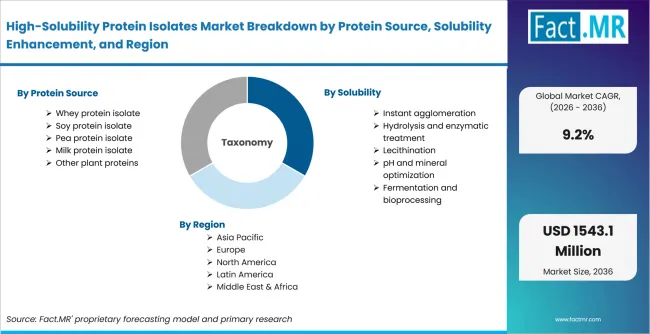
High Solubility Protein Isolates Market Breakdown By Protein Source, Solubility Enhancement, And Region | Source: Fact.MR
| Attribute | Details |
|---|---|
| Quantitative Units | USD million |
| Market Definition | High-solubility protein isolates used in beverages, powders, high-protein foods, clinical nutrition, infant nutrition and specialized nutrition formats. |
| Protein Source | Whey protein isolate; Soy protein isolate; Pea protein isolate; Milk protein isolate; Other plant proteins |
| Solubility Enhancement | Instant agglomeration; Hydrolysis and enzymatic treatment; Lecithination; pH and mineral optimization; Fermentation and bioprocessing |
| Application Format | RTD beverages; Powdered sports nutrition; Medical and clinical nutrition; High-protein foods; Infant and specialized nutrition |
| Solubility Grade | Cold-water dispersible; Clear and low-turbidity; Acid-stable; Heat-stable; Electrolyte-tolerant |
| Regions Covered | North America; Latin America; Western Europe; Eastern Europe; East Asia; South Asia & Pacific; Middle East & Africa |
| Countries Covered | USA; UK; Germany; Japan; Brazil |
| Key Companies Profiled | Arla Foods Ingredients; Fonterra Co-operative Group Limited (NZMP™); Lactalis Ingredients; ADM; Roquette Frères; Ingredion Incorporated |
| Forecast Period | 2026 to 2036 |
| Approach | Hybrid approach using applications, source mix, solubility grade, country adoption, company portfolios and formulation evidence. |
Source: Fact.MR analysis. Updated Sep 2, 2026
How is the market segmented?
-
By Protein Source
- Whey protein isolate
- Soy protein isolate
- Pea protein isolate
- Milk protein isolate
- Other plant proteins
-
By Solubility Enhancement
- Instant agglomeration
- Hydrolysis and enzymatic treatment
- Lecithination
- pH and mineral optimization
- Fermentation and bioprocessing
-
By Application Format
- RTD beverages
- Powdered sports nutrition
- Medical and clinical nutrition
- High-protein foods
- Infant and specialized nutrition
-
By Solubility Grade
- Cold-water dispersible
- Clear and low-turbidity
- Acid-stable
- Heat-stable
- Electrolyte-tolerant
-
By Region
- North America
- Latin America
- Western Europe
- Eastern Europe
- East Asia
- South Asia & Pacific
- Middle East & Africa
Frequently Asked Questions
How big is the High-Solubility Protein Isolates Market in 2026?
What is the CAGR of the High-Solubility Protein Isolates Market from 2026 to 2036?
Which Protein Source leads the High-Solubility Protein Isolates Market?
Which Application Format leads the market?
Who are the leading companies in the High-Solubility Protein Isolates Market?
Who worked on this report


Preview the report firsthand - request a free sample
Free SampleGet the brochure for pricing and purchase details
Download PDF