Heat-to-Power System Market Size, Share, Growth and Forecast (2026 - 2036)

The Heat-to-Power Systems Market is segmented by Heat Source, Gas Turbine Exhaust, Geothermal, Biomass, Temperature Range, Capacity, Technology, Application, and Region. Forecast for 2026 to 2036.

Heat-to-Power Systems Market Overview, Growth Outlook, and Forecast by Fact.MR

  • The Heat-to-Power Systems Market was valued at USD 30.0 billion in 2025 and is expected to grow at a CAGR of 7.2% to reach USD 64.5 billion by 2036.
  • Expanding at a CAGR of 7.2% during 2026 to 2036, the market is projected to grow approximately 2.0x, creating an absolute opportunity of around USD 32.3 billion in 2036 compared to 2026.
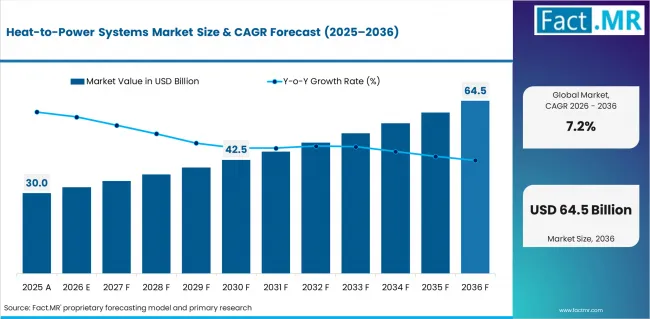
Heat To Power Systems Market Value Analysis

Summary of the Heat-to-Power Systems Market

  • Market Snapshot
    • In 2025, the global Heat-to-Power Systems Market was valued at USD 30.0 billion.
    • The market is expected to grow from USD 32.2 billion in 2026 to an estimated USD 64.5 billion by 2036.
    • The market is projected to expand at a CAGR of 7.2% during the forecast period.
    • The market is expected to generate an absolute dollar opportunity of around USD 32.3 billion from 2026 to 2036.
    • Cement industry holds a dominant position in the market in 2026 by the application segment, driven by high waste heat availability and large-scale deployment of recovery systems.
    • Organic Rankine Cycle (ORC) remains the leading technology segment, accounting for the majority share due to its efficiency in low- to medium-temperature heat recovery.
    • Key growth markets during the forecast period are India (8.8% CAGR), Japan (8.5% CAGR), and China (8.2% CAGR), supported by rapid industrialization, increasing energy efficiency initiatives, and strong demand from cement, steel, and chemical industries.
  • Demand and Growth Drivers
    • Increasing emphasis on industrial energy efficiency and rising electricity prices is promoting the use of heat-to-power systems that convert waste heat into electricity.
    • Large volumes of unused waste heat in cement, steel, oil & gas, and chemical industries create demand for waste heat recovery and power generation systems.
    • There has been an increase in demand for heat-to-power systems for energy consumption reduction and operational efficiency improvement due to rapid industrialization in countries such as India, China and Japan.
    • Growing focus on decarbonization and emission reduction targets is encouraging industries to include waste heat-to-power technology in sustainability strategies.
    • Technology development such as Organic Rankine Cycle (ORC) and better system integration increasing the efficiency level and allowing the use of low- to medium-temperature heat sources, are other factors contributing to market growth.
  • Product and Segment View
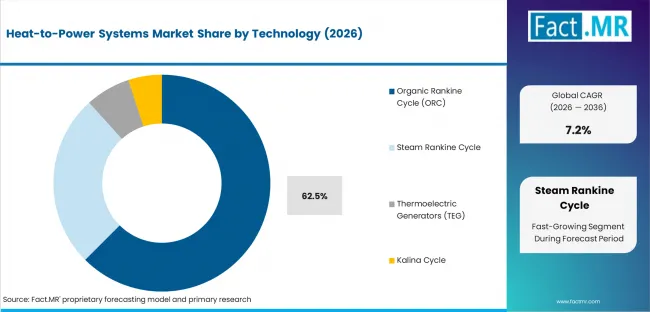
    • Organic Rankine Cycle technology is expected to lead the technology segment with 62.5% share in 2026 due to its efficiency in converting low- to medium-temperature industrial waste heat into electricity.
    • Steam Rankine Cycle accounts for 25.8% share and is supported by high-temperature heat recovery and large-scale industrial systems.
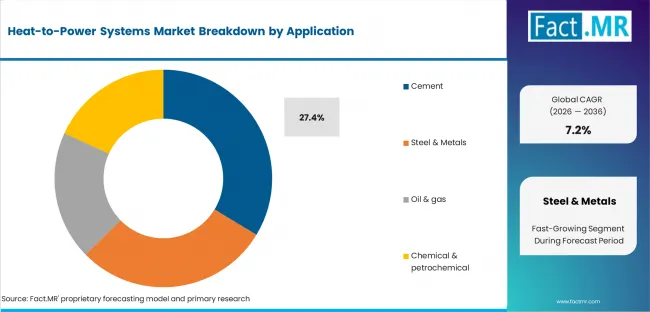
    • The cement application segment is expected to lead with 27.4% share in 2026 due to waste heat availability from preheater and clinker cooler operations.
    • Continuous steel and metals production from blast furnaces and electric arc furnaces supports a 23.6% share.
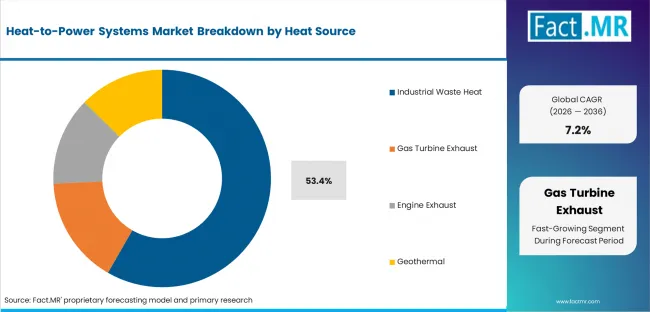
    • Industrial waste heat dominates the heat source segment with 53.4% share, supported by deployment across cement, steel, and chemical industries.
    • Gas turbine exhaust accounts for 14.6% share due to use in power plants and oil & gas facilities.
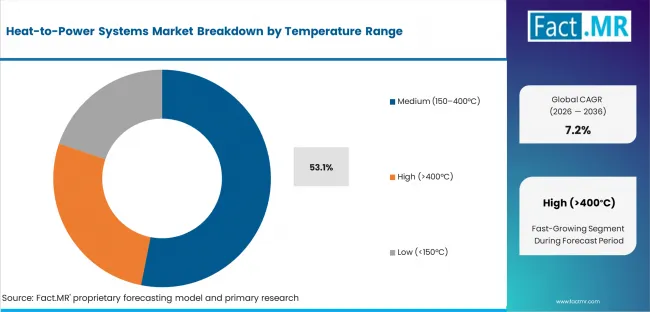
    • Medium temperature range (150–400°C) leads with 53.1% share due to its compatibility with ORC systems and broad industrial use.
    • High temperature (>400°C) accounts for 27.1% and is used mainly in steam based heat recovery systems.
    • Medium-scale systems (1–10 MW) dominate the capacity segment with a 47.5% share, propelling its adoption in industrial facilities.
    • Large-scale systems (>10 MW) are destined to the second place with 31.3 per cent of the market share owing to their use in large scale industry and solar power applications.
  • Geography and Competitive Outlook
    • Rapid urbanization, growing manufacturing capacity, and increasing emphasis on energy-efficiency are driving Asia Pacific to be the fastest-growing region for Heat-to-Power Systems. India, Japan, and China are anticipated to show robust growth led by increasing penetration in cement, steel, and chemical industries along with favorable decarbonization policies.
    • North America and Europe are considered to be more mature markets having early adoption of waste heat recovery technology and sufficient regulatory regime that encourage energy efficiency. Advancements in Organic Rankine Cycle (ORC) systems, and their integration into industrial processes, are increasing system performance and stimulating replacement and upgrade demand.
    • The growing focus on industrial decarbonization and energy cost optimization and the need to harvest low- to mid-grade heat are spurring the adoption of next-generation heat-to-power solutions. New technologies in system efficiency, modular construction and stronger integration opportunities are foreseen to contribute positively to the market growth in the forecast period.
    • Leading Companies in the Market: GE Vernova, Mitsubishi Heavy Industries, Siemens Energy, ABB, Ormat Technologies, Turboden, EXERGY International, Orcan Energy, Calnetix Technologies, and Kaishan Group.
  • Analyst Opinion
    • Shambhu Nath Jha, Principal Consultant at Fact.MR, says " The heat-to-power systems market is anticipated to grow steadily on account of rising demand for industrial energy efficiency, increasing electricity costs, and strong focus on decarbonization. “The growing need to utilize waste heat across industries such as cement, steel, oil & gas, and chemicals is driving adoption of heat-to-power systems. The shift toward efficient Organic Rankine Cycle (ORC) technology and improved system integration is enabling effective conversion of low- to medium-temperature heat into electricity. Integration of waste heat recovery with industrial processes is improving efficiency, reducing energy consumption, and enabling scalable and sustainable power generation across industries."

Heat-to-Power Systems Market— At a Glance

Attribute Details
Market Value 2025 USD 30.0 Billion
Market Value 2026 USD 32.2 Billion
Market Value 2036 USD 64.5 Billion
Absolute Dollar Opportunity USD 32.3 Billion
Total Growth 100.30%
CAGR 7.20%
Growth Multiple 2.0x
Key Demand Theme Rising demand for industrial energy efficiency, waste heat utilization, and decarbonization initiatives
Leading Technology Organic Rankine Cycle (ORC)
Technology Share 62.50%
Leading Application Cement
Application Share 27.40%
Leading Heat Source Industrial Waste Heat
Heat Source Share 53.40%
Leading Capacity Segment Medium-scale (1–10 MW)
Capacity Share 47.50%
Leading Temperature Range Medium (150–400°C)
Temperature Share 53.10%
Key Growth Regions Asia-Pacific, North America, Europe
Key Companies GE Vernova, Mitsubishi Heavy Industries, Siemens Energy, ABB, Ormat Technologies, Turboden, EXERGY International, Orcan Energy, Calnetix Technologies, Kaishan Group
Segmentation by Heat Source Industrial Waste Heat, Engine Exhaust, Gas Turbine Exhaust, Geothermal, Biomass
Segmentation by Temperature Range Low (<150°C), Medium (150–400°C), High (>400°C)
Segmentation by Capacity Small-scale (<1 MW), Medium (1–10 MW), Large-scale (>10 MW)
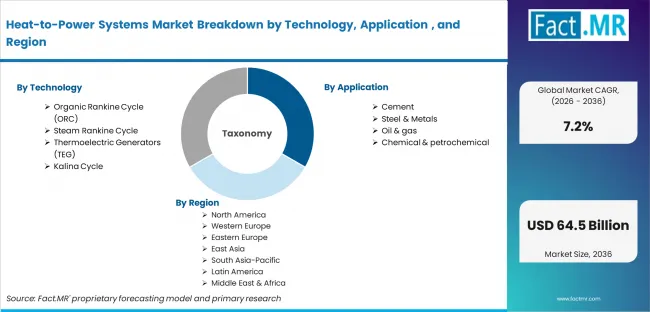
Segmentation by Technology Organic Rankine Cycle (ORC), Steam Rankine Cycle, Thermoelectric Generators (TEG), Kalina Cycle
Segmentation by Application Cement, Steel & Metals, Oil & Gas, Glass melting furnace, Chemical & Petrochemical, Power Generation
Segmentation by Region North America, Latin America, East Asia, South Asia & Pacific, Western Europe, Eastern Europe, Middle East & Africa

Key Growth Drivers, Constraints, and Opportunities

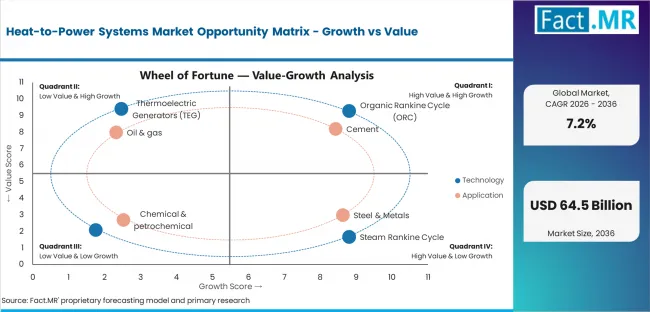
Heat To Power Systems Market Opportunity Matrix Growth Vs Value

Key Factors Driving Growth

  • The increased interest in efficient energy use in industry and high electricity prices are fueling the demand for heat-to-power systems that can produce electricity from waste heat.
  • The huge amount of unused waste heat in industries like cement, steel, oil and gas, and chemical sectors has led to the increased adoption of heat-to-power solutions.
  • There has been increased pressure on industries to cut down emissions and adopt decarbonization measures, which is leading to the increased installation of heat-to-power equipment.
  • There is a high rate of industrial growth in developing countries like India, China, and Southeast Asia, which has increased the need for heat-to-power systems.
Growth Driver Demand Impact Time Horizon Key Impact Area Fact.MR Insight
Increasing focus on industrial energy efficiency and rising electricity costs High Short–Mid Term Adoption acceleration Industries are increasingly deploying heat-to-power systems to reduce energy costs and improve efficiency by converting waste heat into electricity.
Large volume of untapped industrial waste heat across cement, steel, oil & gas, and chemical sectors High Short–Mid Term Resource utilization & cost optimization Significant availability of recoverable heat is driving strong adoption of heat-to-power systems across energy-intensive industries.
Growing emphasis on decarbonization and emission reduction targets High Mid Term Sustainability & regulatory compliance Industries are integrating heat-to-power systems to lower carbon emissions and meet global environmental regulations.
Advancements in Organic Rankine Cycle (ORC) and low-temperature heat recovery technologies Medium-High Mid–Long Term Technology adoption & system efficiency Improvements in ORC systems are enabling efficient utilization of low- to medium-temperature heat sources, expanding application scope.
Rapid industrialization and infrastructure expansion in emerging economies Medium Short–Mid Term Regional growth & capacity expansion Increasing industrial activities in Asia-Pacific regions are boosting demand for energy-efficient heat-to-power systems across multiple sectors.

Key Market Constraints

  • High costs involved during the initial setup phase may discourage its implementation, especially for smaller organizations.
  • The quality and consistency of heat sources used in different industries may affect the performance of the systems.
  • Limited knowledge on how to implement such technology may hamper its use in certain regions.

Key Opportunity Areas

  • The development of ORC technology and low-grade thermal energy recovery systems allows more industries to use thermal energy that had been otherwise impossible to harness.
  • Growing adoption of heat-to-power technology within renewable and hybrid energy systems presents new prospects for growth.
  • Government policies encouraging industrial decarbonization and energy efficiency could drive global growth.

Segment-wise Analysis of the Heat-to-Power Systems Market

  • Organic Rankine Cycle (ORC) holds 62.5% of the technology segment in 2026, supported by its ability to efficiently convert low- to medium-temperature waste heat and its widespread deployment across cement, chemical, and industrial applications.
  • Cement industry accounts for 27.4% of the application segment in 2026, driven by high waste heat availability from preheater and clinker cooler systems and strong adoption of heat recovery technologies.
  • Industrial waste heat holds 53.4% of the heat source segment in 2026, owing to its large untapped potential across energy-intensive industries such as steel, cement, and chemicals.

The report offers an extensive market sizing and in-depth analysis based on heat source, temperature range, capacity, technology, application, and geographical segments.

Which Technology Segment Topped the Heat-to-Power Systems Market?
Heat To Power Systems Market Analysis By Technology

The Organic Rankine Cycle (ORC) is expected to account for the largest share of the Heat to Power Systems Market by 2026, and it is predicted that this dominance will continue, with a contribution margin rate of 62.5% of market value. Its dominance is due to the fact that it can process low- to mid-temperature waste heat very efficiently and the availability of the technology in a wide range of industries including cement, chemical, and biomass.

Which Application Accounts for the Highest Share in the Heat-to-Power Systems Market?
Heat To Power Systems Market Analysis By Application

The cement sector stands out as the major segment, accounting for 27.4% share by 2026. This is due to the abundant waste heat availability from preheater and clinker cooler systems, and high penetration of energy recovery technology in cement plants.

Which Heat Source Holds the Largest Share in the Heat-to-Power Systems Market?
Heat To Power Systems Market Analysis By Heat Source

Industrial waste heat holds the largest share at 53.4% in 2026, primarily due to its extensive availability across energy-intensive industries such as cement, steel, and chemicals, making it the most viable and widely utilized source.

Which Temperature Range Represents the Leading Segment in the Heat-to-Power Systems Market?
Heat To Power Systems Market Analysis By Temperature Range

The 150–400℃ medium temperature segment will hold dominant status, with its share accounting for 53.1% in 2026. This is reinforced by its ability to be used with ORC systems as well as its extensive availability in industry applications.

Which Capacity Segment Leads the Heat-to-Power Systems Market?
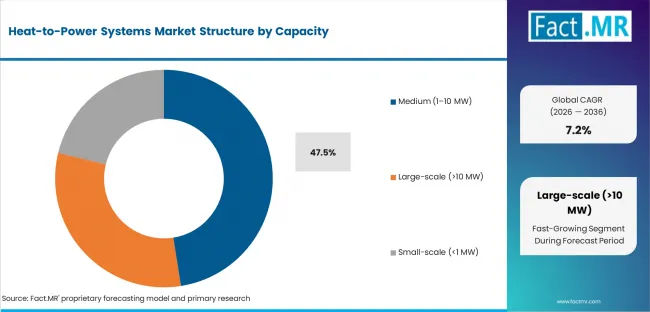
Heat To Power Systems Market Analysis By Capacity

The capacity segment is dominated by the medium-scale systems (1–10 MW), which hold 47.5% in 2026. This is attributed to the efficient tradeoff among their cost, scalability and applicability to most of the industrial applications.

Regional Outlook Across Key Markets

  • India is projected to grow at a CAGR of 8.8% through 2036, supported by industrialization, cement and steel sector growth, and energy-efficiency initiatives.
  • The United States market is projected to grow at a CAGR of 6.4% through 2036. It will be attributed to the presence of an established industrial base, high presence of the oil & gas and power industries, and an increasing focus on decarbonization and energy efficiency. Investments in waste heat recovery technology upgrades and installations have been contributing to market growth.
  • The Asia-Pacific region is expected to register the highest rate of growth overall, with China accounting for 8.2% growth owing to extensive industrial activity and high demand from the cement, steel, and chemical industries. On the other hand, Japan is expected to record a CAGR of 8.5% through 2036, driven by technology innovation, energy-efficiency programs, and high-efficiency heat-to-power system deployment.
  • In Europe, Germany is forecasted to grow at 5.8% due to stringent environmental laws, decarbonization plans within industries, and the adoption of waste heat recovery technology. In Italy, the market is expected to grow at 7.1% mainly due to the availability of many ORC companies and industrial acceptance of the technology.
  • South Korea will record a growth of around 5.7% mainly due to its industrial development and efforts towards energy efficiency and emissions reductions in various manufacturing industries.
  • Asia Pacific is expected to record the fastest regional growth, supported by India, China, and Japan through industrialization, energy demand, and heat-to-power adoption.

Top Country Growth Comparison Heat To Power Systems Market Cagr (2026 2036)

CAGR Table

Country CAGR (%)
India 8.8%
Japan 8.5%
China 8.2%
Italy 7.1%
United States 6.4%
Germany 5.8%
South Korea 5.7%

Source: Fact.MR analysis, based on proprietary forecasting model and primary research.
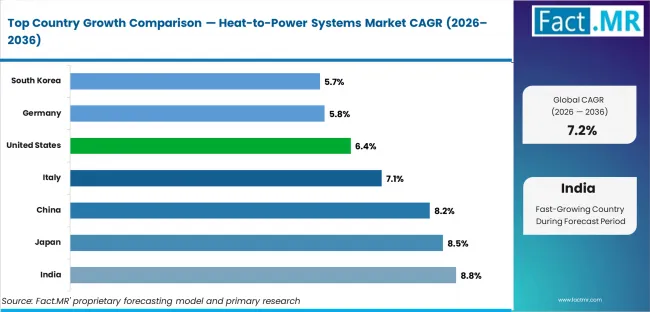
Heat To Power Systems Market Cagr Analysis By Country

North America – The Industrial Efficiency & Energy Optimization Hub

North America is a developed and high technology market where demand for heat-to-power solutions is influenced by Industrial Efficiency Improvement, Decarbonization Targets and Increasing Energy Cost. The region is observing robust penetration in oil & gas, chemicals, and power generation industries along with growing inclination toward retrofitting existing plants with sophisticated waste heat recovery solutions.

  • U.S.: Demand for heat-topower system market is projected to grow at 6.4% CAGR through 2036, driven by industrial energy optimization, refinery upgrades, and adoption of advanced ORC systems.

Europe – The Decarbonization & Sustainability-Driven Market
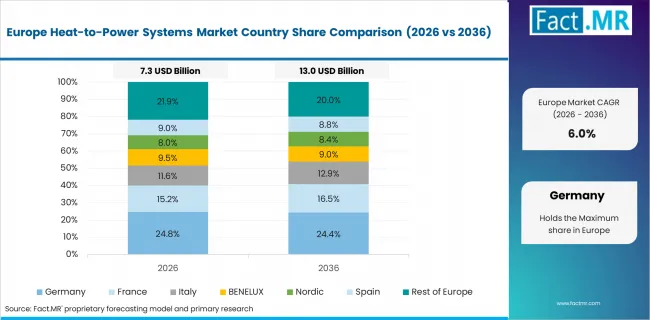
Heat To Power Systems Market Europe Country Market Share Analysis, 2026 & 2036

The European market is driven by stringent environmental regulations and decarbonization objectives, making it a prime market for heat-to-power solutions. Industrial manufacturers are prioritizing decarbonization and energy efficiency using advanced waste heat recovery technologies, especially those based on the ORC.

  • Germany: Germany is expected to grow at 5.8% CAGR, supported by industrial modernization, energy efficiency mandates, and early adoption of heat recovery technologies.
  • Italy: Italy is projected to expand at 7.1% CAGR, driven by strong presence of ORC technology providers and increasing deployment across industrial sectors.

Asia-Pacific – The Industrial Growth Engine
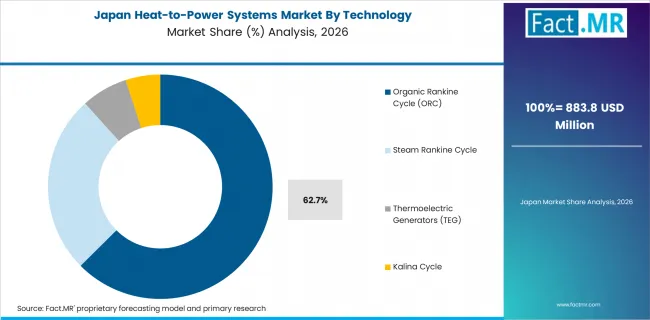
Heat To Power Systems Market Japan Market Share Analysis By Technology

Asia-Pacific is the highest growing region, owing to there is a rapid industrialization, growing manufacturing industry and escalating energy demand. Countries such as China, India, and Japan are major adopters owing to the strong presence of cement, steel and chemical industries and increasing focus on energy efficiency.

  • China: China is expected to grow at 8.2% CAGR, driven by large-scale industrial operations and increasing deployment of waste heat recovery systems.
  • Japan: Japan is projected to grow at 8.5% CAGR, supported by technological advancements and strong emphasis on energy efficiency.

Latin America – The Emerging Industrial Efficiency Market

Latin America is an emerging market for heat-to-power systems, driven by growing industrialization and increasing focus on reducing energy costs. Adoption is gradually increasing across cement, mining, and manufacturing sectors, supported by expanding industrial infrastructure.

  • Brazil: Brazil is expected to witness steady growth through 2036, supported by industrial expansion and increasing investments in energy-efficient technologies.

Competitive Benchmarking and Company Positioning

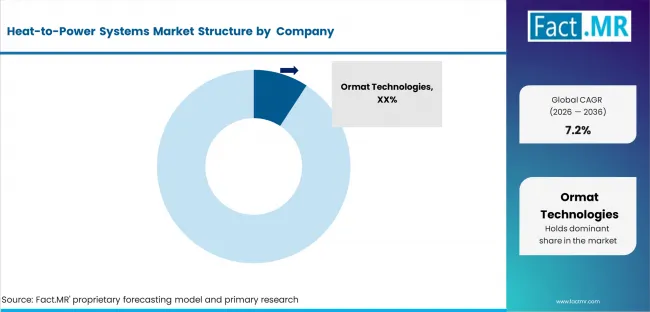
Heat To Power Systems Market Analysis By Company

Leading Companies Shaping the Heat-to-Power Systems Market

Heat-to-Power System Markets Tier 1 vendors: Market share concentration is moderate, the top players in this market such as GE Vernova, Mitsubishi Heavy Industries, Siemens Energy, ABB, Ormat Technologies, Turboden, EXERGY International, Orcan Energy, Calnetix Technologies, and Kaishan Group account for around 50% to 60% of the market. System efficiency, ability to use low or medium-grade heat, scalability, and cost of ownership are major competitive factors.

Due to the size and complexity of their operations, technical expertise and ability to offer end-to-end solutions, dominant market players thrive in this market. End-to-end solutions including turbines, generators, heat recovery and the like are the key competitive advantages to them.

Nevertheless, technology companies in particular in the ORC systems space are still innovating and deliver modularity and flexibility, as well as clean energy solutions. Increased adoption of heat-to-power technology has resulted in fierce competition in the market as industrial companies are adopting multi-vendor approach to improve cost and performance.

Recent Industry Developments

  • Turboden Commissions First Waste Heat-to-Power ORC Plant at Strathcona’s Orion SAGD Facility
    • Turboden announced the commissioning of its first waste heat-to-power Organic Rankine Cycle plant at Strathcona’s Orion SAGD facility in Canada. The system converts industrial waste heat into electricity, reducing reliance on grid power and supporting lower-emission oil sands operations.
  • Siemens Energy Signs Agreement to Build First-of-Its-Kind Waste Heat-to-Power Facility in Canada
    • Siemens Energy announced an agreement to develop a first-of-its-kind waste heat-to-power facility in Canada. The project uses technology that converts gas turbine exhaust heat into electricity, improving energy efficiency and reducing emissions in industrial operations.
  • Tallgrass Selects Turboden for Waste Heat-to-Power Projects in Ohio and Indiana
    • Tallgrass selected Turboden as its technology partner for waste heat-to-power ORC systems across gas compressor stations in Ohio and Indiana. The projects are designed to generate baseload electricity from waste heat, improving site efficiency and reducing emissions.
  • ENOGIA Selected to Supply South Korea’s First Privately Financed Waste Heat-to-Power Project
    • ENOGIA announced its selection to supply a waste heat-to-power system for a fuel cell plant in South Korea. The project represents the country’s first fully privately financed heat-to-power installation, using ORC technology to convert excess heat into electricity.
  • Clean Energy Technologies Delivers ORC Waste Heat-to-Power Project in Tennessee
    • Clean Energy Technologies, in partnership with RPG Energy Group, announced the deployment of a Clean Cycle™ ORC system in Tennessee. The project converts industrial waste heat into electricity, improving energy efficiency and reducing operating costs for a major manufacturing facility.

Leading Companies Shaping the Heat-to-Power Systems Market

  • GE Vernova
  • Mitsubishi Heavy Industries
  • Siemens Energy
  • ABB
  • Ormat Technologies
  • Turboden
  • EXERGY International
  • Orcan Energy
  • Calnetix Technologies
  • Kaishan Group

Sources and Research References

  • Turboden S.p.A. (2025, October 22). Turboden commissions the first waste heat to power ORC plant at Strathcona’s Orion SAGD facility.
  • Turboden S.p.A. (2026, March 12). Tallgrass selects Turboden as waste-heat-to-power provider to deliver new baseload capacity in Ohio and Indiana.
  • ENOGIA. (2025, December 18). ENOGIA selected to supply South Korea’s first fully privately financed waste-heat-to-power project on a fuel cell plant. Euronext.
  • Clean Energy Technologies, Inc. (2025, October 3). Clean Energy Technologies’ waste heat to power & RPG Energy Group delivers breakthrough ORC project in Martin, Tennessee.

Heat-to-Power Systems Market Definition

The heat-to-power systems market is a type of technology that transforms waste heat produced by industrial and energy processes into electricity. These systems work at a low to high temperature using solutions like Organic Rankine Cycle (ORC), Steam Rankine Cycle, Thermoelectric Generators and Kalina Cycle. The sources of heat that they use are in the form of industrial waste heat, engine and turbine exhaust, geothermal and biomass. These systems, which are deployed in small to large-scale capacities, are more cost-efficient and efficient in conserving energy. Heat-to-power systems are widely used in cement, steel, oil and gas, chemical and power generation industries to support sustainable operations by recovering unused thermal energy and reducing emissions.

Heat-to-Power Systems Market Inclusions

The heat-to-power systems market report covers a thorough analysis on the global and regional levels on market size, market type, application, and players, along with the impact of macro and microeconomic factors. The market has been segmented by heat source, temperature range, capacity, technology, application, and region. The research also provides an analysis of pricing trends, growth potential, and adoption in industries including cement, steel, oil & gas, chemical & petrochemical, glass and power generation. The Report also discusses the progress in Organic Rankine Cycle (ORC) systems, the waste heat recovery solutions integration, diversification, energy efficiency, decarbonization and industrial sustainability focus by region.

Heat-to-Power Systems Market Exclusions

The Market does not include separate waste heat recovery equipment such as heat exchangers, boilers, or thermal recovery units that are not part of or connected to power generation systems. It does not cover the thermal-to-electric energy conversion. Conventional power generation using primary fuels (coal, gas, nuclear, renewables without heat recovery integration) is excluded. The scope is further limited to exclude any industrial equipment or parts (such as turbines, generators, or control systems), which might be sold recognizably as a stand-alone unit but without the complete heat-to-power system. Also, services, including installation, maintenance, and consulting, will only be considered if they are offered as a bundle with deployment of the system.

Heat-to-Power Systems Market Research Methodology

  • Primary Research
    • To understand demand trends, technology adoption, pricing, and application-specific deployment of heat-to-power systems, in-depth interviews were conducted with heat-to-power system manufacturers, EPC contractors, technology providers (ORC, steam systems), industrial end-users (cement, steel, oil & gas, chemical), and energy consultants.
  • Desk Research
    • To validate market size, trends, and competitive landscape, secondary sources such as company annual reports, investor presentations, product literature, industry databases, government publications, trade journals, and white papers on waste heat recovery, industrial energy efficiency, and decarbonization were analyzed.
  • Market-Sizing and Forecasting
    • Market estimates were derived using a combination of bottom-up analysis (company revenues, installed base, project deployments) and top-down analysis (industrial output, energy consumption trends, waste heat potential, and adoption of heat recovery technologies).
  • Data Validation and Update Cycle
    • We triangulated all data points with industry experts and iteratively updated them to consider technology progress, regulation changes, industry expansion patterns, and macroeconomic influences affecting energy efficiency and sustainability programs.

Scope of Analysis

Heat To Power Systems Market Breakdown By Technology, Application , And Region


Parameter
Details
Quantitative Units USD 30.0 Billion (2025) to USD 64.5 Billion (2036), at a CAGR of 7.2%
Market Definition The Heat-to-Power Systems Market covers technologies designed to convert waste heat from industrial and energy processes into electricity. These systems operate across low to high temperature ranges using solutions such as Organic Rankine Cycle (ORC), Steam Rankine Cycle, Thermoelectric Generators, and Kalina Cycle. They are deployed across industries to improve energy efficiency, reduce operational costs, and support decarbonization through effective utilization of unused thermal energy.
Regions Covered North America, Europe, Asia-Pacific, Latin America, Middle East & Africa
Countries Covered USA, Canada, Germany, Italy, UK, China, Japan, India, South Korea, Brazil, Saudi Arabia, and 20+ countries
Key Companies GE Vernova, Mitsubishi Heavy Industries, Siemens Energy, ABB, Ormat Technologies, Turboden
Forecast Period 2026 to 2036
Approach Hybrid demand-side and top-down methodology based on industrial output, energy consumption patterns, waste heat potential, technology adoption (ORC, steam systems), and pricing dynamics, validated through primary interviews with system manufacturers, EPC contractors, and industrial end-users across cement, steel, oil & gas, and chemical sectors.

Analysis by Heat Source, Temperature Range, Capacity, Technology, Application, and Region

  • Heat-to-Power Systems Market by Heat Source

    • Industrial Waste Heat
      • Flue gas (kilns, furnaces)
      • Process heat (cooling streams)
    • Engine Exhaust
      • Automotive engines
      • Marine engines
    • Gas Turbine Exhaust
      • Combined cycle plants
      • Simple cycle plants
    • Geothermal
      • Dry steam
      • Flash steam
      • Binary cycle
    • Biomass
      • Agricultural waste
      • Biogas
      • Municipal solid waste
  • Heat-to-Power Systems Market by Temperature Range

    • Low (<150°C)
    • Medium (150–400°C)
    • High (>400°C)
  • Heat-to-Power Systems Market by Capacity

    • Small-scale (<1 MW)
    • Medium (1–10 MW)
    • Large-scale (>10 MW)
  • Heat-to-Power Systems Market by Technology

    • Organic Rankine Cycle (ORC)
    • Steam Rankine Cycle
    • Thermoelectric Generators (TEG)
    • Kalina Cycle
  • Heat-to-Power Systems Market by Application

    • Cement
      • Preheater exhaust
      • Clinker cooler
    • Steel & Metals
      • Blast furnace
      • Electric arc furnace
    • Oil & Gas
      • Refinery units
      • Gas flaring
    • Glass melting furnace
    • Chemical & Petrochemical
    • Power Generation
  • Heat-to-Power Systems Market by Region

    • North America
      • USA
      • Canada
      • Mexico
    • Latin America
      • Brazil
      • Chile
      • Rest of LATAM
    • East Asia
      • China
      • Japan
      • South Korea
      • Taiwan
    • South Asia & Pacific
      • India
      • Singapore
      • Australia
      • ASEAN
    • Western Europe
      • Germany
      • France
      • U.K.
      • Italy
      • Spain
      • BENELUX
      • Nordic
      • Rest of Western Europe
    • Eastern Europe
      • Poland
      • Hungary
      • Czech Republic
      • Balkan & Baltics
      • Rest of Eastern Europe
    • Middle East & Africa
      • Saudi Arabia (KSA)
      • United Arab Emirates (UAE)
      • South Africa
      • Rest of Middle East & Africa

- Frequently Asked Questions -

How large is the demand for Heat-to-Power Systems in the global market in 2025?

Demand for the Heat-to-Power Systems Market is estimated to be valued at USD 30.0 billion in 2025, driven by increasing adoption of waste heat recovery solutions across cement, steel, oil & gas, and chemical industries to improve energy efficiency and reduce operational costs.

What will be the market size of Heat-to-Power Systems globally by 2036?

The market size is projected to reach USD 64.5 billion by 2036, supported by growing industrialization, rising energy demand, and a strong focus on decarbonization and sustainability initiatives.

What is the expected demand growth for Heat-to-Power Systems between 2025 and 2036?

Demand is expected to grow at a CAGR of 7.2%, driven by increasing need for energy optimization, waste heat utilization, and adoption of efficient heat recovery technologies such as ORC systems.

Which technology segment is expected to dominate the market?

The Organic Rankine Cycle (ORC) segment is expected to dominate, accounting for 62.5% share in 2026, due to its efficiency in low- to medium-temperature heat recovery and widespread industrial adoption.

Which application segment is expected to dominate the market?

The cement industry is expected to dominate, capturing 27.4% share in 2026, driven by high waste heat availability from preheater and clinker cooler operations.

Which heat source segment is expected to dominate the market?

Industrial waste heat is expected to dominate, holding 53.4% share in 2026, supported by its availability across energy-intensive industries.

Which temperature range segment is expected to dominate the market?

The medium temperature range (150–400°C) is expected to dominate, accounting for 53.1% share in 2026, due to its compatibility with ORC technology and widespread industrial presence.

Table of Content

  1. Heat-to-Power Systems Market - Executive Summary
  2. Market Overview
    • Market Definition and Introduction
    • Market Taxonomy/ Research Scope
  3. Global Heat-to-Power Systems Market Demand Analysis 2021-2025 and Forecast, 2026–2036
    • Historical Market Volume Analysis, 2021-2025
    • Current and Future Market Volume Forecast, 2026–2036
    • Y-o-Y Growth Trend Analysis
  4. Global Heat-to-Power Systems Market - Pricing Analysis
    • Product Category and Country-Level Pricing Analysis
    • Global Average Pricing Analysis Benchmark
    • Factors Influencing Pricing
    • Cost Structure Analysis: Elementary Deep Dive
    • Competitive Pricing Strategies
    • Price Trends and Forecasts
      • Historical price trends
      • Future price forecasts
  5. Global Heat-to-Power Systems Market Demand Analysis 2021-2025 and Forecast, 2026–2036
    • Historical Market Value Analysis, 2021-2025
    • Current and Future Market Value Forecast, 2026–2036
      • Y-o-Y Growth Trend Analysis
      • Absolute $ Opportunity Analysis
  6. Market Background and Foundation Data
    • Penetration of Heat-to-Power Systems in Global Industrial Market
    • Heat-to-Power Systems: End-User Perception Analysis
    • Recent Developments in Heat-to-Power Systems, by Market Players
      • Technology launches (ORC advancements, modular systems)
      • Partnerships and project deployments
      • Expansion strategies by key players
    • Heat-to-Power Systems Production Analysis
      • By Region
        • Asia-Pacific (manufacturing hub)
        • Europe (technology innovation leader)
        • North America (deployment-driven production)
      • By Key Companies
        • Production capacity and system installations by leading players
        • Role of OEMs and EPC contractors
    • Trade Scenario, 2025
      • Import and Export Analysis
        • Flow of ORC systems, turbines, and components
        • Cross-border technology deployment trends
      • By Region
        • Europe → Asia (technology export)
        • Asia → Global (equipment manufacturing)
      • By Country
        • Key exporting countries: Italy, Germany, China
        • Key importing countries: India, U.S., Southeast Asia
    • Investment in Heat-to-Power Systems, by Region
    • Key Regulations & Policies Favoring Start-ups
    • Key Strategies and Initiatives for Ecosystem Sustainability
    • Porter’s Five Forces and PESTEL Analysis
    • Macro-Economic Factors
    • Forecast Factors - Relevance & Impact
    • Industry Value and Supply Chain Analysis
      • List of Key Channel Partners
      • Profit Margin & Operating Margin at Each Node of Supply Chain.
      • Notes on Value Added at Each Node in the Value Chain
      • Factors Influencing Value Chain
    • Market Dynamics
      • Drivers
      • Restraints
      • Opportunity
      • Trend Analysis
    • Key Regulations & Certifications
  7. Global Heat-to-Power Systems Market Analysis 2021-2025 and Forecast 2026–2036, By Heat Source
    • Introduction / Key Findings
    • Market Size & Volume Analysis by Market Taxonomy, 2021–2036
      • Industrial waste heat
        • Flue gas (kilns, furnaces)
        • Process heat (cooling streams)
      • Engine exhaust
        • Automotive engines
        • Marine engines
      • Gas turbine exhaust
        • Combined cycle plants
        • Simple cycle plants
      • Geothermal
        • Dry steam
        • Flash steam
        • Binary cycle
      • Biomass
        • Agricultural waste
        • Biogas
        • Municipal solid waste
    • Market Attractiveness Analysis by Heat Source
  8. Global Heat-to-Power Systems Market Analysis 2021-2025 and Forecast 2026–2036, By Temperature Range
    • Introduction / Key Findings
    • Market Size & Volume Analysis by Market Taxonomy, 2021–2036
      • Low (<150°C)
      • Medium (150–400°C)
      • High (>400°C)
    • Market Attractiveness Analysis by Temperature Range
  9. Global Heat-to-Power Systems Market Analysis 2021-2025 and Forecast 2026–2036, By Capacity
    • Introduction / Key Findings
    • Market Size & Volume Analysis by Market Taxonomy, 2021–2036
      • Small-scale (<1 MW)
      • Medium (1–10 MW)
      • Large-scale (>10 MW)
    • Market Attractiveness Analysis by Capacity
  10. Global Heat-to-Power Systems Market Analysis 2021-2025 and Forecast 2026–2036, By Technology
    • Introduction / Key Findings
    • Market Size & Volume Analysis by Market Taxonomy, 2021–2036
      • Organic Rankine Cycle (ORC)
      • Steam Rankine Cycle
      • Thermoelectric Generators (TEG)
      • Kalina Cycle
    • Market Attractiveness Analysis by Technology
  11. Global Heat-to-Power Systems Market Analysis 2021-2025 and Forecast 2026–2036, By Application
    • Introduction / Key Findings
    • Market Size & Volume Analysis by Market Taxonomy, 2021–2036
      • Cement
        • Preheater exhaust
        • Clinker cooler
      • Steel & Metals
        • Blast furnace
        • Electric arc furnace
      • Oil & gas
        • Refinery units
        • Gas flaring
      • Glass melting furnace
      • Chemical & petrochemical
      • Power generation
    • Market Attractiveness Analysis by Application
  12. Global Heat-to-Power Systems Market Analysis and Forecast, by Region
    • Introduction / Key Findings
    • Market Size & Volume Analysis by Market Taxonomy, 2021–2036
      • North America
      • Latin America
      • Western Europe
      • Eastern Europe
      • East Asia
      • South Asia & Pacific
      • Middle East & Africa
    • Market Attractiveness Analysis by Region
  13. North America Heat-to-Power Systems Market Analysis and Forecast
    • Market Size & Volume Analysis by Market Taxonomy, 2021–2036
      • By Country
        • United States
        • Canada
        • Mexico
      • By Taxonomy
    • Market Attractiveness Analysis by Country & Taxonomy
  14. Latin America Heat-to-Power Systems Market Analysis and Forecast
    • Market Size & Volume Analysis by Market Taxonomy, 2021–2036
      • By Country
        • Brazil
        • Chile
        • Rest of LATAM
      • By Taxonomy
    • Market Attractiveness Analysis by Country & Taxonomy
  15. Western Europe Heat-to-Power Systems Market Analysis and Forecast
    • Market Size & Volume Analysis by Market Taxonomy, 2021–2036
      • By Country
        • Germany
        • Italy
        • France
        • United Kingdom
        • Spain
        • BENELUX
        • Nordics
        • Rest of Western Europe
      • By Taxonomy
    • Market Attractiveness Analysis by Country & Taxonomy
  16. Eastern Europe Heat-to-Power Systems Market Analysis and Forecast
    • Market Size & Volume Analysis by Market Taxonomy, 2021–2036
      • By Country
        • Russia
        • Hungary
        • Poland
        • Balkan & Baltics
        • Rest of Eastern Europe
      • By Taxonomy
    • Market Attractiveness Analysis by Country & Taxonomy
  17. East Asia Heat-to-Power Systems Market Analysis and Forecast
    • Market Size & Volume Analysis by Market Taxonomy, 2021–2036
      • By Country
        • China
        • Japan
        • South Korea
      • By Taxonomy
    • Market Attractiveness Analysis by Country & Taxonomy
  18. South Asia & Pacific Heat-to-Power Systems Market Analysis and Forecast
    • Market Size & Volume Analysis by Market Taxonomy, 2021–2036
      • By Country
        • India
        • ASEAN
        • Australia & New Zealand
        • Rest of South Asia & Pacific
      • By Taxonomy
    • Market Attractiveness Analysis by Country & Taxonomy
  19. Middle East & Africa Heat-to-Power Systems Market Analysis and Forecast
    • Market Size & Volume Analysis by Market Taxonomy, 2021–2036
      • By Country
        • Kingdom of Saudi Arabia
        • Other GCC Countries
        • Turkiye
        • South Africa
        • Other African Union
      • By Taxonomy
    • Market Attractiveness Analysis by Country & Taxonomy
  20. Country-level Heat-to-Power Systems Market Analysis and Forecast
    • Introduction
      • Market Value Proportion Analysis, By Key Countries
      • Global Vs. Country Growth Comparison
    • United States Heat-to-Power Systems Market Analysis
      • Market Size & Volume Analysis by Market Taxonomy, 2021–2036
        • By Heat Source
        • By Temperature Range
        • By Capacity
        • By Technology
        • By Application
      • Canada Heat-to-Power Systems Market Analysis
      • Mexico Heat-to-Power Systems Market Analysis
      • Brazil Heat-to-Power Systems Market Analysis
      • Chile Heat-to-Power Systems Market Analysis
      • Germany Heat-to-Power Systems Market Analysis
      • France Heat-to-Power Systems Market Analysis
      • Italy Heat-to-Power Systems Market Analysis
      • Spain Heat-to-Power Systems Market Analysis
      • United Kingdom Heat-to-Power Systems Market Analysis
      • BENELUX Heat-to-Power Systems Market Analysis
      • Nordics Heat-to-Power Systems Market Analysis
      • Poland Heat-to-Power Systems Market Analysis
      • Russia Heat-to-Power Systems Market Analysis
      • Hungary Heat-to-Power Systems Market Analysis
      • Balkan & Baltics Heat-to-Power Systems Market Analysis
      • China Heat-to-Power Systems Market Analysis
      • Japan Heat-to-Power Systems Market Analysis
      • South Korea Heat-to-Power Systems Market Analysis
      • India Heat-to-Power Systems Market Analysis
      • ASEAN Heat-to-Power Systems Market Analysis
      • ANZ Heat-to-Power Systems Market Analysis
      • KSA Heat-to-Power Systems Market Analysis
      • Other GCC Countries Heat-to-Power Systems Market Analysis
      • South Africa Heat-to-Power Systems Market Analysis
      • Türkiye Heat-to-Power Systems Market Analysis
    • Heat-to-Power Systems Market Structure Analysis
      • Market Analysis by Tier of Companies
      • Market Share Analysis of Top Players
      • Market Space for New Brands and Dollar Opportunity
      • Market Presence Analysis
        • Regional Footprint of Players
        • Product Footprint by Players
        • Application Footprint by Players
    • Heat-to-Power Systems Competition Analysis
      • Competition Dashboard
      • Pricing Analysis by Competition
      • Competition Benchmarking
      • Competition Deep Dive
        • GE Vernova
          • Overview
          • Product Portfolio
          • Sales Footprint
          • Key Developments
          • SWOT Analysis
          • Strategy Overview
          • Key Financials
        • Mitsubishi Heavy Industries
        • Siemens Energy
        • ABB
        • Ormat Technologies
        • Turboden
        • EXERGY International
        • Orcan Energy
        • Calnetix Technologies
        • Kaishan Group
        • Other Prominent Players
    • Primary Insights
    • Assumption & Acronyms Used
    • Research Methodology & Data Sources

List Of Table

  • Table 1: Global Market Value (USD Bn) Forecast by Region, 2021 to 2036
  • Table 2: Global Market Volume (Units) Forecast by Region, 2021 to 2036
  • Table 3: Global Market Value (USD Bn) Forecast by Heat Source, 2021 to 2036
  • Table 4: Global Market Volume (Units) Forecast by Heat Source, 2021 to 2036
  • Table 5: Global Market Value (USD Bn) Forecast by Temperature Range, 2021 to 2036
  • Table 6: Global Market Volume (Units) Forecast by Temperature Range, 2021 to 2036
  • Table 7: Global Market Value (USD Bn) Forecast by Capacity, 2021 to 2036
  • Table 8: Global Market Volume (Units) Forecast by Capacity, 2021 to 2036
  • Table 9: Global Market Value (USD Bn) Forecast by Technology, 2021 to 2036
  • Table 10: Global Market Volume (Units) Forecast by Technology, 2021 to 2036
  • Table 11: Global Market Value (USD Bn) Forecast by Application, 2021 to 2036
  • Table 12: Global Market Volume (Units) Forecast by Application, 2021 to 2036
  • Table 13: North America Market Value (USD Bn) Forecast by Country, 2021 to 2036
  • Table 14: North America Market Volume (Units) Forecast by Country, 2021 to 2036
  • Table 15: North America Market Value (USD Bn) Forecast by Heat Source, 2021 to 2036
  • Table 16: North America Market Volume (Units) Forecast by Heat Source, 2021 to 2036
  • Table 17: North America Market Value (USD Bn) Forecast by Temperature Range, 2021 to 2036
  • Table 18: North America Market Volume (Units) Forecast by Temperature Range, 2021 to 2036
  • Table 19: North America Market Value (USD Bn) Forecast by Capacity, 2021 to 2036
  • Table 20: North America Market Volume (Units) Forecast by Capacity, 2021 to 2036
  • Table 21: North America Market Value (USD Bn) Forecast by Technology, 2021 to 2036
  • Table 22: North America Market Volume (Units) Forecast by Technology, 2021 to 2036
  • Table 23: North America Market Value (USD Bn) Forecast by Application, 2021 to 2036
  • Table 24: North America Market Volume (Units) Forecast by Application, 2021 to 2036
  • Table 25: Latin America Market Value (USD Bn) Forecast by Country, 2021 to 2036
  • Table 26: Latin America Market Volume (Units) Forecast by Country, 2021 to 2036
  • Table 27: Latin America Market Value (USD Bn) Forecast by Heat Source, 2021 to 2036
  • Table 28: Latin America Market Volume (Units) Forecast by Heat Source, 2021 to 2036
  • Table 29: Latin America Market Value (USD Bn) Forecast by Temperature Range, 2021 to 2036
  • Table 30: Latin America Market Volume (Units) Forecast by Temperature Range, 2021 to 2036
  • Table 31: Latin America Market Value (USD Bn) Forecast by Capacity, 2021 to 2036
  • Table 32: Latin America Market Volume (Units) Forecast by Capacity, 2021 to 2036
  • Table 33: Latin America Market Value (USD Bn) Forecast by Technology, 2021 to 2036
  • Table 34: Latin America Market Volume (Units) Forecast by Technology, 2021 to 2036
  • Table 35: Latin America Market Value (USD Bn) Forecast by Application, 2021 to 2036
  • Table 36: Latin America Market Volume (Units) Forecast by Application, 2021 to 2036
  • Table 37: Western Europe Market Value (USD Bn) Forecast by Country, 2021 to 2036
  • Table 38: Western Europe Market Volume (Units) Forecast by Country, 2021 to 2036
  • Table 39: Western Europe Market Value (USD Bn) Forecast by Heat Source, 2021 to 2036
  • Table 40: Western Europe Market Volume (Units) Forecast by Heat Source, 2021 to 2036
  • Table 41: Western Europe Market Value (USD Bn) Forecast by Temperature Range, 2021 to 2036
  • Table 42: Western Europe Market Volume (Units) Forecast by Temperature Range, 2021 to 2036
  • Table 43: Western Europe Market Value (USD Bn) Forecast by Capacity, 2021 to 2036
  • Table 44: Western Europe Market Volume (Units) Forecast by Capacity, 2021 to 2036
  • Table 45: Western Europe Market Value (USD Bn) Forecast by Technology, 2021 to 2036
  • Table 46: Western Europe Market Volume (Units) Forecast by Technology, 2021 to 2036
  • Table 47: Western Europe Market Value (USD Bn) Forecast by Application, 2021 to 2036
  • Table 48: Western Europe Market Volume (Units) Forecast by Application, 2021 to 2036
  • Table 49: Eastern Europe Market Value (USD Bn) Forecast by Country, 2021 to 2036
  • Table 50: Eastern Europe Market Volume (Units) Forecast by Country, 2021 to 2036
  • Table 51: Eastern Europe Market Value (USD Bn) Forecast by Heat Source, 2021 to 2036
  • Table 52: Eastern Europe Market Volume (Units) Forecast by Heat Source, 2021 to 2036
  • Table 53: Eastern Europe Market Value (USD Bn) Forecast by Temperature Range, 2021 to 2036
  • Table 54: Eastern Europe Market Volume (Units) Forecast by Temperature Range, 2021 to 2036
  • Table 55: Eastern Europe Market Value (USD Bn) Forecast by Capacity, 2021 to 2036
  • Table 56: Eastern Europe Market Volume (Units) Forecast by Capacity, 2021 to 2036
  • Table 57: Eastern Europe Market Value (USD Bn) Forecast by Technology, 2021 to 2036
  • Table 58: Eastern Europe Market Volume (Units) Forecast by Technology, 2021 to 2036
  • Table 59: Eastern Europe Market Value (USD Bn) Forecast by Application, 2021 to 2036
  • Table 60: Eastern Europe Market Volume (Units) Forecast by Application, 2021 to 2036
  • Table 61: East Asia Market Value (USD Bn) Forecast by Country, 2021 to 2036
  • Table 62: East Asia Market Volume (Units) Forecast by Country, 2021 to 2036
  • Table 63: East Asia Market Value (USD Bn) Forecast by Heat Source, 2021 to 2036
  • Table 64: East Asia Market Volume (Units) Forecast by Heat Source, 2021 to 2036
  • Table 65: East Asia Market Value (USD Bn) Forecast by Temperature Range, 2021 to 2036
  • Table 66: East Asia Market Volume (Units) Forecast by Temperature Range, 2021 to 2036
  • Table 67: East Asia Market Value (USD Bn) Forecast by Capacity, 2021 to 2036
  • Table 68: East Asia Market Volume (Units) Forecast by Capacity, 2021 to 2036
  • Table 69: East Asia Market Value (USD Bn) Forecast by Technology, 2021 to 2036
  • Table 70: East Asia Market Volume (Units) Forecast by Technology, 2021 to 2036
  • Table 71: East Asia Market Value (USD Bn) Forecast by Application, 2021 to 2036
  • Table 72: East Asia Market Volume (Units) Forecast by Application, 2021 to 2036
  • Table 73: South Asia and Pacific Market Value (USD Bn) Forecast by Country, 2021 to 2036
  • Table 74: South Asia and Pacific Market Volume (Units) Forecast by Country, 2021 to 2036
  • Table 75: South Asia and Pacific Market Value (USD Bn) Forecast by Heat Source, 2021 to 2036
  • Table 76: South Asia and Pacific Market Volume (Units) Forecast by Heat Source, 2021 to 2036
  • Table 77: South Asia and Pacific Market Value (USD Bn) Forecast by Temperature Range, 2021 to 2036
  • Table 78: South Asia and Pacific Market Volume (Units) Forecast by Temperature Range, 2021 to 2036
  • Table 79: South Asia and Pacific Market Value (USD Bn) Forecast by Capacity, 2021 to 2036
  • Table 80: South Asia and Pacific Market Volume (Units) Forecast by Capacity, 2021 to 2036
  • Table 81: South Asia and Pacific Market Value (USD Bn) Forecast by Technology, 2021 to 2036
  • Table 82: South Asia and Pacific Market Volume (Units) Forecast by Technology, 2021 to 2036
  • Table 83: South Asia and Pacific Market Value (USD Bn) Forecast by Application, 2021 to 2036
  • Table 84: South Asia and Pacific Market Volume (Units) Forecast by Application, 2021 to 2036
  • Table 85: Middle East & Africa Market Value (USD Bn) Forecast by Country, 2021 to 2036
  • Table 86: Middle East & Africa Market Volume (Units) Forecast by Country, 2021 to 2036
  • Table 87: Middle East & Africa Market Value (USD Bn) Forecast by Heat Source, 2021 to 2036
  • Table 88: Middle East & Africa Market Volume (Units) Forecast by Heat Source, 2021 to 2036
  • Table 89: Middle East & Africa Market Value (USD Bn) Forecast by Temperature Range, 2021 to 2036
  • Table 90: Middle East & Africa Market Volume (Units) Forecast by Temperature Range, 2021 to 2036
  • Table 91: Middle East & Africa Market Value (USD Bn) Forecast by Capacity, 2021 to 2036
  • Table 92: Middle East & Africa Market Volume (Units) Forecast by Capacity, 2021 to 2036
  • Table 93: Middle East & Africa Market Value (USD Bn) Forecast by Technology, 2021 to 2036
  • Table 94: Middle East & Africa Market Volume (Units) Forecast by Technology, 2021 to 2036
  • Table 95: Middle East & Africa Market Value (USD Bn) Forecast by Application, 2021 to 2036
  • Table 96: Middle East & Africa Market Volume (Units) Forecast by Application, 2021 to 2036

List Of Figures

  • Figure 1: Global Market Volume (Units) Forecast 2021–2036
  • Figure 2: Global Market Pricing Analysis
  • Figure 3: Global Market Value (USD Bn) Forecast 2021–2036
  • Figure 4: Global Market Value Share and BPS Analysis by Heat Source, 2026 and 2036
  • Figure 5: Global Market Y-o-Y Growth Comparison by Heat Source, 2026 to 2036
  • Figure 6: Global Market Attractiveness Analysis by Heat Source
  • Figure 7: Global Market Value Share and BPS Analysis by Temperature Range, 2026 and 2036
  • Figure 8: Global Market Y-o-Y Growth Comparison by Temperature Range, 2026 to 2036
  • Figure 9: Global Market Attractiveness Analysis by Temperature Range
  • Figure 10: Global Market Value Share and BPS Analysis by Capacity, 2026 and 2036
  • Figure 11: Global Market Y-o-Y Growth Comparison by Capacity, 2026 to 2036
  • Figure 12: Global Market Attractiveness Analysis by Capacity
  • Figure 13: Global Market Value Share and BPS Analysis by Technology, 2026 and 2036
  • Figure 14: Global Market Y-o-Y Growth Comparison by Technology, 2026 to 2036
  • Figure 15: Global Market Attractiveness Analysis by Technology
  • Figure 16: Global Market Value Share and BPS Analysis by Application, 2026 and 2036
  • Figure 17: Global Market Y-o-Y Growth Comparison by Application, 2026 to 2036
  • Figure 18: Global Market Attractiveness Analysis by Application
  • Figure 19: Global Market Value (USD Bn) Share and BPS Analysis by Region, 2026 and 2036
  • Figure 20: Global Market Y-o-Y Growth Comparison by Region, 2026 to 2036
  • Figure 21: Global Market Attractiveness Analysis by Region
  • Figure 22: North America Market Incremental $ Opportunity, 2026 to 2036
  • Figure 23: Latin America Market Incremental $ Opportunity, 2026 to 2036
  • Figure 24: Western Europe Market Incremental $ Opportunity, 2026 to 2036
  • Figure 25: Eastern Europe Market Incremental $ Opportunity, 2026 to 2036
  • Figure 26: East Asia Market Incremental $ Opportunity, 2026 to 2036
  • Figure 27: South Asia and Pacific Market Incremental $ Opportunity, 2026 to 2036
  • Figure 28: Middle East & Africa Market Incremental $ Opportunity, 2026 to 2036
  • Figure 29: North America Market Value Share and BPS Analysis by Country, 2026 and 2036
  • Figure 30: North America Market Value Share and BPS Analysis by Heat Source, 2026 and 2036
  • Figure 31: North America Market Y-o-Y Growth Comparison by Heat Source, 2026 to 2036
  • Figure 32: North America Market Attractiveness Analysis by Heat Source
  • Figure 33: North America Market Value Share and BPS Analysis by Temperature Range, 2026 and 2036
  • Figure 34: North America Market Y-o-Y Growth Comparison by Temperature Range, 2026 to 2036
  • Figure 35: North America Market Attractiveness Analysis by Temperature Range
  • Figure 36: North America Market Value Share and BPS Analysis by Capacity, 2026 and 2036
  • Figure 37: North America Market Y-o-Y Growth Comparison by Capacity, 2026 to 2036
  • Figure 38: North America Market Attractiveness Analysis by Capacity
  • Figure 39: North America Market Value Share and BPS Analysis by Technology, 2026 and 2036
  • Figure 40: North America Market Y-o-Y Growth Comparison by Technology, 2026 to 2036
  • Figure 41: North America Market Attractiveness Analysis by Technology
  • Figure 42: North America Market Value Share and BPS Analysis by Application, 2026 and 2036
  • Figure 43: North America Market Y-o-Y Growth Comparison by Application, 2026 to 2036
  • Figure 44: North America Market Attractiveness Analysis by Application
  • Figure 45: Latin America Market Value Share and BPS Analysis by Country, 2026 and 2036
  • Figure 46: Latin America Market Value Share and BPS Analysis by Heat Source, 2026 and 2036
  • Figure 47: Latin America Market Y-o-Y Growth Comparison by Heat Source, 2026 to 2036
  • Figure 48: Latin America Market Attractiveness Analysis by Heat Source
  • Figure 49: Latin America Market Value Share and BPS Analysis by Temperature Range, 2026 and 2036
  • Figure 50: Latin America Market Y-o-Y Growth Comparison by Temperature Range, 2026 to 2036
  • Figure 51: Latin America Market Attractiveness Analysis by Temperature Range
  • Figure 52: Latin America Market Value Share and BPS Analysis by Capacity, 2026 and 2036
  • Figure 53: Latin America Market Y-o-Y Growth Comparison by Capacity, 2026 to 2036
  • Figure 54: Latin America Market Attractiveness Analysis by Capacity
  • Figure 55: Latin America Market Value Share and BPS Analysis by Technology, 2026 and 2036
  • Figure 56: Latin America Market Y-o-Y Growth Comparison by Technology, 2026 to 2036
  • Figure 57: Latin America Market Attractiveness Analysis by Technology
  • Figure 58: Latin America Market Value Share and BPS Analysis by Application, 2026 and 2036
  • Figure 59: Latin America Market Y-o-Y Growth Comparison by Application, 2026 to 2036
  • Figure 60: Latin America Market Attractiveness Analysis by Application
  • Figure 61: Western Europe Market Value Share and BPS Analysis by Country, 2026 and 2036
  • Figure 62: Western Europe Market Value Share and BPS Analysis by Heat Source, 2026 and 2036
  • Figure 63: Western Europe Market Y-o-Y Growth Comparison by Heat Source, 2026 to 2036
  • Figure 64: Western Europe Market Attractiveness Analysis by Heat Source
  • Figure 65: Western Europe Market Value Share and BPS Analysis by Temperature Range, 2026 and 2036
  • Figure 66: Western Europe Market Y-o-Y Growth Comparison by Temperature Range, 2026 to 2036
  • Figure 67: Western Europe Market Attractiveness Analysis by Temperature Range
  • Figure 68: Western Europe Market Value Share and BPS Analysis by Capacity, 2026 and 2036
  • Figure 69: Western Europe Market Y-o-Y Growth Comparison by Capacity, 2026 to 2036
  • Figure 70: Western Europe Market Attractiveness Analysis by Capacity
  • Figure 71: Western Europe Market Value Share and BPS Analysis by Technology, 2026 and 2036
  • Figure 72: Western Europe Market Y-o-Y Growth Comparison by Technology, 2026 to 2036
  • Figure 73: Western Europe Market Attractiveness Analysis by Technology
  • Figure 74: Western Europe Market Value Share and BPS Analysis by Application, 2026 and 2036
  • Figure 75: Western Europe Market Y-o-Y Growth Comparison by Application, 2026 to 2036
  • Figure 76: Western Europe Market Attractiveness Analysis by Application
  • Figure 77: Eastern Europe Market Value Share and BPS Analysis by Country, 2026 and 2036
  • Figure 78: Eastern Europe Market Value Share and BPS Analysis by Heat Source, 2026 and 2036
  • Figure 79: Eastern Europe Market Y-o-Y Growth Comparison by Heat Source, 2026 to 2036
  • Figure 80: Eastern Europe Market Attractiveness Analysis by Heat Source
  • Figure 81: Eastern Europe Market Value Share and BPS Analysis by Temperature Range, 2026 and 2036
  • Figure 82: Eastern Europe Market Y-o-Y Growth Comparison by Temperature Range, 2026 to 2036
  • Figure 83: Eastern Europe Market Attractiveness Analysis by Temperature Range
  • Figure 84: Eastern Europe Market Value Share and BPS Analysis by Capacity, 2026 and 2036
  • Figure 85: Eastern Europe Market Y-o-Y Growth Comparison by Capacity, 2026 to 2036
  • Figure 86: Eastern Europe Market Attractiveness Analysis by Capacity
  • Figure 87: Eastern Europe Market Value Share and BPS Analysis by Technology, 2026 and 2036
  • Figure 88: Eastern Europe Market Y-o-Y Growth Comparison by Technology, 2026 to 2036
  • Figure 89: Eastern Europe Market Attractiveness Analysis by Technology
  • Figure 90: Eastern Europe Market Value Share and BPS Analysis by Application, 2026 and 2036
  • Figure 91: Eastern Europe Market Y-o-Y Growth Comparison by Application, 2026 to 2036
  • Figure 92: Eastern Europe Market Attractiveness Analysis by Application
  • Figure 93: East Asia Market Value Share and BPS Analysis by Country, 2026 and 2036
  • Figure 94: East Asia Market Value Share and BPS Analysis by Heat Source, 2026 and 2036
  • Figure 95: East Asia Market Y-o-Y Growth Comparison by Heat Source, 2026 to 2036
  • Figure 96: East Asia Market Attractiveness Analysis by Heat Source
  • Figure 97: East Asia Market Value Share and BPS Analysis by Temperature Range, 2026 and 2036
  • Figure 98: East Asia Market Y-o-Y Growth Comparison by Temperature Range, 2026 to 2036
  • Figure 99: East Asia Market Attractiveness Analysis by Temperature Range
  • Figure 100: East Asia Market Value Share and BPS Analysis by Capacity, 2026 and 2036
  • Figure 101: East Asia Market Y-o-Y Growth Comparison by Capacity, 2026 to 2036
  • Figure 102: East Asia Market Attractiveness Analysis by Capacity
  • Figure 103: East Asia Market Value Share and BPS Analysis by Technology, 2026 and 2036
  • Figure 104: East Asia Market Y-o-Y Growth Comparison by Technology, 2026 to 2036
  • Figure 105: East Asia Market Attractiveness Analysis by Technology
  • Figure 106: East Asia Market Value Share and BPS Analysis by Application, 2026 and 2036
  • Figure 107: East Asia Market Y-o-Y Growth Comparison by Application, 2026 to 2036
  • Figure 108: East Asia Market Attractiveness Analysis by Application
  • Figure 109: South Asia and Pacific Market Value Share and BPS Analysis by Country, 2026 and 2036
  • Figure 110: South Asia and Pacific Market Value Share and BPS Analysis by Heat Source, 2026 and 2036
  • Figure 111: South Asia and Pacific Market Y-o-Y Growth Comparison by Heat Source, 2026 to 2036
  • Figure 112: South Asia and Pacific Market Attractiveness Analysis by Heat Source
  • Figure 113: South Asia and Pacific Market Value Share and BPS Analysis by Temperature Range, 2026 and 2036
  • Figure 114: South Asia and Pacific Market Y-o-Y Growth Comparison by Temperature Range, 2026 to 2036
  • Figure 115: South Asia and Pacific Market Attractiveness Analysis by Temperature Range
  • Figure 116: South Asia and Pacific Market Value Share and BPS Analysis by Capacity, 2026 and 2036
  • Figure 117: South Asia and Pacific Market Y-o-Y Growth Comparison by Capacity, 2026 to 2036
  • Figure 118: South Asia and Pacific Market Attractiveness Analysis by Capacity
  • Figure 119: South Asia and Pacific Market Value Share and BPS Analysis by Technology, 2026 and 2036
  • Figure 120: South Asia and Pacific Market Y-o-Y Growth Comparison by Technology, 2026 to 2036
  • Figure 121: South Asia and Pacific Market Attractiveness Analysis by Technology
  • Figure 122: South Asia and Pacific Market Value Share and BPS Analysis by Application, 2026 and 2036
  • Figure 123: South Asia and Pacific Market Y-o-Y Growth Comparison by Application, 2026 to 2036
  • Figure 124: South Asia and Pacific Market Attractiveness Analysis by Application
  • Figure 125: Middle East & Africa Market Value Share and BPS Analysis by Country, 2026 and 2036
  • Figure 126: Middle East & Africa Market Value Share and BPS Analysis by Heat Source, 2026 and 2036
  • Figure 127: Middle East & Africa Market Y-o-Y Growth Comparison by Heat Source, 2026 to 2036
  • Figure 128: Middle East & Africa Market Attractiveness Analysis by Heat Source
  • Figure 129: Middle East & Africa Market Value Share and BPS Analysis by Temperature Range, 2026 and 2036
  • Figure 130: Middle East & Africa Market Y-o-Y Growth Comparison by Temperature Range, 2026 to 2036
  • Figure 131: Middle East & Africa Market Attractiveness Analysis by Temperature Range
  • Figure 132: Middle East & Africa Market Value Share and BPS Analysis by Capacity, 2026 and 2036
  • Figure 133: Middle East & Africa Market Y-o-Y Growth Comparison by Capacity, 2026 to 2036
  • Figure 134: Middle East & Africa Market Attractiveness Analysis by Capacity
  • Figure 135: Middle East & Africa Market Value Share and BPS Analysis by Technology, 2026 and 2036
  • Figure 136: Middle East & Africa Market Y-o-Y Growth Comparison by Technology, 2026 to 2036
  • Figure 137: Middle East & Africa Market Attractiveness Analysis by Technology
  • Figure 138: Middle East & Africa Market Value Share and BPS Analysis by Application, 2026 and 2036
  • Figure 139: Middle East & Africa Market Y-o-Y Growth Comparison by Application, 2026 to 2036
  • Figure 140: Middle East & Africa Market Attractiveness Analysis by Application
  • Figure 141: Global Market – Tier Structure Analysis
  • Figure 142: Global Market – Company Share Analysis

Heat-to-Power System Market

About The Report

down arrow