High-Angle CV Couplings Market (2026 - 2036)

High-Angle CV Couplings Market Size and Share Forecast Outlook 2026 to 2036

Core Findings

    High-Angle CV Couplings Market Forecast and Outlook 2026 to 2036

    High-angle cv couplings market is likely to be valued at USD 0.83 billion in 2026 and is projected to reach USD 1.16 billion by 2036, reflecting a 3.4% CAGR, according to Fact.MR analysis.

    Summary of High-Angle CV Couplings Market - Key Takeaways

    • The high-angle CV couplings market includes drivetrain components designed to transmit torque efficiently at large articulation angles across automotive, industrial machinery, and heavy equipment applications.
    • The global market is estimated at USD 0.83 billion in 2026 and is projected to reach USD 1.16 billion by 2036, expanding at a 3.4% CAGR based on Fact.MR analysis aligned with EV adoption, drivetrain durability requirements, and industrial automation trends.
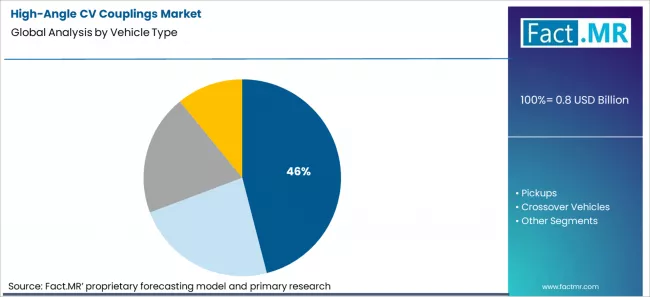
    • By vehicle type, SUVs lead with a 46% share, supported by high-volume production, predictable OEM procurement, and widespread adoption across passenger and fleet vehicle programs.
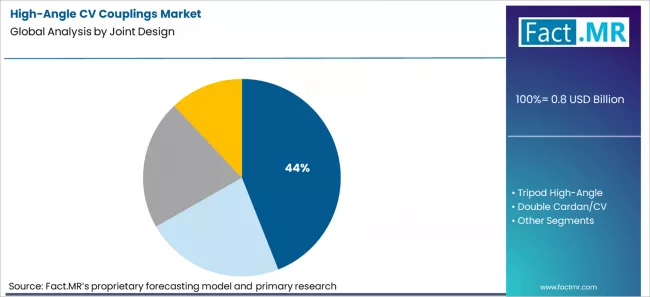
    • By joint design, Rzeppa high-angle couplings account for a 44% share, reflecting standardized geometry, repeatable manufacturing workflows, and efficient integration into automated assembly lines.
    • China and Brazil represent the fastest-growing markets at 4.7% and 4.5% CAGR respectively, driven by expanding EV manufacturing, automotive localization policies, and rising industrial machinery demand.
    • Competition is led by suppliers such as GKN Automotive, Dana, and Schaeffler, where validated material durability, precision joint design, and close OEM alignment define long-term competitive positioning.
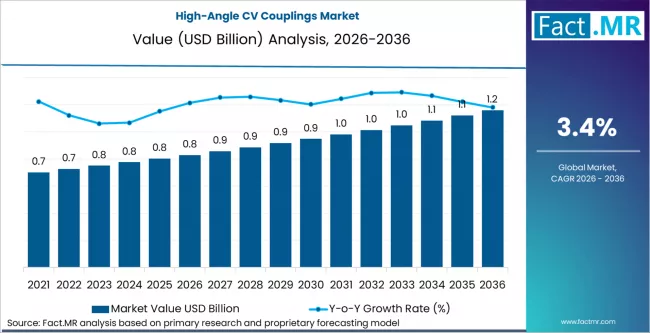
    High Angle Cv Couplings Market Market Value Analysis

    Market expansion is influenced by the increasing integration of flexible drive solutions in automotive, industrial machinery, and heavy equipment sectors where angular motion and torque transmission efficiency are critical. Operational adoption emphasizes standardized coupling tolerances, material durability, and compatibility with automated assembly systems to ensure consistent performance under varying load conditions.

    Supply chain strategies focus on reliable sourcing of high-strength alloys, scalable manufacturing, and multi-region distribution to meet production schedules and maintenance demands. Competitive differentiation arises from companies developing high-precision, low-maintenance designs that enhance operational uptime. Adoption accelerates as manufacturers optimize design, logistics, and installation processes to reduce assembly errors and improve throughput. The market trajectory reflects a structural shift toward operational reliability, scalable deployment, and predictable performance across global high-angle drive applications.

    High-Angle CV Couplings Market

    Metric Value
    Market Value (2026) USD 0.83 billion
    Forecast Value (2036) USD 1,160 billion
    Forecast CAGR (2026-2036) 3.4%

    Category

    Category Segments
    By Vehicle Type SUVs; Pickups; Crossover vehicles; Other
    By Joint Design Rzeppa high-angle; Tripod high-angle; Double Cardan / CV; Other
    By Powertrain ICE; Hybrid; Battery EV; Other
    By Sales Channel OEM line-fit; Aftermarket; Dealer / OES; Other
    Region North America; Europe; Asia Pacific; Latin America; Middle East & Africa

    Segmental Analysis

    By Vehicle Type, Why Do SUVs Lead the High-Angle CV Couplings Market?
    High Angle Cv Couplings Market Analysis By Vehicle Type

    SUVs lead the market with 46% share, reflecting high-volume adoption across passenger and commercial segments where predictable procurement and repeatable production cycles drive market stability. Market demand is shaped by multi-site assembly operations, standardized logistics, and scalable supply chains that support efficient distribution to OEMs and fleet operators. Suppliers benefit from recurring orders, repeatable workflows, and operational efficiency in high-volume vehicle programs. Segment prominence arises from structural market drivers such as channel penetration, workflow repeatability, and high-volume adoption rather than specific vehicle characteristics. SUV production and fleet demand anchor overall market activity.

    By Joint Design, Why Do Rzeppa High-Angle Couplings Represent the Largest Segment?
    High Angle Cv Couplings Market Analysis By Joint Design

    Rzeppa high-angle couplings account for 44% share, reflecting market preference for standardized, repeatable joint designs that simplify manufacturing, inventory planning, and multi-site distribution. Procurement cycles prioritize operational efficiency, predictable supply, and integration into high-volume assembly workflows. Suppliers benefit from scalable production, recurring orders, and streamlined logistics. Segment dominance is determined by structural market factors such as repeatable procurement, channel coverage, and workflow integration rather than the mechanical features of the joint design itself. High-volume deployment and predictable adoption make Rzeppa high-angle couplings the central driver of market activity.

    Country/Region

    Country/Region Driver Restraint Trend
    USA Increasing demand for EVs and high-performance vehicles → drives adoption of high-angle CV couplings OEM safety and regulatory certifications → increase CapEx and slow entry for smaller suppliers Growth of precision-engineered, high-angle CV couplings for performance and EV applications
    Germany Expansion of EV and premium automotive production → fuels demand for high-angle couplings Stringent EU automotive and material regulations → increase testing and compliance costs Adoption of multi-material, lightweight couplings for efficiency and durability
    India Rapid growth in automotive and EV manufacturing → accelerates adoption of CV couplings Limited access to advanced materials and manufacturing → slows rollout for smaller suppliers Growth of cost-effective, locally manufactured high-angle CV couplings
    China Large-scale EV and automotive production → drives demand for high-performance couplings Regional quality and safety standard variability → delays approvals for new designs Expansion of automated production lines and high-precision manufacturing
    Brazil Automotive localization policies → increase demand for advanced CV couplings Import restrictions and compliance requirements → increase production costs Growth of locally sourced, high-performance high-angle CV couplings

    Analysis of the High-Angle CV Couplings Market by Key Country
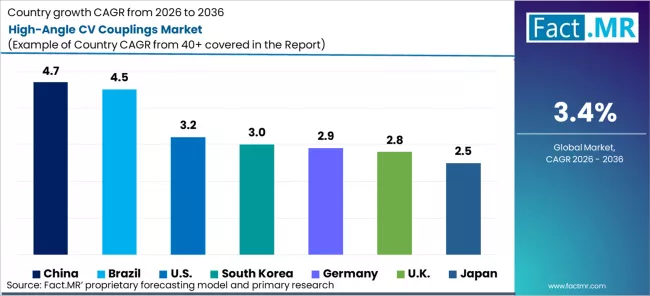
    High Angle Cv Couplings Market Cagr Analysis By Country

    Country CAGR (2026-2036)
    U.S. 3.2%
    Japan 2.5%
    South Korea 3.0%
    Germany 2.9%
    China 4.7%
    U.K. 2.8%
    Brazil 4.5%

    The report covers an in-depth analysis of 40+ countries; top-performing countries are highlighted below.

    How Is Demand for High-Angle CV Couplings Growing in the United States?

    Demand for high-angle CV couplings in the United States grows at 3.2% CAGR through 2036. Automotive and industrial manufacturers increasingly adopt couplings to improve torque transmission, reliability, and angular flexibility in hybrid and electric drivetrains. Operational improvements focus on precision manufacturing, quality assurance, and supply chain efficiency. Urban production hubs and assembly lines integrate automated inspection and calibration. Market expansion is supported by rising EV adoption, regulatory emphasis on vehicle performance and durability, and consumer expectations for smooth and reliable drivetrains. Adoption spans premium and mid-tier vehicles, with industrial applications in machinery and robotics contributing to steady market growth.

    What Is the Growth in Adoption of High-Angle CV Couplings in Japan?

    Growth in adoption of high-angle CV couplings in Japan reaches 2.5% CAGR through 2036. OEMs implement couplings to enhance drivetrain efficiency, torque handling, and angular range in electric, hybrid, and conventional vehicles. Operational improvements include precision assembly, performance testing, and component standardization. Urban and regional production facilities integrate automated inspection to ensure consistent product reliability. Premium vehicle segments lead adoption, while mid-tier applications gradually increase. Market expansion reflects consumer preference for durable, high-performance drivetrains and government incentives promoting energy-efficient vehicles. Industrial machinery sectors also adopt high-angle CV couplings for flexibility and operational resilience.

    How Is the High-Angle CV Couplings Market Shaping in South Korea?

    Adoption of high-angle CV couplings in South Korea grows at 3.0% CAGR through 2036. Automotive OEMs integrate couplings for torque transfer efficiency, drivetrain flexibility, and smooth operation in electric, hybrid, and internal combustion vehicles. Operational improvements focus on automated assembly, quality control, and calibration for consistent performance. Urban production hubs lead adoption, supported by regulatory standards for vehicle durability and safety. Market growth is driven by rising EV and hybrid vehicle production, consumer demand for high-quality drivetrains, and industrial adoption in robotics and heavy machinery. Premium vehicle segments show highest uptake, with mass-market integration gradually increasing.

    What Is the Outlook on High-Angle CV Couplings in Germany?

    Outlook on high-angle CV couplings in Germany grows at 2.9% CAGR through 2036. OEMs adopt high-precision couplings to improve angular flexibility, torque transmission, and drivetrain reliability in premium and mass-market vehicles. Operational improvements include automated inspection, component standardization, and supply chain optimization. Urban automotive clusters integrate high-angle couplings into EV and hybrid platforms. Market growth is supported by regulatory focus on vehicle durability, consumer preference for smooth drivetrains, and industrial adoption for robotics and heavy machinery. Premium vehicle segments lead adoption, with mid-tier vehicles gradually incorporating high-performance couplings to enhance efficiency and operational reliability.

    How Is the High-Angle CV Couplings Market Growing in China?

    Growth in the high-angle CV couplings market in China reaches 4.7% CAGR through 2036. Automotive OEMs implement couplings to support EV, hybrid, and internal combustion vehicle performance, focusing on torque efficiency and angular flexibility. Manufacturers invest in precision production, quality assurance, and supply chain responsiveness. Urban industrial hubs adopt automated assembly and calibration to ensure consistent performance. Market expansion is driven by rapid EV adoption, government policies promoting energy-efficient vehicles, and growing industrial applications in robotics and machinery. Premium and mid-tier vehicle segments increasingly integrate high-angle CV couplings to meet performance and reliability expectations.

    What Are the Growth Patterns in High-Angle CV Couplings in the United Kingdom?

    Growth patterns in high-angle CV couplings in the United Kingdom reach 2.8% CAGR through 2036. OEMs adopt couplings to enhance torque transmission, angular flexibility, and drivetrain performance across passenger and commercial vehicles. Operational improvements emphasize precision assembly, quality validation, and supply chain efficiency. Urban production hubs integrate automated testing and calibration protocols. Market expansion is supported by rising EV production, consumer demand for durable and efficient drivetrains, and industrial adoption in heavy machinery. Premium vehicle segments lead uptake, while mid-tier integration gradually expands, reflecting steady, functional demand for high-performance drivetrain components.

    How Is the High-Angle CV Couplings Market Developing in Brazil?

    Outlook on the high-angle CV couplings market in Brazil grows at 4.5% CAGR through 2036. Automotive manufacturers integrate couplings to improve drivetrain efficiency, torque handling, and angular flexibility, particularly in EV and hybrid vehicles. Operational improvements include automated assembly, quality assurance, and component standardization. Urban and industrial production hubs adopt precise calibration to ensure performance reliability. Market growth is driven by rising EV adoption, consumer preference for smooth drivetrains, and industrial applications in robotics and machinery. Premium and mid-tier vehicle segments incorporate high-angle CV couplings to meet performance expectations, regulatory requirements, and operational reliability standards.

    How Are Material Durability, System Integration, and OEM Validation Creating Competitive Moats in the HighAngle CV Couplings Market?
    High Angle Cv Couplings Market Analysis By Company

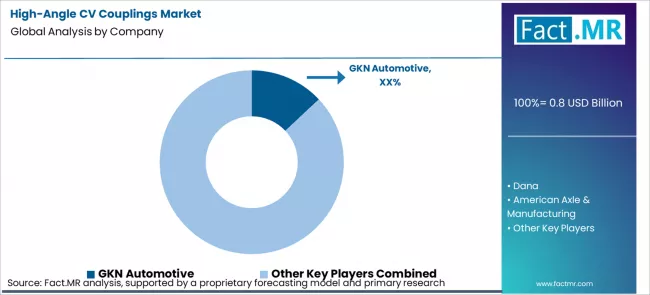
    As per Fact.MR analysis, the high angle constant velocity (CV) couplings market in 2026 is defined by the transition from basic part supply to integrated drivetrain solutions, where validated material durability, cross domain integration, and original equipment manufacturer (OEM) alignment determine sustainable competitive advantage. GKN Automotive and Dana leverage deep metallurgical expertise and validated performance data across full articulation ranges, which strengthens their adoption with global OEMs seeking high torque capacity and long service life. American Axle & Manufacturing and Schaeffler emphasise precision joint geometry and fatigue resistance, which increases consistency in demanding off axis and all terrain applications. NTN and JTEKT focus on optimized bearing interfaces and sealing systems, which improve reliability and reduce maintenance cycles. Nexteer and ZF provide system level integration with steering and torque vectoring controls, which enhances vehicle dynamics coordination. Hyundai WIA and Weichai optimise regional manufacturing and localized compliance, which supports supply continuity across emerging markets. Across the market, validated durability, integrated system design, and strong OEM partnerships form enduring competitive moats that outweigh isolated component claims and reduce reliance on price competition.

    Recent Industry Developments

    • Nexteer launches high-angle CV joint capable of up to 68° articulation - Nexteer’s Constant Velocity High-Angle Joint delivers torque transmission at extreme joint angles up to 68°, with robust durability and environmental protection.
    • Nexteer highlights high-angle fixed CV joint tech (up to 52°) - On its official driveline tech page, Nexteer’s High-Angle Joint (fixed centre) supports up to 52° capability, enabling tighter packaging and improved turning circle performance for advanced driveline systems.
    • Constant velocity high-angle joints defined as key component for advanced steering & driveline - Nexteer’s official product portfolio confirms its high-angle CV joints as part of driveline solutions providing heavy-duty construction, low torsional lash, and high temperature capability for demanding applications.

    Key Players in High-Angle CV Couplings Market

    • GKN Automotive
    • Dana
    • American Axle & Manufacturing
    • NTN
    • JTEKT
    • Schaeffler
    • Nexteer
    • Hyundai WIA
    • ZF
    • Weichai

    Scope of the Report

    Items Values
    Quantitative Units (2026) USD 0.83 billion
    By Vehicle Type SUVs, Pickups, Crossover Vehicles, Other
    By Joint Design Rzeppa High-Angle, Tripod High-Angle, Double Cardan/CV, Other
    By Powertrain ICE, Hybrid, Battery EV, Other
    By Sales Channel OEM Line-Fit, Aftermarket, Dealer/OES, Other
    Region Asia Pacific, Europe, North America, Latin America, Middle East & Africa
    Countries Covered China, Japan, South Korea, India, Australia & New Zealand, ASEAN, Rest of Asia Pacific, Germany, UK, France, Italy, Spain, Nordic, BENELUX, Rest of Europe, USA, Canada, Mexico, Brazil, Chile, Rest of Latin America, KSA, Other GCC, Turkey, South Africa, Other African Union, Rest of Middle East & Africa
    Key Companies Profiled GKN Automotive, Dana, American Axle & Manufacturing, NTN, JTEKT, Schaeffler, Nexteer, Hyundai WIA, ZF, Weichai
    Additional Attributes Dollar by sales by vehicle type, joint design, and powertrain; validated torque and angular performance; low-maintenance and fatigue-resistant designs; precision joint geometry; bearing interface optimization; sealing reliability; integration with EV, hybrid, and ICE drivetrains; multi-region supply continuity; automated assembly compatibility; OEM validation and compliance; predictable performance under variable load conditions; high-volume, repeatable procurement; industrial and automotive application support; operational efficiency and throughput optimization; scalable manufacturing and logistics; aftermarket and dealer service support.

    High-Angle CV Couplings Market Segmentation

    • By Vehicle Type :

      • SUVs
      • Pickups
      • Crossover Vehicles
      • Other
    • By Joint Design :

      • Rzeppa High-Angle
      • Tripod High-Angle
      • Double Cardan/CV
      • Other
    • By Powertrain :

      • ICE
      • Hybrid
      • Battery EV
      • Other
    • By Sales Channel :

      • OEM Line-Fit
      • Aftermarket
      • Dealer/OES
      • Other
    • Region :

      • Asia Pacific
        • China
        • Japan
        • South Korea
        • India
        • Australia & New Zealand
        • ASEAN
        • Rest of Asia Pacific
      • Europe
        • Germany
        • United Kingdom
        • France
        • Italy
        • Spain
        • Nordic
        • BENELUX
        • Rest of Europe
      • North America
        • United States
        • Canada
        • Mexico
      • Latin America
        • Brazil
        • Chile
        • Rest of Latin America
      • Middle East & Africa
        • Kingdom of Saudi Arabia
        • Other GCC Countries
        • Turkey
        • South Africa
        • Other African Union
        • Rest of Middle East & Africa

    References

    • International Organization for Standardization. (2023). ISO 16232: Road vehicles - Cleanliness of components and systems (latest consolidated edition). ISO.
    • International Organization for Standardization. (2024). ISO 1940-1: Mechanical vibration - Balance quality requirements for rotors in a constant (rigid) state. ISO.
    • Bundesanstalt für Materialforschung und -prüfung. (2023). Fatigue behavior of high-strength steels under multiaxial loading. BAM.

    Table of Content

    1. Executive Summary
      • Global Market Outlook
      • Demand to side Trends
      • Supply to side Trends
      • Technology Roadmap Analysis
      • Analysis and Recommendations
    2. Market Overview
      • Market Coverage / Taxonomy
      • Market Definition / Scope / Limitations
    3. Research Methodology
      • Chapter Orientation
      • Analytical Lens and Working Hypotheses
        • Market Structure, Signals, and Trend Drivers
        • Benchmarking and Cross-market Comparability
        • Market Sizing, Forecasting, and Opportunity Mapping
      • Research Design and Evidence Framework
        • Desk Research Programme (Secondary Evidence)
          • Company Annual and Sustainability Reports
          • Peer-reviewed Journals and Academic Literature
          • Corporate Websites, Product Literature, and Technical Notes
          • Earnings Decks and Investor Briefings
          • Statutory Filings and Regulatory Disclosures
          • Technical White Papers and Standards Notes
          • Trade Journals, Industry Magazines, and Analyst Briefs
          • Conference Proceedings, Webinars, and Seminar Materials
          • Government Statistics Portals and Public Data Releases
          • Press Releases and Reputable Media Coverage
          • Specialist Newsletters and Curated Briefings
          • Sector Databases and Reference Repositories
          • FMR Internal Proprietary Databases and Historical Market Datasets
          • Subscription Datasets and Paid Sources
          • Social Channels, Communities, and Digital Listening Inputs
          • Additional Desk Sources
        • Expert Input and Fieldwork (Primary Evidence)
          • Primary Modes
            • Qualitative Interviews and Expert Elicitation
            • Quantitative Surveys and Structured Data Capture
            • Blended Approach
          • Why Primary Evidence is Used
          • Field Techniques
            • Interviews
            • Surveys
            • Focus Groups
            • Observational and In-context Research
            • Social and Community Interactions
          • Stakeholder Universe Engaged
            • C-suite Leaders
            • Board Members
            • Presidents and Vice Presidents
            • R&D and Innovation Heads
            • Technical Specialists
            • Domain Subject-matter Experts
            • Scientists
            • Physicians and Other Healthcare Professionals
          • Governance, Ethics, and Data Stewardship
            • Research Ethics
            • Data Integrity and Handling
        • Tooling, Models, and Reference Databases
      • Data Engineering and Model Build
        • Data Acquisition and Ingestion
        • Cleaning, Normalisation, and Verification
        • Synthesis, Triangulation, and Analysis
      • Quality Assurance and Audit Trail
    4. Market Background
      • Market Dynamics
        • Drivers
        • Restraints
        • Opportunity
        • Trends
      • Scenario Forecast
        • Demand in Optimistic Scenario
        • Demand in Likely Scenario
        • Demand in Conservative Scenario
      • Opportunity Map Analysis
      • Product Life Cycle Analysis
      • Supply Chain Analysis
      • Investment Feasibility Matrix
      • Value Chain Analysis
      • PESTLE and Porter’s Analysis
      • Regulatory Landscape
      • Regional Parent Market Outlook
      • Production and Consumption Statistics
      • Import and Export Statistics
    5. Global Market Analysis 2021 to 2025 and Forecast, 2026 to 2036
      • Historical Market Size Value (USD Million) Analysis, 2021 to 2025
      • Current and Future Market Size Value (USD Million) Projections, 2026 to 2036
        • Y to o to Y Growth Trend Analysis
        • Absolute $ Opportunity Analysis
    6. Global Market Pricing Analysis 2021 to 2025 and Forecast 2026 to 2036
    7. Global Market Analysis 2021 to 2025 and Forecast 2026 to 2036, By Vehicle Type
      • Introduction / Key Findings
      • Historical Market Size Value (USD Million) Analysis By Vehicle Type, 2021 to 2025
      • Current and Future Market Size Value (USD Million) Analysis and Forecast By Vehicle Type, 2026 to 2036
        • SUVs
        • Pickups
        • Crossover Vehicles
        • Other
      • Y to o to Y Growth Trend Analysis By Vehicle Type, 2021 to 2025
      • Absolute $ Opportunity Analysis By Vehicle Type, 2026 to 2036
    8. Global Market Analysis 2021 to 2025 and Forecast 2026 to 2036, By Joint Design
      • Introduction / Key Findings
      • Historical Market Size Value (USD Million) Analysis By Joint Design, 2021 to 2025
      • Current and Future Market Size Value (USD Million) Analysis and Forecast By Joint Design, 2026 to 2036
        • Rzeppa High-Angle
        • Tripod High-Angle
        • Double Cardan/CV
        • Other
      • Y to o to Y Growth Trend Analysis By Joint Design, 2021 to 2025
      • Absolute $ Opportunity Analysis By Joint Design, 2026 to 2036
    9. Global Market Analysis 2021 to 2025 and Forecast 2026 to 2036, By Region
      • Introduction
      • Historical Market Size Value (USD Million) Analysis By Region, 2021 to 2025
      • Current Market Size Value (USD Million) Analysis and Forecast By Region, 2026 to 2036
        • North America
        • Latin America
        • Western Europe
        • Eastern Europe
        • East Asia
        • South Asia and Pacific
        • Middle East & Africa
      • Market Attractiveness Analysis By Region
    10. North America Market Analysis 2021 to 2025 and Forecast 2026 to 2036, By Country
      • Historical Market Size Value (USD Million) Trend Analysis By Market Taxonomy, 2021 to 2025
      • Market Size Value (USD Million) Forecast By Market Taxonomy, 2026 to 2036
        • By Country
          • USA
          • Canada
          • Mexico
        • By Vehicle Type
        • By Joint Design
      • Market Attractiveness Analysis
        • By Country
        • By Vehicle Type
        • By Joint Design
      • Key Takeaways
    11. Latin America Market Analysis 2021 to 2025 and Forecast 2026 to 2036, By Country
      • Historical Market Size Value (USD Million) Trend Analysis By Market Taxonomy, 2021 to 2025
      • Market Size Value (USD Million) Forecast By Market Taxonomy, 2026 to 2036
        • By Country
          • Brazil
          • Chile
          • Rest of Latin America
        • By Vehicle Type
        • By Joint Design
      • Market Attractiveness Analysis
        • By Country
        • By Vehicle Type
        • By Joint Design
      • Key Takeaways
    12. Western Europe Market Analysis 2021 to 2025 and Forecast 2026 to 2036, By Country
      • Historical Market Size Value (USD Million) Trend Analysis By Market Taxonomy, 2021 to 2025
      • Market Size Value (USD Million) Forecast By Market Taxonomy, 2026 to 2036
        • By Country
          • Germany
          • UK
          • Italy
          • Spain
          • France
          • Nordic
          • BENELUX
          • Rest of Western Europe
        • By Vehicle Type
        • By Joint Design
      • Market Attractiveness Analysis
        • By Country
        • By Vehicle Type
        • By Joint Design
      • Key Takeaways
    13. Eastern Europe Market Analysis 2021 to 2025 and Forecast 2026 to 2036, By Country
      • Historical Market Size Value (USD Million) Trend Analysis By Market Taxonomy, 2021 to 2025
      • Market Size Value (USD Million) Forecast By Market Taxonomy, 2026 to 2036
        • By Country
          • Russia
          • Poland
          • Hungary
          • Balkan & Baltic
          • Rest of Eastern Europe
        • By Vehicle Type
        • By Joint Design
      • Market Attractiveness Analysis
        • By Country
        • By Vehicle Type
        • By Joint Design
      • Key Takeaways
    14. East Asia Market Analysis 2021 to 2025 and Forecast 2026 to 2036, By Country
      • Historical Market Size Value (USD Million) Trend Analysis By Market Taxonomy, 2021 to 2025
      • Market Size Value (USD Million) Forecast By Market Taxonomy, 2026 to 2036
        • By Country
          • China
          • Japan
          • South Korea
        • By Vehicle Type
        • By Joint Design
      • Market Attractiveness Analysis
        • By Country
        • By Vehicle Type
        • By Joint Design
      • Key Takeaways
    15. South Asia and Pacific Market Analysis 2021 to 2025 and Forecast 2026 to 2036, By Country
      • Historical Market Size Value (USD Million) Trend Analysis By Market Taxonomy, 2021 to 2025
      • Market Size Value (USD Million) Forecast By Market Taxonomy, 2026 to 2036
        • By Country
          • India
          • ASEAN
          • Australia & New Zealand
          • Rest of South Asia and Pacific
        • By Vehicle Type
        • By Joint Design
      • Market Attractiveness Analysis
        • By Country
        • By Vehicle Type
        • By Joint Design
      • Key Takeaways
    16. Middle East & Africa Market Analysis 2021 to 2025 and Forecast 2026 to 2036, By Country
      • Historical Market Size Value (USD Million) Trend Analysis By Market Taxonomy, 2021 to 2025
      • Market Size Value (USD Million) Forecast By Market Taxonomy, 2026 to 2036
        • By Country
          • Kingdom of Saudi Arabia
          • Other GCC Countries
          • Turkiye
          • South Africa
          • Other African Union
          • Rest of Middle East & Africa
        • By Vehicle Type
        • By Joint Design
      • Market Attractiveness Analysis
        • By Country
        • By Vehicle Type
        • By Joint Design
      • Key Takeaways
    17. Key Countries Market Analysis
      • USA
        • Pricing Analysis
        • Market Share Analysis, 2025
          • By Vehicle Type
          • By Joint Design
      • Canada
        • Pricing Analysis
        • Market Share Analysis, 2025
          • By Vehicle Type
          • By Joint Design
      • Mexico
        • Pricing Analysis
        • Market Share Analysis, 2025
          • By Vehicle Type
          • By Joint Design
      • Brazil
        • Pricing Analysis
        • Market Share Analysis, 2025
          • By Vehicle Type
          • By Joint Design
      • Chile
        • Pricing Analysis
        • Market Share Analysis, 2025
          • By Vehicle Type
          • By Joint Design
      • Germany
        • Pricing Analysis
        • Market Share Analysis, 2025
          • By Vehicle Type
          • By Joint Design
      • UK
        • Pricing Analysis
        • Market Share Analysis, 2025
          • By Vehicle Type
          • By Joint Design
      • Italy
        • Pricing Analysis
        • Market Share Analysis, 2025
          • By Vehicle Type
          • By Joint Design
      • Spain
        • Pricing Analysis
        • Market Share Analysis, 2025
          • By Vehicle Type
          • By Joint Design
      • France
        • Pricing Analysis
        • Market Share Analysis, 2025
          • By Vehicle Type
          • By Joint Design
      • India
        • Pricing Analysis
        • Market Share Analysis, 2025
          • By Vehicle Type
          • By Joint Design
      • ASEAN
        • Pricing Analysis
        • Market Share Analysis, 2025
          • By Vehicle Type
          • By Joint Design
      • Australia & New Zealand
        • Pricing Analysis
        • Market Share Analysis, 2025
          • By Vehicle Type
          • By Joint Design
      • China
        • Pricing Analysis
        • Market Share Analysis, 2025
          • By Vehicle Type
          • By Joint Design
      • Japan
        • Pricing Analysis
        • Market Share Analysis, 2025
          • By Vehicle Type
          • By Joint Design
      • South Korea
        • Pricing Analysis
        • Market Share Analysis, 2025
          • By Vehicle Type
          • By Joint Design
      • Russia
        • Pricing Analysis
        • Market Share Analysis, 2025
          • By Vehicle Type
          • By Joint Design
      • Poland
        • Pricing Analysis
        • Market Share Analysis, 2025
          • By Vehicle Type
          • By Joint Design
      • Hungary
        • Pricing Analysis
        • Market Share Analysis, 2025
          • By Vehicle Type
          • By Joint Design
      • Kingdom of Saudi Arabia
        • Pricing Analysis
        • Market Share Analysis, 2025
          • By Vehicle Type
          • By Joint Design
      • Turkiye
        • Pricing Analysis
        • Market Share Analysis, 2025
          • By Vehicle Type
          • By Joint Design
      • South Africa
        • Pricing Analysis
        • Market Share Analysis, 2025
          • By Vehicle Type
          • By Joint Design
    18. Market Structure Analysis
      • Competition Dashboard
      • Competition Benchmarking
      • Market Share Analysis of Top Players
        • By Regional
        • By Vehicle Type
        • By Joint Design
    19. Competition Analysis
      • Competition Deep Dive
        • GKN Automotive
          • Overview
          • Product Portfolio
          • Profitability by Market Segments (Product/Age /Sales Channel/Region)
          • Sales Footprint
          • Strategy Overview
            • Marketing Strategy
            • Product Strategy
            • Channel Strategy
        • Dana
        • American Axle & Manufacturing
        • NTN
        • JTEKT
        • Schaeffler
        • Nexteer
        • Hyundai WIA
        • ZF
        • Weichai
    20. Assumptions & Acronyms Used

    List Of Table

    • Table 1: Global Market Value (USD Million) Forecast by Region, 2021 to 2036
    • Table 2: Global Market Value (USD Million) Forecast by Vehicle Type, 2021 to 2036
    • Table 3: Global Market Value (USD Million) Forecast by Joint Design, 2021 to 2036
    • Table 4: North America Market Value (USD Million) Forecast by Country, 2021 to 2036
    • Table 5: North America Market Value (USD Million) Forecast by Vehicle Type, 2021 to 2036
    • Table 6: North America Market Value (USD Million) Forecast by Joint Design, 2021 to 2036
    • Table 7: Latin America Market Value (USD Million) Forecast by Country, 2021 to 2036
    • Table 8: Latin America Market Value (USD Million) Forecast by Vehicle Type, 2021 to 2036
    • Table 9: Latin America Market Value (USD Million) Forecast by Joint Design, 2021 to 2036
    • Table 10: Western Europe Market Value (USD Million) Forecast by Country, 2021 to 2036
    • Table 11: Western Europe Market Value (USD Million) Forecast by Vehicle Type, 2021 to 2036
    • Table 12: Western Europe Market Value (USD Million) Forecast by Joint Design, 2021 to 2036
    • Table 13: Eastern Europe Market Value (USD Million) Forecast by Country, 2021 to 2036
    • Table 14: Eastern Europe Market Value (USD Million) Forecast by Vehicle Type, 2021 to 2036
    • Table 15: Eastern Europe Market Value (USD Million) Forecast by Joint Design, 2021 to 2036
    • Table 16: East Asia Market Value (USD Million) Forecast by Country, 2021 to 2036
    • Table 17: East Asia Market Value (USD Million) Forecast by Vehicle Type, 2021 to 2036
    • Table 18: East Asia Market Value (USD Million) Forecast by Joint Design, 2021 to 2036
    • Table 19: South Asia and Pacific Market Value (USD Million) Forecast by Country, 2021 to 2036
    • Table 20: South Asia and Pacific Market Value (USD Million) Forecast by Vehicle Type, 2021 to 2036
    • Table 21: South Asia and Pacific Market Value (USD Million) Forecast by Joint Design, 2021 to 2036
    • Table 22: Middle East & Africa Market Value (USD Million) Forecast by Country, 2021 to 2036
    • Table 23: Middle East & Africa Market Value (USD Million) Forecast by Vehicle Type, 2021 to 2036
    • Table 24: Middle East & Africa Market Value (USD Million) Forecast by Joint Design, 2021 to 2036

    List Of Figures

    • Figure 1: Global Market Pricing Analysis
    • Figure 2: Global Market Value (USD Million) Forecast 2021 to 2036
    • Figure 3: Global Market Value Share and BPS Analysis by Vehicle Type, 2026 and 2036
    • Figure 4: Global Market Y to o to Y Growth Comparison by Vehicle Type, 2026 to 2036
    • Figure 5: Global Market Attractiveness Analysis by Vehicle Type
    • Figure 6: Global Market Value Share and BPS Analysis by Joint Design, 2026 and 2036
    • Figure 7: Global Market Y to o to Y Growth Comparison by Joint Design, 2026 to 2036
    • Figure 8: Global Market Attractiveness Analysis by Joint Design
    • Figure 9: Global Market Value (USD Million) Share and BPS Analysis by Region, 2026 and 2036
    • Figure 10: Global Market Y to o to Y Growth Comparison by Region, 2026 to 2036
    • Figure 11: Global Market Attractiveness Analysis by Region
    • Figure 12: North America Market Incremental Dollar Opportunity, 2026 to 2036
    • Figure 13: Latin America Market Incremental Dollar Opportunity, 2026 to 2036
    • Figure 14: Western Europe Market Incremental Dollar Opportunity, 2026 to 2036
    • Figure 15: Eastern Europe Market Incremental Dollar Opportunity, 2026 to 2036
    • Figure 16: East Asia Market Incremental Dollar Opportunity, 2026 to 2036
    • Figure 17: South Asia and Pacific Market Incremental Dollar Opportunity, 2026 to 2036
    • Figure 18: Middle East & Africa Market Incremental Dollar Opportunity, 2026 to 2036
    • Figure 19: North America Market Value Share and BPS Analysis by Country, 2026 and 2036
    • Figure 20: North America Market Value Share and BPS Analysis by Vehicle Type, 2026 and 2036
    • Figure 21: North America Market Y to o to Y Growth Comparison by Vehicle Type, 2026 to 2036
    • Figure 22: North America Market Attractiveness Analysis by Vehicle Type
    • Figure 23: North America Market Value Share and BPS Analysis by Joint Design, 2026 and 2036
    • Figure 24: North America Market Y to o to Y Growth Comparison by Joint Design, 2026 to 2036
    • Figure 25: North America Market Attractiveness Analysis by Joint Design
    • Figure 26: Latin America Market Value Share and BPS Analysis by Country, 2026 and 2036
    • Figure 27: Latin America Market Value Share and BPS Analysis by Vehicle Type, 2026 and 2036
    • Figure 28: Latin America Market Y to o to Y Growth Comparison by Vehicle Type, 2026 to 2036
    • Figure 29: Latin America Market Attractiveness Analysis by Vehicle Type
    • Figure 30: Latin America Market Value Share and BPS Analysis by Joint Design, 2026 and 2036
    • Figure 31: Latin America Market Y to o to Y Growth Comparison by Joint Design, 2026 to 2036
    • Figure 32: Latin America Market Attractiveness Analysis by Joint Design
    • Figure 33: Western Europe Market Value Share and BPS Analysis by Country, 2026 and 2036
    • Figure 34: Western Europe Market Value Share and BPS Analysis by Vehicle Type, 2026 and 2036
    • Figure 35: Western Europe Market Y to o to Y Growth Comparison by Vehicle Type, 2026 to 2036
    • Figure 36: Western Europe Market Attractiveness Analysis by Vehicle Type
    • Figure 37: Western Europe Market Value Share and BPS Analysis by Joint Design, 2026 and 2036
    • Figure 38: Western Europe Market Y to o to Y Growth Comparison by Joint Design, 2026 to 2036
    • Figure 39: Western Europe Market Attractiveness Analysis by Joint Design
    • Figure 40: Eastern Europe Market Value Share and BPS Analysis by Country, 2026 and 2036
    • Figure 41: Eastern Europe Market Value Share and BPS Analysis by Vehicle Type, 2026 and 2036
    • Figure 42: Eastern Europe Market Y to o to Y Growth Comparison by Vehicle Type, 2026 to 2036
    • Figure 43: Eastern Europe Market Attractiveness Analysis by Vehicle Type
    • Figure 44: Eastern Europe Market Value Share and BPS Analysis by Joint Design, 2026 and 2036
    • Figure 45: Eastern Europe Market Y to o to Y Growth Comparison by Joint Design, 2026 to 2036
    • Figure 46: Eastern Europe Market Attractiveness Analysis by Joint Design
    • Figure 47: East Asia Market Value Share and BPS Analysis by Country, 2026 and 2036
    • Figure 48: East Asia Market Value Share and BPS Analysis by Vehicle Type, 2026 and 2036
    • Figure 49: East Asia Market Y to o to Y Growth Comparison by Vehicle Type, 2026 to 2036
    • Figure 50: East Asia Market Attractiveness Analysis by Vehicle Type
    • Figure 51: East Asia Market Value Share and BPS Analysis by Joint Design, 2026 and 2036
    • Figure 52: East Asia Market Y to o to Y Growth Comparison by Joint Design, 2026 to 2036
    • Figure 53: East Asia Market Attractiveness Analysis by Joint Design
    • Figure 54: South Asia and Pacific Market Value Share and BPS Analysis by Country, 2026 and 2036
    • Figure 55: South Asia and Pacific Market Value Share and BPS Analysis by Vehicle Type, 2026 and 2036
    • Figure 56: South Asia and Pacific Market Y to o to Y Growth Comparison by Vehicle Type, 2026 to 2036
    • Figure 57: South Asia and Pacific Market Attractiveness Analysis by Vehicle Type
    • Figure 58: South Asia and Pacific Market Value Share and BPS Analysis by Joint Design, 2026 and 2036
    • Figure 59: South Asia and Pacific Market Y to o to Y Growth Comparison by Joint Design, 2026 to 2036
    • Figure 60: South Asia and Pacific Market Attractiveness Analysis by Joint Design
    • Figure 61: Middle East & Africa Market Value Share and BPS Analysis by Country, 2026 and 2036
    • Figure 62: Middle East & Africa Market Value Share and BPS Analysis by Vehicle Type, 2026 and 2036
    • Figure 63: Middle East & Africa Market Y to o to Y Growth Comparison by Vehicle Type, 2026 to 2036
    • Figure 64: Middle East & Africa Market Attractiveness Analysis by Vehicle Type
    • Figure 65: Middle East & Africa Market Value Share and BPS Analysis by Joint Design, 2026 and 2036
    • Figure 66: Middle East & Africa Market Y to o to Y Growth Comparison by Joint Design, 2026 to 2036
    • Figure 67: Middle East & Africa Market Attractiveness Analysis by Joint Design
    • Figure 68: Global Market - Tier Structure Analysis
    • Figure 69: Global Market - Company Share Analysis

    - FAQs -

    How big is the high-angle cv couplings market in 2026?

    The global high-angle cv couplings market is estimated to be valued at USD 0.8 billion in 2026.

    What will be the size of high-angle cv couplings market in 2036?

    The market size for the high-angle cv couplings market is projected to reach USD 1.2 billion by 2036.

    How much will be the high-angle cv couplings market growth between 2026 and 2036?

    The high-angle cv couplings market is expected to grow at a 3.4% CAGR between 2026 and 2036.

    What are the key product types in the high-angle cv couplings market?

    The key product types in high-angle cv couplings market are suvs, pickups, crossover vehicles and other.

    Which joint design segment to contribute significant share in the high-angle cv couplings market in 2026?

    In terms of joint design, rzeppa high-angle segment to command 44.0% share in the high-angle cv couplings market in 2026.

    High-Angle CV Couplings Market