- Base Value(2025): 0.99 Bn
- Estimated Value(2026): 1.1 Bn
- Forecast Value (2036): 3.2 Bn
- CAGR (2026 - 2036): 11.3%
EV Driveline NVH Couplings Market Forecast 2026 to 2036
In 2025, the EV driveline NVH couplings market was valued at USD 0.99 billion. Based on FMR’s analysis, demand for vibration-dampening components is estimated to grow to USD 1.1 billion in 2026 and USD 3.2 billion by 2036, at an 11.3% CAGR. This represents an absolute dollar growth of USD 2.1 billion, a transformational shift as cabin "quietness" becomes a primary competitive metric. While the surge in high-performance EVs keeps growth steady, expansion is hindered by substitution pressure from software-based noise cancellation and feedstock volatility in specialized elastomers.
Industry leaders highlight that precision components are now paramount for vehicle refinement. As Liam Butterworth, CEO of GKN Automotive, noted, 'Global demand for EVs is accelerating fast and now is the perfect time for GKN Automotive to underpin its leadership in eDrive systems through next-generation technologies' [1].
Regionally, China leads with a 13.3% CAGR, followed by Brazil (13.0%) and the USA (10.9%). Conversely, Germany (10.6%), the UK (10.5%), and Japan (10.0%) are mature markets focused on replacement demand. A key structural constraint for this group is regulatory costs, specifically tightening environmental standards for the chemical compounds used in advanced elastomer dampeners.
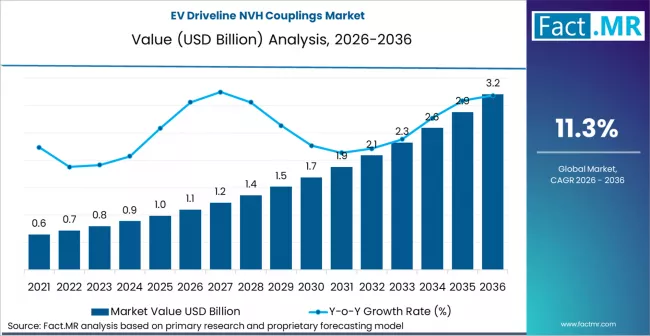
Ev Driveline Nvh Couplings Market Market Value Analysis | Source: Fact.MR
EV Driveline NVH Couplings Market
This market involves specialized mechanical couplings and torsional dampers designed to minimize Noise, Vibration, and Harshness (NVH) in electric vehicle drivetrains. Unlike traditional cars, EVs operate at higher rotational speeds and lack engine noise to mask mechanical whines, making quiet operation a primary industrial function. These components act as vibration isolators between the electric motor and the transmission or wheels. The key end-use is in battery electric and hybrid passenger vehicles, where they ensure cabin comfort and protect the high-torque driveline from premature mechanical wear.
What the Report Covers
The report analyzes global and regional market trends for the 2026 to 2036 forecast period. It segments the industry by product type (torsional dampers and flexible couplings), propulsion (BEV and PHEV), and end-user (OEMs and Aftermarket). Analytical dimensions include regional pricing benchmarks and material analysis, specifically focusing on the shift toward lightweight rubber and composite materials required for high-frequency vibration damping in modern electric axles.
What the Report Does Not Cover
The scope excludes general automotive fasteners and standard engine mounts for combustion vehicles. It also omits internal motor parts like rotors or stators and downstream finished goods such as the vehicles themselves. Niche applications like marine electric propulsion or heavy-duty railway couplings are excluded to focus strictly on mechanical NVH components within the drivelines of passenger and light-commercial road electric vehicles.
- Primary Research: We interviewed drivetrain engineers and NVH specialists at global automotive OEMs and Tier 1 suppliers to gather data on emerging noise-damping requirements.
- Desk Research: Analysts reviewed technical SAE papers, patent filings for torsional vibration control, and manufacturer financial disclosures to track the adoption of specialized coupling technologies.
- Market-Sizing and Forecasting: A hybrid model was used, integrating top-down global EV production forecasts with bottom-up sales data for specific NVH-rated mechanical components.
Data Validation and Update Cycle
Outputs are cross-verified against international trade manifests and industry-standard vibration testing results, with data updated semi-annually to reflect rapid drivetrain innovations.
EV Driveline NVH Couplings Market Definition:
The market includes specialized mechanical couplings and torsional dampers designed to minimize Noise, Vibration, and Harshness (NVH) in electric vehicle drivetrains. These components ensure smooth and quiet operation by isolating vibrations between the electric motor and the transmission or wheels.
Demand Drivers in the Market:
- Transition to Electric Drivetrains: The shift from internal combustion engines to electric drivetrains increases demand for NVH solutions to manage new vibration patterns from electric motors and gear sets.
- Enhanced Driving Experience: As cabin "quietness" becomes a key competitive metric, high-precision NVH couplings are essential to ensure optimal comfort in EVs.
- Regulatory Requirements: Stricter noise and vibration regulations in key markets drive the need for advanced NVH components in EV drivetrains.
Key Segments Analyzed in the Report:
- Coupling Function: Torsional Damping Couplings, Flexible Disc Couplings, Elastomeric NVH Isolators, Other.
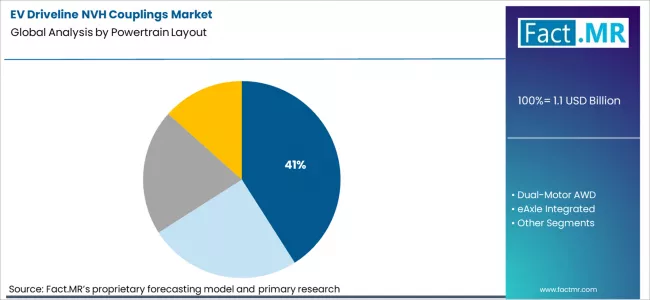
- Powertrain Layout: Single-Motor eDrive (41% market share by 2026), Dual-Motor AWD, eAxle Integrated, Other.
- Speed Class: Up to 12k RPM, 12k-18k RPM, Above 18k RPM, Other.
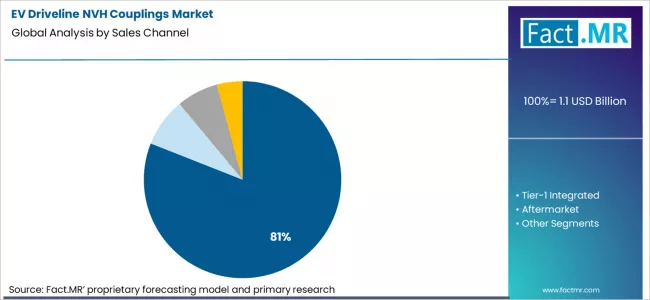
- Sales Channel: OEM Line-Fit (81% market share by 2026), Tier-1 Integrated, Aftermarket, Other.
Analyst Opinion at FMR:
The market is evolving from passive damping to a focus on acoustic engineering, with specialized components designed to neutralize high-frequency electromagnetic whines and torque ripples, critical for maintaining cabin comfort and drivetrain integrity in high-performance EVs.
Strategic Implications/Executive Takeaways:
- Focus on Precision: Companies must innovate to create high-precision, lightweight NVH solutions that can handle the specific demands of electric drivetrains.
- OEM Integration: The OEM line-fit segment will continue to dominate as manufacturers prioritize NVH control in mass-market EV production.
- Regional Strategy: Strong growth opportunities in emerging EV markets, particularly in China and Brazil, while mature markets focus on upgrading legacy systems.
Methodology
Validated through primary research with drivetrain engineers and NVH specialists at global automotive OEMs and Tier-1 suppliers. Forecasts are based on a hybrid top-down and bottom-up modeling approach, with insights from international trade manifests and vibration testing results.
Segmental Analysis
EV Driveline NVH Couplings Market Analysis by Sales Channel
Ev Driveline Nvh Couplings Market Analysis By Sales Channel | Source: Fact.MR
- Market Overview: OEM line-fit is expected to dominate the EV driveline NVH couplings market, capturing 81% of the market share by 2026. As original equipment manufacturers (OEMs) continue to prioritize noise, vibration, and harshness (NVH) control in electric vehicles (EVs), OEM line-fit offers the most direct and efficient integration of NVH couplings into new vehicle models.
- Demand Drivers:
- OEM Prioritization of Quality and Performance: OEMs play a significant role in driving the demand for NVH couplings to ensure a smooth, quiet, and comfortable driving experience in EVs. The importance of NVH performance is crucial in gaining consumer trust and satisfaction.
- Volume Production and Integration: As production volumes of EVs rise, OEM line-fit systems allow manufacturers to streamline processes, ensuring NVH couplings are integrated into vehicles during the assembly process for cost and performance optimization.
- Advanced Technological Integration: OEMs focus on incorporating cutting-edge NVH technologies into the driveline to mitigate noise and vibration in electric drivetrains, enhancing the overall driving experience.
EV Driveline NVH Couplings Market Analysis by Powertrain Layout
Ev Driveline Nvh Couplings Market Analysis By Powertrain Layout | Source: Fact.MR
- Market Overview: The Single-Motor eDrive layout is expected to account for 41% of the market share by 2026. Single-motor systems are the most common powertrain configuration in EVs, offering efficient and simplified drivetrains that benefit from NVH coupling solutions to reduce noise and vibration levels.
- Demand Drivers:
- Simplified Powertrain Design: Single-motor eDrive systems are often seen in mass-market EVs due to their cost-effectiveness, simplicity, and efficiency, increasing the demand for NVH couplings to minimize vibrations and improve overall driving comfort.
- Increased Focus on Driving Experience: As consumers continue to expect smoother, quieter rides in EVs, there is a growing emphasis on NVH performance, particularly in single-motor layouts, where NVH couplings play a significant role in enhancing the vehicle's overall quality.
- Energy Efficiency and Sustainability: The adoption of single-motor eDrive layouts is also driven by the need for energy-efficient solutions in the growing EV market, making NVH coupling technologies vital for both performance and comfort.
EV Driveline NVH Couplings Market Drivers, Restraints, and Opportunities
FMR analysts observe that the EV driveline NVH (Noise, Vibration, Harshness) couplings market is a growing application segment driven by the transition from internal combustion engines to electric drivetrains. Historically, EVs reduced many traditional NVH sources, but new vibration patterns from electric motors and gear sets created fresh NVH challenges that standard rigid couplings could not address. The 2026 valuation reflects this shift: as EV production scales, driveline NVH couplings are increasingly specified to improve cabin comfort and drivetrain smoothness.
Demand for basic mechanical couplings is stabilizing, while advanced NVH‑optimized elastomeric and tuned mass solutions are gaining share. These specialized couplings carry higher per‑unit prices, contributing to net value growth even though overall unit volumes remain tied to EV production cycles. The market exists at its current size because OEMs and Tier 1 suppliers prioritize refinement and differentiation in EV acoustics and ride quality.
- EV Refinement Focus: Increasing EV volumes are driving demand for NVH couplings that address specific vibration frequencies from electric motors, improving perceived quality where traditional couplings fall short.
- OEM Specification Trends: As manufacturers chase premium comfort benchmarks, advanced elastomeric and tuned solutions are replacing simpler couplings despite higher costs.
- Regional Product Priorities: In Europe and North America, where consumer expectations for refinement are high, demand for NVH‑optimized driveline components outpaces markets where cost‑led EV models dominate.
Regional Analysis
The global EV driveline NVH couplings market is segmented into North America, Europe, Asia-Pacific, and Latin America. This study analyzes high-precision damping components across passenger and commercial electric vehicle segments, focusing on the specialized requirements of high-torque electric motors. The full report offers market attractiveness analysis.
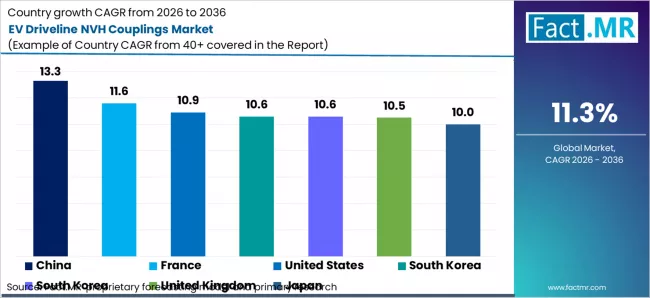
Ev Driveline Nvh Couplings Market Cagr Analysis By Country | Source: Fact.MR
| Country | CAGR (%) |
|---|---|
| United States | 10.9 % |
| Japan | 10.0 % |
| South Korea | 10.6 % |
| China | 13.3 % |
| Germany | 10.6 % |
| United Kingdom | 10.5 % |
| France | 11.6 % |
Source: Fact.MR analysis. Updated Feb 16, 2026
Source: Fact MR (FMR) analysis, based on proprietary forecasting model and primary research
The region operates as the global bidirectional grid-balancing laboratory, where stringent anti-islanding protocols and interoperability standards are currently being refined to ensure safe power export from EVs to the domestic and national grids. Key regional players include Schaeffler AG, which maintains a dominant position through its integrated thermal management and highly elastic coupling systems, and ZF Friedrichshafen AG, which leverages its modular e-drive kits to capture market share. BorgWarner Inc. also holds a significant competitive advantage by providing custom NVH solutions for high-performance AWD electric drivelines.
North America EV Driveline NVH Couplings Market Analysis
- United States: Demand for EV driveline NVH couplings in the United States is projected to rise at 10.9% CAGR through 2036. Growth is driven by federal safety standards and large-scale manufacturing shifts; for instance, the Federal Highway Administration (FHWA) finalized the NEVI Formula Program standards in February 2023, accelerating the rollout of high-torque EVs that require enhanced driveline damping. Additionally, Stryker Corporation and other industrial leaders disclosed significant investments in precision-molded damping materials in January 2024 to meet the rising demand for quieter, high-output electric light trucks.
Asia Pacific EV Driveline NVH Couplings Market Analysis
- Japan: Demand for EV driveline NVH couplings in Japan is projected to rise at 10.0% CAGR through 2036. The market is supported by national road safety and environmental policies; notably, the Ministry of Economy, Trade and Industry (METI) updated its Mobility Digital Transformation (DX) Strategy in May 2024, emphasizing cabin comfort as a key competitiveness factor for export. Furthermore, Panasonic and e-Mobility Power initiated collaborative infrastructure and vehicle testing in mid-2025 to standardize vibration limits for long-haul electric commercial vehicles.
- South Korea: Demand for EV driveline NVH couplings in South Korea is projected to rise at 10.6% CAGR through 2036. Market expansion is propelled by rigorous new safety certification models; the Ministry of Land, Infrastructure and Transport (MOLIT) implemented the Revised Automobile Management Act in February 2025, mandating government-led safety certification for powertrain components. Additionally, the Korea Environment Corporation (K-eco) expanded its smart-mobility subsidy program in January 2024 to include specialized noise-reduction components for urban electric transit buses.
- China: Demand for EV driveline NVH couplings in China is projected to rise at 13.3% CAGR through 2036. The market is driven by comprehensive national standards for NEV quality; the Ministry of Industry and Information Technology (MIIT) released the GB/T 44532-2024 standard in late 2024, specifying safety and performance requirements for hybrid and electric powertrains. Furthermore, the implementation of the GB38031-2025 battery and driveline safety standard, set for July 2026, is forcing manufacturers to adopt higher-grade elastomeric couplings to survive rigorous bottom-impact and vibration tests.
Europe EV Driveline NVH Couplings Market Analysis
- Germany: Demand for EV driveline NVH couplings in Germany is projected to rise at 10.6% CAGR through 2036. Growth is anchored by strict EU noise pollution targets and national infrastructure masterplans; the Federal Ministry for Digital and Transport (BMDV) advanced its Charging Infrastructure Masterplan II in 2024, fostering a vehicle market that demands premium NVH performance. Moreover, the German Federal Government's June 2025 "Responsibility for Germany" initiative provides tax incentives for automotive suppliers investing in high-frequency vibration damping for V2G-enabled drivelines.
- United Kingdom: Demand for EV driveline NVH couplings in the United Kingdom is projected to rise at 10.5% CAGR through 2036. Regulatory focus on consumer experience and local manufacturing supports this growth; the Office for Zero Emission Vehicles (OZEV) announced a £1.5 billion investment boost in December 2025 to support the switch to electric, including funds for powertrain innovation. Additionally, the Department for Transport (DfT) introduced the Public Charge Point Regulations in November 2023, which indirectly accelerated the adoption of refined, smart-connected EVs with superior NVH profiles for urban use.
- France: Demand for EV driveline NVH couplings in France is projected to rise at 11.6% CAGR through 2036. Key growth factors include ecological subsidies and updated performance scores; the French Ministry for the Ecological Transition extended the Advenir Program in December 2023, offering specific bonuses for smart, bidirectional-capable charging points. Moreover, AVERE-France published updated quality and security standards for bidirectional stations in April 2025, aligning with EU Regulation 2023/1804 (AFIR) regarding safe grid-interactive infrastructure.
Latin America EV Driveline NVH Couplings Market Analysis
- Brazil: Demand for EV driveline NVH couplings in Brazil is projected to rise at 13.0% CAGR through 2036. Growth is catalyzed by the National Green Mobility and Innovation Program (Programa Mover), established by Law No. 14.902 in June 2024, which offers financial credits for R&D in sustainable automotive systems. Furthermore, the Ministry of Development, Industry and Foreign Trade (MDIC) mandated new energy-environmental efficiency labeling in January 2025, incentivizing manufacturers to utilize high-performance couplings to reduce energy loss through driveline friction and vibration.
How Are Key Players Competing in the EV Driveline NVH Couplings Market?
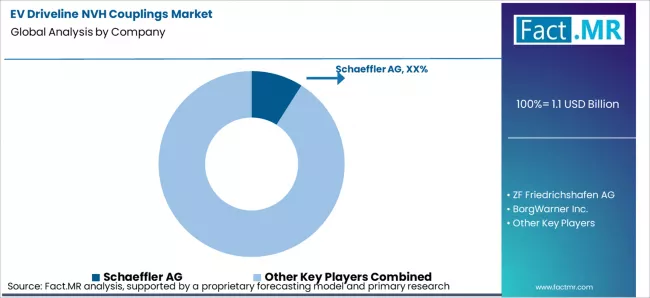
Ev Driveline Nvh Couplings Market Analysis By Company | Source: Fact.MR
The EV driveline NVH (Noise, Vibration, and Harshness) couplings market is evolving with key players like Schaeffler AG, ZF Friedrichshafen AG, and BorgWarner Inc. focusing on developing innovative solutions that minimize noise and vibrations in electric vehicles. Schaeffler and ZF are enhancing driveline performance by providing advanced NVH couplings that offer better noise damping and smooth driving experiences. Dana Incorporated and Magna International Inc. are emphasizing high-performance couplings for electric drivetrains, helping to optimize efficiency and comfort. Vibracoustic SE and KTR Systems GmbH focus on acoustic and vibration isolation systems, while Flender GmbH and Rexnord Corporation contribute with reliable and durable couplings for EV powertrains. Nidec Corporation rounds out the market with high-precision components designed for smooth and silent EV operation.
Recent Industry Developments
- NVH reduction assembly for vehicle motive power transmission (Published Jan 12, 2023): This patent application describes an NVH reduction assembly (including an axial ring configured to attenuate vibration-induced noise) intended for use in vehicle motive power transmission architectures.
- Patent (Granted) - Driveshaft damper with helically-wound attenuation features (Published Mar 5, 2024): This granted patent covers a driveshaft damper design using a core and attenuation elements (with defined pitch-related geometry) to reduce driveline noise, vibration, and harshness.
- Patent (Granted) - Flexible coupling for a drive train (Published Dec 31, 2024): This granted patent discloses a flexible coupling architecture for drivetrain torque transfer that targets misalignment accommodation and coupling performance via connector/yoke interface geometry.
Report Scope
| Metric | Value |
|---|---|
| Quantitative Units | USD 1.1 billion (2026) to USD 3.2 billion (2036), at a CAGR of 11.3% |
| Market Definition | The EV Driveline NVH Couplings Market includes products designed to reduce noise, vibration, and harshness (NVH) in electric vehicle driveline systems, ensuring smooth and quiet operation. |
| By Coupling Function | Torsional Damping Couplings, Flexible Disc Couplings, Elastomeric NVH Isolators, Other |
| By Powertrain Layout | Single-Motor eDrive, Dual-Motor AWD, eAxle Integrated, Other |
| By Speed Class | Up to 12k RPM, 12k-18k RPM, Above 18k RPM, Other |
| By Sales Channel | OEM Line-Fit, Tier-1 Integrated, Aftermarket, Other |
| Regions Covered | North America, Latin America, Europe, East Asia, South Asia, Oceania, Middle East and Africa |
| Countries Covered | United States, Canada, Mexico, Brazil, Argentina, Germany, France, United Kingdom, Italy, Spain, China, India, Japan, South Korea, Indonesia, Australia, and 40+ countries |
| Key Companies Profiled | Schaeffler AG, ZF Friedrichshafen AG, BorgWarner Inc., Dana Incorporated, Magna International Inc., Vibracoustic SE, KTR Systems GmbH, Flender GmbH, Rexnord Corporation, Nidec Corporation |
| Forecast Period | 2026 to 2036 |
| Approach | Hybrid top-down and bottom-up market modeling validated through primary interviews with manufacturers and supported by trade data benchmarking and market research. |
Source: Fact.MR analysis. Updated Feb 16, 2026
Bibliographies
- Liam Butterworth Statement: Butterworth, L. (2025, November 13). Global demand for EVs and GKN Automotive's leadership in eDrive systems. GKN Automotive. [1]
- NVH Reduction Assembly for Vehicle Motive Power Transmission: U.S. Patent Application No. 17/932,124. (2023, January 12). NVH reduction assembly for vehicle motive power transmission. United States Patent and Trademark Office. [2]
- Patent (Granted) - Driveshaft Damper with Helically-Wound Attenuation Features: U.S. Patent No. 11,794,123. (2024, March 5). Driveshaft damper with helically-wound attenuation features. United States Patent and Trademark Office. [3]
- Patent (Granted) - Flexible Coupling for a Drive Train: U.S. Patent No. 11,918,742. (2024, December 31). Flexible coupling for a drive train. United States Patent and Trademark Office. [4]
Segmentation
EV Driveline NVH Couplings Market Key Segments
-
By Coupling Function :
- Torsional Damping Couplings
- Flexible Disc Couplings
- Elastomeric NVH Isolators
- Other
-
By Powertrain Layout :
- Single-Motor eDrive
- Dual-Motor AWD
- eAxle Integrated
- Other
-
By Speed Class :
- Up to 12k RPM
- 12k-18k RPM
- Above 18k RPM
- Other
-
By Sales Channel :
- OEM Line-Fit
- Tier-1 Integrated
- Aftermarket
- Other
-
Region :
- North America
- USA
- Canada
- Mexico
- Europe
- Germany
- UK
- France
- Italy
- Spain
- Nordic Countries
- BENELUX
- Rest of Europe
- Asia Pacific
- China
- Japan
- South Korea
- India
- Australia
- Rest of Asia Pacific
- Latin America
- Brazil
- Argentina
- Rest of Latin America
- Middle East and Africa
- Kingdom of Saudi Arabia
- United Arab Emirates
- South Africa
- Rest of Middle East and Africa
- Other Regions
- Oceania
- Central Asia
- Other Markets
- North America
Frequently Asked Questions
How large is the demand for EV Driveline NVH Couplings in the global market in 2026?
What will be the market size of EV Driveline NVH Couplings in the global market by 2036?
What is the expected demand growth for EV Driveline NVH Couplings in the global market between 2026 and 2036?
Which region is expected to show the highest growth rate for EV Driveline NVH Couplings?
How significant is the growth outlook for Brazil in this market?
What is the growth outlook for the United States in this report?
What is the growth forecast for Japan in the EV Driveline NVH Couplings market?
Which European markets are highlighted in this analysis?
What is the growth forecast for South Korea in the EV Driveline NVH Couplings market?
What is the expected growth rate for China in the forecast period?
What is the leading sales channel for EV Driveline NVH Couplings?
Which company is identified as a leading player in the EV Driveline NVH Couplings market?
What are EV Driveline NVH Couplings used for?
What does the EV Driveline NVH Couplings market include in this report?
How is the market forecast developed in this report?
What is meant by the EV Driveline NVH Couplings market in this report?
Who worked on this report


Preview the report firsthand - request a free sample
Free SampleGet the brochure for pricing and purchase details
Download PDF