Regenerative Braking Couplings Market (2026 - 2036)
Regenerative Braking Couplings Market is segmented by Coupling Function (Motor-Generator Couplings, Gearset/Retarder Interfaces, Torsional Dampers, and Others), Vehicle Segment (Passenger EVs, LCV EVs, Heavy-Duty EVs, and Others), System Type (Integrated eAxle Regen, Brake-by-Wire Coupled, Retarder + Regen Hybrid, and Others), Sales Channel (OEM Line-Fit, Tier-1 Integrated, Service/Replacement, and Others), and Region. Forecast for 2026 to 2036.
Core Findings
Regenerative Braking Couplings Market Forecast 2026 to 2036
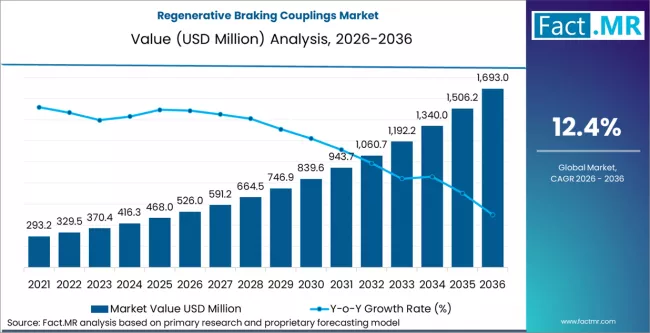
In 2025, the Regenerative Braking Couplings market was valued at USD 472 million. Based on Future Market Insights' analysis, demand for regenerative braking couplings is estimated to grow to USD 526 million in 2026 and USD 1,517 million by 2036. FMI projects a CAGR of 12.4% during the forecast period.
The absolute dollar growth from 2026 to 2036 is USD 991 million. This signifies substantial growth, driven by the increasing adoption of regenerative braking systems in electric vehicles (EVs) and hybrid vehicles. Although this growth is significant, the market is influenced by challenges such as high manufacturing costs, technological integration complexities, and regulatory requirements.
China leads with a CAGR of 14.4%, driven by strong government policies supporting the adoption of electric vehicles (EVs). Brazil follows with a 14.1% CAGR, boosted by the rapid development of EV infrastructure and local market incentives. The USA is projected to grow at 12.0%, supported by an expanding EV market and increasing environmental regulations. South Korea, with an 11.7% CAGR, benefits from growth in hybrid and electric vehicle manufacturing. Germany and the United Kingdom both show 11.7% and 11.6% CAGRs, respectively, as they adopt green technologies in line with EU climate goals and government push for cleaner transportation solutions. In contrast, mature European markets generate mostly replacement demand, with challenges like high manufacturing costs and market saturation limiting growth.
Regenerative Braking Couplings Market Definition
The Regenerative Braking Couplings Market refers to the manufacture and sale of mechanical and electromechanical couplings used in regenerative braking systems. These couplings link the braking mechanism to the drivetrain or motor generator to enable energy recovery during deceleration. Their primary function is to transfer torque and allow controlled braking while capturing kinetic energy for reuse. Key end‑use industries include electric and hybrid vehicles, railway systems, and industrial equipment that adopt regenerative braking to improve energy efficiency and reduce wear on friction brakes.
Market Inclusions
This report covers global and regional market sizes for regenerative braking couplings with a defined forecast period. It includes segment breakdowns by product type (rigid, flexible, magnetic, and torque‑limiting couplings), application (automotive, rail, industrial), and end user. The analysis also incorporates pricing trends, production volumes, and trade flow data to capture comprehensive market dynamics.
Market Exclusions
The scope excludes unrelated components such as standard brake pads, rotors, hydraulic brake systems, and full braking assemblies not integral to regeneration. Finished vehicles, complete motor generators, and other drivetrain subsystems are not covered. Niche couplings used outside braking or energy recovery, such as in robotics or non‑braking power transfer, are omitted.
Research Methodology
- Primary Research: Interviews were conducted with design engineers, OEM sourcing specialists, and industry analysts.
- Desk Research: Data was gathered from published reports, government databases, and industry associations.
- Market‑Sizing and Forecasting: A hybrid model was applied, blending top‑down market estimates with bottom‑up shipment data.
Data Validation and Update Cycle
Findings were validated through expert review and aligned with latest production and sales figures, with periodic updates.
Regenerative Braking Couplings Market Summary
Market Definition
The Regenerative Braking Couplings Market focuses on couplings used in regenerative braking systems, which recover energy during braking and improve vehicle efficiency by transferring torque and enabling energy recovery. Key applications include electric and hybrid vehicles, rail systems, and industrial equipment.
Demand Drivers
- EV & Hybrid Growth: Increasing adoption of electric and hybrid vehicles drives demand for regenerative braking solutions that optimize energy efficiency.
- Regulatory Pressures: Stricter emissions and fuel economy regulations push automakers to adopt energy-efficient braking systems.
- Efficiency Gains: Regenerative braking is essential for extending EV range and reducing wear on conventional brakes, further fueling its adoption.
Key Segments
- Coupling Function: Motor-Generator Couplings (41% market share by 2026), Gearset/Retarder Interfaces, Torsional Dampers.
- Vehicle Segment: Passenger EVs (61% market share by 2026), LCV EVs, Heavy-Duty EVs.
- System Type: Integrated eAxle Regen, Brake-by-Wire Coupled, Retarder + Regen Hybrid.
- Sales Channel: OEM Line-Fit (87% market share by 2026), Tier-1 Integrated, Service/Replacement.
Regional Outlook
- China: Leading growth at 14.4% CAGR, driven by government EV incentives and expanding EV infrastructure.
- Brazil: Growing at 14.1% CAGR, with strong local market adoption and EV infrastructure development.
- USA: Projected to grow at 12.0%, supported by an expanding EV market and regulatory pressures.
Analyst Opinion
As regenerative braking systems become standard in electrified powertrains, demand for high-performance couplings increases. While market growth is robust, challenges such as manufacturing costs and integration complexities remain.
Strategic Takeaways
- OEM Integration: OEM line-fit solutions dominate, integrating regenerative braking couplings into new EV and hybrid models.
- Technological Integration: Shift toward advanced braking systems in EVs and hybrids, focusing on energy recovery.
- Regional Focus: Strong growth in China, Brazil, and the USA, with increasing EV adoption and supportive government policies.
Methodology
Forecasts are based on primary research with industry experts and manufacturers, along with historical data on vehicle adoption and braking system technologies.
Segmental Analysis
Regenerative Braking Couplings Market Analysis by Vehicle Segment
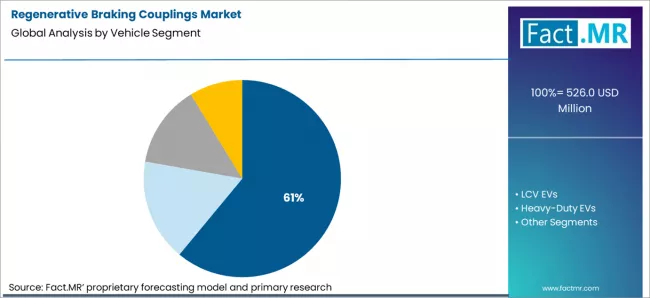
- Market Overview: Passenger EVs are projected to hold 61% of the regenerative braking couplings market by 2026. As electric vehicles (EVs) increasingly feature regenerative braking systems to improve energy efficiency, the demand for specialized couplings that enable smooth and efficient energy recovery grows, particularly in the passenger vehicle segment.
- Demand Drivers:
- Efficiency and Range Optimization: Regenerative braking is crucial for extending the driving range of EVs by converting kinetic energy into electrical energy. As passenger EVs rely heavily on this technology to maximize efficiency, the demand for regenerative braking couplings continues to rise, ensuring seamless integration of the braking and energy recovery systems.
- EV Adoption and Technological Advancements: The growth of the passenger EV market, driven by consumer interest in sustainability and government incentives, increases the need for advanced regenerative braking solutions, further boosting the demand for specialized couplings.
- Integration with Advanced Drivetrains: Regenerative braking is increasingly integrated with sophisticated drivetrains and motor systems, driving the need for couplings that ensure smooth power transfer and optimal braking performance in passenger EVs.
Regenerative Braking Couplings Market Analysis by Coupling Function
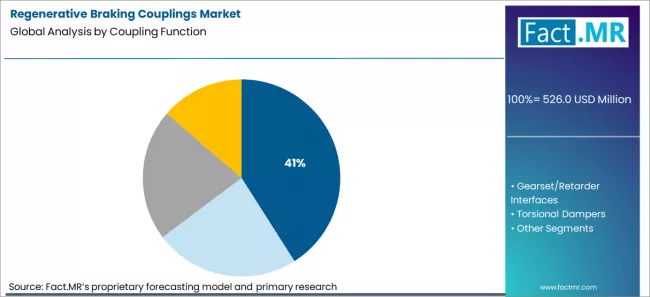
- Market Overview: Motor-generator couplings are expected to capture 41% of the market share by 2026. These couplings are designed to efficiently connect the motor and generator components in regenerative braking systems, ensuring the smooth transfer of energy during braking and improving the overall energy recovery process in EVs.
- Demand Drivers:
- Energy Recovery Efficiency: Motor-generator couplings play a pivotal role in maximizing the efficiency of regenerative braking systems by ensuring smooth, consistent energy transfer between the motor and generator. This contributes to the overall effectiveness of the system in recovering energy and extending the EV’s range.
- Technological Integration: As regenerative braking systems become more sophisticated and integrated with motor control units in EVs, motor-generator couplings are in high demand for their ability to maintain optimal performance under varying conditions.
- Growing Market for EVs: The increasing market share of passenger EVs, coupled with the rising adoption of energy-efficient technologies, is driving the need for reliable and high-performance motor-generator couplings in regenerative braking systems.
Regenerative Braking Couplings Market Drivers, Restraints, and Opportunities
FMR analysts observe that the regenerative braking couplings market is a growing but transitional segment within the electrified vehicle ecosystem. Historically, conventional friction‑based braking systems required minimal coupling complexity, but as regenerative braking systems (RBS) became standard in EVs and hybrids to recapture kinetic energy, demand for precision couplings that link electric motors to brake systems emerged. The 2026 valuation reflects this shift as RBS adoption grows globally and OEMs seek components that balance energy recovery with system reliability.
While demand for basic mechanical couplings tied to legacy braking persists in non‑electrified vehicles, regenerative braking couplings are gaining share. These specialized couplings command higher per‑unit prices, contributing to net market value growth even as overall unit volumes align with EV and hybrid production rates. The market exists at its current size because regenerative braking is now mainstream in electrified powertrains, and efficient energy recovery depends on reliable coupling solutions that handle bidirectional torque and dynamic load conditions.
- Electrification of Braking Systems: As EV and hybrid adoption increases, precision regenerative braking couplings are replacing basic mechanical connections to support energy recapture and drivetrain integration.
- Efficiency and Safety Standards: Regulations such as UN‑R13H global braking safety standards are encouraging OEMs to specify certified regenerative components, raising average selling prices.
- Regional EV Adoption Trends: In Europe and China, with high electrified vehicle penetration, demand for regenerative braking couplings outpaces regions where EV growth is slower.
Regional Analysis
The market analysis covers key global regions, including North America, Latin America, Western Europe, Eastern Europe, South Asia and Pacific, East Asia, and Middle East & Africa. It is segmented geographically, with specific market dynamics for each region. The full report provides a detailed market attractiveness analysis.
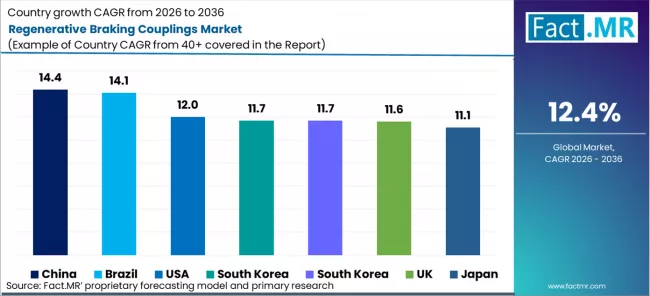
| Country | CAGR (2026 - 2036) |
|---|---|
| USA | 12.0% |
| Japan | 11.1% |
| South Korea | 11.7% |
| Germany | 11.7% |
| China | 14.4% |
| United Kingdom | 11.6% |
| Brazil | 14.1% |
Source: Fact MR (FMR) analysis, based on proprietary forecasting model and primary research.
Asia Pacific:
Asia Pacific is a "key manufacturing hub" for regenerative braking couplings, with strong investments from leading companies in the region. Major players such as BYD Auto and NIO are contributing to the region's dominance in electric vehicle development.
- China: Demand for regenerative braking couplings in China is projected to rise at 14.4% CAGR through 2036. The Chinese Government’s EV Development Initiatives (2025) are driving the market, while BYD Auto continues to expand its electric vehicle production capacity.
- Japan: Demand for regenerative braking couplings in Japan is projected to rise at 11.1% CAGR through 2036. Toyota’s investments in hybrid and electric vehicle production, along with the Japanese Green Vehicle Incentive Program (2024), foster market growth.
- South Korea: Demand for regenerative braking couplings in South Korea is projected to rise at 11.7% CAGR through 2036. Hyundai Motor’s investment in next-generation EV technologies and the Korean Green New Deal (2025) continue to support growth.
Europe:
Europe plays a crucial role as a leader in sustainability and clean energy vehicle adoption, with regulatory frameworks and automakers pushing for widespread electric vehicle deployment.
- Germany: Demand for regenerative braking couplings in Germany is projected to rise at 11.7% CAGR through 2036. The German National Electric Mobility Development Plan (2025) supports the EV transition, while Volkswagen is ramping up investments in electric vehicle technologies.
- United Kingdom: Demand for regenerative braking couplings in the UK is projected to rise at 11.6% CAGR through 2036. The UK’s Road to Zero Strategy (2025) and continued investments by Jaguar Land Rover in electric vehicles further fuel market growth.
Latin America:
In Latin America, particularly Brazil, the market is rapidly expanding, driven by government incentives and an increase in electric vehicle investments from major global automakers.
- Brazil: Demand for regenerative braking couplings in Brazil is projected to rise at 14.1% CAGR through 2036. The Brazilian National Electric Mobility Plan (2024) promotes clean energy vehicles, and Fiat Chrysler Automobiles’ commitment to expanding its EV presence in Brazil enhances market potential.
Fact MR's analysis of the Regenerative Braking Couplings Market in Asia Pacific, Europe, and Latin America consists of country-wise assessments that include China, Japan, South Korea, Germany, the United Kingdom, and Brazil. Readers can find detailed trends, regulatory updates, and company-specific investments shaping the market’s growth in these countries.
How Are Key Players Competing in the Regenerative Braking Couplings Market?
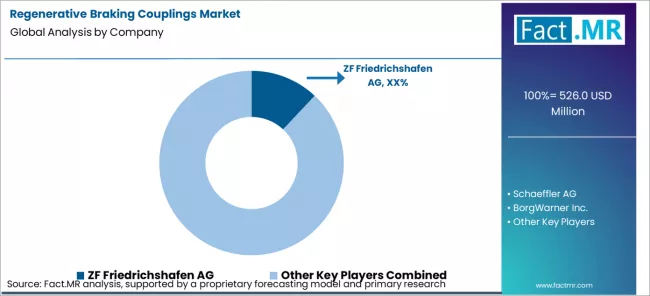
The regenerative braking couplings market is experiencing competition from major industry players like ZF Friedrichshafen AG, Schaeffler AG, and BorgWarner Inc., who are focused on advancing coupling technologies that support energy recovery and efficient braking systems in electric and hybrid vehicles. Dana Incorporated and Knorr-Bremse AG are enhancing their coupling solutions for braking systems, improving efficiency and durability. Robert Bosch GmbH and Continental AG contribute through the development of intelligent braking systems that integrate regenerative capabilities. Voith GmbH & Co. KGaA and Meritor, Inc. (now part of Cummins Inc.) provide specialized braking components for heavy-duty vehicles, while Nidec Corporation strengthens its position with high-performance solutions for energy-efficient powertrains in the growing electric vehicle market.
Recent Industry Developments
- Product launch - Magna modular electro-magnetic eDecoupling unit for BEVs (Announced Aug 1, 2023): Magna announced start of production of its modular eDecoupling unit that disconnects the e-motor from the driveshaft to cut drag losses and improve EV efficiency, supporting drivetrain coupling strategies that optimise coast and regen operating modes. [1]
- Patent - Regenerative braking torque control anticipating launch clutch opening (Published Jul 9, 2024): This granted patent discloses a control method that ramps regenerative braking torque in anticipation of launch clutch opening in a motor-transmission drivetrain, directly addressing regen stability across clutch/coupling transitions. [2]
- Technology update - Amsted Automotive multi-speed shift technology with integrated one-way clutch (Announced Oct 24, 2024): Amsted Automotive announced a multi-speed shift system using integrated one-way clutch (OWC) functionality to improve efficiency and drivability in EV/HEV drivetrains, reflecting ongoing coupling innovations that manage torque flow during decel and energy recovery events. [3]
Key Players of the Regenerative Braking Couplings Market
- ZF Friedrichshafen AG
- Schaeffler AG
- BorgWarner Inc.
- Dana Incorporated
- Knorr-Bremse AG
- Robert Bosch GmbH
- Continental AG
- Voith GmbH & Co. KGaA
- Meritor, Inc. (now part of Cummins Inc.)
- Nidec Corporation
Report Scope
| Metric | Value |
|---|---|
| Quantitative Units | USD 472 million (2026) to USD 1,517 million (2036), at a CAGR of 12.4% |
| Market Definition | The Regenerative Braking Couplings Market includes couplings used in regenerative braking systems, which recover energy during braking and help improve the efficiency and performance of electric vehicles. |
| By Coupling Function | Motor-Generator Couplings, Gearset/Retarder Interfaces, Torsional Dampers, Other |
| By Vehicle Segment | Passenger EVs, LCV EVs, Heavy-Duty EVs, Other |
| By System Type | Integrated eAxle Regen, Brake-by-Wire Coupled, Retarder + Regen Hybrid, Other |
| By Sales Channel | OEM Line-Fit, Tier-1 Integrated, Service/Replacement, Other |
| Regions Covered | North America, Latin America, Europe, East Asia, South Asia, Oceania, Middle East and Africa |
| Countries Covered | United States, Canada, Mexico, Brazil, Argentina, Germany, France, United Kingdom, Italy, Spain, China, India, Japan, South Korea, Indonesia, Australia, and 40+ countries |
| Key Companies Profiled | ZF Friedrichshafen AG, Schaeffler AG, BorgWarner Inc., Dana Incorporated, Knorr-Bremse AG, Robert Bosch GmbH, Continental AG, Voith GmbH & Co. KGaA, Meritor, Inc. (now part of Cummins Inc.), Nidec Corporation |
| Forecast Period | 2026 to 2036 |
| Approach | Hybrid top-down and bottom-up market modeling validated through primary interviews with manufacturers and supported by trade data benchmarking and market research. |
Regenerative Braking Couplings Market Key Segments
-
By Coupling Function :
- Motor-Generator Couplings
- Gearset/Retarder Interfaces
- Torsional Dampers
- Other
-
By Vehicle Segment :
- Passenger EVs
- LCV EVs
- Heavy-Duty EVs
- Other
-
By System Type :
- Integrated eAxle Regen
- Brake-by-Wire Coupled
- Retarder + Regen Hybrid
- Other
-
By Sales Channel :
- OEM Line-Fit
- Tier-1 Integrated
- Service/Replacement
- Other
-
Region :
- North America
- USA
- Canada
- Mexico
- Europe
- Germany
- UK
- France
- Italy
- Spain
- Nordic Countries
- BENELUX
- Rest of Europe
- Asia Pacific
- China
- Japan
- South Korea
- India
- Australia
- Rest of Asia Pacific
- Latin America
- Brazil
- Argentina
- Rest of Latin America
- Middle East and Africa
- Kingdom of Saudi Arabia
- United Arab Emirates
- South Africa
- Rest of Middle East and Africa
- Other Regions
- Oceania
- Central Asia
- Other Markets
- North America
Bibliographies
- Product Launch - Magna Modular Electro-Magnetic eDecoupling Unit for BEVs: Magna. (2023, August 1). Magna modular electro-magnetic eDecoupling unit for BEVs. Magna. [1]
- Patent - Regenerative Braking Torque Control Anticipating Launch Clutch Opening: U.S. Patent No. 11,854,223. (2024, July 9). Regenerative braking torque control anticipating launch clutch opening. United States Patent and Trademark Office. [2]
- Technology Update - Amsted Automotive Multi-Speed Shift Technology with Integrated One-Way Clutch: Amsted Automotive. (2024, October 24). Amsted Automotive multi-speed shift technology with integrated one-way clutch. Amsted Automotive. [3]
Table of Content
- Executive Summary
- Global Market Outlook
- Demand to side Trends
- Supply to side Trends
- Technology Roadmap Analysis
- Analysis and Recommendations
- Market Overview
- Market Coverage / Taxonomy
- Market Definition / Scope / Limitations
- Research Methodology
- Chapter Orientation
- Analytical Lens and Working Hypotheses
- Market Structure, Signals, and Trend Drivers
- Benchmarking and Cross-market Comparability
- Market Sizing, Forecasting, and Opportunity Mapping
- Research Design and Evidence Framework
- Desk Research Programme (Secondary Evidence)
- Company Annual and Sustainability Reports
- Peer-reviewed Journals and Academic Literature
- Corporate Websites, Product Literature, and Technical Notes
- Earnings Decks and Investor Briefings
- Statutory Filings and Regulatory Disclosures
- Technical White Papers and Standards Notes
- Trade Journals, Industry Magazines, and Analyst Briefs
- Conference Proceedings, Webinars, and Seminar Materials
- Government Statistics Portals and Public Data Releases
- Press Releases and Reputable Media Coverage
- Specialist Newsletters and Curated Briefings
- Sector Databases and Reference Repositories
- FMR Internal Proprietary Databases and Historical Market Datasets
- Subscription Datasets and Paid Sources
- Social Channels, Communities, and Digital Listening Inputs
- Additional Desk Sources
- Expert Input and Fieldwork (Primary Evidence)
- Primary Modes
- Qualitative Interviews and Expert Elicitation
- Quantitative Surveys and Structured Data Capture
- Blended Approach
- Why Primary Evidence is Used
- Field Techniques
- Interviews
- Surveys
- Focus Groups
- Observational and In-context Research
- Social and Community Interactions
- Stakeholder Universe Engaged
- C-suite Leaders
- Board Members
- Presidents and Vice Presidents
- R&D and Innovation Heads
- Technical Specialists
- Domain Subject-matter Experts
- Scientists
- Physicians and Other Healthcare Professionals
- Governance, Ethics, and Data Stewardship
- Research Ethics
- Data Integrity and Handling
- Primary Modes
- Tooling, Models, and Reference Databases
- Desk Research Programme (Secondary Evidence)
- Data Engineering and Model Build
- Data Acquisition and Ingestion
- Cleaning, Normalisation, and Verification
- Synthesis, Triangulation, and Analysis
- Quality Assurance and Audit Trail
- Market Background
- Market Dynamics
- Drivers
- Restraints
- Opportunity
- Trends
- Scenario Forecast
- Demand in Optimistic Scenario
- Demand in Likely Scenario
- Demand in Conservative Scenario
- Opportunity Map Analysis
- Product Life Cycle Analysis
- Supply Chain Analysis
- Investment Feasibility Matrix
- Value Chain Analysis
- PESTLE and Porter’s Analysis
- Regulatory Landscape
- Regional Parent Market Outlook
- Production and Consumption Statistics
- Import and Export Statistics
- Market Dynamics
- Global Market Analysis 2021 to 2025 and Forecast, 2026 to 2036
- Historical Market Size Value (USD Million) Analysis, 2021 to 2025
- Current and Future Market Size Value (USD Million) Projections, 2026 to 2036
- Y to o to Y Growth Trend Analysis
- Absolute $ Opportunity Analysis
- Global Market Pricing Analysis 2021 to 2025 and Forecast 2026 to 2036
- Global Market Analysis 2021 to 2025 and Forecast 2026 to 2036, By Vehicle Segment
- Introduction / Key Findings
- Historical Market Size Value (USD Million) Analysis By Vehicle Segment , 2021 to 2025
- Current and Future Market Size Value (USD Million) Analysis and Forecast By Vehicle Segment , 2026 to 2036
- Passenger EVs
- LCV EVs
- Heavy-Duty EVs
- Other
- Passenger EVs
- Y to o to Y Growth Trend Analysis By Vehicle Segment , 2021 to 2025
- Absolute $ Opportunity Analysis By Vehicle Segment , 2026 to 2036
- Global Market Analysis 2021 to 2025 and Forecast 2026 to 2036, By Coupling Function
- Introduction / Key Findings
- Historical Market Size Value (USD Million) Analysis By Coupling Function, 2021 to 2025
- Current and Future Market Size Value (USD Million) Analysis and Forecast By Coupling Function, 2026 to 2036
- Motor-Generator Couplings
- Gearset/Retarder Interfaces
- Torsional Dampers
- Other
- Motor-Generator Couplings
- Y to o to Y Growth Trend Analysis By Coupling Function, 2021 to 2025
- Absolute $ Opportunity Analysis By Coupling Function, 2026 to 2036
- Global Market Analysis 2021 to 2025 and Forecast 2026 to 2036, By Region
- Introduction
- Historical Market Size Value (USD Million) Analysis By Region, 2021 to 2025
- Current Market Size Value (USD Million) Analysis and Forecast By Region, 2026 to 2036
- North America
- Latin America
- Western Europe
- Eastern Europe
- East Asia
- South Asia and Pacific
- Middle East & Africa
- Market Attractiveness Analysis By Region
- North America Market Analysis 2021 to 2025 and Forecast 2026 to 2036, By Country
- Historical Market Size Value (USD Million) Trend Analysis By Market Taxonomy, 2021 to 2025
- Market Size Value (USD Million) Forecast By Market Taxonomy, 2026 to 2036
- By Country
- USA
- Canada
- Mexico
- By Vehicle Segment
- By Coupling Function
- By Country
- Market Attractiveness Analysis
- By Country
- By Vehicle Segment
- By Coupling Function
- Key Takeaways
- Latin America Market Analysis 2021 to 2025 and Forecast 2026 to 2036, By Country
- Historical Market Size Value (USD Million) Trend Analysis By Market Taxonomy, 2021 to 2025
- Market Size Value (USD Million) Forecast By Market Taxonomy, 2026 to 2036
- By Country
- Brazil
- Chile
- Rest of Latin America
- By Vehicle Segment
- By Coupling Function
- By Country
- Market Attractiveness Analysis
- By Country
- By Vehicle Segment
- By Coupling Function
- Key Takeaways
- Western Europe Market Analysis 2021 to 2025 and Forecast 2026 to 2036, By Country
- Historical Market Size Value (USD Million) Trend Analysis By Market Taxonomy, 2021 to 2025
- Market Size Value (USD Million) Forecast By Market Taxonomy, 2026 to 2036
- By Country
- Germany
- UK
- Italy
- Spain
- France
- Nordic
- BENELUX
- Rest of Western Europe
- By Vehicle Segment
- By Coupling Function
- By Country
- Market Attractiveness Analysis
- By Country
- By Vehicle Segment
- By Coupling Function
- Key Takeaways
- Eastern Europe Market Analysis 2021 to 2025 and Forecast 2026 to 2036, By Country
- Historical Market Size Value (USD Million) Trend Analysis By Market Taxonomy, 2021 to 2025
- Market Size Value (USD Million) Forecast By Market Taxonomy, 2026 to 2036
- By Country
- Russia
- Poland
- Hungary
- Balkan & Baltic
- Rest of Eastern Europe
- By Vehicle Segment
- By Coupling Function
- By Country
- Market Attractiveness Analysis
- By Country
- By Vehicle Segment
- By Coupling Function
- Key Takeaways
- East Asia Market Analysis 2021 to 2025 and Forecast 2026 to 2036, By Country
- Historical Market Size Value (USD Million) Trend Analysis By Market Taxonomy, 2021 to 2025
- Market Size Value (USD Million) Forecast By Market Taxonomy, 2026 to 2036
- By Country
- China
- Japan
- South Korea
- By Vehicle Segment
- By Coupling Function
- By Country
- Market Attractiveness Analysis
- By Country
- By Vehicle Segment
- By Coupling Function
- Key Takeaways
- South Asia and Pacific Market Analysis 2021 to 2025 and Forecast 2026 to 2036, By Country
- Historical Market Size Value (USD Million) Trend Analysis By Market Taxonomy, 2021 to 2025
- Market Size Value (USD Million) Forecast By Market Taxonomy, 2026 to 2036
- By Country
- India
- ASEAN
- Australia & New Zealand
- Rest of South Asia and Pacific
- By Vehicle Segment
- By Coupling Function
- By Country
- Market Attractiveness Analysis
- By Country
- By Vehicle Segment
- By Coupling Function
- Key Takeaways
- Middle East & Africa Market Analysis 2021 to 2025 and Forecast 2026 to 2036, By Country
- Historical Market Size Value (USD Million) Trend Analysis By Market Taxonomy, 2021 to 2025
- Market Size Value (USD Million) Forecast By Market Taxonomy, 2026 to 2036
- By Country
- Kingdom of Saudi Arabia
- Other GCC Countries
- Turkiye
- South Africa
- Other African Union
- Rest of Middle East & Africa
- By Vehicle Segment
- By Coupling Function
- By Country
- Market Attractiveness Analysis
- By Country
- By Vehicle Segment
- By Coupling Function
- Key Takeaways
- Key Countries Market Analysis
- USA
- Pricing Analysis
- Market Share Analysis, 2025
- By Vehicle Segment
- By Coupling Function
- Canada
- Pricing Analysis
- Market Share Analysis, 2025
- By Vehicle Segment
- By Coupling Function
- Mexico
- Pricing Analysis
- Market Share Analysis, 2025
- By Vehicle Segment
- By Coupling Function
- Brazil
- Pricing Analysis
- Market Share Analysis, 2025
- By Vehicle Segment
- By Coupling Function
- Chile
- Pricing Analysis
- Market Share Analysis, 2025
- By Vehicle Segment
- By Coupling Function
- Germany
- Pricing Analysis
- Market Share Analysis, 2025
- By Vehicle Segment
- By Coupling Function
- UK
- Pricing Analysis
- Market Share Analysis, 2025
- By Vehicle Segment
- By Coupling Function
- Italy
- Pricing Analysis
- Market Share Analysis, 2025
- By Vehicle Segment
- By Coupling Function
- Spain
- Pricing Analysis
- Market Share Analysis, 2025
- By Vehicle Segment
- By Coupling Function
- France
- Pricing Analysis
- Market Share Analysis, 2025
- By Vehicle Segment
- By Coupling Function
- India
- Pricing Analysis
- Market Share Analysis, 2025
- By Vehicle Segment
- By Coupling Function
- ASEAN
- Pricing Analysis
- Market Share Analysis, 2025
- By Vehicle Segment
- By Coupling Function
- Australia & New Zealand
- Pricing Analysis
- Market Share Analysis, 2025
- By Vehicle Segment
- By Coupling Function
- China
- Pricing Analysis
- Market Share Analysis, 2025
- By Vehicle Segment
- By Coupling Function
- Japan
- Pricing Analysis
- Market Share Analysis, 2025
- By Vehicle Segment
- By Coupling Function
- South Korea
- Pricing Analysis
- Market Share Analysis, 2025
- By Vehicle Segment
- By Coupling Function
- Russia
- Pricing Analysis
- Market Share Analysis, 2025
- By Vehicle Segment
- By Coupling Function
- Poland
- Pricing Analysis
- Market Share Analysis, 2025
- By Vehicle Segment
- By Coupling Function
- Hungary
- Pricing Analysis
- Market Share Analysis, 2025
- By Vehicle Segment
- By Coupling Function
- Kingdom of Saudi Arabia
- Pricing Analysis
- Market Share Analysis, 2025
- By Vehicle Segment
- By Coupling Function
- Turkiye
- Pricing Analysis
- Market Share Analysis, 2025
- By Vehicle Segment
- By Coupling Function
- South Africa
- Pricing Analysis
- Market Share Analysis, 2025
- By Vehicle Segment
- By Coupling Function
- USA
- Market Structure Analysis
- Competition Dashboard
- Competition Benchmarking
- Market Share Analysis of Top Players
- By Regional
- By Vehicle Segment
- By Coupling Function
- Competition Analysis
- Competition Deep Dive
- ZF Friedrichshafen AG
- Overview
- Product Portfolio
- Profitability by Market Segments (Product/Age /Sales Channel/Region)
- Sales Footprint
- Strategy Overview
- Marketing Strategy
- Product Strategy
- Channel Strategy
- Schaeffler AG
- BorgWarner Inc.
- Dana Incorporated
- Knorr-Bremse AG
- Robert Bosch GmbH
- Continental AG
- Voith GmbH & Co. KGaA
- Meritor, Inc. (now part of Cummins Inc.)
- Nidec Corporation
- ZF Friedrichshafen AG
- Competition Deep Dive
- Assumptions & Acronyms Used
List Of Table
- Table 1: Global Market Value (USD Million) Forecast by Region, 2021 to 2036
- Table 2: Global Market Value (USD Million) Forecast by Vehicle Segment , 2021 to 2036
- Table 3: Global Market Value (USD Million) Forecast by Coupling Function, 2021 to 2036
- Table 4: North America Market Value (USD Million) Forecast by Country, 2021 to 2036
- Table 5: North America Market Value (USD Million) Forecast by Vehicle Segment , 2021 to 2036
- Table 6: North America Market Value (USD Million) Forecast by Coupling Function, 2021 to 2036
- Table 7: Latin America Market Value (USD Million) Forecast by Country, 2021 to 2036
- Table 8: Latin America Market Value (USD Million) Forecast by Vehicle Segment , 2021 to 2036
- Table 9: Latin America Market Value (USD Million) Forecast by Coupling Function, 2021 to 2036
- Table 10: Western Europe Market Value (USD Million) Forecast by Country, 2021 to 2036
- Table 11: Western Europe Market Value (USD Million) Forecast by Vehicle Segment , 2021 to 2036
- Table 12: Western Europe Market Value (USD Million) Forecast by Coupling Function, 2021 to 2036
- Table 13: Eastern Europe Market Value (USD Million) Forecast by Country, 2021 to 2036
- Table 14: Eastern Europe Market Value (USD Million) Forecast by Vehicle Segment , 2021 to 2036
- Table 15: Eastern Europe Market Value (USD Million) Forecast by Coupling Function, 2021 to 2036
- Table 16: East Asia Market Value (USD Million) Forecast by Country, 2021 to 2036
- Table 17: East Asia Market Value (USD Million) Forecast by Vehicle Segment , 2021 to 2036
- Table 18: East Asia Market Value (USD Million) Forecast by Coupling Function, 2021 to 2036
- Table 19: South Asia and Pacific Market Value (USD Million) Forecast by Country, 2021 to 2036
- Table 20: South Asia and Pacific Market Value (USD Million) Forecast by Vehicle Segment , 2021 to 2036
- Table 21: South Asia and Pacific Market Value (USD Million) Forecast by Coupling Function, 2021 to 2036
- Table 22: Middle East & Africa Market Value (USD Million) Forecast by Country, 2021 to 2036
- Table 23: Middle East & Africa Market Value (USD Million) Forecast by Vehicle Segment , 2021 to 2036
- Table 24: Middle East & Africa Market Value (USD Million) Forecast by Coupling Function, 2021 to 2036
List Of Figures
- Figure 1: Global Market Pricing Analysis
- Figure 2: Global Market Value (USD Million) Forecast 2021-2036
- Figure 3: Global Market Value Share and BPS Analysis by Vehicle Segment , 2026 and 2036
- Figure 4: Global Market Y to o to Y Growth Comparison by Vehicle Segment , 2026-2036
- Figure 5: Global Market Attractiveness Analysis by Vehicle Segment
- Figure 6: Global Market Value Share and BPS Analysis by Coupling Function, 2026 and 2036
- Figure 7: Global Market Y to o to Y Growth Comparison by Coupling Function, 2026-2036
- Figure 8: Global Market Attractiveness Analysis by Coupling Function
- Figure 9: Global Market Value (USD Million) Share and BPS Analysis by Region, 2026 and 2036
- Figure 10: Global Market Y to o to Y Growth Comparison by Region, 2026-2036
- Figure 11: Global Market Attractiveness Analysis by Region
- Figure 12: North America Market Incremental Dollar Opportunity, 2026-2036
- Figure 13: Latin America Market Incremental Dollar Opportunity, 2026-2036
- Figure 14: Western Europe Market Incremental Dollar Opportunity, 2026-2036
- Figure 15: Eastern Europe Market Incremental Dollar Opportunity, 2026-2036
- Figure 16: East Asia Market Incremental Dollar Opportunity, 2026-2036
- Figure 17: South Asia and Pacific Market Incremental Dollar Opportunity, 2026-2036
- Figure 18: Middle East & Africa Market Incremental Dollar Opportunity, 2026-2036
- Figure 19: North America Market Value Share and BPS Analysis by Country, 2026 and 2036
- Figure 20: North America Market Value Share and BPS Analysis by Vehicle Segment , 2026 and 2036
- Figure 21: North America Market Y to o to Y Growth Comparison by Vehicle Segment , 2026-2036
- Figure 22: North America Market Attractiveness Analysis by Vehicle Segment
- Figure 23: North America Market Value Share and BPS Analysis by Coupling Function, 2026 and 2036
- Figure 24: North America Market Y to o to Y Growth Comparison by Coupling Function, 2026-2036
- Figure 25: North America Market Attractiveness Analysis by Coupling Function
- Figure 26: Latin America Market Value Share and BPS Analysis by Country, 2026 and 2036
- Figure 27: Latin America Market Value Share and BPS Analysis by Vehicle Segment , 2026 and 2036
- Figure 28: Latin America Market Y to o to Y Growth Comparison by Vehicle Segment , 2026-2036
- Figure 29: Latin America Market Attractiveness Analysis by Vehicle Segment
- Figure 30: Latin America Market Value Share and BPS Analysis by Coupling Function, 2026 and 2036
- Figure 31: Latin America Market Y to o to Y Growth Comparison by Coupling Function, 2026-2036
- Figure 32: Latin America Market Attractiveness Analysis by Coupling Function
- Figure 33: Western Europe Market Value Share and BPS Analysis by Country, 2026 and 2036
- Figure 34: Western Europe Market Value Share and BPS Analysis by Vehicle Segment , 2026 and 2036
- Figure 35: Western Europe Market Y to o to Y Growth Comparison by Vehicle Segment , 2026-2036
- Figure 36: Western Europe Market Attractiveness Analysis by Vehicle Segment
- Figure 37: Western Europe Market Value Share and BPS Analysis by Coupling Function, 2026 and 2036
- Figure 38: Western Europe Market Y to o to Y Growth Comparison by Coupling Function, 2026-2036
- Figure 39: Western Europe Market Attractiveness Analysis by Coupling Function
- Figure 40: Eastern Europe Market Value Share and BPS Analysis by Country, 2026 and 2036
- Figure 41: Eastern Europe Market Value Share and BPS Analysis by Vehicle Segment , 2026 and 2036
- Figure 42: Eastern Europe Market Y to o to Y Growth Comparison by Vehicle Segment , 2026-2036
- Figure 43: Eastern Europe Market Attractiveness Analysis by Vehicle Segment
- Figure 44: Eastern Europe Market Value Share and BPS Analysis by Coupling Function, 2026 and 2036
- Figure 45: Eastern Europe Market Y to o to Y Growth Comparison by Coupling Function, 2026-2036
- Figure 46: Eastern Europe Market Attractiveness Analysis by Coupling Function
- Figure 47: East Asia Market Value Share and BPS Analysis by Country, 2026 and 2036
- Figure 48: East Asia Market Value Share and BPS Analysis by Vehicle Segment , 2026 and 2036
- Figure 49: East Asia Market Y to o to Y Growth Comparison by Vehicle Segment , 2026-2036
- Figure 50: East Asia Market Attractiveness Analysis by Vehicle Segment
- Figure 51: East Asia Market Value Share and BPS Analysis by Coupling Function, 2026 and 2036
- Figure 52: East Asia Market Y to o to Y Growth Comparison by Coupling Function, 2026-2036
- Figure 53: East Asia Market Attractiveness Analysis by Coupling Function
- Figure 54: South Asia and Pacific Market Value Share and BPS Analysis by Country, 2026 and 2036
- Figure 55: South Asia and Pacific Market Value Share and BPS Analysis by Vehicle Segment , 2026 and 2036
- Figure 56: South Asia and Pacific Market Y to o to Y Growth Comparison by Vehicle Segment , 2026-2036
- Figure 57: South Asia and Pacific Market Attractiveness Analysis by Vehicle Segment
- Figure 58: South Asia and Pacific Market Value Share and BPS Analysis by Coupling Function, 2026 and 2036
- Figure 59: South Asia and Pacific Market Y to o to Y Growth Comparison by Coupling Function, 2026-2036
- Figure 60: South Asia and Pacific Market Attractiveness Analysis by Coupling Function
- Figure 61: Middle East & Africa Market Value Share and BPS Analysis by Country, 2026 and 2036
- Figure 62: Middle East & Africa Market Value Share and BPS Analysis by Vehicle Segment , 2026 and 2036
- Figure 63: Middle East & Africa Market Y to o to Y Growth Comparison by Vehicle Segment , 2026-2036
- Figure 64: Middle East & Africa Market Attractiveness Analysis by Vehicle Segment
- Figure 65: Middle East & Africa Market Value Share and BPS Analysis by Coupling Function, 2026 and 2036
- Figure 66: Middle East & Africa Market Y to o to Y Growth Comparison by Coupling Function, 2026-2036
- Figure 67: Middle East & Africa Market Attractiveness Analysis by Coupling Function
- Figure 68: Global Market - Tier Structure Analysis
- Figure 69: Global Market - Company Share Analysis
- FAQs -
How large is the demand for Regenerative Braking Couplings in the global market in 2026?
Demand for Regenerative Braking Couplings in the global market is estimated to be valued at USD 472 million in 2026.
What will be the market size of Regenerative Braking Couplings in the global market by 2036?
The market size for Regenerative Braking Couplings is projected to reach USD 1,517 million by 2036.
What is the expected demand growth for Regenerative Braking Couplings in the global market between 2026 and 2036?
Demand for Regenerative Braking Couplings in the global market is expected to grow at a CAGR of 12.4% - between 2026 and 2036.
Which region is expected to show the highest growth rate for Regenerative Braking Couplings?
China is projected to show the highest regional CAGR at 14.4% during the forecast period, driven by the rapid growth of electric vehicles and the increasing adoption of regenerative braking systems.
How significant is the growth outlook for Brazil in this market?
Brazil is expected to grow at a CAGR of 14.1%, reflecting strong growth in the adoption of regenerative braking systems for electric and hybrid vehicles in the region.
What is the growth outlook for the United States in this report?
The United States is anticipated to grow at a CAGR of 12.0% from 2026 to 2036, supported by the growing EV market and the increasing integration of regenerative braking technologies in new vehicle models.
What is the growth forecast for Japan in the Regenerative Braking Couplings market?
Japan is expected to grow at a CAGR of 11.1%, driven by advancements in automotive technologies and the rise of hybrid and electric vehicle adoption in the market.
What is the growth forecast for South Korea in this market?
South Korea is projected to expand at a CAGR of 11.7%, fueled by the country's push for energy-efficient vehicles and the integration of regenerative braking systems.
Which European markets are highlighted in this analysis?
Germany and the United Kingdom are key European markets, with projected CAGRs of 11.7% - which, driven by the adoption of regenerative braking in electric and hybrid vehicles and regulatory pressure for emission reduction.
What is the leading sales channel for Regenerative Braking Couplings?
The OEM line-fit sales channel is expected to dominate the market, accounting for 87% of the market share in 2026, as original equipment manufacturers integrate regenerative braking couplings into their electric and hybrid vehicle production lines.
Which company is identified as a leading player in the Regenerative Braking Couplings market?
ZF Friedrichshafen AG is recognized as a leading player in this market, providing innovative regenerative braking systems and couplings for electric and hybrid vehicles.
What are Regenerative Braking Couplings used for?
Regenerative Braking Couplings are used in electric and hybrid vehicles to capture kinetic energy during braking and convert it into electrical energy, which is then stored in the vehicle’s battery to improve energy efficiency.
What does the Regenerative Braking Couplings market include in this report?
The market scope includes regenerative braking couplings, components, and technologies designed to integrate with electric and hybrid vehicle systems to enhance braking efficiency and energy recovery.
How is the market forecast developed in this report?
The forecast is developed using historical data on electric and hybrid vehicle adoption, trends in braking system technologies, and insights from key industry players in the automotive sector.
What is meant by the Regenerative Braking Couplings market in this report?
The market refers to the global production, trade, and consumption of regenerative braking couplings, components used in electric and hybrid vehicles to optimize braking performance and recover energy.